INTRODUCTION
The use of participatory techniques in plant breeding has become widespread to closely orient farmer requirements with crop improvement (Witcombe et al., Reference Witcombe, Joshi, Gyawali, Musa, Johansen, Virk and Sthapit2005). In the same review, it was clarified that farmer collaboration in participatory varietal selection (PVS) often results in successful breeding outcomes. Within PVS, farmer-managed trials designed for farmer choice of variety often result in the collection of data on measures of yield and farmer perceptions. In this study, which involved a large number of trials, we recorded a wide range of additional information on agro-ecological and management conditions of the trials. This paper investigates the use of such data to identify factors affecting yield, such as farmer plant density and soil pH, in a type of exploratory agronomy within varietal trials. Such yield determinants are valuable in planning follow-up research on adaptation and management practices.
The context of the experimentation is East Timor (Timor-Leste), which is a small, young country and among the poorest in Asia. Since independence, East Timor has ranked third in a UN world ranking of countries with the highest percentage of chronically malnourished children (UNICEF, 2011). Over 80% of the population is in subsistence farming. The terrain comprises narrow coastal plain and dissected uplands. The climate is tropical, dominated by summer rainfall varying from annual means of 600 mm in the north-west to 3000 mm in the highlands with an extended dry season particularly in the north of the country (Barnett et al., Reference Barnett, Dessai and Jones2007). In this climatically variable and mountainous landscape, low-input subsistence agriculture is based on a swidden system of slash and burn. Cropped areas per household are typically 1–2 ha. The main foods are: grains – maize (Zea mays L.) and rice (Oryza sativa L.); tuberous crops – cassava (Manihot esculenta Crantz) and sweet potato (Ipomoea batatas L.); and peanut (Arachis hypogaea L.). The goal of the farmer is more to ensure food security through diversification than to intensify production (Tilman de sa Benevides, Reference Tilman de sa Benevides, da Costa, Piggin, Fox and da Cruz2003). Most rural families suffer from food insecurity producing insufficient cereal staples of maize or rice to last a full 12 months (WFP, 2006).
Peanuts are widely grown in East Timor in small plots within food gardens from up to 1200 m above sea level (asl), as part of farmers’ diversification strategy for food security (SoL, 2007a). In the period 2007–09, national peanut production averaged 4494 t in the shell, while the mean yield was 1.03 t (with shell) ha−1 (FAO, 2011). This is 35% below the global mean yield of 1.58 t ha−1. Local cultivars with low yield potential are grown with little or no inputs with the produce used for direct consumption (Nigam et al., Reference Nigam, Palmer, San Valentin, Kapukha, Piggin, Monaghan, da Costa, Piggin, Fox and da Cruz2003). The crop provides a rich source of high-quality edible oil (45–50%), easily digestible protein (23– 25%), minerals and vitamins (Nigam et al., Reference Nigam, Palmer, San Valentin, Kapukha, Piggin, Monaghan, da Costa, Piggin, Fox and da Cruz2003). Nigam et al. (Reference Nigam, Palmer, San Valentin, Kapukha, Piggin, Monaghan, da Costa, Piggin, Fox and da Cruz2003) also reported that in East Timor the crop is generally free from abiotic and biotic stresses except for iron chlorosis and a moderate intensity of foliar diseases (rust, early leaf spot and late leaf spot).
In neighbouring Indonesia, where improvement efforts have a longer history, average yields are 35% higher – close to the global mean. The major production areas, totalling some 640,000 ha (2007–09; FAO, 2011), are in Java and South Sulawesi, with smaller areas in Bali, Lombok, Sumatra, Kalimantan, Irian Jaya and islands in the Nusa Tengara region, much of which share the infertile soils (including the island of Timor) typical of the Australian tectonic plate. A major international effort in Indonesia, pre-dating independence in East Timor, investigated the causes of low peanut productivity in a number of production systems (Wright and Middleton, Reference Wright and Middleton1992). The diseases bacterial wilt, peanut stripe virus and fungal foliar diseases (leaf spots and rust) were all of major importance in limiting peanut productivity. An omission trial approach was used to determine primary yield limitations in different cropping systems and locations throughout Indonesia. The studies identified four major agronomic factors limiting peanut yield: nutritional deficiencies, acid soil, plant population and irrigation management (Shorter et al., Reference Shorter, Middleton, Sadikin, Bell, Wright, Wrightand and Middleton1992). The authors noted that many of the limitations to increased peanut productivity are common to peanut producing regions throughout South and Southeast Asia.
Post-independence, the Seeds of Life (SoL) programme focused on genetic improvement; especially because agriculture in East Timor is more labour limited than land limited. So systematic peanut improvement started with the introduction of germplasm from the International Crops Research Institute from the Semi Arid Tropics (ICRISAT), which was tested on-station in the 2000/01 and 2001/02 seasons. Many introduced varieties out-performed the local variety at all the test locations across diverse agro-climatic conditions (Nigam et al., Reference Nigam, Palmer, San Valentin, Kapukha, Piggin, Monaghan, da Costa, Piggin, Fox and da Cruz2003). These initial results indicated the potential to increase peanut productivity in East Timor.
An extensive PVS programme for peanut was then conducted across a wide range of agro-ecologies and cropping systems. This study tested if the promising results from researcher-managed cultivar comparisons conducted on-station were validated under farmer management conditions and whether it initiated dissemination of the improved genetic material. Additionally, the study investigated the use of information on agro-ecological and management conditions of the trials to identify factors affecting yield, such as farmer plant density and soil pH, using an unbalanced ANOVA design in a type of exploratory agronomy within varietal trials.
MATERIALS AND METHODS
On-farm trials
Peanut on-farm trials were sown by farmers to compare introduced test varieties with their local check in adjacent 25 m2 plots in the five wet seasons from 2005/06 to 2009/10. Packets of seed of test varieties were given to each participating farmer and seed of the local check variety was derived from farmers’ own sources. Research assistants advised the farmers on how to lay out the plots adjacent to each other along contour lines and how to locate plots so that growing conditions would be as similar as possible for all of them. Each participating farmer managed only one set of plots that was considered as a replicate for the location. Research assistants were generally present at sowing and instructed to visit each site fortnightly, although this was not always achieved in practice. The test variety Utamua was grown each season and is a large-seeded Virginia type introduced as ICGV 88438 from ICRISAT (Hadjichristodoulou et al., Reference Hadjichristodoulou, Dwivedi, Wynne, Nigam, Alexandrou, Theodorides and Mouzouris1997). In the 2005/06 season, there was an additional test entry, ICGV 95278, and two extra entries (ICGV 96165 and ICGV 97128) in the 2008/09 and 2009/10 season trials – all from ICRISAT. Test entries were selected on the basis of their performance in yield trials on-station (Nigam et al., Reference Nigam, Palmer, San Valentin, Kapukha, Piggin, Monaghan, da Costa, Piggin, Fox and da Cruz2003; SoL, 2006). Farmers were requested to use their own agronomic practices with the only exception being that advice was given from the 2006/07 season onwards to pre-soak Utamua seed overnight before sowing to achieve a good plant stand. Anecdotal evidence from farmers in low-rainfall northern coastal areas suggested that Utamua germination could be improved by overnight seed priming prior to sowing, and this was subsequently confirmed in experimentation under different soil moisture conditions (Munro, Reference Munro2008).
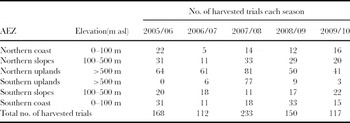
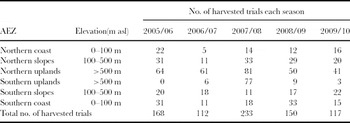
Trials were established in four districts (Aileu, Baucau, Liquica and Manufahi) during the wet season of 2005/06; in four districts (Aileu, Baucau, Liquica and Manufahi) in 2006/07; in six districts in 2007/08, with the addition of Ainaro and Bobonaro; and in seven districts in 2008/09 and 2009/10, with the further addition of Viqueque. Trial sites spanned all major agro-ecologies in the country from coastal lowlands up into the central mountainous ridge classified into six agro-ecological zones (AEZs) based on rainfall and elevation (ARPAPET, 1996). The total number of harvested trials and their distribution over AEZs and seasons are given in Table 1.
Number of harvested trials in each agro-ecological zone (AEZ) and season.
Soil pH, colour and texture were measured from 2006/07 along with other site characteristics using the methodology described in SoL (2007b). Researchers visited the trial sites approximately five times from sowing to harvest. At each visit, they recorded information about the trial monitoring farmer management, household characteristics and trial progress. In-season measurements included plant condition, farmer practices, pests and diseases, wilting and other plant symptoms. Inoculation with Rhizobium was not undertaken in the trials but good nodulation was observed throughout.
At harvest, staff recorded the fresh weight of pods from the whole plot (25 m2). A sub-sample of five random plants was taken from each plot with the number of pods per plant counted. In addition, a sample of 50 pods was weighed at harvest, and after sun-drying the number and weight of seeds from this sample was also recorded. The ratio of dried pod to the pod fresh weight was used to convert the total fresh weight of pods into a dry pod weight per plot, and then converted to t ha−1 of pods (sun dried and unshelled).
Field days were held at one trial per subdistrict at harvest and farmers were interviewed regarding the peanut varieties under evaluation. They were asked to provide information on what characteristics were found in the local and test varieties that would encourage them to replant and whether they would replant and why. As well as farmer field day data, comments from most farmers hosting trials were also solicited after harvest.
Analysis
Peanut yield (dry weight in pods, t ha−1) was analysed by ANOVA (Unbalanced treatment structure) with variety and AEZ as fixed effects in the model once the other location factors of district and sub-district had been tested for each season separately. All analyses were done with GenStat Discovery Edition 3. Plant density was used as a covariant. The ANOVA output was used to test for significant interactions between variety and AEZ. The influence of a wide range of factors on peanut yields was tested using an unbalanced ANOVA design. In turn, each factor was added to the model, one at a time. If they were significant, the factor was kept in the model, and if they were non-significant the factor was discarded. Once a significant factor was identified, the interaction of that factor and variety was also tested for significance at the p < 0.05 level. Finally, a combined analysis over seasons was done by AEZ means for variety Utamua and local, and by elevation and north versus south of the country.
RESULTS
Adaptation
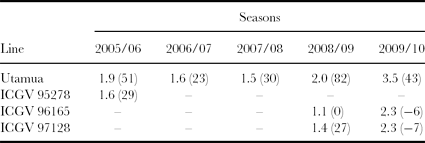
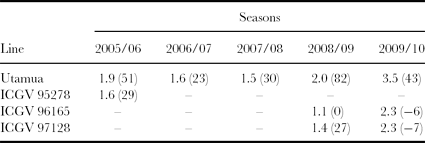
Variety Utamua, with a mean of 2.27 t ha−1 ± 0.04, consistently out-yielded the local (1.54 t ha−1) by an average of 47% over seasons and AEZs in a total of 616 trials (Table 2). None of the other test lines approached this level of yield. Utamua was also dramatically (c. 70%) larger-seeded than the local. In the 2008/09 season, for example, its seed size was 98 g per 100 seeds compared to 57 g per 100 seeds of local.
Mean peanut dry pod yield (t ha−1) and yield (%) advantage over local (in parentheses) of test lines each season.
In the first season (2005/06), there was a significant effect of harvest plant density on yield, which was investigated in subsequent seasons, particularly because of the large seeds of Utamua. In the following season (2006/07), the reduced plant density (33%) of Utamua was confirmed and plant density used as a covariate in yield analysis. Farmers were encouraged to try seed priming from the 2006/07 season, when 39% of farmers tried priming. Harvest plant density increased significantly from a mean of 6.2 plants m−2 without priming to 7.8 plants m−2 when seed was primed overnight. The seed priming x variety interaction was non-significant. In the following season (2007/08), the plant density of Utamua was 20% lower than the local. However, as more farmers (c 50%) did seed priming in the last two seasons (2008/09 and 2009/10), the difference between the varieties in plant density became non-significant. In the 2009/10 season, there were significant differences among sub-districts in the uptake of the practice with adoption highest in Viqueque and Bacau. No seed priming was done by farmers at elevations of 1000 m asl.
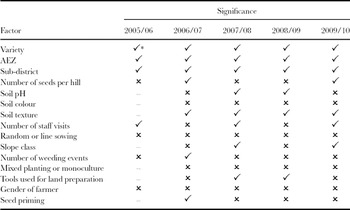
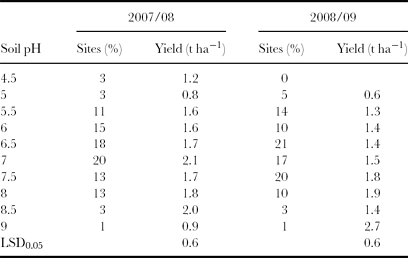
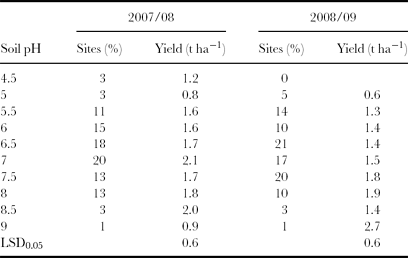
The significance (p < 0.05) of various factors affecting peanut yields is given in Table 3 over five seasons. For soil pH, Table 4 shows that the majority of peanut trials harvested in both 2007/08 and 2008/09 were on soil within a pH range of 5.5 to 8. In both seasons, soil pH significantly impacted on yield (p < 0.001). The correlation between soil pH and elevation was significant at R2 = 0.57 in 2007/08, R2 = 0.37 in 2008/09 and R2 = 0.33 in 2009/10, indicating that generally soil pH became more acidic as elevation increased. Lower pH soil (≤5.5) produced lower yields. Such soils were usually in the uplands. There was an indication that soils with pH of 7 to 8.5 were more productive for peanut than those between 5.5 and neutrality. The effect of soil pH on yield did not reach the level of significance in the 2006/07 and 2009/10 seasons. Other factors can be discussed as follows.
Significance (p < 0.05) of various factors affecting peanut yields each season.
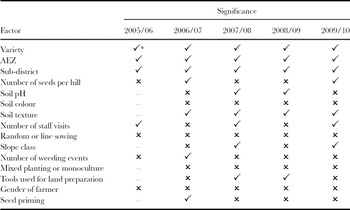
* ✓ = significant at p < 0.05; ✗ = non-significant at p < 0.05; – = data unavailable.
Average dry pod yields and percentage of sites in different soil pH classes in the 2007/08 and 2008/09 seasons.
Soil texture: Soil texture had a significant effect on peanut yield in each season from 2006/07 to 2009/10. Yields in the loam soils were consistently high over seasons. Whereas on clay soils, yields were usually high, though they were reduced in the wet season 2009/10, possibly due to water-logging (data not shown; SoL, 2007b, 2008, 2009, 2010).
Tools for land preparation: For land preparation, farmers mostly use hoes, a single metal bar (aisuak) and tractors, with the latter becoming more frequent over the seasons. These three tools gave equally productive peanuts (SoL, 2008, 2009). Other tools for land preparation – less frequently used than these three tools – such as a pick resulted in lower yield (Table 3).
Seeds per hill: Farmers usually sowed either one or two seeds per hill in their trials. In two seasons (2006/07 and 2009/10), sowing two seeds per hill significantly out-yielded one seed per hill, with the difference non-significant in the intervening seasons.
Number of staff visits: The number of times that research assistants visited the farmers had a significant effect on yield in two of the four seasons. Yields were higher when five or more visits were made by staff (data not shown; SoL, 2006, 2007b, 2008, 2009, 2010). Staff either liked to visit good farmers often, or, as a result of staff field visits, farmers managed their peanuts better.
There were many factors that did not have a significant effect on yield such as soil colour, whether random or line sowing, whether in mixed culture or monoculture, and the gender of the farmer.
Combined analysis of variety Utamua and local over seasons 2006–2010
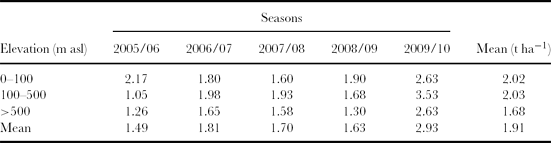
In the combined analysis over seasons using only data from Utamua and local, there were highly significant differences in the seasonal mean yields ranging from a low of 1.49 t ha−1 in 2005/06 to 2.93 t ha−1 in 2009/10 (Table 5). The interaction of AEZ with season was significant. Much of this variation was due to elevation which had a significant effect on overall yield with mean yield dropping to 1.68 t ha−1 in upland sites (500 m asl elevation) compared to a mean of 2.0 t ha−1 at lower elevations. Yields were similar in the northern half of the country (with a shorter wet season) compared to the southern half that has a longer wet season.
Mean peanut yield at differing elevations each season.
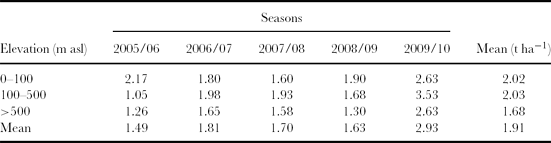
LSD0.05 Season means 0.36; LSD0.05 Elevation means 0.28; LSD0.05 Interaction means 0.39.
Farmer preferences
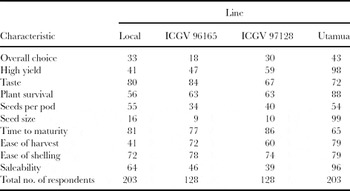
Farmers preferred to grow each of the test varieties for different reasons (Table 6). Similar results were recorded in each season and only the data for 2009/10 are shown (other seasons’ data are in SoL, 2007b, 2008, 2009). Over 200 farmers participated in peanut farmer field days in 2009/10, but ICGV 96165 and ICGV 97128 were not evaluated at all sites. Utamua was the most popular choice overall because of its large seed size and overall yield. Utamua also had a much greater saleability ranking than the other varieties even though seed is often sold by volume rather than weight. Utamua also ranked high on ease of harvest. Comments from farmers hosting trials about Utamua were almost all positive. Many included big seeds as well as good yields, and good, oily taste that lasted for a long time as key positive traits. One consistent negative characteristic of Utamua was its longer season taking an additional 2–3 weeks to mature than the local. This results in a much larger risk of crop predation especially by rats and neighbours.
Reasons farmers (%)* would replant peanut varieties in the 2009/10 season.
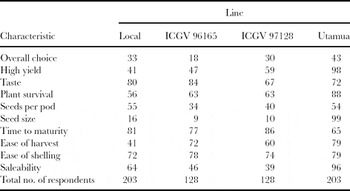
* Many farmers made more than one choice for each criterion.
Local varieties elicited the greatest variety of responses on why they would be replanted. Sweet taste and good productivity ranked high on the list of responses why farmers would continue using local seed. High oil levels also rated favourably. A general liking for local varieties also featured in responses. More specifically, the fact that a local variety was rai nain or from that land was often quoted as a reason for continuing to grow it. Already being adapted to the land was also mentioned. Low yield was stated on many occasions as a reason for not continuing to grow a local variety often contrasting it with Utamua.
DISCUSSION
Our results document an important increase of 47% in peanut on-farm productivity by cultivar Utamua over local in a total of 616 trials grown from 2006 to 2010 in East Timor. This comes from the introduction of peanut germplasm from an International Centre – ICRISAT – followed by extensive adaptive testing with farmers. There was no research on peanut during the Portuguese period in East Timor up to 1975, and records of research during the subsequent Indonesian period are lost. Ensuring the availability and continuing supply of improved seed of food crops has proved successful in catalysing the process of improving food security in post-conflict situations in other parts of the world (Erskine and Nesbitt, Reference Erskine and Nesbitt2009; Sperling et al., Reference Sperling, Cooper and Remington2008). So, given the lack of previous systematic research on key staple crops, the SoL programme chose the approach of plant germplasm introduction followed by PVS as an effective path to impact (Borges et al., Reference Borges, Ferreira, Da Silva, Williams, Andersen, Dalley, Monaghan, Nesbitt and Erskine2009; Williams et al., Reference Williams, Borges, Andersen, Lacoste, Nesbitt and Johansen2011). In the post-conflict context of East Timor with inexperienced trained field staff and security issues, the results illustrate the power of this simple yet robust approach.
Trial sites were spread across a very wide range of tropical climatic AEZs. For example, the Northern Lowland AEZ covered coastal land and valley floors below 100 m with a mean annual rainfall <1000 mm and a four- to five-month wet season (November to March), whereas the Southern Highlands AEZ covering southern hills and mountains above 500 m has a mean annual rainfall >2000 mm and a nine-month wet season (November to April; May to July). Despite this environmental diversity, the variety Utamua was very broadly adapted across all AEZs.
An adoption study has tracked the first SoL on-farm peanut trials implemented in the 2006/07 season and confirmed high initial adoption levels (75% one year after the trials) and farmers’ preferences for the new variety (Lacoste et al., Reference Lacoste, Williams, Erskine, Nesbitt, Pereira and Marçal2012). However, crop failures from weather events and predation by animals resulted in the steady loss of peanut seed (both introduced and local) over the years, reducing diffusion of the introduced variety and forcing dis-adoption from seed loss and the lack of available replacement seed. Clearly, while on-farm trials play a key role in first-stage farmer adoption, combining the approach with comprehensive and reliable seed systems is essential to ensure broad varietal dissemination and long-term adoption. The new phase of the SoL programme focuses on seed systems and dissemination.
Utamua has larger (c. 70%) and more marketable seed than local, making the variety a new option in farmers’ diversification/risk management. Utamua was adopted additional to the existing local cultivar increasing the on-farm biodiversity (Lacoste et al., Reference Lacoste, Williams, Erskine, Nesbitt, Pereira and Marçal2012). This may be partly attributable to the fact that, as the PVS was undertaken under farmer management, adoption required no change to farmers’ agronomic practice (bar seed priming – see below).
Seed size was the main yield component driver for the high yields of Utamua. However, the large seeds resulted in poor germination and a low plant density without overnight seed priming before sowing. This was subsequently confirmed in germination tests of Utamua and local under different soil moisture conditions (Munro, Reference Munro2008). Plant population was documented as a major issue by the Indonesian peanut project prior to independence in East Timor (Wright and Middleton, Reference Wright and Middleton1992). Poor germination of tropical crops under stressful conditions, such as variable soil moisture, is a recognised obstacle to obtaining adequate stands of vigorous seedlings and hence reasonable yields in marginal areas of the less developed world. A large body of on-farm research shows that priming seeds of many other important tropical crops in water, typically overnight, before sowing can increase the rate and extent of emergence (Harris, Reference Harris2006). In East Timor, seed priming is traditionally used for maize and peanuts in the northern coastal region where rainfall is particularly erratic at sowing. Seed priming in peanut is not a major constraint to adoption, as 50% of farmers with on-farm trials undertook seed priming of the large-seeded variety Utamua in the last two seasons’ (2008/09 and 2009/10) trials. Peanut priming was adopted only at elevations below 1000 m and not adopted in the uplands where soil moisture at sowing is assured.
These farmer-managed trials showed overall agricultural performance on-farm against the backdrop of different farmer practices and agro-ecological environments. The volume of trials allied with detailed recording of agro-ecology, farmer practice and household characteristics allowed the identification of factors affecting yield, such as seeding arrangement (two seeds/hill more productive than one seed/hill) and soil pH (pH 7–8.5 more productive than lower values), by using an unbalanced ANOVA design in a type of exploratory agronomy. Farmer innovations in management could be picked up within a set of varietal trials. While not definitive, these point towards future agronomic possibilities. Research on peanut in the cropping system can now address agronomic issues such as plant population and nutrition/soil fertility, and also disease management and aflatoxin levels, as a second quantum jump in productivity from genetic improvement is now unlikely.
CONCLUSION
In East Timor, PVS from 2006 to 2010 showed an increase of 47% in peanut on-farm productivity by cultivar Utamua over local in a total of 616 trials across all six AEZs. Utamua has larger (c. 70%), more marketable seed than local. The large seeds of Utamua require overnight seed priming before sowing, but priming is not a constraint to adoption. The large number of trials with detailed recording of farmer management and site characteristics allowed the identification of factors affecting yield – such as seeding arrangement and soil pH – using an unbalanced ANOVA design in a type of exploratory agronomy within varietal trials. In the post-conflict context of East Timor with inexperienced trained field staff and security issues, the results highlight the power of the simple yet robust strategy of PVS following plant germplasm introduction and evaluation on-station as an effective path towards impact.
Acknowledgements
We gratefully acknowledge the financial support of the Australian Agency for International Development (AusAID) and the Australian Centre for International Agricultural Research (ACIAR), the technical assistance of other members of the Timor-Leste Ministry of Agriculture and Fisheries, and the willing participation of over 600 farmers.