Introduction
Self-regulation is a complex process requiring awareness of contextual demands, self-monitoring of one's behavior to evaluate whether it is appropriate for a context, and adjusting behavior when necessary. Impairments in self-regulation may result in developmentally inappropriate inattentive, hyperactive and impulsive behaviors that define Attention-Deficit/Hyperactivity Disorder (ADHD) (Sergeant, Reference Sergeant2000). Regulatory deficit models better account for the variability which characterizes individuals with ADHD. However, the nature of the self-regulatory deficit in ADHD remains unclear.
Adaptive behavior is an important component of self-regulation. Within the context of a cognitive task, post-error slowing or slowing of response speed on a trial following a commission error is thought to reflect adaptive behavior at a very basic level (Rabbitt, Reference Rabbitt1966). When an individual performs an action that is inconsistent with the demands of a situation, an awareness of this inconsistency (e.g., error) and initiation of adaptive control processes to alter behavior may contribute to slowing of a response to increase the likelihood that performance will be improved. Similarly, errors often occur when an individual does not take the time required to ensure an accurate response. Therefore, response slowing on a trial following an error is a form of adaptive behavior. Improving our understanding of post-error slowing at the cognitive level may elucidate the components of self-regulation and whether this process is disrupted in ADHD.
The literature examining post-error slowing in children with ADHD has produced somewhat mixed results with some studies reporting diminished post-error slowing in ADHD (e.g., Schachar et al., Reference Schachar, Chen, Logan, Ornstein, Crosbie, Ickowicz and Pakulak2004; Wiersema, van der Meere, & Roeyers, Reference Wiersema, van der Meere and Roeyers2005), whereas other studies found comparable post-error slowing for ADHD and control groups (e.g., Groom et al., Reference Groom, Cahill, Bates, Jackson, Calton, Liddle and Hollis2010; O'Connell, Bellgrove, Dockree, & Robertson, Reference O'Connell, Bellgrove, Dockree and Robertson2004; van Meel, Heslenfeld, Oosterlaan, & Sergeant, Reference van Meel, Heslenfeld, Oosterlaan and Sergeant2007). This is surprising as deficient adaptive behavior is theoretically implicated in ADHD as a component of impaired self-regulation (Sergeant, Reference Sergeant2000). Inconsistent results for post-error slowing in the ADHD literature may be affected by characteristics of the sample (e.g., age range, comorbid conditions, ADHD subtype), characteristics of the task (e.g., cognitive demands, event rate), or the type of error (e.g., inhibition vs. discrimination errors).
Another important factor to consider is the way in which post-error slowing is quantified. The majority of studies have compared the mean reaction time (RT) for correct trials following an error versus all other trials. However, if post-error slowing is adaptive following the impulsive response that produced the error, comparing post-error RT with the pre-error RT may provide a more sensitive measure of adaptive behavior. Participants may have slowed their response on the post-error trial compared to the pre-error RT, which tends to be relatively fast. Only one study measured post-error slowing by evaluating the difference between pre-error and post-error RTs and they reported equivalent post-error slowing in ADHD and control children (O'Connell et al., Reference O'Connell, Bellgrove, Dockree and Robertson2004). Furthermore, it may be critical to exclude pre-error RTs from the correct RT mean since these have been shown to be faster than the mean correct RT (Epstein et al., Reference Epstein, Hwang, Antonini, Langberg, Altaye and Arnold2010). Thus, excluding pre-error RTs from the correct RT and examining the two separately may be important since not doing so may reduce the correct RT and inflate the post-error slowing difference. In addition, isolating these RT components may provide information about whether ADHD is associated with an impulsive response style (e.g., pre-error speeding), impairments in adaptive behavior (e.g., pre- to post-error slowing) or both.
The current study builds on previous work by examining post-error slowing on two cognitive tasks, a Choice Discrimination Task (CDT) and Stop Signal Task (SST), in a large sample of children with ADHD-Combined type (ADHD-C), ADHD-Inattentive type (ADHD-I), and typically developing controls. Furthermore, a novel analytic approach was applied to examine post-error slowing, isolating the contributions of pre-error, post-error, and correct RTs. We hypothesized that pre-error speeding and pre- to post-error slowing would be evident across both tasks and post-error slowing would be diminished in children with ADHD, regardless of subtype.
Method
Participants
Medication naïve children, ages 7–11 years old, including 104 children with ADHD (53 ADHD-I; 51 ADHD-C) and 47 typically developing controls, participated in the study. The sample and procedures used in this study are identical to those presented previously (Epstein, Brinkman, et al., Reference Epstein, Brinkman, Froehlich, Langberg, Narad, Antonini and Altaye2011; Epstein, Langberg, et al., Reference Epstein, Langberg, Rosen, Graham, Narad, Antonini and Altaye2011). Children with a Full Scale IQ <80 as estimated by the Wechsler Abbreviated Scale of Intelligence (WASI; Wechsler, Reference Wechsler1999) and/or standardized achievement scores <80 on the Wechsler Individual Achievement Test, Second Edition (WIAT-II; Wechsler, Reference Wechsler2002) Reading or Numerical Operations subtests, or if their medical history suggested organic brain injury, were excluded.
ADHD participants
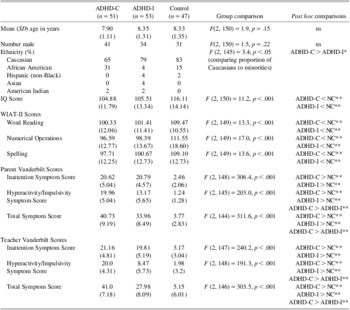
Children with ADHD were recruited through community and clinical sources, including schools and local practitioners. Children were considered to have met criteria for a symptom domain (i.e., inattention and/or hyperactivity/impulsivity) if the parent on the Diagnostic Interview Schedule for Children-Parent Report (DISC-P; Shaffer, Fisher, Lucas, Dulcan, & Schwab-Stone, Reference Shaffer, Fisher, Lucas, Dulcan and Schwab-Stone2000) and the teacher on the Vanderbilt ADHD Rating Scale (VARS; Wolraich, Feurer, Hannah, Baumgaertel, & Pinnock, Reference Wolraich, Feurer, Hannah, Baumgaertel and Pinnock1998) reported 6 non-overlapping symptoms in a symptom domain and both parent and teacher reported at least 4 symptoms in that domain. Children who met these criteria for both inattention and hyperactivity/impulsivity (i.e., >5 symptoms in both domains), were enrolled in the ADHD-C group while children who met symptom criteria for inattention but not hyperactivity/impulsivity (i.e., >5 inattention symptoms and <6 hyperactivity/impulsivity symptoms) were enrolled in the ADHD-I group. Children in the ADHD-I and ADHD-C groups demonstrated comparable demographic profiles (Table 1).
Demographic and clinical characteristics of the ADHD-C, ADHD-I, and Typically Developing Control groups

Note: ADHD-C = ADHD-Combined type; ADHD-I = ADHD-Inattentive type; WAIT-II = Wechsler Individual Achievement Test, Second Edition. *p < .05; **p < .01; ns = not significant; all three comparisons were run for all variables. Only significant differences are presented.
Typically developing participants
Children in the control group were recruited through schools and community settings. Controls were matched to both ADHD groups according to gender and ethnicity. Controls were only admitted to the study if they demonstrated minimal symptoms of ADHD (≤3 in either symptom domain) and did not meet criteria for any other behavioral disorder.
Measures
Choice discrimination task (CDT)
Participants observed a continuous stream of individually presented circles and squares followed by a presentation of a fixation cross for the duration of the ISI. Participants were asked to push a specific key for circle and another key for square. Following a practice block, participants were presented with 6 blocks of 60 trials. Each block contained an equal proportion of circles and squares presented in random order. During the incentive condition, participants received 1 point for each correct response and lost 1 point for each incorrect response.
Stop-signal task (SST)
A fixation cross was presented in the center of a computer screen for 500ms followed by a 500-ms presentation of an airplane facing either left or right (Logan, Cowan, & Davis, Reference Logan, Cowan and Davis1984). Participants were asked to press the button that corresponded to the airplane direction. An auditory “stop signal” (1000 Hz tone) was presented on 25% of trials within each block, which required participants to inhibit their response to the visual stimulus (stop trials). The delay between presentation of the target stimulus and the tone began at 250 ms and varied according to performance. Successful inhibition resulted in increases of 50 ms and unsuccessful inhibition resulted in decreases of 50 ms. Following three practice blocks, participants completed 6 blocks of 60 trials. During incentive blocks, children earned 1 point for each correct response and lost 4 points for each incorrect response.
Task manipulations
Incentive was manipulated within task such that participants either received incentives on the first half or second half of each task. At the end of each task, the number of points earned was reported to the child and exchanged for prizes (i.e., toys, games, etc.). Three different event rates were used within each task. Stimulus presentation was held constant at 500 ms with inter-stimulus intervals of 1 s, 3 s, or 5 s between stimulus presentations. Each task was divided into six continuous “blocks” of trials, with event rate varying across blocks and randomized within task. The task, ER, and incentive condition order was counterbalanced across subjects. Excluding the practice trials, each task took 21 min to complete.
Procedures
All procedures were approved by the Institutional Review Board at Cincinnati Children's Hospital Medical Center. Participants and their parents completed an initial screening visit, during which parents were administered the DISC-P interview and children were administered the WASI and WIAT-II, and two assessment visits during which they completed the SST and CDT.
Statistical Analyses
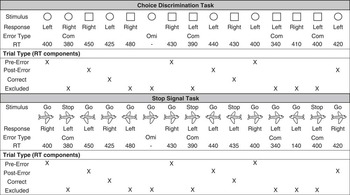
For both tasks, if the percentage of omission errors exceeded 50%, data were omitted from all analyses (CDT n = 4, SST n = 2).Footnote 1 Only RTs on correct trials were used for these analyses and all RTs less than 100 ms were excluded. Three RT variables were computed: (1) Mean correct RT: correct responses that did not precede or follow an omission or commission error; (2) Pre-error RT: correct RTs that preceded a commission error but did not follow a commission error; and (3) Post-error RT: correct RTs that followed a commission error but did not precede a commission or omission error (Figure 1). The separate response indicators include pre-error speeding (i.e., pre-error RT vs. correct RT), pre- to post-error slowing (i.e., pre-error RT vs. post-error RT), and post-error versus correct slowing (i.e., post-error RT vs. correct RT).Footnote 2
Categorization of pre-error, post-error and correct trial types used to compute reaction time components. Stimulus = stimulus presented on a single trial; Response = response made by a hypothetical participant; Error Type = omission (Omi) or commission (Com) error depending on participant's response; RT = reaction time; Pre-Error = correct response that preceded a commission error; Post-Error = Correct response that followed a commission error; Correct = correct response that did not precede or follow an error; Excluded = Trials not included in the RT calculation (i.e., error trials, pre-omission trials, and trials that are both pre-error and post-error trials).

Linear mixed models (i.e., SAS PROC MIXED) were used to test for between-subjects effects (Group: ADHD-C, ADHD-I, controls) and within-subjects effects (Trial Type: pre-error, post-error, correct) for RT mean.Footnote 3 All interactions were modeled, but only effects involving diagnostic group and trial type were of interest. These models were run separately for each task with an autoregressive within-subject covariance matrix due to the time-series nature of the data and models. For analyses that generated significant effects of trial type, post hoc Tukey-Kramer tests were conducted to identify differences among the three types of trials and Cohen's d (Cohen, Reference Cohen1988) is reported as a measure of effect size.
Results
Task Effects
There was a main effect of Trial Type on both the CDT, F(2,282) = 29.53, p < .001, and the SST, F(2,276) = 75.38, p < .0001. On both tasks, there was evidence of pre-error speeding and pre- to post-error slowing (all ps < .0001; ds = 0.65–1.32), but post-error versus correct slowing did not occur (CDT p > .11; SST p > .59).
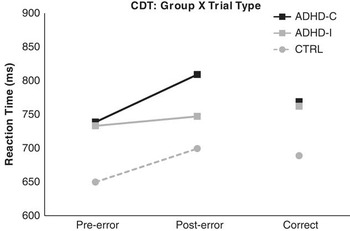
Group X Trial Type on the choice discrimination task (CDT).

ADHD Subtype Effects
There was an interaction of Group X Trial Type on the CDT, F(4,282) = 5.45, p < .001. The ADHD-I group exhibited pre-error speeding (p < .05; d = 0.62) but no pre- to post-error slowing or post-error versus correct slowing (ps > .78). The ADHD-C did not exhibit pre-error speeding (p > .09), but did show significant pre- to post-error slowing (p < .0001; d = 1.36) and post-error versus correct slowing (p < .01; d = 0.78). Finally, controls displayed pre-error speeding (p < .05; d = 0.74) and pre- to post-error slowing (p < .0005, d = 0.93), but no post-error versus correct slowing (p > .90) (Figure 2). There was no evidence of a Group X Trial Type interaction on the SST, F(4,276) = 1.3, p > .26.
Discussion
The current study examined whether post-error slowing is impaired in children with ADHD and whether the cognitive demands of the task impacted post-error slowing. Significant pre-error speeding and pre- to post-error slowing was observed on both the CDT and SST, whereas post-error versus correct RTs did not differ. These findings are consistent with the hypothesis that adaptive behavior consists of a slowing of response time following a commission error to correct for response speeding leading up to the error. Impairments in post-error slowing were limited to children with ADHD-I on the CDT, whereas all children exhibited significant pre- to post-error slowing on the SST.
Pre-error speeding and pre- to post-error slowing occurred on both the CDT and SST, suggesting that these processes are robust to the cognitive demands of the task and type of error (i.e., discrimination vs. inhibition). However, children with ADHD-I only showed significant pre- to post-error slowing on the SST, whereas this was observed on both the CDT and SST for ADHD-C and control groups. Understanding differences in post-error slowing for the most common ADHD subtypes may elucidate whether distinct neural mechanisms contribute to differences in symptom presentation. One possible explanation is that children with ADHD-I were less aware of their error on the CDT due to primary difficulties with attention. Error awareness may have been heightened on the SST as a result of the auditory stop signal, signaling the need for post-error slowing, whereas error detection on the CDT may require greater attention. No study to date has directly compared post-error slowing in the subtypes of ADHD, but our findings suggest that this deficit may be limited to the ADHD-I subtype and may be task dependent.
The finding that children with ADHD-C exhibit equivalent post-error slowing to typically developing controls is inconsistent with some aspects of theoretical models of ADHD (Sergeant, Reference Sergeant2000) implicating deficits in error processing and adaptive behavior as contributing to deficient self-regulation (see review by Shiels & Hawk, Reference Shiels and Hawk2010), yet consistent with findings from several studies reporting equivalent post-error slowing between ADHD and controls (Epstein et al., Reference Epstein, Hwang, Antonini, Langberg, Altaye and Arnold2010; Groom et al., Reference Groom, Cahill, Bates, Jackson, Calton, Liddle and Hollis2010; O'Connell et al., Reference O'Connell, Bellgrove, Dockree and Robertson2004; van Meel et al., Reference van Meel, Heslenfeld, Oosterlaan and Sergeant2007). Self-regulatory models of ADHD postulate that adaptive control is one component of a system influenced by internal and external factors to produce appropriate behavior. It may be that adaptive control is intact in children with ADHD-C, but the adjustment is insufficient to meet the demands of the task due to cognitive deficits. Alternatively, it may be that children with ADHD-C were more responsive to the incentive context than control participants such that the potential of earning a reward improved adaptive behavior during the task in general rather than specifically during the incentive blocks.
Conclusions
In summary, this study provides the first comprehensive evaluation of post-error slowing in children with the most prevalent subtypes of ADHD on two cognitive tasks using a novel approach to analyzing response speed surrounding errors. Pre- to post-error slowing was only impaired in children with ADHD-I on a simple attention task, suggesting disruption of this process may be limited to children with primary attentional difficulties. These findings highlight the importance of considering quantification of post-error slowing, ADHD subtype, and task demands when examining adaptive behavior.
Limitations and Future Directions
Recognition of the limitations of this study is important for interpreting these results. First, participants were all stimulant naïve suggesting that this may represent a milder ADHD sample. Second, this study was not designed to examine associations among adaptive behavior in different contexts, which limits our ability to extrapolate from these findings to social and academic functioning, an important question to address with future research. Finally, this study focused on behavioral measures of adaptive control, but examination of neural correlates may help elucidate the nature of post-error slowing.
Clinical Implications
There is some support for a distinction between the inattentive and combined subtypes of ADHD based on the absence of post-error slowing in the ADHD-I group during a simple attention task, whereas children with ADHD-C may be capable of adapting their behavior after making an error. This may suggest that children with ADHD-I would benefit from learning strategies to either engage in efficient self-monitoring or adapt behavior to meet task demands when an error is detected. Understanding the factors that contribute to producing adaptive behavior and the situations in which it is problematic may inform treatment and preventive interventions.
Acknowledgments
Keri Shiels is now at the Laboratory for Neurocognitive and Imaging Research, Kennedy Krieger Institute, Johns Hopkins University School of Medicine, Baltimore, Maryland. Funding for this study was provided by NIH grants (R01MH074770 and K24MH064478). There are no conflicts of interest to disclose for any of the authors.