Since its inception, the theatre has been a favoured site for the spectres of the past to haunt. The ghost of Darius in Aeschylus’ Persians, Hamlet's father or the undead in Heiner Müller – they emerge as disturbances from ongoing conflicts, breaking the timeless surface of pure presence, throwing time out of joint. Therefore, in discussing concepts of the future, we must face these spectres – be it in order to escape from the past and drive away the ghosts, or to complete unfinished challenges. Contemporary theatre and performance art are characterized by their openness to incorporating material from the past to give it new life. In this respect, how do we regard the oeuvre of Peter Brook, Klaus Michael Grüber or the Wooster Group, whose approaches to mise en scène speak to a distrust of theatre traditions? What concepts of the past can be identified in Marina Abramović's contemporary restagings of the canonized performances of the 1960s and 1970s,Footnote 2 or in the semi-documentary archival subversions of Rabih Mroué?Footnote 3 Here, theatrical performances emerge as models for a cultural remembering that questions the function of a stable memory but places our time at a distance from itself, thus opening up the present towards a future yet to be shaped.
This can be theorized on the basis of Michel Foucault's concept of genealogy, which refers back to history while aiming at processes of transformation. Thus genealogy in Foucault's sense intertwines the perspective of descent, ‘the ancient affiliation to a group, sustained by the bonds of blood, tradition, or social class’, with a sense of emergence, ‘the entry (entrée en scène) of forces . . . their eruption, the leap from the wings to centre stage’.Footnote 4 Such inquiry does not lead back to the past in order to find an origin in which the present might discern its mirror image, but would instead consist of a ‘use of history that severs its connection to memory’ and ‘places within a process of development everything considered immortal in man’.Footnote 5
Creative destruction
The work of Einar Schleef (1944–2001) offers an especially fruitful object of study when we examine this connection between descent and emergence. Schleef, who grew up in East Germany but created his most important productions after fleeing to the West, has left a lasting impression on the aesthetics of German theatre. His genealogical research extended across the various arts that constituted his broad oeuvre. Intertwining personal biography and political history, his novels, diaries and photographs marked his ongoing struggle with the loss of his proper ‘origin’, which he had to give up when he fled from East Germany. However, the engagement of a literary ‘heritage’ and a recurrent focus on the division of Germany were central to his work as stage director and set and costume designer.
The crucial drive behind Schleef's theatrical work was the reinvention of the ancient chorus, a device generally frowned upon in his days. For his directorial debut in the West in 1986 he developed the concept of the chorus, ten years after his last production in East Berlin. The resulting project – the classical tragedy Mütter (Mothers) at the Schauspiel Frankfurt, which combined Euripides’ The Suppliants and Aeschylus’ Seven against Thebes – has come to be recognized as one of the legendary productions of recent theatre history. It can be described as the precursor to a long series of productions that, over the past twenty years, have engendered a renaissance of the chorus in the German-speaking theatre in a great variety of ways.Footnote 6
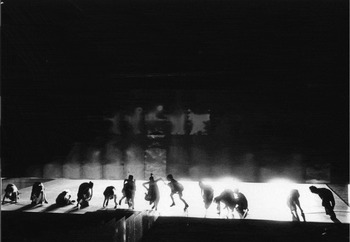
This historical research on the ancient chorus followed an implicit methodology. Characteristically, the narrative unity of the two classical plays was disintegrated: the texts were rhythmically chopped up and stretched to a breaking point, subjected to alienation through frequent repetition, or, in some choral passages, even reduced to pure materiality. Body and language waged an incessant battle. It was through this idiosyncratic appropriation, which might also be called ‘creative destruction’, that Schleef's choral mise en scène developed its transformative potential. Detached from narrative context, his noisy, stomping choruses became an experience that, rather than depicting reality, initiated a collective process in its own right.Footnote 7 Schleef's Mütter created something new, a liminal area between the aesthetic and the political, ‘counter to our time’ and ‘for the benefit of a time to come’ (See Fig. 1).Footnote 8
Chorus entering the orchestra of the Schauspiel Frankfurt in Mütter (1986), directed by Einar Schleef. Copyright: Claus Gretter.

How to respond?
Over the course of the thirteen works that followed between 1986 and Schleef's death in 2001, his conception of the chorus underwent constant change. In this process, his genealogical interests gradually shifted from an engagement with historical, dramatic heritage to the conflicts and catastrophes of German history. This obsession culminated in the last production Schleef completed, Verratenes Volk (A People Betrayed), which opened at the Deutsches Theater on 29 May 2000. It dealt with the failed German revolution of 1918 and its utopian notions of a happy future and ‘the new man’. Framed by a reading of Milton's Paradise Lost and a solo appearance by Schleef, in which he recited Nietzsche's Ecce Homo, the performance presented scenes from the First World War in chronology, including Lenin's Russian parliament, Rosa Luxemburg in prison at Breslau, and the German Spartakus revolts leading up to the proclamation of the Republic in November 1918. What visions of the past would become present in this arrangement? What spectres would emerge?
From the beginning, the representation of historical events focused strongly on acoustic qualities. At the centre of the first historical episode stood a chorus of eleven men dressed in military coats and lined up in front of the audience on an almost dark stage. Through a complex rhythm based on individual and collective voices, they brought to life the state of exhaustion and paralysis felt by German prisoners of war at a Russian military hospital. The grim events of the war were narrated by a dense, clanging choral voice comprising the eleven men, resounding forcefully in unison. But this voice was severed from the actors, who stood transfixed as though dead; in the ephemerality of acoustic emergence it created an auditory space between the actors and the audience. When the iron curtain fell, the chorus scene was cut off like a strange, unresolved experience that urged the viewer to situate it. Or, to use Bernhard Waldenfels's words, we encountered the event ‘as a call in the double sense of that which calls us and that which, in calling us, calls upon us’.Footnote 9
Exploding memory
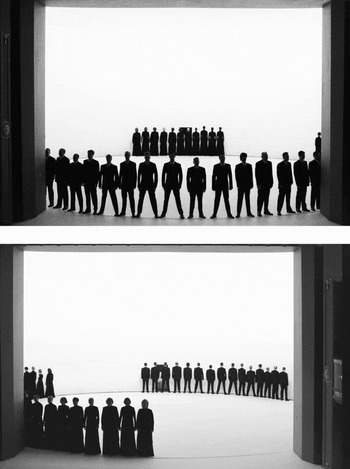
The chorus similarly appeared as an element of the unconscious that surfaced onstage in the historical scenes, loosely based on Alfred Döblin's two-thousand-page novel trilogy, November 1918, which made up the remaining three hours. The chorus, asking and calling, began to take possession of ever greater parts of the stage. In almost complete darkness, excited reports, lengthy speeches, loud background noises, oratorio-like chants and workers’ songs transported the viewer to the October Revolution, to the Bolshevik government, to whistling and jeering demonstrators protesting against Lenin, and, later, to the German November Revolution. All the while, the choruses were either almost invisible in the dark or were placed in highly artificial arrangements in the brightly lit and empty white space.
The rigid formations of the chorus on the revolving stage in Betrayed People (Deutsches Theater, 2000), directed by Einar Schleef. Copyright: davidbaltzer/bildbuehne.de.

Like Robert Wilson or Peter Brook before him and Frank Castorf or Christoph Marthaler after him, Schleef tested the audience's stamina through his unconventionally long performances. The speeches and formations seemed to extend ad infinitum, creating a heterogeneous plethora that was held together solely by the incessant motion of the revolving stage. In this process, the events became increasingly confusing, producing a ‘continuous swelling and teeming’,Footnote 10 throwing the order of time out of joint. When, finally, the masses stormed onto the stage with the words ‘The revolution is set in motion’, any sense of narrative sequence had already been lost. Despite the exterior order, the seemingly polyphonic confusion of the events onstage became a permanent state of affairs.
Thus it became evident that Schleef's performance did not at all represent history but rather focused on the perception of the processes and ‘materials’ of history. As in the soldiers’ scene at the beginning, events were released from their historical framework. On the threshold between historical evidence and spectral presence, the emotions and energies of historical situations were conveyed, even if their narrative interconnections were not depicted. This also clearly distinguished Schleef's production from historical dramas, current attempts at ‘living history’ and re-enactments of historical events. Verratenes Volk thus performed the opposite of what Reinhart Koselleck has described as the historiographer's work, for whom ‘the realities, as they are perceived, are always already misprisions of or even false realities with respect to what will in fact be the case’.Footnote 11 Schleef, by contrast, undid the constructions of history in the process of his performance by dissolving the binding forces of narration and reintroducing the chaos of history. If history is a process post festum, then Schleef razed the fortress of history, tying the audience into the labyrinth of his own space of the present past. Yet these very processes opened up perspectives on what man might be – on the contingencies and possibilities of history and on man's chance to shape or design the chaos.
Timeless thoughts, unredeemed bodies
The point of Schleef's representation of the revolution was that the bodies acting it out were far from liberated and unchained. On the contrary, the choruses were inhibited and lifeless almost throughout, the objects of movement rather than its agents. They stood still, were moved in circles, fell or lay on the ground. During choral movement, the choruses rushing towards the audience were only dimly visible on the darkened stage, perceptible primarily as a stomping noise, and they soon withdrew into the background. The performance visualized the paralysis of the forces of history, its undeveloped potentials and ‘unredeemed energies’.Footnote 12 Yet the power of movement was communicated all the more strongly by the voices and noises: the energy of the days of revolutionary awakening could be recognized in the chants and the acoustic dimensions that were tinged with the power of the utopian, of the future. This tied the audience into the space of history while yet engendering the revolutionary force as something ephemeral, even absent. A rift opened between the presence of the bodies and the acoustic space of the revolution, which could be felt as a disagreement between the revolutionary past (the acoustic dimension) and the inhibited present (the actors’ bodies). The bodies appeared as failures, as figures through which the energy of the acoustic dimension had failed to realize itself.
The best example of this rift between the historical energies of the acoustic dimension and the inhibited bodies of the present was the scene in which the masses waited for their leaders – the climax of the performance, it marked a turning point in German history. In utter darkness almost sixty actors, the biggest chorus so far, crowded the proscenium and began to report the events of 6 January 1919, as they have been described in history books: Berlin bursting with an enormous number of demonstrating workers waiting for the rebellion to begin, while the socialist leaders debated the question as to whether a violent rebellion would make sense until the masses, ready for battle, had dissolved.Footnote 13 Motionless, the chorus stood on stage, raising its concentrated, powerful narrative voice, and waited. In unison, the chorus obsessively repeated the end of a possible revolution in the exclamation ‘AUS!’ (‘OVER!’).
In his essay collection Droge Faust Parsifal, Schleef described the chorus as a repressed figure whose right to exist has been denied.Footnote 14 Since modern theatrical architecture has done away with the classical orchestra, the chorus is without its own site in the theatre.Footnote 15 Schleef did not give the chorus a new physical space but attempted to make the repression of the chorus visible and perceptible. It is for this reason that the chorus in Verratenes Volk was shown not as a mass in motion, counterbalancing this modern absence, but as a dislocated, spectral potentiality that abided in the dark. The chorus was made palpable as an energetic potential and force which may be excluded but can never be refused. Thus the performance brought past experiences of and reflections on community back to life, but simultaneously emptied the idea of community of naive utopianism.
In this way, the performance suggested that the thirst for community was not merely unquenched but unquenchable. For, in Verratenes Volk, the failure of the revolution was presented as a tragic constellation: Schleef's underlying theme emerged through the chaos of disintegrated history, the antagonism of individual and chorus (in this case, the impossibility of unity between ‘intellectuals’ and ‘the people’) – the impossibility of being one. From this perspective, history could be understood as a repetition, an eternal recurrence symbolized by the constantly revolving stage.
Schleef's community, then, engendered no answer, no positive identification, no origin. Instead, his genealogical mise en scène returned the community to the present as an urgent and inevitable problem. The pessimistic perspective did not renew the longing for a revolution; instead, aporia took the place of utopia. The prevailing consciousness was that of the community as an unquenched and unquenchable conflict that would reappear in the future, albeit in different constellations.
Encore
During the final applause, long past midnight, Einar Schleef went onstage and announced to the surprised audience that the company had decided to give encores. To the applause of many audience members, the chorus again filled the stage, which was now fully illuminated, and started to present amusing songs and joyful dances. Thus the end of the revolution was not the end of the performance. Rather, the jolly scenes of the encores superposed the events of the past in which the chorus had been nothing more than a marginalized figure. In this light, Verratenes Volk could also be read as a process of escape and forgetting, invoking Nietzsche's words:
Only through the power of employing the past for the purposes of life . . . did man become man: but with an excess of history man again ceases to exist, and without that envelope of the unhistorical he would never have begun or dared to begin.Footnote 16
The finale seemed to indicate that in order to shape the future one must first break free from the past.Footnote 17 In giving encores, the dancing chorus was already a few steps ahead.