Introduction
Maize (Zea mays L.) is one of the major staple grain foods grown throughout Africa. In developing countries, much of it is produced by smallholder farmers, for their own consumption and for sale. Maize yields are low as a result from a combination of biotic and abiotic stresses. In Africa, more than 13% of crop losses are due to insect pests, the others being cryptogamic, bacterial and viral diseases, weeds and rodents (Pantenius, Reference Pantenius1988). The most damaging storage pest that infests maize in sub-Saharan Africa is the larger grain borer Prostephanus truncatus (Horn) (Coleoptera: Bostrichidae), causing losses of up to 40% after 6 months of storage. It is followed by Sitophilus zeamais (Motschulsky) (Coleoptera: Curculionidae), Tribolium spp. (Coleoptera: Tenebrionidae), Cathartus quadricollis (Guérin) (Coleoptera: Silvanidae), Rhyzopertha dominica (Fabricius) (Coleoptera: Bostrichidae), Oryzaephilus spp. (Coleoptera: Cucujidae), Gnatocerus sp., Palorus spp. (both Coleoptera: Tenebrionidae) and Cryptolestes ferrugineus (Stephens) (Coleoptera: Laemophloeidae) (Pantenius, Reference Pantenius1988).
Storage pests create an environment favourable to mycotoxigenic fungi through physical damage on maize grains (Dowd, Reference Dowd, Sinha and Bhatnagar1998). The presence of fungi can lead to physical and nutritional deterioration, as well as modifying the organoleptic qualities of the infected grains (Wright, Reference Wright, Semple, Frio, Hicks and Lozare1998). The prevailing microflora on maize in the tropics belong to the genera Aspergillus, Fusarium and Penicillium (Cardwell et al., Reference Cardwell, Kling, Maziya-Dixon and Bosqué-Perez2000). In these genera, some species are mycotoxin (e.g. aflatoxin, fumonisin, ochratoxin, citrinin) producers. Mycotoxins are toxic to humans and most animals (Marasas, Reference Marasas1988). Aspergillus flavus Link and Fusarium verticillioïdes (Sacc.) have been reported to be the most prevalent fungi on maize in Africa, with aflatoxin and fumonisin co-occurring (Cardwell et al., Reference Cardwell, Kling, Maziya-Dixon and Bosqué-Perez2000). There are two basic mechanisms for A. flavus contamination on maize: (1) airborne or insect-vectored inoculum contaminates the silk and grow into the cob or, more often, (2) damaged grains become colonized with the fungus (Miller, Reference Miller1995). The distribution of these fungi in stores in Benin is promoted by insect damage to maize in the field: a fungal infection starts from the field and is often compounded by damage from lepidopteran pests (Schulthess et al., Reference Schulthess, Cardwell and Gounou2002). According to King and Scott (Reference King and Scott1981), damage by post-harvest pests predisposes maize to fungal infection.
This study aimed to investigate and make an inventory of mycoflora associated with maize storage pests in Benin. The dynamics of these pests inside the stores and their immigration towards the storage structures were evaluated. The potential of each insect pest to convey fungal spores to maize stores and the relationship of certain insects with fungi were assessed.
Materials and methods
Experimental site
The trial was conducted at the Benin station of the International Institute of Tropical Agriculture in Abomey–Calavi, located in the forest mosaic savannah (FMS) zone. The FMS spreads between the sixth and seventh parallel and has two annual maize-growing seasons; one from April to July and the second from September to November, with average rainfall from 1300 to 1500 mm/annum and mean temperatures between 25 and 35 °C.
Experimental procedure and layout
The local maize variety ‘Toga’ was sowed on 2 ha at the beginning of the first rainy season (80 cm between lines, 40 cm within line) with an application of fertilizer (NPK, 15:15:15) at a dose of 125 kg/ha. Up to the peduncle, some maize cobs were completely covered (‘protected’) in the field just after pollination by a gauze cloth (0.25 mm mesh size), to avoid infestation by insects. Cobs from the ‘non-protected’ treatment were left to be naturally infested. At harvest, three replicates per treatment of ‘Adja’ granaries of 2 m diameter and 0.5–0.75 m high were randomly built in the field using palm baskets (Meikle et al., Reference Meikle, Markham, Holst, Djomamou, Schneider and Vowotor1998). The distance between the granaries was approximately 100 × 150 m. The granaries were wrapped with mosquito netting coated with neutral glue (Tanglefoot®, Grand Rapids, Michigan, USA) to capture storage pests immigrating toward the stores. The netting was changed monthly and every 2 weeks insects were collected from the glue for species identification and counting. After harvest, the gauze cloth was removed and protected and non-protected cobs were stored in three replicates each with at least 500 maize cobs in each granary. Ten maize cobs, on average 1 kg, were sampled monthly from each granary from September 2000 to March 2001 to determine pest and pathogen populations.
Assessment of storage pests and their associated fungi
The sampled maize cobs were dehusked and shelled on a set of sieves. All insects were collected, counted and identified to species level using the keys of Dobie et al. (Reference Dobie, Haines, Hodges, Prevett and Rees1991) and Délobel and Tran (Reference Délobel and Tran1993). Grain moisture content (mc) was determined according to the method of the International Standards Organization (ISO, 1980). Three separate subsamples of about 10 g of maize grains were ground (Tekmar IKA-A10, Analytical Mill, Staufen, Germany), transferred to a metal container, weighed and dried in an oven for 2 h at 130 °C. In three replicates for all the six treatments, maize losses were evaluated using the count and weight method described by Boxall (Reference Boxall1986). For the determination of fungal spectrum on the maize, five replicates per treatment of five maize grains were surface sterilized in 10% sodium hypochlorite, and plated in Petri dishes on filter paper slightly wetted with a mixture of water and 0.05% lactic acid. Petri dishes were incubated for 7 days at 27 °C under 12 h light and 12 h darkness. Fungi present on maize grains were identified using the method described below and from the 25 grains incubated, the percentage of grains infected by each fungus species was calculated to determine their incidence on maize grains.
Assessment of fungi present on insects
All insects found in the granaries and on the glue coated netting were collected, identified and counted. Out of each species group a subsample was plated on potato dextrose agar (PDA) and incubated for 7 days at 27 °C under 12 h light and 12 h darkness. From each treatment, 10 S. zeamais, 10 C. quadricollis, 10 Palorus subdepressus (Wollaston), 5 P. truncatus, 5 Carpophilus dimidiatus (F.) (Coleoptera: Nitidulidae), 5 Tribolium castaneum (Herbst), 5 C. ferrugineus and 5 Gnathocerus cornutus (Fab.) were plated. Fungi were first isolated, identified up to genus level and again cultured on specific media for species identification. The species identification was done by the single spore method on malt extract agar and Czapek yeast agar for Penicillium spp., on potassium chloride and PDA for Fusarium spp. and on PDA for Aspergillus spp. and other species. Keys used for species identification were those of Klich and Pitt (Reference Klich and Pitt1998) for Aspergillus spp. and Watanabe (Reference Watanabe1994) for Fusarium and Penicillium spp. The percentage of insects infested by each fungus species was calculated to determine their relative incidence on immigrants' pests.
Data analyses
Number of insects, losses and incidence of fungi were subjected to ANOVA using the mixed model procedure in SAS version 9.1 (SAS Institute Inc., 2003). Variances were stabilized with the following transformations: x′ = log (x+1) for pest populations; x′ = arcsin√p, with p = x/100 for fungal percentages. Averages were separated with the t-test at 5%. Correlations were computed to establish the interactions between number of insects in stores and fungi and within immigrant insects. Means are presented untransformed in the tables.
Results
Insect infestation in maize stores
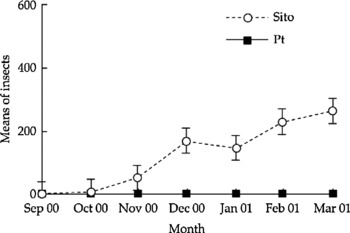
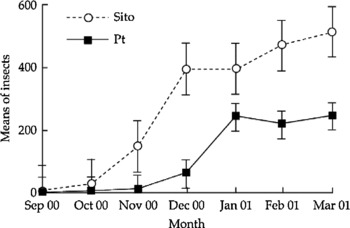
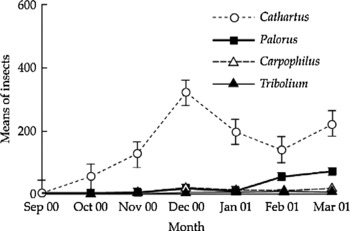
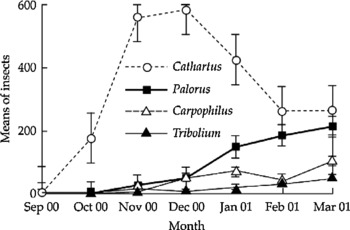
The storage insects found in the stores were P. truncatus, S. zeamais, C. quadricollis, C. dimidiatus, P. subdepressus, T. castaneum, C. ferrugineus and G. cornutus. S. zeamais was the most abundant insect on stored maize. On protected maize, S. zeamais was found after 1 month of storage, while P. truncatus was not encountered during the entire 6 months of storage (Fig. 1). On non-protected maize, S. zeamais was present at harvest and its population increased during storage, while P. truncatus appeared after 2 months of storage (Fig. 2). The number of all other storage pests increased during storage, except for C. quadricollis, which peaked until 3 months of storage and decreased thereafter in both treatments. On protected maize, only Tribolium spp. was present at harvest; C. quadricollis and Carpophilus spp. appeared after 1 month of storage (Fig. 3). On non-protected maize, C. quadricollis and Carpophilus spp. were present at the beginning of storage, while Tribolium spp. and Palorus spp. were observed after 1 month of storage (Fig. 4).
Mean numbers ( ± SE) of Sitophilus zeamais (Sito) and Prostephanus truncatus (Pt) on ‘protected’ maize

Mean numbers ( ± SE) of Sitophilus zeamais (Sito) and Prostephanus truncatus (Pt) on ‘non-protected’ maize

Mean numbers ( ± SE) of secondary storage pests on protected maize

Mean numbers ( ± SE) of secondary storage pests on non-protected maize

Significant differences between the two treatments were found for S. zeamais (P < 0.0001), P. truncatus (P = 0.0002) and for all other insect pests, except for Cryptolestes spp. and Gnatocerus spp.
Grain losses in stores and its mc
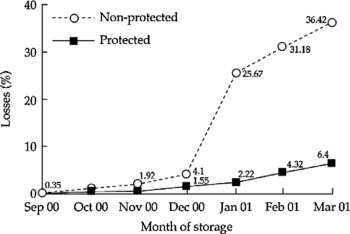
Figure 5 shows the evolution of grain losses due to storage pests during the 6 months of storage. During the first 3 months of storage, there were no significant differences between protected and non-protected maize. After 4 months of storage, losses between treatments differed significantly (P = 0.0051), reaching 36.4 and 6.4% after 6 months on non-protected and protected maize, respectively. mc levels evaluated in the two treatments were similar. It started with 18.5% at the beginning of storage, to decrease to 14.0 and 10.9% after 3 and 6 months, respectively.
Evolution of maize losses (%) during 6 months of storage in the two treatments

Fungal incidence on maize grains
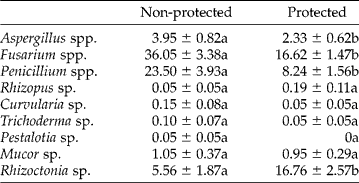
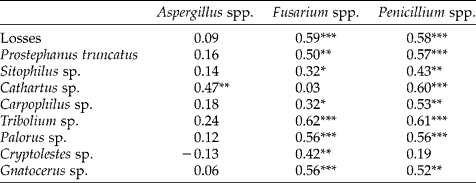
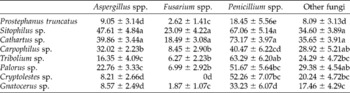
Nine different fungal genera were identified on the maize grains: Aspergillus, Fusarium, Penicillium, Rhizopus, Curvularia, Trichoderma, Pestalotia, Mucor and Rhizoctonia. Fungal incidence, independently of storage time, differed significantly between the two treatments for Aspergillus (P = 0.0067), Fusarium (P < 0.0001), Penicillium (P = 0.0007) and Rhizoctonia (P < 0.0001; Table 1). The relationship between grain losses caused by storage pests, the number of storage pests and fungi is summarized in Table 2. Per cent losses due to insects were significantly correlated with Fusarium spp. and Penicillium spp. (P < 0.001), but not with Aspergillus spp. incidence. Only C. quadricollis numbers were significantly correlated with Aspergillus spp. (P = 0.0019), but not with Fusarium spp. incidence. Except for Cryptolestes sp., all other storage pests' densities were significantly correlated with Penicillium incidence (P < 0.0054).
Effect of maize protection on incidence of different fungi on maize
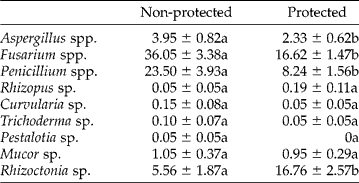
Means ( ± SE) within a column per fungal genera followed by the same letter do not differ significantly from each other (t-test, 5%).
Correlation between losses (%), mean number of insects and the principal fungal genera on maize
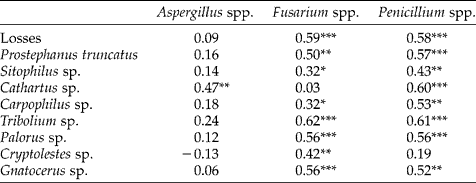
*P = 0.05, **P = 0.01, ***P = 0.001.
Toxigenic fungi
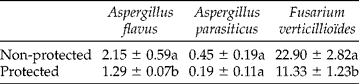
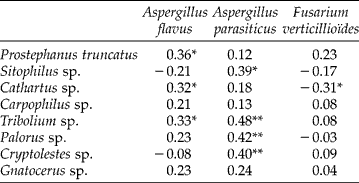
The aflatoxin producer A. flavus appeared on maize after 1 month of storage, whereas Aspergillus parasiticus was found on non-protected and protected maize after 4 and 5 months of storage, respectively. The fumonisin producer F. verticillioïdes colonized maize from the field; it was more abundant at the beginning of storage and its incidence decreased with storage time. Significant differences between both treatments were found for A. flavus and F. verticillioïdes incidence, while no such significant differences were recorded for A. parasiticus (Table 3). The incidence of A. flavus was positively correlated with the number of P. truncatus, Cathartus sp. and Tribolium sp.; the incidence of A. parasiticus with the number of Sitophilus sp., Tribolium sp., Palorus sp. and Cryptolestes sp., whereas the incidence of F. verticillioïdes was only negatively correlated with the number of Cathartus sp. (Table 4).
Effect of maize protection on incidence of toxigenic species on maize
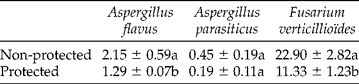
Means ( ± SE) within a column followed by the same letter do not differ significantly from each other (t-test, 5%).
Correlation between mean number of insects and incidence of toxigenic species encountered on maize during the 6 months of storage
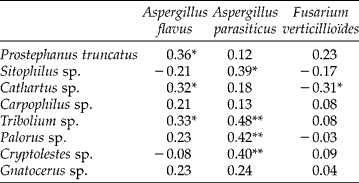
*P = 0.05, **P = 0.01.
Fungi on storage pests
Fifteen different fungal genera were identified on the storage pests. The principal storage fungi Aspergillus, Fusarium and Penicillium were present. Other fungi such as Curvularia, Trichoderma, Pestalotia, Mucor, Colletotrichum, Monilia, Syncephalastrum, Rhizopus, Rhizoctonia, Bipolaris, Alternaria and Candida were also found. The incidence of Aspergillus spp., Fusarium spp. and Penicillium spp. present on S. zeamais and C. quadricollis was significantly different from that found on the other pests. A lower incidence of Penicillium spp. was found on P. truncatus, Carpophilus and Gnatocerus spp. (Table 5).
Incidence of principal fungi on insects in maize stores
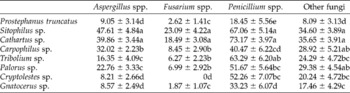
Means ( ± SE) within a column followed by the same letter do not differ significantly from each other (t-test, 5%).
Immigration of pests to stores
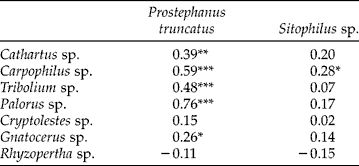
The composition of pests found on the glue during the storage period did not differ much from the species found in the stores. Rhyzopertha sp. was the only insect identified as an immigrant on both non-protected and protected maize, which was subsequently not found inside the stores. There was a positive relationship between the immigration of P. truncatus and the immigration of all secondary pests, except for Cryptolestes sp. and Rhyzopertha sp.; Sitophilus sp. was significantly correlated only with Carpophilus sp. (Table 6).
Correlation between mean number of primary insects and mean number of secondary insects immigrating toward the stores
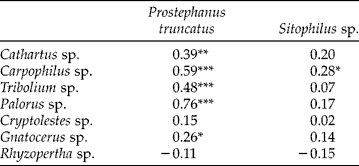
*P = 0.05, **P = 0.01, ***P = 0.001.
Fungi on immigrant insects
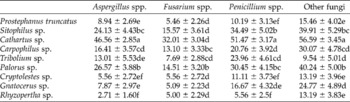
The fungal spectrum identified on the immigrant pests differed little from that found on the pests inside the granaries. Three additional fungi (Botryodiplodia sp., Plodia sp. and Macrophomina sp.) were identified, but incidence of the immigrant pests was low. Statistical analysis of the incidence of the principal storage fungi on the immigrant pests revealed that Cathartus sp. conveys significantly more Fusarium spp. towards the stores, while Cathartus sp., Sitophilus sp. and Palorus sp. were the pests that convey significantly Aspergillus spp. and Penicillium spp. toward the stores (Table 7).
Incidence of principal fungi on immigrant insects
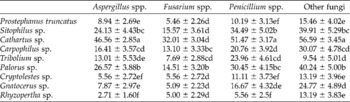
Means ( ± SE) within a column followed by the same letter do not differ significantly from each other (t-test, 5%).
Discussion
Insect infestation in maize stores
The storage trial showed that insect infestation of maize already starts from the field. S. zeamais, C. quadricollis and Tribolium spp. were identified at harvest on non-protected maize. These results corroborate those of Hell (Reference Hell1997), who found that the infestation of maize by storage pests in Benin starts in the field and is carried over into the store. The protection of the maize by gauze in the protected treatment could explain the reduction in the number of insects found on maize cobs at harvest compared with the non-protected ones. The pest spectrum encountered on maize stored in this trial did not differ from the spectrum found in traditional granaries by Borgemeister et al. (Reference Borgemeister, Adda, Djomamou, Degbey, Agboka, Djossou, Meikle, Markham, Highley, Wright, Banks and Champ1994), who reported four out of the eight insect species found in this study. The insects known to infest maize in the FMS are S. zeamais, P. truncatus, Palorus spp., Carpophilus spp., Tribolium spp., C. ferrugineus and Gnatocerus spp. All these insects were also found on our maize samples during the 6 months of storage, except for P. truncatus, which was not recorded on the protected maize. Sources for infestation can be (i) crop residues from the previous harvest; (ii) building material of the granaries that can harbour some of these insects; (iii) neighbouring granaries and (iv) poor hygienic conditions during storage (Pantenius, Reference Pantenius1988). Storage pests can also be attracted towards the granaries by maize volatiles or in the case of P. truncatus by the male aggregation pheromone (Scholz et al., Reference Scholz, Tchabi, Markham, Poehling and Borgemeister1998).
At the beginning of storage, compared with other insect species, high numbers of S. zeamais and P. truncatus were observed on non-protected maize, probably due to an insect succession by which secondary insects (‘scavengers’) appear on maize only after primary pests have damaged the grains. Secondary insects feed on flour and debris produced by primary insects. After 3 months of storage, the number of Cathartus spp. peaked at 585 per kilogram on non-protected maize. At these high densities, there is high intra- and interspecific competition for both food and space (Gaston et al., Reference Gaston, Gregory and Blackburn1999). Such interactions can lead to a reduction in the growth rate of certain species and sometimes a population reduction in the granary, as observed for Cathartus sp. in our experiment. Such competition between storage pests has previously been observed by Biliwa and Richter (Reference Biliwa, Richter, Fleurat-Lessard and Ducom1990) for P. truncatus and S. zeamais, and Meikle et al. (Reference Meikle, Markham, Holst, Djomamou, Schneider and Vowotor1998) found a negative correlation between the growth rate of P. truncatus and that of S. zeamais on maize stored in granaries in Benin.
Grain losses in stores
The recorded grain losses of 6.4% on protected maize after the 6 months of storage were mainly due to S. zeamais. Average losses of up to 10% have been previously recorded in Benin by Meikle et al. (Reference Meikle, Markham, Holst, Djomamou, Schneider and Vowotor1998) for S. zeamais. On non-protected maize, grain losses increased considerably, reaching 36.4% at 6 months of storage. Most of these grain losses can probably be attributed to a P. truncatus infestation. The incidence of this pest often increases after 3–4 months of storage (Hell, Reference Hell1997). Likewise, trials conducted in Togo and Benin recorded grain losses due to P. truncatus of 30.2 and 20.5%, respectively, after 6 months of storage in traditional granaries (Pantenius, Reference Pantenius1988; Fandohan et al., Reference Fandohan, Langner, Mutlu, Boeye, Wright and Laborius1992).
Fungal infection on maize kernels
Lower infection rates on protected than on non-protected maize at the beginning of storage indicated that the gauze significantly reduced fungal contamination. Either the gauze presented a physical barrier for fungal spores or the vectoring by birds and/or insects was impeded. Fusarium spp. incidence was high at the beginning of storage; Aspergillus spp. occurred only later in stores, reflecting the observations of Pitt and Hocking (Reference Pitt and Hocking1999), who classified Fusarium spp. among the field fungi and Aspergillus spp. as post-harvest fungi. Fusarium spp. incidence increased with time, indicating that insect activity might have led to a spread of the fungal spores, and the metabolic activity of pests might have increased moisture levels (Beti et al., Reference Beti, Phillips and Smalley1995; Schulthess et al., Reference Schulthess, Cardwell and Gounou2002). The positive correlation recorded between the number of the majority of the storage pests and the incidence of Fusarium spp. and Penicillium spp. indicates that secondary pests, which occurred in high numbers, seem to be the principal disseminators of fungi in the granaries even though they do not cause high losses.
Toxigenic fungi
The principal toxigenic species A. flavus, A. parasiticus and F. verticillioïdes recorded in this study were also observed earlier by Hell (Reference Hell1997) in the same agro-ecologic zone in Benin. Cardwell and Cotty (Reference Cardwell and Cotty2002) found that A. flavus was the predominant Aspergillus species, with 90% belonging to this group. Several authors have pointed out the role that storage pests play in the transmission of spores of toxigenic species in the field or on stored maize. Wright (Reference Wright, Semple, Frio, Hicks and Lozare1998) observed that S. zeamais infestations favour A. flavus incidence in the granaries through its feeding activity that damages grains, thereby facilitating the transmission of fungal spores into the grains. According to Dowd (Reference Dowd, Shotwell and Hurburgh1991), high S. zeamais populations can change the environmental conditions in the granaries to the advantage of fungi. Also certain toxigenic species of Penicillium spp. and F. verticillioïdes were found to be vectored by S. zeamais (Wright et al., Reference Wright, Harein and Collins1980; Munkvold and Carlton, Reference Munkvold and Carlton1997).
Fungal infection on storage pests
Some fungal species were found on certain storage pests but not on the maize. These species might be fungi that have a symbiotic relationship with pests as described by Dowd (Reference Dowd, Shotwell and Hurburgh1991), or maize is not a good substrate and/or host material for the development of these fungi. S. zeamais and C. quadricollis seem to be the best disseminators of fungal spores since spores of Aspergillus, Fusarium and Penicillium spp. were more often found on these than on other storage pests. Several authors reported S. zeamais vectoring fungal spores into maize stores (see above). In C. quadricollis possibly, its high mobility in the store, due to the insect's small, elongated body-shape, enables it to clear a way between the husks, and through intact grains (Gwinner et al., Reference Gwinner, Harnish and Mück1996).
Immigration of pests to stores
Attraction plays a role in the migration of pests towards a store, either by pheromones produced by conspecifics already present in the granaries or by the odour of damaged maize grains and maize starch (Scholz et al., Reference Scholz, Tchabi, Borgemeister, Markham, Poehling and Lawson1997). Insects seem to be also attracted to maize infected by fungi. Ako et al. (Reference Ako, Schulthess, Gumedzoe and Cardwell2003) found that S. zeamais and C. dimidiatus are attracted towards maize infected by F. verticillioïdes. Likewise, Schulthess et al. (Reference Schulthess, Cardwell and Gounou2002) previously suggested that some lepidopteran and coleopteran pests are attracted and survive longer or have lower mortality on plants infected with Fusarium spp.
The positive correlation between P. truncatus and the majority of the secondary insects is due to the tunnelling behaviour of the beetle that results in the production of large amounts of flour and damaged grains (Pantenius, Reference Pantenius1988) and induces fungal growth. That was not the case for S. zeamais, in which density was only correlated with Carpophilus spp., possibly because of the affinity of both insects towards deteriorating grains (Wright et al., Reference Wright, Harein and Collins1980).
Fungal incidence on immigrating pests
The fungal spectrum associated with immigrant insects showed that Cathartus spp. are likely to vector more fungi towards granaries, in particular Aspergillus, Fusarium and Penicillium spp., than other post-harvest maize pests. This is a new finding since the role of Cathartus spp. in the propagation of fungal spores and in the predisposition of maize to fungal infection has not been previously described.
Conclusion
This paper shows a novel avenue for the control of infestation of maize by toxigenic fungi through the protection of maize cobs with gauze before pollination; whether this is a practical solution for small-scale farmers in Africa needs to be verified in future studies.
Acknowledgements
We thank Pascal Gbelissanon for field assistance, Josephine Hotegni and Georg Georgen for laboratory assistance and the late Saka Gounou for critical review of this manuscript. This work was supported by the Aflatoxin Project of the International Institute of Tropical Agriculture (IITA), funded through BMZ/GTZ.