


1. Introduction
The world is entering a new era of fiscal uncertainty with countries battling with sluggish economic growth and heightened global uncertainty. Meanwhile, consumer confidence globally has plummeted to its lowest levels since the pandemic. Reverting from their stance of fiscal austerity since the debt crisis, several European nations have recently announced substantial fiscal packages aimed at stimulating growth and strengthening economic resilience against disturbances like armed conflicts and trade wars. This paper shows that the success of these fiscal measures in stimulating growth can also depend on their ability to generate confidence about future economic outcomes. In other words, fiscal policy can be more effective in raising economic growth if it also improves consumer sentiments.
Movements in consumer sentiments have important aggregate implications. Sentiments in the U.S., as measured by the Michigan Survey of Consumer Sentiments, have been shown to influence future output growth (Benhabib and Spiegel, Reference Benhabib and Spiegel2019) and predict fall of future consumption (Blanchard, Reference Blanchard1993). Sentiments can also explain large proportions of business cycle experienced in the U.S. (Milani, Reference Milani2017). Nowzohour and Stracca (Reference Nowzohour and Stracca2020) provide an overview of literature on the contribution of sentiments to business cycles.
This paper focuses on whether economic optimism and pessimism as measured by surveys can influence the effectiveness of fiscal policy. To answer this question, I look at the countries in the European Monetary Union, or simply the euro area, where monetary policy is determined centrally by the European Central Bank (ECB) while member countries set their fiscal policy independently. A currency union is the ideal setting for teasing out channels of transmission of fiscal policy as the monetary policy only responds to union-wide shocks. This makes fiscal policy the main macroeconomic tool in combating country-specific shocks (Gali and Monacelli, Reference Gali and Monacelli2008). Farhi and Werning (Reference Farhi and Werning2016) show that the fiscal multiplier in a currency union is higher due to the constraints on monetary policy. An increase in public spending can thus transmit to consumer sentiments if agents believe fiscal policy to be the main policy tool for stabilization of domestic output and prices.
This paper shows that fiscal expansion coupled with higher sentiments can increase aggregate demand more than the standard Keynesian effects, resulting in higher fiscal multipliers. The analysis is conducted for eight euro area countries: Belgium, Finland, France, Germany, Italy, Netherlands, Portugal, and Spain. Consistent with the literature, consumer sentiments is measured using the household survey of consumer expectations conducted by the European Commission across all countries in the European union. The VAR includes five variables—government spending news, government expenditure, consumer sentiments, GDP, and real interest rate, with government spending news ordered first. The VAR also includes an interaction term between consumer sentiments and government spending news to capture the effects of fiscal shock on output through the additional consumer sentiments channel. To isolate the sentiments channel, I introduce a counterfactual exercise where the economy receives a zero confidence shock every period along-with the fiscal news shock in the first period. The resulting impulse response functions from the two exercises allow us to distinguish between the Keynesian effect of fiscal policy and the additional role played by sentiments in transmission.
One of the key challenges in studying the empirical effects of fiscal policy is identifying fiscal policy shocks. Ramey (Reference Ramey2011) and Ramey and Zubairy (Reference Ramey and Zubairy2018) have criticized the identification of fiscal shocks in a VAR using Cholesky decomposition as it fails to distinguish between anticipated fiscal policy measures and unexpected “news” shocks. To address this, they introduce two methods for identifying the unanticipated component of fiscal policy: the narrative approach and forecast errors. For Europe, Alesina et al. (Reference Alesina, Favero and Giavazzi2019a) applies the narrative method to measure unexpected government expenditure shocks at the annual frequency. Using VAR at annual frequency results in a significant loss of dynamics in macro variables and raises endogeneity concerns between fiscal policy measure, sentiments, and output. I instead use forecast of fiscal expenditure made by the OECD to identify fiscal policy news using the difference between actual and forecasted growth in government expenditure, an approach based on the forecast error method of Ramey (Reference Ramey2011).Footnote 1
Results show that there is significant heterogeneity in how much consumer sentiments matter for propagation of fiscal policy. In Spain, Italy, and Netherlands, the persistence in response of output to fiscal news is driven by consumer sentiments. In Spain and Netherlands, the cumulative multiplier is nearly three times as much in the baseline with consumer sentiments than the counterfactual with no confidence, while in Italy the multiplier with sentiments is nearly double. For other countries in the sample, including, Belgium, France, and Portugal, there is no evidence of a sentiments channel of fiscal policy. For Germany and Finland the output response is lower under the counterfactual but the difference is not significant. These findings imply a core vs periphery pattern among euro area countries where fiscal policy is more effective in generating optimism in peripheral nations. I extend the analysis using a Panel VAR with low-sensitivity and high-sensitivity countries based on the strength of sentiments channel in these economies. Among high-sensitivity countries, higher consumer sentiments raises consumption of non-durable goods and services, as well as stock prices, but the sentiment channel plays no role in economic expansion among low-sensitivity countries.
While consumer sentiments have been extensively studied to understand movements in aggregate productivity and inflation, limited attention has been paid to how macroeconomic policy could influence these sentiments. Konstantinou and Tagkalakis (Reference Konstantinou and Tagkalakis2011) studies a panel of 9 OECD countries (not in monetary union) and find that some components of fiscal policy can raise confidence while others reduce it. Bachmann and Sims (Reference Bachmann and Sims2012) show that sentiments make fiscal policy more effective in the U.S. during recessions. The heterogeneity in effectiveness of fiscal policy between countries within a monetary union is the focus of this paper.
An important application of this analysis is to understand whether consumer sentiments can make fiscal consolidation policies more effective. The consolidation measures adopted by the European Commission during the European debt crisis were largely criticized to be too costly in terms of loss of output. However, many have argued that fiscal consolidation can also raise confidence by reducing the probability of default in high debt countries which can translate into smaller and milder contractions, and even result in potential expansion of the economy (Giavazzi et al., Reference Giavazzi, Jappelli and Pagano2000; Fazzari et al., Reference Fazzari, Morley and Panovska2015). To test whether sentiments can make fiscal consolidation less costly, I use a Threshold-VAR model with panels of low-sensitivity and high-sensitivity countries. In high-sensitivity countries, both sentiments and output were significantly lower during periods of consolidation relative to normal times. The findings push against the idea of creating a fiscal union in politically independent countries, and suggest that nations should be allowed to make their fiscal decisions according to the effectiveness of policy in raising confidence within their economy.
1.1 Related literature
To understand why consumer sentiments may matter for policymakers in determining the effectiveness of policy measures, we need to understand what survey based consumer sentiments is capturing. Barsky and Sims (Reference Barsky and Sims2012) argues that the expectations component of the Michigan Survey of Consumer Sentiments are noisy measures of changes in expected productivity over a long period of time, and hence only reflect “news” about future productivity. Féve and Guay (Reference Fève and Guay2018) study the effect of sentiments orthogonal to news on total factor productivity and find evidence that the news channel is the main driver of business cycles. Another interpretation is that consumer sentiments are animal spirits that captures optimism and pessimism about future economic outcomes. Literature on sentiments show that waves of optimism and pessimism orthogonal to economic fundaments can persistently affect macroeconomic aggregates like labor market outcomes, and economic activity (Benhabib and Spiegel, Reference Benhabib and Spiegel2019; Bhandari et al., Reference Bhandari, Borvicka and Ho2024; Lagerborg et al., Reference Lagerborg, Pappa and Ravn2023).
Sentiments have also been incorporated in papers studying fiscal policy. Bachmann and Sims (Reference Bachmann and Sims2012) use VAR to show that sentiments increase the effectiveness of fiscal policy during recessions in the U.S. De Grauwe and Foresti (Reference De Grauwe and Foresti2020) use a model which generates waves of optimism and pessimism to show that fiscal multiplier is highest in periods of extreme optimism and pessimism. This paper contributes to the literature by studying the role of sentiments in transmission of fiscal policy in a monetary union. A systematic study of euro area countries can highlight how sentiments can result in varying effectiveness of fiscal policy shocks across countries, with implications for a fiscal union.
There are several reasons why fiscal policy news can influence optimism or pessimism about future economic activity. One perspective suggests that partisan bias plays a role where consumers who do not support the ruling party are more likely to have a pessimistic outlook on future economic conditions (Benhabib and Spiegel, Reference Benhabib and Spiegel2019). Other reasons could include concerns about unsustainable fiscal debt, or news about development of public utilities and infrastructure. Fiscal policy has been shown to have non-linear effects on some European economies based on the level of household debt (Zurita, Reference Zurita2025). In the euro area this can also signify whether consumers in some countries perceive monetary policy as less responsive to domestic shocks.
Given euro area’s recent experience with fiscal consolidation, this paper also highlights how movements in sentiments can influence the cost of such consolidation on economic activity. The results supplement Beetsma et al. (Reference Beetsma, Cimadomo, Furtuna and Giuliodori2015) who find that consolidations lowered confidence in European countries with weak institutions. Other studies corroborate the finding that optimal fiscal strategy across different regions in a monetary union can differ depending on the state of the economy. Cook and Devereux (Reference Cook and Devereux2019) use a model of currency union with core and periphery regions to show that during periods of zero lower bound, fiscal expansion is the optimal policy for periphery countries while it can be either expansionary or contractionary for core countries.
The rest of the analysis is structured as follows. Section 2 discusses the sentiments data and the construction of the fiscal news variable used in the model. Section 3 underlines the methodology used in the study, while Section 4 discuss the findings for the baseline model and the fiscal consolidation exercise. Section 5 concludes.
2. Data
The analysis is based on quarterly data for eight euro area countries including Belgium, Finland, France, Germany, Italy, Netherlands, Portugal, and Spain. These countries are selected based on the availability of sentiments measures and macroeconomic data series. Quarterly time series data on per capita real government consumption expenditure, per capita real GDP, and interest rate on three month government bonds are taken from OECD. The sample period for all countries start in 1997:Q1 with the exception of Germany and France for which the sample starts in 1991:Q1 and Italy for which it starts in 1995:Q1. The sample ends in 2019:Q4 for all countries to avoid confounding effects from expenditure policies during COVID.Footnote 2
The European Commission conducts a monthly and quarterly climate survey in multiple sectors for each country that is part of the European Union. The survey for the consumer sector is comparable to the Michigan Survey of Consumer Sentiments. Consumers are asked about personal financial spending- “How do you expect the financial position of your household to change over the next 12 months?” and “Compared to the past 12 months, do you expect to spend more or less money on major purchases (furniture, electrical/electronic devices, etc.) over the next 12 months?” Additionally the survey asks two questions about general economic conditions- “How do you expect the general economic situation in this country to develop over the next 12 months?” and “How do you expect the number of people unemployed in this country to change over the next 12 months?” The final measure reports the balance of all positive and negative responses for each question.
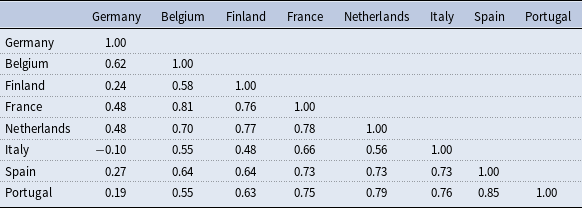
Contemporaneous cross-correlation of consumer sentiment across countries

Table 1. Long description
The table is lower diagonal matrix with countries as 8 euro area countries on rows and columns. Each cell shows the pairwise correlations of the quarterly consumer-sentiment index, computed on each pair’s sample of consumer sentiments.
Notes: Pairwise correlations of the quarterly consumer-sentiment index, computed on each pair’s sample of consumer sentiments Sample period extends from 1997Q1 to 2020Q1 for most countries with longer samples for Germany, France and Italy.
The forward looking index is created by averaging the balance share of the above four questions, normalized to 100 at the starting of the sample period for each country. By limiting the sentiments index to only measure expectations component allow us to avoid some of the reverse causality from current economic conditions to macroeconomic policy and outcomes.
Table 1 reports the cross-correlation of sentiments measure across countries. Countries such as Belgium, Netherlands, Finland, France, and Germany have highly correlated consumer sentiments across each other. For example, the cross correlation of sentiments between Netherlands and France is 0.78, while that between Belgium and France is 0.81. Aside from being two of the smallest countries in the sample, both Belgium and Netherlands also have high economic integration with neighboring France and Germany, which can explain the high correlation in consumer sentiments. Similarly, sentiments across peripheral European countries are highly correlated. Correlation between Italy and Spain is 0.73, while that between Portugal and Spain is 0.85. The differences in co-movements of sentiments highlight the differences in beliefs about economic outlook across countries within the monetary union.
2.1 Construction of news shock
A primary concern in analysis of fiscal policy is that many changes to fiscal policy are announced to the public much before the implementation of the policy. As a result, anticipation of fiscal expenditure may have already influenced sentiments, spending, and production before the actual spending is reflected in the data. To account for these anticipation effects the literature has instead turned to alternative measure of fiscal shocks including narrative approach where timing of large military expenditure is accurately assessed by reviewing government documents.
This paper follows the approach taken by Ramey (Reference Ramey2011) of using forecast error from professional forecasts to measure the unanticipated component of fiscal expenditure. Fiscal news shock is then defined as the difference between forecasted growth and actual growth in government consumption expenditure where the forecast of expenditure is collected from quarterly economic projections made by the OECD.Footnote 3 If governments were announcing their fiscal plans in advance, a well-informed, independent forecaster would already incorporate that signal into their projection of spending. The resulting difference in OECD forecasts and actual government spending should capture only surprise changes to fiscal spending.
OECD Economic Outlook and Projections data releases bi-annual forecast reports (May and November) for all OECD countries for a series of economic variables. The earliest available forecasts for Belgium, Finland, Netherlands, Portugal, and Spain starts in 1996 edition 2 of the report while that of Germany and France are available since 1960. Until 2003 edition 1, each report forecast government expenditure at semi-annual frequency (combined forecast for Q1 and Q2 and a second combined forecast for Q3 and Q4). Since 2003 edition 2, the forecasts are released at quarterly frequency (one forecast for each quarter). As the forecast reports are only generated twice a year, the forecasts for quarters 2 and 4 in the data is taken from the first edition of the report, and the forecast for quarter 1 and 3 is taken from the second edition of the report. This implies that the forecast is made using information up to period t for quarters 2 and 4, and using information up to period t-1 for quarter 1 and 3. Mixed frequency in fiscal projections before and after 2003 is dealt with imputed data using the Kalman filter. The Kalman filter operates only on the forecast data to obtain a continuous series of forecasts and plays no role in the VAR estimation.Footnote 4
The news shock variable is defined as the unanticipated growth in government expenditure i.e. the difference between actual and forecast of growth in expenditure:
 \begin{equation*}\text{News shock}_t = \text{Actual growth}_t - \text{Forecast of growth}_t\end{equation*}
The forecast of quarterly growth of real government expenditure is given by-
 \begin{equation*}\text{Forecast of growth}_t = \left (\frac {f_{t}(d_{t+1}) - f_{t}(d_{t})}{f_{t}(d_{t})}\right )\end{equation*}
where
 $f_{t}(d_{t+1})$
is the forecast made in the current period for government expenditure in period
 $t+1$
and
 $f_t(d_t)$
is forecast made in period
 $t$
for the same period
 $t$
.
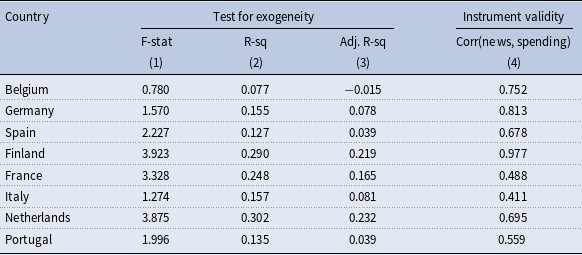
I can test whether news shocks are largely unanticipated by regressing the shock series on lagged macroeconomic variables. If the government spending shocks used in the VAR are anticipated, it should be correlated with lagged changes in output and interest rate. A high explanatory power of news shock by lagged macro variables will suggest that the news of government spending are already anticipated and reflected in economic activity. Table 2 shows the fit of regressions of news shock on two lags of the macroeconomic variables included in the VAR. The low R-squared across all countries confirms that the magnitude of predictability of news shock using existing macro variables is small, and the news series captures unanticipated government spending shock. Column 4 of Table 2 shows the correlation between news shock and the actual growth of government consumption expenditure. The shock series is highly correlated with the actual spending growth in all countries suggesting that it is a valid instrument for government spending.
Validity of forecast errors as instruments

Table 2. Long description
Columns (1), (2), and (3), show the F-stat, R-squared, and Adjusted R-squared for the country-wise regression of news shock on lagged government spending growth, lagged GDP growth, lagged consumer sentiments, and lagged real interest rate. Column (4) shows the correlation between the news shock and the actual growth in government spending for each country.
Notes: Columns (1), (2), and (3), show the F-stat, R-squared, and Adjusted R-squared for the country-wise regression of news shock on lagged government spending growth, lagged GDP growth, lagged consumer sentiments, and lagged real interest rate. All regressions include 2 lags to be consistent with the VAR. Column (4) shows the correlation between the news shock and the actual growth in government spending.
Although forecast errors in government spending can capture deviations from budgeted fiscal expenditures, concerns remain about potential endogeneity when spending is implemented in response to economic developments after the forecast is issued. In cases where spending measures are both announced and executed within the same quarter, a larger forecast error may reflect not an exogenous economic shock but rather an endogenous fiscal response. However, this endogeneity is unlikely to pose a serious concern for our analysis for two reasons. First, endogenous spending responses are largely driven by automatic stabilizers. Since most automatic stabilizers are designed as transfers, they are excluded from our measure of discretionary spending. Second, stimulus measures introduced in response to economic conditions typically involve a lengthy approval process, often extending beyond a single quarter.Footnote 5 Together, I argue that forecast errors used in the analysis are a credible measure of exogenous fiscal shocks.
3. Methodology
For the baseline analysis I use a vector auto-regression framework (VAR) with first order interaction term between sentiments and government spending news. The interaction term allows us to capture the non linear effects of fiscal policy due to different levels of sentiments.Footnote 6 Consider the baseline specification-
 \begin{equation} Y_t = \alpha + \sum _{k=1}^{L} A_{k}Y_{t-k} + \sum _{k=1}^{L}B_k (Sentiments_{t-k} \times Fiscal_{t-k}) + u_t \end{equation}
 \begin{equation*} E(u_tu_t') = \Omega _u\end{equation*}
where
 $Y_t$
is a vector of five variables: government spending news, log real government expenditure per capita, consumer sentiments index, log real GDP per capita, and core inflation, in that order. The government spending news variable
 $(Fiscal_t)$
is constructed to account only for the unanticipated component of fiscal policy in period
 $t$
and thus, does not respond contemporaneously to shocks to other variables. I use two lags for baseline estimation based on the lowest information criterion for lag length selection for a maximum length of eight lags.
Counterfactual Exercise: The hypothesis of the paper is that positive sentiments associated with government expenditure can result in higher spending multiplier. To isolate the role of sentiments in propagation of spending shocks, I introduce a counterfactual exercise where the response of consumer sentiments to fiscal shocks is shutdown with concurrent sentiments shock in every period.Footnote
7
To set up the exercise formally, recall that the vector
 $Y_t$
consists of five variables in the following order: (1) government spending news, (2) log real government expenditure per capita, (3) consumer sentiments index, (4) log real GDP per capita, and (5) the real short-term interest rate. This ordering is maintained throughout the structural identification. Consider the structural VAR representation of the baseline model:
 \begin{equation*}Y_t = \alpha + A(L) Y_{t-1} + S \epsilon _t\end{equation*}
where
 $\epsilon _t$
is a
 $5 \times 1$
vector of structural shocks and
 $S$
is a
 $5 \times 5$
upper triangular matrix obtained from the Cholesky decomposition of the reduced-form error covariance matrix
 $\Omega _u$
, satisfying
 $SS' = \Omega _u$
. Each element of the
 $S$
matrix measures the response of
 $Y$
to structural shock
 $\epsilon$
. In particular, two elements of
 $S$
are central to the counterfactual. First, the matrix element
 $S_{3,1}$
which measures the contemporaneous response of fiscal news shock (variable 1) on consumer sentiments (variable 3), and second the matrix element
 $S_{3,3}$
which measures the contemporaneous response of sentiments shock on consumer sentiments. Isolating the sentiments channel relies on introducing a sequence of shocks that sets the response of sentiments to the fiscal news shock to zero at every horizon
 $t$
. The series of confidence shock generated each period will then take the form:
 $\epsilon _{3,1} = -\frac {S_{3,1}}{S_{3,3}}$
.
Generalized Impulse Response Functions (GIRFs): In a linear VAR, the traditional impulse response functions are symmetric, i.e. positive and negative shock have symmetric responses, linear in shocks, and history independent, i.e., past realizations do not affect the responses to the shock. Koop et al. (Reference Koop, Pesaran and Potter1996) show that introducing non-linearity in a VAR model makes the impulse responses dependent on the choice of history and shocks. As an alternative, they propose using an algorithm to compute history-independent impulse response functions. GIRFs are calculated as the difference in conditional expectations conditional on the history and shock. The impulse responses for each horizon is then averaged over all the histories. The computation of GIRFs can be summarized by the following equation:
 \begin{equation} GIRF_y(n,\nu _t, \omega _{t-1}) = E[Y_{t+n}| \nu _t,\omega _{t-1}] - E[Y_{t+n}| \omega _{t-1}] \end{equation}
To compute the GIRFs, draw a sequence of shocks using the residuals of the VAR for a given history of data. The impulse responses for each history and sequence of shock are then given by the difference between forecast of a variable with and without a one standard deviation fiscal news shock in period
 $t$
. The impulse responses are calculated for period
 $t+1$
to
 $t+H$
. Repeat the process for N draws of shocks for each history of the data.Footnote
8
The impulse response for each history is the average response over all draws of shocks. The Generalized impulse response is then the average of impulse responses for all histories for all horizons 1 to H.Footnote
9
4. Baseline results
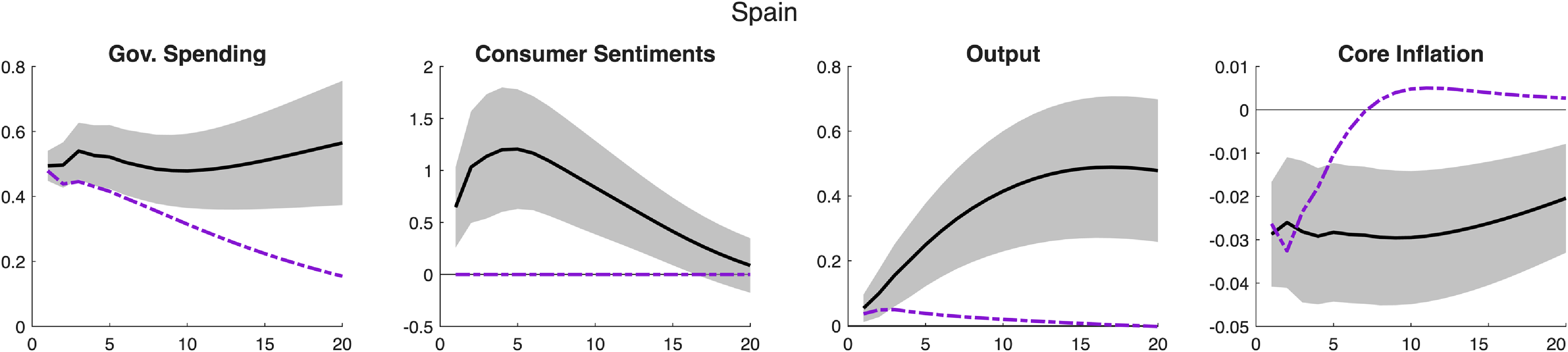
I begin by examining how an unanticipated fiscal news shock propagates through the economy and, in particular, whether consumer sentiment amplifies its effects on output. Figure 1 presents the results for Spain, which is used as a motivating example to illustrate the transmission mechanism. Figure 2 extends the analysis to the remaining countries in the sample. In each figure, the solid line plots the GIRFs of government spending, consumer sentiment, output, and the real interest rate to a one-standard-deviation fiscal news shock. The dashed line reports a counterfactual response in which consumer sentiment is held fixed at its pre-shock level at every horizon, thereby isolating the direct effect of fiscal policy from the indirect effect operating through consumer sentiment.
Spain provides a clear illustration of the mechanism. Following an expansionary fiscal news shock, government spending, consumer sentiment, and output all increase on impact. Government spending and output remain significantly above their pre-shock levels for more than twenty quarters, while consumer sentiment stays elevated for approximately two years. These responses suggest that fiscal news influences output through two complementary channels: the conventional Keynesian effect of higher government spending and an expectations channel operating through consumer sentiment.Footnote 10
Results from the baseline VAR model.
Notes: Solid lines are the Generalized impulse response functions (GIRFs) for a positive one standard deviation shock to fiscal news in the baseline model. The dashed line is the impulse responses for the counterfactual with no confidence, discussed in Section 3. Shaded region is the one standard error bands around the GIRFs for the baseline model generated through a bootstrap procedure with 1000 simulations.

Figure 1. Long description
A four paneled figure presenting the result for Spain. Each figure has a solid black line with shaded area around it which shows the impulse response from the baseline model and its confidence bands. Each figure also a purple dotted line which shows the result from the counter-factual exercise.
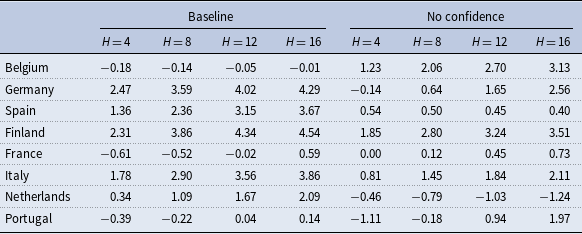
The importance of the sentiment channel becomes apparent in the counterfactual exercise. Holding consumer sentiment fixed has little effect on the impact responses of government spending or output, indicating that consumer confidence does not materially influence the contemporaneous effects of fiscal policy. However, the output response becomes substantially less persistent once the sentiment channel is removed. This difference is most clearly reflected in the implied fiscal multipliers. Although the impact multiplier is nearly identical across the two specifications, the cumulative multiplier over four quarters falls from 1.36 in the model with endogenous consumer sentiment to 0.54 when the sentiment channel is shut down, and that over sixteen quarters falls from 3.7 to only 0.4 under the two scenarios.Footnote 11 These findings are consistent with Bachmann and Sims (Reference Bachmann and Sims2012), who show that consumer confidence primarily affects the persistence, rather than the contemporaneous impact, of fiscal multipliers.
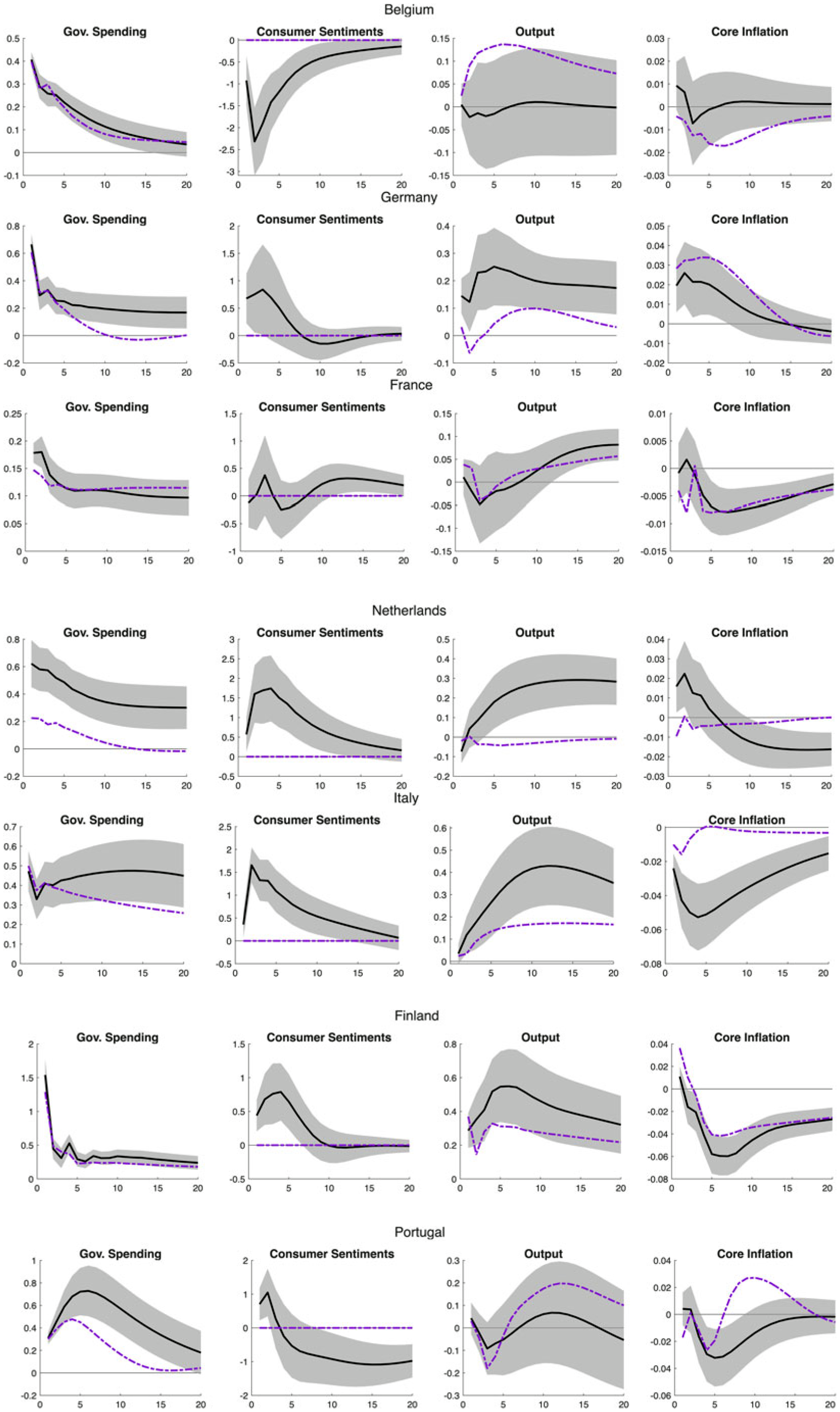
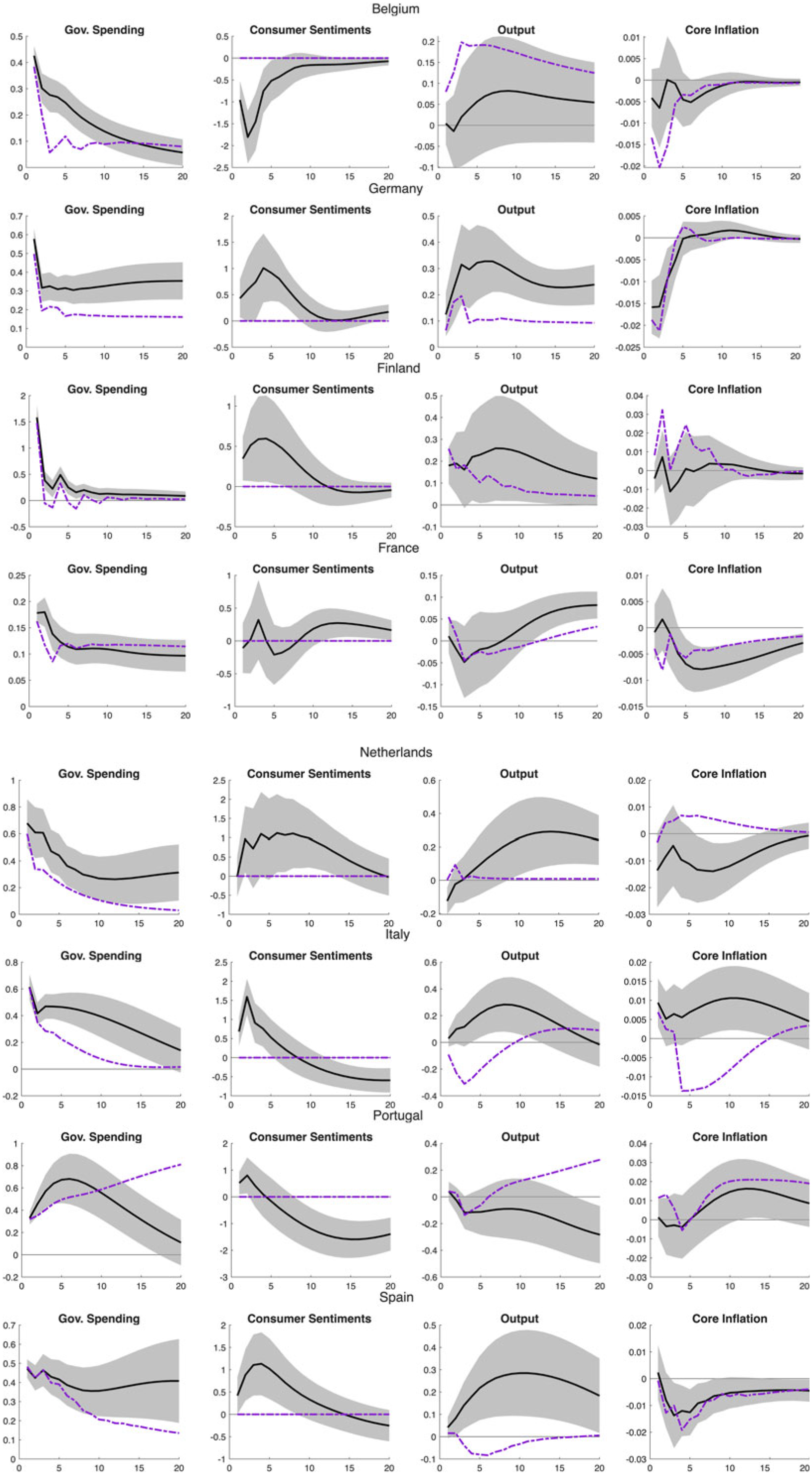
I next ask whether the evidence presented for Spain generalizes to the rest of the euro area. Figure 2 shows that an expansionary fiscal news shock increases output in nearly every country, although the response is not statistically significant in Belgium and Portugal. Consumer sentiment also rises on impact in all countries except Belgium, where it falls significantly before gradually returning to its steady state. While fiscal news generally improves consumer confidence, both the magnitude of this response and its importance for output transmission differ considerably across countries.
Results from the baseline VAR model—All countries.
Note: Solid lines are the Generalized impulse response functions (GIRFs) for a positive one standard deviation shock to fiscal news in the baseline model. The dashed line is the impulse responses for the counterfactual with no confidence, discussed in Section 3. Shaded region is the one standard error bands around the GIRFs for the baseline model generated using bootstrap.

Figure 2. Long description
The figure has seven sub-figures, one for each country, with each figure including four panels. Each figure has a solid black line with shaded area around it which shows the impulse response from the baseline model and its confidence bands. Each figure also a purple dotted line which shows the result from the counter-factual exercise.
Table 3 quantifies this heterogeneity by comparing cumulative fiscal multipliers under the baseline and counterfactual specifications after four, eight, twelve, and sixteen quarters. Along with Spain, the sentiment channel plays an important role in Italy, and the Netherlands, where eliminating the response of consumer sentiment substantially reduces the effectiveness of fiscal policy. For example, the sixteen-quarter multiplier declines from
 $3.86$
to
 $2.11$
in Italy, and from
 $2.09$
to
 $-1.24$
in the Netherlands. Germany and Finland also exhibit a noticeable decline in the short-run multiplier, although the effect is more modest. By contrast, Belgium displays the opposite pattern. Because fiscal news lowers consumer sentiment, shutting down the sentiment channel raises output relative to the baseline in the short and medium run. Finally, the multipliers for France, and Portugal are statistically indistinguishable across the two specifications, suggesting that consumer sentiment plays only a limited role in transmitting fiscal policy in these economies.
Fiscal multipliers at different horizon

Table 3. Long description
Table has 9 columns where first column is country name, and the remaining reports the fiscal multiplier at 4, 8, 12, and 16 quarters under baseline and counterfactual estimation.
Notes: Table reports the fiscal multiplier at 4, 8, 12, and 16 quarters under baseline and counterfactual estimation. Multiplier for each country at horizon
 $h$
is computed as
 $\frac {\bar {Y}}{\bar {G}} \frac {\sum _{t=1}^h IRF_t^Y}{\sum _{t=1}^hIRF_t^G}$
.
The observed cross-country heterogeneity is broadly consistent with the existing empirical literature. For Germany, Wolff et al. (Reference Wolff, Tenhofen and Heppke-Falk2006) find that the effects of government spending depend on its composition: increases in personnel expenditure reduce output, government consumption has little effect, and public investment raises output. In contrast, Giordano et al. (Reference Giordano, Momigliano, Neri and Perotti2007) document a hump-shaped and persistent increase in private GDP following government spending shocks in Italy, with the effects lasting roughly two years. Take together, these studies similarly point to substantial heterogeneity in the transmission of fiscal policy across euro-area economies.
The strong trade and macroeconomic linkages among euro area countries make the heterogeneity observed in the VAR results somewhat puzzling. One possible explanation lies in the historical perceptions of government spending, monetary policy, and inflation across member states. Jalil and Wandschneider (Reference Jalil and Wandschneider2025), for example, use a historical narrative approach to show that Germany’s strong post-war anti-inflation ethos led to highly contractionary monetary policy and significant output losses. Another factor may be differences in household behavior. In higher-debt economies such as Italy and Spain, households tend to respond more strongly to fiscal policy than those in lower-debt economies like Belgium and Germany. More broadly, the heterogeneity may reflect divergent perceptions of monetary policy across the Euro area. In countries such as Italy and Spain, often referred to as peripheral economies, agents may view monetary policy as less responsive to domestic shocks, which in turn amplifies the co-movement of economic sentiment with expansionary fiscal measures.
An example of the divergence in economic conditions within countries that are part of the euro area can be found after the financial crisis. As unemployment rates in Germany and France stabilized after the crisis and even started to fall in Germany, the unemployment rate in both Italy and Spain started to worsen due to the impending risk of a debt crisis. In April 2011, unemployment rate in Germany was 5.6% and falling, while that in Spain was over 20%, and rising. Over the next two quarters the ECB raised its key policy rates by 50 basis points citing the signs of economic recovery in some countries. Increase in interest rates worsened the economic conditions in countries such as Spain, Italy, and Portugal. The challenges of setting a uniform monetary policy in a currency union can render central bank decisions sub-optimal for some countries in the union, leaving fiscal policy as the main macroeconomic policy tool in responding to domestic economic shocks.
4.1 Analysis with panel VAR
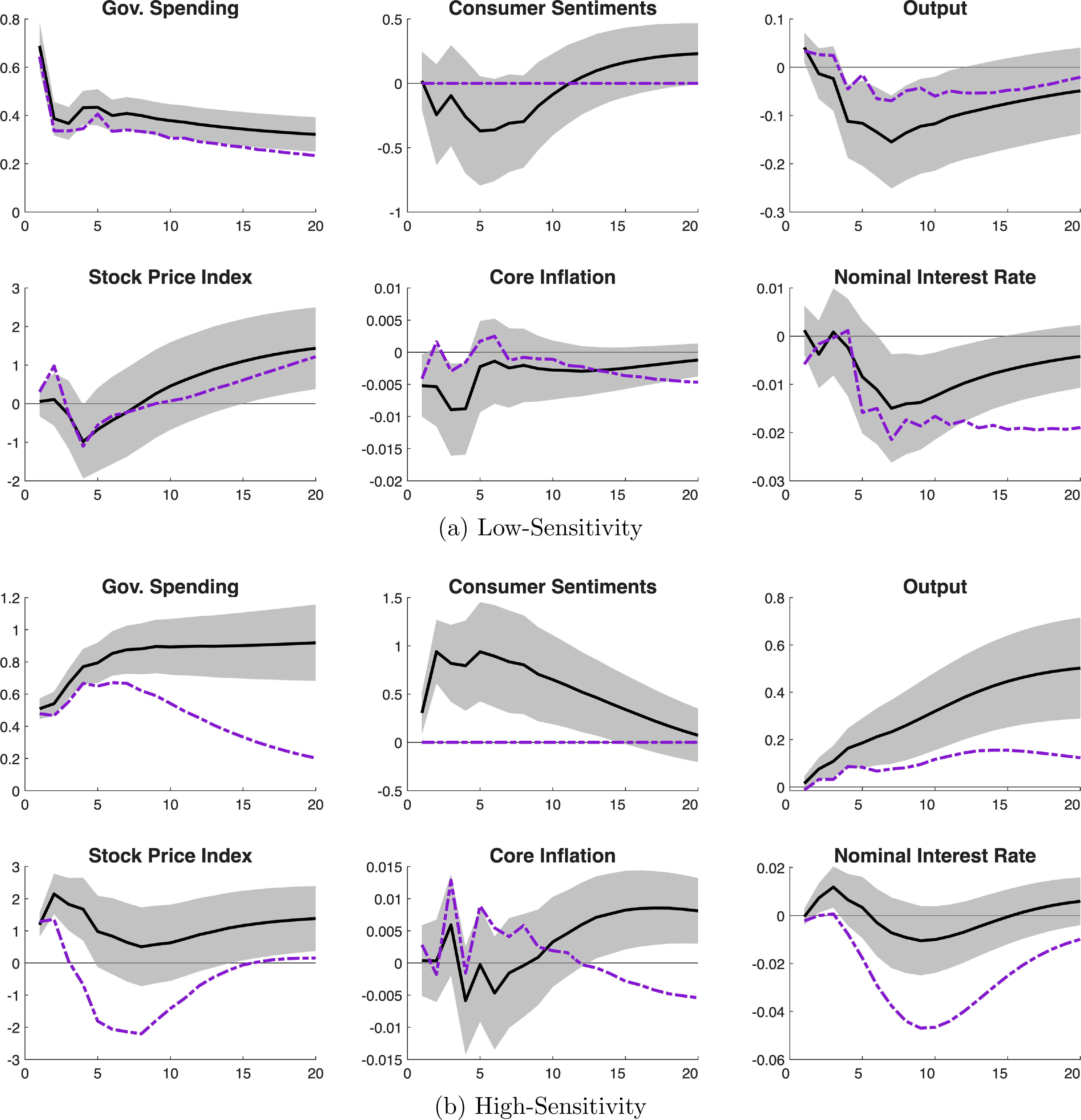
The baseline results point to a clear country-wise pattern where the forward looking sentiment channel is strongest in high-debt, peripheral economies such as Spain and Italy, and weak or absent in countries such as Belgium, France, and Germany. However, fiscal shocks may also affect financial market expectations, which the baseline analysis does not capture. To address this, I augment the VAR with each country’s stock price index. Beaudry and Portier (Reference Beaudry and Portier2006) show that stock prices embed news about future fundamentals, moving in anticipation of, and well before, realized changes in output. Equity prices therefore provide a market-based measure of agents’ expectations that complements the survey-based sentiment index used in the baseline. If fiscal shocks operate through expectations, their effect should be visible in the response of stock prices, and most strongly in countries where the sentiment channel is already pronounced. I additionally include the short-term nominal interest rate and inflation, so that the expanded system accounts for changes to monetary-policy, ensuring that the estimated stock-price and sentiment responses are not confounded by contemporaneous movements in interest rates.
Panel VAR with stock prices.

Solid lines are the GIRFs for a positive one standard deviation shock to fiscal news in the baseline model. The dashed line is the impulse responses for the counterfactual with no confidence, discussed in Section 3. Panel of low-sensitivity countries include Belgium, Finland, France, and Germany, while that high-sensitivity includes Italy, Netherlands, Portugal, and Spain. Shaded region is the one standard error bands around the GIRFs for the baseline model generated using bootstrap.
Estimating a VAR with two additional variables separately for each country is infeasible given the short country-level samples. I, therefore, group the countries into two panels, low- and high-sensitivity, and estimate panel VARs for each group. The panel of low-sensitivity countries comprises of Belgium, Finland, France, and Germany, i.e., countries where the estimated sentiment response is weak or absent. The high-sensitivity panel of countries consists of Italy, Netherlands, Portugal, and Spain, where the sentiments channel is systematically larger. The Panel VAR is estimated with four lags. Beyond addressing the sample size constraint, the panel structure provides a natural summary of the cross-country heterogeneity documented above.Footnote 12 I consider two extensions of the baseline model in this section. First, I extend the existing VAR to include the two new variables, quarterly value of stock price index converted to per capita value in logs, and nominal interest rate. Second, I use the extended panel to study the behavior of private consumption expenditure of non-durable goods and services, in logs, converted to real per-capita values.Footnote 13
Figure 3 reports the responses to an expansionary fiscal news shock in the extended VAR that adds the stock price index and the short-term nominal interest rate, shown separately for low-sensitivity (Panel a) and high-sensitivity (Panel b) economies. The solid line is the baseline generalized impulse response and the dashed line is the counterfactual in which the sentiment channel is shut down. On average, among low-sensitivity countries, the shock raises government spending persistently and triggers a sharp and statistically significant rise in consumer sentiment, which propagates to the real economy as output increases steadily and remains significantly positive throughout, while the stock price index jumps on impact and stays elevated. The equity-price response is consistent with an upward revision in agents’ expectations of future output in the sense of Beaudry and Portier (Reference Beaudry and Portier2006). Inflation and the nominal interest rate also increase, consistent with a demand-driven expansion. Crucially, the counterfactual paths are significantly weaker where output rises only marginally and the stock price index falls in response to the spending shock. In the low-sensitivity economies, by contrast, an expansionary fiscal news shock raise government spending but lowers consumer sentiments and output in the short run before converging to zero. The response of other variables are also not significantly different from zero. As the sentiments channel play a limited role in these countries, the response of baseline and counterfactual analysis are statistically indistinguishable from each other.
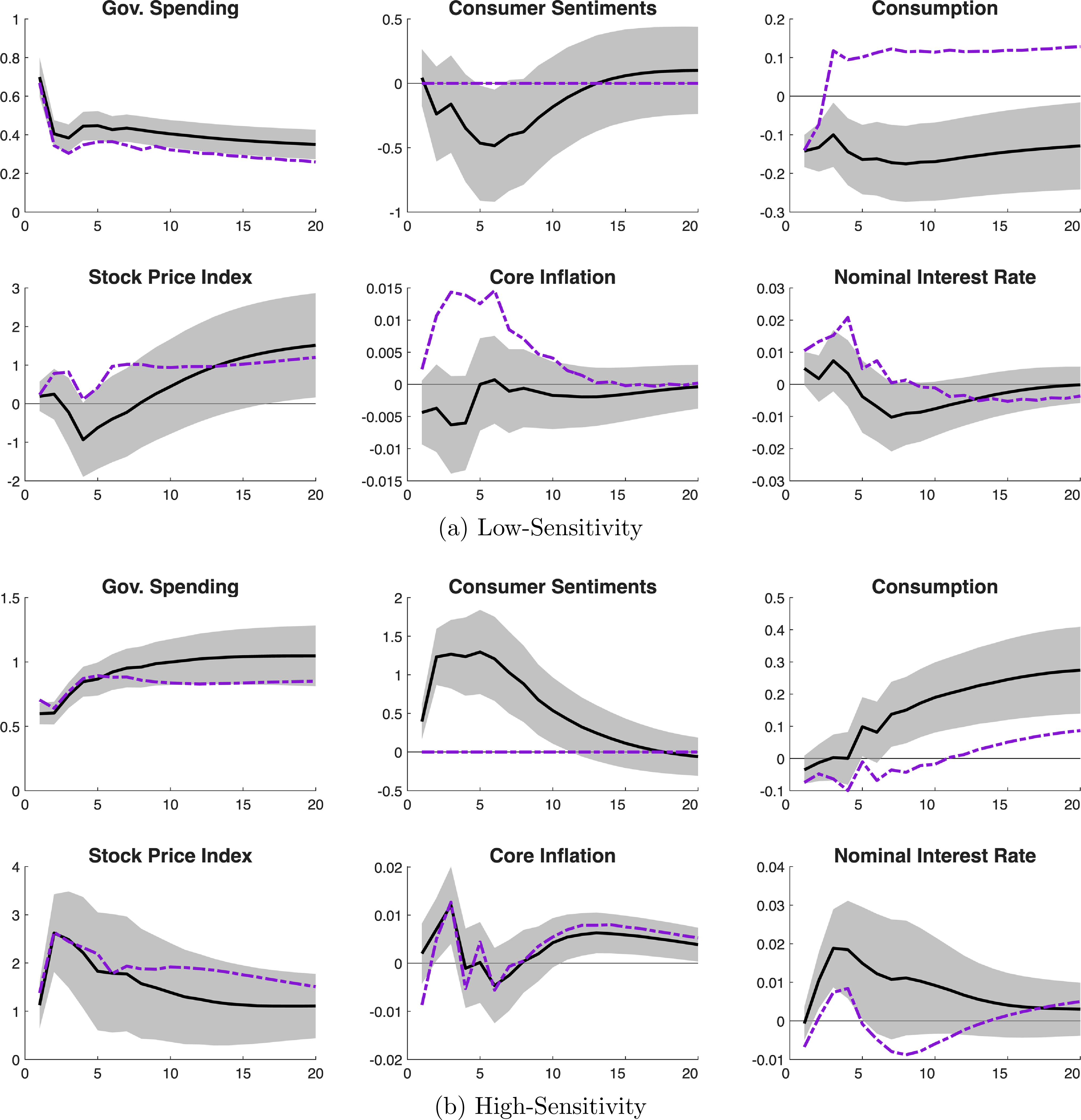
Panel VAR with private consumption expenditure.

Figure 4. Long description
Figure shows results from Panel VAR for low-sensitivity and high-sensitivity countries. Each panel has six variables- government spending, consumer sentiments, output, stock price, inflation, and nominal interest rate. Each figure has a solid black line with shaded area around it which shows the impulse response from the baseline model and its confidence bands. Each figure also a purple dotted line which shows the result from the counter-factual exercise.
Solid lines are the GIRFs for a positive one standard deviation shock to fiscal news in the baseline model. The dashed line is the impulse responses for the counterfactual with no confidence, discussed in Section 3. Panel of low-sensitivity countries include Belgium, Finland, France, and Germany, while that high-sensitivity includes Italy, Netherlands, and Spain. Shaded region is the one standard error bands around the GIRFs for the baseline model generated using bootstrap.
If fiscal news raises output because it makes households more optimistic, the improvement in confidence should raise consumer spending, resulting in higher output. I augment the baseline specification with log real consumption expenditure of non-durables and services, in per capita, ordered after consumer sentiments.Footnote 14 Additionally, while the baseline VAR model only incorporates inflation, the Panel VAR setup allows us to incorporate more variables, including stock prices and short term interest rate. Figure 4 reports the GIRFs for the high- and low-sensitivity panels to a one standard deviation expansionary fiscal news shock, along with the counterfactual responses in which consumer sentiment is held fixed at its pre-shock level. Among high-sensitivity countries (Panel b), consumption rises significantly following the shock, and the response mirrors that of output. Shutting down the sentiments channel substantially reduces the persistence of both consumption and output. In the panel of low-sensitivity countries, however, private consumptions raises slightly on impact, then decreases significantly before converging back to steady state in two years. The counterfactual lies close to the baseline, indicating a limited role for sentiments in transmission of fiscal shocks in these countries. The behavior of consumption thus confirms that the amplification documented in the baseline model operates through household spending, consistent with the interpretation of the sentiment channel as an expectations-driven demand channel.
Taken together, the panel estimates reinforce the central message of the baseline analysis. Across both extended specifications, an expansionary fiscal news shock raises consumer sentiments in high-sensitivity countries, and eliminating the sentiment response substantially weakens the transmission of fiscal policy to consumption and output. Among low-sensitivity countries, the sentiment channel remains limited. The heterogeneous response of sentiments channel that emerges from country-by-country analysis is therefore robust to accounting for forward looking variables such as stock prices, nominal interest rate, and household consumption. The panel analysis motivates the use of the same structure in the evaluation of sentiments channel to periods of fiscal consolidation.
4.2 Application: sentiments under fiscal consolidation
This section tests the hypothesis that fiscal consolidation can be less costly for some high debt countries through its positive effects on consumer sentiments. Fiscal expansions in many European economies are coupled with higher risk of default (Bianchi et al., Reference Bianchi, Ottonello and Presno2023), resulting in higher borrowing cost and lower market confidence. The literature on austerity in Europe argues that exogenous fiscal consolidation can potentially have zero or positive effects on output by raising economic sentiments of agents (Alesina et al., Reference Alesina, Favero and Giavazzi2019a). Cuts in government expenditure in high debt countries can lower the risk of government default potentially lowering the borrowing cost for private borrowers. However, these benefits of consolidation are only realized at longer horizons while still being costly for households in the short run due to large cuts to public sector employment and social security programs.
As the economy is expected to behave differently during periods of fiscal normalcy and consolidation, I use a Threshold VAR (TVAR) model where the parameters of the VAR are estimated separately for the two state of the economy, normal state and the state of fiscal consolidation.Footnote 15 The analysis uses the same panel VAR adopted in previous sections with six variables: fiscal news shock, government spending, consumer sentiments, GDP, inflation, and long-term interest rate. The long-term interest rate measures the long run borrowing cost faced by the economy and is expected to decrease during consolidation.
The periods of fiscal consolidation are obtained from Alesina et al. (Reference Alesina, Favero and Giavazzi2019b) who use narrative approach to identify the years in which the general government tightens expenditure or increases tax exogenously for the purpose of correcting its primary deficit and reducing debt. They exclude periods in which the reduction in expenditure or increase in tax revenue is endogenous to the state of the economy. Their dataset covers the sample period of 1970–2014. The data is extended using their methodology to identify the years for which a country in the sample enters fiscal consolidation for the years 2015–2019.Footnote 16 As the data on consolidation is only annual, a given quarter is classified as a period of consolidation if the country was under consolidation at any time during that financial year.Footnote 17
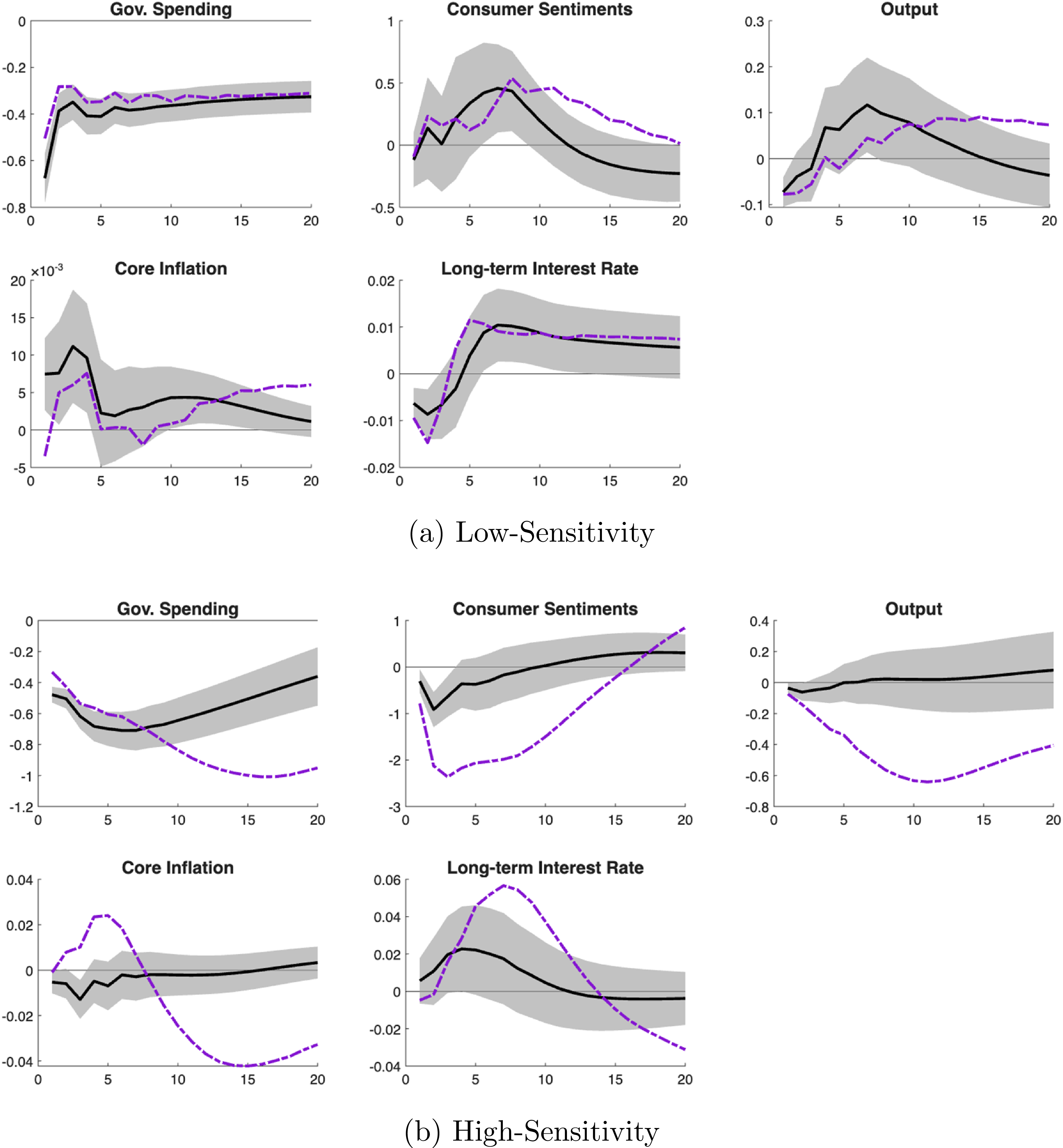
Figure 5 shows the GIRFs of government spending, consumer sentiments, output, and long-term real interest rate to a one standard deviation contractionary fiscal policy news shock. The solid line shows the response during normal times while the dashed line shows the response during fiscal consolidation. The shaded region is the one standard error bands around the GIRFs for normal times. If consolidation raises household sentiments, it should attenuate the output cost of contractionary fiscal shocks.
Fiscal consolidation: non-linear effects of fiscal policy.

Figure 5. Long description
Figure shows results from Panel VAR for low-sensitivity and high-sensitivity countries. Each panel has five variables- government spending, consumer sentiments, output, inflation, and nominal interest rate. Each figure has a solid black line with shaded area around it which shows the impulse response from the baseline model and its confidence bands. Each figure also a purple dotted line which shows the result from the counter-factual exercise.
Solid line is the GIRFs for a one standard deviation contractionary fiscal news news under normal times. The dashed line is the impulse responses during periods of fiscal consolidation. Panel of low-sensitivity countries include Belgium, Finland, France, and Germany, while that high-sensitivity includes Italy, Portugal, and Spain. Shaded region is the one standard error bands around the GIRFs for normal times.
For the panel of low-sensitivity countries, there is no significant difference in the behavior of macro variables between normal and consolidation periods. An unanticipated contraction in fiscal policy results in an insignificant response of consumer sentiments on impact. Sentiment raises and becomes positive and significant in medium run, before converging to zero. Output is negative on impact but quickly converts to zeros. On the other hand, fiscal contraction during periods of consolidation significantly lower sentiments and output among high-sensitivity countries, and raises long-term interest rate. Inflation increases in the short run before decreasing over time. This is markedly different from the muted response of sentiments and output during normal times.
Existing literature for euro area countries show that the effects of fiscal consolidation depend not only on the composition of expenditure cuts but also on households’ perceptions of these measures (Hommes et al., Reference Hommes, Lustenhouwer and Mavromatis2018; Gechert et al., Reference Gechert, Hallett and Rannenberg2016; Cugnasca and Rother, Reference Cugnasca and Rother2015; Erceg and Lindé, Reference Erceg and Lindé2013). Although fiscal consolidation improves the long-run sustainability of public finances, it may reduce consumer confidence in the short run for several reasons. Large and unexpected consolidation measures may signal that governments face difficulties in financing public debt, raising concerns about future economic conditions, financial stability, and borrowing costs. Moreover, households’ assessment of fiscal policy is likely to depend on their confidence in monetary policy’s ability to offset the contractionary effects of consolidation. Consistent with this view, Bergbauer et al. (Reference Bergbauer, Hernborg, Jamet, Persson and Scholermann2020) show that trust in the ECB depends strongly on households’ perceptions of both their personal financial situation and broader economic conditions in their country of residence. A decline in consumer sentiment in some countries following fiscal consolidation may therefore also reflect weaker confidence in the ECB’s ability to mitigate the short-run costs of fiscal adjustment.
4.3 Extensions and robustness
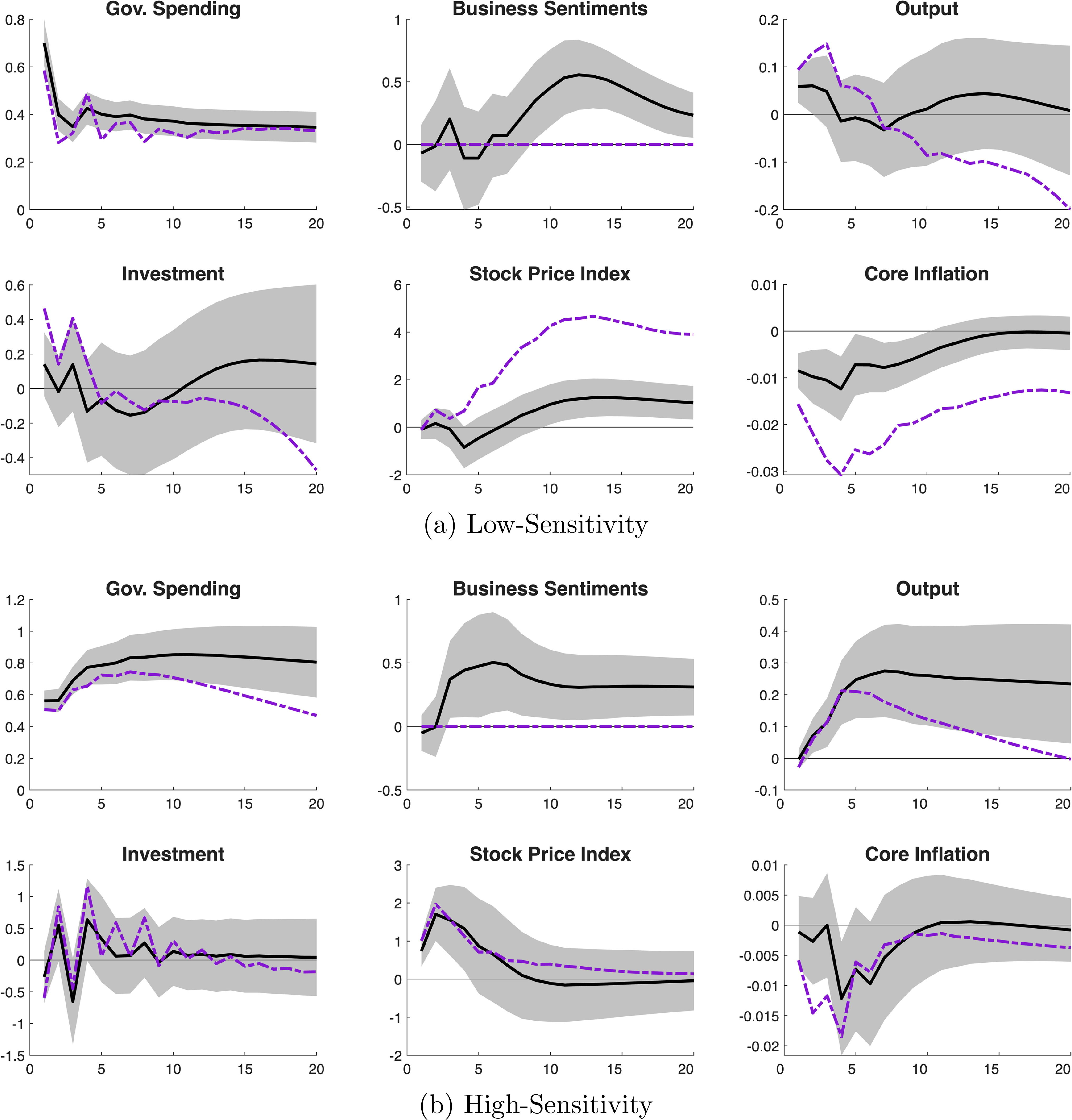
Given the large share of private consumption in GDP, our baseline analysis focuses on the interaction between fiscal policy and household sentiment. Fiscal news, however, may also influence firms’ expectations and investment decisions. Announcements of higher government spending, particularly spending aimed at stimulating investment, may improve firms’ expectations about future demand and economic activity. At the same time, higher government expenditure may raise expectations of future tax burdens or tighter financing conditions, leading firms to become more pessimistic about future business conditions. To examine whether fiscal policy also operates through a business sentiment channel, we replace consumer sentiment in the baseline VAR with a forward-looking business confidence indicator constructed from the European Commission’s Business and Consumer Surveys.Footnote 18 The VAR also includes data on investment by non-financial corporation which is available at quarterly frequency from 1999:Q1. To incorporate additional variables and smaller sample size, I estimate a panel VAR described in Section 4.1 with two panels, Low- and High-Sensitivity. The corresponding results are reported in Figure A1.
In contrast to consumer sentiments, business confidence exhibits weaker response in high-sensitivity countries. Business sentiment and output increases gradually in response to an expansionary fiscal news shock. The stock price index also rises on impact, corroborating the sentiment response with a market-based measure of expectations, while investment and inflation are positive on average but insignificant. Shutting down the sentiments channel does not affect the quantitative response of any variable but lowers the persistence of output. Surprisingly, the increase in business sentiments is larger and more persistent in low-sensitivity countries. However, this does not translate into a comparable output expansion. These results suggest that, unlike households, firms do not systematically revise their expectations in response to fiscal news. One possible explanation is that businesses weigh the prospective costs of higher government spending, such as higher future taxes or tighter financing conditions, more heavily than any short-run increase in demand. This interpretation is consistent with the greater sensitivity of firms to borrowing costs, particularly in high-debt economies where government borrowing may crowd out private financing.Footnote 19
Appendix B presents two robustness exercises designed to assess the sensitivity of the baseline results to alternative empirical specifications. First, I examine whether the introduction of the euro constitutes a structural break in the transmission of fiscal policy. Although most euro-area countries had already adopted fixed exchange rates under the Exchange Rate Mechanism during the 1980s and 1990s, the creation of the monetary union in 1999 eliminated national monetary policy and may therefore have altered the effects of fiscal shocks. To address this concern, we re-estimate the model using only data from 1999:Q1 to 2019:Q4. As shown in Figure B1, the results remain qualitatively unchanged across all countries, suggesting that our findings are not driven by the transition to the euro.
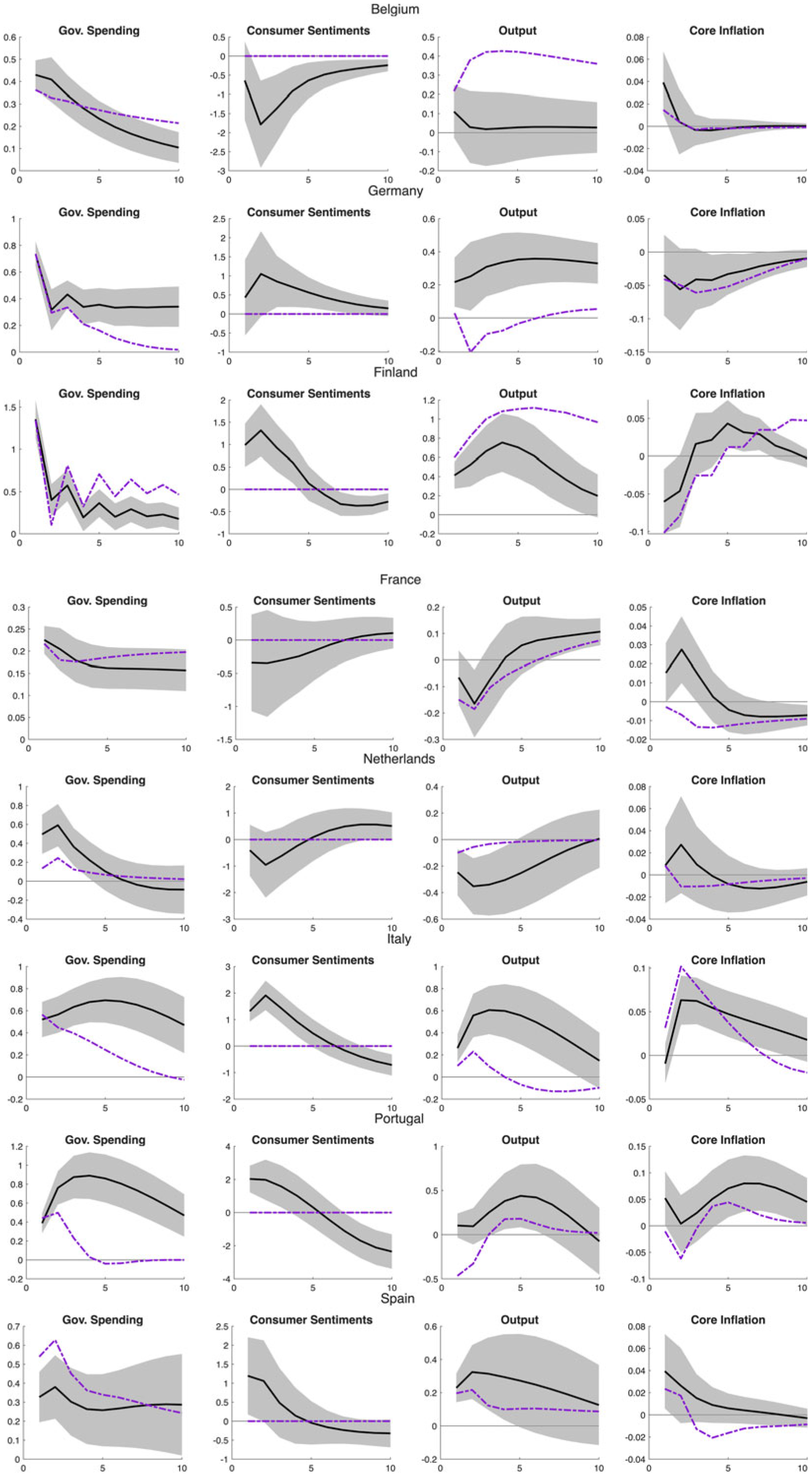
Second, I re-estimate the model using semi-annual rather than quarterly data (Figure B2). This addresses the concern that, prior to 2003, fiscal forecasts were released only semi-annually and quarterly forecasts must therefore be obtained through Kalman smoothing. The semi-annual specification yields results that are broadly consistent with the baseline analysis. The role of the sentiment channel is somewhat weaker for the Netherlands and stronger for Portugal, but the conclusions for the remaining six countries are largely unchanged despite the greater noise inherent in measuring fiscal news at a semi-annual horizon.Footnote 20
5. Conclusion
This paper demonstrates that consumer sentiment is an important determinant of the effectiveness of fiscal policy. Using data from countries in the European Economic and Monetary Union, I show that fiscal news influences output not only through the conventional Keynesian channel of higher government spending, but also by shaping households’ expectations about future economic conditions. Expansionary fiscal news generally raises consumer sentiment, which in turn amplifies the effects of fiscal policy on economic activity.
The strength of this transmission mechanism, however, differs substantially across countries. In Spain, Italy, and the Netherlands, consumer sentiment responds strongly to fiscal news, generating significantly larger and more persistent fiscal multipliers. In contrast, the sentiment channel plays a much smaller role in Belgium, France, and Germany, where fiscal policy primarily affects output through its direct impact on aggregate demand. These findings are robust to alternative model specifications and to measuring fiscal news using financial market expectations.
The heterogeneous role of consumer sentiment has important implications for the design of fiscal policy within a monetary union. In countries where consumer sentiment responds strongly to fiscal news, fiscal consolidations can be substantially more contractionary because they simultaneously reduce government demand and weaken private-sector confidence, leading to a persistent decline in output. By contrast, in countries where consumer sentiment is largely unresponsive, the costs of fiscal consolidation are considerably smaller. More broadly, the results suggest that differences in expectations formation constitute an important source of heterogeneity in fiscal transmission across euro-area economies. As a consequence, a common fiscal policy may produce markedly different macroeconomic outcomes across member states, highlighting the challenges of conducting stabilization policy within a heterogeneous monetary union.
Appendix A. Adding business sentiments
This section replaces the consumer sentiments with forward looking business sentiments.
Results from the VAR model with business sentiments.
Notes: Solid lines are the Generalized impulse response functions (GIRFs) for a positive one standard deviation shock to fiscal news in the baseline model. The dashed line is the impulse responses for the counterfactual with no confidence, discussed in Section 3. Panel of low-sensitivity countries include Belgium, Finland, France, and Germany, while that high-sensitivity includes Italy, Netherlands, Portugal, and Spain. Shaded region is the one standard error bands around the GIRFs for the baseline model generated using bootstrap.

Figure A1. Long description
Figure shows results from Panel VAR for low-sensitivity and high-sensitivity countries. Each panel has five variables- government spending, consumer sentiments, output, inflation, and nominal interest rate. Each figure has a solid black line with shaded area around it which shows the impulse response from the baseline model and its confidence bands. Each figure also a purple dotted line which shows the result from the counter-factual exercise.
Appendix B. Robustness
This section presents robustness to two alternative data structures, first with data at semi-annual frequency, and second, by restricting the sample to start in 1999:Q1.
B.1 Robustness: restricting sample to 1999:Q1
Baseline results with start of sample restricted to 1999:Q1.
Notes: Sold lines are the Generalized impulse responses (GIRFs) for a positive one standard deviation shock to fiscal news in the baseline model. The dashed line is the impulse responses for the counterfactual with no confidence, discussed in Section 3. Shaded region is the one standard error bands around the GIRFs for the baseline model generated using bootstrap.

Figure B1. Long description
The figure has eight sub-figures, one for each country, with each figure including four panels. Each figure has a solid black line with shaded area around it which shows the impulse response from the baseline model and its confidence bands. Each figure also a purple dotted line which shows the result from the counter-factual exercise.
B.2 Robustness to semi-annual data
The forecast data used to compute fiscal policy news variable is only available in semi-annual frequency until 2003. Moreover, the forecasts are generated only twice a year which results in different horizon for Q1 and Q3 compared to Q2 and Q4. Conducting the baseline analysis in semi-annual frequency solves the issue of mixed frequency data and information asymmetry that may result in different horizons for quarterly forecasts. This section tests the robustness of the baseline results by using semi-annual data. All variables except consumer sentiments is converted from quarterly to semi-annual frequency by summing the values for two quarters. For example, the government consumption expenditure for the first half year is equal to the sum of government consumption expenditure in Q1 and Q2. For sentiments indicator, I calculate the mean sentiments index at semi-annual frequency. The lag length for all countries is one, as picked by the information criterion.
Figure B2 shows the impulse response from the baseline model discussed in Section 3 with the semi-annual data frequency. The solid line shows the impulse response of log real government spending, consumer sentiments, log real GDP, and real interest rate to a one standard deviation expansionary shock to the fiscal policy news. The dashed line shows the response for a one standard deviation shock in the counterfactual analysis with zero confidence. The shaded area is the one standard error bands around the GIRFs. The results for the baseline hypothesis is largely robust with the lower frequency data.
Results from the baseline VAR model with semi-annual data.
Notes: Sold lines are the Generalized impulse responses (GIRFs) for a positive one standard deviation shock to fiscal news in the baseline model. The dashed line is the impulse responses for the counterfactual with no confidence, discussed in Section 3. Shaded region is the one standard error bands around the GIRFs for the baseline model generated using bootstrap.



 Open access

