(ALJ) Can you introduce yourselves and your roles at the Wellcome library, particularly in connexion with the zine collection? Did you have any previous experience of working with zines, or personal interest/involvement in zines (reader, collector, maker)?
Wellcome Collection is a free museum and library, which encourages new ways of thinking about health and humanity by connecting science, medicine, life and art. Inspired by the collections assembled by Henry Wellcome in the 19th and 20th centuries, whose main interest was focused on the history of medicine and ancillary subjects such as alchemy and anthropology, today the library holds over 2.5 million items in various formats and languages, relating to the history of biomedical sciences, medical, surgical and pharmaceutical practice, alternative and unorthodox medicine.
Loesja and I [Nicola] are both Librarians in the Collections and Research department, and we are part of a multidisciplinary team whose purpose is to contribute to the development, discoverability and accessibility of our collections, as well as acquiring material and working on public engagement to promote library collections and services to wider audiences.
Neither of us have previous experience working with zines, but have been personally interested in DIY cultures, self/independent publishing, and activist communities, art and publishing for many years. We were also independently drawn to different parts of the library collections that compliment and overlap with zines in many ways, so it felt like a natural progression.
I [Loesja] am particularly interested in the Ephemera collection, which included stamps, leaflets, loose advertising, and call cards. With a background in comparative literature, I find the fusion of activism, self-publication, and personal information fascinating, particularly when its put through a medical historical lens. I am also very interested in format: how zines challenge and subvert traditional or typical literary form, and also how they mimic it.
I [Nicola] have a background in History of Art and find myself drawn to anything visual, and I am interested in helping to develop our growing graphic medicine collection. There's something particularly compelling about a graphic representation of lived experience, especially those focussed around health, be it that of the writer, or someone close to them. I'm also interested by the immediacy of zines, and the way in which the creator has full control over their content and distribution; something which poses both an opportunity and a challenge for libraries collecting them.
(ALJ) When did the Wellcome Library start acquiring zines to be part of its collections? Why do you acquire this material and what is the scope of the zine collection? How does it relate to the other collections held at the Wellcome, and its purpose as a specialist library? Is it considered a ‘special collection’?
We acquired our first zine in late 2016, following a conversation with our Collections Development librarian, Mel Grant, about Doll Hospital Footnote 1 a beautifully illustrated journal on mental health that we had recently acquired, which describes itself as a journal and a zine.
After some initial research (and seeing an increase in articles online about perzines and zines related to mental health and self-care)Footnote 2, we began to scope out zines with that particular focus, then health more generally; and the more we looked, the more we found! We became increasingly aware that there was a perzine zeitgeist that we needed to capture, much as we would with other aspects of our collection like popular, media-driven health trends (see our collection of cookery books, for example).
We already have a brilliant ephemera and pamphlet collection, where you'll find the single issue comics (including self-published) we've been collecting for many years on themes around medicine, the human (and superhuman) body and experiences of health, and a growing graphic medicine collection (graphic novels, graphic memoirs and pathographies) so we felt that zines fit naturally into what we already do. The more zines we discovered, the more we realised there is a gap in the representation of health in official or “traditional” medical literature, and that including zines in our collection meant that we begin to fill this gap and preserve different perspectives and experiences that traditional literature was lacking.
Our zine collection focuses, very broadly, around themes of health (both physical and mental), medicine and the human condition and can range from personal experiences to informative resources. Subjects include, but aren't limited to, mental health, self care, chronic pain, trauma, the body, eating and food, specific conditions like diabetes or insomnia, death and grief, pregnancy, gender, sex, women's rights, menstruation, disability and aging, to name a few.
For us, there are lots of aspects of this collection that could qualify it as a ‘special collection’. It's very new (in terms of collections within Wellcome Library) and has a different set of acquisition needs to other collections (e.g. developing relationships with sellers, visiting and representing at zinefests, etc). It has a different set of practical and ethical needs too (e.g. cataloguing requirements and ethics). There is also the ephemerality of this material: it often cannot be replaced and so, somehow, becomes more ‘precious’.
(ALJ) How does your collection compare to other UK and international zine collections? Is there any relation between yours and other collections? Was there a model or a library collection that you used as a reference point for the development of your own collection?
As far as we know, there are no other specialist medicine & health-related zine collections in the UK, although many have lots of crossover content that fits our collecting remit.
Whilst developing our collection, we did a lot of research into other zine collections and also visited many collections in the UK and further afield (and spoke to a fair few zine librarians, many of whom are featured in this issue, thanks to the JISC email discussion list). This was less for content reasons and more for the practical side of things, e.g. looking at different ways to shelfmark, shelve and/or store, catalogue, etc.
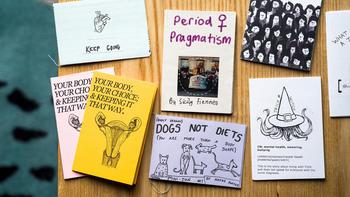
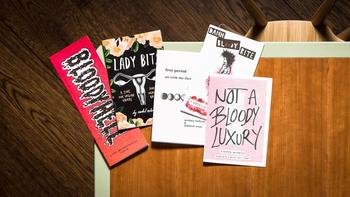
Some zines collected at the Wellcome Library.

So, there's no specific reference or model but we did definitely get practical inspiration from a lot of collections! Places that particularly guided us were Salford Zine Library; London College of Communication Library (University of the Arts London); Long Beach Public Library (US); Barnard Zine Library (US); and the Tate Library (and we've also loved watching Edinburgh Zine Library launch recently, and follow what they're doing).
(ALJ) How did you identify a user need to have this material included in your collections? Is there a tension between representing diverse or radical ideas (both in terms of content and presentation) and the institutional procedures of an academic research library like the Wellcome?
As an institution, Wellcome prides itself on seeking and upholding diversity, and the Library is a good representation of that (although it can always be more diverse and more representative!). Wellcome Library, especially in most recent times, has always strived to collect a range of complementary (and uncomplimentary!) voices and to represent strands of health and medicine that remain on the fringes of institutional practices.
There are lots of pockets of our collections, particularly in our archives, that represent grassroots and/or radical health initiatives, for example, and we feel they are paramount to us being able to balance out the voices in our collections to enable a holistic view of the history of medicine that researchers can really dig into. We need the official, commercially published, institutional voice, but we also need those on the fringes!
That said, as our open shelves collections (History of Medicine and Medical Collection) are mostly focussed around commercially published monographs, we have found that the zine collection taps into thematic gaps we might not have otherwise realised were there without direct, targeted collecting drives. As we hope the zines become part of these open access collections, they help to diversify them even further, and present either welcome alternative voices to those already well-represented in the collections, or new voices that we can continue adding to.
A good example of this is the subject of autism. We have collected many zines focussed around the subject of autism, particularly those focussed on self-care and positive representations of living with this condition. Since this, we have noticed a significant underrepresentation in other open shelves collections and can now build on these to find those institutional voices too.
At the moment, we're on the cusp of making decisions about cataloguing and housing the collection. In an ideal world, we'd like this collection to be fully and freely accessible to the public on the open shelves, so that it doesn't have those same access restraints as a typical library special collection would. One of the arguments for this would be that it has the potential to expand our reader base and also directly welcome people from the zine community, and so that it ‘lives’, so they can be read, shared and discussed freely without the restraints of a traditional research library environment.
Zines at the Wellcome Library.

In reality, though, we need to balance this with collecting for posterity, so this requires the same amount of care and consideration as with any other aspect of our collection, and will also mean they'll be discoverable on the catalogue and retrieved for library members to view in the library. We do have spaces in Wellcome Collection like the Reading Room, that sit outside of the institutional constraints of the library, which we can exploit to promote the zine collection and provide a place for people to enjoy it in a more relaxed atmosphere.
We began a monthly Zine Club, with the help of two talented artists and zine collectors/makers in Wellcome Collection's Visitor Experience team, to do just that: to provide a space for people to find out what zines are, to make them with materials we provide, or just to sit and read a selection of our zines.
(ALJ) How do you select titles to be acquired? What role do aesthetics and content play in selection?
They don't! We make decisions based on content, themes, topics, much in the same way as we do for our art collection, which is concerned with the subjects of pictures rather than their aesthetic qualities.
(ALJ) Have you got a formal collection development and management policy for zines, or including zines?
Not yet, but we're working on it, in line with the rest of our collection development policy.
(ALJ) Acquiring zines presents a number of challenges, both ethical and practical, how do you navigate the potential difficulties and contradictions of developing your collection?
This has been top of the list of challenges since before we purchased our first zine. Aside from asking zine librarians for first-hand advice, the Zine Librarians Code of Ethics, which was borne out of the Zine Librarians (un)Conference, has been a reliable source of guidance for us in this area.
We try to make an effort to start a conversation with creators and sellers at the point of purchase to let them know who we are, and where their zine is going. We're very conscious that the topics most of our zines cover are very personal, so it is really important to us to respectfully engage with zine communities, and to ensure that we are aware of the implication of including the material in a collection that makes it widely accessible when that possibly wasn't the original intention for the zine.
(ALJ) Do you acquire via purchase and/or donation? What are your main sources of acquisition? Do you attempt retrospective collecting for older materials? Is there a specific budget for zines?
We don't have a specific budget for zines; they're currently acquired using an existing budget, which covers non-medical specific monographs. Although we do accept donations we try to purchase (or offer to cover the cost of postage) when we can, and directly from the creator if possible (again, we generally follow the guidance set out in the Code of Ethics).
We don't make a specific effort to retrospectively collect older material, as this can often be time consuming and more costly, and a little frustrating when we find a zine that would be perfect for our collection, but from decades ago and there's no way of acquiring it (unless by persistence and chance). There is also an abundance of exciting and relevant material out there that we are able to develop the collection further.
(ALJ) Do you apply standard cataloguing rules (RDA, LCSH, DDC…) and procedures to cataloguing zines? Do you follow special local or specialist cataloguing practices? Have you developed any local documentation (templates, guidelines, training, etc.)? Do you have sufficient resources to catalogue all newly acquired material promptly?
Currently, we are at the planning stage with our policy for cataloguing zines. As the rest of the Library is catalogued to RDA/MARC21 standards, and also contributes to cooperative cataloguing using OCLC for discoverability, we aim to work with the same standards for cataloguing zines. However, we aim to develop a local cataloguing template and guidelines that guide cataloguers through the sticky parts of working with this type of material compared to standard commercially published monographs. The only thing we have in place currently is that they will be catalogued as individual monographs, if appropriate, and have the genre term ‘Zines’.
In terms of cataloguing resources, we currently have a backlog of around 300 zines, as none have yet been catalogued! This is a huge project to undertake, but we aim to start making moves towards forming a working group this year. We want to try something new with zine cataloguing, as we think it's a great opportunity to work as an interdisciplinary, interdepartmental team, training people in cataloguing, getting people involved in looking at the content of the zines and promoting it individually, and also practically, it would be great to do it differently to standard cataloguing, e.g. group cataloguing workshops (like in the style of a Wiki edit-a-thon) where we can pool our resources and catalogue collectively and diversely.
(ALJ) How do you manage use of the collection? How well used is it at present? Can you describe the way it is used and its users?
As the collection is currently uncatalogued, we have to manage use in the same way we would with other uncatalogued material: it requires an email conversation, and we make the collection available in our Rare Materials Room. This isn't ideal, but it is something we'd like to be able to experiment with, as we'd like to be able to make the collection as accessible as possible while balancing preservation and security.
(ALJ) What activities do you organise to promote awareness and use? Do you organise exhibitions or loan to exhibitions?
As we've been developing the collection we've tried to build as much interest as we reasonably can, while it remains uncatalogued, to see how much user interest there might be in a collection of this type. Knowing that we have a challenge around accessibility, we always make sure to bring along our duplicates/handling collection to our monthly Zine Club, or other zine-making workshops in Wellcome Collection, like the ones facilitated by Sick! for the Can Graphic Design Save Your Life? exhibitionFootnote 3. Over the past year we've been promoting the collection, and zines in general, internally across Wellcome Collection, to ensure that there is awareness of what we're doing and of the potential for this kind of material in exhibitions, events, or for collection development purposes too.
(ALJ) Have you got a preservation policy for this material? Is conservation a concern in the way it is currently managed?
As we have a dedicated Conservation department, we are content with adhering to the limits and restrictions they currently put on all open access material. Our open shelves collections are environmentally controlled in a similar way to our Special Collections (although at a slightly different temperature), and we can go to Conservation with queries about particular items if needed, e.g. damaged items, under/oversized material. We also have a handling collection of duplicated material for engagement purposes, which is particularly useful to minimize this kind of damage, and wouldn't be limited in the same way.
(ALJ) You document online (blog, twitter) the collection and activities around it, can you describe your online documentation/promotional strategies?
Our first online articleFootnote 4 tied in with International Zine Library Day, which was great for dipping our toes in the water for promoting the collection generally, telling people that we're actively collecting zines (and accepting recommendations and donations), highlighting subject areas we're interested in and showcasing some brilliant things we've collected so far.
We generally don't promote collections that are uncatalogued, as they are essentially inaccessible, so this was a bit of a risky experiment. We had a good reception though, which led to us writing a second articleFootnote 5 to highlight a particular subject area we're interested in (menstruation) and we continue to gently promote the collection through Twitter and Instagram posts.
(ALJ) Do you have a digitisation policy? Any current or future plans to digitise some or all of your zines?
Any digitisation of the zines would feed into the larger digitisation schedule for the Library as a whole, whose priorities are longer and broader than ours. Digitisation of the zine collection could well be made a priority in the future, but this would depend on user demand and research worth. It's also got ethical repercussions that would need to be considered, as many zinesters have not envisaged their work being entered into the digital realm.
(ALJ) Are you in contact with zine makers and do you keep zine maker's information files (acquisition information, display permission information, copyright permission information, etc.), or about zine fairs, shops, etc.?
While we are in contact with zine makers, we don't have an ‘information file’ at the moment, though this is something we're interested in. We know that LCC/UAL are keeping a record of permission/copyright information on file, and have found it useful for knowing what zines can or can't be used in an exhibition for instance.
As for fairs and shops, we use social media quite a bit: we follow zinesters, distros and small press publishers on Instagram to find new titles and use Twitter to keep track of events and fairs/fests. Being part of the UK and Ireland Zine LibrariansFootnote 6 network has been crucial too, as it's connected us to zine libraries and librarians – and we're able to share experiences as well as promote our own collections.
(ALJ) Are you part of networks related to zine making and collecting?
Aside from UIZL, mentioned previously, social media, again, has enabled us to see what's happening worldwide – although it is often quite hard to keep up with everything that's going on! We discovered the zine libraries interest groupFootnote 7 relatively early on in our research, and have been inspired and impressed by the huge, active community of zine libraries (both institutional and grassroots) across the pond and their guidance on setting up a zine collection, the Code of Ethics, their work on the Zine Union catalog and the metadata standard xZineCorex.
Last year, we were fortunate enough to travel to the US to attend the Zine Librarian (un)ConferenceFootnote 8 where we met some of the influencers behind the zine libraries group (like Jenna Freedman, Barnard Zine Library, and Milo Miller, Queer Zine Archive Project) and discussed everything from the practicalities of cataloguing or organising a zine fest, to succession planning and collection development policies. One of the main successes was the informal nature of the unconference, and the open invitation to all (librarians, library workers, zine collectors, zine makers, any one with an interest in zines) – that and there was no cost to register.
As ZLuC has been running since 2009, it was well organised and really well documented. It got us thinking about how we can do something similar over here in the UK, or to try to contribute remotely through social media or video chats (though the time difference is always a problem!). It was also embedded in zine culture: hosted in Long Beach public library, which has a fantastic circulating zine collection, and held over the same weekend as Long Beach Zine Fest (there was even a zine librarian panel at the fest discussing the challenges of cataloguing, and a pop-up zine library courtesy of Long Beach Public Library).
(ALJ) Would you consider your practice as curators of the collection as an activist practice? Do you aim to engage activist users and activist uses of the collection, as opposed to traditional academic research? Do you think that this is a potential area of conflict between institutional practices and radical or activist ones?
We're not sure we would call our collection or method of collecting ‘activist practice’ quite so directly, although we do think it's important to seek out and represent those voices on the fringes of the conversation that are actively engaged with it from a different perspective to that of the main bulk of the collections, and that does very integrally include activism in all its forms. So, it's true that we do seek out those activist voices and we enthusiastically and actively collect zines with that in mind.
In terms of content, then, deliberately targeting zines to grow and improve Wellcome Library's collections is a direct attempt to fill in gaps in content that are underrepresented and also an attempt to represent individuals, communities and experiences that are also underrepresented, both in mainstream publishing and in our collections. But this is something Wellcome, and the Library in particular, challenges us to do every day in all aspects of our work (but particularly collection development), so in many ways that kind of thinking is sewn into the seams of our job description!
(ALJ) What are your short and long-term plans for the collection, both in terms of development and use?
We would like to continue collecting indefinitely, and as much as possible! We do not have a separate budget to do this however, so it will likely stop and start with the ebb and flow of our broader collecting remits and priorities. The zine collection is part of a bigger Graphic Medicine targeted collecting drive, which will likely continue for as long as it is relevant.
Once housed in the Library and made accessible to readers, we hope it is used in a research context as a primary resource, and equally used more broadly for information, leisure, and inspiration for readers to create their own zines.
We will continue to promote it through user engagement, e.g. Zine Club and handling sessions, as well as digital engagement, such as digital stories, blog posts and social media. We want to cross-pollinate as much as possible, working with different user groups, and different departments of our own organisation, and develop meaningful relationships with zine makers and communities, and useful collaborations with other zine libraries and collections to promote and reinforce the value of zines as a whole.