Introduction
The ability of an insect to respond to specific habitat conditions depends on its ecological range of tolerance and physiological condition (e.g., gonadic maturity), which can in turn vary according to individual sex (Hardie et al. Reference Hardie, Gibson and Wyatt2001; Arellano et al. Reference Arellano, León-Cortés and Halffter2008a, Reference Arellano, León-Cortés and Ovaskainen2008b; Córdoba-Aguilar et al. Reference Córdoba-Aguilar, González-Tokman and González-Santoyo2018). Specifically, both sexes may have particular habitat requirements and are likely to search for different types of resources: males search for food and females, whereas females primarily spend their time locating optimum conditions (i.e., abiotic factors, food, sites, and mates) for feeding and egg-laying (Bell Reference Bell1990; Ting et al. Reference Ting, Judge and Gwynne2017, but see Wagner and Bakare Reference Wagner and Bakare2017). Similar behavioural differences have also been detected between mature and immature individuals (Hanski Reference Hanski1980; Cisneiros and Rosenheim Reference Cisneiros and Rosenheim1998; Kemp Reference Kemp2018). Understanding how an organism’s condition (e.g., physiological condition, sex) shapes individual distribution in distinct habitats may offer cues regarding differential intraspecific responses to habitat conditions and change. In order to understand how habitat transformation affects population responses (e.g., Fahrig Reference Fahrig2003; Tabarelli et al. Reference Tabarelli, Aguiar, Ribeiro, Metzger and Peres2010, Reference Tabarelli, Peres and Melo2012), disentangling inter- and intraspecific responses to habitat distribution and change may provide relevant data for population persistence.
Dung beetles (Coleoptera: Scarabaeidae) comprise a copro-necrophagous insect group for which the biological and ecological aspects are relatively well understood, and therefore dung beetles have been considered as adequate indicators of habitat quality (Hanski and Cambefort Reference Hanski and Cambefort1991; Halffter and Favila Reference Halffter and Favila1993; Scholtz et al. Reference Scholtz, Davis and Kryger2009; Filgueiras et al. Reference Filgueiras, Tabarelli, Leal, Vaz-de-Mello and Iannuzzi2015; Souza et al. Reference Souza, França, Barlow, Dodonov, Santos, Faria and Baumgarten2020). Because of this, these insects represent an adequate model to investigate the effects of different habitats on intraspecific distribution. In dung beetles, immature males and females emerge from their nests and search for food (Favila Reference Favila1993; Scholtz et al. Reference Scholtz, Davis and Kryger2009). Physiologically immature adults then undergo a period of feeding and maturation before mating and nesting (Halffter and Edmonds Reference Halffter and Edmonds1982; Hanski and Cambefort Reference Hanski and Cambefort1991; Favila and Díaz Reference Favila and Díaz1996; Favila Reference Favila2001). During the reproductive period, some dung beetles exhibit different strategies related to their nesting behaviour and lifestyles, actively searching for suitable sites to build nests (see Halffter and Edmonds Reference Halffter and Edmonds1982; Scholtz et al. Reference Scholtz, Davis and Kryger2009). In the neotropical region, some dung beetle species can co-occur in both disturbed and preserved habitats (Hanski and Cambefort Reference Hanski and Cambefort1991; Larsen et al. Reference Larsen, Lopera and Forsyth2006; Otavo et al. Reference Otavo, Parrada-Rosselli and Noriega2013; Barretto et al. Reference Barretto, Cultid-Medina and Escobar2018). However, knowledge remains lacking regarding the link between habitat preferences and sexual gonadic maturity. Understanding whether the stage of dung beetle’s gonadic maturity influences individual distribution and reproduction across different habitats may provide relevant insights for organisms inhabiting disturbed and heterogeneous landscapes. Such information would also provide a clearer understanding about the importance of landscape structure for the persistence of beetle species.
Dung beetle nesting and gonadic maturity condition have been the subject of various behavioural studies (Halffter and Edmonds Reference Halffter and Edmonds1982; Tyndale-Biscoe and López-Guerrero Reference Tyndale-Biscoe and López-Guerrero1982; Lumbreras et al. Reference Lumbreras, Galante and Mena1991; Cruz and Huerta Reference Cruz and Huerta1998; Cruz and Martínez Reference Cruz and Martínez1998; López-Guerrero and Halffter Reference López-Guerrero and Halffter2000; Huerta and Martínez Reference Huerta and Martínez2008; Martínez et al. Reference Martínez, Lumaret, Zayas and Kadiri2017). Some of these studies suggest that there is a relationship among gonadic maturity, phenology, and abiotic parameters (e.g., temperature and precipitation; Lumbreras et al. Reference Lumbreras, Galante and Mena1991; Martínez and Montes-de-Oca Reference Martínez and Montes-de-Oca1994; Favila Reference Favila2001; Martínez Reference Martínez2015; Martínez et al. Reference Martínez, Escobar, Almendarez, Kory-Martínez, González-Gómez and González-Tokman2019). In dung flies, Scathophaga stercoraria (Linnaeus, 1758) (Diptera: Scathophagidae), temperatures, seasonal rainfall, and other environmental parameters are important for regulating reproductive cycles (Blanckenhorn and Henseler Reference Blanckenhorn and Henseler2005). However, to our knowledge, there are no data regarding the relationship between the stage of sexual gonadic maturity and occupancy patterns of dung beetles in contrasting habitats. Among neotropical dung beetles, Canthon cyanellus LeConte, 1859 is a copro-necrophagous beetle that constitutes an excellent model for biological and ecological studies, because its biology, behaviour, and dispersal ability are well documented (Favila Reference Favila1988, Reference Favila1993, Reference Favila2001; Arellano et al. Reference Arellano, León-Cortés and Ovaskainen2008b; Chamorro-Florescano and Favila Reference Chamorro-Florescano and Favila2008; Chamorro-Florescano et al. Reference Chamorro-Florescano, Favila and Macías-Ordóñez2017; Nolasco-Soto et al. Reference Nolasco-Soto, Favila, De Los Monteros, González-Astorga, Halffter and Valdez-Carrasco2020).
Does sexual condition influence beetle occupancy in a fragmented landscape? Does sexual maturity condition confer advantages for different-aged beetles in the occupancy of high-quality habitats in fragmented landscapes? The objective of this study was to assess whether habitat type (i.e., forest, live fence, and pasture) and key environmental parameters (i.e., air humidity, soil hardness, and light quantity) determine the spatial distribution of C. cyanellus individuals with regard to age category and stage of sexual gonadic maturity (i.e., number and size of oocytes in females and glandular reservoir volume in males). As previously stated, to reach gonadic maturation, recently emerged dung beetles are sexually immature and nourish themselves during this period (Favila Reference Favila1988; Huerta et al. Reference Huerta, Halffter and Halffter2005; Halffter et al. Reference Halffter, Halffter and Favila2011). We therefore would expect that, because of their energetic needs, immature beetles could exhibit wider spatial distributions in comparison to sexually mature individuals. We also would expect that C. cyanellus beetles of better body condition (e.g., larger body size, higher body mass) could be more successful in competing for reproductive resources (Chamorro-Florescano et al. Reference Chamorro-Florescano, Favila and Macías-Ordóñez2011, Reference Chamorro-Florescano, Favila and Macías-Ordóñez2017; Salomão et al. Reference Salomão, Favila, González-Tokman and Chamorro-Florescano2019), that is, sexually mature beetles would preferentially inhabit higher-quality habitats (forests) than live fences and pastures, thereby favouring individual and offspring fitness.
Materials and methods
Study site
This study was performed in the community of Vicente Guerrero, located in the municipality of San Fernando, in Chiapas State, southeastern Mexico (16° 47′ 57″–16° 53′ 01″ N, 93° 09′ 23″–93° 13′ 58″ W). The study area is at an elevation between 767 and 1088 m above sea level. It covers a total of 263 ha and comprises a mosaic of tropical dry forest elements – namely, tropical dry forest, secondary forest, live fences, isolated trees, and pastures. Farmers use live fences to shelter and feed cattle and for fuel and building materials. Trees commonly found in the area include Bursera simarouba (Linnaeus) (Burseraceae), Guazuma ulmifolia Lamarck (Malvaceae), Gyrocarpus americanus Jacquin (Hernandiaceae), and Cordia alliodora (Ruiz and Pavón) Oken (Boraginaceae). According to Köppen’s classification, the regional climate is warm sub-humid with summer rains (Aw) concentrated between May and October. Mean annual rainfall is 864 mm, and mean annual temperature is 23.8 °C (Bellon and Brush Reference Bellon and Brush1994). For a complete description of the study area, see Arellano et al. (Reference Arellano, León-Cortés and Halffter2008a, Reference Arellano, León-Cortés and Ovaskainen2008b).
Beetle surveys
Canthon cyanellus beetles were sampled from May to October in 2004, 2005, and 2008, using baited pitfall traps installed along 16 fixed transects – six in forest fragments, six in adjacent pastures, and four in live fences. In each transect, 18 traps were installed 25 m apart, and transects were approximately 750 m apart (Arellano et al. Reference Arellano, León-Cortés and Halffter2008a; Arellano and León-Cortés Reference Arellano and León-Cortés2011). The pitfall trap consisted of a cylindrical plastic jar (12 cm diameter × 15 cm depth) that was buried in the soil and baited with approximately 150 g of three types of baits (type 3: bottom trap, following Halffter and Arellano Reference Halffter and Arellano2002): human excrement, cow dung, and squid (N = 6 per transect). Traps were left for 48 hours in the field. Traps were protected from rain by a plastic plate that covered them at 10 cm height above the rim of the trap. Trap sampling lasted for a total of eight months. During each transect visit, three to five live individuals (of the total recorded) were randomly selected (based on random number table), for which an age category was assigned (see the section below, Age category and individual gonadic maturity stage). Voucher individuals were deposited at the entomological collection of the El Colegio de la Frontera Sur (ECOSUR, register code: CHI.IN.015.0497; San Cristóbal de Las Casas, Chiapas, Mexico), and a sample of the reproductive structures in toto of the studied organisms was deposited at the Red de Ecoetología of the Instituto de Ecologia, A.C. (INECOL; Xalapa, Veracruz, Mexico).
Environmental parameters
Key parameters describing the environmental local conditions of the 16 fixed transects in the studied habitats (20 measurements × 16 transects = 320 data points) were quantified during the beetle sampling period (years 2004 and 2005). Because no drastic landscape change – for example, deforestation, forest fragmentation – occurred in the study area during the sampling period, climatic data obtained from 2004 and 2005 were used as reference points for environmental conditions. Three environmental parameters were measured using a weather microstation Kestrel 4000 (Kestrel Meters, Boothwyn, Pennsylvania, United States of America): wind velocity (m/s), environmental temperature (°C), and relative humidity (%). Light quantity (lux rank × 10) was measured using a luxometer SM700 (Milwaukee Instruments Inc., Rocky Mount, North Carolina, United States of America). Soil hardness was measured with a pocket penetrometer LAPACA (LAPACA S.A., Tres Rios, Cartago, Costa Rica), and soil moisture content (%) and pH were measured with a Kelway soil moisture and pH tester (Kel Instruments Co., Inc., Teaneck, New Jersey, United States of America).
Age category and individual gonadic maturity stage
A first approach to determine age category was defined in the field (Arellano et al. Reference Arellano, León-Cortés and Ovaskainen2008b), following Martínez and Montes-de-Oca (Reference Martínez and Montes-de-Oca1994) and Favila and Díaz (Reference Favila and Díaz1996), as well as considering the aspect and hardness of the corporal cuticle, the condition of the anterior leg spurs, and the apex of the clypeus. Recently emerged scarabs have a soft, bright cuticle with relatively intact anterior leg spurs, whereas mature individuals typically have hard cuticles with worn anterior leg spurs, and old beetles have hard, very opaque cuticles, worn anterior leg spurs, and may present broken legs.
To obtain complementary information regarding gonadic maturity, 233 collected individuals (105 females and 128 males) from across the study landscape were dissected. Using morphometric techniques (Martínez Reference Martínez2002), we then examined the reproductive organs of males and females and the gonadic maturity state of the population sample. Individuals were dissected using a Zeiss Stemi SV 11 stereoscopic microscope (Carl Zeiss AG, Oberkochen, Germany) with a camera lucida. All studied organs were extracted and deposited in Ringer solution (0.50 g sodium chloride, 0.25 g potassium chloride, 0.30 g calcium chloride, 0.20 g sodium bicarbonate, and 100 cc distilled water) and drawn to scale using a camera lucida. The organs were then fixed in Carnoy fluid, dyed with Feulgen-light green stain, and mounted in toto in Canada balsam (Gabe Reference Gabe1968).
The sexual gonadic maturity of individuals was confirmed using the following characteristics: for females, ovarian activity was indirectly determined by measuring the length of the basal oocyte and the presence or absence of developed oocytes; for males, reproductive status was determined indirectly by calculating the volume of the glandular reservoirs, using the spheroid equation: (V = 4/3π ab2; Martínez Reference Martínez2002).
Because a significant relationship occurs between basal oocyte length and age category (Spearman rank correlation, r = 0.24, P = 0.02) and between glandular reservoir volume and age category (Spearman rank correlation, r = 0.39, P < 0.001), age categories were defined as follows: (1) recently emerged, (2) young, (3) young maturing, and (4) mature. Categories (5) mature old and (6) old were determined according to the presence of reabsorption bodies for females and the glandular reservoir for males. Recently emerged individuals (category 1) are sexually immature, with females having no maturing oocytes in the ovary and males having empty glandular reservoirs. In young individuals (category 2), females already have 1–2 oocytes in vitellogenesis, which allows the basal oocyte to be measured, and males’ glandular reservoirs are beginning to fill. In young maturing individuals (category 3), females present 2–3 large oocytes in vitellogenesis phase and males present increasing glandular reservoir volume. In mature individuals (category 4), females present 3–5 oocytes in vitellogenesis, with the basal oocytes reaching laying size, and males’ glandular reservoirs are full of a whitish secretion. In mature old individuals (category 5), females present rests of reabsorption bodies in the ovary but new oocytes in vitellogenesis, and males continue to present full glandular reservoirs. In old individuals (category 6), both females and males exhibit sexual organs in degeneration. See Halffter et al. (Reference Halffter, Halffter and Huerta1983) and Martínez and Cruz-Rosales (Reference Martínez and Cruz-Rosales1988, Reference Martínez and Cruz-Rosales1992) for detailed descriptions of the gonadic maturity stages.
Statistical analyses
To assess the effect of habitat type on the distribution of C. cyanellus beetles according to age category, we used general linear mixed models with Poisson error distribution. The interaction between habitat type and age category was used as a predictor variable, and beetle abundance was used as response variable. In addition, we ran a general linear mixed model with Poisson error distribution to test the effect of habitat type on the number of oocytes in females. For all general linear mixed models, sampling month was included as a random effect. To assess the effect of habitat type on oocyte length in females and glandular volume in males, we used generalised least squares corrected with varIdent, because the variances differed among the treatments (Pinheiro et al. Reference Pinheiro, Bates, DebRoy, Sarkar and Heisterkamp2019). In all models, normality of the residuals was visually determined from normal Q–Q plots, and homogeneity of variance was examined with Fligner-Killeen tests (Crawley Reference Crawley2013). The general linear mixed models were performed using the lme4 library, and the generalised least squares were performed using the nlme library (Bates et al. Reference Bates, Maechler, Bolker, Walker, Christensen and Singmann2019; Pinheiro et al. Reference Pinheiro, Bates, DebRoy, Sarkar and Heisterkamp2019). All analyses were performed in R software, version 3.2.0 (R Core Team 2015).
We used permutational multivariate analysis of variance to analyse whether habitat type influenced the structure of C. cyanellus populations according to age category. We ran 9999 permutations to test the significance of the permutational multivariate analysis of variance models. To assess heterogeneity of dispersion between habitat types, we used the permutational multivariate analysis of dispersion with 999 permutations (Anderson Reference Anderson2006). In addition, to explore the distribution of C. cyanellus beetles according to age category in the different habitats, we used similarity profile analysis and generated a heat map. For such analyses, each monthly survey of an environment was considered one sample and the age categories were used as variables. The permutational multivariate analysis of variance was performed using the vegan library (Oksanen et al. Reference Oksanen, Blanchet, Kindt, Legendre, Minchin and O’Hara2016), the permutational multivariate analysis of dispersion was performed using the permute and lattice libraries in R (Sarkar Reference Sarkar2018; Simpson et al. Reference Simpson, Bates and Oksanen2018), and the similarity profile analysis was performed using Primer software, version 6.0 (Clarke and Gorley Reference Clarke and Gorley2006).
In addition, we assessed the effects of wind velocity, environmental temperature, relative humidity, light quantity, soil hardness, and pH on C. cyanellus age category and individual gonadic maturity stage. For this, we performed general linear models with Poisson error distribution for abundance data, linear models for mean oocyte length and mean oocyte number in the females, and general linear models with negative binomial distribution for mean glandular volume in the males. We used the Akaike information criteria to select the model that best explained the change in response variables. The ranked variables were tested and those with P < 0.05 retained. The significance of the dependent variables was tested using a likelihood ratio test between the full and the reduced model (Zuur et al. Reference Zuur, Ieno, Walker, Saveliev and Smith2009; Hothorn et al. Reference Hothorn, Zeileis, Farebrother, Cummins, Millo and Mitchell2018). Normality of the residuals was visually assessed from normal Q–Q plots, and the presence of outliers was tested using Cook’s distance. All analyses were performed using R software, version 3.2.0 (R Core Team 2015).
Results
Effect of habitat type on age category and sexual gonadic maturity stage
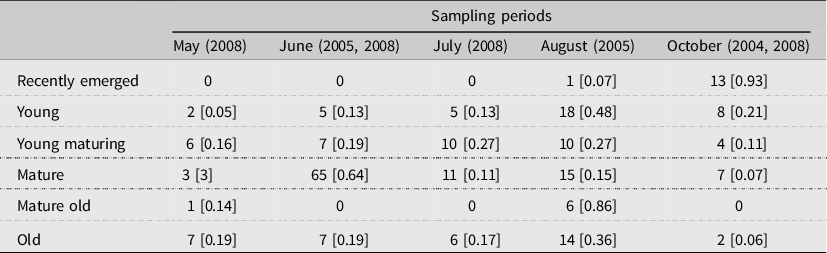
For both sexes, mature beetles were the most abundant individuals found in this study (females: 51%; males: 36%). According to the monthly distribution of each age category, recently emerged beetles were absent during the first sampling months of the year, occurring mostly in October (Table 1). Although young and young maturing beetles were observed in all sampling months, young beetles occurred mostly during August and October, whereas young maturing beetles occurred mostly in July and August (Table 1). Mature beetles were recorded across the entire sampling period, although their highest abundance was recorded in June. Mature old individuals were recorded only in May and August and were most abundant in August (Table 1). Old beetles were recorded in all sampling months, with highest abundances recorded in August (Table 1).
Distribution of age categories of C. cyanellus during the sampling period. Numbers in parentheses indicate the years that C. cyanellus were sampled at each month; numbers in brackets indicate the relative abundance of age categories recorded at each month.

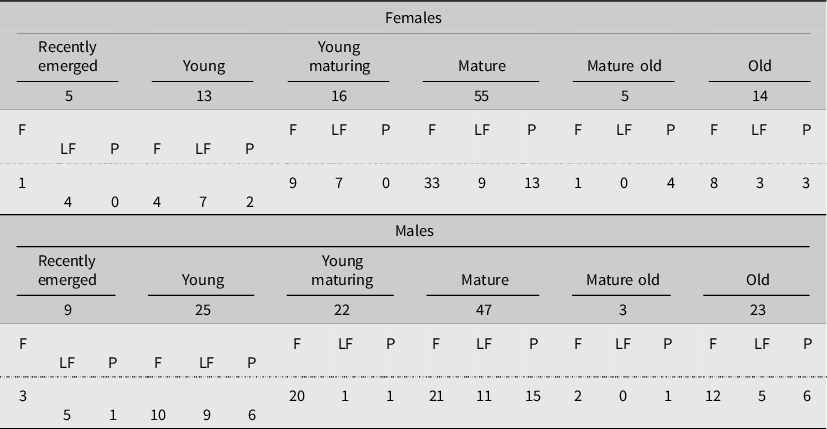
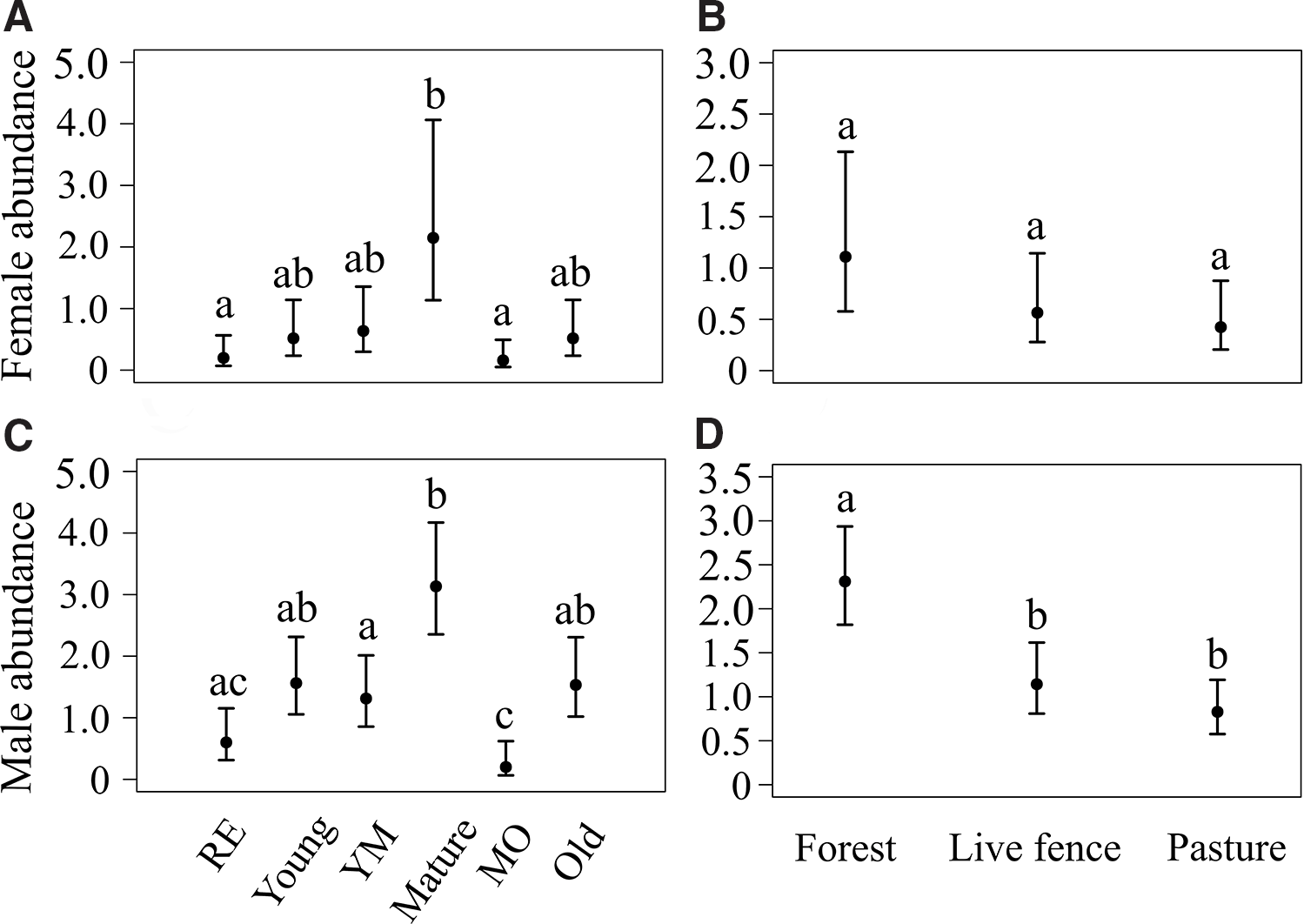
Recently emerged and mature old beetles had the lowest number of recorded beetles (see Table 2). Among females, both recently emerged and mature old represented 5 and 4% of their abundance, respectively, whereas among males, recently emerged beetles represented 7% of total male abundance, and mature old beetles represented 2%. For females, neither recently emerged nor young mature beetles were recorded in pastures, and mature old beetles were absent from live fences. According to the general linear mixed models, the interaction between age category and habitat type did not significantly influence female abundance (X 2 10 = 16.04, P = 0.09). Female abundance was statistically higher for mature than for recently emerged and mature old females (X 2 5 = 42.16, P < 0.01; Fig. 1A). Females tended to be more abundant in forests than in pastures (X 2 2 = 14.56, P < 0.01; Fig. 1B). Among males, no mature old beetles were recorded in live fences. Male distribution was not affected by the interaction between age category and habitat type (X 2 10 = 13.07, P = 0.22); however, male distribution was affected by each factor separately (age category: X 2 5 = 35.14, P < 0.01; habitat type: X 2 2 = 15.50, P < 0.01). Among males, mature beetles were disproportionately more abundant (P < 0.05), and mature old males were statistically less abundant than other groups, except for recently emerged individuals (Fig. 1C). Canthon cyanellus males were significantly more abundant in forest fragments than in live fences and pastures (Fig. 1D).
Distribution of dissected female and male C. cyanellus, according to age categories, recorded in forest fragments (F), live fences (LF), and pastures (P) in Vicente Guerrero, Chiapas, Mexico.

Canthon cyanellus female (A and B) and male (C and D) distribution, according to age categories and environment types recorded in Vicente Guerrero, Chiapas, Mexico (mean ± 95% confidence intervals). Different letters indicate significant differences. RE, recently emerged; YM, young maturing; MO, mature old.

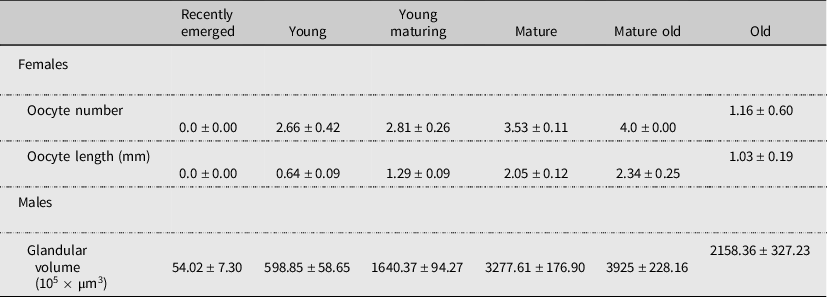
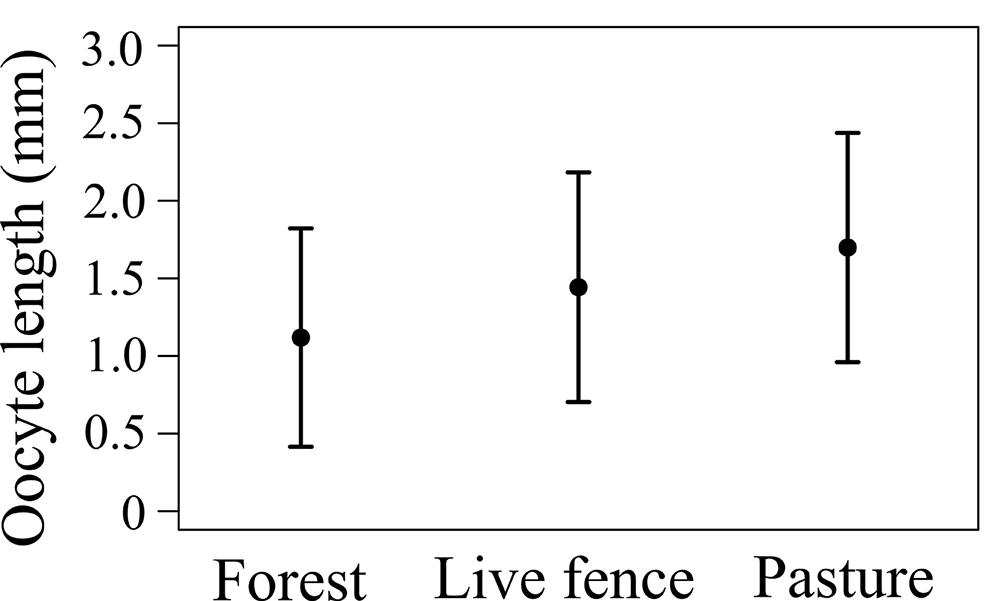
Oocyte number ranged from zero to five per female beetle, with recently emerged beetles presenting no oocytes (Table 3). Habitat type did not statistically affect the number of oocytes observed in C. cyanellus females (X 2 2 = 0.017, P = 0.99). Oocyte length ranged from 0.16 mm to 4.05 mm. Young females presented the lowest mean oocyte length, and mature old females presented the highest mean values of this parameter (Table 3). Female beetles from pastures recorded statistically larger oocytes than did females from forest fragments (F 2,86 = 4.55, P = 0.01; Fig. 2). Among the C. cyanellus males, individual glandular volume ranged from 23.8 × 105 μm3 to 7502.0 × 105 μm3, with the lowest mean glandular volumes recorded in recently emerged males and the highest recorded in mature old individuals (Table 3). Habitat type did not statistically affect male glandular volumes (F 2,109 = 1.19, P = 0.31).
Mean ± standard error number and length of female oocytes and male glandular volume, according to age categories, from C. cyanellus beetles recorded in Vicente Guerrero, Chiapas, Mexico.

Mean oocyte length for Canthon cyanellus females in forest, live fence, and pasture in Vicente Guerrero, Chiapas, Mexico (mean ± 95% confidence intervals).

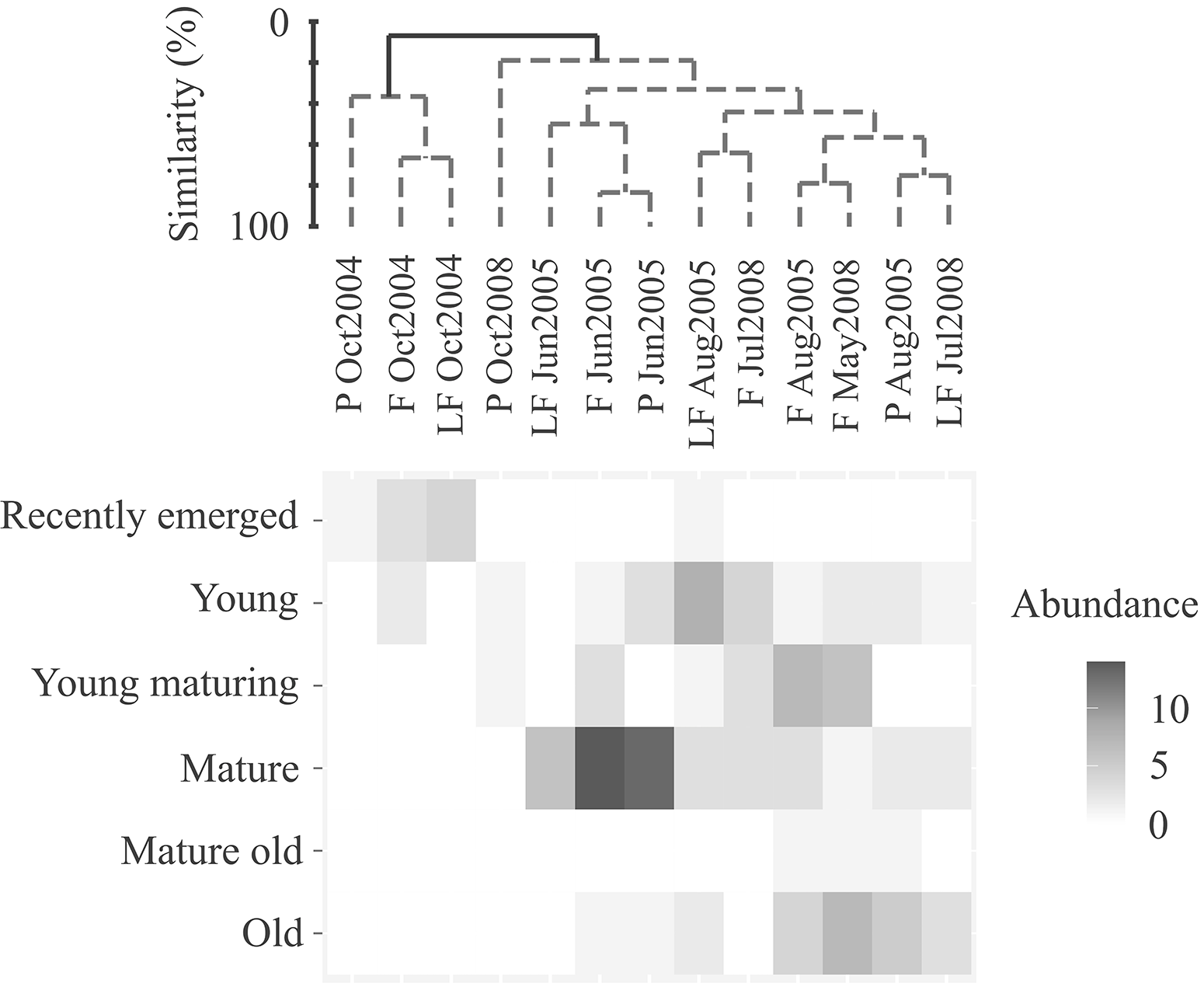
According to age category, the population structure of female C. cyanellus beetles did not differ among the forest, live fence, and pasture habitats (F 2 = 0.73, P = 0.67). Moreover, habitat types did not show statistical differences in terms of the dispersion of the variance of data (permutational multivariate analysis of dispersion: F 2 = 0.19, P = 0.82). All samples shared 17% similarity in female distribution according to age category, with no statistical groupings found among samples. As was observed in females, the population structure of male beetles did not differ among habitat types (F 2 = 0.60, P = 0.83), and no statistical differences emerged regarding the dispersion of the variance for male individuals (permutational multivariate analysis of dispersion: F 2 = 0.71, P = 0.51). Among male individuals, all samples shared 7% similarity according to age category, and two statistically distinct groups (similarity profile analysis: P < 0.05) were structured (Fig. 3). One group comprised samples from October 2004 taken in forest, live fence, and pasture habitats, clustered with 37% similarity, whereas the other group encompassed all the other samples, clustered with 19% similarity.
Heat map of age category distribution for male Canthon cyanellus beetles collected in Vicente Guerrero, Chiapas, Mexico. Solid lines represent statistical differences between groups, based on similarity profile analysis analyses (P < 0.05). F, forest; LF, live fence; P, pasture.

Effect of environmental parameters on age category and sexual gonadic maturity stage
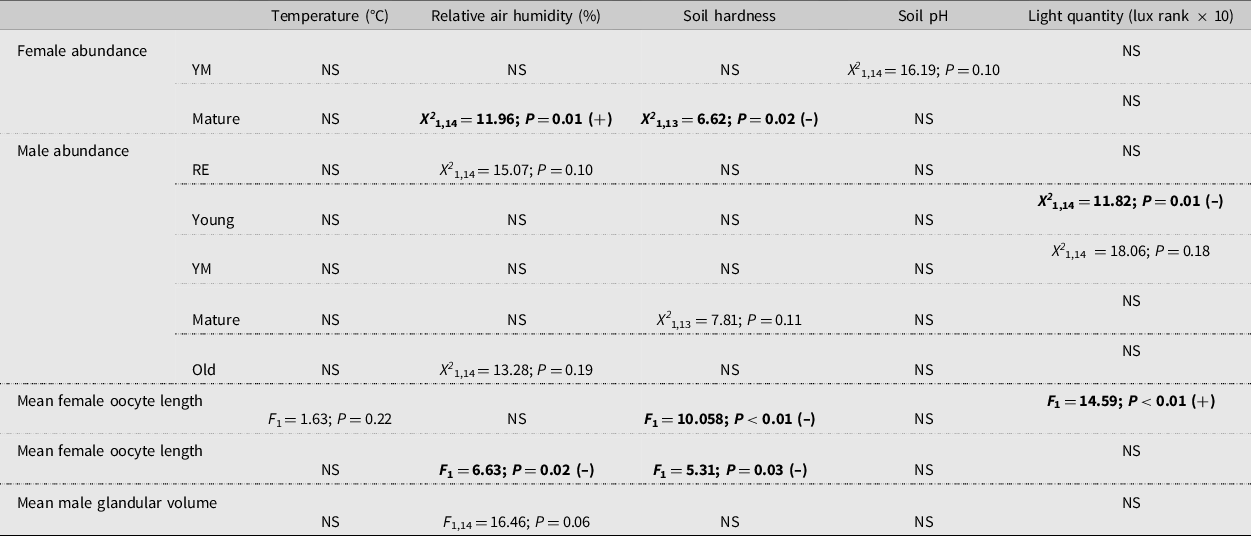
Distribution of C. cyanellus beetles according to age category and sexual gonadic maturity stage was related to changes in environmental parameters (Table 4). The model that best explained young mature female abundance included soil pH, although the effect was not significant. Mature female abundance was significantly higher in sites with relatively higher air humidity, but it was significantly lower in sites with greater soil hardness. Due to the absence of recently emerged, mature old, and old females in most of the sampling sites, being present in fewer than four of the 16 sites, we were unable to distinguish potential effects of environmental parameters on beetle abundance values.
Statistical models for the effects of environmental factors on beetle abundance, mean female oocyte length, mean oocyte number, and mean male glandular volume in 16 fixed transects located in Vicente Guerrero, Chiapas, Mexico. Statistically significant variables are shown in bold.

RE, recently emerged; YM, young maturing; NS, nonsignificant (variables not selected by the best-supported model); +, positive relationship; –, negative relationship.
Among C. cyanellus males, abundance of recently emerged beetles was best explained by relative air humidity, although the effect on beetle abundance was not significant. Young male abundance was significantly lower in sites with higher light incidence. Although mature and old male abundance was best explained by light incidence, soil hardness, and relative air humidity, effects on male abundance were not significant. Since mature old males were not recorded in most of the sites, being present in only two of the 16 sites, we failed to detect effects of environmental factors on their abundance.
Among the females, mean oocyte length was significantly shorter in sites with greater soil hardness but significantly longer in sites with higher light incidence. In addition, temperature was retained in the model that best explained mean female oocyte length, although its effect on oocyte length was not significant. Mean oocyte number was negatively related to soil hardness and relative air humidity. Among males, mean glandular volume was best explained by relative humidity, but this parameter had no significant effect on male glandular volume.
Discussion
The matching habitat choice hypothesis predicts that individuals with specific attributes will settle in environments that best suit their characteristics and ecological requirements (Edelaar et al. Reference Edelaar, Siepielski and Clobert2008). Because dung beetles have different energetic needs and resource-use strategies throughout their lifetime (Favila Reference Favila1988; Huerta et al. Reference Huerta, Halffter and Halffter2005; Halffter et al. Reference Halffter, Halffter and Favila2011), we expected that the distribution of C. cyanellus individuals, in regard to age category and sexual gonadic maturity, would be affected by habitat type and environmental parameters. Indeed, our results indicate that: (1) sex may determine the distribution of C. cyanellus individuals according to sexual gonadic maturity stage and age, and (2) habitat type and environmental parameters may filter individuals according to their body condition (i.e., oocyte length, number of oocytes).
Habitat occupancy of C. cyanellus according to age and sexual gonadic maturity
Our results represent the first concrete evidence of the relationship between the stage of sexual gonadic maturity and occupancy patterns of dung beetles in neotropical agro-pasture landscapes. The first striking result was that for female and male C. cyanellus beetles, mature individuals represented the most abundant category throughout our field observations. In this regard, previous surveys (Martínez and Montes-de-Oca Reference Martínez and Montes-de-Oca1994) have also reported mature beetles as a dominant condition among C. cyanellus individuals during their reproductive period. A dominance of mature beetles has also been recorded in populations of the African dung beetle Kheper nigroaeneus (Boheman, 1857) studied at Mkuze Game Reserve, South Africa (Edwards Reference Edwards1988). Populations of K. nigroaeneus exhibit comparable patterns to those observed in C. cyanellus, in which mature beetles represented the most abundant sexual maturation stage. Despite the different life history strategies (Halffter and Edmonds Reference Halffter and Edmonds1982; Hanski and Cambefort Reference Hanski and Cambefort1991; Scholtz et al. Reference Scholtz, Davis and Kryger2009), dung beetle populations seem to chronologically adjust their periods of reproduction, with the highest number of mature individuals found during the active seasons. Such chronological patterns occur in species that follow seasonal activities, although it is not clear if nonseasonal organisms (e.g., those occurring in tropical rainforests) present populations dominated by sexually mature individuals throughout the year. One hypothesis is that organisms that inhabit seasonal ecosystems such as temperate forests and dry forests (including our landscape) require the presence of a high number of mature individuals during the relatively short period of population activity. Future studies should address evaluating how maturation stage dynamics of C. cyanellus’ populations differ among habitat types and environmental conditions.
Among female C. cyanellus, mature beetles recorded in forest fragments were more abundant than any other age categories recorded in the forest fragments, live fences, or pastures. Depending on individual gonadic maturity stage, insects may seek to occupy specific habitats (Cisneiros and Rosenheim Reference Cisneiros and Rosenheim1998; Kemp Reference Kemp2018). For example, Cisneiros and Rosenheim (Reference Cisneiros and Rosenheim1998) found that, according to sexual maturation stage, individuals of the true bug, Zeius renardii (Kolenati, 1856) (Hemiptera: Reduviidae), may shift their distribution towards higher-quality habitats. Mature females may then choose sites that will allow them to increase their offspring fitness, guaranteeing their development and success under optimal conditions (Paukku and Kotiaho Reference Paukku and Kotiaho2008; Kemp Reference Kemp2018). In the present study, mature females were more abundant in sites with higher air humidity and less soil hardness. In our case, mature C. cyanellus females were in better condition than older females, in terms of ability to reproduce (Favila Reference Favila1993). Because mature females were most abundant in forest fragments, this habitat condition may represent optimal environmental conditions for reproduction (e.g., stable microclimatic conditions and food resource availability). The oocytes of the C. cyanellus females were significantly larger in pastures than in forest fragments, and we detected a negative relationship between oocyte size and light quantity. Large oocytes indicate that females have not yet oviposited, which may imply that females are avoiding breeding in pastures.
Because male body condition affects the dynamics of contests for female dung beetles (Sato and Hiramatsu Reference Sato and Hiramatsu1993; Chamorro-Florescano and Favila Reference Chamorro-Florescano and Favila2008; Salomão et al. Reference Salomão, Favila, González-Tokman and Chamorro-Florescano2019), we could expect that relatively fitter males would be more successful in forested sites. Under this rationale, what body conditions favour males to find mates successfully? Are males in poor condition forced to occupy low-quality habitat to increase mating probabilities? It has been observed that C. cyanellus beetles feed on small invertebrate carcasses (e.g., worms and myriapods; L. Arellano personal observation) in live fences and forest edges. This may represent an alternative resource for necrophagous dung beetles that typically feed on vertebrate animal carcasses (Hanski and Cambefort Reference Hanski and Cambefort1991; Favila and Díaz Reference Favila and Díaz1996). This result also reinforces the idea that, although C. cyanellus beetles occur in a wide range of habitat conditions (Halffter et al. Reference Halffter, Favila and Halffter1992; Solís and Kohlmann Reference Solís and Kohlmann2002), its specific sexual gonadic maturity stage can be favoured by their ability to occupy higher-quality habitats. On an individual scale, the availability of resources may condition intra- and interspecific interactions, which, in turn, influence the patterns of how individuals use different habitats and the individuals’ spatial and temporal distribution. Future studies should focus on understanding how different individual conditions can affect the population dynamics and microhabitat distribution of eurytopic species such as C. cyanellus.
Landscape context
Although dung beetles were affected by soil hardness, light intensity, and air humidity (Doube Reference Doube1983; Martínez and Cruz Reference Martínez and Cruz1998; Damborsky et al., Reference Damborsky, Alvarez-Bohle, Ibarra-Polesel, Porcel and Fontana2015), we failed to detect significant relationships between these variables and the fitness of beetle individuals. In our study, the abundance of beetles at each age category was clearly different, limiting the sample size of each age category. Sample size is determinant of trustworthiness in studies encompassing ecological analyses and may bias statistical results (Jennions and Moller Reference Jennions and Moller2002; McPherson et al. Reference McPherson, Jetz and Rogers2004). Therefore, it is possible that the number of dissected individuals at each environment was not sufficient to find significant relationships between the environmental variables, age categories, and gonadic maturity. Furthermore, we acknowledge that intraspecific interactions (i.e., potential competition) between males of different sexual condition might not be strictly determined by the environmental variables that we measured. Other experimental designs (i.e., controlled experiments, where these and other variables can be modulated and related to beetle activity patterns) might better enable rigorous testing for microhabitat variation effects on beetle sexual performance and occupancy.
Canthon cyanellus females and males were more abundant in forest fragments than in live fences and pastures. The greater observed abundance of males in forest fragments may be related to the great abundance of mature females in this habitat. Males of C. cyanellus strongly compete for mating and successful reproduction (Chamorro-Florescano and Favila Reference Chamorro-Florescano and Favila2008; Chamorro-Florescano et al. Reference Chamorro-Florescano, Favila and Macías-Ordóñez2011; Salomão et al. Reference Salomão, Favila, González-Tokman and Chamorro-Florescano2019). Previous studies suggest that mature C. cyanellus males move more frequently within shaded habitats (Arellano et al. Reference Arellano, León-Cortés and Ovaskainen2008b), which could increase their success of finding a mate and successfully breeding. In Odonata, reproductive ecology and landscape connectivity may have the greatest influence on the movement of individuals (Conrad et al. Reference Conrad, Wilson, Whitifield, Harvey, Thomas and Sherratt2002). Thus, landscape configuration and reproductive ecology, particularly sexual gonadic maturity stage, likely shape dung beetles’ spatial distribution. When insects are sexually mature, there is a tendency to increase movement within breeding sites (Kemp Reference Kemp2018), which may indicate a strategy for enhancing fitness.
Although we did not assess the effect of fragment size and connectivity on beetle distribution among forest fragments, our observations suggest that landscape elements and their spatial configuration could influence the population structure and, particularly, spatial variations of beetle age categories. A previous survey in the same landscape detected that distance between forest fragments and the total surface of forest represented key variables in explaining species richness and abundance and that males moved more frequently through live fences and forest fragments (Arellano et al. Reference Arellano, León-Cortés and Halffter2008a, Reference Arellano, León-Cortés and Ovaskainen2008b). Based on those results, the qualitative conclusion that landscape structure along with the ability of sexually mature beetles to locate high-quality habitat should hold. Future studies should assess the effects of such landscape parameters on the distribution of dung beetle populations according to individual age categories.
Conclusions
Our results shed light on an important ecological aspect – that eurytopic species may displace across preserved and disturbed environments, but that there are optimum conditions under which sexually mature individuals are more evenly distributed. These behaviours could exacerbate the long-term consequences of the current scenario of environmental transformation and exemplify the “winner” and “loser” species paradigm (Arellano and Halffter Reference Arellano and Halffter2002; McKinney and Lockwood Reference McKinney and Lockwood1999; Arellano et al. Reference Arellano, León-Cortés and Ovaskainen2008b; Tabarelli et al. Reference Tabarelli, Peres and Melo2012; Salomão et al. Reference Salomão, González-Tokman, Dáttilo, López-Acosta and Favila2018). We conclude that reproductively ready C. cyanellus individuals disproportionality inhabit forested sites and that, depending on beetle life stage, local environmental preferences may be more easily distinguished, particularly when including conditions of sexual maturity.
Acknowledgements
The authors are very grateful to Vicente Jiménez and Reinalda Hernández for allowing access to their land. The authors also thank Imelda Martínez of the Instituto de Ecología for use of laboratory facilities, and Manuel Girón and Karla Leal for field assistance. This study was supported by CONACYT SEMARNAT (108222). R.P.S. thanks CAPES for a postdoctoral scholarship. The authors thank two reviewers for helpful comments. Keith MacMillan checked the English version.