INTRODUCTION
Many directed energy systems are based on long distance propagation of high power laser beams through the atmosphere in a variety of environments like maritime, desert, rural, and urban. The efficiency of propagation, i.e., the ratio of the power of the laser beam incident on a target to the initial power of the beam is significantly affected by the phenomenon of thermal blooming; it is of interest to consider the basics of this phenomenon. When a Gaussian beam with maximum irradiance on the axis of the beam propagates through an absorbing medium, the temperature are maximum on the axis and falls off radially. Such a temperature profile corresponds to radially increasing refractive index in air and consequent defocusing, known as thermal blooming (Akhmanov et al., Reference Akhmanov, Sukhorukov and Khokhlov1968a; Reference Akhmanov, Krindach, Migulier, Sukhorukov and Khokhlov1968b; Brown & Smith, Reference Brown and Smith1975; Schmitt, Reference Schmitt2003).
The scattering and absorption of laser radiation in the water vapor absorption windows, specifically corresponding to the wavelengths 1.045 µ, 1.625 µ, and 2.141 µ has been reviewed at length by Sprangle et al. (Reference Sprangle, Penaus and Hafizi2005); the gross scattering and absorption coefficients, evaluated by these authors, which are in agreement (Dos Hammel et al., Reference Doss-Hammel, Tsintrkidis, Merrit and Fontana2004; Bodhaine, Reference Bodhaine1995) with in situ observations have been used in computations, reported in this paper.
A steady-state paraxial theory of thermal blooming was given by Akhmanov et al. (Reference Akhmanov, Sukhorukov and Khokhlov1968a; Reference Akhmanov, Krindach, Migulier, Sukhorukov and Khokhlov1968b) and seen to be in agreement with experiments on laser propagation in water and acetone. Brown and Smith (Reference Brown and Smith1975) pointed out that aerosol absorption is mainly responsible for thermal blooming in air and that the steady-state gets established in a time on the order of a millisecond. Kaushik et al. (Reference Kaushik, Tripathi and Sharma1975) evaluated thermal distortion of the beam due to wind. Weiss and Me Innis (Reference Weiss and McInnis1980) concluded from computer simulations that contrary to the suggestion by Fried (Reference Fried1974), a round beam in all cases of interest suffers less thermal blooming than a square beam. Armstrong (Reference Armstrong1984) has studied the dynamics of laser aerosol interaction including vaporization, breakdown, etc. Sprangle et al. (Reference Sprangle, Penano and Hafizi2002) and Penano et al. (Reference Penano, Sprangle, Hafizi, Ting, Gordon and Kapetanakos2004) have studied the propagation of a very high energy laser pulse in air, causing a host of nonlinear phenomena on a time scale, much shorter than that for the onset of thermal blooming. On the basis of numerical simulation, Schmitt (Reference Schmitt2003) has concluded that thermal blooming can be mitigated by the use of short pulses of very intense laser beams with associated nonlinear effects (causing self-focusing).
Possibly the most advanced tool for the study of high energy laser propagation in the atmosphere viz HELCAP was developed at NRL (Sprangle et al., 2003). The model incorporates (1) aerosol and molecular absorption and scattering, (2) aerosol heating and vaporization, (3) thermal blooming, (4) atmospheric turbulence, and (5) laser beam quality. However, all these studies to date are confined to Gaussian beams and little if any attention has been given to other types of beams.
In this paper, the authors have investigated the thermal blooming of laser beams with central shadow, usually called dark hollow beams (DHB) for possible applications; such beams have found attractive applications in modern optics, atomic optics, and plasmas (Soding et al., Reference Soding, Grimm and Ovchinnikov1995; Kuga et al., Reference Kuga, Torii, Shiokawa, Hirano, Shimizu and Sasada1997; Ovchinnikov et al., Reference Ovchinnikov, Manek and Grimm1997; Yin et al., Reference Yin, Gao and Zhu2003; Song et al., Reference Song, Milam and Hill1999; Xu et al., Reference Xu, Wang and Jhe2002; Cai et al., Reference Cai, Lu and Lin2003; York et al., Reference York, Milchberg, Palastro and Antonsen2008). A number of experimental methods have been developed for production of hollow Gaussian beams (Herman & Wiggins, Reference Herman and Wiggins1991; Wang & Littman, Reference Wang and Littman1993; Lee et al., Reference Lee, Atewart, Choi and Fenichel1994). The focusing of such beams in plasmas has been extensively studied (Sodha et al., Reference Sodha, Mishra and Misra2009a; Reference Sodha, Mishra and Misra2009b; Misra & Mishra, Reference Misra and Mishra2009).
In central portion of the dark hollow beam 0 < r < r m, the temperature increases radially, while in the peripheral region r > r m the temperature falls radially (the maximum of irradiance occurs at r = r m) Hence, the refractive index is maximum on the axis and it decrease radially in the central region; for r = r m, the refractive index increases radially. Hence, the central portion tends to focus while the peripheral one defocuses. As a result, such a beam defocuses less than that experienced by a corresponding Gaussian beam.
In this paper, the authors have analyzed the thermal blooming for a Gaussian and a dark hollow beam in the atmosphere, characterized by specific absorption and scattering coefficients in the paraxial and near paraxial approximation as outlined by Akhmanov et al. (Reference Akhmanov, Sukhorukov and Khokhlov1968a; Reference Akhmanov, Krindach, Migulier, Sukhorukov and Khokhlov1968b) and Sodha et al. (Reference Sodha, Mishra and Misra2009a). The theory has been used to study the beam width parameter for DHB and Gaussian beam in the four environments, characterized by Sprangle (Reference Sprangle, Penaus and Hafizi2005).
In a preliminary study like the present one, the use of paraxial approximation indicates the relative merits of the Gaussian and DHB beams. However, it is indicated that in all environments the DHB defocuses less than a corresponding Gaussian beam; it is suggested that this conclusion be verified by a more rigorous numerical simulation (like HELCAP).
PROPAGATION OF ELECTROMAGNETIC BEAM
The Dielectric Function
Following Sodha et al. (Reference Sodha, Tripathi and Ghatak1976), the variation of the dielectric function of air due to thermal self-action at a temperature T may be expressed as,
 $${\rm \varepsilon} \lpar r\comma z\rpar = {\rm \varepsilon} _r \lpar T_0 \rpar + \left[T\lpar r\comma z\rpar - T_0 \right]{\left.{d{\rm \varepsilon} _r \over dT}\right\vert_{T = 0}} - i{\rm \varepsilon} _i\comma$$
where ɛr is the real part of the dielectric function, T0 is the maximum temperature on the wave-front of the beam, and ɛi is the imaginary part of the dielectric function and is practically independent of temperature; for air  $d{\rm \varepsilon} _r / dT$ is negative. Since T is a function of r and z, Eq. (1a) may be written as
 $${\rm \varepsilon} \lpar r\comma z\rpar = {\rm \varepsilon} _R \lpar r\comma \; z\rpar - i{\rm \varepsilon} _i\comma$$
where R = g, n for Gaussian and Hollow Gaussian beam, respectively, in this analysis.
Propagation
Consider the propagation of a linearly polarized radially symmetric electromagnetic beam with its electric vector polarized along the y-axis, propagating in air along the z-axis. The amplitude of the electric field vector E satisfies the scalar wave equation for such a beam, which may be expressed in a cylindrical coordinate system with azimuthal symmetry as
 $${\partial ^2 {E} \over \partial z^2} + \left({\partial ^2 \over \partial r^2 } + {1 \over r} {\partial \over \partial r} \right)E + {{\rm \omega}^2 \over c^2} {\rm \varepsilon} \lpar r\comma z\rpar \;E =0\comma$$
where c is the speed of light in vacuum. Eq. (2) can be solved in the paraxial approximation by following the analysis of Akhmanov et al. (Reference Akhmanov, Sukhorukov and Khokhlov1968a; Reference Akhmanov, Krindach, Migulier, Sukhorukov and Khokhlov1968b) and its extension by Sodha et al. (Reference Sodha, Ghatak and Tripathi1974; Reference Sodha, Tripathi and Ghatak1976) for Gaussian beam and the work of Sodha et al. (Reference Sodha, Mishra and Misra2009a; Reference Sodha, Mishra and Misra2009b) and Misra and Mishra (Reference Misra and Mishra2009) on nonlinear propagation of hollow Gaussian beams in plasmas.
The starting point is a solution of the form
 $$E\lpar r\comma z\rpar = A\lpar r\comma z\rpar \exp \left(- i \int_0^z k\lpar z\rpar dz \right)\comma$$
where A(r,z) is the complex amplitude of the electric field,  $k\lpar z\rpar = {{\rm \omega} / c}\sqrt {{\rm \varepsilon} _{R0} \lpar z\rpar }$, ɛR0 (z) is the dielectric function, corresponding to the maximum electric field on the wave-front of the electromagnetic beam. Substituting for E(r,z) from Eq. (3) in Eq. (2) and neglecting ∂2A/∂z 2 (in the Jeffreys-Wentzel-Kramers-Brillouin approximation) one obtains
 $$2ik{\partial A \over \partial z} + iA{\partial k \over \partial z} + k^2 A = \left({{\partial ^2 A \over \partial r^2} + {1 \over r}{\partial A \over \partial r}}\right)+ {{\rm \omega}^2 \over c^2}{\rm \varepsilon}\lpar r\comma z\rpar A.$$
For a nearly spherical wave front (a valid assumption in the paraxial approximation), the complex amplitude A(r,z) may be expressed as,
 $$A\lpar r\comma z\rpar = A_0 \lpar r\comma z\rpar \exp \left(- ik\lpar z\rpar S\lpar r\comma z\rpar \right)\comma$$
where S(r,z) is the eikonal associated with the electromagnetic beam and A 0(r,z) is the real amplitude of the electromagnetic beam. The propagation of the Gaussian beam and various orders HGBs in air has been analyzed separately as follows.
The Gaussian Beam
The electric field distribution for the Gaussian beam may be expressed as
 $$\lpar E_{0g} \rpar _{z = 0} = E_{00g} \exp \left(- {r^2 \over 2r_{0g}^2 } \right)\comma$$
where r 0g is the initial beam width of the Gaussian beam.
Following the paraxial approach the relevant parameters (i.e., dielectric function ɛ(r,z), eikonal and irradiance) may be expanded around the maximum of the Gaussian electromagnetic beam, i.e., around r = 0. Thus, one can express the dielectric function ɛg(r,z) as
 $${\rm \varepsilon} _g \lpar r\comma z\rpar = {\rm \varepsilon} _{0g} \lpar z\rpar - \lpar r^2 /r_{0g}^2 \rpar {\rm \varepsilon} _{2g} \lpar z\rpar - i{\rm \varepsilon} _i \comma$$
where ɛ0g(z) and ɛ2g(z) are the coefficients associated with r 0 and r 2 in the expansion of ɛg(r,z) around r = 0. The expressions for these coefficients (all real) have been derived later.
Substitution for A(r,z) from Eq. (5) and ɛ(r,z) from Eqs. (1b) and (7) in Eq. (4) and equating the real and imaginary parts on both sides of the resulting equation one obtains
 $$\eqalign{& \displaystyle{{2S_g } \over k}\displaystyle{{\partial k} \over {\partial z}} + 2\displaystyle{{\partial S_g } \over {\partial z}} + \left({\displaystyle{{\partial S_g } \over {\partial r}}} \right)^2 \cr & \quad= \displaystyle{1 \over {k^2 A_{0g} }}\left({\displaystyle{{\partial ^2 A_{0g} } \over {\partial r^2 }} + \displaystyle{1 \over r}\displaystyle{{\partial A_{0g} } \over {\partial r}}} \right) - \displaystyle{{r^2 } \over {r_{0g}^2 }}\displaystyle{{{\rm \varepsilon} _{2g} \lpar z\rpar } \over {{\rm \varepsilon} _{0g} \lpar z\rpar }}\comma \;}$$
and
 $$\eqalign{&\displaystyle{{\partial A_{0g}^2 } \over {\partial z}} + A_{0g}^2 \left({\displaystyle{{\partial ^2 S_g } \over {\partial r^2 }} + \displaystyle{1 \over r}\displaystyle{{\partial S_g } \over {\partial r}}} \right)+ \displaystyle{{\partial A_{0g}^2 } \over {\partial r}}\displaystyle{{\partial S_g } \over {\partial r}} \cr & \quad + A_{0g}^2 \left({\displaystyle{1 \over {k\lpar z\rpar }}\displaystyle{{\partial k\lpar z\rpar } \over {\partial z}} + k\lpar z\rpar \displaystyle{{{\rm \varepsilon} _i \lpar z\rpar } \over {{\rm \varepsilon} _{0g} \lpar z\rpar }}} \right)= 0\comma \; }$$
where ɛi(z) is the imaginary part of the dielectric function.
One can express the solution of Eq. (8b) (in the paraxial approximation r/r 0 ≪ 1) as
 $$\eqalign{A_{0g}^2 & = \displaystyle{{E_{0g}^2 } \over {\,f_0^2 }}\left({\displaystyle{{{\rm \varepsilon} _{0g} \lpar 0\rpar } \over {{\rm \varepsilon} _{0g} \lpar z\rpar }}} \right)^{1/2} {\rm exp}\left({ - \displaystyle{{r^2 } \over {r_{0g}^2 f_0^2 }}} \right)\cr & \quad \times {\rm exp}\left[{ - \int_0^z {\displaystyle{{{\rm \varepsilon} _i \lpar {\rm \omega} /c\rpar dz} \over {\sqrt {{\rm \varepsilon} _{0g} \lpar z\rpar } }}} } \right]\comma \; \cr & \quad \approx \displaystyle{{E_{0g}^2 } \over {\,f_0^2 }}\left({\displaystyle{{{\rm \varepsilon} _{0g} \lpar 0\rpar } \over {{\rm \varepsilon} _{0g} \lpar z\rpar }}} \right)^{1/2} {\rm exp}\left({ - \displaystyle{{r^2 } \over {r_{0g}^2 f_0^2 }}} \right)\times {\rm exp}\lpar\! -\! {\rm \delta} z\rpar \comma \; }$$
where
 $$\eqalign{& S_g \lpar r\comma \; z\rpar =\displaystyle{{r^2 } \over 2}{\rm \beta} _g \lpar z\rpar +{\rm \varphi} _g \lpar z\rpar \comma \; \cr & {\rm \beta} _g \lpar z\rpar =\displaystyle{1 \over {\,f_0 }}\displaystyle{{df_0 } \over {dz}}\comma \; \cr & {\rm \varepsilon} _{0g} \lpar z\rpar \approx 1 \hbox{for air}\comma \; \cr & {\rm \delta}= \varepsilon_i({\rm \omega}/c) \;\hbox{may be recognized as the irradiation} \cr & \hbox{attenuation constant in the medium}, \cr & {\rm \varphi}_g(z) \;\hbox{is an arbitrary function of} \;z,}$$
and
 $${f}_0(z) \hbox{is the beam width parameter, associated with the Gaussian beam.}$$
On substituting for A 0g2 and S g from Eqs. (9a) and (9b) in Eq. (8a) and equating the coefficient of r 2 on both sides of the resulting equation, one obtains
 $$\,f_0 \displaystyle{{d^2 f_0 } \over {dz^2 }} =\displaystyle{1 \over {k^2 r_{0g}^2 f_0^2 }} - \displaystyle{1 \over {r_{0g}^2 }}\displaystyle{{{\rm \varepsilon} _{2g} } \over {{\rm \varepsilon} _{0g} }}.$$
The dependence of the beam width parameter f 0 on z can be obtained by the numerical solution of Eq. (10) after putting suitable expressions for ɛ0g and ɛ2g, with the initial boundary conditions f 0 = 1,  ${{df_0 \over dz} = B^{ - 1}}$ at z = 0, where B is the initial radius of curvature of the beam.
The Hollow Gaussian Beam
The amplitude of the electric field associated with a hollow Gaussian electromagnetic beam (HGB) having zero irradiance along the axis r = 0 and a maximum away from the axis, can be expressed as
 $$\lpar E_{0n} \rpar _{z =0} {\bi \;=\;}E_{00n} \left({\displaystyle{{r^2 } \over {2r_{0n}^2 }}} \right)^n \exp \left({ - \displaystyle{{r^2 } \over {2r_{0n}^2 }}} \right)\comma$$
where r 0n is the initial beam width of the HGB, n is the order of the HGB and a positive integer, characterizing the shape of the HGB and position of its maximum and |E 0| is maximum at r 2 = r max2 = 2nr 0n2.
To proceed further one can adopt a paraxial like approach (Sodha et al., Reference Sodha, Mishra and Misra2009a; Reference Sodha, Mishra and Misra2009b; Misra & Mishra, Reference Misra and Mishra2009), analogous to the paraxial approximation. Thus, one may start by expressing Eq. (4) in terms of variables η and z, where η is defined as
 $${\rm \eta}^2 = \left[\left(r / r_{0n} f_n \right)^2 -\, 2n \right]\comma \;$$
r 0nf n (z) is the width of the beam, and r 2 = 2nr 0n2f n2 is the position of the maximum irradiance of the propagating beam. It is shown later that in the paraxial like approximation, i.e., when η2 ≪ 2n, the beam retains its profile.
In the paraxial like approximation the relevant parameters (i.e., dielectric function ɛ(r,z), eikonal and irradiance) may be expanded around the maximum of the HGB, i.e., around η = 0. Thus, one can express the dielectric function ɛn(η,z) around the maximum (η = 0) of the HGB as
 $${\rm \varepsilon} _n \lpar {\rm \eta} \comma \; z\rpar ={\rm \varepsilon} _{0n} \lpar z\rpar - {\rm \eta} ^2 {\rm \varepsilon} _{2n} \lpar z\rpar - i{\rm \varepsilon} _i\comma \;$$
where ɛ0n(z) and ɛ2n(z) are the coefficients (both real) associated with η0 and η2 in the expansion of ɛn(η ,z) around η = 0. The expressions for these coefficients have been derived later.
Substitution for A(r,z) from Eq. (5) and ɛ(r,z) from Eq. (1b) and ɛn(η,z) from Eq. (13) in Eq. (4) by using the transformation Eq. (12) and the separation of the real and imaginary parts on both side of the resulting equation leads to
 $$\eqalign{& \displaystyle{{2S_g } \over k}\displaystyle{{\partial k} \over {\partial z}} +2\left({\displaystyle{{\partial S_n } \over {\partial z}} - \displaystyle{{\lpar \sqrt {2n} +{\rm \eta} \rpar } \over f}\displaystyle{{\partial f} \over {\partial z}}\displaystyle{{\partial S_n } \over {\partial {\rm \eta} }}} \right)\cr & \quad +\displaystyle{1 \over {r_{0n}^2 f_n^2 }}\left({\displaystyle{{2n +{\rm \eta} ^2 } \over {{\rm \eta} ^2 }}} \right)\left({\displaystyle{{\partial S_n } \over {\partial {\rm \eta} }}} \right)^2 \cr & \quad =\left[{\left({\displaystyle{2 \over {\rm \eta} } - \displaystyle{{2n +{\rm \eta} ^2 } \over {{\rm \eta} ^3 }}} \right)\displaystyle{{\partial A_{0n} } \over {\partial {\rm \eta} }} +\displaystyle{{2n +{\rm \eta} ^2 } \over {{\rm \eta} ^2 }}\displaystyle{{\partial ^2 A_{0n} } \over {\partial {\rm \eta} ^2 }}} \right]\cr &\qquad - {\rm \eta} ^2 \displaystyle{{{\rm \varepsilon} _{2n} \lpar z\rpar } \over {{\rm \varepsilon} _{0n} \lpar z\rpar }}\comma \; }$$
and
 $$\eqalign{& \left({\displaystyle{{\partial A_{0n}^2 } \over {\partial z}} - \displaystyle{{\lpar \sqrt {2n} +{\rm \eta} \rpar } \over f}\displaystyle{{\partial f} \over {\partial z}}\displaystyle{{\partial A_{0n}^2 } \over {\partial {\rm \eta} }}} \right)+\displaystyle{{A_{0n}^2 } \over {r_{0n}^2 f_n^2 }}\cr & \quad \times \left[{\left({\displaystyle{{\partial ^2 S_n } \over {\partial {\rm \eta} ^2 }} +\displaystyle{1 \over {\rm \eta} }\displaystyle{{\partial S_n } \over {\partial {\rm \eta} }}} \right)+\displaystyle{{2n} \over {{\rm \eta} ^2 }}\left({\displaystyle{{\partial ^2 S_n } \over {\partial {\rm \eta} ^2 }} - \displaystyle{1 \over {\rm \eta} }\displaystyle{{\partial S_n } \over {\partial {\rm \eta} }}} \right)} \right]\cr & \quad +\displaystyle{1 \over {r_{0n}^2 f_n^2 }}\displaystyle{{\lpar 2n +{\rm \eta} ^2 \rpar } \over {{\rm \eta} ^2 }}\displaystyle{{\partial A_{0n}^2 } \over {\partial {\rm \eta} }}\displaystyle{{\partial S_n } \over {\partial {\rm \eta} }} \cr & \quad +A_{0n}^2 \left({\displaystyle{1 \over {k\lpar z\rpar }}\displaystyle{{\partial k\lpar z\rpar } \over {\partial z}} +k\lpar z\rpar \displaystyle{{{\rm \varepsilon} _{i0} \lpar z\rpar } \over {{\rm \varepsilon} _{0n} \lpar z\rpar }}} \right)=0.}$$
One can express the solution of Eq. (14b) (in the paraxial like approximation η2 ≪ 2n) as
 $$\eqalign{A_{0n}^2 & = \displaystyle{{E_{0n}^2 } \over {2^{2n} f_n^2 }}\left({\displaystyle{{{\rm \varepsilon} _{0n} \lpar 0\rpar } \over {{\rm \varepsilon} _{0n} \lpar z\rpar }}} \right)^{1/2} \left({2n + {\rm \eta} ^2 } \right)^{2n} \cr & \quad \times \exp \left({ - \left({2n + {\rm \eta} ^2 } \right)} \right)\times \exp\lpar \! - {\rm \delta} z\rpar \comma \;}$$
where
 $$\eqalign{& S_n \lpar {\rm \eta} \comma \; z\rpar = \displaystyle{{{\rm \eta} ^2 } \over 2}{\rm \beta} _n \lpar z\rpar + {\rm \varphi} _n \lpar z\rpar \;\hbox{is the eikonal term} \cr & \qquad \qquad\quad\hbox{corresponding to HGB}\comma \; \cr & {\rm \beta} _n \lpar z\rpar = r_{0n}^2 f_n \displaystyle{{df_n } \over {dz}}\comma \; \cr & {\rm \varphi} _n \lpar z\rpar \;\hbox{is an arbitrary function of z}\comma \;}$$
and
 $$\,f_{n}(z) \;\hbox{is the beam width parameter for the HGB.}$$
On substituting for A 0n2 and S n from Eqs. (15a) and (15b) in Eq. (14a) and equating the coefficients of η2 on both sides of the resulting equation, one obtains
 $${\rm \varepsilon} _{0n} f_n \displaystyle{{d^2 f_n } \over {dz^2 }} = \displaystyle{{\lpar 12n^2 - 2n - 13/4\rpar } \over {k^2 r_{0n}^2 f_n^2 }} - \displaystyle{{{\rm \varepsilon} _{2n} } \over {r_{0n}^2 }}.$$
The variation of the beam width parameter f n with z can be obtained by the numerical integration of Eq. (16) after putting suitable expressions for ɛ0n and ɛ2n, with appropriate initial boundary conditions viz. f n = 1,  $\displaystyle{{df_n } \over {dz}} = B^{ - 1}$ at z = 0.
The Nonlinear Term
Consider a cylindrical shell of thickness dr (with radius r), whose axis is coincident with the beam. Neglecting convection effects the steady state thermal balance may be expressed as
 $${\rm \chi} {\partial \over \partial r} \left(r{\partial T \over \partial r} \right)= r{dI\lpar r\comma \; z\rpar \over dz}\comma \;$$
where
 $$\eqalign{& I\lpar r\comma \; z\rpar = \lpar c/4{\rm \pi} \rpar A_0^2 \lpar r\comma \; z\rpar \comma \; \cr & {A_0^2}\ \hbox{is given by Eqs. (9a) and (15a) with}\ \varepsilon_{0r}\approx 1,}$$
and
 $${\rm \chi} \;\hbox{is the thermal conductivity of the medium.}$$
The attenuation coefficient δ is the sum of the absorption (αa) and scattering (αs) coefficients, i.e.,
 $${\rm \delta} = {\rm \alpha} _a + {\rm \alpha} _s .$$
Gaussian Beam
In the paraxial approximation (r/r 0 ≪ 1), one can expand T(r,z) around the maximum viz. r = 0, as
 $$T\lpar r\comma \; z\rpar = T_{0g} - \lpar r^2 /r_0^2 \rpar T_{2g}.$$
Substituting for T(r,z) from Eq. (18) in Eq. (1) and comparing the coefficient of r 0 and r 2 in the resulting equation with Eq. (7) one obtains,
 $${\rm \varepsilon} _{0g} = {\rm \varepsilon} _0 + \left[{T_{0g} - T_0 } \right]\displaystyle{{d{\rm \varepsilon} } \over {dT}}\comma \;$$
and
 $${\rm \varepsilon} _{2g} = T_{2g} \displaystyle{{d{\rm \varepsilon} } \over {dT}}.$$
On substituting for T(r,z) from Eq. (18) in Eq. (17a) and comparing the r independent terms on both side of the resulting equation one obtains,
 $$T_{2g} = \displaystyle{{{\rm \alpha} _a cr_{0g}^2 } \over {16{\rm \pi} {\rm \chi} }}\displaystyle{{E_{0g}^2 } \over {\,f_0^2 }}\exp \left({ - \lpar {\rm \alpha} _a + {\rm \alpha} _s \rpar z} \right)$$
Substituting for T 2g from Eq. (19) in Eq. (7)
 $${\rm \varepsilon} _{2g} = \displaystyle{{{\rm \alpha} _a cr_{0g}^2 } \over {16{\rm \pi} {\rm \chi} }}\displaystyle{{E_{0g}^2 } \over {\,f_0^2 }}\exp \left({ - \lpar {\rm \alpha} _a + {\rm \alpha} _s \rpar z} \right)\displaystyle{{d{\rm \varepsilon} } \over {dT}}$$
or
 $${\rm \varepsilon} _{2g} = \displaystyle{{{\rm \alpha} _a } \over {4{\rm \pi} {\rm \chi} }}\displaystyle{{P_{0g}^{} } \over {\,f_0^2 }}\exp \left({ - \lpar {\rm \alpha} _a + {\rm \alpha} _s \rpar z} \right)\displaystyle{{d{\rm \varepsilon} } \over {dT}}\comma$$
where
 $${P}_{0g} = cr_0^2 E_{0g}^2 /4 \hbox{is the initial power of the Gaussian electromagnetic beam.}$$
On substituting for ɛ2g from Eq. (20a) in Eq. (10) and remembering that ɛ0g ≈1 one obtains,
 $$\,f_0 \displaystyle{{d^2 f_0 } \over {dz^2 }} = \displaystyle{1 \over {r_{0g}^4 k^2 f_0^2 }} - \displaystyle{{{\rm \alpha} _a } \over {r_{0g}^2 4{\rm \pi} {\rm \chi} }}P_{0g}^{} \exp \left({ - \lpar {\rm \alpha} _a + {\rm \alpha} _s \rpar z} \right)\displaystyle{{d{\rm \varepsilon} } \over {dT}}\comma \;$$
or
 $$\,f_0 \displaystyle{{d^2 f_0 } \over {d{\rm \xi} ^2 }} = \displaystyle{1 \over {\,f_0^2 {\rm \rho} _{0g}^2 }} + \Pi _{0g} \exp \left({ - {\rm \beta} {\rm \xi} } \right)\comma$$
where  $\Pi _{0g} = \Lambda = - \left({\displaystyle{{{\rm \alpha} _a P_{0g}} / {4{\rm \pi} {\rm \chi} }}\displaystyle{{d{\rm \varepsilon} } / {dT}}} \right)$ is proportional to the product of the initial power of the Gaussian electromagnetic beam and the absorption coefficient, ρ0g= (r 0gω/c) is the dimensionless beam width, β = r 0g (αa + αs) and ξ = z/r 0.
Hollow Gaussian Beam
Following the paraxial like approach (i.e., η2 ≪ 2n), the radial dependence of the electron temperature T(η,z), can be expanded around the maximum of the irradiance of the beam; thus,
 $$T \lpar {\rm \eta} \comma \; z\rpar = T_{0n} - {\rm \eta} ^2 T_{2n} .$$
Substituting for T(η,z) from Eq. (21) in Eq. (1) and comparing the coefficient of r 0 and r 2 in the resulting equation with Eq. (13) one obtains,
 $${\rm \varepsilon} _{0n} = {\rm \varepsilon} _0 + \left[{T_{0n} - T_0 } \right]\displaystyle{{d{\rm \varepsilon} } \over {dT}}\comma \;$$
and
 $${\rm \varepsilon} _{2n} = T_{2n} \displaystyle{{d{\rm \varepsilon} } \over {dT}}.$$
The thermal balance (Eq. (17a)) may be expressed in terms of variables (η,z) as follows,
 $$\displaystyle{{\rm \chi} \over {r_{0n}^2 f_n^2 }}\left[{\left({\displaystyle{{\partial ^2 T} \over {\partial {\rm \eta} ^2 }} + \displaystyle{1 \over {\rm \eta} }\displaystyle{{\partial T} \over {\partial {\rm \eta} }}} \right)+ \displaystyle{{2n} \over {{\rm \eta} ^2 }}\left({\displaystyle{{\partial ^2 T} \over {\partial {\rm \eta} ^2 }} - \displaystyle{1 \over {\rm \eta} }\displaystyle{{\partial T} \over {\partial {\rm \eta} }}} \right)} \right]= \displaystyle{{dI} \over {dz}}\comma$$
where
 $${\rm \beta} = r_{0g} \lpar {\rm \alpha} _a + {\rm \alpha} _s \rpar .$$
Substituting for T(η,z) from Eq. (21) in Eq. (23) and comparing the η independent terms on both sides in the resulting equation one gets,
 $$T_{2n} =\displaystyle{c \over {4{\rm \pi} }}\displaystyle{{{\rm \alpha} _a r_{0n}^2 } \over {4{\rm \chi} f_n^2 }}E_{0n}^2 \exp \left({ - 2n} \right)n^{2n} \exp \left({ - \lpar {\rm \alpha} _a + {\rm \alpha} _s \rpar z} \right).$$
From Eqs. (22b) and (24) one obtains,
 $${\rm \varepsilon} _{2n} = \displaystyle{c \over {4{\rm \pi} }}\displaystyle{{{\rm \alpha} _a r_{0n}^2 } \over {4{\rm \chi} f_n^2 }}E_{0n}^2 \exp \left({ - 2n} \right)n^{2n} \exp \left({ - \lpar {\rm \alpha} _a + {\rm \alpha} _s \rpar z} \right)\displaystyle{{d{\rm \varepsilon} } \over {dT}}\comma \;$$
or
 $${\rm \varepsilon} _{2n} = \displaystyle{{{\rm \alpha} _a } \over {4{\rm \pi} {\rm \chi} f_n^2 }}\left({\displaystyle{{2^{2n} } \over {2n!}}} \right)P_{0n} \exp \left({ - 2n} \right)n^{2n} \exp \left({ - \lpar {\rm \alpha} _a + {\rm \alpha} _s \rpar z} \right)\displaystyle{{d{\rm \varepsilon} } \over {dT}}\comma$$
where
 $$P_{0n} = \displaystyle{{cr_{0n}^2 E_{0n}^2 } \over 4}\left({\displaystyle{{2n!} \over {2^{2n} }}} \right)\;\hbox{is the initial power of the HGB.}$$
On substituting for ɛ2n from Eq. (25a) in Eq. (16) and remembering that ɛ0n ≈ 1 the equation for beam width parameter f n is
 $$\eqalign{\,f_n \displaystyle{{d^2 f_n } \over {dz^2 }} = & \displaystyle{{\lpar 12n^2 - 2n - 13/4\rpar } \over {k^2 r_{0n}^4 f_n^2 }} - \displaystyle{{{\rm \alpha} _a } \over {4{\rm \pi} {\rm \chi} }}\displaystyle{{P_{0n} } \over {r_{0n}^2 }}\displaystyle{{d{\rm \varepsilon} } \over {dT}}\left({\displaystyle{{2^{2n} } \over {2n!}}} \right)n^{2n} \cr & \quad \times \exp \left({ - 2n} \right)\exp \left({ - \lpar {\rm \alpha} _a + {\rm \alpha} _s \rpar z} \right)\comma \; }$$
or
 $$\,f_n \displaystyle{{d^2 f_n } \over {d{\rm \xi} ^2 }} = \displaystyle{{\lpar 12n^2 - 2n - 13/4\rpar } \over {\,f_n^2 {\rm \rho} _{0n}^2 }} + \Pi _{0n} \exp \left({ - {\rm \beta} {\rm \xi} } \right)\comma$$
where
 $$\eqalign{\Pi _{0n} &= - \left({\displaystyle{{{\rm \alpha} _a } \over {4{\rm \pi} {\rm \chi} _e }}\displaystyle{{d{\rm \varepsilon} } \over {dT}}P_{0n}^{} \left({\displaystyle{{2^{2n} } \over {2n!}}} \right)n^{2n} \exp \left({ - 2n} \right)} \right)\cr&\quad= \left({\left({\displaystyle{{2^{2n} } \over {2n!}}} \right)n^{2n} \exp \left({ - 2n} \right)} \right)\Lambda \;\lpar \hbox{with}\ P_{og} = P_{on} \rpar \comma}$$
corresponds to initial dimensionless power of the HGB, ρ0n = (r 0n ω/c) is the dimensionless beam width and βn = r 0n (αa + αs ); for n = 1, Πon = 2exp(−2)Λ.
NUMERICAL RESULTS AND DISCUSSION
Atmospheric Parameters
The absorption (αa) and scattering (αs) coefficients for four environments, arrived at by Spangle et al. (2005) are given in Table 1.
Absorption and scattering coefficients of laser beams in air (Sprangle et al., Reference Sprangle, Penaus and Hafizi2005)

Thermal conductivity of air χ = 2.5 × 10³erg/s cmK
Rate of change of dielectric function with temperature 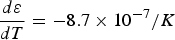 $\displaystyle{{d{\rm \varepsilon} } \over {dT}} = - 8.7 \times 10^{ - 7} /K$
Laser Parameters
r 0 (r 0g = r 0n) = 50 to 100 cm, initial power P 0 = 0.5 to 5.0 MW and wavelengths 1.045 μm, 1.625 μm and 2.141 μm (water absorption windows).
Dimensionless Parameters
With the above data the relevant dimensionless parameters lie in the ranges indicated as follows;
 $$\Lambda = \displaystyle{{{\rm \alpha} _a } \over {4{\rm \pi} {\rm \chi} }}\displaystyle{{P_0^{} } \over {r_{0n}^2 }}\displaystyle{{d{\rm \varepsilon} } \over {dT}}\semicolon \; 10^{ - 6} \;to\; 5 \times 10^{ - 4}\comma \;$$
 $${\rm \beta} = r_0 \lpar {\rm \alpha} _a + {\rm \alpha} _s \rpar \semicolon \; 2.5 \times 10^{ - 5} \;to\; 2 \times 10^{ - 4}\comma \;$$
and
 $${\rm \rho} _0 = \lpar r_0 {\rm \omega} /c\rpar = \lpar 2{\rm \pi} r_0 /{\rm \lambda} \rpar \semicolon \; 1.5 \times 10^6 \;to\; 6 \times 10^6.$$
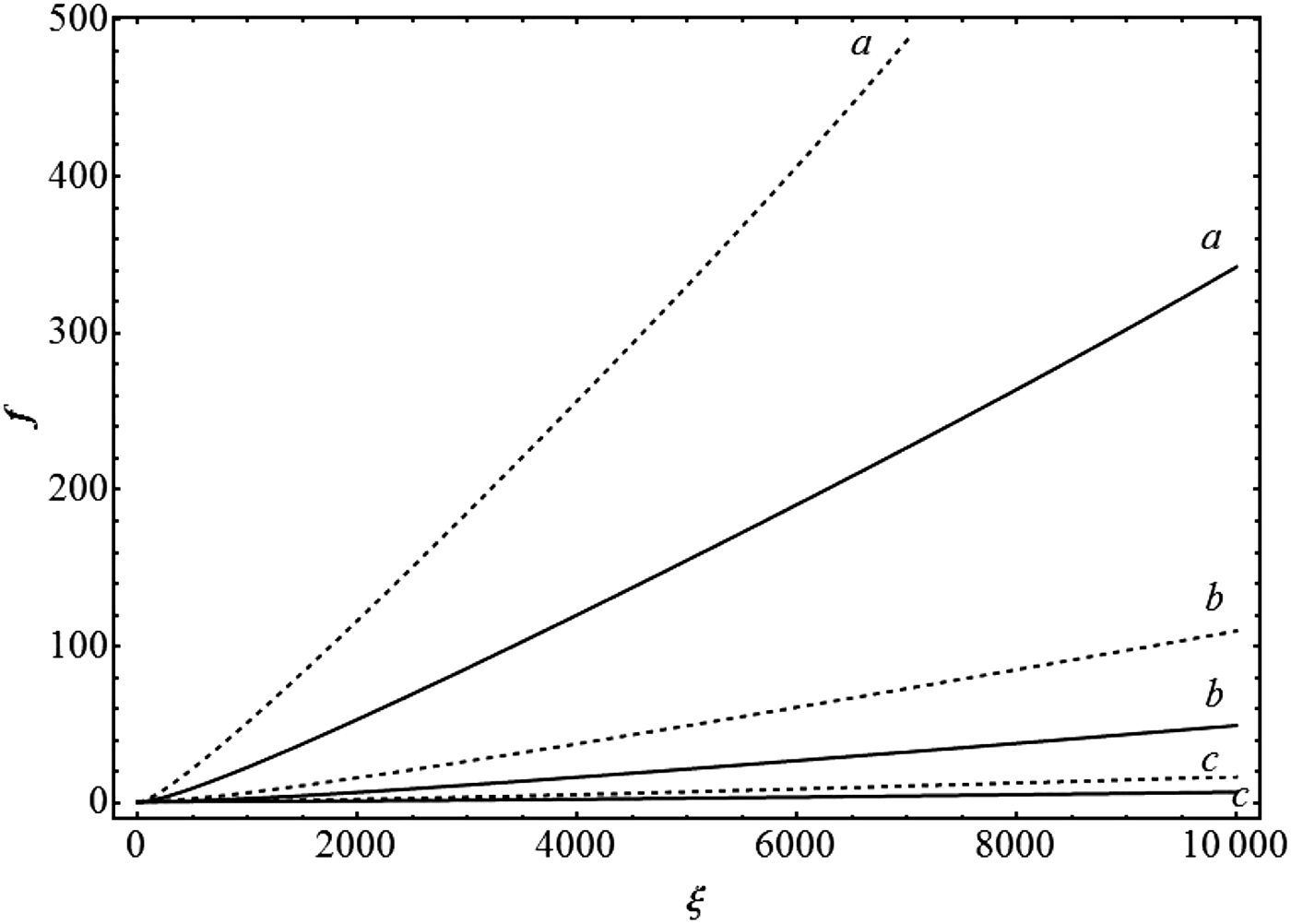
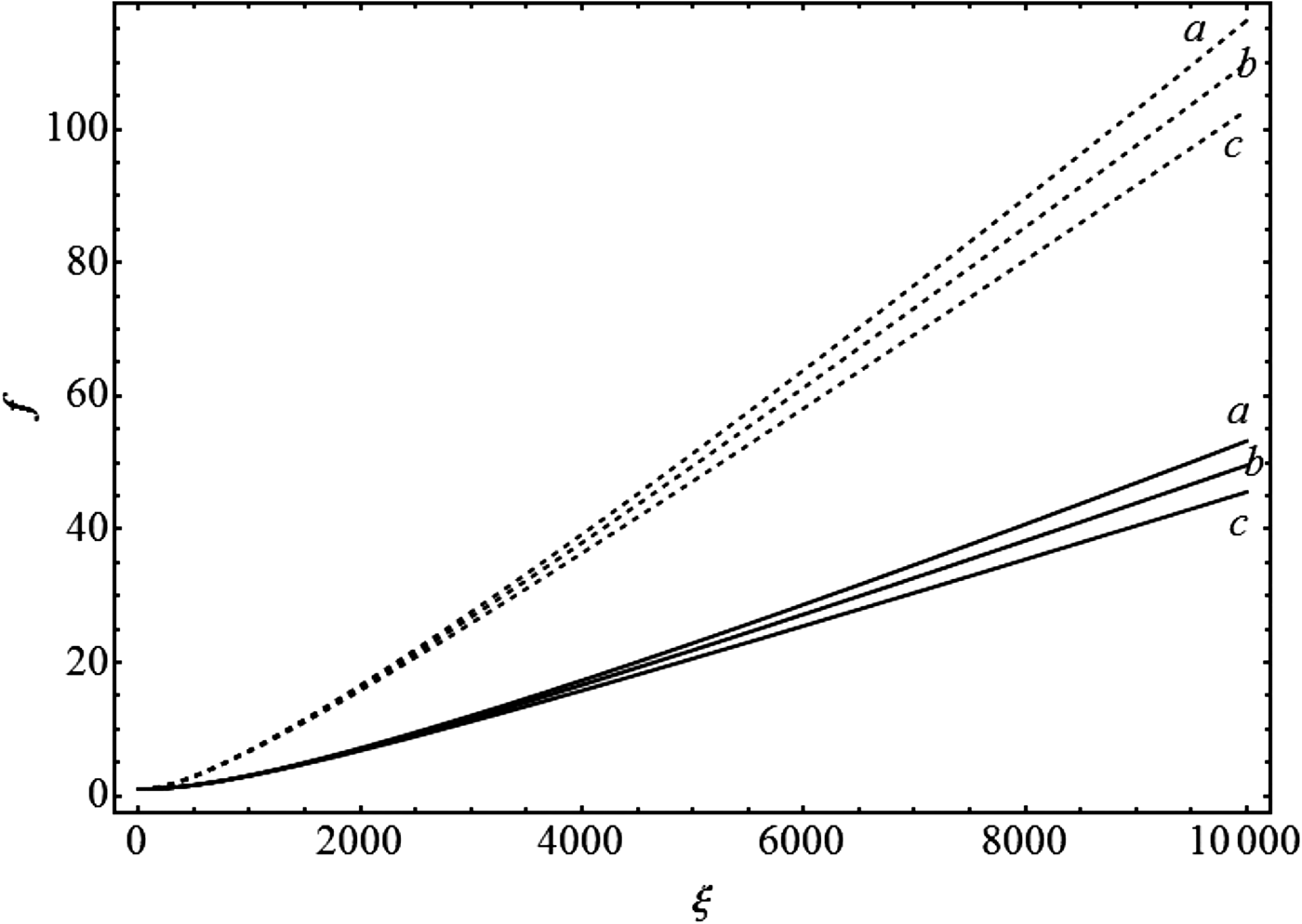
Figure 1 illustrates the dependence of the focusing parameter f on dimensionless distance of propagation ξ for different values of Λ (proportional to the product of initial beam power and the absorption coefficient). It is seen that f (or defocusing) increases with increasing Λ and that it is very much less for a hollow Gaussian beam as compared to that for a Gaussian beam; the physical reasoning for this fact is rather simple. In the central portion of a dark hollow beam 0 < r < r m the temperature increases radially, while in the peripheral region the temperature decreases radially; the maximum irradiance of the beam occurs at r = r m. Hence the dielectric function decreases radially in the central r < r m portion of beam which tends to focus the beam, while the peripheral portion of the beam (in which ɛ increases with r) defocuses. Hence in contrast to a Gaussian beam the central r <r m portion of HGB tends to focus the beam, while the peripheral portion of the beam defocuses. As a result the defocusing in case of HGB is much less than that in case of Gaussian beams, where all portions of the beam defocus. Fig. 2 indicates the dependence of f on ξ for different values of β. It is seen that f or defocusing decreases with increasing β this is due to the fact that the thermal effect decreases as the beam propagates due to decrease in the beam power, corresponding to enhanced absorption. Fig. 2 also indicates much reduced defocusing for the hollow Gaussian beam, as compared to a Gaussian beam. Computations also lead to an interesting conclusion that f – ξ relationship is independent of ρ0 and to a good approximation f ∝ ξ (=z/r 0) and hence inversely proportional to r 0 at a given position (value of z).
Dependence of beam width parameter f on dimensionless distance of propagation ξ for different values of Λ (proportional to the product of initial beam power and the absorption coefficient) for β = 10− 4 and ρ = 4.5 × 10⁶; where a, b and c refer to Λ = 5 × 10− 4, 2 × 10− 5 and 10− 5 respectively. The broken and full curves correspond to Gaussian and hollow Gaussian beams, respectively.
Dependence of beam width parameter f on dimensionless distance of propagation ξ for different values of attenuation constant β = r 0 (αa + αs ) for Λ = 2 × 10− 5 and ρ = 4.5 × 10⁶; where a, b and c refer to β = 5 × 10− 4, 2 × 10− 5and 10−5 respectively. The broken and full curves correspond to Gaussian and hollow Gaussian beams, respectively.
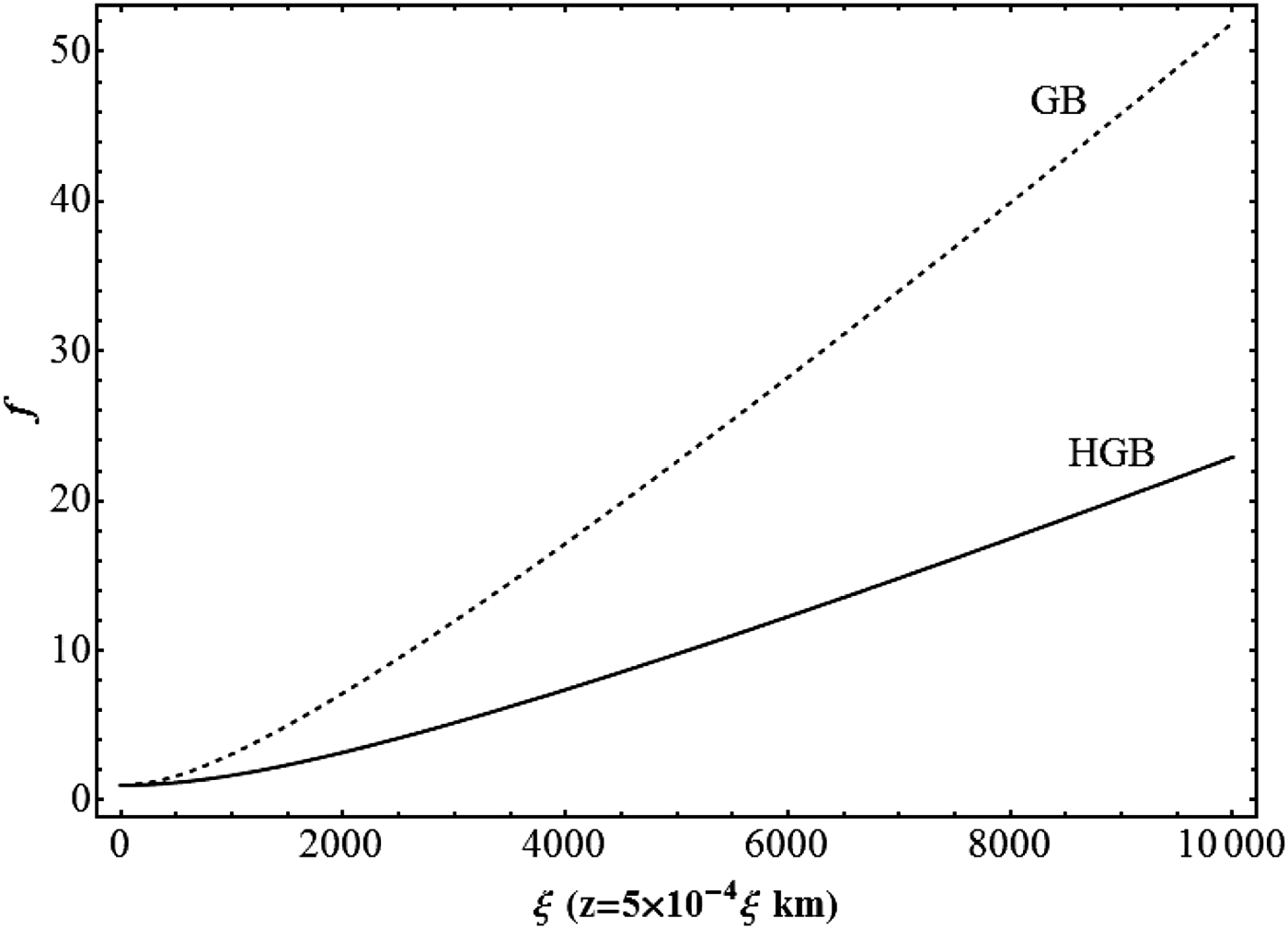
In addition to the dimensionless discussion (Figs. 1 and 2), it will also be of general interest to consider a specific case of propagation (in maritime environment) viz. λ = 1.045 μm, P0 = 1 MW, αa = 2 × 10⁻³ km−1, αs = 1.2 × 10⁻¹ km−1 and r 0 = 50 cm; the dependence of the beam width parameter f on the distance of propagation z in km is shown in Figure 3. This figure also highlights the fact that an HGB defocuses significantly less than a corresponding Gaussian beam of same radius and power.
Dependence of beam width parameter f on dimensionless distance of propagation ξ(=z/r 0) in maritime environment; λ = 1.045 μm, P 0 = 1 MW, αa = 2 × 10⁻³km −1, αs = 1.2 × 10⁻¹km −1 and r 0 = 50 cm. The broken and full curves correspond to Gaussian and hollow Gaussian beams, respectively.
CONCLUSION
The thermal defocusing of a hollow Gaussian beam in the atmosphere is much less than that of a corresponding Gaussian beams with the same radius and power.
ACKNOWLEDGEMENT
The authors are grateful to Prof. M. P. Verma for valuable discussion and to Department of Science and Technology, Government of India for financial support.