There is limited information about the chondrichthyan species in the eastern Mediterranean. Although 39 species were reported in Syrian waters (Ali, Reference Ali2003), only one of these was a chimaeroid (Chimaera monstrosa).
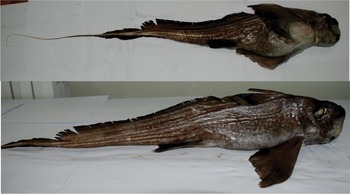
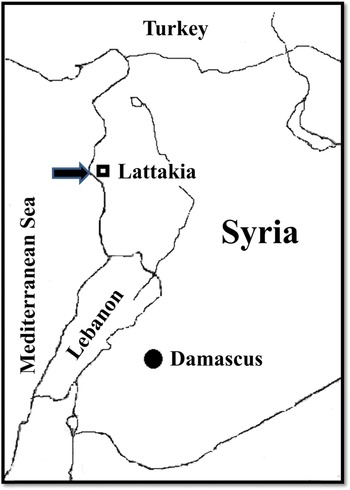
In December 2011, a large female specimen (730 mm total length (L T)) of a large-eyed rabbitfish, Hydrolagus mirabilis (Collett, 1904) (Figure 1) was caught for the first time in Syrian waters (eastern Mediterranean, Lattakia Coast) (Figure 2). The specimen was captured by a trawler at a 500 m water depth and deposited in the Laboratory of Ichthyology (Faculty of Agriculture, Tishreen University). The meristic data and morphometric characteristics of this specimen are as follows: the standard length was 500 mm (68.5% L T) and the body depth was 100 mm (13.7% L T). The head was large (with a blunt snout), with a head length of 70 mm (9.6% L T) and width of 40 mm (5.5% L T). The eye diameter was 24 mm (34.3% L H) and the caudal filament's length was 175 mm. The first dorsal fin (70 mm length, 74 mm height) was erectile, with one spine and 12 soft rays. The second dorsal fin was large (250 mm length, 20 mm height) and spineless with 370 soft rays and a distal margin deeply indented in the middle. The pectoral fin (68 mm length, 130 mm height) had 85 soft rays and the pelvic fin (45 mm length, 73 mm height) had 60 soft rays. The caudal fin (105 mm length, 12 mm height) had 150 soft rays but the anal fin was absent. The colour was dark brown, darker dorsally and lighter to white ventrally. All counts, measurements and other characteristics agree with the taxonomic descriptions of H. mirabilis (e.g. Didier, Reference Didier and Carpenter2002).
Hydrolagus mirabilis, 500 mm standard length, Syrian coast.

Specimen collecting locality (Lattakia, Syrian coast, eastern Mediterranean), from Google Maps, 2010.

Hydrolagus mirabilis, as H. alberti, is distinguished from Chimaera cubana and Chimaera monstrosa by the absence of the anal fin. It is distinguished from H. alberti through the second dorsal fin, where the distal margin is deeply indented in the middle (Didier, Reference Didier and Carpenter2002). Hydrolagus mirabilis is distinguished from Hydrolagus affinis, H. pallidus and H. lusitanicus through the concaved second dorsal fin and through the eyes which are larger than one-third of the head length (Moura et al., Reference Moura, Figueiredo, Bordalo-Machado, Almeida and Gordo2005).
Hydrolagus mirabilis (as with some other Chimaeridae species) is distributed in the eastern and western Atlantic (Uyeno et al., Reference Uyeno, Matsuura and Fujii1983). It has been reported from the Faeroe Islands, France, Ireland and Spain (Stehmann & Bürkel, Reference Stehmann, Bürkel, Whitehead, Bauchot, Hureau, Nielsen and Tortonese1984) and in Namibia, Senegal and West Sahara (Krefft, Reference Krefft, Quero, Hureau, Karrer, Post and Saldanha1990). Hydrolagus mirabilis is bathydemersal and lives in the marine deep-water (450–1200 m) (Krefft, Reference Krefft, Quero, Hureau, Karrer, Post and Saldanha1990). It is moderately common on the continental slopes and feeds on small fishes and invertebrates (Breder & Rosen, Reference Breder and Rosen1966). This species is not known to be taken in the commercial catch but is occasionally taken as a minor by-catch in trawls.
Data on the geographical distribution of this and related species are based primarily on fishing records and more extensive sampling in deep waters is needed to better establish a comprehensive picture of the geographical range for such species.