INTRODUCTION
Narratives have been widely used to study aspects of language production and acquisition in both typically developing children and children with linguistic and developmental problems (Botting, Reference Botting2002; Loveland & Tunali, Reference Loveland, Tunali, Baron-Cohen, Tager-Flusberg and Cohen1993; Wetherell, Botting & Conti-Ramsden, Reference Wetherell, Botting and Conti-Ramsden2007). Narratives, and especially elicited narratives, require children to make out the story presented in the elicitation material, remember the storyline and a sufficient amount of detail to tell a comprehensive story, and present the narrative in a coherent way that is typical of their language (Berman, Reference Berman and Bavin2009; Berman & Slobin, Reference Berman and Slobin1994; Slobin, Reference Slobin, Gumperz and Levinson1996).
Some children find it particularly difficult to tell a story. Children with autism have difficulties reading other people's minds (Baron-Cohen, Leslie & Frith, Reference Baron-Cohen, Leslie and Frith1985; but see Bowler, Reference Bowler2007; Hobson, Reference Hobson1991, Reference Hobson1993). Therefore they may fail to grasp the motivations behind story characters’ actions, and their stories may appear terse because they are lacking in descriptions of the characters’ thoughts and feelings. At a deeper level, an inability to ascribe intentions, feelings, and thoughts to the characters may lead to a weaker grasp of the storyline (Bamberg & Damrad-Frye Reference Bamberg and Damrad-Frye1991). Children with developmental language impairment do not have problems understanding the motivations behind actions, but they struggle with the use of grammar and vocabulary. These children may thus lack the linguistic means to tell a story (Colozzo, Gillam, Wood, Schnell & Johnston, Reference Colozzo, Gillam, Wood, Schnell and Johnston2011; Liles, Duffy, Merritt & Purcell, Reference Liles, Duffy, Merritt and Purcell1995; Miranda, McCabe & Bliss, Reference Miranda, McCabe and Bliss1998).
In this study, narratives from three groups of children were compared, children with autism, children with language impairment, and typically developing children. The aim of the study is to throw light on the relationship between the children's use of mental-state language about the story characters and their grasp of the storyline. The children's grasp of the storyline is measured by means of the semantic–pragmatic relevance index developed by Norbury, Gemmell, and Paul (Reference Norbury, Gemmell and Paul2014) for the same Frog story as was used in the current study (Mayer, Reference Mayer1967). The children's use of mental-state language is measured by their use of different linguistic categories within three semantic domains: communication, emotions, and thoughts. In terms of linguistic categories, we distinguish purely lexical classification, as in (1), from the use of subordinate clauses or infinitival constructions that give reasons for or elaborate on the contents of the characters’ mental states, as in (2a–b).
-
(1) the boy was mad at the frog
-
(2)
-
a. the frog was glad that it got away
-
b. the frog thinks it is quite funny
-
In this ‘Introduction’ we first summarize earlier studies on narratives from children with autism and children with language impairment, focusing on the types of categories used for the analyses. Then we present the linguistic categories used in the study and their theoretical justification. The introduction ends with a presentation of the predictions.
Narratives by children with autism and children with language impairment
Several studies have compared narratives by children with autism, children with other developmental disorders, and typically developing children. Especially early studies of linguistic expressions in narratives did not focus specifically on mental-state language as they were directly or indirectly influenced by Labov and Waletzky's (Reference Labov, Waletzky and Helm1967) study of adults’ narratives of personal experience and the framework presented there. Labov and Waletzky proposed a distinction between the referential function and the evaluative function of clauses in personal narratives. They described the global structure of narratives as consisting of an orientation, a complication, an evaluation, a result, and, in some cases, a coda. The orientation, complication, and result constitute the backbone of the narrative and fulfil the referential function, but, as pointed out by Labov and Waletzky, a narrative with only these elements “lacks significance: it has no point” (p. 33) and may even be difficult to understand. The evaluation section of narratives, which appears at the height of the complication just before the result section, establishes “some point of personal interest” (p. 34). It may contain, for instance, direct speech or lexical intensifiers (e.g. “He was beat up real, real bad” (p. 37)). The evaluation section thus represents a mixture of expressions of the narrator's personal involvement, inferences, and “attention hookers” (Reilly, Klima & Bellugi, Reference Reilly, Klima and Bellugi1990), i.e. attempts at engaging the audience.
Most studies of narratives by children with developmental impairments are based on data elicited by means of stimuli such as a picture-book (for studies of narratives of personal experience, see, however, Goldman, Reference Goldman2008; Losh & Capps, Reference Losh and Capps2003; McCabe, Bliss, Barra, & Bennett, Reference McCabe, Bliss, Barra and Bennett2008; Miranda et al., Reference Miranda, McCabe and Bliss1998). There is a huge difference between telling a story about a personally experienced life-threatening situation (Labov & Waletzky, Reference Labov, Waletzky and Helm1967) and telling a story based on prefabricated stimuli. Nevertheless, Labov and Waletzsky's distinction between the referential and the evaluative function of narratives has been transferred to studies of these other types of narratives, especially the linguistic categories set up by Labov and Waletzky to characterize the evaluation section. The categories were further developed by Reilly et al. (Reference Reilly, Klima and Bellugi1990) and Bamberg and Damrad-Frye (Reference Bamberg and Damrad-Frye1991), and they are used in one form or another in studies of narratives by children with autism (Capps, Losh & Thurber, Reference Capps, Losh and Thurber2000; Losh & Capps, Reference Losh and Capps2003; Norbury & Bishop, Reference Norbury and Bishop2003; Tager-Flusberg, Reference Tager-Flusberg1995; Tager-Flusberg & Sullivan, Reference Tager-Flusberg and Sullivan1995) and by children with language impairment (Botting, Reference Botting2002; Norbury & Bishop, Reference Norbury and Bishop2003). In these studies, under the category of evaluation we find subcategories such as direct speech, causal connectors (e.g. because), sound effects, negation, and hedges (e.g. he could be there). This is a very heterogeneous group of linguistic expressions that is not based on an understanding of the specific problems of children with socio-cognitive or linguistic problems.
Some studies account for the subcategories of evaluation separately, which makes it possible to focus specifically on the children's use of mental-state language. They distinguish, for instance, emotion verbs, emotion adjectives, and cognitive verbs (Capps et al., Reference Capps, Losh and Thurber2000; Colle, Baron-Cohen, Wheelwright & van der Lely, Reference Colle, Baron-Cohen, Wheelwright and van der Lely2008; Norbury & Bishop, Reference Norbury and Bishop2003; Tager-Flusberg, Reference Tager-Flusberg1995; Tager-Flusberg & Sullivan, Reference Tager-Flusberg and Sullivan1995). However, these studies did not find differences between children or adults with autism and the comparison groups on these measures. Using a greater repertoire of mental-state expressions, Baron-Cohen, Leslie, and Frith (Reference Baron-Cohen, Leslie and Frith1986) found that children with autism produced significantly fewer narratives with mental-state expressions than typically developing children and children with Down's syndrome when talking about cartoons about everyday activities involving false beliefs (cf. also Barnes, Lombardo, Wheelwright & Baron-Cohen, Reference Barnes, Lombardo, Wheelwright and Baron-Cohen2009, on adults with autism). Rumpf, Kamp-Becker, Becker, and Kauschke (Reference Rumpf, Kamp-Becker, Becker and Kauschke2012) also focused specifically on mental-state language in narratives, this time by German-speaking children with autism. Their categories included lexical expressions of, among others, emotion, evaluation, and cognition. They found a significant difference between the children with autism and the typically developing children on the total number of mental-state expressions and on several subcategories. By contrast, in a study of English-speaking children, Norbury et al. (Reference Norbury, Gemmell and Paul2014) did not find any difference between the children with autism and the typically developing children when using a slightly different main category of mental-state language, including lexical expressions of emotions, thoughts, and character intentions. This study also included a group of children with language impairment, and they produced fewer instances of mental-state expressions than both the group with autism and the group of typically developing children.
The results are thus far from conclusive, but the studies are also difficult to compare because of differences in methodology and in the participants’ age and degree of impairment. The study by Rumpf et al. (Reference Rumpf, Kamp-Becker, Becker and Kauschke2012), which found group differences, demonstrates the advantage of using linguistic categories derived from hypotheses about how the socio-cognitive problems of children with autism may be reflected linguistically. Rumpf et al., distinguished, for instance, terms for “mental, cognitive states, expressions of knowledge, belief, remembrance” (p. 1400) from terms “[l]abeling discrete emotions” or “referring to expressive behavior” (p. 1400). They found that the children with autism used significantly fewer terms of cognition than the typically developing children, but there was no difference in their use of emotion terms. None of the studies distinguished lexical expression and clausal expression of mental states.
Lexical vs. clausal expression of mental states
Linguistic expressions that describe others’ inner mental states and activities, such as what the characters think or know, can be expected to be more sensitive to socio-cognitive impairment than expressions denoting “expressive behavior” (Rumpf et al., Reference Rumpf, Kamp-Becker, Becker and Kauschke2012, p. 1400), such as cry or be mad. Crying and being mad can be immediately observed, at least in a picture-book. Frequently used training materials for children with autism include tasks of classifying facial expressions by means of pictures (Nielsen, Møller, Callesen, & Attwood, Reference Nielsen, Callesen and Attwoodn.d.). By contrast, we have to grasp intuitively or infer what others are thinking or the reasons for their crying. We may thus expect a child with autism to find it easier to name the facial expression of a character in a story-book by means of a lexeme (he is happy) than to express the contents of the characters’ thoughts or the reasons for their emotions by means of a subordinate clause (he is happy that the frog came).
Therefore, a theoretical aim of the present study is to explore the utility of using functional linguistic categories that can be expected to reflect the socio-cognitive problems of children with autism. Specifically, we distinguish between clausal expressions that involve the contents of or reasons for the mental states and activities, as in (2a–b), and those that do not, as in (1). The former are here called mental-state clauses, the latter lexical expressions of mental states (see also the ‘Appendix’ in the online supplementary material, available at <journals.cambridge.org/JCL>). Most earlier studies have not made this distinction (but see Baron-Cohen et al., Reference Baron-Cohen, Leslie and Frith1986, p. 113, on “Intentional states with content”).
If linguistically competent children with autism use fewer mental-state clauses than typically developing children, we shall get a better understanding of how these children's socio-cognitive difficulties manifest themselves linguistically. By contrast, mental-state clauses can be expected to be difficult for children with language impairment because of their difficulties with subordinate clauses. That is, if both groups have problems with these expressions, but the children with autism have age-appropriate linguistic skills, it is reasonable to conclude that the children with autism fail for cognitive reasons, the children with language impairment most likely for linguistic reasons.
A demonstration of a difference between children with autism and typically developing children on lexical versus clausal expressions of mental states and activities may further substantiate analyses of such expressions in a cognitive linguistic framework as they give independent cognitive evidence for the analyses (Langacker, Reference Langacker, Janssen and Redeker1999).
Communication reports vs. reports of thoughts and emotions
Within the category of mental-state clauses, we make a main distinction between communication reports and reports of thoughts and emotions because communication is public for everyone to hear, while thoughts and emotions are covert. When others speak, they state their thoughts or emotions publicly. If we are present in the situation when an action takes place, we do not have to infer someone's emotional state or thoughts if they make them public by talking about them. We can immediately register their wishes, emotions, or intentions based on what they say, if they are sincere at least. By contrast, if someone does not say anything, we only have intuitive access to the reasons for their emotions or the contents of their thoughts. As the grasp of what takes place in others is particularly difficult for children with autism (Frith, Reference Frith2003; Tager-Flusberg, Reference Tager-Flusberg1992), we expect them to prefer to talk about the contents of others’ mental states and activities as communication reports than to talk about them as reports of thoughts or reasons for emotions.
The distinction between reports of publicly expressed mental states as in character speech and reports of thoughts and reasons for emotions is not made in earlier studies of narratives. The distinction is primarily semantic. Communication can be expressed by finite and non-finite clauses alike, as in (3) and (4).
-
(3) and he shouts to the frog that it should come back (communication, finite)
-
(4) so the boy asks the dog to go to one side of the tree (communication, non-finite)
The same is true of expressions of emotions as in (5) and (6), and thoughts, including intentions, as in (7) and (8) (cf. also the ‘Appendix’).
-
(5) and the frog is pleased that it managed to get away (emotions, finite)
-
(6) he was pleased to see the boy and the dog (emotions, non-finite)
-
(7) the frog thinks it is quite funny (thoughts, finite)
-
(8) they make themselves ready to catch it (intentions, non-finite)
When telling a story that they have not heard before, children themselves must create the contents of both publicly expressed communication and of the characters’ thoughts and emotions based on their understanding of the story. Therefore both reports of communication and reports of thoughts and emotions can be expected to be difficult for children with autism. But we expect children with autism to prefer communication reports to descriptions of inner mental states since children with autism are trained to pay attention to observable signals of others’ mental life.
Direct speech vs. indirect speech
A further distinction made in this study is the distinction between communication reports in the form of direct speech and communication reports in the form of indirect speech. The reason for making this distinction is that direct speech is mono-perspectival, presenting the quotation from the original – source – speaker's perspective only (Clark & Gerrig, Reference Clark and Gerrig1990; Evans, Reference Evans, Brown, Chumakina and Corbett2012). A direct-speech report may appear as a verbatim quotation of the source speaker's utterance, as in (9).
-
(9) and the frog said, “no no don't hurt me” (direct speech)
It requires the reporting speaker to take another individual's perspective. Indirect speech is bi-perspectival in that it mixes the reporting speaker's perspective in the choice of deictic terms with the source speaker's perspective in the contents of the quotation, as in (10).
-
(10) and he shouts to the frog that it should come back (indirect speech)
The socio-cognitive demands on the reporting speaker differ in the two cases. Moll and Meltzoff (Reference Moll, Meltzoff, Roessler, Lerman and Eilan2011) distinguish two steps in children's perspective-taking development. First, children learn to take perspectives. Second, they learn to confront perspectives as in the classical theory-of-mind tasks. In direct speech reports the reporting speaker takes another individual's perspective. In indirect speech reports, the two perspectives are not contrasted, but they have to be integrated in one syntactic construction by the reporting speaker. Moreover, indirect speech may include markers of grammatical subordination not found in direct speech, e.g. a complementizer (that), as in example (10). Thus, for both socio-cognitive and linguistic reasons, direct speech is expected to be the preferred form of communication report by both children with socio-cognitive and children with linguistic impairment compared with typically developing children. A full list of the categories used for the analysis can be seen in the ‘Appendix’.
Predictions
The participants in this study are Danish-speaking children with autism, children with developmental language impairment, and typically developing children who do not differ significantly on chronological age and non-verbal cognitive ability (see below). The children with autism and the typically developing children do not differ significantly on receptive and productive vocabulary and grammar either.
The predictions concentrate on the relationship between the children's grasp of the storyline and their understanding of the characters’ thoughts, emotions, and intentions (predictions 1 and 2) and on the relationship between what is particularly difficult for – or accessible to – children with autism within the socio-cognitive domain, and its linguistic expression (predictions 3–5):
-
1. The children with autism and the children with language impairment will mention fewer content elements as measured by the semantic–pragmatic relevance index (SPRI) than the typically developing children (Norbury et al., Reference Norbury, Gemmell and Paul2014), but for different reasons. The children with autism have an impaired understanding of the story characters’ mental states and activities, and the children with language impairment have linguistic difficulties.
-
2. We expect to find a correlation between the scores on the measure of content elements (SPRI) and the scores on the total number of mental-state expressions (lexical and clausal expressions of communication, of thoughts, and of emotions) for all groups as the story used in the study involves the characters’ intentions and feelings.
-
3. The children with autism and the children with language impairment will use fewer subordinate mental-state clauses of communication, thoughts, and emotions than the typically developing children, again for different reasons: the children with autism can be expected to have greater problems grasping the content of the story characters’ mental states, and the children with language impairment greater problems with expressing mental states in clausal form that requires grammatical subordination (see examples (3–8)).
-
4. The children with autism will prefer to talk about mental states and activities in terms of communication – what the story characters say – to a greater extent than the typically developing children. There is no difference in grammatical complexity between subordinate clauses about communication and subordinate clauses about thoughts and emotions, i.e. between publicly expressed mental states, as in examples (3–4), and covert mental states, as in examples (5–8). Therefore, the children with language impairment should not differ from the typically developing children on this measure, provided that the children with language impairment manage to construct subordinate clauses at all.
-
5. The children with autism and the children with language impairment will use more direct speech (see example (9)) than the children with typical development because of the reduced socio-cognitive demands and the less complex syntax of direct speech compared with indirect speech.
METHOD
Participants
The participants in this study are twenty-seven Danish-speaking children with autism (ASD, 23 male), twelve children with developmental language impairment (LI, 9 male), and thirty typically developing children (TD, 16 male). The children with autism were recruited from three special schools in the greater Copenhagen area. A criterion for admission to the special schools for children with autism in Denmark is a diagnosis within the autism spectrum based on psychiatric evaluation. Ten of the children with language impairment were recruited from language units and two from the caseload of speech and language pathologists (SLPs). Admission to school language units is based on SLP and psychological evaluations showing significant difficulties with spoken language, but unimpaired non-verbal cognitive skills. The typically developing children were recruited from general schools in Copenhagen.
The parents of the children in all three groups gave informed, written consent that the children participate in the research study.
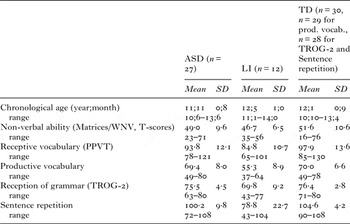
The children were between 10;6 and 14;0, most were eleven to twelve years of age (see Table 1). Non-parametric analyses of variance with the Kruskal–Wallis test showed that the three groups did not differ significantly on chronological age (H(2) = 1·49, p = ·47) or on non-verbal cognitive skills measured by the Matrices subtest of the Wechsler Non-verbal Scale of Ability (WNV; Wechsler & Naglieri, Reference Wechsler and Naglieri2009) (H(2) = 4·34, p = ·11) (see Table 1). The ASD and TD groups did not differ significantly on receptive vocabulary (U = 342·50, z = –0·81, p = ·42) measured by a Danish non-standardized version of the Peabody Picture Vocabulary Test (PPVT; Dunn & Dunn, Reference Dunn and Dunn1981; Danish version by Bremer Nielsen, Reference Bremer Nielsen2008), and the ASD group did not differ from the LI group either (U = 107·50, z = 1·66, p = ·10), but the LI group performed significantly poorer than the TD group (U = 92·50, z = –2·34, p = ·02, r = –0·36). On productive vocabulary measured by a Danish picture-naming test developed for research purposes (Billedbenævnelse; Gellert & Christensen, Reference Gellert and Christensen2012) the ASD and the TD groups did not differ from each other (U = 387·50, z = 0·28, p = ·78), but both groups differed significantly from the LI group (H(2) = 20·79, p < ·001; TD – LI: U = 23·50, z = 4·37, p < ·001, r = 0·67; ASD – LI: U = 31·50, z = 3·98, p < ·001, r = 0·64). On reception of grammar measured by items correct in the Danish version of the Test of Reception of Grammar-2 (TROG-2; Bishop, Reference Bishop, de Lopez, Knüppel and Olsen2010), the ASD and the TD groups did not differ from each other (U = 360·00, z = 0·31, p = ·76), but both differed significantly from the LI group (H(2) = 10·73, p < ·01; TD – LI: U =59·50, z = 3·23, p = ·001, r = 0·50; ASD – LI: U = 76·00, z = 2·63, p < ·01, r = 0·42). On a test of sentence repetition, which included subordinate clauses (Christensen, Jensen & Nielsen, Reference Christensen, Jensen and Nielsen2012), there was a trend towards a significant difference between the ASD and TD groups (U = 272·00, z = –1·80, p = ·07), and again both differed significantly from the LI group (H(2) = 21·24, p < ·001; TD – LI: U = 18·50, z = 4·44, p < ·001, r = 0·69; ASD – LI: U = 51·00, z = 3·39, p = ·001, r = 0·54).
Descriptive statistics for chronological age, non-verbal cognitive skills, receptive and productive vocabulary, grammar comprehension, and grammar production

Procedure
All the assessments took place in a quiet room at the participants’ schools. Language production tasks were audio-recorded digitally on an Olympus LS-11 recorder for later transcription and scoring.
The children's narratives were elicited by means of the wordless picture book A Boy, a Dog, and a Frog (Mayer, Reference Mayer1967). The children were first asked to leaf through the book to get an idea of what the story is about. They were then asked to tell the story to the experimenter (one of the authors or a trained student). The experimenter turned their back to the child to reduce the possibility of the child pointing to the pictures and to encourage the child to tell as comprehensive a narrative as possible. This unusual behaviour had the further advantage that the experimenter could avoid eye contact with the children with ASD, thereby reducing the number of disturbing elements in the environment for a child with autism. The children were allowed to look at the pictures while telling the story. The experimenter responded by back channel signals, including laughter at appropriate moments, to make the child comfortable.
In this type of experiment, children are asked to generate a story based on pictures. On the one hand, they are not free to generate whatever story they please, as they are presented with a source; on the other hand, they cannot retell something they have heard: they need to create a story that fits the contents of the pictures. The demands are quite high on their ability both to extract a coherent narrative from pictures and to represent it linguistically (cf. Botting, Reference Botting2002).
A Boy, a Dog, and A Frog is a story about a boy who goes fishing or frog-catching with his dog. In a pond he sees a frog. After several unsuccessful attempts to catch the frog, also involving the dog, the boy gives up and walks home with the dog. The frog follows their footprints and arrives in the boy's bathroom where the boy is having a bath with the dog. The frog joins them. This story was chosen because the boy's and the frog's intentions are reasonably clear all through the story, there is much interaction involving all three characters, and the boy and the frog have emotional reactions that can be picked up from their facial expressions in the drawings.
The narratives were analyzed for their contents according to the semantic–pragmatic relevance index developed by Norbury et al. (Reference Norbury, Gemmell and Paul2014), hereafter called SPRI. These authors divided a fictive full version of the story into thirty-three propositions, each with a number of content units (the underlined elements), e.g. 1. There was a boy and a dog 2. at a pond. 3. Boy or boy and dog are going fishing or frog catching 4. with a net and a bucket (see the Appendix of Norbury et al., Reference Norbury, Gemmell and Paul2014). Two points are given when all the underlined content units of a proposition are found in a child's narrative. By way of example, a child's sentence så den følger efter dem, følger deres spor ‘so it follows them, follows their footprints’ combines propositions 24 (‘The boy and the dog leave footprints’) and 26 (‘He followed the footprints’). In the example, the sentence got a score of four for mentioning ‘He’ (den ‘it’), ‘followed’ (følger ‘follows’), and the footprints with the ones who left them (deres spor ‘their footprints’). As the example demonstrates, it was not important that the children used specific words; the content was what mattered. For instance, all the words sø ‘lake’, dam ‘pond’, and mose ‘bog’ were accepted as equivalents of pond in proposition 2, and pronouns, e.g. han ‘he’, counted as much as nominals like drengen ‘the boy’. That is, we did not examine whether the children made clear references, but interpreted their use of referential expressions to the child's advantage. The maximum possible score on the SPRI is sixty-six.
An initial scoring on the SPRI of seven narratives from the group of children with ASD and eight narratives from the TD group (26% of the narratives by these two groups) by two raters independently (the first author and a trained assistant blind to the group the children belonged to) resulted in 78% agreement. Points of disagreement were systematic, relating to the interpretation of specific propositions in Norbury et al.’s (Reference Norbury, Gemmell and Paul2014) instructions and the distribution of different pieces of information over sentences. This procedure led to more explicit instructions for scoring. The authors subsequently rated eight narratives from the children with LI independently of each other and reached an agreement of 91·6%. After resolution of the points of disagreement, all the other narratives were rescored by the first author.
Besides scoring each narrative on the SPRI, we calculated the total number of mental-state expressions (lexical and clausal). Furthermore, we divided the clauses of each narrative into the three semantic main categories expressing the characters’ mental states and activities communication, emotions, and thoughts (including intentions). The linguistic subcategories are listed in the ‘Appendix’. The main distinction of linguistic expression is:
-
• lexical expression only, e.g. thoughts expressed by a modal verb (such as Danish ville in og så ville de fange frøen ‘and then they wanted to catch the frog’), emotions by a subject complement in the form of an adjective (og frøen ser meget sur ud ‘and the frog looks very mad’), and communication by a verb only (drengen råber af frøen ‘the boy is shouting at the frog’);
-
• expression by means of a subordinate non-finite or finite clause, e.g. thoughts expressed by an infinitive complement after a preposition (de løb ned for at fange frøen ‘they ran in order to catch the frog’), emotions by a causal clause (der blev frøen glad fordi at han fandt endnu mere vand ‘there the frog got pleased because he found even more water’), and communication by a communication report or a causative construction with a verb of saying (så drengen beder hunden om at gå hen på den ene side af træet ‘so the boy asks the dog to go to one side of the tree’). Such expressions are what we will call mental-state clauses.
This gives the following categories besides the total number of mental-state expressions (lexical and clausal):
-
• Mental-state clauses (Communication, Thoughts, Emotions)
-
• Communication clauses
-
• Thought clauses
-
• Emotion clauses
The descriptions here called communication clauses include all cases of direct speech even when the content was not clausal, such as one-word greetings or exclamations (e.g. drengen siger “oj” ‘the boy says “oj”’), and even when it was not subordinate because there was no introductory clause such as he said. This construction type was found in the narrative from a child with autism who told the entire story as character speech (fifteen utterances) without any framing like the boy said. He only changed his voice quality.
Within the category of Communication we compared the participant groups with respect to their use of direct speech reports.
RESULTS
The semantic–pragmatic relevance index (SPRI)
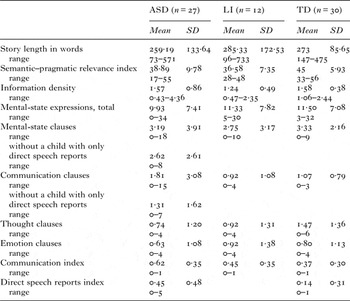
There was no significant group difference in narrative length as measured by number of words (H(2) = 1·85, p = ·40) (see Table 2). For this reason we did not use a relational measure of the contents of the children's narratives as did Norbury et al. (Reference Norbury, Gemmell and Paul2014), who found significant group differences in narrative length.
Descriptive statistics for story length in words, the semantic–pragmatic relevance index (SPRI), information density, total number of mental-state expressions, total number of clausal mental-state expressions, number of clausal expressions of Communication, of Thoughts, and of Emotions. For the Communication index and the Index of direct speech reports, only the children who did use speech reports are included (ASD: n = 19, LI: n = 8, TD: n = 24).

As mentioned, the SPRI is an index of the relevant contents of each narrative with a maximum possible score of sixty-six (Norbury et al., Reference Norbury, Gemmell and Paul2014). As hypothesized in the first prediction, results of the Kruskal–Wallis test showed a significant effect of group on this score (H(2) = 11·68, p = ·003). Follow-up analyses with the Mann–Whitney test revealed that both groups with impairment provided significantly fewer components of the storyline than the TD children (ASD – TD: U = 248, z = –2·51, p = ·012, r = –0·33; LI – TD: U = 71, z = –3·04, p = ·002, r = –0·47), and the effect sizes were moderate (above the ·3 criterion, but below the ·5 criterion).
The SPRI scores did not correlate significantly with chronological age, grammar comprehension, sentence repetition, or non-verbal cognitive skills for any of the groups, but correlated with vocabulary for the children with ASD only (vocabulary comprehension: ρ = ·57, p = ·002, vocabulary production: ρ = ·59, p = ·001). The children with ASD and low scores on receptive and productive vocabulary gave less relevant information, as measured by the SPRI.
As a background to the measures of mental-state expressions, we gauged information density as each child's score on the SPRI divided by the child's total number of sentences. There was no significant effect of group on information density in the narratives (H(2) = 5·145, p = ·076), but we suspected this result to be due to the very substantial variation in the group with ASD (Table 2). For this reason we compared the groups with LI and TD and found a significant group difference (LI – TD: U = 88·5, z = –2·548, p = ·011, r = –0·39). Taking story length into account, the children with LI still produced less relevant information than the TD children.
Expressions of mental states and activities
A Kruskal–Wallis test showed no effect of group on the total number of expressions of mental states and activities (Communication, Emotions, and Thoughts) (H(2) = 0·86, p = ·65) (Table 2). Neither was there any group effect on the total number of expressions within each category Communication (H(2) = 4·51, p = ·11), Emotions (H(2) = 1·30, p = ·52), and Thoughts (H(2) = 2·05, p = ·36). As hypothesized in the second prediction, for all three groups, the children's total number of mental-state expressions correlated with their scores on the SPRI. The correlations were strong for the TD children and the children with LI, but moderate for the children with ASD (TD: ρ = ·75, p < ·001; LI: ρ = ·82, p < ·02; ASD: ρ = ·49, p = ·01). For the children with LI and the TD children, there was also a strong correlation between their total number of mental-state clauses and their scores on the SPRI (LI: ρ = ·68, p = ·02; TD: ρ = ·75, p < ·001). For the children with ASD, the correlation was again moderate (ASD: ρ = ·49, p = ·01). This last result reflects the fact that some of the children with ASD scored relatively high on the SPRI without using as many expressions of mental states and activities and especially clausal expressions as the children with LI and TD.
Contrary to what we expected (cf. the third prediction), a Kruskal–Wallis test showed no effect of group on the total number of mental-state clauses (Communication, Emotions, and Thoughts) (H(2) = 2·49, p = ·29). Looking at the individual semantic categories, we found a significant effect of group on the number of clauses expressing thoughts (H(2) = 7·19, p = ·03), but not communication clauses (H(2) = 1·11, p = ·57) or emotion clauses (H(2) = 0·51, p = ·77) (Table 2). Mann–Whitney follow-up tests of the results for thought clauses showed a significant difference with a moderate effect size between the children with ASD and TD (U = 248·5, z = –2·64, p < ·01, r = –0·34), but no significant difference between the children with LI and TD (U = 130·0, z = –1·45, p = ·15). That is, only the children with ASD used significantly fewer clauses expressing thoughts than the TD children. On average, all children used few emotion clauses, and the children with ASD used more communication clauses than the TD children, however, not significantly so (Table 2).
To test the fourth prediction, we calculated an index of preference for communication as the number of communication clauses of the total number of mental-state clauses for each child, i.e. a measure between ·00 (no communication clauses) and 1·00 (only communication clauses), leaving out children with no mental-state clauses at all. A Kruskal–Wallis test showed an effect of group (H(2) = 6·00, p = ·05). Mann–Whitney follow-up tests showed a significant difference between the children with ASD and the children with TD (U = 159·00, z = –2·410, p = 0·02, r = –0·37) and no other group differences (LI – TD: U = 100·5, z = –0·78, p = ·45; LI – ASD: U = 65·5, z = 0·24, p = ·25). The children with ASD had a significantly higher proportion of communication clauses of their total number of mental-state clauses than the TD children.
Direct speech reports
As the children with LI used very few communication clauses at all (altogether eleven clauses by eight children), we did not include them in the following comparison of the use of direct speech. In order to test the fifth hypothesis, we calculated an index of preference for direct speech as the proportion of direct speech reports of the total number of speech reports, leaving out children who used no speech reports. Here a measure of ·00 indicates that the child does not use any direct speech and only indirect speech, a measure of 1·00 that the child only uses direct speech and no indirect speech. A Mann–Whitney test showed that the children with ASD who did use speech reports (n = 19) used significantly more direct speech reports than the TD children who used speech reports (n = 24). The effect size was moderate (U = 147·0, z = –2·343, p = ·02, r = –0·36) (Table 2).
DISCUSSION
Summary of results
As hypothesized in prediction 1, the children with ASD and the children with LI had lower scores on the SPRI than the TD children. We also found significant correlations between the children's scores on the SPRI and their total number of mental-state expressions (cf. prediction 2). Contrary to our expectations (cf. prediction 3), there was no significant group effect of the children's overall use of mental-state clauses. But it turned out that the children with ASD used fewer thought clauses than the TD children. Furthermore, the children with ASD used relatively more communication clauses than emotion and thought clauses compared with the TD children: the children with ASD preferred to talk about mental states and activities as communication to a greater extent than the TD children (cf. prediction 4). Finally, as hypothesized in prediction 5, the children with ASD used more direct speech reports than the TD children. The children with LI had too few speech reports to be included in the comparisons within the Communication category.
The children with language impairment
There was much variation in the small group of children with LI, but as a group they differed significantly from the TD children only on the linguistic background measures (vocabulary and grammar) and on the SPRI and information density, i.e. the SPRI score divided by the number of sentences.
The difference between the children with LI and the TD children on the SPRI cannot be explained only in terms of lower scores on the linguistic background measures. If their linguistic skills as measured by general tests of grammar and vocabulary had been the only reason for their lower scores on the SPRI, we would expect significant correlations between the SPRI and the linguistics measures. But these correlations were not significant for either the LI or the TD group. In order to qualify this unexpected result, we looked at the results for the individual children.
It follows from our initial predictions that the children with LI who earned very low language test scores (more than 1·25 SD below the mean of the TD children on all four linguistic background measures) should (1) have a poorer grasp of the storyline reflected in particularly low scores on the SPRI, and (2) produce few mental-state clauses, given the grammatical complexity of these expressions. Three children with LI obtained low scores on all included linguistic background measures, and their scores on the SPRI were indeed below average for the group with LI. But taking story length into account, the information density of these children's stories are all within ±1 SD of the LI group's mean. With respect to the grammatically complex mental-state clauses, one of these children did not produce any clausal expressions at all, whereas the other two produced one and two mental-state clauses (the mean for the group with LI was 2·75 and for the TD group 3·33 – Table 2). Thus, the number of subordinate mental-state clauses for these three children was considerably lower than the mean for the TD children, but not much lower than for the other children with LI.
It seems that the children with LI with very low scores on the linguistic background measures were to some extent able to draw on skills that were not measured in these tests. Systematic analyses may reveal that the children with LI conveying surprisingly much relevant information given their language test scores did so at the expense of grammar, e.g. one of the children with very low language test scores saying, og så smile frøen ‘and then the frog smile’ with an infinitive, but nonetheless a score of one point on the SPRI (cf. Colozzo et al., Reference Colozzo, Gillam, Wood, Schnell and Johnston2011; Wetherell et al., Reference Wetherell, Botting and Conti-Ramsden2007). The children's efforts may also be reflected in higher frequencies of pauses or reformulations. Finally, it is possible that they compensate for their linguistic difficulties by drawing on their socio-cognitive skills.
Cautiously, given the small number of children, we may conclude that the children with LI rely as much as the TD children on an understanding of the characters’ mental states to tell a coherent story, since for both groups there was a strong correlation between their scores on the SPRI and their use of mental-state expressions. But the reduced language skills of the children with language impairment strain their capacities to such an extent that their narratives turn out less informative.
The children with autism: the semantic–pragmatic relevance index (SPRI)
We found a significant difference between the children with autism and the typically developing children on the number of content elements in the narratives as measured by the SPRI. This result is not so far from the results in the study by Norbury et al. (Reference Norbury, Gemmell and Paul2014), although they only found a trend towards significance (p = ·19), possibly because their participants varied much more in age (age range 6;6–15;8).
A closer look at the SPRI (Norbury et al., Reference Norbury, Gemmell and Paul2014, pp. 509–510) reveals that eight of the thirty-three propositions concern emotions (propositions 10, 14, 20, 23, 25, 30, 31, 33), three relate to the characters’ intentions (propositions 3, 6, 11), and two are about communication (propositions 15, 21). That is, altogether thirteen of the thirty-three propositions relate to the characters’ mental states and activities. It is thus to be expected that the children's scores on the SPRI correlate with their total number of mental-state expressions. Nevertheless, the correlations were strong only for the TD and LI groups and moderate for the children with ASD. The same pattern is found for the correlations between the children's scores on the SPRI and their total number of mental-state clauses. It seems that some children with ASD were able to tell a story with more content elements than would be expected from their problems with using especially thought clauses, while others used more mental-state expressions than might be expected from their scores on the SPRI.
In order to shed light on this unexpected result for the children with ASD, we took a closer look at the narratives by those children with ASD whose scores on the SPRI diverged from their total number of mental-state expressions. Two children especially used very few mental-state expressions, but nevertheless had average or above-average scores on the SPRI for their group. One told a narrative with content units from seventeen of the twenty propositions without mental-state content in the SPRI. He also included content units from five of the thirteen propositions about mental states. The other child mentioned content units from eighteen of the twenty propositions without mental-state content, and content units from five of the thirteen propositions with mental-state content. Thus both had a good grasp of the storyline almost without mentioning the characters’ thoughts and emotions. Both also had high scores on the tests for expressive vocabulary and grammar comprehension. Solid linguistic skills may have helped them structure the stories even though the results suggest that their socio-cognitive problems made them pay less attention to the characters’ mental states.
Other children with ASD had more mental-state expressions than expected from their scores on the SPRI. As mentioned, one child told the entire story by means of fifteen speech reports with no introductions such as he says. Instead he indicated the speaker by changing his voice quality. This way of telling the story increased his total number of mental-state expressions considerably, but did not necessarily provide much relevant information as measured by the SPRI. Another child with ASD used many expressions of emotions, but as comments to the pictures rather than as a way of forwarding the storyline: Og der der ser frøen lidt ked af det ud ‘And there the frog looks a bit sad’, Og der er han glad ‘And there he is happy’. A third child with ASD used many speech reports in the form of greetings and exclamations ascribed to the characters, but the reports did not gain points as they were not essential to the story. One more child in this group used speech reports about episodes that are seen as deviant from the storyline by the standard of the SPRI. He said, for instance, that the boy asked the frog to leave the bathroom at the end as he and the dog were having a bath. This child seems to have a weak understanding of plots of traditional children's books.
For the children with ASD, the moderate correlations of the total number of (clausal) mental-state expressions and their scores on the SPRI as opposed to the strong correlations of the other two groups point to the complexity of autism. Another sign of this complexity is the fact that the scores on the SPRI correlated significantly with the scores on the tests for receptive and productive vocabulary only in the ASD group. The reason why the children with ASD had lower scores on the SPRI than the TD group may thus be sought in some factor underlying both the ability to grasp and present a storyline and the ability to acquire vocabulary. Some researchers have pointed to the need to distinguish subgroups within the autism spectrum (Tager-Flusberg & Joseph, Reference Tager-Flusberg and Joseph2003), especially autism combined with language impairment (ALI) and autism with normal language abilities (ALN) (Norbury & Nation, Reference Norbury and Nation2011). Although it seems that some of the children with autism were helped by especially good linguistic skills to tell a story with many content elements, the children's scores on the SPRI did not correlate with their scores on the grammar tests, only with their vocabulary skills. Vocabulary acquisition and the ability to make inferences from texts have been linked in research on text comprehension (e.g. Oakhill, Cain & McCarthy, Reference Oakhill, Cain, McCarthy, O'Brien, Cook and Lorch2015). The scores on the SPRI from approximately the same group of children with ASD correlate significantly with their scores on two other tests, one of reading comprehension and one of making inferences from non-fictive texts (Engberg-Pedersen, unpublished observations). This is especially noteworthy as the same TD children as in the present study also took both these other tests, but their scores on the reading tests do not correlate significantly with their scores on the SPRI.
The children with autism: clausal expressions of mental states and activities
As expected from the results by Rumpf et al. (Reference Rumpf, Kamp-Becker, Becker and Kauschke2012) and the nature of autism, the children with ASD used fewer thought clauses than the children with TD. Unexpectedly, there was no difference between the children with ASD and the children with TD in their use of emotion clauses, i.e. expressions explaining why the characters were happy or sad. The reason was probably that the TD children did not talk much about the reasons for the characters’ emotions either.
On average, the children with ASD used more communication clauses than the TD children, but the difference was not significant. However, compared with the children with TD, the children with ASD preferred to talk about the contents of mental states and activities as communication rather than thoughts. In the present study, these two groups of children both generated speech reports in two scenes: (1) the boy communicates with the dog when he wants it to help catch the frog, and (2) he shouts at the frog just before leaving the pond after the failed attempts to catch it. But some of the children with ASD also generated speech reports about situations in the story where none of the TD children used speech reports. The following two examples are descriptions of the same situation by a TD child and a child with ASD, the first with a causal clause motivating the boy's action by his wish, the second with a dialogue between the boy and the frog.
-
TD: han vil række ud for at fange frøen for han vil jo gerne have frøen fange frøen ja, men frøen den hoppede bare væk
-
‘he is about to reach out to catch the frog for he wants the frog to catch the frog yes, but the frog just jumped away’
-
ASD: han siger “kom så her” {fast, in an angry voice}, men frøen siger “kvæk”, drengen siger “oj”
-
‘he says “do come here” {fast, in an angry voice}, but the frog says “croak”, the boy says “oj”’
It seems that some children with ASD try to describe interactions as verbal interaction instead of interaction motivated by mental states. We interpret this as resulting from the children with ASD being less inclined to speculate about what goes on inside the characters in a narrative than the TD children. However, even when the children with ASD comment on the characters’ thoughts, they may use a report in the form of direct speech, as in the following example:
-
ASD: og nu tænker vist drengen nok “det var dråben, nu vil jeg hellere have fang- nu vil jeg fange den frø her”
-
‘and now the boy is probably thinking “that was the last straw, now I'd rather have cau- now I'll catch that frog here”’
The children with autism: direct speech reports
The finding that the children with ASD used more direct speech reports than the TD children appears at odds with earlier studies of narratives. Both Losh and Capps (Reference Losh and Capps2003) and Rumpf et al. (Reference Rumpf, Kamp-Becker, Becker and Kauschke2012) found that typically developing children used more character speech and sound effects than children with autism. But the children in both these studies were younger than the children in our study, which may explain the difference.
To understand the preference for direct speech over indirect speech reports of the children with ASD in our study, we need to take a closer look at the characteristics of the different constructions. Classical accounts of reported speech distinguish three types, direct speech, indirect speech, and free indirect style (for a summary, see Coulmas, Reference Coulmas and Coulmas1986; Evans, Reference Evans, Brown, Chumakina and Corbett2012). The main difference is briefly that direct speech demonstrates what the source speaker is supposed to have said (Clark & Gerrig, Reference Clark and Gerrig1990), indirect speech and free indirect style change the original so that the report reflects the current speaker's deictic perspective. The exact way this is done depends on the grammar of individual languages.
-
direct speech: ASD: så råber drengen og frøen “vi kommer tilbage næste gang”
-
‘then the boy and the frog shout “we'll come back next time”’
-
indirect speech: TD: så står drengen inde ved bredden og råber af frøen at hn- han kommer tilbage tror jeg nok hvor frøen bare sidder og er trist
-
‘then the boy is standing on the shore and shouting at the frog that h- he will be back I think where the frog is just being sad’
In the direct speech example, the child uses the pronoun (vi ‘we’) that the source speaker, the boy, might have used in the (imagined) original communication situation. In the indirect speech example, the child uses the pronoun han ‘he’ appropriate to the current speaker's perspective. Moreover, the indirect speech construction has an initial complementizer at ‘that’, which is, however, optional.
Indirect-speech constructions require the speaker to mix two perspectives. The perspective of the current speaker is expressed in the deictic elements (in the example han ‘he’) and in the way the illocutionary value is marked (in the example, declarative by means of the optional at ‘that’ in contrast to the obligatory om ‘if’ indicating interrogative). The perspective of the source speaker or thinker is responsible for the clausal content of the reported speech or thoughts and for the original illocutionary value (whether it is a declarative, an interrogative, or an imperative). This requirement of perspective mixing may be one explanation why the children with ASD prefer direct speech with a single perspective to a greater extent than the typically developing children. Engberg-Pedersen and Boeg Thomsen (Reference Engberg-Pedersen, Boeg Thomsen, Dancygier, Lu and Verhagen2016) found that approximately the same group of children with ASD scored significantly lower than the typically developing children on a test of comprehension of Danish dialogue particles that require language users to track the interlocutors’ shared knowledge and potential agreement or disagreement, i.e. a different linguistic feature that also requires an understanding of perspective mixing.
Another possible explanation for the ASD children's preference for direct over indirect speech, an explanation that does not preclude the first one, might be that children with ASD have access to other people's minds primarily through what they say. To find out about other people's thoughts they go by what they say. Giving what looks like a verbatim account of others’ thoughts may thus appear to the child as the best way of presenting those thoughts.
CONCLUSIONS
The narratives of three groups of children, children with autism, children with language impairment, and typically developing children, were compared with respect to their grasp of the story content and their expressions of the story characters’ mental states and activities. As the primary aim of the study was to examine the extent to which either socio-cognitive or linguistic difficulties influence children's ability to understand and tell a story and express the characters’ mental states and activities, the children did not differ with respect to chronological age and non-verbal cognitive ability, and the children with autism and the typically developing children did not differ with respect to productive and receptive vocabulary and grammar.
The children with autism and the children with language impairment as groups had significantly lower scores on the semantic–pragmatic relevance index (Norbury et al., Reference Norbury, Gemmell and Paul2014) than the typically developing children. This result supports the results found in the study by Norbury et al.
There was not the clear relationship between the linguistic background measures and the scores on the semantic–pragmatic relevance index for the children with language impairment that we expected. For both the children with language impairment and the typically developing children, there was a strong correlation between their scores on the semantic–pragmatic relevance index and their use of mental-state expressions, as opposed to the only moderate correlation found for the children with autism. Here, the children with language impairment were more similar to the typically developing children than to the children with autism. Moreover, the scores on the semantic–pragmatic relevance index of the children with language impairment and the typically developing children did not correlate significantly with their scores on the vocabulary measures, in contrast to what was seen for the children with autism. We conclude that the children with language impairment tend to use the same resources as the typically developing children when trying to get a grasp of the story, namely their socio-cognitive skills. To some extent, they manage to compensate for their linguistic problems, although their narratives end up less informative than those of the typically developing children. But the conclusions are tentative, as the group of children with language impairment was small with much variance.
The lower scores on the semantic–pragmatic relevance index of the children with autism could not be explained solely by the children's socio-cognitive problems. We suggest that an additional factor influencing the results may be weaker inferencing skills. Poor inferencing skills may lead both to a weaker grasp of the storyline and a smaller or less stable vocabulary. This could explain the significant correlations between the scores on the semantic–pragmatic relevance index and the vocabulary measures for the children with autism, and possibly also the fact that the correlation between the total number of clausal and lexical mental-state expressions and the scores on the semantic–pragmatic relevance index was only moderate for the children with autism but strong for the other two groups. For the children with autism, their grasp of the storyline may have been influenced by their poor inferencing skills as well as by their difficulties with understanding others' mental states.
As in many earlier studies, there were no group differences on the total number of linguistic expressions of the characters’ mental states and activities. But by distinguishing between lexical and clausal expressions of communication, emotions, and thoughts, we found significant differences between the children with autism and the typically developing children on the measure of clauses expressing thoughts. The children with autism talked less about the content of the characters’ thoughts than the typically developing children (cf. Rumpf et al., Reference Rumpf, Kamp-Becker, Becker and Kauschke2012). Moreover, some children with autism used speech reports where the typically developing children used reports of thoughts, and the children with autism used more direct speech reports than the typically developing children. We interpret the latter difference in the light of the different cognitive and functional demands of the two grammatical forms. It is worth pursuing whether very capable children with autism have problems in other areas of linguistic perspective mixing (cf. Engberg-Pedersen & Boeg Thomsen, Reference Engberg-Pedersen, Boeg Thomsen, Dancygier, Lu and Verhagen2016, on dialogue particles in Danish).
The study has demonstrated the usefulness of distinguishing lexical from clausal expressions of mental states and activities, reports of communication from reports of thoughts and emotions, and direct vs. indirect speech in the analysis of narratives based on picture-books from children with autism, rather than using Labov and Waletzky's (Reference Labov, Waletzky and Helm1967) category of evaluation developed for personally experienced stories from adults.
SUPPLEMENTARY MATERIALS
For supplementary materials for this paper, please visit https://doi.org/10.1017/S0305000916000507.
ACKNOWLEDGEMENTS
The research behind this paper was undertaken in the project Language and Cognition – Perspectives from Impairment (LaCPI) 2011–2014, supported by grant no. 11-104420 to Elisabeth Engberg-Pedersen from the Danish Council for Independent Research | Humanities, by the Faculty of Humanities, University of Copenhagen, and by the Department of Scandinavian Studies and Linguistics, University of Copenhagen. The other members of the research group were Hanne Trebbien Daugaard and Ditte Boeg Thomsen, and we were assisted by neuropsychologist Käte From and a number of students of speech therapy, linguistics, and psychology. Elisabeth Engberg-Pedersen has main responsibility for the analysis of the children with autism, and Rikke Vang Christensen for the analysis of the children with language impairment.
Parts of the paper were presented at a workshop on narratives at the University of Copenhagen, April 2014, at the 5th UK Cognitive Linguistics Conference, University of Lancaster, July 2014, and at the Child Language Symposium, University of Warwick, July 2015. We would like to thank the audiences at these conferences, and especially Courtenay Norbury and Nikki Botting, for helpful comments on several occasions. We are furthermore grateful for comments from two anonymous reviewers and from the editors. Without these the paper would have been much harder to read. Any shortcomings and unclear points remain our responsibility. Finally, we would like to thank above all the children and their parents, without whom the study would have been impossible.