Significant outcomes
-
∙ Asenapine-induced anxiolytic-like effects in mice in three out of four tests.
-
∙ These anxiolytic-like effects were demonstrated in an exploration-based test and in acute stress induced tests.
-
∙ The results warrant further exploration of the possible use of asenapine in anxiety disorders.
Limitations
-
∙ Asenapine was not active as an anxiolytic in all the behavioural tests but only in three out of four.
-
∙ The study was performed only in one strain of mice and only in male mice.
-
∙ The study does not include experiments that can unravel the underlying biological basis of the behavioural effects.
Introduction
A number of atypical antipsychotic drugs were demonstrated to have anxiolytic effects in patients and in animal models (Reference Hershenberg, Gros and Brawman-Mintzer1). For example, Barnett et al. (Reference Barnett, Kramer, Casat, Connor and Davidson2) demonstrated efficacy of olanzapine monotherapy in patients with social anxiety disorder and extended release quetiapine was shown to be effective in the treatment of individuals with generalised anxiety (Reference Bandelow, Chouinard and Bobes3). Work with animal models also supported some anxiolytic effects of atypical antipsychotics and permitted further investigation of the underlying mechanisms of the effects. For example, ziprasidone ameliorated stress-induced anxiety-like behaviour in rats (Reference Peng, Zhang and Wang4) and quetiapine reduced anxiety-like behaviour of rats in the elevated plus-maze (EPM) (Reference McLelland, Martin-Iverson and Beninger5). The anxiolytic effects of atypical antipsychotics is mostly suggested to be related to their various effects on the serotonin system and its receptors (Reference Hershenberg, Gros and Brawman-Mintzer1). In addition, these effects were also suggested to be related to enhancement of neuroprotection and neurogenesis (Reference Peng, Zhang and Wang4).
Asenapine is a relatively new atypical antipsychotic drug that is prescribed for schizophrenia and for bipolar mania (Reference McIntyre and Wong6). The drug has a broad pharmacological profile with effects on a number of neurotransmitter receptors and with variable affinities and specificities to selected brain areas (Reference Tarazi and Neill7). Notably, asenapine acts on a large number of serotonin receptors including 5-HT1A, 5-HT1B, 5-HT2A, 5-HT2B, 5-HT2C, 5-HT5A, 5-HT6 and 5-HT7 (Reference Tarazi, Moran-Gates, Wong, Henry and Shahid8). Moreover, asenapine was shown to restore components of cognition after brain lesion, suggesting it may have effects on cellular plasticity and neuroprotection (Reference Tait, Marston, Shahid and Brown9). Hence, it is just reasonable to expect that asenapine may have some anxiolytic effects. The present study was therefore designed to examine possible effects of asenapine on anxiety-like behaviour of mice.
Material and methods
Animals
Male, ICR (CD-1®) mice from Harlan USA origin were bred in our laboratory. Mice were group housed (2–4/cage) in a colony room at 22°C±2°C, with ad libitum food (standard rodent chow) and water and 12 h light/12 h dark cycle. Animals were tested at age 9–12 weeks, and all procedures and tests were conducted during the light phase of the light/dark cycle. Study adhered to the Israeli Ministry of Health guide for the care and use of laboratory animals and was approved by the Tel Aviv-Yaffo Academic College IACUC (Protocol No. MTA-2012-19-3).
Drugs
Asenapine (H. Lundbeck, Copenhagen, Denmark) was dissolved in saline to a 10 ml/kg volume and administered twice daily (morning and early evening, both during light phase) via subcutaneous injection at 0.1 or 0.3 mg/kg doses. Similar volume of saline served as vehicle. Asenapine was administered for a week before start of behavioural experiments and administration continued during days of behavioural testing. On testing days, asenapine was administered 30 min before the test. Doses and schedule of administration were selected based on previous data with asenapine in other research context (Reference Marston, Young and Martin10–Reference Ene, Kara and Einat14).
Diazepam (Sigma, Israel) was dissolved in saline to a 10 ml/kg volume and administered acutely via subcutaneous injection, 30 min before testing, at 0.25 or 0.5 mg/kg dose. Equal volume saline injections served as control.
Procedure
General
The study included two experiments (Reference Hershenberg, Gros and Brawman-Mintzer1): initial validation of an anxiety-related test battery in our setting with diazepam (Reference Barnett, Kramer, Casat, Connor and Davidson2); testing the effects of asenapine in an anxiety-related test battery. Experiment 2 was conducted in two replications. The test battery for both experiments included exposure to an open-field, EPM, hyponeophagia test and defensive marble burying test. Tests were conducted serially, one test every day. The use of animals for more than one behavioural test is considered less than ideal, because each test has effects on the animals and can influence the performance of later tests. However, it is also suggested that observing animals in more than one situation can give a more thorough understanding of its behavioural profile and of the effects of treatment and a test battery approach is therefore accepted to evaluate effects of drugs and distinguish between profiles of different treatments (Reference Ene, Kara and Einat14,Reference Kara and Einat15). The specific tests were selected because they represent two groups of anxiety-related measurements, exploratory behaviour tests (open field and EPM) and acute stress-induced behaviour (hyponeophagia and defensive marble burying) (Reference Haller and Alicki16). The order of tests was set from the least to the more intrusive to minimise the effects of previous tests of later ones. For experiment 2, it is important to note that the open-field test of the second replication was not recorded because of a computer failure and therefore data presented are only for one replication and lower number of animals compared with the rest of the tests.
Behavioural tests
Open field
Mice were individually placed in the centre of a large Plexiglas open field (80×80 cm with 30 cm opaque white walls) and their behaviour monitored for a 30-min session. Behaviour is recorded and tracked using the Viewer software (BioBserve, Bonn, Germany) and measures for total activity levels as well as the distribution of activity in the open field were analysed. Drugs with anxiolytic properties are expected to increase the time spent and the number of entries to the central area of the open field (defined as the central 25% of the arena) and to reduce thigmotaxis (time spent in close proximity with the walls) (Reference Prut and Belzung17). At the end of session mice are replaced in their home cages and the arena is cleaned with a 10% alcohol solution.
EPM
The EPM is one of the most frequently used models for anxiety-like behaviour and is based on the natural balance of rodents between exploratory drive and fear of open and well-lighted areas. Individual mice were placed in the centre of an EPM apparatus (black Plexiglas maze with white floor, 30×5 cm arms, 5×5 cm central area and 25 cm walls in the two closed arms, and elevated 50 cm above ground). Session length was 6 min and mice’ behaviour was digitally recorded and scored using the Viewer software. Scored parameters included time spent and number of entries to each of the arms as well as total activity in the maze. Drugs with anxiolytic activity are expected to increase the open/closed arms ratios of time spent and number of entries to the arms.
Hyponeophagia
The hyponeophagia procedure is based on a recently published detailed protocol (Reference Deacon18). Mice were placed on food rations the evening before the test (12–14-h restriction) and were provided with 1.0 g regular food/mouse for the night. The next morning, mice were separated into individual cages where they stayed before and immediately after the experiment. Replacing mice in their home cages immediately after testing is not recommended because of the possibility of social transmission of food preference. For the actual test, each mouse was placed in a novel environment (glass jar, 20 cm in diameter, 20 cm walls) where it was presented with a few niblets of caramel corn. The experiment was digitally recorded. Session length was 2 min and time to eat (at least 2 s of eating), time spent eating during the session and the amount of caramel corn consumed (weight was taken before and after session) were scored. At the end of session, the mouse is removed and replaced in the waiting cage. In case a mouse did not start eating during the session it was held in its cage for a minute and then reintroduced to the environment with the caramel corn for an additional session of 2 min as described above. Similarly, mice that did not start eating during both the first and second sessions were introduced for a third (and last) opportunity. Drugs with anxiolytic activity are expected to reduce the time to initiation of eating, increase the time spent eating and increase the amount eaten.
Marble burying
Whereas the marble burying test is somewhat less frequently used compared with the previously described tests, it was demonstrated to be efficacious for detecting anxiolytic activity of drugs including clonazepam (Reference Broekkamp, Rijk, Joly-Gelouin and Lloyd19) and specific serotonin reuptake inhibitors (SSRIs) (Reference Borsini, Podhorna and Marazziti20). For the test, each mouse was singly placed in a small cage with 5 cm layer of saw dust bedding and with 25 glass marbles placed in close contact in the middle of the cage. Mice were left with the marbles for a 30-min session after which they were placed back in their home cages and the number of marbles that were more than two thirds covered with bedding were counted (Reference Broekkamp, Rijk, Joly-Gelouin and Lloyd19). Drugs with anxiolytic properties are expected to reduce marble burying.
Statistical analysis
Data for each test in experiment 1 were analysed using a one-way analysis of variance (ANOVA) with diazepam dose as the main factor. Significant effects were further analysed using least significant difference (LSD) post hoc tests. Data for experiment 2 were analysed using a two-way analysis with replication and asenapine dose as main factors. Significant effects were further analysed using LSD post hoc tests.
Results
Experiment 1: diazepam
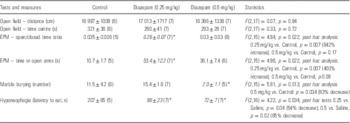
As expected, at the tested doses, diazepam did not modify activity levels in the open field but had an anxiolytic-like effect in the EPM, the marble burying test and the hyponeophagia test (see Table 1 for results and statistical analyses). The administration of diazepam did not influence time spent in the centre of the open field (Table 1).
Effects of acute diazepam injection on anxiety-like behaviour

Numbers represent mean±SEM. Number of animals per group is shown in parentheses. Groups that are significantly different from control are also highlighted in italics. For the elevated plus-maze (EPM), two mice were excluded as outliers, one from the Control group and one from the 0.5 mg/kg group. For the hyponeophagia analysis, one animal from the Saline group was excluded because it was much fatter (>2×SD away from the mean) compared with the others.
*Significant difference from the Control group.
Experiment 2: asenapine
Open field
The administration of asenapine had no effects on the distance travelled [Table 2; F(2,24)=0.96, p=0.4] or the time spent in the centre [Table 2; F(2,24)=0.46, p=0.63] of the large open field.
Results for the open-field and the hyponeophagia tests

Numbers represent mean±SEM. Number of animals per group is shown in parentheses. Data for open field is for only one replication as a different arena was used in the second experiment and therefore the data cannot be combined.
EPM
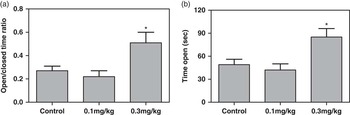
Administration of 0.3 mg/kg asenapine resulted in a significant increase in the open/closed arms ratio [Fig. 1a (pooled across replications); asenapine effect: F(2,35)=6.4, p=0.004; replication effect: F(1,35)=0.75, p=0.4; asenapine×replication interaction: F(2,35)=1.5, p=0.24; post hoc analysis: asenapine 0.3 mg/kg different than other groups]. The effects of asenapine on the open/closed time ratio were the consequence of its effect to increase the time spent in the open arms [Fig. 1b (pooled across replications); asenapine effect: F(2,35)=7.69, p=0.002; replication effect: F(1,35)=0.18, p=0.67; asenapine×replication interaction: F(2,35)=1.33, p=0.28; post hoc analysis: asenapine 0.3 mg/kg different than other groups]. Asenapine had no effect on activity level in the EPM as the distance travelled during the test was not significantly different across groups [data not shown, ANOVA, asenapine effect: F(2,37)=0.1, p=0.89]. Two animals were excluded from analysis as outliers (>2×SD away from the mean), one mouse from the 0.1 mg/kg group and one mouse from the 0.3 mg/kg group. After exclusions, the number of mice per group was: Control – 12; 0.1 mg/kg – 14; 0.3 mg/kg – 15.
Effects of repeated asenapine administration on (a) open/closed time ratio and (b) time in the open arms in the elevated plus-maze. The 0.3 mg/kg treatment resulted in a significant increase in the open/closed time ratio [89% increase; ANOVA – asenapine effect: F(2,35)=6.4, p=0.004; post hoc least significant difference (LSD) 0.3 mg/kg vs. Saline – p=0.02; N=12 for Control group, 14 for 0.1 mg/kg group and 15 for 0.3 mg/kg group]. The same dose also increased the open/closed entries ratio [73% increase, ANOVA – asenapine effect: F(2,35)=7.69, p=0.002; post hoc LSD 0.3 mg/kg vs. Saline – p=0.009]. *Significant difference from the Control group (p<0.05).

Marble burying
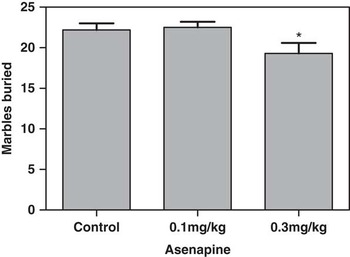
Administration of 0.3 mg/kg asenapine resulted in a significant decrease in the number of buried marbles [Fig. 2 (pooled across replications); asenapine effect: F(2,35)=3.6, p=0.04; replication effect: F(1,35)=0.04, p=0.84; asenapine×replication interaction: F(2,35)=2.6, p=0.09; post hoc analysis: asenapine 0.3 mg/kg different than other groups]. *Two animals were excluded from analysis as outliers (>2×SD away from the mean), one mouse from the 0.1 mg/kg group and one mouse from the 0.3 mg/kg group. After exclusions the number of mice per group was: Control – 12; 0.1 mg/kg – 14; 0.3 mg/kg – 15.
Effect of asenapine administration in the defensive marble burying test. Treatment with the 0.3 mg/kg dose resulted in small but significant decrease in the number of marbles buried [13% decrease; ANOVA – asenapine effect: F(2,35)=3.6, p=0.04; post hoc least significant difference – p=0.048; N=12 for Control group, 14 for 0.1 mg/kg group and 15 for 0.3 mg/kg group]. *Significant difference from the Control group (p<0.05).

Hyponeophagia
The administration of asenapine did not affect the latency to start eating in the hyponeophagia test [Table 2; asenapine: F(2,37)=0.6, p=0.6; replication: F(1,37)=1.1, p=0.3; asenapine×replication interaction: F(2,37)=0.5, p=0.6].
Discussion
The present study was designed to examine the effects of asenapine in a number of tests for anxiety-like behaviour in mice. The results show that asenapine had an anxiolytic-like effect in two of the four tests of the battery, the EPM (Fig. 1) and the defensive marble burying test (Fig. 2). In contrast, asenapine had no significant effects on open-field spontaneous activity and on hyponeophagia (Table 2). The fact that asenapine did not alter behaviour in all four tests does not preclude an anxiolytic-like potential as even the prototypic anxiolytic drug diazepam was effective in our setting in only three of the four tests (Table 1). Moreover, asenapine was effective in one test from each group, in the EPM which is an exploratory behaviour test and in the defensive marble burying test that represents and acute stress-induced behaviour (Reference Haller and Alicki16).
Interestingly, in the current study, neither diazepam nor asenapine had significant effects on anxiety-like behaviour in the open field. However, large variability of responses in the open field had been repeatedly reported and this complex exploratory behaviour can be influenced by many factors such as strain (Reference Flaisher-Grinberg and Einat21), light intensity (Reference Fonken, Finy and Walton22) or arena size (Reference Decker, Grider and Cobb23). Hence, the lack of significant effects in the open-field test might be related to the specific test parameters.
The effects size of asenapine in this study was lower than that of diazepam (see Table 1 vs. Fig. 1 and Fig. 2), but the issue of effect size in animal models for anxiety is not clear and the general approach is to use these tests as a categorical measure for yes or no significant effects. The effect size of the same drug may show large variations across tests. For example, acute administration of 1.0 mg/kg diazepam in C57bl/6 male mice resulted in ~150% increase in time spent in the open arms in one study (Reference Bahi, Schwed, Walter, Stark and Sadek24), but the same acute dose did not have a significant effect in another study of the same strain where the higher doses of 2.0 and 3.0 mg/kg resulted in an ~100% increase in the same measure (Reference Griebel, Belzung, Perrault and Sanger25). Yet, in a third study with the same strain of mice, administration of 2.5 mg/kg diazepam resulted in an increase of 335% in the time spent in open arms (Reference Gard, Haigh, Cambursano and Warrington26). Such differences suggest that attempts to emphasise effect sizes in animal models may not be of much value. Moreover, in the current study there was also a significant difference between the results of the Control groups in the diazepam experiment and the asenapine experiment. For example, the mean time that control mice in the diazepam experiment spent in the open arms of the EPM was 10.7 s, whereas the mean for the control mice in the asenapine study was 49 s. Such differences between experiments are well known in animal models work and can be attributed to a large variety of factors even when the best attempts for standardisation are made (Reference Crabbe, Wahlsten and Dudek27). One major factor in the present study that might have had a significant influence on the behaviour of the control mice is that controls in the diazepam experiment were injected with vehicle only ones, whereas controls in the asenapine experiment were repeatedly injected with vehicle. Differences in handling as well as vehicle injections were demonstrated to influence behaviour in anxiety-related tests (Reference Lapin28).
One of the reported problems with the use of atypical antipsychotics to treat anxiety is their known side effect to induce sedation and fatigue (Reference Hershenberg, Gros and Brawman-Mintzer1). Interestingly, the anxiolytic-like effects of asenapine in the present study were shown at doses that did not induce reduction in activity levels measured either in the open field or in the EPM. These results stand is some contrast with previous work with asenapine where similar doses of the drug resulted in a reduction in spontaneous activity in the open field (Reference Ene, Kara and Einat14). However, this difference in results may be directly related to the different strain of mice used in the two studies. The previous work examined the effects of asenapine in black Swiss mice, a strain that is suggested to be a model for manic-like behaviour. Accordingly, the reduction of activity levels in black Swiss mice may be related to mood stabilisation effects of asenapine rather than to sedation (Reference Ene, Kara and Einat14). The current study used ICR mice, a standard strain that is used for a variety of modelling studies and therefore the present results may suggest that it could be possible to identify similar doses also in patients that will have anxiolytic effects without inducing sedation.
Whereas some atypical antipsychotics were already tested for anxiolytic properties in patients, we did not identify any such study regarding asenapine. Moreover, some of the recent reviews on this topic state that their authors also did not find any literature related directly to asenapine and anxiety treatment (Reference Hershenberg, Gros and Brawman-Mintzer1). Yet, one clinical study of asenapine in schizophrenic patients does mention that an adverse effect of the drug was a small increase in anxiety compared with placebo (Reference Kane, Mackle, Snow-Adami, Zhao, Szegedi and Panagides29). Whereas this finding may stand in contrast with a potential anxiolytic effect of asenapine, it is important to remember that the study was conducted in patients with schizophrenia and not with an anxiety disorder and that anxiety and anxiety measures were not the centre of the study and were only superficially observed. It is possible that (Reference Hershenberg, Gros and Brawman-Mintzer1) the effects on anxiety in schizophrenic patients is not similar to effects on anxiety in individuals with a diagnosed anxiety disorder (Reference Barnett, Kramer, Casat, Connor and Davidson2); that if more measures of anxiety would have been observed, the outcomes of the study could have been different. Regardless of the possible explanations, the results of the current study in mice as well as previous clinical trials with other atypical antipsychotic drugs suggest that it could be beneficial to examine the effects of asenapine in a clinical trial for patients with anxiety disorders. The current study does not imply that asenapine will have an advantage over some of the other atypical antipsychotic drugs that were shown to have anxiolytic effects and only clinical trials will be able to compare the efficacy and the possible adverse effects profiles in patients with anxiety disorders. However, studies that compared asenapine with other atypical antipsychotics in the context of schizophrenia or bipolar disorder treatments offer some possible advantages to asenapine including lower risk of metabolic adverse effects compared with olanzapine (Reference Maina and Ripellino30), better quality of life in some patients (Reference Michalak, Guiraud-Diawara and Sapin31) and better cost-effectiveness compared with some other atypical antipsychotic drugs (Reference Caresano, Di Sciascio and Fagiolini32).
Acknowledgements
The study was partially supported by funds from H. Lundbeck A/S. Asenapine was generously donated by H. Lundbeck A/S.
Authors’ contributions: All authors were involved in the design of the studies. H.M. Ene and N.Z. Kara were responsible for the daily management of the project and for data analysis. H.M. Ene, N. Barak and T. Reshef Ben-Mordechai performed the experiments and contributed to writing the initial draft of the manuscript. H. Einat served as mentor for all other authors, was involved in the design of the study, the analysis of data and the final writing of the manuscript.
Financial Support
The study was partially funded by H. Lundbeck A/S. N.Z. Kara is a recipient of a graduate students’ scholarship from the faculty of life sciences, Ben-Gurion University of the Negev.
Conflicts of Interest
None.
Ethical Standards
Study adhered to the Israeli Ministry of Health guide for the care and use of laboratory animals and was approved by the Tel Aviv-Yaffo Academic College IACUC (Protocol No. MTA-2012-19-3).