Introduction
Vestibular evoked myogenic potentials are short latency electrical impulses which are produced in response to higher level acoustic stimuli, and which may be detected using surface electrodes placed over the tonically contracted sternocleidomastoid muscle. Neurophysiological and clinical data indicate that normal vestibular evoked myogenic potentials are mediated by a pathway which includes the saccular macula, inferior vestibular nerve and the motor neurons of the ipsilateral sternocleidomastoid muscle.Reference Halmagyi and Curthoys1
Normal vestibular evoked myogenic potential responses are characterised by biphasic (positive–negative) waves. In the majority of studies, these peaks and troughs are labelled with the mean latency expressed in milliseconds preceded by the lowercase letters p (for positive) or n (for negative), as proposed by Yoshie and OkudairaReference Yoshie and Okudaira2 to distinguish them from neurally generated evoked potentials. The first positive–negative complex is often labelled p13–n23.Reference Colebatch, Halmagyi and Skuse3 Other authors have reported vestibular evoked myogenic potentials with later serial peaks, labelled n34–p44. Vestibular evoked myogenic potential amplitudes are large and vary from a few microvolts to more than 100 microvolts, depending on the muscle tension and the stimulus intensity.Reference Cheng and Murofushi4, Reference Cheng and Murofushi5
Clinically, vestibular evoked myogenic potential testing is used to assess sacculocollic function in cases of vestibular neuritis, endolymphatic hydrops, superior canal dehiscence syndrome, acoustic neuroma, auditory neuropathy and some neurodegenerative diseases.Reference Murofushi, Halmagyi, Yavor and Colebatch6–Reference Kumar, Sinha, Singh, Bharti and Barman9
Vestibular evoked myogenic potentials are usually elicited by a train of short duration tone bursts,Reference Murofushi, Matsuzaki and Mizuno10 a click stimulusReference Colebatch, Rothwell, Bronstein and Ludman11 or a low frequency logon stimulus.Reference Trivelli, Vicini, D'Ascanio, Greco and Salvinelli12 Data from animal studies indicate that afferent saccular nerve fibres are most sensitive to low frequency acoustic stimuli; therefore, low frequency tone bursts (at 500 or 1000 Hz) or logon stimuli may provide more robust vestibular evoked myogenic potential responses than broadband clicks.Reference Trivelli, Vicini, D'Ascanio, Greco and Salvinelli12, Reference McCue and Guinan13
It has been reported that vestibular evoked myogenic potentials can be false positive or false negative. The same results can be elicited by click and tone burst stimuli.
A few studies have compared vestibular evoked myogenic potentials elicited using click and tone burst stimuli; however, findings have been equivocal. For example, Cheng et al. Reference Cheng, Haung and Young14 reported a shorter latency with click stimuli compared with tone burst stimuli, and a higher amplitude with tone burst stimuli compared with click stimuli. These authors also reported a higher response rate with click stimuli compared with tone burst stimuli. In contrast, Akin et al. Reference Akin, Murnane and Proffitt15 reported a higher response rate with tone burst stimuli. Picciotti et al. Reference Picciotti, Fiorita, Di Nardo, Quaranta, Paludetti and Maurizi16 reported no difference between the two stimuli as regards response latency or amplitude.
If vestibular evoked myogenic potentials are to be used as a clinical tool, suitable stimulus parameters need to be established. In the present study, we used a 500 Hz tone burst stimulus and a click stimulus. Our use of a 500 Hz tone burst was based on an earlier studyReference Akin, Murnane and Proffitt15 which found that vestibular evoked myogenic potential responses were better in wave morphology following a 500 Hz tone burst compared with a higher frequency tone burst.
The main objective of the present study was to compare vestibular evoked myogenic potential responses elicited by click and tone burst stimuli, in normal hearing individuals.
Methods
Participants
Seventeen subjects aged from 20 to 30 years (eight men and nine women) participated in the study. Subjects were unpaid student volunteers from a health institute. All subjects had normal hearing sensitivity in both ears (i.e. thresholds were within 15 dB HL for air conduction and bone conduction) and normal middle-ear functioning (i.e. a normal tympanogram with stapedial reflexes present in both ears). No subjects had any history of neurological or otological symptoms.
All participants underwent testing in both ears; hence, data were collected from 34 ears.
Instrumentation
To evaluate hearing sensitivity, a calibrated two-channel clinical audiometer (Orbiter-922 V-2x, G N Otometrics, Taastrum, Denmark) with TDH-39 headphones (Telephonics, 815 Broad Hollow Road, Farmingdale, New York 11735) and a B-71 bone vibrator (Radioear, KIMMETRICS, 22050 Mohawk Drive, Smithsburg, MD 21783) were used to determine the air and bone conduction thresholds.
Middle-ear function was analysed using a GSI-Tympstar system (GSI VIASYS Healthcare, Wisconsin, USA).
Vestibular evoked myogenic potentials were recorded using an Intelligent Hearing Systems (Smart EP) System (Intelligent Hearing System, Florida, USA) with an Insert ER-3A earphone (Etymotic Research, Inc., 61 Martin Lane, Elk Grove Village, IL 60007, USA).
Procedure
Firstly, pure tone thresholds were obtained at octave intervals between 250 and 8000 Hz for air conduction and between 250 and 4000 Hz for bone conduction. The pure tone threshold was calculated using the modified Hughson and Westlake method.Reference Carhart and Jerger17
Secondly, immittance audiometry was conducted with a probe tone frequency of 226 Hz. Ipsilateral and contralateral acoustic reflex thresholds were measured for 500, 1000, 2000 and 4000 Hz tones.
Thirdly, all subjects' uncomfortable level for speech was established using the two-down one-up procedure.
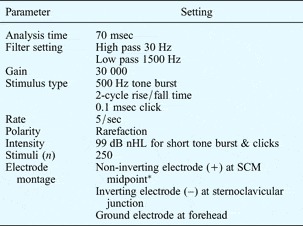
Finally, vestibular evoked myogenic potentials were recorded using the parameters described in Table I.
Vestibular evoked myogenic potentials: recording parameters

*Ipsilateral to stimulus. SCM = sternocleidomastoid
In order to control for the electrical effect of sternocleidomastoid muscle contraction upon the recorded vestibular evoked myogenic potential amplitude, subjects were asked to maintain unilateral muscle contraction producing a tonic electromyography signal of 50–100 µv; this was monitored using the software supplied with the vestibular evoked myogenic potential recording system. Thus, the vestibular evoked myogenic potential results recorded were presumably due to the acoustic stimuli supplied, rather than to changes in sternocleidomastoid muscle contraction.
Waveforms produced in response to click and tone burst stimuli were recorded twice to ensure reliability. The p13 and n23 latencies were determined for all waveforms, and the amplitude of the p13–n23 complex was evaluated.
Data were statistically analysed using the Statistical Package for the Social Sciences version 10 software program.
Results
All 17 subjects participated in all testing.
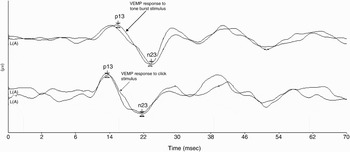
An equal percentage of vestibular evoked myogenic potential responses was observed for both the click stimulus and the short duration tone burst stimulus: 30 ears (88.23 per cent) showed a response to the click stimulus, while 30 ears (88.23 per cent) showed a response to the tone burst stimulus. The p13 and n23 latencies were longer for the tone burst stimulus compared with the click stimulus. The vestibular evoked myogenic potential response amplitude was greater for the tone burst stimulus compared with the click stimulus. Figure 1 shows vestibular evoked myogenic potential responses recorded from the same individual, using both a short duration tone burst stimulus and a click stimulus.
One subjects' vestibular evoked myogenic potentials for click and short duration tone burst stimuli.

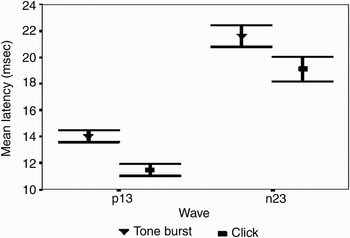
Figure 2 shows the mean and standard deviations of the p13 and n23 latencies obtained using click and short duration tone burst stimuli. It can be seen that the vestibular evoked myogenic potential latency elicited by the tone burst stimulus is longer than that elicited by the click stimulus, for both the p13 and n23 peaks.
Error bar comparing the mean and standard deviation of P13 and N23 latency of short duration tone burst and click stimuli.

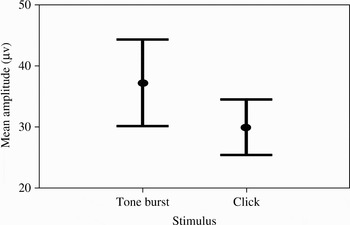
Figure 3 shows the mean and standard deviations for the peak-to-peak amplitude of the vestibular evoked myogenic potential responses to the click stimulus and the short duration tone burst stimulus. It can be seen that this amplitude was greater for responses elicited using the tone burst stimulus compared with the click stimulus.
Error bar comparing the mean and standard deviation of peak to peak amplitude (P13-N23) of VEMP evoked by short duration tone burst and click.

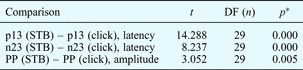
Data for all the ears were analysed using the paired sample t-test to test the statistical significance of differences in latency and amplitude, comparing click-evoked and short duration tone burst evoked vestibular evoked myogenic potentials. The t values, degrees of freedom and significance levels are shown in Table II.
Statistical analysis of VEMPs elicited by click and short duration tone burst stimuli

*Two-tailed. VEMPs = vestibular evoked myogenic potentials; DF = degrees of freedom; STB = short duration tone burst; PP = peak-to-peak
A statistically significant difference was observed for both p13 and n23 latencies, comparing the click stimulus versus the short duration tone burst stimulus. A statistically significant difference was also observed for the p13–n23 waveform amplitude. In summary, shorter p13 and n23 latencies were seen for the click stimulus compared with the tone burst stimulus, while a longer p13–n23 amplitude was seen for the tone burst stimulus compared with the click stimulus.
Discussion
In the present study, a statistically significant difference was seen between the latency of vestibular evoked myogenic potentials elicited by click versus short duration tone burst stimuli: longer latencies were seen for the tone burst stimulus compared with the click stimulus. These findings are consonant with those of Cheng et al. Reference Cheng, Haung and Young14 These longer latencies may be attributed to different excitation patterns of vestibular neurons when exposed to tone burst stimuli. It has been reported that primary vestibular neurons may respond to one tone burst stimulus by double or triple firing; hence, the longer latency associated with short duration tone burst stimuli may be due to the influence of second or third electrical impulse ‘spikes’.Reference Cheng and Murofushi4
Furthermore, vestibular evoked myogenic potentials elicited by the short duration tone burst stimulus had greater amplitudes than those elicited by the click stimulus at the same to equal intensity levels.
The observed differences between vestibular evoked myogenic potentials elicited by click versus short duration tone burst stimuli may be due to differences in the stimulus spectrum level. When comparisons are made at an equal peak to equal intensity levels, the click stimulus has a lower stimulus spectrum level than the tone burst stimulus, due to its wider bandwidth.Reference Akin, Murnane and Proffitt15 The lower level of spectrum energy in the click stimulus would result in a reduced amplitude for click-evoked vestibular evoked myogenic potentials.
The present study findings are contrary to those of Cheng et al.,Reference Cheng, Haung and Young14 who reported a greater peak-to-peak amplitude for click-evoked vestibular evoked myogenic potentials compared with tone burst evoked vestibular evoked myogenic potentials. The difference between the two studies' findings may be due to differences in subjects' sternocleidomastoid muscle contraction strength – one of the major factors affecting vestibular evoked myogenic potential amplitude. Variation in muscle contraction strength results in large differences in vestibular evoked myogenic potential amplitude.Reference Akin, Murnane and Proffitt15
In the present study, click-evoked vestibular evoked myogenic potentials were observed in 30 ears (88.23 per cent), while short duration tone burst evoked vestibular evoked myogenic potentials were seen in 30 ears (88.23 per cent) also. In contrast, Cheng et al. reported click-evoked vestibular evoked myogenic potentials in 57 ears (98 per cent) and short duration tone burst evoked vestibular evoked myogenic potentials in 51 ears (88 per cent), at 95 dB nHL level in the same subjects.Reference Cheng, Haung and Young14
• Vestibular evoked myogenic potentials are short latency electrical impulses elicited by higher level acoustic stimuli
• Measurement of vestibular evoked myogenic potentials may prove clinically useful for the investigation of saccular and inferior vestibular nerve function
• This study compared vestibular evoked myogenic potentials elicited by click and by short duration tone burst stimuli, in normal hearing individuals
• An equal response rate was found for click-evoked and short duration tone burst evoked vestibular evoked myogenic potentials
The present study observed more variability in vestibular evoked myogenic potential amplitude than in vestibular evoked myogenic potential latency. Thus, vestibular evoked myogenic potential latency may be a more reliable assessment parameter. Furthermore, click stimuli may be preferable when assessing vestibular evoked myogenic potentials in a clinical population to identify abnormality. However, short duration tone burst stimuli may elicit better vestibular evoked myogenic potential waveform morphology.
Conclusion
The present study observed an equal response rate for click-evoked and for short duration tone burst evoked vestibular evoked myogenic potentials, in normal hearing individuals. We observed larger p13–n23 amplitudes for short duration tone burst evoked vestibular evoked myogenic potentials, compared with click-evoked responses; however, shorter p13 and n23 latencies were seen for click-evoked vestibular evoked myogenic potentials, compared with tone burst evoked responses.
Vestibular evoked myogenic potentials may prove clinically useful in the assessment of saccular and/or inferior vestibular nerve function, and the identification of saccular involvement may have implications for the management of patients with balance disorders. For the purposes of clinical identification of abnormality, click stimuli may be more useful than short duration tone burst stimuli, due to lesser variability in vestibular evoked myogenic potential responses. However, when assessing the presence or absence of vestibular evoked myogenic potential responses, low frequency, short duration tone burst stimuli may be preferable to click stimuli due to the robust amplitude of the resulting response.