Background
Depression and post-traumatic stress disorder (PTSD) are common and etiologically complex psychiatric conditions (Kessler et al., Reference Kessler, Demler, Frank, Olfson, Pincus, Walters and Zaslavsky2005; Kilpatrick et al., Reference Kilpatrick, Resnick, Milanak, Miller, Keyes and Friedman2013). The individual and global impact of these disorders is substantial, with high rates of suicide, hospital admissions, substance abuse, and millions of working days lost (Davidson, Reference Davidson2000; Greenberg et al., Reference Greenberg, Kessler, Birnbaum, Leong, Lowe, Berglund and Corey-Lisle2003). One crucial consideration is that women are approximately two times more likely to develop depression or PTSD as compared to men (depression: 26% v. 15%; PTSD: 12% v. 5%) (Hasin et al., Reference Hasin, Sarvet, Meyers, Saha, Ruan, Stohl and Grant2018; Kessler et al., Reference Kessler, Demler, Frank, Olfson, Pincus, Walters and Zaslavsky2005). Sex hormones are known to be major determinants of sex differences and could contribute to the higher rates of depression and PTSD among women (Altemus, Sarvaiya, & Neill Epperson, Reference Altemus, Sarvaiya and Neill Epperson2014; Angold & Worthman, Reference Angold and Worthman1993; Nolen-Hoeksema & Girgus, Reference Nolen-Hoeksema and Girgus1994). Both endogenous variation in hormone levels and exogenous sex hormone medications may influence the risk for psychiatric disorders.
Focus on exogenous hormone medications and potential effects on mental health is critical because over 80% of American women have taken hormone medications at least once (Centers for Disease Control, 2019). Estrogen-containing medications are most frequently taken as contraceptives, but they are also frequently used as hormone therapy around the time of menopause. Note that ‘hormone therapy’ for menopause-related symptoms was previously referred to as ‘hormone replacement therapy’ HRT. The median age of menopause in the US is 51 years, and it is clinically defined as the lack of a period for 1 year (Bromberger et al., Reference Bromberger, Matthews, Kuller, Wing, Meilahn and Plantinga1997; Cooper & Sandler, Reference Cooper and Sandler1998; Gottschalk, Eskild, Hofvind, Gran, & Bjelland, Reference Gottschalk, Eskild, Hofvind, Gran and Bjelland2020; McKinlay, Brambilla, & Posner, Reference McKinlay, Brambilla and Posner1992). Most women experience menopause symptoms such as hot flashes, oftentimes for years at a time, surrounding the menopause transition (perimenopause) (‘ACOG Practice Bulletin No., 141,’, 2014). While many symptoms may occur, vasomotor (i.e. hot flashes and night sweats) and vaginal symptoms are the most common. Importantly, sleep is disrupted for many women (‘ACOG Practice Bulletin No., 141,’, 2014), and depression and anxiety occur at higher rates among women experiencing hot flashes during the menopause transition (Freeman, Sammel, & Lin, Reference Freeman, Sammel and Lin2009; Freeman et al., Reference Freeman, Sammel, Lin, Gracia, Kapoor and Ferdousi2005; Joffe et al., Reference Joffe, Crawford, Freeman, White, Bianchi, Kim and Cohen2016). In sum, menopause symptoms are common, last for years, and can cause serious life impairment.
Defining a proxy variable for menopause symptoms using medication data in the UK Biobank
With the dual goals of better understanding the genetic basis of menopause symptoms and determining the degree to which genetic influences on menopause symptoms might be shared with genetic influences on psychiatric disorders, we sought to use the UK Biobank to perform a genome-wide association study (GWAS) of menopause symptoms. While the age range (39–71 years old) and size of the UK Biobank (232 993 women) are well suited for performing a GWAS of menopause symptoms, such symptoms were not assessed directly. Consequently, we used a proxy variable for menopause symptoms: estrogen medication use, not as a contraceptive. The strategy of analyzing medication use was implemented previously in the UK Biobank for many non-hormonal medication classes. It successfully identified known genetic risk factors for the target conditions of various medications (Wu et al., Reference Wu, Byrne, Zheng, Kemper, Yengo, Mallett and Wray2019). For example, there was a high genetic correlation between antidepressant use and depression, and a high genetic correlation between vasodilators used in cardiac disease and coronary artery disease (Wu et al., Reference Wu, Byrne, Zheng, Kemper, Yengo, Mallett and Wray2019). Thus, prior work demonstrated successful use of medication proxies in GWAS. The medications used most frequently to treat menopause symptoms are estrogens and estrogens and progestogens in combination (‘ACOG Practice Bulletin No. 141,’, 2014; Skouby et al., Reference Skouby, Al-Azzawi, Barlow, Calaf-Alsina Erdogan Ertüngealp, Gompel, Graziottin and Stevenson2005). The other primary indication for estrogens is as a contraceptive, thus we excluded women using hormonal contraceptives. Progestogens alone are typically used for contraception, as part of fertility treatments, or for pregnancy maintenance (Carp, Reference Carp2018, p. 2018; Sitruk-Ware, Reference Sitruk-Ware2018).
To summarize, we built upon the work of Wu et al. (Reference Wu, Byrne, Zheng, Kemper, Yengo, Mallett and Wray2019) which classified medications in the UK Biobank according to the Anatomical Therapeutic Chemical (ATC) classification system. We identified the medication classes most likely to be used to treat menopause symptoms including hot flashes and night sweats: G03C (estrogens) and G03F (estrogens and progestogens in combination). We hypothesized that estrogen medication use – excluding use as a contraceptive, and in an appropriately aged sample – would be a useful (albeit imperfect) proxy for menopause symptoms.
Synopsis of present study goals
Here we examined the phenotypic and genetic correlates of estrogens use (and estrogens combined with progestogens) by women in the UK Biobank (age 39–71) (Bycroft et al., Reference Bycroft, Freeman, Petkova, Band, Elliott, Sharp and Marchini2018). We first conducted non-genetic analyses to test for associations between estrogen use and the psychiatric phenotypes of lifetime depression and future PTSD. We then conducted GWAS comparing women taking estrogen to women not taking estrogen in order to characterize the genetic architecture of estrogen medication use not as a contraceptive, which we hypothesize to be a proxy for menopause symptoms. Consistent with current best practices, GWAS within ancestry groups was followed by trans-ancestry GWAS meta-analysis. Using the results from the European ancestry GWAS, we then conducted genetic correlation analyses to identify shared genetic influences between estrogen use and psychiatric phenotypes.
Methods
(see supplementary text for more complete descriptions of these topics)
UK Biobank participants
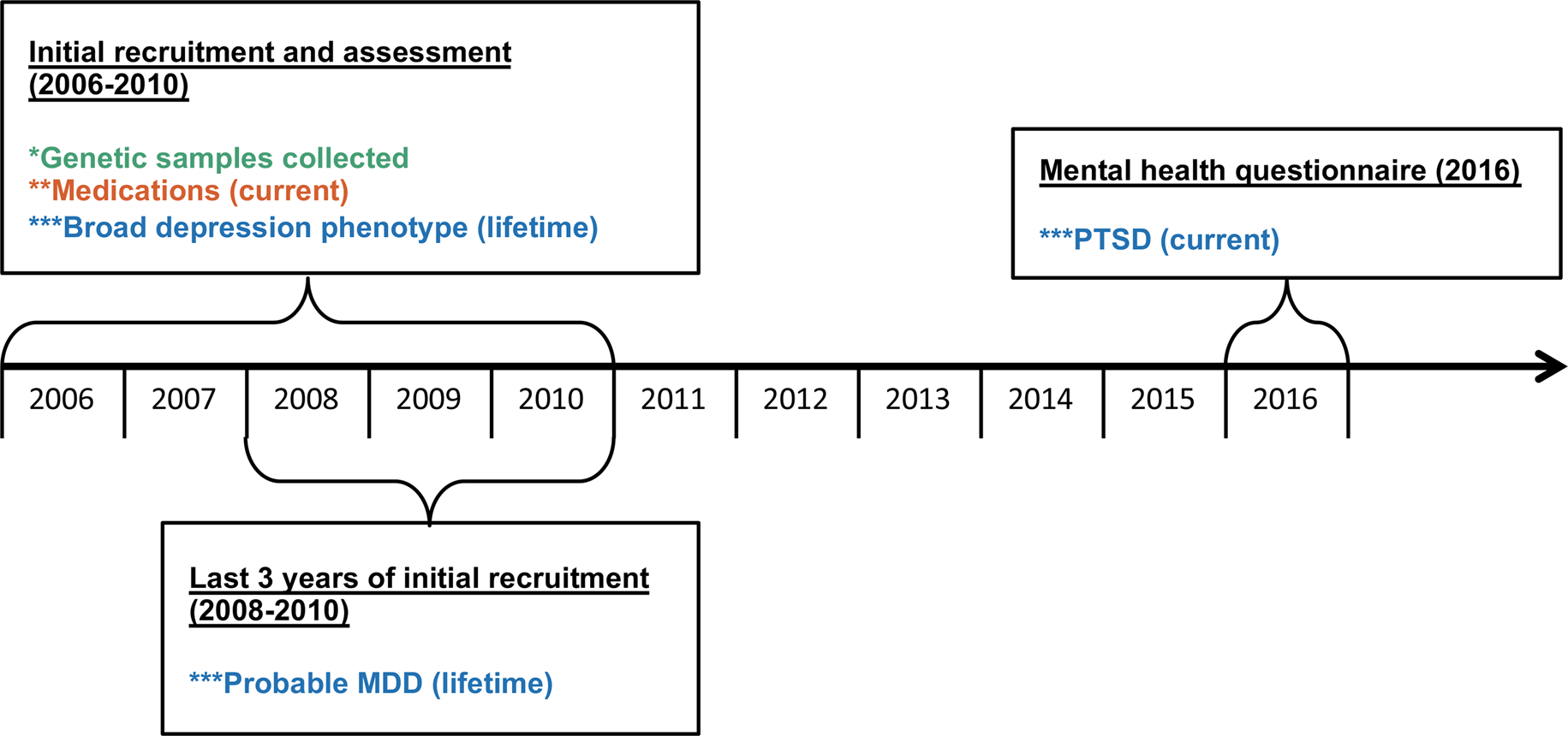
The UK Biobank is a well-documented, population-based study of 502 492 individuals, sampled from 23 different locations in Great Britain (Bycroft et al., Reference Bycroft, Freeman, Petkova, Band, Elliott, Sharp and Marchini2018; Collins, Reference Collins2012; Sudlow et al., Reference Sudlow, Gallacher, Allen, Beral, Burton, Danesh and Collins2015). It is a prospective study of predictors (e.g. clinical, demographic, and genetic) of diseases and traits more commonly observed in middle and older age. Only women were included in our analysis, and they were between the ages of 39 and 71. Between 2006 and 2010, participants were recruited (see Fig. 1). At the initial recruitment visit, they completed questionnaires, underwent physical measurements, performed cognitive tests, and gave biological samples (blood, urine, and saliva). Given the focus of this investigation on menopause symptoms, women were excluded for hormonal contraceptive use. This resulted in the exclusion of only 1.9% of women (consistent with the older age of this sample). Women were also excluded if specific variables were missing (menopause status, socioeconomic status, and self-reported ancestry), and if they were related to other individuals in the UK Biobank. The final dataset included 232 993 women (9.6% of women were removed based on these exclusion criteria).
Timeline of assessments in the UK Biobank. *Genetic samples are in green, **medication usage variables are in red, and ***psychiatric phenotypes are in blue. Medication usage was assessed concurrently with the depression phenotypes and 6–10 years prior to the assessment of PTSD.

Estrogen and progestogen medication-taking variables
During the initial UK Biobank assessment interviews (2006–2010), participants were asked to register, on a touch screen, the current use of prescription and over-the-counter medications. Using published protocols, all medications were mapped to their corresponding active ingredients (e.g. estradiol) and then grouped according to the ATC classification system (Santos et al., Reference Santos, Ursu, Gaulton, Bento, Donadi, Bologa and Overington2017; Wu et al., Reference Wu, Byrne, Zheng, Kemper, Yengo, Mallett and Wray2019). We then used three subgroups from the G03 Sex hormones and modulators of the genital system: G03C (estrogens), G03D (progestogens), and G03F (estrogens and progestogens in combination) to define our hormone use variables.
UK Biobank phenotypes of depression and PTSD
We used UK Biobank data to construct three psychiatric phenotypes for analysis: broad depression, probable major depressive disorder, and PTSD. Criteria used to define a case-control status for these three phenotypes were taken from previously published papers (Howard et al., Reference Howard, Adams, Clarke, Hafferty, Gibson, Shirali and McIntosh2019; Nievergelt et al., Reference Nievergelt, Maihofer, Klengel, Atkinson, Chen, Choi and Koenen2019; Smith et al., Reference Smith, Nicholl, Cullen, Martin, Ul-Haq, Evans and Pell2013). We also used available data to make continuous variable versions of these three phenotypes to be tested along with binary case-control status (neuroticism symptoms score for depression phenotypes and total PTSD symptom score for PTSD; see below).
Phenotypic analysis
We assessed potential differences in age, socioeconomic status (Townsend Index), assessment center, ethnic background, and menopause status (pre/post-menopause, or had a hysterectomy) between women taking estrogen medications and those not taking them. We also compared depression and PTSD cases and controls with respect to the previously mentioned variables. Case and control definitions for depression and PTSD were defined according to previously published procedures which utilized self-report of symptoms and medical record diagnoses for depression and self-report symptoms for PTSD (Howard et al., Reference Howard, Adams, Clarke, Hafferty, Gibson, Shirali and McIntosh2019; Nievergelt et al., Reference Nievergelt, Maihofer, Klengel, Atkinson, Chen, Choi and Koenen2019). We also used a continuous score for PTSD symptoms (scores from 0 to 29) and, as a related variable to depression symptoms: neuroticism symptom count (scores from 0 to 12). We used this surrogate variable for depression symptoms because (1) it was available on nearly all women and (2) because neuroticism has been shown to be highly genetically and phenotypically correlated with depression and depression symptoms (Kendler, Gatz, Gardner, & Pedersen, Reference Kendler, Gatz, Gardner and Pedersen2006; Luciano et al., Reference Luciano, Hagenaars, Davies, Hill, Clarke, Shirali and Deary2018).
Using the R Statistical Computing Environment 3.5.1 (R Core Team, 2005), baseline comparisons of phenotypic differences between classes of women taking and not taking hormone medications were tested using t tests (for continuous variables) and chi-square tests (for categorical variables). Regression analyses were used to test for associations between medication use and psychiatric phenotypes while controlling for the above-mentioned covariates. Logistic regression was used for binary psychiatric phenotypes and linear regression for continuous phenotypes.
GWAS of hormone medication use
Imputed genotypes from the UK Biobank were cleaned according to published procedures (Duncan et al., Reference Duncan, Ratanatharathorn, Aiello, Almli, Amstadter, Ashley-Koch and Koenen2018). Consistent with current best practices for the analysis of multi-ancestry data(Peterson et al., Reference Peterson, Kuchenbaecker, Walters, Chen, Popejoy, Periyasamy and Duncan2019), we then extracted unrelated individuals of European (n = 187 465), South-Asian (n = 3713), African (n = 3582), and East-Asian (n = 1190) ancestry for ancestry-specific GWAS. We performed GWAS comparing women taking estrogen medications to women that did not take them: G03C = estrogens (n = 10 103 medication positive/222 890 medication negative) and G03C + F = estrogens and estrogens and progestogens in combination (n = 15 305 medication positive/217 688 medication negative). Age, Townsend index, menopause information, and 20 genetic principal components (PCs, to control for population stratification) were added as covariates to each GWAS. Eight individual GWAS were performed (4 ancestry groups × 2 medication categories) using PLINK v1.90b5.3 (Chang et al., Reference Chang, Chow, Tellier, Vattikuti, Purcell and Lee2015; Purcell et al., Reference Purcell, Neale, Todd-Brown, Thomas, Ferreira, Bender and Sham2007). Trans-ancestry meta-analyses were performed for each medication group using GWAMA version 2.2.2 (Mägi & Morris, Reference Mägi and Morris2010). The standard genome-wide significance threshold of p < 5 × 10⁻⁸ was used; note that results also exceeded Bonferroni correction for eight GWAS (p < 6.3 × 10⁻⁹). Multi-marker Analysis of GenoMic Annotation (MAGMA) (de Leeuw, Mooij, Heskes, & Posthuma, Reference de Leeuw, Mooij, Heskes and Posthuma2015), incorporated into the FUMA-GWAS webtool (Watanabe, Taskesen, Bochoven, & Posthuma, Reference Watanabe, Taskesen, Bochoven and Posthuma2017), was used to perform gene and gene-set analyses. SNP heritability (h2 SNP) of estrogen medication use and genetic correlations (rg) with psychiatric phenotypes were estimated using linkage-disequilibrium score regression (LDSC) (Bulik-Sullivan et al., Reference Bulik-Sullivan, Loh, Finucane, Ripke, Yang and Neale2015a; Bulik-Sullivan et al., Reference Bulik-Sullivan, Finucane, Anttila, Gusev, Day, Loh and Neale2015b). We restricted to use of the European ancestry only summary statistics for LDSC analyses because LDSC can only be applied to groups with more homogenous ancestry and because power was too low for the non-European ancestry groups.
Results
Descriptive statistics
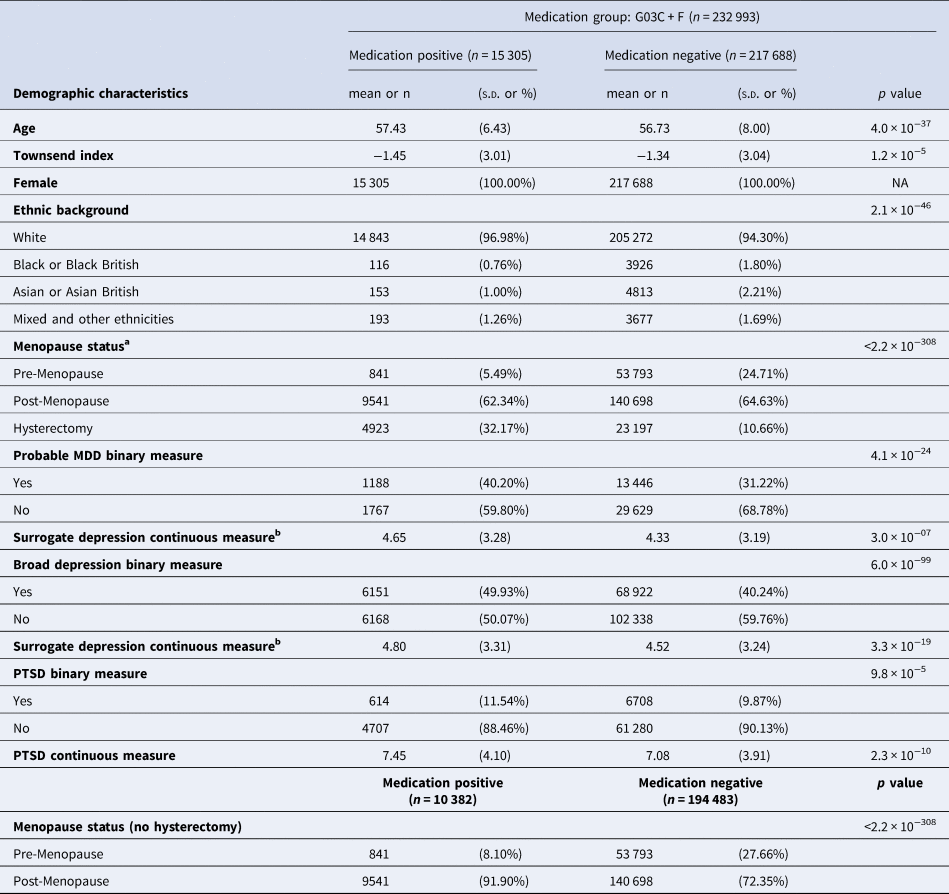
We observed numerous phenotypic differences between women taking estrogen medication and those who do not (Table 1). First, women taking estrogen medication (either estrogen alone or estrogens and progestogens in combination; G03C + F) were more likely to be white (97% v. 94%, p = 9.9 × 10−45), older (57.4 v. 56.7, p = 4.05 × 10−37), and from areas of higher socioeconomic status (lower scores correspond to higher SES on Townsend Index: −1.45 v. −1.34, p = 1.19 × 10⁻⁵). Furthermore, women taking these medications were more likely to have had a hysterectomy (32% v. 11%, p < 2.2 × 10⁻¹⁶); among women who had not had a hysterectomy, women taking estrogen medication were more likely to be post-menopausal (92% v. 72%, p < 2.2 × 10⁻¹⁶). Women taking estrogen medication had higher rates of lifetime broad depression (50% v. 40%, p = 1.26 × 10−94), lifetime probable major depressive disorder (40% v. 31%, p = 7.73 × 10⁻²²), and future PTSD (11% v. 10%, p = 2.22 × 10⁻⁴) as compared to controls.
Demographic characteristics by medication group

Results for the most inclusive estrogen medication group are presented here, which corresponds to women taking estrogen-only medications and estrogens and progestogens in combination (G03C + F), excluding use as contraceptives. t tests were used for comparisons of continuous variables (age, Townsend, and continuous measures of psychiatric symptoms) and chi-square tests for categorical measures (ethnic background, binary psychiatric symptoms, and menopause symptoms). ‘Ethnic background’ categories are those provided by the UK Biobank. Note that we added ‘Chinese’ to ‘Asian or Asian British’.
a For menopause status among the subsample of women without a hysterectomy; see above.
b As a surrogate continuous depression variable, neuroticism scores were used; see text.
Demographic characteristics and medication status by disorder status (of broad depression, probable MDD, and PTSD) are given in Supplementary Table S2. Women with each of these disorders, on average, were younger, came from areas of lower socioeconomic status, and were more likely to have had a hysterectomy. Cases also had higher rates of prescribed hormone medications.
Phenotypic association analysis
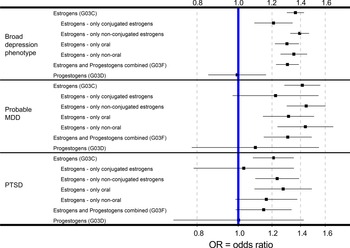
Using regression analyses that controlled for the covariates of age, socioeconomic status, ethnic background, and menopause status, we observed significant positive associations between the use of estrogen medications and all three psychiatric phenotypes. As shown in Fig. 2, women using estrogen-only medications (medication group: G03C) were more likely to have lifetime broad depression (OR 1.36, s.e. = 0.02, p = 7.7 × 10−39), lifetime probable major depressive disorder (OR 1.41, s.e. = 0.05, p = 3.0 × 10⁻¹²), and to develop PTSD 6–10 years later (OR 1.21, s.e. = 0.06, p = 8.1 × 10⁻⁴). These odds ratios (ORs) were slightly attenuated, but more statistically significant, when women taking combined estrogen and progestogen medications were added to the group of women taking estrogen-only medications (i.e. medication group: G03C + F). The continuous variable versions of these psychiatric variables yielded similar results (see Supplementary Table S3 for full results). In contrast, we did not observe any significant associations between the use of progestogen-only medication (G03D) and psychiatric phenotypes: lifetime broad depression (OR 0.99, s.e. = 0.08, p = 0.94), lifetime probable major depressive disorder (OR 1.10, s.e. = 0.18, p = 0.60), and future PTSD (OR 1.00, s.e. = 0.18, p = 0.99) (see Supplementary Table S3 for all results and sample sizes for each comparison).
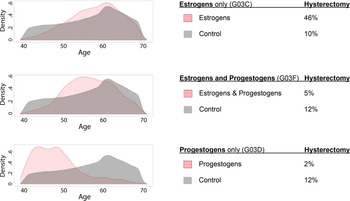
Density plots of age for women taking (and not taking) each of three classes of medications: G03C = estrogens only, G03F = estrogens and progestogens in combination, and G03D = progestogens only. The red grid pattern depicts ages for women using each medication group and the gray shading depicts controls, meaning women who took none of these medications. Women using contraceptive medications were excluded. Percentages of women who had a hysterectomy are also given for each group. Consistent with indications for prescription, estrogens and estrogens and progestogens in combination were taken by women around the time of menopause, whereas progestogens only tended to be taken by younger women.

Estrogen medications can also be categorized into different subtypes, and we provide results for two sub-categories of estrogen medications: conjugated v. non-conjugated and oral v. non-oral administration. As shown in Fig. 2 and in Supplementary Table S3, the ORs for non-conjugated estrogens were larger than conjugated estrogens, but confidence intervals (CIs) usually overlapped.
Age distribution and hysterectomy prevalence of women in medication groups
Given our use of a proxy phenotype for menopause symptoms, we sought to understand more about the women that used particular hormone medication classes (not as contraceptives). To this end, we examined age distributions for three groups of women (estrogens alone = G03C, estrogens and progestogens in combination = G03F, and progestogens alone = G03D). We also compared the frequency of hysterectomy for women in these groups; see Fig. 3. As expected based on the indicated use of estrogens and estrogens and progestogens in combination as hormone (replacement) therapy, women taking these two classes of medications tended to be around the average age of menopause, which is commonly reported as 51 years (Bromberger et al., Reference Bromberger, Matthews, Kuller, Wing, Meilahn and Plantinga1997; Cooper & Sandler, Reference Cooper and Sandler1998; Gottschalk et al., Reference Gottschalk, Eskild, Hofvind, Gran and Bjelland2020; McKinlay et al., Reference McKinlay, Brambilla and Posner1992). In contrast, progestogens alone are used for indications more common among younger women (amenorrhea, preterm delivery); accordingly, the women taking progestogens only (G03D) tended to be younger. Hysterectomy rates also conformed to expectations, namely, that estrogen plus progestogen is recommended for women with a uterus (because progestogens reduce the risk of endometrial cancer), but estrogen alone is suitable for women who have had a hysterectomy (and therefore no longer need progestogen to prevent endometrial cancer). Note that only 5% of women taking estrogens and progestogens in combination had a hysterectomy as compared to 46% hysterectomy among women taking estrogens only.
Forest plot of medication associations with depression and PTSD. The vertical blue bar denotes OR = 1, which is the null hypothesis. Error bars denote 95% CIs. Note wide CIs for progestogen-only medication analyses (G03D); wider CIs are consistent with the smaller sample sizes of these analyses.

GWAS of estrogen medication use
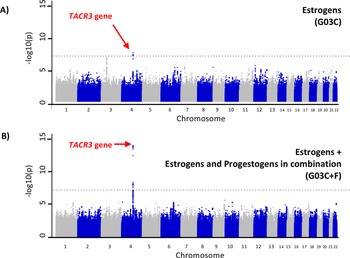
We observed genome-wide significant associations with estrogen medication use in participants of European ancestry (n = 187 465, which is 94% of the sample) and in the trans-ancestry meta-analysis (described below). All genome-wide significant variants were on chromosome 4 in the tachykinin receptor 3 gene (TACR3) (see Fig. 4), with top SNP rs77322567 (G03C + F OR = 0.78, p = 7.7 × 10⁻¹⁵). Furthermore, gene-level significant associations (p < 2.27 × 10⁻⁶) were observed for TACR3 (p = 4.7 × 10⁻¹³) and for two genes located close together on chromosome 9 PTGES2 (p = 1.9 × 10⁻⁶) and LCN2 (p = 1.9 × 10⁻⁶). Full genome results for each ancestry group are provided separately along with trans-ancestry meta-analytic results (Psychiatric Genomics Consortium, downloads page and available from authors), and see Supplementary Table S4 for all genome-wide significant SNPs from the trans-ancestry meta-analysis (G03C + F; the broadest category of estrogen medication use). All ancestry groups other than European ancestry were underpowered for single variant and gene-level analyses but will be useful for future meta-analyses and fine-mapping efforts.
SNP-based Manhattan plots for GWAS of estrogen medication use (a) estrogen medications only (G03C) and (b) estrogens + estrogens and progestogens in combination (G03C + F). The dotted line represents genome-wide statistical significance (p = 5 × 10⁻⁸). The chromosome 4 locus, in the TACR3 gene, is a known locus for hot flashes and night sweats (i.e. vasomotor symptoms). The chromosome 4 locus observed in the estrogen medication only GWAS (a) is more statistically significant in the larger sample (b). Results for European ancestry participants are depicted here but are almost identical to trans-ancestry results.

Gene set analyses
No gene sets from the default list analyzed with the FUMA webtool (using MAGMA gene set analysis) were significant after correcting for multiple testing. However, it is notable that three of the top twenty gene sets pertained to estrogen biosynthesis. Specifically, ‘estrogen biosynthesis’ was the second most strongly associated gene set (p = 0.0001; from Reactome), ‘estradiol-17beta-dehydrogenase activity’ was the eighth (p = 0.0007; from Gene Ontology, GO), and ‘estrogen biosynthetic process’ was the thirteenth (p = 0.0009; from Gene Ontology, GO).
Heritability and genetic correlation estimation with linkage-disequilibrium score regression (LDSC)
Using LDSC as applied to the European ancestry summary statistics, SNP heritability (h2 SNP) estimates were small in magnitude but significant. Note that estimates were similar for the most inclusive estrogen use analysis (G03C + F h2 SNP = 0.015, s.e. = 0.003, p = 1.5 × 10⁻⁸) and the estrogen-only analysis (G03C h2 SNP = 0.0092, s.e. = 0.003, p = .0015). Significant positive genetic correlations were found between genetic influences on the use of estrogen medication (medication group: G03C + F) and depression (r g = 0.231, s.e. = 0.06, p = 2.81 × 10⁻⁵) and neuroticism (r g = 0.231, s.e. = 0.08, p = 0.0024). The genetic correlation between estrogen medication use and PTSD was not significant, but this could be due to low power in the PTSD GWAS. See Supplementary Table S5 for full genetic correlation results.
Conclusion
Hormone medication associations with depression and PTSD
In this study, we investigated associations between estrogen medication used by women age 39–71 and the psychiatric phenotypes of depression and PTSD in the UK Biobank (N = 232 993). In this sample, women using estrogen medications were more likely to have lifetime broad depression, lifetime probable major depressive disorder, and to develop PTSD 6–10 years later. These results were held after accounting for socioeconomic status, age, menopause status, and self-reported ethnic background. The exclusive use of progestogens was not associated with differential risk for these psychiatric phenotypes, but statistical power may have been too low. Alternatively, baseline difference between these two medication-defined groups of women or effects of these medications could have contributed to the observed higher rates of depression and PTSD among women taking estrogen medications – but not progestogens alone – in this UK Biobank sample.
Regarding the possible public health significance of these findings and the need for additional studies, we note that all large observational studies (Gerber et al., Reference Gerber, King, Pineles, Wiltsey-Stirman, Bean-Mayberry, Japuntich and Haskell2015; Wassertheil-Smoller et al., Reference Wassertheil-Smoller, Shumaker, Ockene, Talavera, Greenland, Cochrane and Dunbar-Jacob2004) reveal higher levels of depression and PTSD among older women taking hormone medications. Among postmenopausal women in the Women's Health Initiative (WHI) study, the current use of estrogen was associated with a greater risk for current depression [OR 1.25; 95% CI 1.18–1.32; N = 93 676] (Wassertheil-Smoller et al., Reference Wassertheil-Smoller, Shumaker, Ockene, Talavera, Greenland, Cochrane and Dunbar-Jacob2004). This finding is similar to our finding that current use of estrogen medication was associated with higher lifetime depression (OR 1.36, s.e. = 0.02, p = 7.7 × 10−39), though it must be noted that the timing of lifetime depression was not available in this study and depression undoubtedly preceded estrogen medication use for many women. The relationship between hormone therapy and PTSD was previously assessed in women veterans using a cross-sectional design (Gerber et al., Reference Gerber, King, Pineles, Wiltsey-Stirman, Bean-Mayberry, Japuntich and Haskell2015). Gerber et al. found that women with PTSD were more likely to use hormone therapy (OR 1.27; 95% CI 1.20–1.34). Similarly, Lawn et al., found that, compared to women that experienced no trauma, the hazard ratio for initiating menopausal hormone therapy was higher among women with PTSD (e.g. HR = 1.31, 95% CI 1.25–1.36 for women in the high PTSD severity category) (Lawn et al., Reference Lawn, Nishimi, Kim, Jung, Roberts, Sumner and Kubzansky2020). Thus, hormone therapy among older women appears to be positively correlated with both depression and PTSD.
Why is the prevalence of depression and PTSD higher among women taking hormone therapy? Hormone therapy could increase psychiatric symptoms or vice versa; psychiatric symptoms could make it more likely that women use hormone therapy. A third possibility is that both variables – hormone therapy and depression (and/or PTSD) – are influenced by an unmeasured variable, such as shared genetic influences. Our results, described below, suggest that shared genetic factors are likely to be at least part of the explanation for higher depression prevalence among women taking hormone medications for menopause symptoms.
Genetic effects on menopause symptoms (via estrogen medication use proxy)
The GWAS results were consistent with our premise that estrogen medication use would serve as a useful (albeit imperfect) proxy for menopause symptoms including hot flashes. Specifically, the TACR3 locus reported here was previously identified in a GWAS of hot flashes and night sweats (Crandall et al., Reference Crandall, Manson, Hohensee, Horvath, Wactawski-Wende, LeBlanc and Sinsheimer2017). Further, the protein coded for by TACR3 (neurokinin B / neurokinin 3) plays a critical role in hot flashes, as demonstrated in experimental studies in animals (Padilla, Johnson, Barker, Patterson, & Palmiter, Reference Padilla, Johnson, Barker, Patterson and Palmiter2018; Rance, Dacks, Mittelman-Smith, Romanovsky, & Krajewski-Hall, Reference Rance, Dacks, Mittelman-Smith, Romanovsky and Krajewski-Hall2013) and clinical trials in humans (Fraser et al., Reference Fraser, Lederman, Waldbaum, Kroll, Santoro, Lee and Ramael2020; Jayasena et al., Reference Jayasena, Comninos, Stefanopoulou, Buckley, Narayanaswamy, Izzi-Engbeaya and Dhillo2015; Prague et al., Reference Prague, Roberts, Comninos, Clarke, Jayasena, Mohideen and Dhillo2018). In addition, neurokinin 3 receptor antagonists have recently been demonstrated to be effective treatments for hot flashes (Fraser et al., Reference Fraser, Lederman, Waldbaum, Kroll, Santoro, Lee and Ramael2020; Prague et al., Reference Prague, Roberts, Comninos, Clarke, Jayasena, Mohideen and Dhillo2018; Santoro et al., Reference Santoro, Waldbaum, Lederman, Kroll, Fraser, Lademacher and Ramael2020). Taken together, these findings suggest that genetic variability in the neurokinin B receptor is one factor relevant to women's different experiences of hot flashes. Intriguingly, the neurokinin B signaling system has also been the focus of numerous investigations of psychiatric symptoms (Al Abed, Reynolds, & Dehorter, Reference Al Abed, Reynolds and Dehorter2021; Zhang, Wang, & Chu, Reference Zhang, Wang and Chu2020).
Finally, we found positive genetic correlations between our estrogen use phenotypes and both depression and neuroticism. These findings are consistent with previous observations that depression- and anxiety-related phenotypes are more common among women that experience hot flashes (Deecher, Andree, Sloan, & Schechter, Reference Deecher, Andree, Sloan and Schechter2008; Freeman et al., Reference Freeman, Sammel and Lin2009, Reference Freeman, Sammel, Lin, Gracia, Kapoor and Ferdousi2005; Joffe et al., Reference Joffe, Crawford, Freeman, White, Bianchi, Kim and Cohen2016). These findings are also interesting because treatments for depression (e.g. selective serotonin reuptake inhibitors, SSRIs) are sometimes used for vasomotor symptoms (Ruddy & Loprinzi, Reference Ruddy and Loprinzi2015) and vice versa (i.e. estrogen for depression). Thus, partially shared etiology may explain the overlap between medications used to treat depression and vasomotor symptoms.
Future directions: extension to other hormone medications and mendelian randomization
Interestingly, other forms of hormone medications commonly prescribed to women – contraceptive medications – have also been associated with higher rates of depression in large population samples (N = 1 061 997 and N = 815 662) (Skovlund, Mørch, Kessing, & Lidegaard, Reference Skovlund, Mørch, Kessing and Lidegaard2016; Zettermark, Vicente, & Merlo, Reference Zettermark, Vicente and Merlo2018). Importantly, these studies employed prospective study designs, controlled for many confounding variables, and excluded women that developed psychiatric conditions prior to contraceptive use. Putative mental health effects of contraceptives could be very different from effects of hormone therapy for menopause (given differences in age, formulations, dose, and endogenous hormone levels), and yet, the direction of results is the same in large observational studies: higher depression has been consistently observed among women using estrogen medications. Future studies should test for shared genetic influences between depression and contraceptive use. Another important step will be to use Mendelian Randomization to better understand putatively causal pathways involving genetics, hormone medications, and psychiatric phenotypes.
Finally, the relationship of hormones and mood (or affect) may be more complex than can be fully explained by the presence/absence of exogenous hormones. For example, the prevailing understanding of the etiology of Premenstrual Dysphoric Disorder is that a subset of women may be particularly susceptible to affective dysregulation caused by changes in endogenous hormone levels rather than absolute levels (Reid & Soares, Reference Reid and Soares2018). Differential sensitivity to hormone fluctuation has also been implicated in the pathophysiology of postpartum depression (Bloch et al., Reference Bloch, Schmidt, Danaceau, Murphy, Nieman and Rubinow2000). Likewise, perimenopausal depression is hypothesized to be related to sensitivity in some women to endogenous hormonal fluctuations (Freeman et al., Reference Freeman, Sammel, Liu, Gracia, Nelson and Hollander2004; Gordon et al., Reference Gordon, Girdler, Meltzer-Brody, Stika, Thurston, Clark and Wisner2015) or withdrawal (Schmidt et al., Reference Schmidt, Ben Dor, Martinez, Guerrieri, Harsh, Thompson and Rubinow2015). Therefore, it is possible that a subset of women may also be more susceptible to deleterious mood symptoms or mood benefits brought about by exogenous hormone treatments. Additionally, such sensitivity may be related to either temporary changes in hormone levels or to longer-term effects of hormone use.
Limitations
This study has a number of limitations related to data availability in the UK Biobank. We used estrogen medication used as a proxy for menopause symptoms because the UK Biobank does not currently contain information about the presence or absence of specific menopause symptoms. Estrogen medications are also used for hypogonadism, moderate acne vulgaris, prevention of osteoporosis, primary ovarian insufficiency, and oral contraception (the latter of which we excluded) (Delgado & Lopez-Ojeda, Reference Delgado and Lopez-Ojeda2021; Levine, Reference Levine2003). Note that depression is not an FDA approved indication for estrogen medication use, nor is it a standard treatment in the UK (Craig, Reference Craig2013). Nevertheless, there is some evidence that estrogen therapy enhances mood and has antidepressant effects, particularly in perimenopausal women (de Novaes Soares, Almeida, Joffe, & Cohen, Reference de Novaes Soares, Almeida, Joffe and Cohen2001; Gordon et al., Reference Gordon, Rubinow, Eisenlohr-Moul, Xia, Schmidt and Girdler2018; Rasgon et al., Reference Rasgon, Altshuler, Fairbanks, Dunkin, Davtyan, Elman and Rapkin2002; Schmidt et al., Reference Schmidt, Nieman, Danaceau, Tobin, Roca, Murphy and Rubinow2000). Consensus guidelines suggest estrogen therapies for the treatment of depression should be used with caution, preferably when also indicated for other menopausal symptoms (Maki et al., Reference Maki, Kornstein, Joffe, Bromberger, Freeman, Athappilly and Soares2019). Given these other indications for estrogen medications, some misclassification of women must have occurred, and the effects of this misclassification in our GWAS could be either reduced power due to greater heterogeneity in phenotypes or false positives (in either the TACR3 locus and/or the polygenic signal captured in SNP heritability and SNP genetic correlations). Arguably most impactful for our analysis was the likelihood that some women who had previously experienced menopausal symptoms were not taking hormone medication at the time of assessment. Thus, our proxy variable for menopause symptoms almost certainly had many false negatives, and this likely contributed to the low SNP heritability estimates for estrogen medication use. It is notable that our GWAS nevertheless identified a locus for menopause symptoms and further implicated estrogen biosynthesis pathways. Thus, we report these results with the caveat that it is also possible that genetic findings reported here could be linked to any of the other conditions treated with estrogen in this population (e.g. hypogonadism, osteoporosis, acne).
The psychiatric phenotypes used in this analysis are also sub-optimal. Both the depression and PTSD phenotypes were based on abbreviated self-report measures rather than standardized clinician diagnoses. We also had limited temporal information about diagnoses. Thus, we cannot draw conclusions about whether hormone medication use preceded or started after the development of particular episodes of depression or PTSD. Finally, the non-random sampling of participants in the UK Biobank (e.g. participants are older and of higher socioeconomic status than average UK residents) means that selection bias could have attenuated or inflated estimates of observed relationships.
Synopsis
The UK Biobank and other observational studies are frequently used to test for relationships between putative risk factors and medical outcomes, but genetic confounders are not typically considered. The present results demonstrate that genetic factors very likely influence estrogen medication use. Specifically, the present GWAS of estrogen medication use identified a genetic locus previously linked to hot flashes, suggesting that genetic factors influence menopause symptoms and therefore indirectly influence women's decisions to take hormone medications. Further, evidence suggests that genetic influences on depression overlap with genetic influences on hot flashes. Taking these genetic factors into account, it is clear that higher depression among older women taking estrogen medications is likely caused, in part, by shared genetic influences on psychiatric and menopause symptoms. This work also demonstrated a polygenic etiology for menopause symptoms and suggested that estrogen signaling genes likely contribute to menopause symptoms, consistent with a priori expectations about the central role of decreased estrogen in menopause symptoms. Finally, the TACR3 gene identified here implicates a known pharmacological target of certain medications used to treat hot flashes (neurokinin 3 receptor antagonists). Thus, this work confirmed – with genetic methods – known mechanisms contributing to hot flashes (Fraser et al., Reference Fraser, Lederman, Waldbaum, Kroll, Santoro, Lee and Ramael2020; Jayasena et al., Reference Jayasena, Comninos, Stefanopoulou, Buckley, Narayanaswamy, Izzi-Engbeaya and Dhillo2015; Prague et al., Reference Prague, Roberts, Comninos, Clarke, Jayasena, Mohideen and Dhillo2018; Rance et al., Reference Rance, Dacks, Mittelman-Smith, Romanovsky and Krajewski-Hall2013), and it yielded evidence that shared genetic factors likely contribute to increased rates of anxiety and depression around the time of menopause.
Supplementary material
The supplementary material for this article can be found at https://doi.org/10.1017/S0033291721004037.
Acknowledgements
This research has been conducted using the UK Biobank Resource under application 52498. We are grateful to all the individuals who have volunteered and the whole UK Biobank team, including the interviewers, technicians, research scientists, healthcare professionals, clerical workers, and receptionists. We thank the PGC teams that conducted the PTSD and depression GWAS meta-analyses for providing the summary statistics necessary for this research.
Financial support
This work was supported by the National Institute of Mental Health (LD, R01 MH123486) and the Stanford WHSDM Center (LD, seed grant from Women's Health & Sex Differences in Medicine).
Conflicts of interest
None.