Introduction
Attitudes toward aging encompass a complex, personalized perspective on the experience of aging over the life course. Attitudes can reflect experiences as well as particular social, cultural, and historical contexts, giving meaning and reference to the individual's world (Ajzen and Fishbein, Reference Ajzen and Fishbein1977). To help understand and protect the health of the world's aging population, the relationship of health and attitudes to aging is receiving greater attention. Individuals with positive attitudes have been found to live longer and in better health than those with more negative attitudes (Uotinen et al., Reference Uotinen, Rantanen and Suutama2005; Demakakos et al., Reference Demakakos, Gjonca and Nazroo2007). In a classic study, individuals with more positive self-perceptions of aging lived an average of seven years longer than those with less positive perceptions, over a 23-year period, after controlling for a range of sociodemographic, health, and social factors (Levy et al., Reference Levy, Slade and Kasl2002).
The impact of health on subjective well-being is well established (Dolan et al., Reference Dolan, Peasgood and White2008). It is poor health, rather than actual age, that causes a decline in subjective well-being (Kunzmann et al., Reference Kunzmann, Little and Smith2000). Having a greater number of chronic conditions has been linked with poorer quality of life, lower levels of well-being, depression, and a younger age of retirement (Kunzmann et al., Reference Kunzmann, Little and Smith2000; Stephens et al., Reference Stephens, Alpass, Towers, Noone and Stevenson2011). Negative associations have been found between attitudes to aging and specific chronic conditions, such as heart disease (Kuper and Marmot, Reference Kuper and Marmot2003), hypertension (Demakakos et al., Reference Demakakos, Gjonca and Nazroo2007), depression (Uotinen et al., Reference Uotinen, Rantanen and Suutama2005), and respiratory mortality (Levy and Myers, Reference Levy and Myers2005). However, the relationship between health and attitudes to aging is complex, as individuals in poor health can still feel positive about their own aging (Pruchno et al., Reference Pruchno, Wilson-Genderson, Rose and Cartwright2010).
Attitudes to aging have been measured since the 1940s. In more recent times, the Attitudes to Aging Questionnaire (AAQ) has enabled the validated testing of attitudes to aging in a range of countries and settings (Laidlaw, Power, Schmidt and WHOQOL-OLD Group, Reference Laidlaw, Power and Schmidt2007). The AAQ conceptualizes and measures the subjective perception of the aging process, to assess individual attitudes to aging in three domains: psychosocial loss, physical change, and psychological growth. The questionnaire was developed in conjunction with the World Health Organization Quality of Life – Old Group and involved extensive pilot testing in 15 centers worldwide. A total of 5,566 participants aged 60 years and over from 20 centers worldwide contributed to the final 24-item scale. The majority of studies examining attitudes to aging using the AAQ has been with older participants, aged 60 years and over. The only known study to briefly report on attitudes to aging of a midlife sample was based in Australia, with participants divided into three age groups, including a midlife group aged 41 to 60 years (Matthews et al., Reference Matthews, Lindner and Collins2007). Positive attitudes to aging were found, with attitudes becoming more positive across domains from midlife to older age, as part of a general shift to more positive affect and subjective well-being recognized in later years (Windsor and Anstey, Reference Windsor and Anstey2010).
Close relationships between attitudes to aging and health have been found among older participants, particularly with mental health. Strong relationships between depression, anxiety, and the AAQ have been reported in a number of studies. Even relatively minor symptoms of depression were associated with negative attitudes to aging, a pattern that increased with greater symptoms of depression in a sample of over 4,000 participants aged 60 years and over across 20 countries (Chachamovich et al., Reference Chachamovich, Fleck, Laidlaw and Power2008). An improvement in mood resulted in more positive attitude to aging scores. All AAQ domains showed negative associations with depression in Canada and Norway with adults aged 60 years and over (Kalfoss et al., Reference Kalfoss, Low and Molzahn2010). Psychosocial loss and physical change attitudes were both negatively related to current depression in Spain among those aged 60 years and over (Lucas-Carrasco et al., Reference Lucas-Carrasco, Laidlaw, Gómez-Benito and Power2013), while among similar aged Australians, psychosocial loss and psychological growth attitudes were negatively correlated with current depression (Bryant et al., Reference Bryant, Bei, Gilson, Komiti, Jackson and Judd2012). The same Australian study also found that current anxiety was associated with negative psychosocial loss attitudes to aging. A recent UK study, of adults born in 1936, identified low mood as an important influence on attitudes toward aging, possibly by activating negative age stereotypes (Shenkin et al., Reference Shenkin, Laidlaw, Allerhand, Mead, Starr and Deary2014).
The AAQ has been examined with other health variables including the number of chronic conditions, self-rated or subjective health, depression, anxiety, chronic obstructive pulmonary disease (COPD), dementia, and mental illness. A pattern of negative attitudes has been reported in individuals with ill health. Greater numbers of chronic health conditions have been linked to significantly more negative psychosocial loss and physical change attitudes toward aging (Kalfoss et al., Reference Kalfoss, Low and Molzahn2010; Lucas-Carrasco et al., Reference Lucas-Carrasco, Laidlaw, Gómez-Benito and Power2013). Specifically, individuals with functional limitations from COPD held more negative physical change attitudes, but minimized their symptoms in order to enjoy a greater quality of life in a sample aged 44 years and over (Low et al., Reference Low, Ross, Stickland, Wilson and Wong2013). Individuals aged 60 years and over with early dementia have reported more negative psychosocial loss scores than those without, particularly those with greater awareness of memory dysfunction (Trigg et al., Reference Trigg, Watts, Jones, Tod and Elliman2012). Those with mental illness have reported significantly more negative physical change and psychological growth attitudes to aging than those without (Quinn et al., Reference Quinn, Laidlaw and Murray2009).
In this study of a random sample of adults aged 49–51 years, we examined the relationships between the AAQ and chronic physical and mental health conditions, such as diagnosed hypertension, heart disease, high cholesterol, arthritis, asthma, allergies, lifetime depression and anxiety, and current depression. We expected to find more positive attitudes to aging in individuals with better health. We also examined relationships between the AAQ and a range of commonly investigated sociodemographic variables such as gender, ethnicity, education, relationship status, and income. Based on reported findings (Chachamovich et al., Reference Chachamovich, Fleck, Laidlaw and Power2008; Bryant et al., Reference Bryant, Bei, Gilson, Komiti, Jackson and Judd2012; Lucas-Carrasco et al., Reference Lucas-Carrasco, Laidlaw, Gómez-Benito and Power2013), we anticipated some factors, such as higher education and income, to be positively associated with attitudes to aging. Identifying relationships between chronic conditions and attitudes to aging in midlife offers the prospect of modifying health and contextual factors prior to a detrimental effect on well-being.
Methods
Participants
The first three-hundred participants were selected from the first wave of the Canterbury Health, Ageing and Life Course (CHALICE) study, a multidisciplinary longitudinal study of healthy aging from midlife in the Canterbury region in the South Island of New Zealand. The rationale, design, and methodology of the CHALICE study have been described elsewhere (Schluter et al., Reference Schluter2013). Briefly, a representative sample of adults aged 49–51 years was obtained from New Zealand electoral rolls for the Canterbury District Health Board area. The indigenous people of New Zealand, those of Māori descent, have the choice of being on either the Māori or the general electoral roll, and choice of electoral roll was used to stratify the sample. The Māori descent roll was sampled at a rate to bring Māori to one in five to provide reliable ethnic estimates.
Procedure
Participants were initially approached by letter and followed up by phone calls or home visits if response was not forthcoming. Eligibility was determined by being aged 49–51 years at entry, traceable, planning to stay in the Canterbury area for at least six out of the following 12 months, community living, proficiency in spoken English, and being mentally and physically able to participate. Written consent was obtained, prior to commencement of the interview. Ethical approval for the CHALICE study was obtained from the Upper South A Regional Ethics Committee on June 14, 2010.
Collection of data occurred between August 2010 and June 2012. Interviewing commenced one week before the first of the Canterbury earthquake sequence (Ardagh et al., Reference Ardagh2011). Baseline CHALICE assessments took between four and six hours to complete. Assessment was divided into seven modules covering a broad range of health factors, including physical measurements, retinal photography, blood pressure, BMI measurements, blood and urine testing, heart echocardiogram and electrocardiogram, sociodemographic factors, health history, use of health services, family health history, attitudes to aging, personality measures, impact of the Canterbury earthquakes, social and community factors, mental health screening, cognitive assessment, and lifestyle information on activity and nutritional intake. All results were reviewed by a practicing physician, who contacted the participant (and their primary healthcare practitioner if consented) regarding any results varying from healthy norms.
Measures
Sociodemographic factors
Five sociodemographic factors were selected for analyses: gender, ethnicity, education, relationship status, and household income. For ethnicity, participants self-identified as being of Māori ethnicity or not, regardless of electoral roll selection. Individuals identifying as both Māori and any other ethnicity were designated as being Māori. Those identifying as an ethnicity other than Māori were designated as being non-Māori. Education level was determined by the participant's highest completed qualification involving at least three months full-time study. Categories included no formal qualification; secondary school qualification; post-secondary school certificate, diploma or trade qualification; and university qualification. Relationship status was reported as married or living together in a de facto relationship for one year or more, separated or divorced, widowed, or never married. Four household income bands were used: ≤NZ$50,000; NZ$50,001 to $70,000; NZ$70,001 to $100,000; and ≥NZ$100,001 (As of June 2014, the exchange rate of NZ$1 was US$0.87.).
Attitudes to aging questionnaire
The AAQ is a self-report measure in which individuals express attitudes toward their own aging process. The questionnaire consists of three subscales, or domains, each with eight questions (Laidlaw et al., Reference Laidlaw, Power and Schmidt2007). The questionnaire has performed well psychometrically. Sound Rasch properties were established, as were acceptable Cronbach's α coefficients on the three subscales (0.68, 0.75, and 0.84), an overall model scale fit of 93.8%, good test–retest reliability, and concurrent validity (Laidlaw et al., Reference Laidlaw, Power and Schmidt2007). The psychosocial loss domain focuses on psychological and social losses that can be experienced with increasing age. The physical change domain assesses the physical changes observed with aging. The psychological growth domain measures the positive aspects of wisdom and generativity that adults can feel as they grow older. Responses are elicited on a five-point Likert scale ranging from one to five, with the sum of each subscale total ranging from 8 to 40. A higher score in each subscale was taken to reflect a stronger endorsement of the predominant theme of that subscale. As reported in a number of other publications, the psychosocial loss subscore was recoded to achieve consistency with the two other subscales: a higher score indicating a more positive attitude to aging in each domain. In this study, Cronbach's α for psychosocial loss, physical change, and psychological growth subscales were 0.81, 0.75, and 0.74, respectively.
Current depression
Participants were assessed at interview for depression over the past two weeks, using the Mini International Neuropsychiatric Interview (MINI), which has been shown to have good reliability and validity (Sheehan et al., Reference Sheehan1998). A DSM-IV diagnosis of current major depressive episode was made (yes/no). In this study, Cronbach's α for the MINI current depression diagnostic criteria was 0.73.
Chronic conditions
Interview questions on chronic conditions were primarily taken or adapted from the 2006/07 New Zealand Health Survey (Ministry of Health, 2008). A chronic condition was defined as a physical or mental illness that lasted, or was expected to last, for six months or more. Symptoms could come or go, or be present all the time. Participants were asked whether a doctor had ever told them they had the following chronic conditions: heart disease, stroke, diabetes, allergies, asthma, COPD, arthritis, hypertension, high cholesterol, cancer, depression or anxiety. Responses were coded yes or no for each.
Data management
After interviewing, non-identifying data were entered into a Progeny clinical version 8 database (Progeny Software LLC, Needham, South Suffolk, UK, www.progenygenetics.com). Data were checked for reliability using double entry of 10% of randomly selected participants. The error rate for the first 300 participants was 0.26% per field entered. All individual variables were checked for outliers and out-of-range or unusual responses were checked against the original form. To minimize difficulties with missing data, missing responses were dealt within one of three ways: the participant was contacted immediately after the interview to complete the missing questions; missing data for scale items were imputed using conventionally adopted strategies; or missing values on the database were recorded as missing data, resulting in a reduced sample size for that variable. Overall, rates of missing items were low. One missing AAQ item from two participants were imputed by calculating item scores from the same subscale and dividing by the number of items. Diagnosed depression and current depression each had one missing response, and household income had nine missing responses. These were recorded as missing data and the sample size was accordingly reduced. Data were exported from the Progeny database to the Statistical Product and Service Solution (SPSS) statistical software version 19 for Windows (IBM Corporation, Somers, New York, USA) and in R2 4.1 (R Foundation for Statistical Computing, Vienna, Austria) and the survey package (Lumley, Reference Lumley2010).
Data analyses
Unless explicitly stated otherwise, analyses were weighted inversely proportional to sampling probability to accommodate the stratified design over-sampling of Māori participants. A series of weighted generalized linear regressions were conducted to separately examine the relationships between psychosocial loss, physical change, and psychological growth subscales of the AAQ with sociodemographic factors, diagnosed chronic conditions, and current depression. Independent variables included sociodemographic factors (gender, ethnicity, highest educational qualification, relationship status, and household income level); diagnosed chronic conditions (hypertension, heart disease, high cholesterol, arthritis, asthma, allergies, lifetime depression, and anxiety); and current depression. Adjusted estimates were controlled for gender, ethnicity, education, relationship status, and household income as covariates in the model. Additionally, current depression was also included as a covariate in all analyses except when current depression was itself the subject of analysis. To avoid statistical issues associated with small cell size, an a priori decision was made to only investigate those chronic conditions with a measured prevalence of ≥10%.
Results
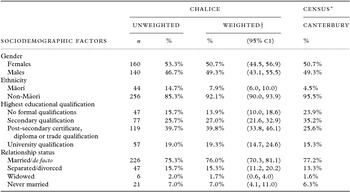
The response rate was 63.7% for the first 300 participants recruited (44 Māori and 256 non-Māori). Recruitment may have been affected by the Canterbury earthquakes. Interviews commenced just prior to the first of the devastating series of Canterbury earthquakes that resulted in the deaths of 185 individuals, over 10,000 homes being irreparably damaged or red zoned and 100,000 homes requiring repairs. The Christchurch city center was largely destroyed, and hill and eastern suburbs were particularly affected. Canterbury residents faced ongoing exhaustion, distress, and stress, with thousands moving within and out of Canterbury (Statistics New Zealand, 2011; Spittlehouse et al., Reference Spittlehouse, Joyce, Vierck, Schluter and Pearson2014). Of 690 invitation letters posted to potential participants, 96 individuals were unable to be contacted, 546 individuals responded, with 44 ineligible, 184 declined to participate and, at that time, 18 had interviews scheduled and 48 were still being followed up. Table 1 shows the breakdown of sociodemographic characteristics of the sample and comparisons with 2006 Census data for adults aged 50–54 years in the Canterbury region (The 2006 Census is the most recent fully reported Census to capture population statistics in New Zealand, following the delay of the 2011 Census because of the February 22 earthquake in Christchurch.).
Unweighted and weighted sociodemographic profile for 300 CHALICE participants compared to the 2006 census Canterbury population estimates for adults aged 50–54 years

*Census figures for the Canterbury population aged 50–54 years taken from the most recent complete New Zealand census on March 7, 2006; and census figures for relationship status total excludes “not stated” but includes “single not further defined” (1.6%).
†Figures weighted for the oversampling of Māori.
Overall, 53.3% of participants were female, 14.7% identified as being of Māori descent, 19.0% had university qualifications, and 75.3% were married or living in a de facto relationship. Gender and relationship status was close to 2006 Census figures for adults aged 50–54 years in the Canterbury region (Statistics New Zealand, 2012). However, the CHALICE sample was more highly educated than the Canterbury population of a similar age. In addition, 42.7% of participants reported living in higher income households, earning over NZ$100,000 per annum. Comparatively fewer participants reported household incomes less than NZ$50,000 (17.9%), NZ$50,001 to $70,000 (16.5%), or NZ$70,001 to $100,000 (19.7%). Comparability with income data from the New Zealand Census was not possible, given that household income was reported differently.
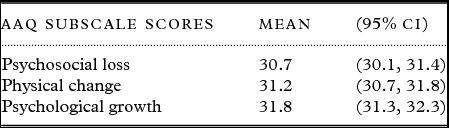
Attitudes to aging were measured using the AAQ as a validated instrument. Table 2 shows the three AAQ subscale means and 95% confidence interval estimates.
Weighted mean and 95% confidence interval (CI) estimates for the attitudes to aging questionnaire (AAQ) subscale scores

Note: AAQ subscale range = 8–40; psychosocial loss subscale reversed so higher scores indicate more positive attitudes on each subscale.
Attitudes to aging in this midlife sample were relatively optimistic, with average scores in excess of 30/40 across domains, defined elsewhere (with older adults) as scores ≥24/40, or an average individual item score of 3/5 (Bryant et al., Reference Bryant, Bei, Gilson, Komiti, Jackson and Judd2012). According to this definition, 89.3% of participants were positive about psychosocial losses, 90.0% expressed optimism about their physical aging, and 97.3% reported positive psychological growth attitudes. Distributions of AAQ subscales were positively skewed, with evidence of a ceiling effect for some participants.
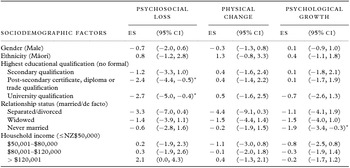
Attitudes to aging were examined in relationship to sociodemographic factors and are shown in Table 3.
Weighted effect size (ES) and 95% confidence interval (CI) for the association of the attitudes to aging questionnaire (AAQ) subscales and sociodemographic factors

Note: All variables n = 300, except for Household Income (n = 291); *p < 0.05, **p < 0.01, ***p < 0.001.
Two out of the five sociodemographic factors examined showed significant relationships with AAQ domains. Higher educational qualifications were significantly associated with more negative attitudes toward psychosocial losses (with weighted effect sizes between −2.4 and −2.7). Participants who were never married reported more significantly more negative psychological growth attitudes (−1.9) than those who were married/de facto, separated/divorced, or widowed. There was no evidence of AAQ response differences based on gender, ethnicity, or household income.
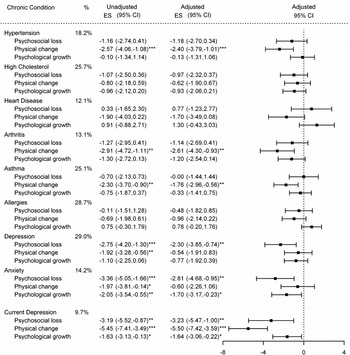
The presence of commonly diagnosed conditions and current depression was compared with each of the three AAQ subscales, both with and without adjustment for sociodemographics and current depression (see Table 4), to quantify the relationships between health and attitudes to aging.
Weighted effect size (ES) and 95% confidence interval (CI)s of unadjusted and adjusted analyses examining the association of diagnosed chronic conditions and current depression with attitudes to aging questionnaire (AAQ) subscales†

†Adjusted estimates were controlled for gender, ethnicity, education, relationship status, and household income as covariates in the model. Additionally, current depression was also included as a covariate in all analyses except when current depression was itself the subject of analysis.
Note: All variables n = 300, except for depression (n = 299), current depression (n = 299) and Household Income (n = 291); *p < 0.05, **p < 0.01 and ***p < 0.001.
Physical change attitudes to aging were significantly related to a number of health conditions examined. Participants with diagnosed hypertension, arthritis, and asthma reported significantly more negative physical change scores, with weighted effect sizes in excess of −2.3. Psychosocial losses were significantly more negatively perceived by those with diagnosed lifetime depression (−2.8) and anxiety (−3.36). Physical changes were negatively reported by those with diagnosed lifetime depression (−1.9) and anxiety (−2.0). Psychological growth was associated with diagnosed anxiety (−1.7), but not with diagnosed lifetime depression. Current depression was significantly associated with more negative scores in all domains and showed the greatest effect size of all health variables tested: −5.5 in observed physical change scores. Of note, the physical change items that showed significant relationships with current depression at the 0.001 level were “I don't feel old”; “problems with my physical health do not hold me back from doing what I want”; “my health is better than I expected for my age”; and “I keep as fit and physically active as possible by exercising.”
The associations between chronic health conditions and attitudes to aging showed reduced statistical significance and magnitude after controlling for gender, ethnicity, education, relationship status, household income, and current depression. However, effects remained in the same direction. After adjustment, current depression continued to show significant relationships with all three AAQ domains in the model, including the greatest negative effect size between attitudinal subscales and any health condition, with physical change attitudes (−5.5). Gender, ethnicity, education, relationship status, and household income were not significantly related to attitudes to aging in the model.
Discussion
This study of a midlife cohort finds that attitudes to aging are associated with chronic physical and mental health conditions. These relationships persist after controlling for the impact of sociodemographic variables and current depression. Mood shows the highest estimated effect size with attitudes to aging.
CHALICE participants with diagnosed arthritis, hypertension, asthma, lifetime depression, and anxiety report significantly more negative physical change attitudes to aging. These relationships continue after controlling for gender, ethnicity, education, relationship status, household income, and current depression. While these specific diagnosed chronic conditions have not yet been reported on with the AAQ, their relationship to psychological well-being has, in the main, been confirmed (Steptoe et al., Reference Steptoe, Wardle and Marmot2005; Mojon-Azzi and Sousa-Poza, Reference Mojon-Azzi and Sousa-Poza2011). The relationships between health and subjective well-being are well established across datasets, countries, time periods, and methods of investigation (Dolan et al., Reference Dolan, Peasgood and White2008).
Results support the consistent finding that negative perceptions of physical changes with aging are linked to the presence of chronic conditions, and confirm this relationship with a midlife cohort. Individuals with a greater number of chronic physical conditions have reported significantly more negative physical change attitudes toward aging, in Spain, Canada, and Norway (Kalfoss et al., Reference Kalfoss, Low and Molzahn2010; Lucas-Carrasco et al., Reference Lucas-Carrasco, Laidlaw, Gómez-Benito and Power2013). However, unlike our study, more negative perceptions of psychosocial loss were also reported in these studies. Our findings are more similar to a study with a broad age range of Canadians with COPD who expressed more negative physical change attitudes, but not psychosocial loss attitudes (Low et al., Reference Low, Ross, Stickland, Wilson and Wong2013). Most previous studies using the AAQ have focused on older populations and it could be argued that, in comparison, those in midlife generally maintain a range of social relationships through family, friends, and employment, and also have spent fewer years living with ill health.
Both depression and anxiety are significantly associated with more negative attitudes to aging, supporting findings from a number of other studies (Kalfoss et al., Reference Kalfoss, Low and Molzahn2010; Bryant et al., Reference Bryant, Bei, Gilson, Komiti, Jackson and Judd2012; Lucas-Carrasco et al., Reference Lucas-Carrasco, Laidlaw, Gómez-Benito and Power2013; Shenkin et al., Reference Shenkin, Laidlaw, Allerhand, Mead, Starr and Deary2014). Depression, even at subclinical levels, has been strongly linked with the most changes to AAQ scores, while controlling for gender, age, and marital status, among over 4,000 individuals from 20 countries (Chachamovich et al., Reference Chachamovich, Fleck, Laidlaw and Power2008). In this study, current depression showed a greater effect size to attitudes to aging than any other health variable tested, with or without controlling for sociodemographic factors. Attitudes to physical change, in particular, are related to the presence of current depression in this midlife sample, supporting other studies with older populations (Chachamovich et al., Reference Chachamovich, Fleck, Laidlaw and Power2008; Kalfoss et al., Reference Kalfoss, Low and Molzahn2010; Bryant et al., Reference Bryant, Bei, Gilson, Komiti, Jackson and Judd2012; Lucas-Carrasco et al., Reference Lucas-Carrasco, Laidlaw, Gómez-Benito and Power2013; Shenkin et al., Reference Shenkin, Laidlaw, Allerhand, Mead, Starr and Deary2014). In midlife, with a comparatively reduced prevalence of chronic conditions, low mood appears to be a key factor increasing individual perceptions of negative physical change with age. Current anxiety has been examined with the AAQ in just one other known study to date, finding that greater psychosocial losses were associated with anxiety, but not across attitudinal domains (Bryant et al., Reference Bryant, Bei, Gilson, Komiti, Jackson and Judd2012). In contrast, the current study finds that lifetime diagnosed anxiety and attitudes to aging in the current study show a more generalized relationship.
It is not surprising to find that sociodemographic factors can have a bearing on attitudes to aging, but relationships were modest. Reporting of sociodemographic factors in relation to the AAQ is still relatively limited. More negative psychosocial losses have previously been associated with being single (Bryant et al., Reference Bryant, Bei, Gilson, Komiti, Jackson and Judd2012) and with higher educational qualifications (Chachamovich et al., Reference Chachamovich, Fleck, Laidlaw and Power2008; Lucas-Carrasco et al., Reference Lucas-Carrasco, Laidlaw, Gómez-Benito and Power2013). It was of interest that gender, ethnicity, and household income were not related to attitudes to aging in this study. Consistent with many studies, no significant attitudinal variability with gender was found, although men have reported more negative attitudes to psychosocial losses (Lucas-Carrasco et al., Reference Lucas-Carrasco, Laidlaw, Gómez-Benito and Power2013) and physical change attitudes (Shenkin et al., Reference Shenkin, Laidlaw, Allerhand, Mead, Starr and Deary2014). While country of origin has been reported on with regards to the AAQ, no reports of ethnicity have yet been published to date, preventing comparison. Income was not related to attitudes toward aging, despite having been directly and strongly associated with psychological distress, loneliness, and less social support in New Zealand (Stephens et al., Reference Stephens, Alpass, Towers, Noone and Stevenson2011) and with attitudes to aging (Bryant et al., Reference Bryant, Bei, Gilson, Komiti, Jackson and Judd2012).
It is of relevance that interviewing took place during the devastating series of Canterbury earthquakes (Spittlehouse et al., Reference Spittlehouse, Joyce, Vierck, Schluter and Pearson2014). Paradoxically, while current depression and diagnosed lifetime depression were greater than those reported nationally, attitudes toward aging were more positive compared to the literature. Thus, while lifetime diagnosed and current depression shows strong associations with attitudes to aging, for those without depression, attitudes to aging appear to be relatively untouched by the experience of a major disaster. This is a new finding, occurring during uncommon circumstances of assessing such factors together. It may be that in the two years from the first major earthquake that participants felt relieved and grateful to have survived the disaster and were imbued with an immediate sense of purpose in dealing with resettlement and reconstruction of their physical and social environments. Repeat assessment of the CHALICE sample may capture a lowering of positive attitudes to aging, particularly for those weary from ongoing insurance, financial, land, repair, and rebuild issues.
This research makes a contribution to what is known about attitudes to aging and health, at a time when attention is increasingly focused on protecting the health of aging populations. This study may be the first of its kind to examine the association of such a range of chronic physical and mental conditions with attitudes to aging, as measured by the AAQ. The CHALICE study is the first New Zealand study to report on use of the AAQ. To our knowledge, it is also the first time that internal consistency coefficients for the three AAQ subscales have been reported for populations younger than 60 years. That Cronbach's α for this midlife sample are comparable to those reported in the literature for adults aged 60 years and over may encourage use of the AAQ with younger participants. Focusing on the attitudes to aging of those in midlife has been relatively neglected in contrast to research on older individuals’ attitudes. Just one previous study has reported on the attitudes of a midlife cohort to their own aging, as measured by the AAQ, finding that attitudes became more positive with increasing age (Matthews et al., Reference Matthews, Lindner and Collins2007). Those currently in midlife are the older generation of the future and, as such, warrant greater understanding and attention.
Limitations of this study
The present study does have some limitations. The age of the sample ranged between 49 and 51 years, limiting generalizability to other age groups. A midlife sample may report lower psychological well-being, but fewer chronic conditions, which impact on their attitudes to aging. The sample size of 300 participants has relatively modest statistical power for the investigation of factors with low prevalence, and some erroneous null findings may have resulted. With the acquisition of more participants, this statistical power will increase. A response rate of 63.7% is reasonable, given the circumstances. Despite some methodological differences, household income levels in our sample were higher than the Canterbury population aged 50–54 years. Causation between health and attitudes to aging has not yet been established, due to the design of this and other studies. However, it is likely that attitudes impact on health and health on attitudes.
Conclusion
To conclude, we find that health is associated with attitudes to aging in midlife. These associations remain significant for those with diagnosed arthritis, hypertension, asthma, lifetime depression, and anxiety, as well as for those who are currently depressed, after controlling for sociodemographic factors and current depression. In particular, individuals who are currently depressed or have had a diagnosis of lifetime depression are much more likely to feel negative about their own aging over a range of domains. Negative attitudes to aging appear to be mood-dependent (Laidlaw et al., Reference Laidlaw, Power and Schmidt2007; Bryant et al., Reference Bryant, Bei, Gilson, Komiti, Jackson and Judd2012; Lucas-Carrasco et al., Reference Lucas-Carrasco, Laidlaw, Gómez-Benito and Power2013; Shenkin et al., Reference Shenkin, Laidlaw, Allerhand, Mead, Starr and Deary2014), as well as being closely linked to individual health.
These results extend our understanding of attitudes toward personal aging and relationships with a range of physical and mental health conditions, and have some practical implications. First, it may be useful to increase health practitioner awareness of the relationship between the diagnosis of chronic conditions and negative attitudes toward physical aging, which could have a further impact on health and well-being. Second, increased support and treatment for those suffering from depression and anxiety would be of value for individuals as they age. Finally, since personal aging occurs within the context of aging societies, it is essential to promote positive aging in specific, meaningful, and productive ways. This includes challenging negative age stereotypes to foster more positive attitudes about aging, promoting key healthy lifestyle and help-seeking behaviors at midlife to help protect health in later life, and preparing individuals to age successfully in a range of life domains.
Longitudinal research following individuals’ attitudes as they age, both with and without chronic physical and mental health conditions, is called for. It would be of interest to understand how those with ill health maintain positive attitudes toward their own aging, as would understanding what could make a difference to those “worried well” who feel negative about aging. Understanding how individuals view their life, health, and future as they age is of importance in protecting well-being.
Conflict of interest
None.
Description of authors’ roles
Ms A.M. Thorpe and Professor P.R. Joyce formulated the research questions; Ms A.M. Thorpe and Ms J.K. Spittlehouse carried out data collection; Dr J. Pearson and Ms A.M. Thorpe were responsible for carrying out the data analysis, Ms A.M. Thorpe interpreted results and prepared the draft paper; and all authors contributed to its revision.
Acknowledgments
The authors gratefully acknowledge participants’ time and openness during stressful times, interviewers Dr Esther Vierck and Ms Julia Martin, data manager Ms Monica Johnstone, and the Department of Internal Affairs, Lotteries Health, Canterbury Community Trust, and the University of Otago for grants awarded.