


There are few empirical studies of cognitive style, such as self-esteem and dysfunctional attitudes, in bipolar disorder (Reference Pardoen, Bauwens and TracyPardoen et al, 1993; Reference Alloy, Reilly-Harrington and FrescoAlloy et al, 1999; Reference Scott, Stanton and GarlandScott et al, 2000; Reference Scott and PopeScott & Pope, 2003; Reference Lam, Wright and SmithLam et al, 2004). Studies have produced inconsistent findings; sample sizes tend to be small and selective, and some include non-clinical samples. The issue of whether bipolar disorder is associated with characteristic cognitive styles, and whether these factors are related to the onset or course of illness, is theoretically and clinically relevant. The aim of this study was to examine aspects of cognitive style (self-esteem and dysfunctional attitudes) in a large, representative, well-characterised and narrowly defined sample with bipolar disorder in comparison with unipolar major recurrent depression and healthy controls.
METHOD
Samples
Samples were recruited using systematic and non-systematic methods as part of our ongoing research programmes to investigate genetic and non-genetic determinants of affective disorders. Community mental health teams and lithium clinics in the West Midlands used screening methods to systematically identify individuals with major affective disorders and, with the permission of the responsible medical officer, all those meeting the entry criteria were invited to participate in the study. Advertisements for volunteers were placed in local general practitioner surgeries, local newspapers and television news programmes and circulated via patient support organisations (Manic–Depressive Fellowship and Depression Alliance).
Individuals were included if they met the following criteria:
-
(a) capable of giving voluntary informed written consent;
-
(b) aged 18 years or over;
-
(c) met DSM–IV–TR (American Psychiatric Association, 2000), ICD–10 (World Health Organization, 1993) and Research Diagnostic Criteria (RDC; Reference Spitzer, Endicott and RobinsSpitzer et al, 1978) for bipolar I affective disorder or major recurrent depression; and
-
(d) because they were recruited for molecular genetic studies, UK/Irish White ethnicity.
Individuals were excluded if they:
-
(a) had only experienced affective illness in relation to, or as a consequence of, alcohol or substance misuse or dependence;
-
(b) had only experienced affective illness as a consequence of medical illness or medication;
-
(c) were an intravenous drug misuser with a lifetime diagnosis of dependency;
-
(d) had an organic brain disorder or other cognitive problem that impeded their ability to complete the questionnaires;
-
(e) declined to complete the questionnaires; or
-
(f) were biologically related to another study participant.
Of those suitable individuals identified via our systematic screening procedure, 44.0% refused to participate and we were unable to make contact with a further 13.9%. Of those who agreed or volunteered to take part, 9.4% failed to complete the questionnaires. Our final sample comprised 118 individuals with bipolar I disorder (47.5% recruited systematically) and 265 with unipolar major recurrent depression (39.2% recruited systematically).
The controls were a sub-sample of participants who had originally been recruited to the GENESiS (Genetic and Environmental Nature of Emotional States in Siblings) study (Reference Sham, Sterne and PurcellSham et al, 2000). This study recruited 34 371 individuals from general practices in England and Wales. Index individuals were registered with these practices, were aged between 18 and 55 years and had no current serious medical illness or disability. GENESiS participants were approached to take part in the current study if they fell into the bottom 20% of the distribution on the Sham Composite Index of Liability to Depression and Anxiety (G; Reference Sham, Sterne and PurcellSham et al, 2000). G comprises responses to the following self-report measures: General Health Questionnaire (GHQ–12, 12-item version; Reference Goldberg, Gater and SartoriusGoldberg et al, 1997); short form of the neuroticism sub-scale of the Eysenck Personality Questionnaire (EPQ–N; Reference Eysenck and EysenckEysenck & Eysenck, 1975); and two sub-scales of the Mood and Anxiety Symptoms Questionnaire (MASQ; Reference Watson, Weber and AssenheimerWatson et al, 1995) which measure levels of anxious arousal (MASQ–AA) and high positive affect (MASQ–HPA).
Controls were screened for a personal or family history of psychiatric illness using a semi-structured telephone interview. Of those controls who agreed to take part in the study, 3.9% failed to complete the questionnaires. Our final control sample comprised 268 individuals.
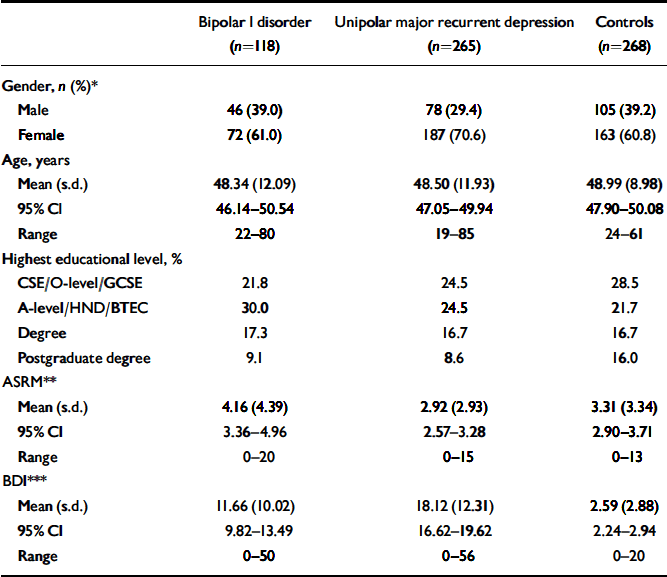
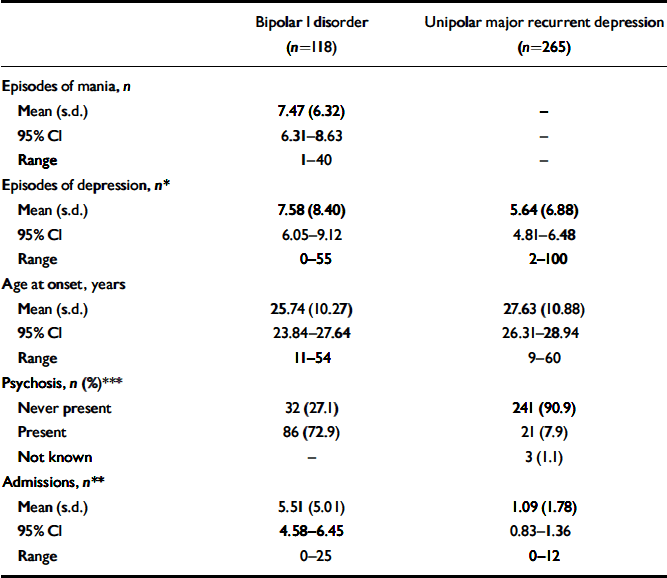
Basic demographic and clinical features of the samples are presented in Tables 1 and 2.
Basic demographic features, Altman Self-Rating Mania Scale (ASRM) and Beck Depression Inventory (BDI) scores of those with bipolar I disorder, those with unipolar major recurrent depression and controls
| Bipolar 1 disorder (n=118) | Unipolar major recurrent depression (n=265) | Controls (n=268) | |
|---|---|---|---|
| Gender, n (%)* | |||
| Male | 46 (39.0) | 78 (29.4) | 105 (39.2) |
| Female | 72 (61.0) | 187 (70.6) | 163 (60.8) |
| Age, years | |||
| Mean (s.d.) | 48.34 (12.09) | 48.50 (11.93) | 48.99 (8.98) |
| 95% CI | 46.14-50.54 | 47.05-49.94 | 47.90-50.08 |
| Range | 22-80 | 19-85 | 24-61 |
| Highest educational level, % | |||
| CSE/O-level/GCSE | 21.8 | 24.5 | 28.5 |
| A-level/HND/BTEC | 30.0 | 24.5 | 21.7 |
| Degree | 17.3 | 16.7 | 16.7 |
| Postgraduate degree | 9.1 | 8.6 | 16.0 |
| ASRM** | |||
| Mean (s.d.) | 4.16 (4.39) | 2.92 (2.93) | 3.31 (3.34) |
| 95% CI | 3.36-4.96 | 2.57-3.28 | 2.90-3.71 |
| Range | 0-20 | 0-15 | 0-13 |
| BDI*** | |||
| Mean (s.d.) | 11.66 (10.02) | 18.12 (12.31) | 2.59 (2.88) |
| 95% CI | 9.82-13.49 | 16.62-19.62 | 2.24-2.94 |
| Range | 0-50 | 0-56 | 0-20 |
Clinical features of those with affective disorders
| Bipolar 1 disorder (n=118) | Unipolar major recurrent depression (n=265) | |
|---|---|---|
| Episodes of mania, n | ||
| Mean (s.d.) | 7.47 (6.32) | - |
| 95% CI | 6.31-8.63 | - |
| Range | 1-40 | - |
| Episodes of depression, n* | ||
| Mean (s.d.) | 7.58 (8.40) | 5.64 (6.88) |
| 95% CI | 6.05-9.12 | 4.81-6.48 |
| Range | 0-55 | 2-100 |
| Age at onset, years | ||
| Mean (s.d.) | 25.74 (10.27) | 27.63 (10.88) |
| 95% CI | 23.84-27.64 | 26.31-28.94 |
| Range | 11-54 | 9-60 |
| Psychosis, n (%)*** | ||
| Never present | 32 (27.1) | 241 (90.9) |
| Present | 86 (72.9) | 21 (7.9) |
| Not known | - | 3 (1.1) |
| Admissions, n** | ||
| Mean (s.d.) | 5.51 (5.01) | 1.09 (1.78) |
| 95% CI | 4.58-6.45 | 0.83-1.36 |
| Range | 0-25 | 0-12 |
Assessments
Those with affective disorders were interviewed using the Schedules for Clinical Assessment in Neuropsychiatry (SCAN; Reference Wing, Babor and BrughaWing et al, 1990) and psychiatric/general practice case notes were reviewed. These data were combined for each participant to form a written case vignette. Best-estimate lifetime diagnoses were made according to DSM–IV–TR, ICD–10 and RDC. The vignettes were also used to rate other key clinical variables (such as age at onset and number of episodes of illness). Each individual was diagnosed and had key clinical variables rated independently by at least two members of the research team, and consensus was reached. Inter-rater reliability was high. This was formally assessed using 20 cases and resulted in mean kappa statistics of 0.85, 0.83 and 0.80 for DSM–IV–TR, ICD–10 and RDC diagnoses, respectively. Mean kappa statistics for other key clinical variables ranged from 0.81 to 0.99. Mean intraclass correlation coefficients for other key clinical variables ranged from 0.91 to 0.97.
The following self-rated questionnaires, all with demonstrated validity and reliability, were part of a larger pack of questionnaires administered to the groups with affective disorders and the controls.
Rosenberg Self-Esteem Questionnaire
The Rosenberg Self-Esteem Questionnaire (SEQ; Reference RosenbergRosenberg, 1965) measures trait self-esteem. It is a ten-item questionnaire comprising five positive statements (e.g. ‘On the whole I am satisfied with myself’) and five negative statements (e.g. ‘At times I think I am no good at all’). We used the version in which each item is rated on a 1–4 scale (from strongly disagree to strongly agree for the positive items and strongly agree to strongly disagree for the negative items). Thus, scores can range from 5 to 20 on both sub-scales, with high scores on the positive sub-scale reflecting high positive self-esteem and high scores on the negative sub-scale reflecting low negative self-esteem. Combining these sub-scales produces a total SEQ score which can range from 10 to 40, with higher total scores reflecting higher total self-esteem.
Dysfunctional Attitudes Scale
The Dysfunctional Attitudes Scale (DAS) measures underlying beliefs and attitudes. We used the 24-item version of the DAS (Reference Power, Katz and McGuffinPower et al, 1994). Each item is rated on a 1–7 scale (totally disagree to totally agree, except for three items where the scoring is reversed). As well as a total score, which can range from 24 to 168, the DAS gives three sub-scale scores, each ranging from 8 to 56. The three sub-scales are achievement (example item: ‘If I fail partly, it is as bad as being a complete failure’), dependency (example item: ‘If others dislike you, you cannot be happy’) and self-control (‘I should always have complete control over my feelings’).
Altman Self-Rating Mania Scale
The Altman Self-Rating Mania Scale (ASRM; Reference Altman, Hedeker and PetersonAltman et al, 1997) assesses the presence and/or severity of current manic symptoms. It comprises five items scored from 0 (absent) to 4 (present to a severe degree). Total scores range from 0 to 20.
Beck Depression Inventory
The Beck Depression Inventory (BDI; Reference Beck and SteerBeck & Steer, 1987) assesses the presence and/or severity of current depressive symptoms. It comprises 21 items scored from 0 (absent) to 3 (present to a severe degree). Total scores range from 0 to 63.
Eysenck Personality Questionnaire
We used the 90-item version of the Eysenck Personality Questionnaire (EPQ; Reference Eysenck and EysenckEysenck & Eysenck, 1975). Each item is rated either ‘yes’ or ‘no’ by respondents. The EPQ gives scores for three personality dimensions: extraversion, neuroticism (EPQ–N) and psychoticism. Scores for the EPQ–N range from 0 to 23.
Procedure
Individuals were approached to participate in the study when they were judged by the treating medical team to be in a euthymic state. After the semi-structured interview, the questionnaires were left with participants to rate and return to the team (stamped, addressed return envelopes were provided). They were given written instructions to complete all of the questionnaires at the same time within 1 week of receiving them. If the questionnaires were not returned after 1 month, a reminder letter was sent with another copy of the questionnaires and a return envelope. If the questionnaires were still not returned after a further 2 weeks, a reminder telephone call was made.
Controls received the questionnaires via the post. Otherwise the procedure was identical to that outlined above.
This study received all necessary multi-region and local research ethics committee approval.
Statistical analysis
The three groups were compared for socio-demographic variables using the χ2-test or one-way analysis of variance (ANOVA), followed by post hoc comparisons using the Tukey test. Differences in key clinical variables between those with bipolar I disorder and those with unipolar major recurrent depression were examined using independent sample t-tests or χ2-tests.
The distributions of the questionnaire scores in each of the groups approximated normal, thus the three groups were compared on the ASRM, BDI and all cognitive style measures using univariate one-way ANOVAs, followed by the Tukey test. Two-way univariate analyses of covariance (ANCOVAs) were then carried out with group and gender as factors and age, ASRM and BDI scores (both separately and together) as covariates.
Binary logistic regression using forward stepwise likelihood ratio for variable selection was carried out to determine the best predictors of affective disorder versus control status. Stepwise linear multiple regression was used to examine which cognitive style variables best predicted EPQ–N score in those with affective disorders.
The Spearman rank correlation coefficient was used to examine the correlations between the cognitive style variables and key measures of past psychiatric history in those with affective disorders.
All analyses were undertaken using the Statistical Package for the Social Sciences for Windows (version 10.0.7).
RESULTS
Sample characteristics
The three groups were well matched for age and educational achievement (Table 1). Participants were predominantly female in all groups; however, there was a significantly higher proportion of females in the group with unipolar major recurrent depression (70.6%) than the other two groups. Those with bipolar I disorder scored significantly higher on the ASRM than those with major recurrent depression, and non-significantly higher than the controls. Both groups with affective disorders scored significantly higher than the controls on the BDI, and those with unipolar major recurrent depression scored significantly higher than those with bipolar I disorder.
Clinical features of those with affective disorders are summarised in Table 2. Age at illness onset, defined as age at first clinically significant functional impairment due to affective illness, was similar for the two groups. Those with bipolar I disorder had significantly more episodes of illness and significantly more psychiatric hospital admissions than those with unipolar major recurrent depression. Nearly three-quarters of those with bipolar I disorder (n=86) had experienced psychosis compared with approximately 8% (n=21) of those with unipolar major recurrent depression.
Comparison of cognitive style between the groups
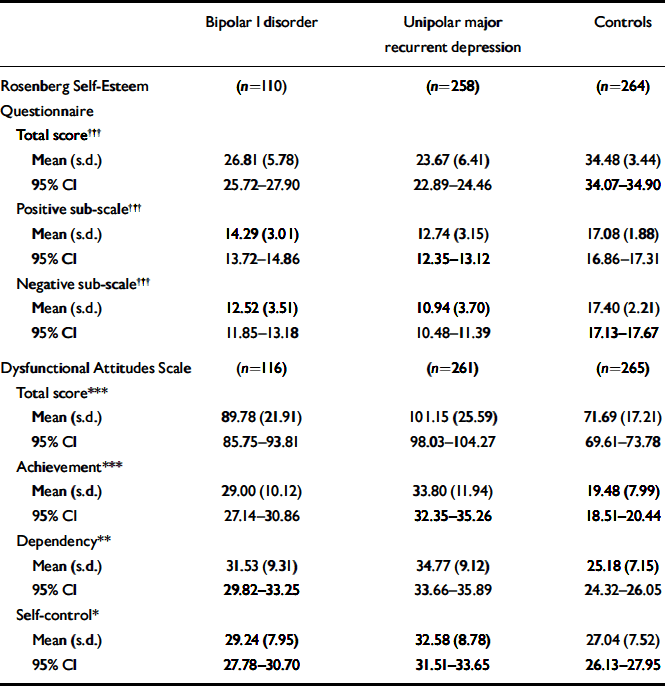
Mean scores for each of the groups on each of the cognitive style measures are presented in Table 3. There were statistically significant differences between groups on all measures. Not only did those with affective disorders differ from controls but they also showed a significantly different pattern of results. Those with unipolar major recurrent depression showed the lowest levels of self-esteem (low positive and high negative self-esteem) and those with bipolar I disorder scored significantly lower than controls and higher than those with major recurrent depression. Those with major recurrent depression also showed the highest level of dysfunctional attitudes, followed by those with bipolar I disorder, followed by controls. This pattern was true for each of the sub-scales of the DAS.
Cognitive style scores in the three groups
| Bipolar I disorder | Unipolar major recurrent depression | Controls | |
|---|---|---|---|
| Rosenberg Self-Esteem | (n=110) | (n=258) | (n=264) |
| Questionnaire | |||
| Total score††† | |||
| Mean (s.d.) | 26.81 (5.78) | 23.67 (6.41) | 34.48 (3.44) |
| 95% CI | 25.72-27.90 | 22.89-24.46 | 34.07-34.90 |
| Positive sub-scale††† | |||
| Mean (s.d.) | 14.29 (3.01) | 12.74 (3.15) | 17.08 (1.88) |
| 95% CI | 13.72-14.86 | 12.35-13.12 | 16.86-17.31 |
| Negative sub-scale††† | |||
| Mean (s.d.) | 12.52 (3.51) | 10.94 (3.70) | 17.40 (2.21) |
| 95% CI | 11.85-13.18 | 10.48-11.39 | 17.13-17.67 |
| Dysfunctional Attitudes Scale | (n=116) | (n=261) | (n=265) |
| Total score*** | |||
| Mean (s.d.) | 89.78 (21.91) | 101.15 (25.59) | 71.69 (17.21) |
| 95% CI | 85.75-93.81 | 98.03-104.27 | 69.61-73.78 |
| Achievement*** | |||
| Mean (s.d.) | 29.00 (10.12) | 33.80 (11.94) | 19.48 (7.99) |
| 95% CI | 27.14-30.86 | 32.35-35.26 | 18.51-20.44 |
| Dependency** | |||
| Mean (s.d.) | 31.53 (9.31) | 34.77 (9.12) | 25.18 (7.15) |
| 95% CI | 29.82-33.25 | 33.66-35.89 | 24.32-26.05 |
| Self-control* | |||
| Mean (s.d.) | 29.24 (7.95) | 32.58 (8.78) | 27.04 (7.52) |
| 95% CI | 27.78-30.70 | 31.51-33.65 | 26.13-27.95 |
These data were further analysed using ANCOVA. No significant gender by group interactions were observed, and controlling for age and ASRM scores (both separately and together) did not alter the findings. When current levels of depression, as measured by the BDI, were taken into account, no differences between the two groups with affective disorders on any of the measures emerged. However, both groups still exhibited lower levels of self-esteem and more dysfunctional attitudes (total score and achievement and dependency sub-scales) than controls. Those with major recurrent depression scored significantly higher than controls on the DAS self-control sub-scale, and those with bipolar I disorder were not significantly different from those with major recurrent depression or controls. These analyses were repeated using only those who had been recruited systematically (56 with bipolar I disorder and 104 with unipolar major recurrent depression) and an identical pattern of results emerged.
Logistic regression was carried out to determine which combination of cognitive style variables best predicted group membership (i.e. control or affective disorder). Gender, age, BDI scores, ASRM scores and all cognitive style measures were entered into the regression. The best solution correctly classified 86.3% of participants. The significant variables in this solution were BDI (OR=1.23, 95% CI 1.15–1.31, P<0.0001) and SEQ negative sub-scale (OR=0.68, 95% CI 0.62–0.75, P<0.0001).
EPQ neuroticism in those with affective disorders
In order to explore how cognitive style related to more widely used concepts of personality and vulnerability to mood disturbance, we undertook a multiple linear regression analysis in those with affective disorders with EPQ–N as the dependent variable. After controlling for BDI score, the following cognitive style variables predicted 49.5% of the variance in EPQ–N: SEQ total score (standardised β=–0.34, P<0.0001) and DAS achievement score (standardised β=0.20, P<0.0001). These two cognitive style variables and EPQ–N were also significantly correlated with age at illness onset (SEQ total r=0.13, P=0.02; DAS achievement r=–0.13, P=0.01; EPQ–N r=–0.12, P=0.02). SEQ total score and EPQ–N were significantly correlated with number of previous episodes of depression (r=–0.13, P=0.01; r=0.17, P=0.001, respectively).
DISCUSSION
We have investigated aspects of cognitive style in individuals with bipolar I disorder, those with unipolar major recurrent depression and healthy controls. Our samples were large and powerful: post hoc power calculations, undertaken using nQuery Advisor (version 4.0), showed that on all of the questionnaire measures our sample size had >99% power to detect at the 0.05 level the difference in means between the three groups that we demonstrated.
Those participating in this study were: (a) narrowly defined – they met lifetime diagnostic criteria according to three widely used psychiatric classification systems; (b) well characterised – illness data were collected using a validated semi-structured interview and case note review, and a range of clinical variables were rated using the consensus method, with excellent interrater reliability; (c) representative – a large percentage were systematically recruited. The controls were unaffected and selected for a low risk of developing a mood disorder. This study builds on previous work in this area which has tended to use small, selective samples and has shown inconsistent results.
Comparison of those with mood disorders and healthy controls
We have shown lower self-esteem (greater negative evaluation of self and less positive evaluation of self) and more dysfunctional attitudes (greater need for achievement, greater dependency on others and greater need for control of self) among those with bipolar and unipolar disorders compared with healthy controls. Our finding of abnormalities of cognitive style in those with mood disorders supports previously published work (Reference Scott, Stanton and GarlandScott et al, 2000). We have demonstrated that when possible confounding factors are controlled for, the best predictor of whether a participant has a mood disorder or is a healthy control is the score on the negative sub-scale of the SEQ. It is interesting to note that Scott & Pope (Reference Scott and Pope2003) showed that negative self-esteem was the most robust predictor of both manic and depressive relapse in those with bipolar disorder. This sub-scale should be a target for future research into cognitive style in affective disorders.
Importance of measuring current mental state
Our data show that it is essential to take account of current mental state when investigating aspects of underlying cognitive style in individuals with mood disorders. Although participants were studied when, in the opinion of the responsible medical team, they were clinically euthymic, we found significant levels of depressive symptoms. When we controlled for this in our analyses, the pattern of findings was considerably altered. This supports previous work that has demonstrated confounding effects of residual affective symptoms in those with mood disorders on measures of cognitive style and neuropsychological functioning (Reference Ferrier, Stanton and KellyFerrier et al, 1999; Reference Clark, Iversen and GoodwinClark et al, 2002; Reference Farmer and Di LallaFarmer, 2004). However, it is important to note that a 12-year follow-up of over 100 individuals with bipolar disorder demonstrated that sub-syndromal and syndromal symptoms of depression were present for nearly 50% of the time, suggesting that this characterises the ‘usual’ mental state of many individuals with bipolar disorder (Reference Judd, Akiskal and SchlettlerJudd et al, 2002). Those with unipolar and bipolar disorders with persistent residual symptoms and the associated abnormalities of cognitive style are particularly at risk of further relapse (Reference Paykel, Ramana and CooperPaykel et al, 1995; Reference Scott and PopeScott & Pope, 2003).
Comparison of bipolar disorder with unipolar major recurrent depression
When current mental state is taken into account, the measures of cognitive style employed in this study do not differentiate individuals who experience episodes of mania from those with unipolar depression. We have not shown a pattern of cognitive style that is unique to individuals with bipolar disorder. The measures we have included indicate a non-specific, generalised pattern associated with mood disorders or psychiatric ill health in general. These findings reflect previous studies in smaller or mixed clinical and non-clinical samples that have shown similar patterns in both illnesses (Reference Ashworth, Blackburn and McPhersonAshworth et al, 1982; Reference Rosenfarb, Becker and KhanRosenfarb et al, 1998; Reference Alloy, Reilly-Harrington and FrescoAlloy et al, 1999; Reference Scott and PopeScott & Pope, 2003; Reference Lam, Wright and SmithLam et al, 2004), and studies which have demonstrated abnormal scores on measures of cognitive style in individuals with other mental disorders, such as schizophrenia (Reference Hollon, Kendall and LumryHollon et al, 1986; Reference Van Os and JonesVan Os & Jones, 2001). Much of the previous work on cognitive changes in bipolar disorder has focused on information-processing systems (Reference Taylor Tavares, Drevets and SahakianTaylor Tavares et al, 2003). It is interesting to note that the majority of studies have shown overlapping deficits in bipolar and unipolar disorder (Reference Bearden, Hoffman and CannonBearden et al, 2001). It is difficult to find a valid explanation of how shared beliefs across mood disorders increase the risk of depressive relapse in one group but of manic and depressive episodes in the other. Scott and others have hypothesised that individuals with bipolar disorders show greater day-to-day variability in cognitive style and have a self-esteem that is more vulnerable to shift in response to external events. Such differences may emerge when cognitive style is measured in a prospective longitudinal study, and are less likely to be apparent in cross-sectional studies (Reference Scott, Reisnecke and ClarkeScott, 2004).
Implications of the findings
The investigation of cognitive style in bipolar disorder is of clinical relevance. For example, such factors could influence the development of psychotherapies specific to the illness, likely adherence and response to medication regimens and prognosis. We have shown that, independent of current levels of symptoms, those with bipolar disorder show a fragile cognitive style similar to those with unipolar depression. Therefore, it is not surprising that psychological treatments that are effective in depression are also helpful in reducing symptoms, improving global functioning and reducing relapse in bipolar disorder (Reference Scott, Garland and MoorheadScott et al, 2001). Other aspects of cognition should be further investigated in bipolar disorder to refine psychological models for the development of specific targeted psychotherapies.
Neuroticism and cognitive style
We were interested to examine the relationship between measures of cognitive style and EPQ–N in those with affective disorders. The concept of neuroticism fell out of favour for some time, but Martin (Reference Martin1985) described it in a clinically meaningful way, namely as a marker of vulnerability to depression and of a vulnerable cognitive style (fragile self-esteem, high levels of trait dysfunctional beliefs). This relationship between neuroticism and cognitive style appears to hold true for those with unipolar and bipolar disorder and also was related, albeit modestly, to key measures of past psychiatric history, such as number of previous episodes of depression and age at illness onset. However, the nature of our control group (i.e. they were selected partially on the basis of having low EPQ–N scores) means that we cannot explore the relationship between cognitive style and neuroticism across groups who have normal as compared with abnormal variability in mood states.
Limitations
Our study cannot determine whether the differences in cognitive style observed in those with mood disorders are a cause or a consequence of the onset or course of affective illness. It has generally been accepted that the personality trait EPQ–N, for example, is genetically determined and underlies vulnerability to develop unipolar depression (Reference Duggan, Sham and LeeDuggan et al, 1995; Reference Fanous, Gardner and PrescottFanous et al, 2002). However, other authors (Reference Farmer, Redman and HarrisFarmer et al, 2002) have argued that elevated EPQ–N in depression may merely reflect residual symptoms. Prospective longitudinal studies which begin in the premorbid state (e.g. using high-risk samples) are essential if we are to understand the role of cognitive style in the development of affective disorders. If aspects of cognition are shown to be markers of underlying liability to bipolar disorder, they could be useful in aetiological research, such as molecular genetic studies, and early intervention studies.
A possible limitation of our study is that we have included individuals recruited systematically (via community mental health teams and lithium clinics) and opportunistically (via advertisements). However, the analysis was repeated using only those recruited using systematic methods, and the pattern of findings was unchanged.
To maximise our power to detect differences, we used a control group selected for low risk of developing a mood disorder (‘supernormal’ controls). The measures of cognitive style examined here, however, were not used to define the control group, and it is unlikely that the differences are accounted for merely by the selection of controls. Future research should aim to use unselected controls.
Our assessment tools can also be criticised. We used self-report measures of cognitive style and single subjective ratings of current manic and depressive symptoms, rather than combining them with objective investigator-rated scales. There is evidence that self-esteem in individuals with bipolar disorder is better measured by implicit means (Reference Lyon, Startup and BentallLyon et al, 1999) and that these individuals may show social conformism (Reference Pardoen, Bauwens and TracyPardoen et al, 1993), which could bias self-report measures. However, we did not observe a significant difference between our three groups on the lie scale of the EPQ (data not shown).
In this study we have investigated only limited aspects of cognitive style in those with bipolar disorder. We have shown that although they exhibit abnormal patterns, these are not unique when compared with individuals with other mood disorders. Future studies of large, unselected samples of individuals with bipolar disorder with appropriate psychiatric and non-psychiatric controls could focus on other potentially interesting aspects of cognitive style, such as attributions, self-representations, novelty seeking traits, affective temperaments and perfectionism.
Clinical Implications and Limitations
CLINICAL IMPLICATIONS
-
▪ Those with bipolar and unipolar disorder have similar fragile self-esteem and dysfunctional beliefs.
-
▪ It is not surprising that psychological treatments that target negative cognitive style in unipolar depression are also helpful in bipolar disorder.
-
▪ Unless unique aspects of cognitive style are identified in bipolar disorder, it will be difficult to develop a more specific model of psychotherapy for bipolar disorders.
LIMITATIONS
-
▪ Not all patients were recruited systematically.
-
▪ We relied exclusively on the use of self-report measures.
-
▪ We utilised a ‘supernormal’ control group.
Acknowledgements
We are grateful to the Wellcome Trust and Medical Research Council for financial support. We thank Dr George Pelios for database programming, Debbie Baker and Natalie Kynes for data entry and Dr Roger Holder for statistical advice. We thank all mental health professionals who helped to recruit participants. Finally, we thank all participants who gave their time and support.




eLetters
No eLetters have been published for this article.