I. INTRODUCTION
Grain refinement of cast metals can not only improve the strength and ductility but also promote the uniformity of subsequent wrought products. Thus, grain refinement has been a long-term research topic. Although advanced casting processes, such as rapid cooling and high pressure die casting, also produce fine grains in castings, addition of grain refiners is still considered as one of the most important and effective approaches to grain refinement. This is even more critical for ingot casting.
In the past decades, it has been very successful in producing refined grains in aluminum cast alloys by adding grain refiners, including Al3Ti, TiB2, and TiC.Reference Easton and StJohn1 However, the challenge still remains to refine Mg alloys containing Al, Mn, or Si. This attributed higher affinity to Zr to form an intermetallic component with these elements and therefore eliminating its grain refining effect. Thus, seeking effective grain refiners for this type of Mg alloys, Mg–Al alloys in particular, has been one of the most active research topics in the area of Mg alloys.
In recent years, a number of potential grain refiners for Mg–Al alloys have been reported. A new Al-C master alloy discovered by Guang et al.Reference Han, Liu and Ding2 using a powder metallurgy processing reduces the grain size of AZ31 castings from 400 to 140 μm with 2% addition. However, the preparation of the master alloy, in particular, the use of pure argon to protect the powders, significantly increases its cost with such large amount of additions, and this may limit its practical application. Li et al.Reference Li, Zhou and Li3 investigated the effect of Gd on the microstructure and the rolling capability of AZ31 alloy and found that a 3 wt% addition reduced the grain size of as-cast alloy from 100 to 46 μm. Although the rolling capability of the alloy was improved due to the formation of Al2Gd, the grain refining efficiency of Gd is not particularly significant and 3 wt% Gd addition also too costly. Similarly, other rare earths (RE), such as Ce and Y, have been used to refine the grains of Mg–Al-based alloys. Tian et al.Reference Tian, Wang, Wang, Liu, An and Cao4 reported that the average grain size of the as-cast Mg–3Al–3RE varied from 50 to 82 μm. However, because the grain size of the alloy without RE was not discussed, the grain refining efficiency of these elements cannot be verified. A more successful recent approach to grain refinement of Mg–3Al alloy was achieved through the combination of carbon inoculation with an addition of either SrReference Du, Yang, Kuwabara, Li and Peng5 or Ca.Reference Du, Yang, Kuwabara, Li and Peng6 Additions of 0.2 wt% C and 0.2 wt% Sr or Ca into Mg–3wt% Al melts reduce the grain size from 400 to 110 μm. This grain refinement is considered to result from heterogeneous nucleation on the in situ formed Al–C–O particles. However, the reported results were based on a small scale of 20 g melts and therefore the grain refining efficiency of the technique at larger scales needs to be verified. Furthermore, ZnO particles have also been reported as a possible grain refiner for Mg alloys due to the similar crystal structure between ZnO and Mg.Reference Fu, Qiu, Zhang, Wang, Kelly and Taylor7 However, the instability of this oxide in Mg melts dramatically weakens its efficiency. AlN has been considered as an effective grain refines for Mg alloy due to its similar crystal structure with Mg.Reference Dahle, Lee, Nave, Schaffer and StJohn8 But, recent workReference Fu, Zhang, Qiu, Kelly and Taylor9 indicates that the best grain refining efficiency can only be achieved at casting temperature of 765 °C, which is higher than that normal casting temperature for this alloy. TiB2Reference Wang, Zeng and Ding10,Reference Liu, Zhang, Han and Li11 and TiCReference Han, Liu and Ding12 particles have also been used for the grain refinement of Mg–Al alloys, but their grain refinement efficiency is unstable and the mechanism needs to be further examined. In addition, Qiu et al.Reference Qiu and Zhang13–Reference Qiu, Zhang and Kelly15 used the edge-to-edge matching model discovering that Al2Y particles are effective heterogeneous nucleation sites for α-Mg and therefore can significantly reduce the grain size. But, it only works in Mg alloys that contain more than 9 wt%Y. Hence, developing new and more effective grain refiners for Mg–Al-based alloys still have technological and scientific significance.
To reduce the cost and to produce high quality Mg alloy sheet, twin-roll casting has widely been used to produce 1- to 8-mm-thick cast strips for subsequent hot rolling or hot extrusion processes.Reference Ding, Pan, Jiang, Wang, Li, Wu, Xu and Wen16–Reference Jiang, Gao, Huang, Ding and Wang18 Compared with the general hot rolling or extrusion processes from block ingots, the total reduction is much smaller using strips. Thus, intermediate annealing process can be eliminated. However, to obtain high quality sheets, fine and uniform microstructure of the as-cast strip is important and essential. Although the higher cooling rate during strip casting leads to finer microstructure, further grain refining treatment is required to produce equiaxed and fine grains. Li et al.Reference Li, Jiang and Liao19 and Bae et al.Reference Bae, Bae, Kang, Lee and Kim20 reported that addition of Ca during strip casting of AZ31 alloy effectively refines the microstructure due to the in situ formation of Al2Ca. But, the addition of Ca in AZ31 melt is apt to increase the viscosity of the meltReference Qian, Geng, Tao, Zhao and Tian21 and to cause the surface defect.Reference Li, Jiang and Liao19 The work of Wang et al.Reference Wang, Kang and Cho22 showed the microstructure evolution of Mg–3Al–0.5Mn thin strip containing mischmetal during hot rolling. However, the grain refinement effect of the mischmetal on the thin strip was not indicated. In the present work, the grain refining efficiency by adding Ce during strip casting of AZ31 alloy will be investigated. In addition, the grain refinement mechanism will be discussed from crystallographic point of view in terms of the edge-to-edge matching model and TEM observation.
II. EXPERIMENTAL
Fifteen kilograms of commercial AZ31 alloy ingots with chemical composition of Mg–3Al–1Zn–0.2Mn was molten in a mild steel crucible in an electric resistance furnace under the protection of SF6 and CO2 mixed gas. Minor Ce was added into AZ31 alloy melt using an Mg–20 wt% Ce master alloy. After isothermally holding at 720 °C for 30 min, the melt protected by the SF6 and CO2 mixed gas was poured into a vertical twin-roll caster (250 mm in diameter and 150 mm in width) at the casting speed of 10 m/min, and the AZ31 cast alloy was obtained. At room temperature, small sample blocks for microstructure analysis were cut from the center of the AZ31 cast alloy. In addition to the measurement of the average grain size on the optical micrographs using by the linear intercept method, phase analysis was conducted through x-ray diffraction (XRD) using Co Kα target. TEM specimens were prepared by ion milling after mechanical grinding and polishing 0.8-mm-thick plates cut from the small blocks down to 0.05 mm.
III. RESULTS AND DISCUSSIONS
A. Effect of addition of Ce on the microstructure of the AZ31 cast alloy
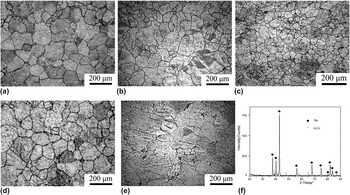
Figure 1 shows typical optical microstructure of the AZ31 cast alloys produced by twin-roll caster at different additions of Ce. Equiaxed grains were obtained in all alloys because of the high cooling rate during twin-roll casting. Without addition of Ce, the average grain size of the cast alloy is around 115 μm. With increase of the addition level of Ce to 0.4 wt%, the grain size reduces to 55 μm. However, when the addition of Ce was over 0.4%, the grains start coarsening. A similar result was also observed in both aluminum and magnesium alloys when adding Al–Ti–B master alloy,Reference StJohn, Qian, Easton, Cao and Hildebrand23 ZnO,Reference Fu, Qiu, Zhang, Wang, Kelly and Taylor7 and AlNReference Dahle, Lee, Nave, Schaffer and StJohn8 as grain refiners.
The optical microscopy microstructures of the AZ31 cast alloy without and with different additions of Ce (a) 0 wt%, (b) 0.2 wt%, (c) 0.4 wt%, (d) 0.8 wt%, (e) 1.2 wt%, and (f) XRD pattern of the AZ31 cast alloy with 0.4 wt% Ce addition (Co Kα target was used).

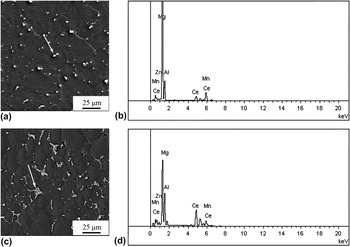
To identify the phases presented in the cast alloy, XRD analysis was conducted. Figure 1(f) shows the XRD pattern taken from the sample containing 0.4 wt% Ce. In addition to the Mg peaks, reflection of Al4Ce phase with body-centered tetragonal structure can also be indexed. To understand the morphology and distribution of this Al4Ce phase and further confirm the phase, the microstructure of the same sample was examined using backscatter electron image in SEM and the chemical composition was estimated through EDS analysis. As shown in Fig. 2(a), bright spherical particles with the size of 2–4 μm uniformly distribute in the α-Mg matrix. EDS analysis combined with XRD result shows that the chemical composition of the particles is consistent with Al4Ce, and the brightness of the particles in the backscatter electron image is due to the high atomic number of Ce. Compared with those particles in Fig. 2(a), these Al4Ce particles in the AZ31 cast alloy containing 1.2 wt% Ce are obviously coarser, shown as Fig. 2(c), and some are observed as coarse blocky, some as near net-like.
(a) Backscatter electron image and (b) EDS analysis of the bright particles at the white arrow in Fig. 2(a) of the AZ31 cast alloy adding 0.4 wt% Ce and (c) backscatter electron image and (d) EDS analysis of the bright particles at the white arrow in Fig. 2(c) of the AZ31 cast alloy adding 1.2 wt% Ce.

B. Grain refinement mechanism
Based on the above experimental results, as the smallest grains were obtained in the AZ31 cast alloy with 0.4 wt% Ce addition and Al4Ce particles have been identified within the α-Mg grain centers [shown in Fig. 2(a)], it is reasonable to conclude that the heterogeneous nucleation of α-Mg on the Al4Ce particles is responsible for the grain refinement. One may argue that the solute effectReference StJohn, Qian, Easton and Cao24,Reference Qian, Cao, Easton, McDonald and StJohn25 may also contribute to refining of the grains resulting from the segregation of Ce at the front of the interface between the solid and liquid during the solidification process, which limits the grain growth. However, the calculated growth restrict factor of Ce in Mg is 2.74, which is much smaller than Zn (5.31) and Al (4.32).Reference Lee, Dahle and StJohn26 Meanwhile, the addition level of Ce is also lower than that of Al and Zn in AZ31 alloy, thus the solute effect should be weak. Furthermore, according to Mg–Ce phase diagram,Reference Liu, Zhu and Zhou27 if the addition of Ce has the obvious solute effect, Mg12Ce intermetallic should be precipitated after solidification because Ce has almost no solubility in α-Mg at room temperature. In addition, the difference in electronegativity between Ce and Al (EN = 0.49) is bigger than that between Ce and Mg (EN = 0.19).Reference Schaffer, Saxena, Antolovich, Sanders and Waner28 And also, according to the Al–Ce and Mg–Ce phase diagrams,Reference Liu, Zhu and Zhou27 all the Al–Ce intermetallics have much higher melting temperature than the Mg–Ce intermetallics. This implies that Ce has stronger affinity with Al than Mg. Thus, Al–Ce intermetallic is more likely to form than the Mg–Ce intermetallic. Thus, no any Mg–Ce intermetallics are detected in the present work shown in Fig. 1(f) and then the solute effect of Ce in Mg should be ignored.
The larger grains obtained in the AZ31 cast alloy when the addition level of Ce is 1.2 wt% may be considered as a result of coarsening of Al4Ce. Previous workReference Easton and St John29 indicates that the active particles for heterogeneous nucleation are within a particular size range from 3 to 6 μm, which corresponds to the highest grain refining efficiency. Although the actual size of active Al4Ce particles to be effective grain refiners needs to be further investigated, if the particles are too big, they are not active grain refiners. Hence, coarsening of such particles is responsible for the increase in grain size at higher level of Ce additions.
The question remaining is that whether the Al4Ce is an effective grain refiner for Mg alloy. Although the physical and chemical properties of the heterogeneous nucleation sites, such as the wetting angle of liquid Mg on Al4Ce, have significant effect on the grain refining efficiency, as an essential requirement of grain refiners, the crystallography of Al4Ce with Mg will be further examined in terms of the edge-to-edge matching model following the previous studies.Reference Jiang, Qiu, Zhang, Ding and Gao30–Reference Qiu, Zhang, Taylor, Fu and Kelly34
C. The crystallography relationship between Al4Ce and α-Mg matrix
The edge-to-edge matching model proposed by Zhang et al.35,Reference Zhang and Kelly36 has been successfully used to understand the grain refinement mechanism and efficiency in both Al and Mg alloys.Reference Qiu, Zhang, Taylor and Kelly14,Reference Zhang, Kelly, Qian and Taylor31–Reference Qiu, Zhang, Taylor, Fu and Kelly34 According to this model, it is essential, between the Mg matrix and the intermetallic compound, to identify the potential matching plane pairs, which are normally the close-packed or nearly close-packed planes, and the potential matching direction pairs, which are the close-packed or nearly close-packed directions in the matching planes. If the mismatch (f d) between the potential matching plane pairs and the misfit (f r) between the potential matching direction pairs are less than 10%, the intermetallic compound will have crystallographic potential to be an effective grain refiner for α-Mg.
According to the XRD and PDF database,35 the close-packed planes of Mg are identified to be {0002},  $\{ 10\bar 11\}$, and
 $\{ 10\bar 10\}$, those of Al4Ce with body-centered tetragonal structures are {103}, {112}, and {101}. After calculating the f d values applying the method described in Refs. Reference Zhang and Kelly32 and Reference Zhang, Kelly, Easton and Taylor33, there are six matching plane pairs between Mg and Al4Ce corresponding to the principle of f d values less than 10%, which are listed in Table I.
The matching plane pairs between Mg and Al4Ce that have f d values less than 10%.

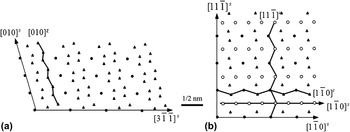
To calculate the misfit, f r value, along the matching direction pairs, the atom configurations in the  $\{ 103\}$ and
 $\{ 112\}$ planes were graphically plotted in Fig. 3, in terms of the atom positions in the Al4Ce lattice.35 Thus, the close-packed atom rows can be identified. There is only one close or nearly close-packed direction in the
 $\{ 103\} _{{\rm{Al}}_{\rm{4}} {\rm{Ce}}}$ plane. It is the zigzag [010]Z direction. But, in the
 $\{ 112\} _{{\rm{Al}}_{\rm{4}} {\rm{Ce}}}$ plane, there are three close-packed or nearly close-packed directions. They are
 $[11\bar 1]^{\rm{Z}}$,
 $[1\bar 10]^{\rm{Z}}$, and
 $[1\bar 10]^{\rm{S}}$. The first two are zigzag rows and the third one is straight. Similarly, the possible matching planes and matching directions of Mg have been identified in the previous work.Reference Qiu and Zhang13–Reference Qiu, Zhang and Kelly15 They are the straight
 $[11\bar 20]^{\rm{S}}$ and zigzag
 $\[\bar 1100]^{\rm{Z}}$ directions in
 $\{ 0002\}$ plane, and straight
 $[\bar 12\bar 10]^{\rm{S}}$ and zigzag
 $[11\bar 2\bar 3]^{\rm{Z}}$ directions in
 $\{ 10\bar 10\}$ and
 $\{ 10\bar 11\}$ planes. According to the rulesReference Zhang, Kelly, Qian and Taylor31–Reference Zhang, Kelly, Easton and Taylor33 that zigzag atom rows match with zigzag rows and straight rows match with straight rows, the f r values can be calculated by applying the methods of Qui et al.Reference Qiu and Zhang13–Reference Qiu, Zhang and Kelly15 The pairs with f r values below 10% are listed in Table II. Normally, the direction pairs that have the lowest misfit f r value have the highest potential to form an orientation relationship. In the present work, it can be predicted as
 $[1\bar 10]_{{\rm{Al}}_{\rm{4}} {\rm{Ce}}}^{\rm{Z}}$/
 $[\bar 1100]_{{\rm{Mg}}}^{\rm{Z}}$,
 $[1\bar 10]_{{\rm{Al}}_{\rm{4}} {\rm{Ce}}}^{\rm{S}}$/
 $[\bar 12\bar 10]_{{\rm{Mg}}}^{\rm{Z}}$,
 $\{ 112\} _{{\rm{Al}}_{\rm{4}} {\rm{Ce}}}$ nearly parallel to
 $\{ 0002\} _{{\rm{Mg}}}$.
The f r values between the close-packed atom rows in the matching planes.

The atom arrangements in (a) {103} plane and (b) {112} plane of Al4Ce compound. Superscript Z denotes zigzag atom row, ● for Ce atom in the plane, ○ for Al atom in the plane, △ for Al atom below the plane, and ▲ for Al atom above the plane.

To define the rotation angle of the matching planes relative to each other about the matching direction, these orientation relationships (ORs) need to be further refined applying the Δg theory. The actual ORs that are predicted between Mg matrix and the Al4Ce, and their corresponding habit planes can be obtained. They are  $[1\bar 10]_{{\rm{Al}}_{\rm{4}} {\rm{Ce}}}$‖
 $[\bar 12\bar 10]_{{\rm{Mg}}}$,
 $\{ 112\} _{{\rm{Al}}_{\rm{4}} {\rm{Ce}}}$ 2.1208° from
 $\{ 0002\} _{{\rm{Mg}}}$.
Figure 4 shows simulated diffraction patterns of Mg matrix and Al4Ce along the zone axis  $[1\bar 10]_{{\rm{Al}}_{\rm{4}} {\rm{Ce}}}$‖
 $[\bar 12\bar 10]_{{\rm{Mg}}}$ with a set of parallel Δgs. To confirm such prediction, the microstructure of the sample with 0.4 wt% Ce addition was examined in the TEM. Al4Ce particles were observed in the center of Mg grains as shown in Fig. 5. Obvious twin crystal structure is shown in the TEM image, while basically this structure has no interference to distinguish Al4Ce particles and Mg grains. The selected area electron diffraction pattern taken from the area surrounding one Al4Ce particle in the AZ31 cast strip containing 0.4 wt% Ce indicates an OR between Al4Ce and Mg as follows:
 $[1\bar 10]_{{\rm{Al}}_{\rm{4}} {\rm{Ce}}}$‖
 $[\bar 12\bar 10]_{{\rm{Mg}}}$,
 $\{ 112\} _{{\rm{Al}}_{\rm{4}} {\rm{Ce}}}$ 2.0° from
 $\{ 0002\} _{{\rm{Mg}}}$.
Simulated diffraction patterns of Mg matrix and Al4Ce along the zone axis  $[\bar 12\bar 10]_{{\rm{Mg}}}$‖
 $[1\bar 10]_{{\rm{Al}}_{\rm{4}} {\rm{Ce}}}$, showing a set of parallel Δgs. Dashed line indicates the habit plane. Where the superscript “M” denotes Mg matrix and superscript “A” denotes Al4Ce.

The bright-field image (a) of Al4Ce phase and Mg in the AZ31 cast strip containing 0.4 wt% Ce and (b) the diffraction pattern of  $[1\bar 10]_{{\rm{Al}}_{\rm{4}} {\rm{Ce}}}$‖
 $[\bar 12\bar 10]_{{\rm{Mg}}}$zone.

Obviously, it is very close to the predicted OR. In addition, similar parallelograms are drawn in Figs. 4 and 5. As a consequence, the TEM result well verified the reliability of simulated diffraction patterns and the practicability of edge-to-edge matching model. Furthermore, both the mismatch and misfit values shown in Tables I and II are all very low, indicating that, at least from crystallographic point of view, the Al4Ce is an effective grain refiner for Mg–Al alloys.
D. Conclusions
The addition of Ce into the AZ31 alloy melt can effectively refine the grains of the AZ31 cast alloy from 115 to 55 μm, and addition of 0.4 wt% Ce results in the finest grains. The existence of Al4Ce confirmed by both XRD and SEM results evidences the effect of heterogeneous nucleation of Mg on Al4Ce particles on grain refinement. The lower misfit and mismatch between Al4Ce and Mg, together with the consistency between the predicted ORs applying the edge-to-edge matching model and the experimental ORs reflected by TEM results, indicate that Al4Ce is an effective grain refiner for Mg alloys.
ACKNOWLEDGMENTS
The authors are grateful to the financial supports from National Natural Science Foundation of China (Grant No. 51171212), Chongqing Science & Technology Commission (Grant Nos. 2010CSTC-HDLS, CSTC2010AA4048, and CSTC2012JJJQ50001), China National Funds for Distinguished Young Scientists (Grant No. 50725413), The National Industrialization Technology and Development Program of China (Grant No. 2011BAE22B03-3), and Project (Grant No. CDJXS12130009) supported by Chongqing University.