Are Kazanistan’s Papers in Order?
In his 1999 book, The Law of Peoples, John Rawls presents a hypothetical example of a society that is non-liberal but decent.Footnote 1 It is inclusive of women and minorities. It is non-expansionist. It may not be democratic but it has a consultation hierarchy. This hypothetical is crucial for Rawls’s attempt to extend the political morality of liberal societies beyond their borders to foreign policy. Rawls supposes that different interests, worldviews, and doctrines animate liberal societies and decent non-liberal ones; in the “Law of Peoples,” liberal and non-liberal peoples uphold the same principles, but for different reasons. Because the non-liberal, decent societies affirm these principles, they should be tolerated by liberal societies. Rawls thus argued that a global order can include, rather than coerce or exclude, some non-liberal societies that do not share liberal aspirations and self-conceptions. In turn, liberal societies find assurance that their principles are justifiable and reasonable for all.
When Rawls offers his hypothetical example, the non-liberal, decent peoples are a culturally and historically distinct other. He makes Islam their religion. He calls their fictional state “Kazanistan.” Rawls (Reference Rawls1999) describes Kazanistan’s interpretation of jihad: “Unlike most Muslim rulers, the rulers of Kazanistan have not sought empire and territory. This is in part a result of its theologians’ interpreting jihad in a spiritual and moral sense, and not in military terms” (76). He explains in a footnote: “The spiritual interpretation of jihad was once common in Islamic countries; under this interpretation, jihad was understood to be an obligation of every individual Muslim. See Bernard Lewis, The Middle East (New York: Scribner, 1995), pp. 233ff” (76n18). Kazanistan’s doctrine of toleration is, likewise, similar to “one found in Islam some centuries ago” (76n17).
The features of Rawls’s ideal type of a decent, non-liberal society—with regard to minorities, women, toleration, violence, and sectarianism—take on a distinct politial cast in relation to discourses about Islam. This conceptual grammar is, put simply, fundamental to how Euro-American liberal discourses apprehend and produce Islam as a problem (Asad Reference Asad1997, Reference Asad2007; Mahmood Reference Mahmood2006; Devji Reference Devji2005; Scott Reference Scott2007; Norton Reference Norton2013; S. Ahmed Reference Ahmed2014; Massad Reference Massad2015). Indeed, reflecting on the long history of these topics in liberal constructions of Islam, Joseph Massad argues that liberalism constitutes itself by constituting Islam as its antithesis through “a series of projections, disavowals, displacements, and expulsions” (Massad Reference Massad2015, 11).
Rawls’s concretization of his non-liberal, decent society as the “idealized Islamic people” of Kazanistan injects what some critical theorists have called “the Muslim Question” into liberal political philosophy’s global justice paradigm. The Muslim Question refers to a political constellation in which Muslims in Europe and America are treated as “a problem” (Norton Reference Norton2013; Scott Reference Scott2012; Farris Reference Farris2014; Fernando Reference Fernando2014; Mansouri, Lobo, and Johns Reference Mansouri, Lobo and Johns2015; Selby and Beaman Reference Selby and Beaman2016; Akbarzadeh Reference Akbarzadeh2016; O’Brien Reference O’Brien2016; Bracke and Hernández Aguilar Reference Bracke and Aguilar2020). Deliberately so named for its resonances with the Jewish Question of the nineteenth and twentieth centuries, as Sara R. Farris observes, the Muslim Question frames “the contours of a debate according to which Muslims, now rather than Jews, are criticized for allegedly behaving as a separate body within Western nations and discriminated against on this ground” (Farris Reference Farris2014, 296). At its core, it means that Euro-American consideration of Muslims and of Islam tends to be posed as a “question” about whether Muslims will (want to) assimilate and about whether Islam is or can be rendered sufficiently liberal that it should be “tolerated.”Footnote 2
Given that Rawls could have found any name for his hypothetical decent, non-liberal society, and ascribed to it any number of cultural, religious, ethnic, or other characteristics, what work is performed by naming the hypothetical Kazanistan and making Islam specifically central to its description? Kazanistan’s peculiar importance is well-spotted by Antoine Hatzenberger: “the only concrete example described by Rawls is an Islamic country” (Hatzenberger Reference Hatzenberger2013, 107). If Kazanistan exemplifies liberalism’s version of a non-liberal but good Islam, what specific projections, displacements, and expulsions animate its founding in Rawls’s theorization? Put differently, if the post-9/11 figuration of the “Muslim terrorist” as a “universal enemy” has its genealogy in concrete historical episodes and public discourses surrounding Palestinian armed struggle (Kemerli Reference Kemerli, Dietze and Verhoeven2014), what episodes and struggles in the 1990s underwrite the reconstitution of Kazanistan’s tolerant Islam and its spiritualized jihad? How does the description of Kazanistan—along with its status in his imagined society of people as representing “the best we can realistically—and coherently—hope for” (Rawls Reference Rawls1999, 78)—redirect the ways in which Islam is a persistent but elliptical presence across the history of political philosophy (Almond Reference Almond2009)? What political and cultural assumptions animate this example and its development, and what logics of liberalism might such assumptions inadvertently disclose?
The genealogy of Kazanistan that I offer here is the first examination of Islam in the John Rawls archives. Through a close examination of the Kazanistan papers, or Rawls’s drafts, correspondences, and notes, I historicize Rawls’s invention of Kazanistan in The Law of Peoples and its transformations across the drafts, and I draw out the political implications of Rawls’s turn to Islam. Kazanistan was a late addition in Rawls’s revisions, and the text’s tethering of Islam to jihad came even later. Kazanistan’s name receives no explanation and its description accentuates “Islamic” features and keywords; to borrow Edward Said’s (Reference Said1994, 89) evocative phrase, it is both “casual and stressed.” Rawls gradually added references to Islam, draft by draft, and Kazanistan itself was a late innovation that responded to criticisms of earlier drafts. Crucially, then, Kazanistan and its details were neither a longstanding idea coeval with the book, one that Rawls simply failed to revise, nor momentary afterthoughts. The revision history attests that more attention to detail went into its development and description. It is thus striking, I argue, that Kazanistan is out of this world, or more precisely, out of the world as recorded in the Rawls Papers: it is at odds with the archive’s snapshot of geopolitical situations in the 1990s involving Muslims and real-world places with the suffix -stan. The oddness is not the result of an apparent moral aspiration that Muslims in these contexts fail to meet. At stake in the dissonance between Kazanistan’s rendition of “Islam” and the archive’s Muslim contexts is the space that such distance clears for the Muslim Question and for liberalism’s global imaginaries.
The archival story is important because it shows that Rawls did not set out to write about Islam at all. And yet, as he read certain works about Islam and revised Kazanistan, he came to reproduce those hegemonic frames and assumptions that propel commentators into Orientalist and racializing understandings of Islam. At the end, I argue, “Kazanistan” reflected the basic structure of the Muslim Question. It also ran against the grain of the world as recorded in Rawls’s own papers. As I explain, Kazanistan functions partly as what Jeanne Morefield (Reference Morefield2014) calls “liberal deflection” of colonial violence and exploitation; but also, and more pronounced, its logic is one of “liberal inflection,” which insistently frames matters of connected history, relations of violence, and structures of power in the form of isolated cultural difference to be evaluated as propositions. At the same time, we will see, Kazanistan’s revisions in unpublished drafts can illuminate an alternative set of questions that Rawls opened—namely, the possibility to contend with Kazanistan’s history, but which he then forecloses.
In turning to the Kazanistan papers, my broader aim is to recover the implications of those moments in which (American) philosophy constitutes a (racialized) Muslim other; it turns its (parochial) gaze toward the world, but away from the world, and quietly appeals to the (white, imperial) imaginaries of everyday idioms. The aim is to unbracket what is nestled between parentheses—American, parochial, racialized, white, imperial. To adapt Ian Almond (Reference Almond2009, 29) on Islam in Enlightenment thought, the aim is to illuminate the political operations of the “footnoting of Islam,” its reduction to “a curious appendix, an eccentric cross-reference, a pair of problematic parentheses,” or in this case, a hypothetical example of a decent, non-liberal people.
Let me be clear about the scope of my argument and the terms its analysis.Footnote 3 This is an analysis of the ideological structures and discourses that Rawls’s construction of Kazanistan reflects. It is not about what Rawls intended. As J.G.A. Pocock (Reference Pocock2019, 99) recently wrote, “It’s a rule of research that any document contains more than the author meant to put there.” It is also not a diagnosis of his personal psychology or subconscious or things he might have been thinking but did not write down. My focus is on discursive structures, or the relationship between knowledge and power that is emblematized by Rawls’s invention of Kazanistan. My argument is not concerned with whether Rawls’s normative position was “right” or “wrong” about whether a “decent” people is or is not tolerable to a hypothetical liberal order. Instead, I offer a critical-historical perspective on the politics of when and how the hypothetical that he called “Kazanistan” came about as an explicitly Muslim decent people by reading its history and relationship to the world in Rawls’s papers. The analysis thus both challenges and refuses the structural weight of the compulsion to pose the question, and indeed, to answer it—a structural weight to which Rawls was also subject. This also means that my analysis is not invested in the moral dilemma that Kazanistan was supposed to solve, but rather, in the discursive structures that the framing of “Kazanistan” reflects. It might seem that the Muslimness of Rawls’s example is purely incidental. However, the terms of its features are fundamental to the Muslim Question and thus to the broader discourses and inherited frames in which The Law of Peoples’s consideration of Islam participates, no matter Rawls’s intentions. Rawls’s example could have been non-Muslim, in which case this would be a dramatically different article. But, in the published text and in the drafts, Rawls’s Kazanistan is, to wit, Muslim. (Rawls does not fabricate a hypothetical Hindu, Jewish, Buddhist, Confucian, or explicitly Christian state. He may mention America, Germany, Brazil, Israel, India, or China, among other states, but he does not construct them as exemplars of his categories.) This is the only fictional place to which Rawls gives a proper name, and the only hypothetical nation that he fleshes out in detail. Likewise, the focus is not on whether Rawls’s example is empirically wrong in some details about “Islam” nor is it that Kazanistan only partly captures the conduct, beliefs, or culture of some Muslims. Put simply, the vocabulary that Rawls uses to construct Islam and the terms that constitute Kazanistan are symptomatic of broader ideological structures that exceed his intentions.
All this is a marked shift from how moral philosophers treat Kazanistan. At present, the Rawlsian approach is hegemonic in political theory; in stepping outside that hegemony and raising critical questions about it, this article goes against the grain of the literatures on Kazanistan and those that extend Rawls’s categories to Islam.Footnote 4 Instead, it joins recent critical examinations of the political and discursive limits of the Rawlsian analytic paradigm in relation to power relations (Mills Reference Mills2017; Goodhart Reference Goodhart2018), as well as the agenda-setting work of Katrina Forrester (Reference Forrester2014, Reference Forrester2019a, Reference Forrester and Bell2019b), Samuel Moyn (Reference Moyn2018, Reference Moyn and Bell2019), and Brandon Terry, which historicize the Rawlsian paradigm, including Rawls’s early international thought. It thus contributes to the archival turn more broadly (e.g., Livingston Reference Livingston2020; Gališanka Reference Gališanka2017, Reference Gališanka2019; Bevir Reference Bevir2017; Bok Reference Bok2017; Botti Reference Botti2017; Reidy Reference Reidy2017; Bevir and Gališanka Reference Bevir and Gališanka2012).
The archival turn, however, has neglected the last phase of Rawls’s career and his book-length attempt devoted to thinking internationally. I address this oversight and offer a critical reading of that text’s relationship to Islam and global politics. Rawls’s papers on Islam offer a unique opportunity to interrogate how a major work of post-Cold War liberal philosophy approaches Muslim difference, here through the example of how the most prominent figure in American philosophy constructs Islam through the name “Kazanistan.” My analysis thereby also contributes to a growing body of work that critically examines the ideological basis, racialized assumptions, and stylized narratives in how Islam figures as a problem in the writings of major twentieth-century Euro-American thinkers, including Hannah Arendt, Jacques Derrida, Julia Kristeva, Slavoj Zizek, Jurgen Habermas, and Carl Schmitt (Almond Reference Almond2007; Asad Reference Asad2007; Norton Reference Norton2013; Massad Reference Massad2015; Sheedy Reference Sheedy2018; Idris Reference Idris2019).
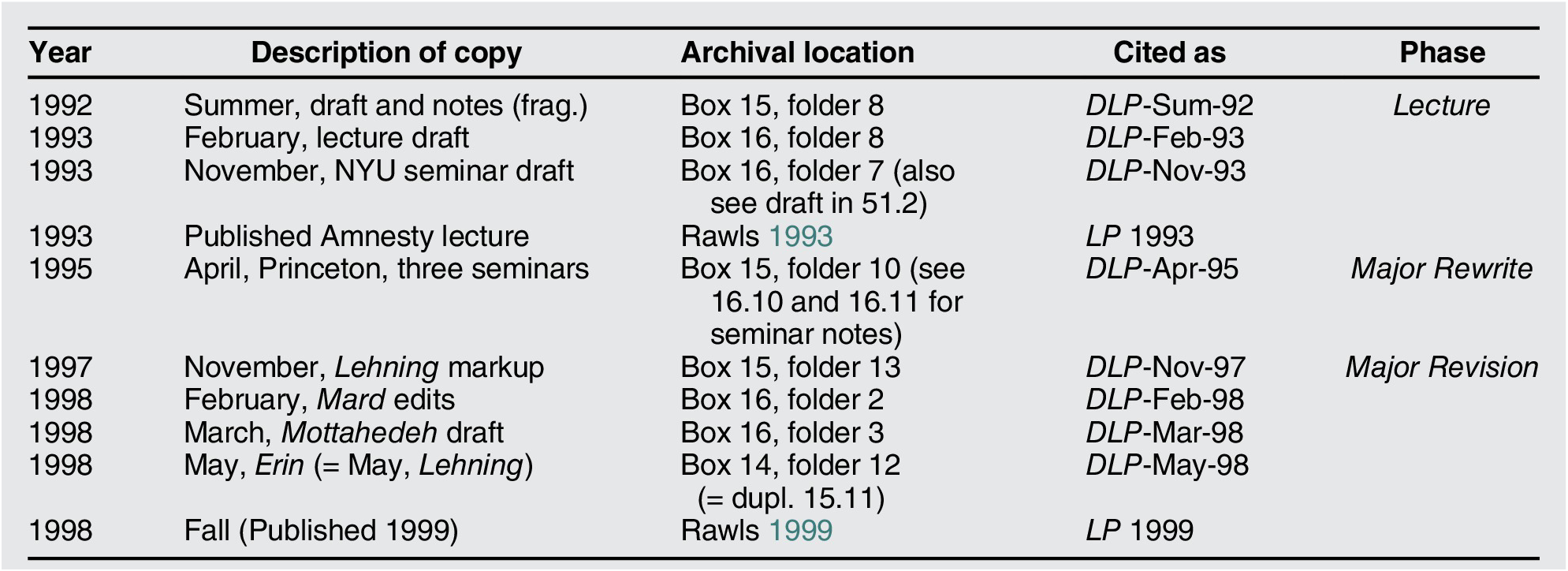
In early 1997, Rawls noted that he had revised “The Law of Peoples” four times.Footnote 5 Drafts of the Law of Peoples (DLP) reveal that Rawls only introduced Kazanistan to the manuscript a year later, in the second-to-last draft of March 1998, that is, during the fifth and final round of revisions. (For the chronology of all eleven extant drafts/manuscripts, their archival location, and how I cite them, refer to the appendix.) Rawls started reworking The Law of Peoples in late 1991, and it was delivered and published as an Amnesty Lecture. In the 1992–1993 lecture and drafts (DLP-Sum-92; DLP-Feb-93; DLP-Nov-93; LP Reference Rawls, Shute and Hurley1993), there were no references to Islam or Kazanistan. In the major rewrite for a 1995 seminar at Princeton University, Islam appeared in a couple of footnotes, one on the caliphal institution of consultation or shura and another on women in Islam (DLP-Apr-95, 54n53, 77n41). The final phase is Rawls’s major revisions, Fall 1997–Spring 1998. It comprises four draft manuscripts and the published book. In the drafts dated Fall 1997 and February 1998, Rawls added more notes about Islam and brief, in-text discussions of “Islamic toleration” (DLP-Nov-97, 95–96, 95n64, 96n65; also DLP-Feb-98, 101). It was only at the tail end of this final rewrite that he invented Kazanistan. Across the March draft (DLP-Mar-98, supp. 1–2), the May draft (DLP-May-98, 42, 52–54, 67), and the final manuscript of 1998 (LP Reference Rawls1999, 64, 75–78, 92) he worked out its description.
The next section outlines liberal deflection and argues that a logic of liberal inflection is also at work. I situate this critical-historical argument in relation to recent work on the Muslim Question, Kazanistan, and genealogies of philosophical devices. Next, I offer a brief summary of Rawls’s gradual engagement with Islam, from correspondence, to footnotes, to Kazanistan. The archival history establishes Kazanistan’s ambiguous and contingent origins. The following section identifies the “Islamic” contexts mentioned in Rawls’s own papers, and I highlight the distance of Kazanistan from the structures of violence in these geopolitical sites: Bosnia, Palestine, and Afghanistan. In the penultimate section, I interrogate the assumptions about Islam that generate this distance. I offer a close reading of the archival history of Kazanistan, focusing on Rawls’s additions and deletions across drafts, including an alternate description of Kazanistan that Rawls removed. Finally, in the conclusion, I draw out some implications of historicizing Kazanistan’s politics and reading its archival history against the grain.
Arrivals: Putting Kazanis in Their Place
Kazanistan reproduces the basic structure of the Muslim Question. As a discourse, the Muslim Question commonly has four aspects: Islam and Muslims are alien to “the West,” which is supposed to have received its bearings from the Enlightenment and liberalism; the salient divide is the cultural orientation and religious beliefs of Muslims; Muslim difference causes conflict or poses a threat to national identity, unity, or security; and hence, the demand that Muslims assimilate in order to be tolerated. By foregrounding the status of Islam and Muslims in relation to what Foucault calls problematization—“how and why certain things, conducts, phenomena, processes, become a problem” (Foucault Reference Foucault, Fruchaud, Lorenzini and Luxon2019, 224)—scholars who analyze this constellation have highlighted two structural features. They converge around showing, on the one hand, the forms of discrimination and securitization to which Muslim immigrants and minorities are subjected, and on the other hand, that talk of Muslim (in)compatibility with liberal values hides from view Euro-American anxieties about those same values and issues (whether in terms of failing to live up to them, more actively undercutting them, or the forms of violence and inequality that they justify) (Norton Reference Norton2013; Scott Reference Scott2012; Farris Reference Farris2014; Mansouri, Lobo, and Johns Reference Mansouri, Lobo and Johns2015; Selby and Beaman Reference Selby and Beaman2016; Akbarzadeh Reference Akbarzadeh2016; O’Brien Reference O’Brien2016; Bracke and Hernández Aguilar Reference Bracke and Aguilar2020). As Anne Norton pithily writes, Muslims in Europe and America appear “without the imperative to acceptance” and evaluations of Islam “map sites of domestic anxiety” (Norton Reference Norton2013, 4–5, 8).
The Muslim Question is usually posed in domestic contexts, about whether Muslims and Islam belong in “Western” states. Rawls’s construction of a hypothetical Muslim state that is tolerable replays these questions, but at the level of international order. Here, too, the Muslim is alien to an imagined Enlightenment order; the rift derives from Muslims’ cultural orientation and Islamic religious beliefs; this rift would ordinarily produce intolerable forms of difference if not outright conflict, but not in the case of Kazanistan’s culture and theology; and thus the fictional Kazanis are Muslims who should be tolerated. The displacement of the Muslim Question to the globe clearly differs from overtly hostile constructions of “Islam versus the West,” from ideas about Muslims as God’s punishment or unusually evil conquest-driven enemies (see Malcolm Reference Malcolm2019), to Carl Schmitt’s idea of a “thousand-year struggle” between Islam and Christianity (Schmitt Reference Schmitt and Schwab2007, 29), to the “clash of civilizations” popularized by Bernard Lewis and Samuel Huntington (Lewis Reference Lewis1990; Huntington Reference Huntington1993; see Mamdani Reference Mamdani2004, ch. 1; Sheehi Reference Sheehi2011). Instead, with the projection of the Muslim Question to the globe, the Muslim is again a candidate for toleration, internationally, not just domestically.
Kazanistan as a discursive artifact implicitly asks the question, what kind of Islam would liberalism tolerate? It unfastens the bolts of history that bind Islam and liberalism and it uncouples this history from power (Hourani Reference Hourani1983; Massad Reference Massad2015; Hanssen and Weiss Reference Hanssen and Weiss2016; Devji and Kazmi Reference Devji and Kazmi2017). The maneuver is doubly distancing, first of Islam in relation to liberalism, but also of both Islam and liberalism in relation to contemporary politics. This maneuver insulates the positionality of Rawlsian liberalism from reckoning with the broader domestic and geopolitical terrain and from a diagnosis of the colonial violence and racialized power relations through which “Islam” becomes a problem. The distancing maneuver, we will see, facilitates a series of political erasures: of the contemporaneous geopolitics of violence involving Muslims, specifically in Bosnia, Palestine, and Afghanistan; of domestic racial politics surrounding the ideas of “holy war” and “jihad”; and of the work that constructing Islam out of history performs for liberal critiques of empire.
The dissonance between Kazanistan and the “Islamic” sites recorded in Rawls’s papers, as the disjuncture between text and context, or philosophy and politics, illuminates how Rawls constructs a dehistoricized and depoliticized Islam. “Kazanistan,” I suggested, operates in a manner somewhat comparable to what Jeanne Morefield (Reference Morefield2014) astutely calls “liberal deflection,” through which readers can avert their eyes away from colonial violence and economic exploitation, back to the liberal society, its ideals, and its good intentions. The deflections performed by Kazanistan are less straightforward; their logic is one feature of Kazanistan, but not its most prominent, because Rawls explicitly disapproves of American interventionism and censures constitutional democracies for falling short of his ideal liberal society. The affiliated logic of Kazanistan is one of liberal “inflection.”
If deflection refers to how the attention of readers is drawn away from colonial violence and economic exploitation (in favor of ideals and good intentions), inflection refers to how their gaze is directed toward alternative stories, explanations, and frames for regarding violence, exploitation, oppression, or other events outside the liberal society (here, too, instead of indicating geopolitical asymmetries and their links to domestic discrimination). Such stories and explanations are narrated in a stylized frame—in the form, for example, of an isolated, culturally dissimilar hypothetical society, rather than in a form that speaks more directly to the existing worlds of geopolitical relations, colonial violence, and postcolonial presents. The example that Rawls constructs is thus inflected by “Islamic” qualities, as a culturalized and religious Other, but without a history or social life. If a term like jihad, as Sara Ahmed has influentially argued, “sticks to some bodies” and “slides into other words” (S. Ahmed Reference Ahmed2014, 76), Kazanistan’s “spiritual interpretation of jihad” is articulated in terms that reinforce the association between jihad as a problem and Muslim bodies—a problem that requires the pacification of, for instance, an Islamic propensity toward religious violence, militancy, holy war, terrorism, or extremism. Kazanistan naturalizes the background association between Islamic “culture” and the apparent failings that Kazanistan overcomes. It reframes geopolitical sites of asymmetrical struggle and postcolonial connection as a problem of Muslim belief and practice.
Indeed, in debates informed by The Law of Peoples, Anne Norton details how “commentators and reviewers have not hesitated to elaborate the ‘Muslim’ features of Kazanistan”: some imagine all sorts of “Islamic” discrimination and others offer unflattering accounts of the Kazanis far more elaborate than Rawls’s. Some search for contemporary candidates that might be construed as an empirical “good fit” for Rawls’s description, while others identify candidates that Rawls never mentioned in his papers but might have been thinking of, all while simply holding the terms in place. This is even though Rawls himself only justifies Kazanistan’s Islam by pointing to a distant Muslim past, not any contemporary places.
And yet, Norton argues, it is actually Rawls’s descriptions of Kazanistan that, ironically, offer apposite descriptions of the West (Norton Reference Norton2013, 97–99).
William A. Edmundson, too, gestures to the potential intersection between Kazanistan and Rawls’s critical assessment of America. Edmundson observes that Rawls’s tone is “bitter in some of his asides,” as in “his posthumously published lectures on Hegel”; in those lectures, Rawls describes how Hegel’s idea of a just consultation hierarchy between the economic classes moderates the influence of the market and business class. Although Hegel’s “constitutional scheme with its three estates no doubt strikes us as quaint and out of date, and teaches us little,” Rawls continues, “does a modern constitutional society do better? Certainly not the United States, where the purchase of legislation by ‘special interests’ is an everyday thing.” Edmundson comments: “As if the comparison of the contemporary United States to 1820 Germany were not invidious enough, readers of The Law of Peoples will be reminded of Rawls’s imaginary Kazanistan, his example of a ‘decent’ but illiberal consultation hierarchy” (Edmundson Reference Edmundson2017, 197n2). Edmundson’s note is suggestive, for Rawls does derive his idea of “consultation hierarchy” from Hegel, which he later transported to Kazanistan’s institutional structure. However, as we will see, Rawls himself did not offer Kazanistan as an indirect criticism of the United States (unless this was an esoteric argument). Thus, while it would be an exaggeration to say that Rawls’s engagement with Islam sanitizes the West of its inequalities, it would also be inaccurate to take Kazanistan to be Rawls’s veiled critical account of America; careful readers might see the America in Kazanistan, but Rawls himself did not suggest this connection. On Rawls’s own terms, America and Kazanistan belong in different categories based on their different “ideals” or proclaimed commitments; America can be a failed democracy but not a “Kazanistan” because the United States claims to idealize democratic equality while Kazanistan does not.Footnote 6 As Norton and Edmundson attest, this separation does not, of course, foreclose one’s ability to note the similarities between their structures or institutions.
By leaving this connection unmade, Rawls’s Kazanistan operates differently from a common strain in discussions of Islam across the history of European thought. The presentation of an Islamic Orient as a mirror to indirectly, and more or less critically, describe one’s own society is a common topos in European and American thought (Hatzenberger Reference Hatzenberger2013, 105–6), one that has played a useful role in the development of modern European thought (Pitts Reference Pitts2018; Malcolm Reference Malcolm2019). Exemplars in this genre of dislocation include Montesquieu’s Persian Letters (Euben Reference Euben2006, 144–56), Voltaire on “fanaticism” (Devji Reference Devji2013, 123–32), and Erasmus on Turks (Idris Reference Idris2014). Some eighteenth- and nineteenth-century Orientalists, as Megan Thomas observes, similarly found value in the Orient as a mirror for their own societies, to call for a re-evaluation of self-understanding, and to link, not just contrast, Europe with the rest of the world (Thomas Reference Thomas2010, 662–63). Kazanistan is less a self-reflexive mirror that unsettles assumptions about the boundary between “the West” and “Islam” or that illuminates the distance of one’s society from its stated ideals; it is an Islam made tolerable to liberalism.
Kazanistan stipulates Islamic reform along the culturalized lines of the Muslim Question, in which Muslims metonymize⸺and must disavow⸺intolerance, the oppression of women and minorities, and violent expansionism through jihad. Its features thus function discursively as the apotheosis of the liberal critique of an abstract “Islam” (Massad Reference Massad2015; Norton Reference Norton2013; Scott Reference Scott2007). Rawls’s description leaves the links between Kazanistan (and the discursive structure that his rhetoric about its good Islam emblematizes) to the West unexamined and to geopolitics unmentioned.
The abstraction and delinking of Kazanistan are symptomatic of the distance between Rawls’s theorization of Islam and political events.
It is helpful to illustrate what this means by way of contrast with two structurally parallel arguments. Almost twenty years ago, Susan Buck-Morss (Reference Buck-Morss2000) suggested that Hegel’s understanding of master and slave silently drew on the Haitian revolution. In the case of Rawls, Kazanistan has the inverse relationship to the world: his understandings of Islam, jihad, and “holy war” quietly misapprehended twentieth-century constellations of violence surrounding Muslims—sites mentioned in his own archives—and obscured their structures. Second, Samuel Moyn recently argued that the turn to “human rights” and “global justice” in American philosophy was extracted from, but eclipsed and depoliticized, the agenda of the Global South’s New International Economic Order on global inequality (Moyn Reference Moyn2018). Forrester (Reference Forrester2019a, ch. 5), too, tracks this moment in which liberal philosophy abstracts from the NIEO’s debates about decolonization and international justice to a values- and culture-based image of international society. Such shifts and abstractions are liberal inflections. Here, Kazanistan is emblematic of how liberal philosophy’s abstractions shift the form of a problem, especially to code a variety of sites and groups as religious and cultural. However, it is the opposite in relation to contemporary events: Rawls does not explicitly or tacitly rely on, for example, the political agendas of Muslim struggles against colonialism, liberalism, or geopolitical inequality, and instead, the discourse on Kazanistan elides precisely such histories and political formations. Whereas Buck-Morss’s, Moyn’s, and Forrester’s genealogies of philosophical schemas, each in their own way, excavate the suppressed but constitutive relationship between political event and philosophical discourse, the genealogy of Kazanistan is remarkable because of the dissonance between its terms and political realities, events, and sites in Rawls’s papers.
“DONE in Kazanistan”: Along the Archival Tarmac
For Rawls, a “just consultation hierarchy” defines decent hierarchical societies (or as he called them in 1992, “traditional societies”).Footnote 7 Before he invented Kazanistan, he offered no examples, and explained in a letter that “I don’t worry about there not being actually trad[itional] societies. There aren’t actually any democracies either, as I describe them. We are talking about certain kinds of idealized societies in both cases.”Footnote 8
The Amnesty Lecture drafts and its immediate revisions (1992–1994) do not mention Islam, and Rawls’s own unpublished references to Islam during this period are offhand. In an undated letter (probably from late 1994), he called it “an interesting (to me) coincidence” that his Hegel-inspired consultation hierarchy resonates with shura, the Muslim institution of consultation.Footnote 9 Rawls had been alerted to this coincidence by Wilfried Hinsch, who shared with him a number of articles on “the idea of consultation in Islamic religious thinking.”Footnote 10 Some of these engaged with Abdullahi an-Na’im’s (Reference An-Na’im1990) Toward an Islamic Reformation, which Rawls read in 1997: “I have just read a fascinating book in which the author, Abdullah an-Na’im, argues that given the situation of the modern world, Islam’s doctrine of Shari’a must be reformed to allow for constitutional democracy, the equality of men and women, human rights (denying the rights of slavery), and much else. The essential point is that the religion itself must also uphold political institutions of democracy.”Footnote 11
One of these articles was by Rawls’s Harvard University colleague in the History Department, Roy Mottahedeh. Probably drawing on this piece, Rawls added a footnote in 1995 to clarify that the purpose of shura in Islamic history was to reinforce the power of the caliph; it is not a just consultation hierarchy (DLP-Apr-95, 54n53; LP Reference Rawls1999, 72n12). A second article by Mottahedeh identified principles of “full toleration” in pre-modern Islamic theology. Rawls cited it two years later, in the 1997 draft (DLP-Nov-97, 96n65), in the conclusion of the text.Footnote 12 He puts it this way: “Many different paths can lead to toleration. One way found in Islam some centuries ago affirms the worthiness of all decent religions and provides the essentials of what reconciliation to realistic utopia requires” (95–96). He then lists Mottahedeh’s principles (with whom he had already been in contact about Islamic government and toleration).
In his extensive comments on this November 1997 draft, Charles Beitz remarked that the passages on Islamic toleration do not belong at the end: “(2) what does the passage on Islamic toleration (from Mottahedeh) contribute to the discussion at this stage? …. why place the illustration here? It might have come, instead, in the discussion of the extension to decent hierarchical societies in Part II, perhaps in the section on a decent consultation hierarchy.”Footnote 13 Along the margins of Beitz’s comment, Rawls wrote in large print:
-
DONE
-
in Kazanistan
A few days later, Rawls replied to Beitz that his suggestion is correct, and that “my discussing an Islamic view of toleration” belongs instead “in a brief description of a decent society, named ‘Kazanistan’, which is said to be Muslim. To be decent needs to tolerate other faiths. Mott[a]hedeh’s example belongs there.”Footnote 14 The very next day, Rawls asked Mottahedeh for help with Kazanistan. He confided that “my project collapses if I cannot” provide an example of a decent people. He enclosed a two-page description of Kazanistan—“a somewhat imaginary account of an Islamic society”—along with the February 1998 draft. “In brief,” Rawls asked, “are there any Islamic countries that either now, or in history, might be illustrated by Kazanistan, as I call it? …. Might the rulers of Kazanistan recognize my description as an idealized form of what they tried to do in their best moments? …. have there been any actual examples?”Footnote 15
At this point, Rawls relocated the discussion of toleration into the description of Kazanistan, with Mottahedeh’s principles moved into a footnote (DLP-Mar-98, enc. 1n1; DLP-May-98, 52n18; LP Reference Rawls1999, 76n17). Over the next months, Rawls revised Kazanistan, expanding and then shrinking the description. In May 1998, he added Kazanistan’s interpretation of spiritual rather than armed jihad together with the citation to Bernard Lewis (DLP-May-98, 52–53, 53n20). Lewis, I should note, argues for exactly the opposite temporality than what Rawls indicates: “Some Muslim theologians, particularly in more modern times, have interpreted the duty of ‘striving in the path of God’ in a spiritual and moral sense. The overwhelming majority of early authorities, however, citing relevant passages in the Qur’an and in the tradition, discuss jihad in military terms” (Lewis Reference Lewis1995, 233, emphasis added). While Lewis thus implies that the spiritualization of jihad is a modern, largely unfounded innovation, Rawls locates it as indigenous to classical Muslim discourse and with History’s stamp of authenticity.Footnote 16
On July 9, 1998, along with this new, penultimate draft, Rawls shared with Beitz both his worry that Kazanistan might “seem too outrageous” and the impression that “I think we have [to] speak to these people.”Footnote 17 Beitz endorsed Kazanistan. He added, in what Almond (Reference Almond2009, 29) might call another “pair of problematic parentheses” in discourses about Islam: “(I like Kazanistan. Perhaps, as you say, it will strike some readers as outrageous, but it’s hardly objectionably so, and it serves your purposes well.)”Footnote 18 And so, Rawls retained “Kazanistan”—the hypothetical; the made-up name—having been reassured that Beitz did not find it too outrageous: “You found Kazanistan not objectionably outrageous, good and I am happy to think it serves its purpose well.”Footnote 19
Neither Rawls nor these interlocutors say anything about the fictional name “Kazanistan.” Perhaps “Kaza-” riffs on the Arabic kadha, as in kadha wa-kadha—such-and-such, so-and-so—which would indeed serve Rawls’s purposes well; but Kazanistan then would have been “Kazastan” and Rawls would have said so.Footnote 20 The suffix ‑stan in Persian means “land,” and it has what Sara Ahmed (Reference Ahmed2014, 76) might also here call a “sticky” quality to Islam and lands where Muslims live in large numbers.Footnote 21 This sticky quality is the sense that the Critical Muslim Studies theorist S. Sayyid puts on display when he uses the term “Muslimistan” to refer to countries “which are dominated (either formally or informally) by the Islamicate” (Sayyid Reference Sayyid2014, 195–196n2; Reference Sayyid, Sayyid and Vakil2010, 3). This aggregate of Muslim lands and -stans is roughly designated by “the Muslim world”—an idea that, as Cemil Aydin (Reference Aydin2017) suggests, remains “so entrenched despite the obvious naiveté of categorizing one and a half billion people, in all their diversity, as an imagined unity” (2), or as interchangeable “Islamic societies,” essentially connected to each other and to an abstract “Islam.” For Rawls, it seems, Kazanistan is both an exemplar of Muslimness in its very name and an exception to the political order found in the Muslim world. It is further attached to and within the Muslim world in that, as Aydin argues, the idea of “the Muslim world” belongs to essentializing narratives that forget the genealogies of their terms and continue the “work of racializing Muslims, especially in Europe and the United States” (228).Footnote 22
The next section examines the discursive and political work that is “DONE in Kazanistan,” as well as what in Kazanistan is done and undone for liberal philosophy’s relationships to the political world and the Muslim Question.
Nearest Exit: Bosnia, Palestine, Afghanistan
There are little to no traces of an engagement with Islam in Rawls’s earlier writings. And neither Rawls’s correspondence nor his published and unpublished work indicate why he calls his fictional Muslim state “Kazanistan.” At best, it is unclear where, if anywhere, it is based. Rawls himself says to Mottahedeh that it is “somewhat imaginary”; although Rawls asked if any examples exist, he appeals in the general direction of a distant past, not to the present. These archival dead-ends, however, are important precisely in illuminating the relationship of this rhetorical device to the world.
Rawls’s papers contain three geopolitical contexts that involve Muslims and discourses about Islam. In what follows, I summarize each of these three archival trails, to draw out the vast distance between their political constellations and the conceptualization of Islam presumed by Kazanistan. The distance between Kazanistan and contexts recorded in Rawls’s global present exemplifies Kazanistan’s logics of deflection and inflection. The dissonance between the terms of Kazanistan’s theology and the geopolitical situations displaces questions of power, history, and empire with propositions about ideals, values, and culturalized difference.
The first is Bosnia. Steven Shute, in his capacity as co-editor of the Oxford Amnesty Lectures volume, wrote to the contributors about the atrocities in Bosnia. These atrocities, he underscored, are part of what makes the lectures (and volume) on human rights “particularly timely.”Footnote 23 Two of the other lecturers, Catharine A. MacKinnon and Richard Rorty, discussed the ethnic cleansing of Muslims and Croatians by Serbs in the Bosnian War, which began in 1992; Mackinnon (Reference Mackinnon, Shute and Hurley1993) focused on the mass rape of Muslim and Croatian women by Serbs, Rorty (Reference Rorty, Shute and Hurley1993) on the dehumanization of Muslims in Bosnia as an instance of a broader phenomenon.Footnote 24 Rawls himself saved some news items that mentioned the violence against Muslim Bosnians,Footnote 25 as well as an article by Sohail Hashmi—then a recent Harvard Ph.D—titled “Is There an Islamic Ethic of Humanitarian Intervention?” in a reader on “Ethics and Humanitarian Intervention.”Footnote 26
Bosnia, then, is one of the discursive nodes around which Islam and Muslims figured in the American public and scholarly imaginary. Little here suggests Kazanistan. Rawls’s papers present Bosnia in the idiom of humanitarian intervention and the prevention of atrocities. It was Muslims who were being massacred. Rather than Islam’s oppression of women, Muslim women were raped. It is neither Kazanistan’s Muslim non-violence nor what Kazanistan’s spiritual jihad ostensibly corrects, namely Islamic violence.
The second major geopolitical context discussed in Rawls’s papers is Palestine. Just as Rawls constructs Kazanistan through the discursive prism of religious violence and cultural difference, Euro-American discourses tend to recast the colonial relation and anti-colonial resistance in a dominantly religious key. In May 1993, Rawls traveled to Israel for a conference in Tel Aviv.Footnote 27 The invitation stated that the conference “will focus especially on possibilities to apply your work to current issues in Israeli and Middle East politics, such as the Peace [sic] process, the Palestinian problem, and other social and political questions in an ethnically and nationally divided area.” It continued: “We hope that colleagues from Bir Zeit University on the West Bank will also be ready to participate.”Footnote 28 The organizer, José Brunner, would report a few months later: “Unfortunately, it appears that Palestinian scholars on the West Bank are not at all familiar with your work, and hence I found none who agreed to participate.”Footnote 29
Rawls responded: “I am honored by the invitation & by your interest in my work. I worry that it has very little to say—even if it is sound—about the difficult questions that concern you.”Footnote 30 Again: “As I said before, I worry that my work may have little relevance to the matters that concern you & my knowledge of them is certainly not thorough, as I am hardly acquainted with the details of Middle Eastern politics. I worry, then, about what I can say as a speaker & hope that some kind of general discussion of how I see my work may suffice. I would make no attempt to apply it to more immediate concerns.”Footnote 31 At Brunner’s behest, Rawls included some remarks on the law of peoples, but confided (again euphemistically), “However, it was rather sketchy and abstract and I worry as much as before that it will contribute little to the practical problems with which you and your colleagues are concerned.”Footnote 32
Rawls’s distancing rhetoric about Palestine, alongside his repeated declarations of ignorance about settler colonialism and occupation, is noteworthy: “the difficult questions,” “the matters,” “more immediate concerns,” and “practical problems” reflect a broader and pervasive American discourse of Palestinian exceptionalism, which treats Palestine as too complex for any “outsider” (Feldman Reference Feldman2019, 197).
Upon his return, Rawls described the trip to Israel as a “sobering experience.” He continued to present the question of Palestine (the “complexities” of the “concerns” that Rawls refused to name) as one that is “dauntingly complicated” and beyond his scope, while nonetheless couching the “problems” in terms of symmetry and the untenable equivalence of “both sides”:
The ostensible aim of our visit to Israel was so that I could attend a conference at Tel-Aviv University allegedly addressed to the question of whether the view in A Theory of Justice can throw any light of the problems that now divide the Israelis and the Palestinians. I told them beforehand that I didn’t think it could, other than obvious considerations any conception of justice would yield. Nevertheless, I decided to go, determined to keep my ears open and to learn as much about the Israeli situation as I could. I have made some progress but the question is dauntingly complicated by so many divisions passionately held on both sides, with each side also very divided, that one gets the sense that it cannot be resolved unless the contending forces somehow change or great political leadership appears from nowhere evident at the moment.Footnote 33
When Rawls did describe Israel a couple of years later in letters to Thomas Pogge,Footnote 34 Michael Perry,Footnote 35 and Onora O’Neill,Footnote 36 it was a “constitutional democracy” struggling with its religious Jewish population. There is no Palestine, no settler colonialism, nothing “dauntingly complicated.”
In his longstanding correspondence with his former student Susan Neiman, Palestine is similarly erased. In 1996, shortly after her move to Israel,Footnote 37 Neiman once mentioned that “the political situation has been terrifying at several moments these last two months,” and highlighted daily uncertainty surrounding a possible war and bombs on buses. She analogized the “17th century wars of religion” that interested Rawls to the “Middle East,” thereby redescribing the settler colonial relation as religious war. She was struck, she informed Rawls, by
the extraordinary relevance of much of your work for the Middle East. I confess that I had, in the past, not understood your interest in the 17th century wars of religion, and felt that other historical paradigms or questions were more dangerous, and pressing, for contemporary political society. At least in this part of the world, for better or for worse, I have clearly been proven wrong.Footnote 38
Violence thus throws “the Middle East” into the past of Europe: colonial and postcolonial places folded back in time, only recognizable as hopeful followers in the stylized narrative of the Reformation and the Thirty Years War. In the template of religion and religious relations, anti-colonial resistance is militant jihad. As Hashmi writes in the abovementioned article, “In modern cases, it [jihad] has, of course, been used to legitimate anti-colonial struggles and the Palestinian struggle against Israel. The latter conflict has evoked more just war rhetoric and concerted action than any other contemporary issue facing Muslims, especially since the 1967 Israeli occupation of Jerusalem.”Footnote 39 From such a frame, “bombs on buses” signify jihad.
But as with Bosnia, there is a remarkable gap between Palestine and Kazanistan. Palestine is occupied, “dauntingly complicated,” and apparently un-nameable, while Kazanistan is not at war, remarkably simple, and has an army powerful enough to fend off danger. After all, Kazanistan’s “various non-Islamic religions and other minorities,” Rawls writes, “have been living in its territory for generations, originating from conquests long ago or from immigration which the people permitted” (LP Reference Rawls1999, 76).Footnote 40 This is all in stark contrast with twentieth-century settler colonialism in Palestine: conquered rather than conqueror, without the power to permit the right of return or prevent settlements, ongoing rather than historical.
A third context appears in the Rawls Papers, more elliptically and only at the margins, though it shares the rhythm or metrical quantity of the name Kazanistan: Afghanistan and the mujahidin. In May 1998, the same month as the penultimate draft, the philosopher Allen Buchanan shared with Rawls a draft of his paper, “Justice, Legitimacy, and Human Rights.” Buchanan criticized “Rawls’s conjecture that the reasonableness criterion does not rule out social orders that are deeply sexist.” Buchanan offered Afghanistan as an example of a society with assumptions that “fail to meet the minimal standards of moral argument”; and he also observed that apartheid and Jim Crow racist laws must be challenged in a similar way.Footnote 41
At the same time, references to Afghanistan in relation to jihad appear in a few articles in the Rawls archives. For example, Akeel Bilgrami’s “What Is a Muslim?” mentions the “powerful guerilla forces” in Afghanistan who, in contrast to reform-minded moderate Muslims, are an example of “the susceptibility of Islamic polities to constant threat from powerful minority movements that assert Islamic identity”—a point that Rawls underlined in his copy.Footnote 42 Hashmi describes “the decade-long war in Afghanistan” together with Bosnia and Palestine as conflicts that have “also evoked widespread support as cases of jihad against foreign aggression”; the war featured “volunteer, self-financed mujahidin units from a number of Muslim countries.”Footnote 43 Stanley Hoffman lists the fight of “the Afghans against the Soviet Union” as an example of the mass violence and human rights violations that attend struggles for independence, or “the traumas of self-determination.”Footnote 44
The Soviet-Afghan War, from 1979–1989, and the Afghan civil wars between Islamic resistance armies from 1989 until well past the publication of The Law of Peoples, launched Islam and jihad into everyday American discourse in the 1980s and 1990s. Throughout the 1990s, for example, The New York Times used the terms mujahidin, mujahedeen, and jihad and could count on its readers to know what they mean; they were well integrated into the popular Anglophone vocabulary.
This context puts Rawls’s description of Kazanistan’s good doctrine of jihad, one that is moral and non-violent, in a different light. Kazanistan, again, is the opposite of Afghanistan in a few important respects. Most obviously, Afghanistan features militant jihad, the very thing that Kazanistan renounces in favor of a moral or spiritual interpretation. More significantly, the mujahidin against the Soviets, as is well known, were sponsored and supported by foreign states, especially the United States, in what was widely understood as a transnational resistance movement against an occupying force. As Mahmood Mamdani demonstrates, this constellation of events, the “high point” of the Cold War, informed narratives about a “good Islam” and a “bad Islam” but also disrupts them: the United States organized the Afghan jihad against the Soviet Union, or “[t]he Afghan jihad was in reality an American jihad” (Mamdani Reference Mamdani2004, 128). And further, throughout the Afghan civil war that followed the withdrawal of Soviet troops, each of the factions continued to be sponsored and supported by foreign powers. Meanwhile, Kazanistan, as in my preceding discussion of Palestine, is not occupied, does not confront the question of resistance, and neither depends on nor overcomes foreign interests. Whereas Afghanistan’s wars depended on factions and groups allied with foreign powers, external relations and the structures of global power do not feature in the description of Kazanistan, nor in their relationship to the description.
These three brief comparisons between Kazanistan to Bosnia, Palestine, and Afghanistan indicate the distance between Rawls’s “idealized Islamic people” and the ways in which Muslims are recorded in Rawls’s own papers. This is not the kind of gap marked by a moral aspiration that real Bosnians, Palestinians, and Afghanis fail to meet. On the contrary, the distance is important because these sites of conflict invert and undo Kazanistan along dimensions that complicate its description and denude its presumptions. The dissonance between Kazanistan’s description and the terms on which Muslims appear in the archive marks the ideological hegemony of understanding “Islam” as a problem of violence, specifically violent expansionism. After all, Kazanistan is exceptional because “unlike most Muslim rulers,” it does not seek territorial expansion through jihad. In Bosnia, Muslims were the objects of mass violence, not its subjects. Palestinians are occupied; they seek territory, not territorial expansion. Afghanistan’s mujahidin against the Soviets were in a war of defense, sponsored and supported by both liberal and non-liberal states.
What accounts for the dissonance between Rawls’s philosophical discourse on Islam and contemporaneous geopolitics? One possible answer is that ideal moral theory’s epistemology and methodological starting points elide injustice, race, and discursive fields of power, as different philosophers including Charles Mills (Reference Mills2017) and Michael Goodhart (Reference Goodhart2018) have argued.Footnote 45 But Kazanistan is peculiar because its starting point is not ideal justice, but rather Islamic injustice, in that Rawls implies that Islam is predominantly unlike Kazanistan—that is, intolerant, oppressive of women, and encouraging of territorial expansion. Its position is different from the ideal, just and reasonable liberal democracy theorized across his writings. And yet, in the geopolitical “Islamic” contexts recorded in his own papers as he invented Kazanistan, the questions surrounding Islam and Muslims appear in forms radically different from the problem that Kazanistan claims to solve: Kazanistan is inflected into the Muslim Question. The mantra of reforming Islam so that it is peaceful, tolerant, and without fanatic religious violence absorbs these geopolitical and discursive formations. As a liberal inflection, this absorption relocates the reader’s attention from the existing worlds of geopolitics, violence, and discourse to a debate about tolerating Muslims when their Islam disavows religious violence and becomes peaceful and tolerant. A reader can thus condemn imperial behavior in principle and champion pluralism while re-entrenching a discursive structure that apprehends Muslims as a problem.
This double distance, of liberalism from Islam and of liberal philosophy from politics, is remarkable in light of Rawls’s declaration that “we have [to] speak to these people.” As Mills (Reference Mills2017) argues, running through Rawls’s oeuvre are “tacit conceptions of the populations he is speaking about and to, and his assumptions about how best to frame their narrative” (150). He continues: “whether overtly acknowledged or not, one is really addressing oneself to the white population” that ignores settler colonialism, the racialization of liberalism, and the white domination of the planet (151). This is the case, I would add, even when Rawls is speaking to (or about) “these people.” His Kazanistan reflects a broader discursive structure that normalizes tacit conceptions about Muslims and about who is permitted to evaluate them and on what terms. Rawls frames his narrative about the Kazanis in terms of Islam as a problem, a problem that is solved with an improved culture and better theology. The result is Kazanistan’s Islam. Just as Kazanistan itself is a displacement of the geopolitical present in the Rawls Papers—attention to which would undermine both his framework and the ability to pose the question about “Islam”—Kazanistan also displaces “good” Islam into the distant past, against the present.
“Its History Worthy of Careful Reflection and Study,” or, Changing Terminals
Rawls obviously aligns himself against the blatantly anti-Muslim view that “Islam” is inherently violent, oppressive, intolerant, or with no place in a modern order. Kazanistan is an abstraction and extension of the liberal reformist response, which holds that “Islam” has the (mostly unrealized) capacity to be peaceful, inclusive, and tolerant. And yet, the disjuncture between Kazanistan and geopolitics is important not simply because Rawls does not get Islam, Muslims, or Islamic contexts “right.” The anti-Muslim and the liberal perspectives disagree about whether Islam is reformable and tolerable. But, as two sides of a debate, they fortify the discursive centrality of Islam, reform, jihad, and intolerance and they agree on the cultural, theological, and values-based terms by which to evaluate “Islam.”
The dissonance between the terms of Rawls’s imaginary people and the geopolitical world reflects, and indeed helpfully subverts, the broader assumptions built into Kazanistan. One set of assumptions, about jihad and Islam, supposes that the pressing question of “Islam” is that it seeks empire and territory because of a violent theological doctrine, and because of which Rawls attempts to reinterpret it away as a depoliticized doctrine of spirituality. Another set of assumptions, about liberal philosophy and history, limits the scope of the question of empire and insulates the grammar of the Muslim Question.
To draw out these sets of assumptions, in this penultimate section, I trace a series of significant changes across the drafts of the Law of Peoples. In so doing, my aim is to further underscore the gap between Kazanistan and the worlds of politics and history, and to introduce the pieces necessary to reconstruct a critical, decolonial, and genealogical basis for an inquiry into the “law of peoples.”
In 1992, Rawls called “decent hierarchical” peoples “traditional societies.” His description of “traditional” society was general and included as one of five “Crucial Features” that “its comprehensive doctrine is not aggressive & expansionist & so it meets the necessary conditions of being reasonable & rational for Law of Peoples Original Position” (DLP-Sum-92, verso of 7: “How to Deal with Trad Socs”). In the published lecture, Rawls further notes that the religion of his hierarchical society supports its “peaceful conduct and distinguishes it from leading European states during the religious wars of the sixteenth and seventeenth centuries” (LP Reference Rawls, Shute and Hurley1993, 61). He describes historical Spain, France, and the Hapsburgs as examples of “outlaw regimes” that “tried at some time to subject much of Europe and the world to their will” (LP Reference Rawls, Shute and Hurley1993, 72). The story of “The Law of Peoples” is, at this point in the 1993 iteration, about “Western” progress: the religious violence of Europe gives way to hierarchical and liberal states. The polarization is absolute: bad and coercive religion as opposed to peaceful order. As a story largely centered around the West, the 1993 lecture puts emphasis on medieval and early modern Europe’s illiberal, violent, and disordering history, as opposed to well-ordered regimes, be they hierarchical or liberal. This opposition powerfully suggests a tale of redemption: even the worst, violent regimes become good, liberal states.
The turn to Islam reframes both the significance of a non-violent doctrine and the temporal arc of the text. The requirement against “aggressive & expansionist” doctrines was thus redirected some six years later when Rawls makes his hierarchical, decent regime a Muslim state that refuses a military understanding of jihad. At best, this change redirects the reader from the history of European religious and imperial violence to other violence as well, specifically a decontextualized violence by Muslims (which shifts the new difference to “Muslims” as opposed to a peaceful order informed by liberal ideals); at worst, this change dulls the critical edge of the hierarchical society, in which one might see an indirect critique of “modern” European states for claiming to be guided by democratic equality but failing to live up even to “traditional” society. When Rawls frames his “decent” and “hierarchical” society as a Muslim one, he particularizes aggressive expansion as “jihad”—and insists on the exceptional nature of these good Muslims, for whom “toleration” is a norm as it had been once upon a time (as “found in Islam some centuries ago”) and in which “jihad” is spiritual and moral, not imperial and militaristic (“[u]nlike most Muslim rulers” and theologians) (LP Reference Rawls1999, 76, 76n17, 76n18).
Recall that Rawls had insisted since 1992 that neither decent hierarchical peoples nor democracies actually exist; and yet, in his correspondence with Mottahedeh and Beitz, he searches for an example of the former kind exclusively in Islamic history. By mining Islam for examples, Rawls neither actively nor directly presents the United States or European polities as cases that overlap with decent hierarchical societies, where Kazanistan would exemplify “what they tried to do in their best moments”—from spiritualizing their holy wars to respecting women’s voices because of their dissent. This move of focusing on and isolating Islam suppresses the critical readings that Norton and Edmundson suggest, either that the United States is at best a decent hierarchical society (Norton) or that Rawls intended to say that it is even worse than Kazanistan (Edmundson). Rawls does not make either connection.Footnote 46 Instead, the discursive universe of The Law of Peoples, in privileging apparent commitments and stated aspirations, contains unmarked fictional democracies and fictional decent societies marked with an Islamic idiom. It contains real Euro-American states that Rawls calls “constitutional democracies” and criticizes in two paragraphs for their imperial history and recent interventions against democratically-elected governments elsewhere (LP Reference Rawls1999, 53–54). These states might someday reform, with either democracy or perhaps decent hierarchy as their standards. Notably, they do not have the cultural baggage that Kazanistan overcame, or the difficult relationship of “Islam” to jihad, toleration, and women.
In March 1998, in the first of the three iterations of Kazanistan, Rawls’s description was brief. The Kazanis are a Muslim people who tolerate non-Islamic religions and minorities who have long inhabited the land, either from ancient conquest or legal immigration. In pre-Kazanistan drafts, “toleration” had figured exclusively as the open question of whether there are non-liberal societies that are tolerable to liberal societies; here, toleration becomes also a requirement of the tolerable non-liberal society’s domestic order. The non-Muslims are loyal members of society. They are publicly and socially equal to Muslims and subject to the same taxes as their Muslim counterparts.Footnote 47 They may serve in the armed forces in Kazanistan’s wars of defense and may attain any military rank. Muslims and non-Muslims alike are loyal to Kazanistan as their country of birth. They have a consultation hierarchy, one that progressively has become more attuned to the people. Representatives can object to the government. They are not corrupt. Dissent is respected (DLP-Mar-98, enc. 1–2).
In the next draft of May 1998, Rawls expanded the description of Kazanistan. He describes Kazanistan’s as a “decent” rather than “reasonable” consultation hierarchy. In this version, he relocated the exposition of “consultation hierarchy” and integrated it into Kazanistan, listing its various conditions, including the protection of minorities.
The two most important changes involve jihad and history.
First, Rawls added two sentences to highlight the exceptional nature of Kazanistan vis-à-vis Muslim history: “Unlike most Muslim rulers, the rulers of Kazanistan have not sought empire and territory. This is in part a result of its theologians’ interpreting jihad in a spiritual and moral sense, and not in military terms” (DLP-May-98, 53).
On the one hand, this description would seem to reiterate the idea that a hierarchical or “traditional” society is not aggressive and expansionist. On the other hand, Rawls now expresses this non-aggression and non-expansionism in the idiom of jihad, military versus spiritual. The explicit contrast is no longer traditional/hierarchical society versus modern European states. Rather, it is explicitly Kazanistan versus Islamic history. Rawls explains: “The latter had been more common in earlier times in Islam countries [sic] and an obligation of every individual Muslim. See Bernard Lewis, The Middle East (New York: Scribner, 1995), pp. 233f” (DLP-May-98, 53n20).
This addition offers a pacific Islam and denies that jihad must be violent. The denial, nonetheless, braids Islam and violence: it suggests that Muslim rulers sought empire because of a violent Islamic doctrine, and that the exceptions to this are either in the distant ancient past or in the fiction of a hypothetical. Sara Ahmed’s remarks are again insightful: “Utterances like ‘this is not a war against Islam’ coexist with descriptions such as ‘Islamic terrorists,’ which work to restick the words together and constitute their coincidence as more than simply temporal” (S. Ahmed Reference Ahmed2014, 76). In this instance, Rawls’s claim that Kazanistan’s theologians “interpret jihad in a spiritual and moral sense” coexists with his proclamation that these fictional Muslims are different from “most Muslim rulers” who seek “empire and territory” and interpret jihad “in military terms”; it likewise works to “restick” the words Islam and military jihad or “holy war,” constituting their coincidence as more than temporal and the possibility of a different interpretation as always already a reform, a difference, or a critique. The same might be added of how Rawls’s claim that dissent in Kazanistan led to “significant changes” including recent “reforms in the rights and role of women in Kazanistan” who are “not yet equal” but still more than before, works to restick Islam as oppressor of women; and that it imposes severe penalties on corruption resticks Muslim-majority states and corruption. Significantly, this braiding of Kazanistan as the exceptional Islam appears all without mention of foreign relations, influences, or empire.
The second major addition, found partly in March and with greater detail in May (DLP-May-98, 54), is a lengthy passage worth quoting in its entirety, because it was entirely removed from the final draft:
Perhaps the lesson of the (imagined) history of Kazanistan is that a decent government is viable provided that those who hold and exercise political power do not allow themselves to be corrupted by it, either by favoring the rich and wealthy, or demanding their wealth by bribes and such, or worst of all, by enjoying the exercise of domination itself and the thrill of its cruelties. Somehow the Muslim rulers of Kazanistan found a way to avoid these evils, which makes its history worthy of careful reflection and study about how they achieved their success. Did they discover that when the members of society are governed decently, they willingly allow others to carry the burdens of rule, and concern themselves primarily with the affairs of civic and private life?
In March, Rawls had not said “Perhaps” or “(imagined).” This was the lesson of Kazanistan, though it is unclear who the pupils are: Muslims or liberal Anglophone philosophers. He had also not mentioned bribery. In May, he removed a sentence that continued this passage, that this is why Kazanistan imposed “severe penalties for all forms of political corruption,” and that “such conduct by Muslims would be seen as undermining one of the essential bases of Kazanistan’s success” (DLP-Mar-98, enc. 2). On the one hand, Kazanistan’s lesson seems to depend heavily on its history of apparently uninterrupted independence; the mismatch between this history and its lesson in relation to Bosnia, Palestine, and Afghanistan is again noteworthy.
On the other hand, it is striking that Rawls mentions Kazanistan’s history as being worthy of study and reflection in the first place. After all, there is nothing clear about its history. It is a hypothetical. When he mentions the history of a history-less hypothetical, one might read Rawls against the grain, to ask what kind of history it would have taken for Kazanistan to come into existence; and what kind of histories of power enable “Western” peoples to view themselves as on a path defined by modernity rather than colonialism and empire; and what constructions of historical change and national history are required so as to imagine this Muslim state in decidedly liberal terms but without reference to the twinned development of liberalism and colonialism in Europe.Footnote 48
In either case, this passage is one that Rawls removed. Kazanistan became without history. “What is the history of Kazanistan?” Anne Norton asks. “Was Kazanistan colonized?” (Norton Reference Norton2013, 98). If Kazanistan was colonized, might its resonance be with a different -stan, outside of Muslimistan, namely Bantustan, or the poor territories set up for blacks under Apartheid South Africa? These other -stans were abolished in the early 1990s, precisely during which time Rawls was theorizing his law of peoples; from 1985 to Nelson Mandela’s election as the president of South Africa in 1994, Bantustan is a -stan that raises the questions of settler colonialism, race, and colonial dispossession. The resonance would compel an account of Kazanistan to address the political dynamics surrounding the racialization of Kazanistan’s Muslims and the historical legacies of its relationship to colonialism. Rawls erases Kazanistan’s history, so to speak, when he deletes this passage on its past from the final draft; in erasing its history, he deflects attention away from these dynamics.Footnote 49 But if Kazanistan was colonized, this would be crucial to understanding its present. If it was not colonized either formally or informally, then the way it escaped empire would present it less as “outrageous” in the way he feared and more as fantastical—a Wakanda for Muslims, made possible against history, as the un-postcolonial state.
Rawls’s erasure of history is inadvertently on display in his papers: at roughly the same time, mere months before he gave Kazanistan a doctrine of jihad that must be spiritualized, Rawls read about “holy war” closer to home. A folder in the papers devoted to the Law of Peoples, titled “Civil Wars, [news clippings, 1997],” is about the US Civil War and slavery, probably for Rawls’s brief references to secession and slavery in the Ante-Bellum South. The title of the first article reads, in large, bold print, “America’s Holy War.” The copy has Rawls’s annotations; he read it. In the review, America’s holy war refers to the discourse of “honor” that upheld white supremacy and Christian faith in the American South.Footnote 50 “Holy war” itself was a common idiom that both abolitionists and slaveholders used to describe the religious stakes of their respective political visions.Footnote 51 Indeed, the inversion of America’s racial holy war can be heard in the adaptation of jihad’s other translation, struggle, into the language of Black Muslim politics and the civil rights struggle.Footnote 52 Such histories, translations, and uses caution against deploying asymmetrical diagnostics and frames that reproduce the Islam/American opposition and erase relations that go beyond it (see Asad Reference Asad2007). “America’s Holy War” was published in November 1997 and Rawls first made reference to jihad a mere six months later in May 1998. Rawls does not draw the connection here either.
The refusal to conceptualize Kazanistan in relation to geopolitics, race, and empire is not simply a matter of intellectual preference or style. It constrains imaginations and impedes drawing critical connections that disrupt the conventional disciplinary boundaries that have carved up such terrain into distinct periods, religions, and traditions. The refusal misapprehends that evaluations of difference and discourses about otherness are not outside power, but rather, that they meet long histories of representation and intersect with asymmetrical relations that cut across the domestic and the international. The refusal to think Kazanistan’s exceptional spiritualization of Islam’s (otherwise aggressive and expansionist) jihad in tandem with, for example, America’s racial holy war or the American jihad in Afghanistan or developmentalist discourses that braid European histories of violence with contemporary “Islamic” contexts, all this exemplifies the logics of deflection from empire and inflection into the Muslim Question. Kazanistan thus raises the specters of multiple structures of violence but by design can only misdiagnose them. These structures range from the politics of settler colonialism and decolonization in Palestine and South Africa, to the genealogies of holy war, to the relations of the non-Kazani Muslims of the world to the postcolonial networks and colonial histories that frame the conditions for militarizing or spiritualizing jihad. Rawls’s imperative that “we have to speak to these people” ends up only speaking about them. It misrecognizes them and the world.
Conclusion: Departing from Kazanistan
The philosophical device “Kazanistan” is detached from America and the situatedness of Muslims in geopolitics. While Rawls does not treat the Kazanis as a mirror to reflect on either, retrieving this critical potential can subvert the imagined distance between Kazanistan, one’s own society, and the world.Footnote 53 Both the distance and the possibilities of its subversion are visible in the “Kazanistan papers” or this hypothetical’s archival history, from its relationship to Muslim geopolitics, to its textual transformations, to the silences and elisions in the archives. This is a question of political theory’s points of departure in relation to politics.
Rawls invented Muslim Kazanistan as his exemplar of a decent hierarchical people. He was also certainly willing to criticize democracies for their foreign policy and to use the United States as a negative example. And yet, Edmundson’s exculpatory reading of Kazanistan as Rawls’s roundabout indictment of America has no evidence in the archives, while Norton’s own indictment misses Rawls’s willingness to criticize America. Reading the Muslim Question in Rawls’s papers draws attention to a third position, one defined by liberal deflection and inflection. Consider these logics in Rawls’s criticisms of America. In an undated five-page document titled, “A new ending for The Law of Peoples,” the final footnote offers a liberal indictment of the United States and other self-styled democracies. These states, he writes, are marked “by considerable injustice and oligarchic tendencies, intervening, often covertly, in smaller countries whose democracies are less well-established and secure. Witness the United States’s overturning the democracies of Allende in Chile, Arbenz in Guatemala, Mossadegh in Iran, and some would add, the Sandanistas in Nicaragua.” He then decries the American government’s “covert operations,” “oligarchic interests,” lack of transparency, and cynical invocations of “national security.”Footnote 54
In the final version of the text, Rawls’s critique of democracies’ behavior as interventionist, expansionary, and economically motivated is notably relocated between Part I on liberal peoples and Part II on decent non-liberal peoples: it simultaneously ends the discussion of democratic states on a note of critique, while nonetheless transitioning into Part II’s discussion of Kazanistan, making those who imagine themselves to be aspiring to liberal democracy the arbiters of global toleration. The critique quarantines the question of empire to one of particular behaviors rather than ordering structures. It fails to admit of a historical and political discursive link between America and Kazanistan, be it in seeing the Kazanistan in America, in seeing Kazanistan’s relationship to American desire, or in seeing how the actions of “allegedly constitutional democratic regimes” that enjoy the name of democracy—like America—might impact, foreclose, or transform the conditions of possibility for a “Kazanistan,” and the conditions for idealizing it.
The text shifts from momentary critique to Kazanistan. This shift also contains the logics of deflection and inflection. The critique decries American intervention but deflects attention from the colonial relation and structures of which these policies are a part; it then inflects the text’s hypothetical decent people with the terms of the Muslim Question rather than with a consideration of those structures. Kazanistan changes the form of political questions from colonial histories and geopolitical structures to Muslims’ beliefs and practices.
Taking these affiliated logics seriously means, I think, engaging the question of Kazanistan in terms of its broader conditions of historical impossibility and contemporaneous irrelevance. That means starting with Kazanistan’s place in geopolitical structures. On the one hand, it is a discursive artifact whose out of place-ness can render legible a liberal worldview’s structural and historical conditions and its deflections. On the other hand, it is a device whose very limits can inadvertently facilitate drawing missed connections that run against the grain of that worldview while expanding its political horizons. It means reading Kazanistan to excavate the genealogies of the liberal terms through which it is described, and through which it, along with the imagined global society to which it belongs, is desired.
In the final text, in place of the description of Kazanistan’s lesson and history, Rawls defends whether it is reasonable to imagine such a society, one that is “decent” but not “perfectly just.” This society, he claims, is “not without precedent in the real world” (he refers the reader to the footnote on Lewis and spiritual jihad).Footnote 55 Rather than use Kazanistan as a point of reflection about American power or about the hierarchies and tropes that it re-entrenches, Rawls defends himself against the imagined charge of “baseless utopianism” for arguing that it is worthy of toleration. He presents an either/or between enlightened coexistence and cynical power struggle:
Readers might charge me with baseless utopianism, but I disagree. Rather, it seems to me that something like Kazanistan is the best we can realistically—and coherently—hope for. It is an enlightened society in its treatment of religious minorities. I think enlightenment about the limits of liberalism recommends trying to conceive a reasonably just Law of Peoples that liberal and nonliberal peoples could together endorse. The alternative is a fatalistic cynicism which conceives the good of life solely in terms of power.
(LP Reference Rawls1999, 78)The structure of power that produces Rawls’s description of Islam goes unremarked. Indeed, consideration of the structures of power that give rise to Rawls’s hopeful “we”—the unmarked “we” that accepts the compulsion to inquire into tolerating the Muslim, and the same structures of power that afford legitimacy to such an inquiry—is absent from The Law of Peoples as a whole. Beyond the utopianism and cynicism is the structure of power that gives Kazanistan a name in the first place, a grammar for diagnosing its alleged limits, and a history that can be narrated or withheld. There is, then, a third possibility beyond the either/or: Kazanistan is a projection of the Muslim Question, a projection that reflects and emanates from a constellation of power. That constellation is visible—along with possible experiments in thinking against its grain—once we turn our eyes to the deflections that Kazanistan creates and the inflections it naturalizes.
Appendix
Extant Drafts and Manuscripts of “The Law of Peoples”