


Introduction
The necessity for a common language in the presentation of snowpack observation results is discussed in detail in the International Classification for Seasonal Snow on the Ground (ICSSG; Reference FierzFierz and others, 2009). A number of national snow classifications have been developed over decades, while for various specific applications the common snow-related terminology is often updated and enhanced. Such variety makes navigation of the international snow-related literature difficult, especially when similar symbols and names with different background or meaning are used in presenting the results of snow investigations (e.g. JSSI, 1998).
The classification systems used in Russia have also evolved over time. While the first attempts to use such a common language involved adoption of the Swiss experience (Reference Maeno and EbinumaMolochnikov, 1938), further developments involved other classifications dealing not only with snowpack but also with snow cover, with a view to understanding specific land-use requirements of various Russian territories (Reference Molochnikov and TikhomirovRikhter, 1954; Reference Shertzer and AdamsTroshkina, 1992) or specific climatic conditions (Reference KolomytzKotlyakov, 1961).
Probably the most fascinating process taking place in natural snow cover is snow metamorphism, determining the snow properties and their spatio-temporal variability. Evidently, description of this process also requires specific terminology and classification. For this reason, Reference Kazakov, Okopny, Zhiruev, Gensiorovsky and AnikinKolomytz (1976, Reference Kolomytz1977, Reference Kolomytz1984, Reference Kolomytz2012) introduced a new classification, rearranged for practical avalanche forecast by Drevilo (1981). This classification is mentioned by Reference FierzFierz and others (2009) as a ‘specialized classification’ covering ‘temporal evolution of snow in snowpack’, which is ‘not represented’ by the ICSSG. Also, it is used continuously by the presently active part of the Russian snow and avalanche community (Kazakov and Drevilo, 1990; Reference Kazakov and DreviloKazakov and others, 1999; Reference DreviloDrevilo, 2000; Reference KotlyakovLobkina and Mikhalev, 2011). The approach on which this classification is based is used by practitioners for real-time snow avalanche forecast in some units of the Russian Meteorological Service, which unfortunately prevents open publication of investigative results due to security classification. However, the background of the Russian terminology and approach deserves to be brought to international attention and requires explanation, sparsely available in Russian-language or international literature.
The Metamorphic Process (Crystal Growth)
The process of snow metamorphism is normally associated with the process of sintering, incorporating various mechanisms of mass transfer between the ice grains and the effects of settlement (Reference Lobkina and MikhalevMaeno and Ebinuma, 1983). Another aspect of the metamorphic process is the change in grain shape. The latter is studied quite intensively for crystal growth in clouds (e.g. Reference Bailey and HalletBailey and Hallet, 2009), i.e. for separate crystals affected by environmental conditions. For deposited snow the results of similar crystal habit diagrams are very limited (Reference Delsol, Marbouty, Pahaut and PougatchDelsol and others, 1978; Reference Fierz and BaunachFierz and Baunach, 2000). These are mainly obtained in the laboratory, and the presentation of the observed or expected results of the metamorphic process is normally limited in type either to the grain size (e.g. Reference Sheftal’ and KolomytzSokratov, 2001) or to the grain/bond size evolution (Reference Brown, Edens and BarberBrown and others, 1999).
Snow-pit observations, despite their structure/destructive character, provide information directly on the grain shapes in each particular snow layer (Reference FierzFierz and others, 2009). Extensive data, collected by Kolomytz and co-workers (Reference Kazakov, Okopny, Zhiruev, Gensiorovsky and AnikinKolomytz, 1976, Reference Kolomytz1977), were used to construct a conceptual model of dry-snow metamorphism, based on the law of symmetry (Reference RikhterSheftal’ and Kolomytz, 1973; Reference KolomytzKolomytz, 1977, Reference Kolomytz1984, Reference Kolomytz2012), devoted to the description of the observed temporal phasic changes in crystal shapes. In contrast to the commonly accepted regulation of the metamorphic process by external environmental conditions (temperature, temperature gradient, etc.), the model incorporates the ‘internal’ forces related to adaptation of natural snow crystals to ‘dissymmetric medium’ (Reference KolomytzKolomytz, 2012). Superposition of external and internal forces in snow results in certain routes of possible evolution, in the case of dry-snow metamorphism corresponding to the scheme presented in Figure 1.
The stages and routes of crystal growth in dry snow cover.
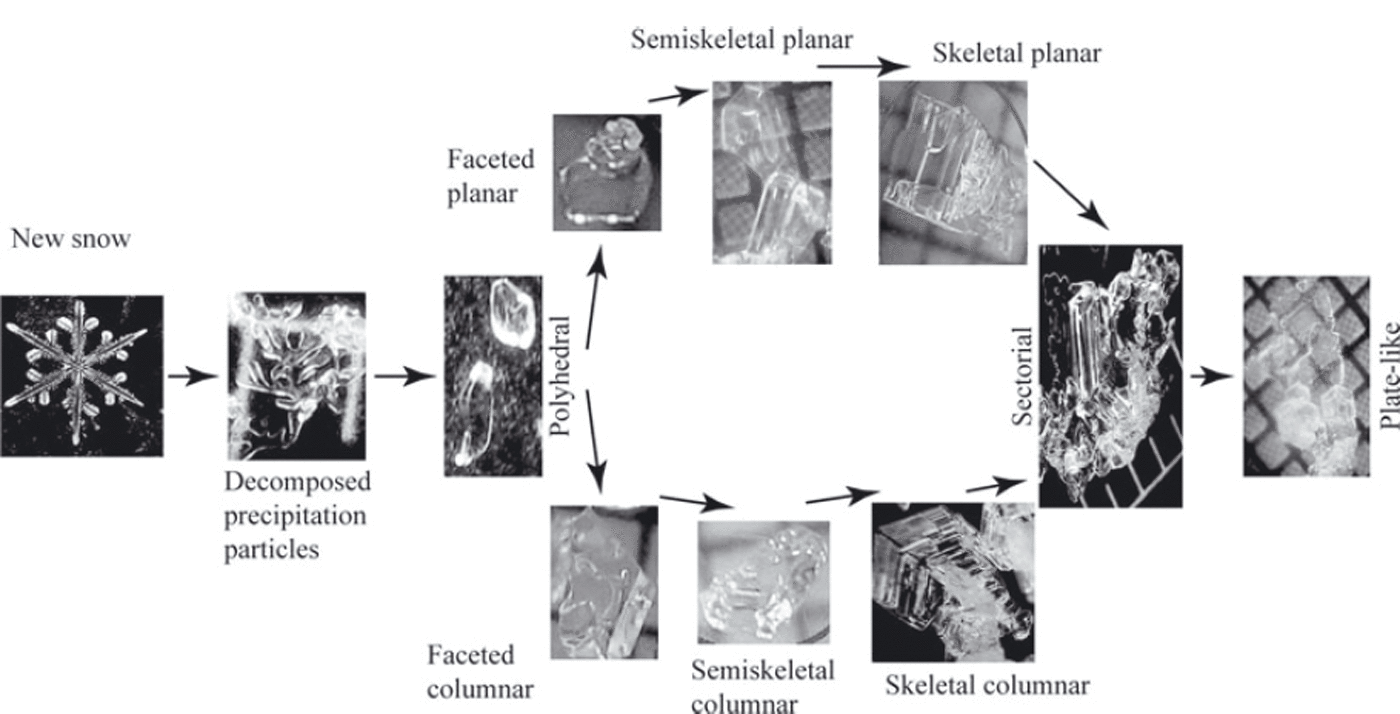
The scheme and the corresponding model were validated in several geographic regions of Russia (West Siberia, Sakhalin, Transbaikalia, Khibiny Mountains, Caucasus Mountains). The most detailed data, including the duration of the stages, were obtained at Sakhalin island and are presented in Table 1. These data show the temporal change in the type of snow according to the scheme (Fig. 1) as a function of the initial properties of snow for a given range of environmental conditions.
The observed average time intervals of the stages of the metamorphic process in snow layers of the snow cover at Sakhalin Island
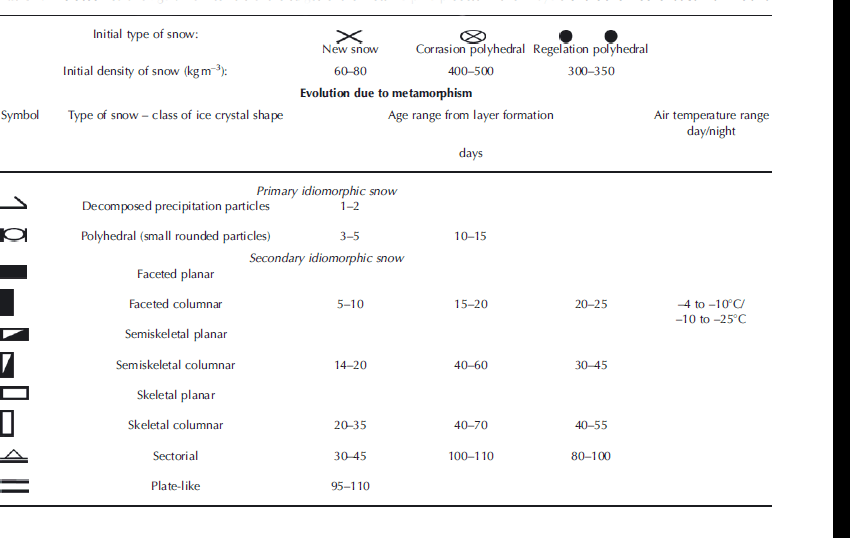
The data presented in Table 1 are the generalization of results of numerous repeated snow-pit observations in mountainous regions of south and central Sakhalin. They correspond to snow-cover depths between 55 and 160cm (the shallow and deeper snowpacks were found to have different timings of stages) in winters with similar meteorological conditions (presented as temperature ranges in Table 1). Snow layer evolution was monitored below a depth of 20–25cm (the propagation of the daily temperature variability). The last days in the development are the beginning of the wet metamorphic process and start of the snowmelt season.
Terminology
Clearly, attempts to base snow crystal classification purely on stages of the metamorphic process require terminology and ‘boundaries’ between the classes, differing from the widely accepted ones. The terms from crystallography gave names that sounded unusual for most of the field snow researchers. However, it is not difficult to relate the classification of the ‘temporal evolution of snow in snowpack’ represented by the ‘morphological classification of crystals in snow cover’ (MCC; Reference KolomytzKolomytz, 1977, Reference Kolomytz1984, Reference Kolomytz2012) with the grain-shape classification (GSC) developed by Reference FierzFierz and others (2009) (Table 2).
The stages of the dry metamorphic process in snow in terminology of the morphological classification of crystals in snow cover, and correspondence to the grain-shape classification from the ICSSG
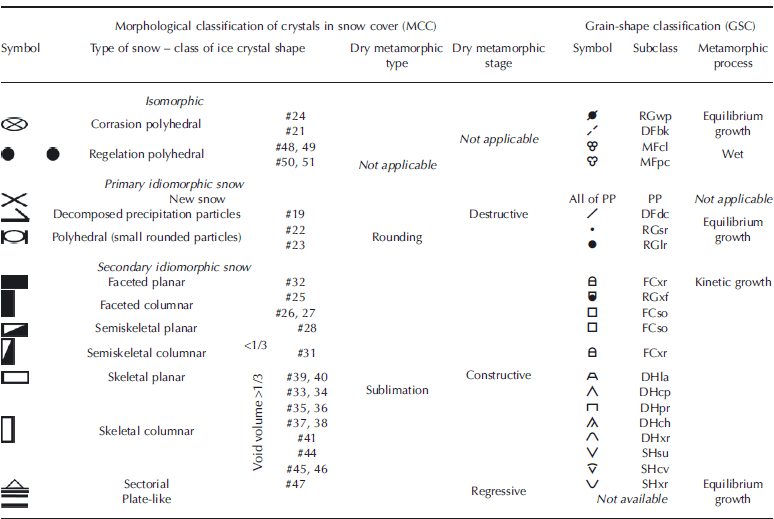
Note: The numbers after number signs (#) correspond to the photographs of crystals of subclasses in the GSC representing the classes of the MSC when available.
The difference between the right-hand and left-hand sides of Table 2, in addition to differences in accepted symbols, is the temporal order of shapes in the MCC for the stages of the metamorphic process (Fig. 1). It can be seen that the MCC is more general than the GSC. Focusing on the dry metamorphic process inside the snowpack, some subclasses are missed in the MCC (FCsf, MFsl) and newly introduced in the GSC. The MM class was not of interest in development of the MCC either. It is mentioned in the GSC that detailing is not always possible without knowing the history of the snowpack. For example, recognition between FCsf and FCso and between FCxr and RGxf is expected to be difficult. In the MCC the first pair would be treated as the same shape, while the second corresponds to the same type and stage of dry-snow metamorphic process, though the difference is supposed to be visible due to incorporation of the ‘planar’ and ‘columnar’ routes of the dry metamorphic process (Fig. 1). The former was found to be the case under low-temperature conditions (–20˚C to –30˚C), while the latter was found at higher temperatures (Reference DreviloDrevilo, 1981).
The melt forms are also more schematic in the MCC (Table 3) since these are mainly considered as a stabilizing factor for spring-season snow avalanches (Reference DreviloDrevilo, 1981).
The crusts and ice formations in terminology of the morphological classification of crystals in snow cover, and correspondence to the grain-shape classification from the ICSSG
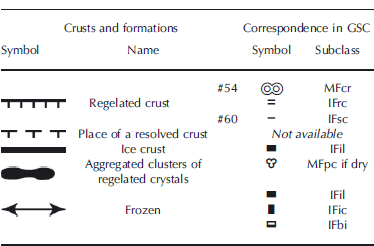
Note: The numbers after number signs (#) correspond to the photographs of crystals of subclasses in the GSC representing the classes of the MSC when available.
The practical use of the MCC includes monitoring of the development of macroscale anisotropic structures in snowpacks (in Russian literature named ‘texture’). The anisotropy of natural snowpack resulting from different prevailing processes leading to the recrystallization of snow in different snow layers can be quantified for physical characteristics of snow (e.g. Reference Calonne, Flin, Morin, Lesaffre, Rolland du Roscoat and GeindreauCalonne and others, 2011; Reference Schneebeli and SokratovShertzer and Adams, 2011). It is a qualitative observer-dependent measure in field observations, which is why it did not become part of the GSC. In the MCC it is determined by semi-subjective ranges of prevailing orientation of optical axes of snow crystals in a snowpack (Table 4) and shows the activity of recrystallization processes used in forecasting avalanche danger. The ‘texture’ is formed at the secondary idiomorphic phase of snow crystal transformations, and each of the types can be related to some range of possible snow hardness and originally was linked to a particular empirically determined range of tensile strength (Reference DreviloDrevilo, 1981).
Types of macroscale anisotropic snow structures (‘texture of snow’) in the MCC
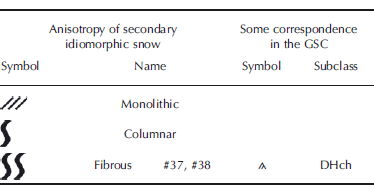
The monolithic ‘texture’ corresponds to chaotic orientation of snow crystals in a snow layer. No clusters can be observed, while the grain contact areas are relatively high. The columnar ‘texture’ is represented by the snow crystals starting to join into clusters oriented vertically as the contact area decreases. The fibrous ‘texture’ shows clear vertical orientation of clusters of snow crystals. The pore space is also constructed by vertical pores. The contact areas are smaller at vertical faces of ice matrix than at horizontal faces, meaning that the bearing strength of snow cover is decreased together with the visco-plasticity of snow with increasingly fibrous texture. Examples of such anisotropy ‘measurement’ based on ‘width to height’ of observed macrostructures are shown in Figure 2, with a cluster of snow crystals shown in Figure 3.
(a) Monolithic, (b) columnar and (c) fibrous structure (‘texture’) of snow constructed by semiskeletal and skeletal (Table 2) crystals. Dashed lines show vertical coordinate.

Cluster of ice crystals of semiskeletal and skeletal shape from the snow layers with fibrous structure (‘texture’).

Discussion and Conclusions
We have discussed the Russian classification for snow (MCC) and related it to the international classification of Reference FierzFierz and others (2009; GSC). The classification presented above is not a substitute for the ICSSG (Reference FierzFierz and others, 2009), but complements it by including metamorphic stages and landscape factors. Direct translation between the two classification systems is possible (Table 2); however, it is not necessarily desirable. Such translation risks deleting a valuable body of information, currently accessible to those familiar with the corresponding background and justification (Reference Kazakov, Okopny, Zhiruev, Gensiorovsky and AnikinKolomytz, 1976, Reference Kolomytz1977, Reference Kolomytz1984, Reference Kolomytz2012).
The recently developed techniques of snow research also present the results in parameters, not well connected to the conventional forms of presentation of the results of snow studies (e.g. Reference Painter, Molotch, Cassidy, Flanner and SteffenSchneebeli and Sokratov, 2004; Reference Marshall and JohnsonPainter and others, 2007; Reference Lobkina and MikhalevMarshall and Johnson, 2009; Reference Gergely, Schneebeli and RothGergely and others, 2010). Further development would inevitably introduce new characteristics. Therefore, it becomes especially important in attempts at finding a common language not to lose the existing knowledge, even if presented in terms of different terminology and structure.
Since the description of the dry metamorphic process of snow in the form as presented above has solid empirical back-up, it would most probably be useful to take it into account in further experimental, theoretical and numerical attempts to describe the metamorphic process and its consequences. ‘Translation’ of the MCC as presented here would make this result less likely to be overlooked in future developments.



