A relatively small group of adolescents is responsible for most crimes and violent behaviors from early childhood until adulthood (Fergusson, Horwood, & Nagin, Reference Fergusson, Horwood and Nagin2000; Patterson, Forgatch, Yoerger, & Stoolmiller, Reference Patterson, Forgatch, Yoerger and Stoolmiller1998; Stattin, Kerr, & Bergman, Reference Stattin, Kerr and Bergman2010; Stattin, Magnusson, & Reichel, Reference Stattin, Magnusson and Reichel1989). Recent work on problematic personality traits, also known as psychopathic traits, shows that children with high levels of these traits are at risk for engaging in high and stable antisocial behavior. The psychopathic personality syndrome consists of a constellation of emotional, interpersonal, and behavioral deficits. The interpersonal grandiose–manipulative dimension is characterized by superficial charm, pathological lying, feelings of grandiosity, and manipulative behaviors. The callous–unemotional affective dimension includes a lack of empathy, an absence of guilt, and low emotional understanding. The behavioral impulsive–irresponsible dimension comprises impulsive behavior, not taking responsibility for one's own actions, and a lack of realistic long-term goals (Cooke & Michie, Reference Cooke and Michie2001; Harris, Rice, & Cormier, Reference Harris, Rice and Cormier1991). These interpersonal, affective, and behavioral deficits tend to co-occur within the same individuals, yet each dimension also uniquely predicts high and stable antisocial behavior throughout adolescence (Salihovic, Özdemir, & Kerr, Reference Salihovic, Özdemir and Kerr2013) and in early adulthood (McCuish, Corrado, Lussier, & Hart, Reference McCuish, Corrado, Lussier and Hart2014). Thus, recent findings have revealed links between high and stable antisocial behavior and psychopathic traits in childhood and adolescence.
Although recent studies show a link between psychopathic traits and antisocial behavior in adolescence, little is known about what impact adolescents with psychopathic traits have on other peers in their social environment. Individuals with psychopathic traits have been considered as rejected and socially isolated by peers, leading a life of violence and solitude (Cleckley, Reference Cleckley1976). Following this line of reasoning, adolescents with psychopathic traits might be assumed to be similarly socially isolated. The handful of studies on the links between psychopathic traits and peer relationships in adolescence reveals a different picture, however. To our knowledge, there are currently only three studies on psychopathic traits and peer relationships in adolescence (Kerr, Van Zalk, & Stattin, Reference Kerr, Van Zalk and Stattin2012; Kimonis, Frick, & Barry, Reference Kimonis, Frick and Barry2004; Munoz, Kerr, & Besic, Reference Munoz, Kerr and Besic2008). These studies jointly indicate that adolescents with high psychopathic traits are not rejected by peers. Instead, they appear to have close friendships and form close-knit social networks with peers. For example, seventh to eighth graders who scored consistently high on psychopathic traits across four annual measurements (13% of the total population) nominated other peers as friends equally often as other seventh and eighth graders (Munoz et al., Reference Munoz, Kerr and Besic2008). Boys who scored consistently high on psychopathic traits were nominated as friends more often than were other boys. Thus, adolescents with high psychopathic traits appear to be embedded in peer networks and have multiple friends.
Prior findings showing that adolescents with psychopathic traits are embedded in peer networks raise a critical question: as psychopathic traits tend to be expressed in aggressive, impulsive, cold, and other socially undesirable behaviors, why would adolescents with these traits have at least as many social relationships as other adolescents without those traits? This process concerns peer selection, or how two adolescents who at first do not have a relationship select each other and form a friendship. When taking all three dimensions of psychopathic traits together, adolescents with high levels of average psychopathic traits only showed a weak tendency to nominate others with similar levels of these traits (Munoz et al., Reference Munoz, Kerr and Besic2008). Moreover, when distinguishing among the three dimensions of psychopathic traits, support for a link between similarity and friendship was found only for impulsive–irresponsible traits (Kerr et al., Reference Kerr, Van Zalk and Stattin2012). This implies that whereas adolescents with high impulsive–irresponsible traits form relationships with similar others, adolescents with high grandiose–manipulative and callous–impulsive traits do not.
If adolescents with high levels of grandiose–manipulative and callous–unemotional traits do not form relationships with similar youths, whom do they select instead? Literature concerning a subgroup of adolescents with high antisocial behavior and problematic personality traits provides indications that they may select vulnerable, less popular peers with low self-esteem. Life-course-persistent offenders (Moffitt, Reference Moffitt1993) are described as a small subgroup of juvenile offenders who are responsible for most crimes and violence from childhood to adulthood. Underlying this groups' stable antisocial behavior are problematic personality traits, such as psychopathic traits, which in early childhood make them unpopular among their peers. However, this groups' peer status changes dramatically in adolescence, as they shift from the periphery to central and high-status positions in their peer network. The reason for this may be that they have already pioneered risky and aggressive behaviors before their peers and are regarded by other adolescents as models of maturity. Adolescents with problematic personality traits thus become popular “magnets” for vulnerable and rejected youths, such as adolescents with low self-esteem. They pull their vulnerable peers into deviant peer groups, and subsequently socialize them into increasing their levels of delinquent behavior (Moffitt, Caspi, Dickson, Silva, & Stanton, Reference Moffitt, Caspi, Dickson, Silva and Stanton1996; Roberts, Caspi, & Moffitt, Reference Roberts, Caspi and Moffitt2001). Consistent with these suggestions, studies show that violent and delinquent adolescents gain high status among and form friendships with less popular peers in adolescence (Cillessen & Mayeux, Reference Cillessen and Mayeux2004; Farmer, Estell, Bishop, O'Neal, & Cairns, Reference Farmer, Estell, Bishop, O'Neal and Cairns2003), and subsequently influence these peers to increases in delinquent behavior (Allen, Porter, McFarland, Marsh, & McElhaney, Reference Allen, Porter, McFarland, Marsh and McElhaney2005). Little is currently known, however, about which problematic personality traits make these adolescents more popular as friends. Further, although low self-esteem seems to increase adolescents' susceptibility to deviant peer influence (Donnellan, Trzesniewski, Robins, Moffitt, & Caspi, Reference Donnellan, Trzesniewski, Robins, Moffitt and Caspi2005), suggesting they are a particularly vulnerable group, it remains unclear whether these youths are targeted by adolescents with problematic personality traits. One possibility, therefore, is that adolescents with psychopathic traits form friendships with adolescents who have low self-esteem.
The formation of peer relationships between adolescents with high psychopathic traits and adolescents with low self-esteem is important because it may have problematic consequences for the further development of psychopathology. We distinguish between target adolescents, or adolescents being influenced, and peers, or adolescents exerting influence. On the one hand, the literature on antisocial behavior provides consistent evidence for peer influence, or peers' antisocial behavior influencing target adolescents' own antisocial behavior, increasing their similarity over time (Veenstra & Dijkstra, Reference Veenstra, Dijkstra, Laursen and Collins2011). It appears that antisocial and violent peers influence target adolescents' antisocial behavior through verbal and nonverbal reinforcement of deviant attitudes (Dishion & Patterson, Reference Dishion, Patterson, Cicchetti and Cohen2006; Dishion, Spracklen, Andrews, & Patterson, Reference Dishion, Spracklen, Andrews and Patterson1996; Poulin, Dishion, & Haas, Reference Poulin, Dishion and Haas1999). On the other hand, target adolescents with low self-esteem may be particularly susceptible to peer influence. One suggestion is that by imitating their antisocial peers and gaining acceptance in the peer group, adolescents with low self-esteem strengthen their sense of self and increase their self-esteem over time (Donnellan et al., Reference Donnellan, Trzesniewski, Robins, Moffitt and Caspi2005; Mason, Reference Mason2001). According to these perspectives, then, target adolescents' self-esteem is believed to interact with peers' violent behavior in predicting increases in target adolescents' violence. Furthermore, peers' psychopathic traits may interact with peers' violence to predict changes in adolescent violence over time.
The Current Study
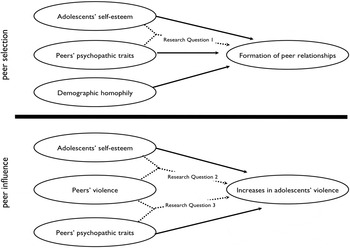
This study aims to examine the roles of self-esteem and psychopathic traits in two peer processes: how target adolescents form relationships with peers (i.e., selection), and how peers influence target adolescents after relationships have been formed (i.e., influence). Selection is defined as the extent to which target adolescents' and peers' characteristics (i.e., their self-esteem and psychopathic traits) predict target adolescents and peers selecting each other as friends, as well as forming friendships. Influence is defined as the extent to which peers' behavior (i.e., peers' violence) predicts increases in target adolescents' behavior (i.e., adolescents' violence). Figure 1 depicts a graphical representation of this conceptual model.
A conceptual model of the roles of self-esteem and psychopathic traits in peer selection and peer influence.

The first research question pertains to the extent to which target adolescents with low self-esteem form relationships with peers who have psychopathic traits (depicted in the upper part of Figure 1). To our knowledge, peer relationships between these two groups have not yet been studied. We suggest that these relationships are important to study, because both groups are at risk for developing antisocial behaviors. The second research question concerns what happens after peer relationships have been formed, or the extent to which peers with psychopathic traits influence target adolescents with low self-esteem (depicted in the lower part of Figure 1). Because target adolescents with low self-esteem are thought to be susceptible to peer influence and peer pressure, this group may be most vulnerable to antisocial peers. The third research question pertains to how peers' psychopathic traits interact with peers' violent behavior to predict changes in adolescents' violence. Based on a prior study concerning adolescent delinquency (Kerr et al., Reference Kerr, Van Zalk and Stattin2012), we expect that peers' psychopathic traits will increase peer influence and, therefore, interact with peer violence to predict adolescent violence. In addition, interactions among the grandiose–manipulative interpersonal style, callous–unemotional affect, and impulsive–irresponsible behavior may influence antisocial behavior. Psychopathy is a syndrome comprising several traits, and individuals with high scores on all three dimensions are thought to represent a small group of the general population who account for a disproportionate amount of serious crime and violence (Harris et al., Reference Harris, Rice and Cormier1991). Alternatively, each personality dimension itself may have differential influences, and we will examine unique and combined influences from the three dimensions. Finally, little is known about whether boys and girls are affected differently by peers with psychopathic traits. To gain more insight regarding gender differences in peer selection and influence processes, we contrast girls and boys in all of our hypotheses by entering gender interactions with the main and interaction effects. Because a prior study did not find gender differences in peer selection and peer influence concerning delinquent behavior (Kerr et al., Reference Kerr, Van Zalk and Stattin2012), however, we hypothesize that there will be no gender differences in peer influence on adolescent violence.
To answer our research questions, we use a large longitudinal network of adolescents and all of their nominated peers followed annually over three measurement periods. This sample is different from the previously used sample where peer influence on adolescent delinquency was examined (Kerr et al., Reference Kerr, Van Zalk and Stattin2012). In order to study selection and influence, it is important to examine them simultaneously in one model, because problematic peer selection for target adolescents with low self-esteem puts these adolescents at risk for peer influence on violence. Thus, problematic peer selection can serve as a basis for problematic peer influence. Hence, we use stochastic actor-oriented modeling (Snijders, Reference Snijders2001; Snijders, Van de Bunt, & Steglich, Reference Snijders, Van de Bunt and Steglich2010), with the advantage of estimating selection and influence processes together, thus examining how peer selection feeds back into peer influence. We control for demographic homophily, or the tendency for adolescents to select others with the same gender, age, and ethnic group membership (Kandel, Reference Kandel1978; McPherson, Smith-Lovin, & Cook, Reference McPherson, Smith-Lovin and Cook2001). Similarly, because the formation of new peer relationships is predicted by already existing peer relationships, we control for network effects (Veenstra, Dijkstra, Steglich, & Van Zalk, Reference Veenstra, Dijkstra, Steglich and Van Zalk2013).
Method
Participants
Participants were 1,772 adolescents and their peers (M age = 13.03, SD age = 0.53 at Time 1; 51.1% girls) from a midsize Swedish municipality with a total population of about 135,000. The participants filled out questionnaires at three consecutive longitudinal annual assessments, referred to as Time 1, Time 2, and Time 3. Research assistants, who were trained according to ethical guidelines, collected questionnaire data during school hours. The participants were informed that their participation was voluntary and their answers would never be shown to parents, teachers, or anyone else. Parents were informed about the study via letters and in meetings that were organized in the municipality. Before each wave, parents received new information and were asked to return an informed consent form (with a prepaid postcard) if they did not want their adolescent to participate (only 1% of parents did so). The study was approved by the regional ethics review board.
We started with all participants in the data set at Time 1 (n = 1,797). There were 7 participants who failed to nominate any peers, and 18 who did not provide data on self-esteem, psychopathic traits, and violence. Missing data on each of the variables within each time point was less than 15%. Furthermore, we compared adolescents who dropped out of the study at either Time 2 or Time 3 (12%) with those who did not (88%) on all variables used in this study. In two logistic regressions, we used all Time 1 measures as independent variables to predict the dropout at Times 2 and 3. None of the variables at Time 1 significantly predicted dropout at Times 2 and 3. In addition, Time 2 and Time 3 measures did not predict adolescents who did not participate at Time 1. Data for participants who entered the sample at a later measurement or left the sample before the next measurement were treated as structurally missing. Missing values for individual characteristics (e.g., violence, self-esteem, and psychopathic traits) and peer relationships for students who did not answer although they were part of the sample at any measurement were treated as noninformative in the estimation process (for more details, see Huisman & Snijders, Reference Huisman and Snijders2003).
Measures
Peer nominations
Adolescents and their peers were asked to identify up to three peers who were most important to them (List A). Next, participants had to indicate whether these peers were their friends, romantic partners, siblings, or other. We only selected those who were nominated as friends (43.5% to 57.6% across the three measurements). Furthermore, participants identified up to 10 peers with whom they spent time in school (List B). When the same peer was nominated on both List A and List B, we removed one name to avoid double entries in the data. Because entire schools participated, 97.3% of all nominated peers themselves provided independent self-reports on all measures included in this study. The 12.7% of peers who did not participate did not significantly differ on any of the variables used in this study (p > .10). On average, from one measurement to the next, 27% of all peer ties in the network were formed, 32% ended, and 41% remained stable. These nomination scales have been used in a number of other studies and have shown validity when predicting friendship quality, friendship interaction, and other indicators of friendships (Kerr, Stattin, & Kiesner, Reference Kerr, Stattin, Kiesner, Engels, Kerr and Stattin2007; Van Zalk, Kerr, Branje, Stattin, & Meeus, Reference Van Zalk, Kerr, Branje, Stattin and Meeus2010).
Psychopathic traits
Psychopathic traits were assessed with the Youth Psychopathic Traits Inventory (Andershed, Kerr, Stattin, & Levander, Reference Andershed, Kerr, Stattin, Levander, Blaauw and Sheridan2002). This self-report instrument has demonstrated good reliability and construct validity (Declercq, Markey, Vandist, & Verhaeghe, Reference Declercq, Markey, Vandist and Verhaeghe2009; Poythress, Dembo, Wareham, & Greenbaum, Reference Poythress, Dembo, Wareham and Greenbaum2006). There were three dimension scores, calculated as mean values of the subscales making up the dimensions. The grandiose–manipulative traits were measured with 20 items, reflecting dishonest charm, grandiosity, lying, and manipulation. An example item is “I have the ability to con people by using my charm and my smile.” The Cronbach αs ranged from 0.78 to 0.83 across the three measurements. The callous–unemotional traits were measured with 15 items reflecting unemotionality, remorselessness, and callousness. An example item is “I think that crying is a sign of weakness, even if no one sees you.” The Cronbach αs ranged from 0.75 to 0.82 across measurements. The impulsive–irresponsible traits were measured with 15 items concerning impulsiveness, thrill seeking, and irresponsibility. An example item is “I prefer to spend my money right away rather than save it.” The Cronbach αs ranged from 0.71 to 0.73 across measurements.
Violence
Violence was measured with 8 items that were part of a previously used scale measuring delinquency (e.g., Burk, Steglich, & Snijders, Reference Burk, Steglich and Snijders2007). Example items include “Have you threatened or forced someone to give you money, cigarettes, or anything else,” “Have you taken part in a street fight in town,” and “Have you intentionally hurt someone?” Items referred to behaviors during the past year and were rated on a 5-point scale (0 = no, it has never happened, 4 = more than 10 times). The Cronbach αs ranged from 0.93 to 0.95 across measurements.
Analytical strategy
To examine selection and influence processes, we used Simulation Investigation for Empirical Network Analysis (Snijders, Reference Snijders2001). With this analysis, all effects are estimated simultaneously in one single model, meaning that the analysis allowed us to examine (a) whether adolescents' self-esteem interacted with peers' psychopathic traits to predict peer relationship formation and (b) whether peers' violence interacted with target adolescents' self-esteem and peers' psychopathic traits to predict increases in target adolescents' violence. To our knowledge, this is the only available technique to examine these longitudinal effects in one single model while retaining all peer nominations at each measurement. All three discrete measurements over time are used to estimate the underlying time parameter as a continuous process. The behavioral outcome variable (violence) was recoded into four categories: 0 (no violent act; 48.5%–86.8% of the sample), 1 (1 violent act; 7.1%–40.5%), 2 (2 violent acts; 2.6%–5.6%), and 3 (3 or more violent acts; 3.5%–5.3%). This new violence variable correlated highly (r > .97, p < .001) with the original score, and was used in all analyses discussed below.
Results
Descriptives
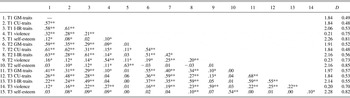
Table 1 shows the correlations, means, and standard deviations for all study variables. To test for differences between time points, a repeated-time analysis was performed in which the factor time represents the changes across all time points for the three variables. No significant changes emerged across time, F (6, 984) = 1.79, p > .10.
Correlations, means, and standard deviations for all study variables across the three time points

Note: GM-traits, Grandiose–manipulative traits; CU-traits, callous–unemotional traits; I-IR-traits, impulsive–irresponsible traits.
**p < .01. ***p < .001.
Research question 1: Do adolescents with low self-esteem and adolescents with high psychopathic traits form peer relationships?
Our first research question concerns whether adolescents with low self-esteem form relationships with peers who have high psychopathic traits. Thus, we examined selection effects. Selection effects refer to the extent to which variables predict the change from no nomination to subsequently either (a) a target adolescent nominating a peer or (b) a target adolescent not nominating a peer. Note that for peer selection, the target adolescent refers to the person nominating, and the peer refers to the person receiving the nomination. Thus, we examined whether the target adolescents' self-esteem interacted with the peers' psychopathic traits to predict whether the target adolescent selected the peer. We discuss several controlled selection effects before discussing our results concerning the roles of self-esteem and psychopathic traits in peer selection. For a technical discussion of these effects, we refer to prior studies that discuss each one of these effects in more detail (Huisman & Snijders, Reference Huisman and Snijders2003; Snijders, Reference Snijders2001; Snijders & Baerveldt, Reference Snijders and Baerveldt2003; Snijders, Steglich, & Schweinberger, Reference Snijders, Steglich, Schweinberger, Van Montfort, Oud and Satorra2007; Snijders et al., Reference Snijders, Van de Bunt and Steglich2010).
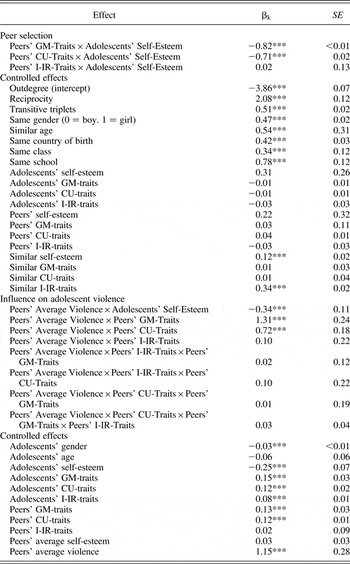
Because these effects of self-esteem and psychopathic traits on peer selection may be confounded with other tendencies to form peer relationships, we controlled for network effects and effects from other variables. Network effects reflect basic tendencies in network changes (Snijders, Reference Snijders2001). We explored three network effects, which are shown in Table 2 under the controlled effects: outdegree, reciprocity, and transitive triplets. The significant outdegree effect can be interpreted as the intercept in the formula when explaining friendship selection. The significant and positive reciprocity effect indicated that adolescents tended to reciprocate peer nominations (e.g., John selects Marc, Marc selects John). The significant and positive transitive triplets effect indicates that adolescents formed triadic peer relationships; that is, they became friends with the friends of their friends (e.g., John selects Marc, Marc selects Sue, John selects Sue). Thus, because these effects of the network on subsequent changes in the network were significant, they were controlled for in the model.
The roles of self-esteem and psychopathic traits in peer selection and influence

Note: GM-traits, Grandiose–manipulative traits; CU-traits, callous–unemotional traits; I-IR-traits, impulsive–irresponsible traits. All effects were estimated by using all three measurements, and the underlying time parameter is estimated as a continuous process. For selection, positive and significant effects indicate a higher likelihood for adolescents and peers to form a peer relationship. Negative and significant effects indicate a lower likelihood for adolescents and peers to form a peer relationship. For influence, positive and significant effects indicate a higher likelihood for increases in adolescent violence and self-esteem. Negative and significant effects indicate a lower likelihood for increases in adolescent violence.
**p < .01. ***p < .001.
Below the network effects in Table 2 are controlled effects for other variables on peer selection. We controlled for demographic homophily by testing whether adolescents formed peer relationships with those who were similar to them in age, gender, and ethnicity. Findings showed strong support for demographic homophily on all variables. The significant and positive same gender, same ethnicity, similar age, same class, and same school effects showed that adolescents tended to form peer relationships with peers with the same gender and ethnicity, who were of a similar age and in the same class and school. In sum, all demographic homophily effects were significant and were therefore controlled in further analyses.
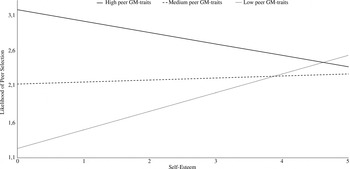
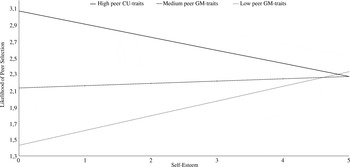
As we tested interaction effects between adolescents' self-esteem and peers' psychopathic traits, we controlled for main effects of these variables as well. We distinguished between three types of main effects: adolescents' mean levels of a variable, peers' mean levels of a variable, and similarity between adolescents and peers. We examined to what extent target adolescents' self-esteem and peers' psychopathic traits interact to predict friendship selection between adolescents and peers (shown in the upper part of Table 2). We found two negative and significant interactions: the interaction between target adolescents' self-esteem and peers' grandiose–manipulative traits, and the interaction between target adolescents' self-esteem and peers' callous–unemotional traits. We explored these interaction effects further in Figures 2 and 3, which depict the effects of adolescents' self-esteem on the likelihood of peer selection moderated by peers' grandiose–manipulative and callous–unemotional traits. To enhance interpretation of these interactions, we compared participants scoring 1 SD below the mean of a variable (low; 15.9% of the total sample), those scoring between 1 SD below and 1 SD above the mean (medium; 68.2% of the total sample), and those scoring 1 SD above the mean (high; 15.9% of the total sample).
Interaction effects between adolescents' self-esteem and peers' grandiose–manipulative traits on peer selection. GM-traits, Grandiose–manipulative traits. Low, medium, and high peers' grandiose–manipulative traits represent peers scoring 1 SD below, between 1 SD below and 1 SD above, and 1 SD above the mean of grandiose–manipulative traits, respectively. Selection effects examined to what extent variables predicted that a nonpeer dyad would change to a peer dyad (i.e., adolescents select a peer) rather than remain a nonpeer dyad (i.e., adolescents do not select a peer) over time.

Interaction effects between adolescents' self-esteem and peers' callous–unemotional traits on peer selection. CU-traits, Callous–unemotional traits. Low, medium, and high peers' CU traits represent peers scoring 1 SD below, between 1 SD below and 1 SD above, and 1 SD above the mean of CU traits, respectively.

Figure 2 shows that for target adolescents with low levels of self-esteem, high levels of peers' grandiose–manipulative traits predicted a higher likelihood of peer selection than lower levels of these traits. In a similar vein, Figure 3 showed that low levels of target adolescents' self-esteem and high levels of peers' callous–unemotional traits predicted a higher likelihood of peer selection. No such interaction was found for impulsive–irresponsible traits. Thus, adolescents' with low self-esteem tend to form relationships with adolescents who have high grandiose–manipulative and callous–unemotional traits.
Research question 2: Are adolescents with low self-esteem particularly susceptible to peer influence?
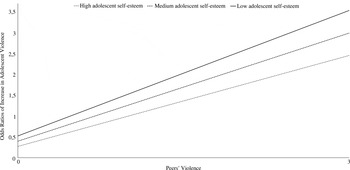
Our second research question concerned the extent to which target adolescents with low self-esteem were influenced by peers' violence. In the same model as the previously discussed selection effects, we examined the interaction effect between target adolescents' self-esteem and peers' violence on subsequent increases in targets' violence. Table 2 shows that this interaction was negative and significant. Note that this two-way interaction shown in Table 2 is controlled for the three-way and four-way interactions, yet it was nearly identical in effect size (Δβ k = 0.0001) and p value (Δp = .0001) when the three- and four-way interactions were excluded. We explored the two-way interaction between target adolescents' self-esteem and peers' violence further in Figure 4. For self-esteem, we focus on those adolescents being influenced on violence (i.e., the targets). We compared targets scoring 1 SD below the mean on self-esteem (i.e., targets' low self-esteem), targets scoring between 1 SD below and above the mean (i.e., targets' medium self-esteem), and targets scoring 1 SD above the mean (i.e., targets' high self-esteem). Figure 4 shows that peers' violence had stronger effects at lower levels of targets' self-esteem. Thus, peers' violence predicted increases in target adolescents' violence, particularly for adolescents with low self-esteem.
Interaction effects between adolescents' self-esteem and peers' violence on increases in adolescent violence. Low, medium, and high adolescents' self-esteem represent adolescents scoring 1 SD below, between 1 SD below and 1 SD above, and 1 SD above the mean for self-esteem, respectively. Influence effects examined to what extent variables predicted increases in adolescents' violence (e.g., an adolescent changed from scoring 0 to scoring 1 on violence) rather than not increasing violence (e.g., an adolescent scored 0 across time, or decreases in violence).

Other significant effects on increases in targets' violence that emerged in the analyses are shown in Table 2. Gender significantly predicted increases in violence, showing that boys had stronger tendencies to increase in violence than girls had. In addition, self-esteem had a negative and significant effect, showing that targets with lower self-esteem had a higher likelihood of increasing in violence than targets with higher self-esteem. In summary, we found support for stronger susceptibility to peer influence on adolescents' violence for adolescents with low self-esteem than for other adolescents, even after controlling for other potential influences on targets' violence.
Research question 3: Is peer influence moderated by peers' psychopathic traits?
As in a prior study with a different sample (Kerr et al., Reference Kerr, Van Zalk and Stattin2012), our findings show that peers' grandiose–manipulative traits and peers' callous–unemotional traits interacted with peers' violence. The interactions were nearly identical to the ones in the prior study using a different sample and are therefore not shown in figures. At high levels of peers' grandiose–manipulative traits, peers' violence predicted a higher likelihood of increase in target adolescents' violence than at lower levels of these peers' traits. In a similar vein, peers' callous–unemotional traits interacted with peers' violence. At high levels of peers' callous–unemotional traits, peers' violence predicted a higher likelihood of increases in target adolescents' violence than at lower levels of these peers' traits. Thus, the current findings and the results from another study using a different sample (Kerr et al., Reference Kerr, Van Zalk and Stattin2012) jointly indicate that peers with higher psychopathic traits are more influential on adolescent delinquency and violence than peers with lower psychopathic traits.
Finally, we examined whether peer influence is particularly strong in relationships between peers with high psychopathic traits and adolescents with low self-esteem. We therefore explored whether each separate psychopathic dimension enhanced peer influence for adolescents with low self-esteem by entering three-way interactions among adolescents' self-esteem, peers' violence, and each of the three psychopathic dimensions, respectively. We controlled for all two-way interactions between these variables. Contrary to our expectations, none of the three-way interactions were significant (<.05, SE < .13, p < .10). This indicates that peers' violence did not have the strongest influence on adolescents' violence in relationships between adolescents with low self-esteem and peers with psychopathic traits.
Research question 4: Are peers with high levels on all three dimensions of the psychopathic syndrome most influential?
One suggestion in the literature is that the psychopathic syndrome is a constellation of all three dimensions. That is, adolescents who score high on all three dimensions may be particularly prone to developing violent and criminal behavior. These adolescents might be at the forefront of antisocial networks, and they may exert the most influence on adolescents with low self-esteem. To explore this idea, we examined a four-way interaction among the three psychopathic trait dimensions and peers' average violence, controlling for all main affects, two-way interactions, and three-way interactions (see Table 2). This four-way interaction was not significant. Thus, this indicates that peers who were high on all psychopathic traits did not influence adolescents with low self-esteem more than other peers.
Research question 5: Are selection and influence processes different for boys and girls?
To answer our final research question, we examined gender differences in peer selection and influence effects by entering six three-way interactions among gender and the two-way interaction effects shown in Table 2. We hypothesized that there would be no significant gender difference in peer selection and peer influence. All previous main effects and interactions were retained in the model. When predicting peer selection, the three interactions among Gender × Adolescents' Self-Esteem × Peers' Psychopathic Traits (one for each of the three psychopathic traits) were not significant (<.02, SE < .10, p < .10). In a similar vein, when predicting peer influence on adolescent violence, the interaction among Gender × Adolescents' Self-Esteem × Peers' Violence was not significant (<.03, SE = .08, p < .10). Thus, our results indicate that the roles of self-esteem and psychopathic traits in peer selection and influence were similar for boys and girls.
Discussion
Adolescents as active agents: Their choices impact how they are socialized
The current study contributes to prior literature in several ways. This study is among the few (e.g., Kerr et al., Reference Kerr, Van Zalk and Stattin2012; Kimonis et al., Reference Kimonis, Frick and Barry2004) to provide empirical evidence for how adolescents' own personality moderates their choices of peers, and how these choices in turn impact peer socialization processes. Using a stochastic actor-oriented approach (Snijders, Reference Snijders2001; Snijders et al., Reference Snijders, Van de Bunt and Steglich2010), we modeled both adolescents' social choices and the consequences of these choices. Rather than being passive subjects shaped by their peers, our results show that adolescents' own personality traits influence who they select as peers and how much they are influenced by these peers. That is, adolescents with high grandiose–manipulative and callous–unemotional traits and adolescents with low self-esteem tended to form peer relationships. Who initiated this friendship formation was not examined in the current study, however. One possibility is that adolescents with high psychopathic traits may be particularly motivated to select vulnerable adolescents with low self-esteem, because they tend to take up leadership positions in antisocial networks (Kimonis et al., Reference Kimonis, Frick and Barry2004). Adolescents with low self-esteem may in turn seek peer acceptance from nonconventional peers who engage in antisocial behavior, because it may boost their self-esteem (Mason, Reference Mason2001). Future studies should provide more insight into who initiates these friendship formations and what processes explain them. As expected, no gender differences were found regarding these peer selections and influences. This indicates that despite the consistent support for higher antisocial behavior among boys compared to girls (e.g., Moffitt et al., Reference Moffitt, Caspi, Dickson, Silva and Stanton1996; Selfhout, Branje, & Meeus, Reference Selfhout, Branje and Meeus2008), the peer processes that affect these differences seem to be similar for both genders. Consequently, this study offers an additional important insight into how girls, who have been largely neglected in the established literature on antisocial behavior, are influenced by antisocial peers. In sum, adolescents' personality and their peers' personality were both found to influence adolescent social choices and in turn their antisocial development.
These results provide empirical evidence for Moffitt's (Reference Moffitt1993) characterization of life course persistent offenders and their peer relationships with vulnerable peers. This framework suggests that life course persistent offenders have antisocial personalities, and thus act as magnets for other adolescents who are struggling to find their way among peers. Adolescents with low self-esteem in particular have a hard time forming friendships in adolescence, and might even conform to antisocial peer norms more readily as they receive praise from their antisocial peers, which may boost their self-esteem (Mason, Reference Mason2001). Moreover, the current study moves beyond the prior body of work and offers additional new insights into whom adolescents with psychopathic traits select, and why they are motivated to do so. Adolescents with low self-esteem seem to be more susceptible to peer influence and may therefore be selected by adolescents with psychopathic traits.
The final contribution this study makes to the current literature concerns comparing the unique effects of all three dimensions of the psychopathic personality syndrome. In this study, additional analyses showed no evidence for the idea that it is the constellation of all three dimensions together (i.e., interpersonal, emotional, and behavioral deficits) that makes adolescents most influential in antisocial peer groups. In the past, strong arguments have been made for the cold and unemotional dimension as most central to identifying a psychopathy-like subgroup of conduct-disordered youth (for a review, see Frick & White, Reference Frick and White2008). Current results show that next to this affective dimension, interpersonal grandiose–manipulative tendencies are equally important for friendship processes. Adolescents high on this dimension are able to manipulate and charm others to do their bidding (Andershed, Gustafson, Kerr, & Stattin, Reference Andershed, Gustafson, Kerr and Stattin2002), and may therefore prefer to choose susceptible adolescents with low self-esteem. Thus, this study suggests that future studies need to examine the unique effects of each psychopathic dimension, because each seems to have different social consequences. This study is one of the few to examine the constellation of the three dimensions separately, and future studies should further examine how combinations of interpersonal, affective, and behavioral deficits in the psychopathic syndrome may influence social development.
An unexpected finding was that our additional analyses did not show that peer influence was highest in peer relationships between adolescents with low self-esteem and peers with psychopathic traits. This means that, although adolescents with low self-esteem were found to be most susceptible to violent peer influence, and peers with psychopathic traits were in turn found to be most influential, peer relationships between these two groups did not lead to further escalations of peer influence. This finding could be explained by a ceiling effect for peer influence. Perhaps the connection between targets with low self-esteem and peers with high psychopathic traits does not further enhance peer influence because violent peer influence is already high in these relationships. Future studies should examine what mediates such peer influence processes. One possibility is that increases in self-esteem mediate the link between having a violent peer and increases in violence for adolescents with low self-esteem. Another equally viable possibility is that specific peer influence processes, such as deviancy training (Dishion et al., Reference Dishion, Spracklen, Andrews and Patterson1996), act as a mediator, increasing violence for adolescents with low self-esteem. In sum, current results provide direction for future studies to examine what explains peer influence for adolescents with low self-esteem.
Limitations
The current study has several limitations. First, although we included all peers adolescents nominated within schools, other studies have found that including peers outside of school is especially important when examining deviant peer influence (Kiesner, Kerr, & Stattin, Reference Kiesner, Kerr and Stattin2004; Van Zalk et al., Reference Van Zalk, Kerr, Branje, Stattin and Meeus2010). For example, research indicates that outside-school peers may have stronger influence on delinquency than in-school peers (Kiesner et al., Reference Kiesner, Kerr and Stattin2004). Nevertheless, these same studies also indicate that although peers outside school are more important, peers inside school still have a significant impact on antisocial behavior. This implies that including peers outside school might have led to finding stronger effects. The current study design did not allow us to examine differences between inside- and outside-school peer influence. Second, the specific mechanisms explaining peer influence were not examined in the current study. Characteristics and behaviors inherent to grandiose–manipulative traits, such as the ability to charm and manipulate peers, were offered as explanations for why these peers formed relationships with peers who had low self-esteem. In a similar vein, the ability to organize and lead antisocial peer groups may explain why adolescents with high callous–unemotional traits formed peer relationships with susceptible adolescents. However, the current study did not examine whether these abilities explained the peer influence processes we found. Third, we could not examine differences between the target sample and the population. To summarize, future studies should examine whether abilities associated with psychopathic traits mediate peer selection, as well as the effect of differences between peers found inside and outside school on peer selection and peer influence.
Strengths and conclusions
Despite these limitations, this study has several strengths that enable us to offer unique insight into the roles of adolescents' social choices and their personality traits in antisocial development. We examined adolescents' peer selection simultaneously with the extent to which they were influenced by peers. In doing so, we were able to show that adolescents' choices of psychopathic peers have problematic consequences, because they appear to predict peer influence on violence. Thus, our design allowed us to examine both social choices and the consequences of these choices in one single model. In addition, we used peers' independent self-ratings on violence, which reduces shared observer bias because each person reports on his or her own behavior (Kandel, Reference Kandel1978; Kenny, Kashy, & Cook, Reference Kenny, Kashy and Cook2006). Furthermore, we followed a large sample of adolescents and their peers over 3 years in a social network, and thus examined adolescents' multiple interconnected peers. This design has the advantage over dyadic analyses in that all possible peer selections and influences are examined simultaneously (Burk et al., Reference Burk, Steglich and Snijders2007; Snijders, Reference Snijders2001). In dyadic designs, peer selection and influence are studied in each pair of peers, which may not capture realistic peer processes going on in the periphery of the peer network (Snijders, Reference Snijders2001). In summary, then, by using adolescents' and peers' self-ratings to examine both selection and influence in a large peer network, we were able to offer insight into the roles of personality traits on social choices and the way peers influence each other.
Prior literature has established strong evidence for the detrimental effects of delinquent and violent peers on adolescent antisocial behavior. The current study contributes to understanding moderators of peer influence in adolescence, because it indicates that personality traits of both the person influencing as well as the person being influenced moderate this process. Moreover, adolescents with interpersonal and affective deficits in the psychopathic syndrome do not seem to form peer relationships with each other, but rather tend to form peer relationships with vulnerable adolescents who have low self-esteem. Adolescents with psychopathic traits may thus be building up leadership positions in antisocial peer networks, which is particularly worrying because these adolescents are prone to influencing their peers to increase their violent behavior. The focus for future studies should therefore be on how these possibly detrimental processes in antisocial networks can be prevented and changed.
Future directions for translating research on the influential child into preventive interventions
This study provides guidelines for individual approaches to preventive interventions. Our findings indicate that adolescents with low self-esteem are vulnerable to deviant peer influence from peers with psychopathic traits. This suggests that when targeting deviant adolescents, those with low self-esteem should not be grouped together with adolescents who are high on psychopathic traits, because this puts them at risk for increases in violence. In accordance with this, interventions grouping teenagers with high levels of delinquency and violence together have resulted in escalations, rather than decreases, in these antisocial behaviors (Dishion, McCord, & Poulin, Reference Dishion, McCord and Poulin1999). Delinquent and violent peers in these interventions likely engage in deviancy training, or verbal and nonverbal reinforcement of deviant attitudes and values, which increases delinquency (Dishion & Patterson, Reference Dishion, Patterson, Cicchetti and Cohen2006). The current study indicates that deviancy training may particularly occur for specific pairs of deviant friends, namely, those with low self-esteem and high psychopathic traits. Future studies should therefore further examine such processes as explanations for escalations in violence within adolescent friendships, and use this knowledge to target adolescents with low self-esteem and high psychopathic traits. Hence, programs aiming at helping adolescents with antisocial tendencies may benefit from taking into account how psychopathic traits and self-esteem moderate prevention effects. In sum, because psychopathic traits and self-esteem may moderate preventive intervention effects, we recommend that these traits are assessed when targeting antisocial adolescents for intervention purposes, which might result in more effective interventions in the future.