Introduction
Dopamine transporter (DAT) dysregulation is known to play an important role in both adults and children with attention-deficit hyperactivity disorder (ADHD). Neuroreceptor imaging techniques have been used to investigate DAT function in ADHD;Reference Spencer, Biederman and Madras 1 – Reference Solanto 3 however, the results have been inconsistent.Reference Fusar-Poli, Rubia, Rossi, Sartori and Balottin 4 , Reference Volkow, Wang and Newcorn 5 A metaanalysis showed that striatal DAT availability depends on patients’ previous psychostimulant exposure, and that the striatum appears to play a prominent role in ADHD symptoms.Reference Fusar-Poli, Rubia, Rossi, Sartori and Balottin 4 It is generally accepted that DAT availability is lower in ADHD patients.
In addition to DAT imaging, the event-related potentials (ERPs) technique was used to investigate the psychophysiological functioning of adults with ADHD. ERPs can elucidate cognitive mechanisms and their neural substrates, and so are useful for the detection of impairments in cognitive processes in ADHD. P300 (or P3b) is one of the most well-studied components of ERPs.Reference Steve 6 P300 amplitude is linked to the attentional processing of the target stimulus events that appear to be related to memory processing, and P300 peak latency is proportional to stimulus evaluation timing and varies with cognitive capability.Reference Polich 7 Indicative of an attentional dysfunction are decreased P300 amplitude during target detection that increases with ageReference Szuromi, Czobor, Komlósi and Bitter 8 and a longer-latency P300 wave.Reference Barry, Clarke and Johnstone 9 , Reference Barry, Johnstone and Clarke 10
Imaging studies have shown abnormalities in DAT levels in the central dopaminergic system and P300 impairment at a cognitive processing level in ADHD patients. It would be valuable to investigate the correlation between DAT availability and P300 to clarify their interactions. There are relatively few studies on this, but some research has shown an association between the dopamine system and P300 in schizophrenia.Reference Chen, Lee and Yang 11 The correlation between DAT availability and P300 is still unclear. The aims of the present study were to compare DAT availability and P300 ERPs in adults with ADHD and controls, and to identify the relationships between these two parameters.
Methods
Ethics statement
The research protocol was approved by the Ethical Committee for Human Research at the National Cheng Kung University, and written informed consent was obtained from each subject before any procedures were performed.
Participants and procedures
The participants were adults with a clinical diagnosis of ADHD who were referred from the psychiatry outpatient clinics of a university hospital between 2012 and December of 2015. The inclusion criteria were: (1) fulfill the fourth edition of the Diagnostic and Statistical Manual of Mental Disorders (DSM–IV) criteria for ADHD; (2) be aged between 20 and 60 years; (3) be without physical illness and have stable vital signs; (4) have no evidence of substance abuse/dependence as assessed during a clinical interview with the research psychiatrist at the time of enrollment; and (5) have never received any antipsychotic or antidepressant treatment and be free of any psychotropic medication for more than one week at the time of testing. The exclusion criteria for all participants were as follows: (1) other comorbid psychiatric illnesses, substance abuse/dependence, or neurological illnesses; (2) mental retardation or intelligence quotient (IQ) <70; and (3) all female participants of childbearing age had to take an acceptable form of contraceptive throughout the duration of the study in order to be included. All female participants underwent an instant urine pregnancy test prior to starting the experiment. Some 11 participants (9 males and 2 females) with ADHD were recruited. Before screening, 7 participants had never taken medication for ADHD, and 4 had received methylphenidate before. All 4 of the ever-medicated participants had been dispensed methylphenidate 10 mg once a day. One had received medication that lasted for 15 months and had stopped taking the medication prior to the SPECT and ERP studies for 90 months. The other three had received methylphenidate that lasted less than a month and stopped taking the medication prior to the studies for 5, 82, and 96 months, respectively.
A group of healthy controls—matched in terms of sex, age, body mass index (BMI), smoking, and educational level (within 2 years)—was also enrolled from the community of our previous cohort study.Reference Chen, Yang and Howes 12 All participants were confirmed by a senior psychiatrist to be free of any psychological disorder by the Mini-International Neuropsychiatry Interview (MINI) and had not received any medication for more than 3 months.
[99mTc]TRODAT-1 single-photon emission computed tomography (SPECT) and magnetic resonance imaging (MRI)
The imaging procedure was identical to that used in our previous study.Reference Chen, Yeh and Lee 13 For brain imaging, each subject was intravenously administered 740 MBq (20 mCi) [99mTc]TRODAT-1 (a radiolabeled form of a tropan derivative for the selective labeling of DAT) in a quiet environment about 10 minutes after insertion of an intravenous line. The SPECT data were obtained using an energy window of 15% centered on 140 keV for [99mTc]. Imaging of [99mTc]TRODAT-1 was initiated approximately 240 minutes after injection, and SPECT images were acquired over a circular 360° rotation in 120 steps, 50 seconds per step, in a 128×128×16 matrix. The images were then reconstructed using Butterworth and Ramp filters (cutoff frequency=0.3 Nyquist, power factor=7) with attenuations according to Chang’s method, and the reconstructed transverse images were realigned parallel to the canthomeatal line. The slice thickness of each transverse image was 2.89 mm. In addition, all subjects underwent MRI (Signa CV-I, 1.5 Tesla, GE Medical Systems, Milwaukee, WI, USA). Using PMOD commercial software (PMOD Technologies, Zurich, Switzerland), each subject’s SPECT image was coregistered with the corresponding T2-weighted MRI image automatically and was then finely adjusted manually by an experienced nuclear medicine physician. The MRI image was used as a reference, so the slice thickness of the coregistered images was the thickness of the T2-weighted MRI images (3.3 mm). For coregistration, rigid transformations were defined by six parameters: the rotation angles and translation distances in the three spatial directions. The interpolation method was trilinear. On the coregistered images, the two contiguous transverse slices that contained the most intense striatal radioactivity were further examined in order to ascertain whether the SPECT and MRI images were coregistered accurately and whether the striatum was best seen on the two slices of the MRI images. If that was not the case, further adjustment of coregistration was performed manually until a satisfactory outcome was achieved. Regions of interest (ROIs)—the striatum (basal ganglia, caudate nucleus, and putamen) and occipital cortex—were then drawn on the two contiguous MRI transverse slices, and these ROIs were projected onto the coregistered SPECT images. The ratio of the radioactivity [(St – Oc)/Oc ratio] was then derived by dividing the difference between the average activity in the striatum (St) and the average activity in the occipital cortex (Oc) by the average activity in the occipital cortex (Oc).Reference Hwang, Yao, Wey and Ting 14
Event-related potential (ERP)
The ERPs were recorded using an auditory oddball paradigm, based on methods that had been established previously.Reference Picton, Bentin and Berg 15 Electroencephalograms (EEGs) were recorded using the SYNAMPS recording apparatus (Compumedics Neuroscan, El Paso, TX, USA). Recordings were performed using an electrocap in a sound-attenuated, electrically shielded environment with an acoustic Celotex board. Auditory stimuli were delivered binaurally through headphones, and the interstimulus interval was 1 to 2 seconds. Random deviant tones (2000 Hz, possibility=0.2) that differed from the non-target events (1000 Hz, possibility=0.8) in pitch were established. Participants were instructed to look at the plus target on the screen and press the button as soon as possible when they identified one of the target tones. P300 potentials were recorded from the electrodes referenced linked to mastoids. P300 amplitude was measured relative to the mean of the 100-ms prestimulus baseline, with peak latency defined as the timepoint associated with the maximum positive amplitude during the 200–400 ms interval following the stimulus. Eye movements were recorded by an electrode lateral to both eyes, which was near the outer regions of the canthus. The EEG and eye channels (NuAmps, Compumedics Neuroscan) were appropriately amplified (EEG gain=1000) and filtered (bandpass=0.1–30 Hz). Both the amplitudes and latencies were recorded by technicians. Electrooculographies of trials with amplitudes over 50 μV were excluded from our study. Subjects who completed fewer than 20 accepted trials for the target were excluded. Three patients’ (27%) data were excluded due to a low number of accepted trials. Eight patients were analyzed finally, three of whom had received methylphenidate for less than a month, and five were drug-naïve.
Wechsler Adult Intelligence Scale–Revised (WAIS–R)
The WAIS–RReference Wechsler 16 was utilized to evaluate individual intelligence. This test gives a full-scale IQ (FIQ) and two different dimensions of IQ. The six-subtest short-form combination was composed of digit symbol, block design, object assembly, digit span, similarity, and arithmetic tests. We used the former three to obtain an estimated performance IQ (PIQ), while the latter three were employed to obtain an estimated verbal IQ (VIQ). The mean FIQ score in this test was 100 (standard deviation [SD]=15).
Adult ADHD Self-Report Scale (ASRS)
The ASRS is an 18-question scale that was developed in conjunction with a revision of the World Health Organization’s Composite International Diagnostic Interview (CIDI).Reference Kessler and Ustun 17 The ASRS consists of two subscales—inattention and hyperactivity–impulsivity—each containing nine items. Each item maps onto one of the 18 DSM–IV Criterion A symptoms of ADHD. The ASRS items are measured on a 5-point Likert-type scale, with higher scores indicating greater severity. Each subject was asked how often a symptom had occurred over the past six months.Reference Kessler, Adler and Ames 18 The cutoff point of the ASRS was 17. The Chinese version of the ASRS has been validated.Reference Yeh, Gau, Kessler and Wu 19 In the current study, those participants whose ASRS scores were high either on the inattention (≥17) or hyperactivity–impulsivity (≥17) subscales were recruited.
Statistics
As the sample size was small and was matched for age, sex, and years of education, Wilcoxon signed-rank tests were employed to examine differences in age, years of education, DAT availability, ERP, and IQ between groups. The level of significance was set at p<0.05 (two-tailed). Cohen’s d was utilized as a statistical power index, where a value of 0.8 was large, 0.5 medium, and 0.2 small.Reference Cohen 20 All analyses were performed using SPSS software (v. 17.0, SPSS Inc., Chicago, IL, USA).
Results
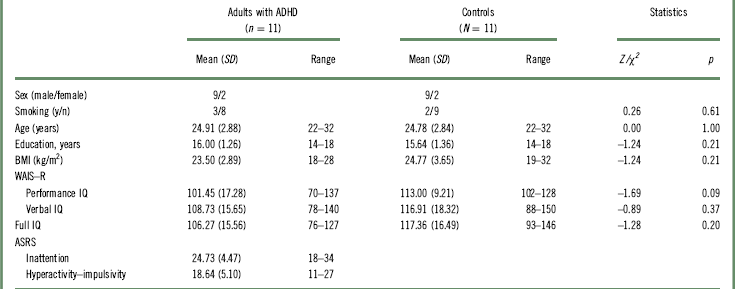
No significant differences were found in terms of age, sex, BMI, smoking, years of education, or performance on the WAIS–R between groups, as shown in Table 1. Participants’ ASRS subscale scores were above the cutoff point.
Demographic data of the ADHD and control groups

ADHD=attention-deficit hyperactivity disorder; ASRS=Adult ADHD Self-Report Scale; BMI=body mass index; IQ=intelligence quotient; WAIS–R=Weschler Adult Intelligence Scale–Revised.
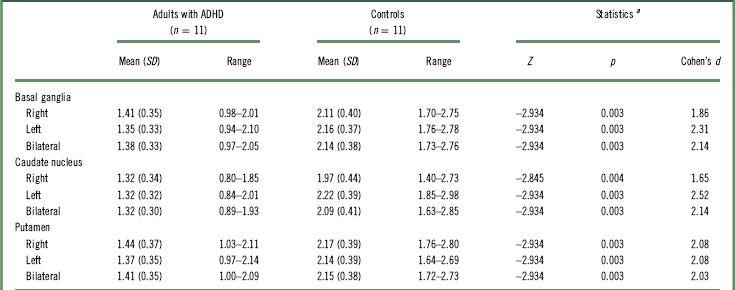
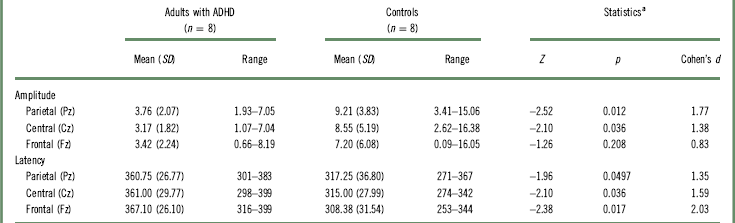
DAT availability was significantly lower in the basal ganglia (p<0.01), caudate nucleus (p<0.01), and putamen (p<0.01) of ADHD patients compared to controls (Table 2). Further, Cohen’s effect size values (d=1.65–2.52) suggested large (>0.8)Reference Cohen 20 practical significances. The ADHD group had smaller auditory P300 amplitudes at Pz (p<0.01) and Cz (p<0.05), but not at Fz, than the control group. Cohen’s effect size values (d=1.38 and 1.77) demonstrated high significance. Furthermore, latencies were much prolonged in the ADHD group compared to healthy controls among Pz, Cz, and Fz (p<0.05) (Table 3). Cohen’s effect size values (d=1.35–2.03) were highly significant.
Dopamine transporter availability in the ADHD and control groups

a Wilcoxon signed-rank test.
ADHD=attention-deficit hyperactivity disorder.
ERPs P300 in the ADHD and control groups

a Wilcoxon signed-rank test.
ADHD=attention-deficit hyperactivity disorder.
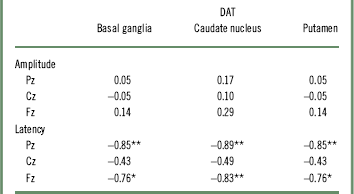
In the ADHD group, there were significant negative correlations between DAT availability and Pz and Fz latency, but not Cz latency (Table 4). There was no significant correlation between DAT availability and ERP amplitude.
Correlations between DAT and P300 in the ADHD group

Values in the table are Spearman’s p: *p<0.05; **p<0.01.
ADHD=attention-deficit hyperactivity disorder; DAT=dopamine transporter.
Discussion
Our results suggest that adults with ADHD have lower DAT levels than sex-, age-, and education-matched controls, and this is in line with the findings from studies with drug-naïve ADHD subjects.Reference Hesse, Ballaschke, Barthel and Sabri 21 , Reference Volkow, Wang and Kollins 22 Dopamine transporters were lower in both the caudate nucleus and putamen in ADHD adults than in controls. The finding of lower striatal DAT levels in ADHD adults is consistent with the prominent theory that ADHD is a dysfunction of the dopamine neurotransmitter. The striatal dopamine receptor and transporter genotypes have been associated with the disorder.Reference Fusar-Poli, Rubia, Rossi, Sartori and Balottin 4 Volkow et al.Reference Volkow, Wang and Newcorn 5 investigated DATs in ADHD subjects while controlling for potentially confounding factors (previous medication and/or drug histories, and comorbidities) and found that striatal DAT availability was enhanced in patients receiving long-term treatment. Another study also revealed upregulation of DAT levels to compensate for chronically elevated striatal dopamine availability.Reference Wang, Volkow and Wigal 23 Due to the fact that striatal dopamine transporter availability appears to depend on previous psychostimulant exposure, our results in drug-free ADHD adults support the finding that there are abnormally low striatal DAT levels compared to never-medicated children.
The second main finding in the current study was abnormal P300 amplitude and latency in ADHD adults compared to controls. This also corresponded to the results of previous studies that found poor cognitive processes in ADHD patients. Adults with ADHD had lower P300 amplitudes and longer latency. Ford et al.Reference Ford, Sullivan, Marsh, White, Lim and Pfefferbaum 24 indicated that the P300 recorded at Pz during automatically elicited attention was significantly correlated with frontal lobe activity, and that the P300 recorded during effortful attention was significantly correlated with parietal but not frontal lobe activity. Besides, the P300 amplitude is usually reflective of the resources allocated to processing the task-relevant stimulus.Reference Azizian and Polich 25 PolichReference Polich 7 indicated that P300 wave latency is related to the processing speed of stimulus evaluation. Abnormal P300 reflects impairments in processing speed and that patients cannot devote more effort to the task. Furthermore, comorbid psychiatric diseases might affect P300 performance,Reference Gershon and Gershon 26 so that we included participants without comorbidities to confirm these abnormalities in the current study. Our results reverify the impairment of processing at a subtle cognitive level observed in ADHD patients.
Both abnormal DAT and P300 in adults with ADHD who were not medicated were found in our current study. People with ADHD symptoms not only had abnormalities at a neurobiological level, but they also had poor cognitive processing. The results of the study show an association between DAT availability and P300 Pz and Fz latency in ADHD adults. Due to the P300 at Cz, Pz, and Fz reflecting the cognitive process rather than brain localization, it is not appropriate to speculate that there is a direct relationship between the abnormalities in the striatal DAT and the three ERP locations. However, both abnormal findings support the idea that the dysfunction of attentional processes related to target detection that is fundamental to ADHD in adults is associated with dopaminergic systems. Our findings suggest that the P300 is altered in the later stages of ADHD, and that DAT availability may influence P300 amplitude, and especially P300 latency. There is a correlation between the dysfunction of the dopamine neurotransmitter and altered ERP. Progression of illness may also play an important role.Reference Chen, Lee and Yang 11
The present study has several limitations. First, the sample size is relatively small; a greater number of participants is required to improve the power of the current results. Second, the ADHD group had a relatively large IQ range. Although there was no significant difference between the two groups, there may be the possibility of a bigger IQ variance confounding the results. Third, ADHD is a highly heterogeneous condition with several subtypes. Animal models show differences in striatal DAT availability between the combined and inattentive subtypes of ADHD, suggesting that these have potentially different underlying neurobiological mechanisms.Reference Roessner, Sagvolden and Dasbanerjee 27 Due to the small sample size, it was not possible to analyze the different subtypes of ADHD, so that this should be investigated further in the future. Finally, the participants with ADHD in the current study were not all never-medicated: four had received methyphenidate in the past. Although patients had stopped receiving all medications for at least 5 months before the study was performed, our results were the same when the participant with long-term treatment was excluded. Treatment still could be a confounding factor in the relationship between DAT availability and ADHD.Reference Fusar-Poli, Rubia, Rossi, Sartori and Balottin 4 , Reference Volkow, Wang and Newcorn 5 , Reference Hannestad, Gallezot and Planeta-Wilson 28 , Reference Wang, Volkow and Wigal 29 Above all, the results have shown that abnormal DAT availability and P300 occur simultaneously and require further exploration.
Conclusions
We report both abnormal DAT and P300 in adults with ADHD who are not medicated, which indicates that people with observable ADHD symptoms also have abnormal neurobiological levels, accompanied by a poor cognitive process related to response selection and execution. Furthermore, DAT availability was correlated to abnormal P300 latency, suggesting the positive association between dysfunction of the central dopaminergic system and poor cognitive processes. There is limited literature on exploring abnormal DAT and P300 simultaneously. The current study provides preliminary evidences about the relationships between these two parameters. Further studies are necessary to explore the interaction of symptom severity and DAT availability as well as P300.
Disclosures
Ching-Lin Chu, I-Hui Lee, Mei Hung Chi, Kao Chin Chen, Po See Chen, Wei Jen Yao, Nan Tsing Chiu, and Yen Kuang Yang report grants from the National Science Council of Taiwan (NSC 102-2420-H-006-007-MY2); from the Ministry of Science and Technology (MOST 104-2314-B-006-053-MY2); from the National Cheng Kung University Hospital (NCKUH-10104019); and from the Headquarters of University Advancement at the National Cheng Kung University (D102-35001 and D103-35A09) during the conduct of this study.
Conflicts of Interest
The authors hereby declare that they have no conflicts of interest in relation to this work to disclose. The funders had no role in study design, data collection, or analysis, in the decision to publish or in the preparation of this manuscript.