INTRODUCTION
The subphylum Crustacea is so named because of the rigid carapace that the majority of their representatives have. Thanks to this rigid exoskeleton, which provides more accurate measurements, as well as to the discontinuous growth, these animals are widely used in studies of relative growth (Du Preez & McLachlan, Reference Du Preez and McLachlan1984; Leite et al., Reference Leite, Fonteles-Filho, Silva and Cardoso2006). The ontogeny of Crustacea is characterized by morphological changes related to sex and puberty (Hartnoll, Reference Hartnoll and Bliss1982), which includes the differential growth of some tagmas. The secondary characters appear with the transition from juvenile to adult phase (Hartnoll, Reference Hartnoll1978). This can be detected by inflection or discontinuity in a series of linear or curvilinear relationships of bivariate analysis (Haefner, Reference Haefner1990). Therefore, through relative growth, it is possible to evaluate the size of individuals during that transition; this is the morphological maturity. The assessment of the size of the organisms when they reach maturity has also been made using macroscopic observations of gonads, providing the physiological or gonadal maturity, and by behavioural observations of the courtship and copulation processes, assessing the functional maturity (Hartnoll, Reference Hartnoll1974; Vazzoler, Reference Vazzoler1996; Pinheiro & Fransozo, Reference Pinheiro and Fransozo1998; Moura & Coelho, Reference Moura and Coelho2004; Lima & Oshiro, Reference Lima and Oshiro2006). The ideal is to perform a comparative study from the gonadal and morphological points of view, as there may be some asynchrony between the two maturities (Sastry, Reference Sastry and Bliss1983; Mantelatto & Fransozo, Reference Mantelatto and Fransozo1996).
The term sexual maturity is applied to the set of morphological and physiological changes under which juveniles attain the capacity to produce gametes, which can fertilize or can be fertilized (Hartnoll, Reference Hartnoll and Wenner1985). Estimating the size at which a given species reaches sexual maturity is an important parameter for understanding its life cycle. It is also important for the implementation of management plans for the conservation of some species (Annala et al., Reference Annala, Mckoy, Booth and Pike1980; Pinheiro & Fransozo, Reference Pinheiro and Fransozo1998). Among the different criteria used to estimate the onset of maturity, the observation of the carapace width at which at least 50% of the population is able to reproduce (CW50%) has been identified as one of the main methods to achieve this information (Wenner et al., Reference Wenner, Fusaro and Oaten1974; Freire et al., Reference Freire, Muiño, Fernández and González-Guirrirán1991; Barreto et al., Reference Barreto, Batista-Leite and Aguiar2006).
The infraorder Brachyura represents a diverse and successful group of Crustacea and includes species of significant economic importance, such as the swimming crabs of the genus Callinectes Stimpson (1860) (Portunidae), and among them, Callinectes danae Smith, 1869. Biological aspects of this species have been well studied on the southern and south-eastern Brazilian coast (Medeiros & Oshiro, Reference Medeiros and Oshiro1990; Branco & Thives, Reference Branco and Thives1991; Branco & Avilar, Reference Branco and Avilar1992; Costa & Negreiros-Fransozo, Reference Costa and Negreiros-Fransozo1998; Branco & Masunari, Reference Branco and Masunari2000; Baptista-Metri et al., Reference Baptista-Metri, Pinheiro, Blankensteyn and Borzone2005). In north-eastern Brazil, where this species is also exploited in estuaries, its socio-economic importance contrasts with the lack of peer reviewed literature about it. The sexual maturity of this species in the north-east was estimated by Pereira-Barros (Reference Pereira-Barros1980), considering males and females together, and by Barreto et al. (Reference Barreto, Batista-Leite and Aguiar2006), for females only. As cited by Hines (Reference Hines1982) and Díaz & Conde (Reference Díaz and Conde1989), intraspecific variation in size at sexual maturity of crabs has been reported for different spatial scales. Therefore, further studies are needed on the sexual maturity of C. danae at the north–north-east Brazilian coast, where the knowledge about the biology of this species remains scarce.
The aim of this study was to estimate the size at morphological and gonadal maturity of males and females of C. danae from a tropical coastal environment, the Santa Cruz Channel, State of Pernambuco, Brazil, as well as to elucidate some aspects of the relative growth of this species.
MATERIALS AND METHODS
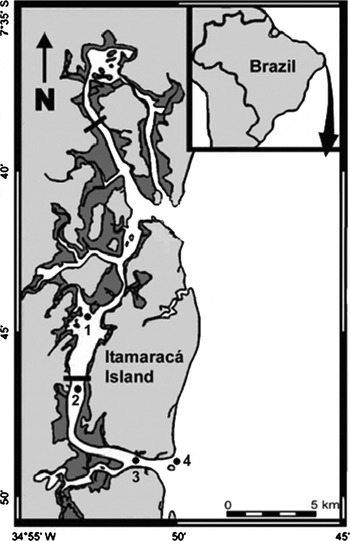
The Santa Cruz Channel (Figure 1), State of Pernambuco, is considered one of the most productive estuaries in the north-east of Brazil, with high phytoplanktonic production and biomass (Macedo et al., Reference Macedo, Montes, Lins, Barros, Eskinazi-Leça, Macedo and Lima2000). It is a U-shaped channel between Itamaracá Island and the continent, occupying an area of 730 km2 between the geographical coordinates 07°34′00″S/ 07°55′16″S and 34°04′48″W/34°52′24″W.
Sampling stations at the Santa Cruz Channel, Brazil. (1) Congo River mouth; (2) President Vargas bridge; (3) Paripe River mouth; (4) Coroa do Avião sand bank.

Sampling took place at four stations along the Santa Cruz Channel (Figure 1): (1) Congo River mouth (7°46′26″S/34°53′27″W); (2) President Vargas bridge (7°46′28″S/34°53′13″W); (3) Paripe River mouth (7°48′38″S/34°51′27″W); and (4) Coroa do Avião sand bank (7°48′59″S/34°50′28″W). Stations 1 and 2 represent mangrove forests, and wide mud flats are exposed at low tide, with dominance of fine sand grains (Paiva et al., Reference Paiva, Coelho and Torres2005) and depths up to 2 m. Stations 3 and 4 show remarkable marine influence, and the sediment is mainly composed of sand, with depths up to 17 m (Eskinazi-Leça et al., Reference Eskinazi-Leça, Macedo and Passavante1980).
Specimens of Callinectes danae were monthly collected from January to December 2009 at full moon low tides. Crabs were attracted with bait and captured with a conical net. For the preservation of the gonads, specimens were transported in ice to the laboratory, where they were kept in a freezer until the analysis. The following variables of each individual were measured with a 0.05 mm precision caliper: carapace width (CW)—the greatest distance between the two ends of the carapace, excluding the lateral spines; carapace length (CL)—the distance from the front to the posterior margin of the cephalothorax; abdomen width (AW)—the width at the joint of the sternite of the fifth abdominal somite; and length at the right chelipod (LRC)—the distance from the base of the propodus to its end.
In the laboratory, the specimens were dissected with a fine-tipped scissors for the observation of the gonads. Six stages of ovarian maturity (immature (IM); rudimentary (RU); developing (DG); intermediary (INT); advanced (AD); and depleted (DP)) and four stages of testes maturity (IM; RU; DG; and developed (DD)) were considered, based on Costa & Negreiros-Fransozo (Reference Costa and Negreiros-Fransozo1998). The stage DP for females was added and defined as ovigerous female gonads with long, thin and flaccid appearance, indicating the loss of oocytes. Also, the following morphological data were recorded: for females—triangular and sealed or semicircular and unsealed abdomen, closed or opened gonopore; and for males—sealed or unsealed abdomen.
For each biometric variable, the minimum, mean (± standard deviation) and maximum values were estimated. The Student's t-test was applied to compare the biometric values between sexes (α = 0.05) (Zar, 1996).
The growth of C. danae was described through the allometric equation y = a x b (Huxley, Reference Huxley1950), posteriorly linearized (log y = log a + b log x). The CW was used as the independent variable (x) and related to other body dimensions of the crab (dependent variables, y). The ‘b’ of the equation is the allometric constant that expresses the analogy between the two variables. It can determine the growth pattern, where b > 1 indicates positive allometric growth, b = 1 isometric growth and b < 1, negative allometric growth. The value of ‘b’ was tested through the Student's t-test (α = 0.05). The power and linear equations for juveniles and adults were obtained in each studied relationship. To test the equality of the slopes and the intercepts of the lines of each stage of development, an analysis of covariance was performed (α = 0.05) (Zar, Reference Zar1996).
To obtain gonadal maturity, individuals of each sex were grouped into two categories: immature (♀ and ♂ = IM + RU) and mature (♀ = DG + INT + AD + DP; ♂ = DG + DD). The percentage frequency of these categories was then calculated by classes of CW for males and females. To obtain morphological maturity, the relationship between LRC versus CW, and AW versus CW was considered for males and females, respectively. The choice of these relationships was made taking into account the importance of these dependent variables in the reproductive processes. Individuals of each sex were grouped into two age-classes: juvenile and adult. For that, the biometric data were log-transformed, and an analysis of K-means clustering, followed by a bivariate discriminant analysis, was performed (Sampedro et al., Reference Sampedro, González-Gurriarán, Freire and Muiño1999). The percentage frequency of these age-classes was also determined by classes of CW for males and females.
In both cases, the percentage frequency of the categories by size-classes was adjusted to a logistic equation (y = a / (1 + b e−cx). Subsequent interpolation was performed to determine the size at which 50% of individuals were already mature and adult (CW50%). The same procedure was adopted to obtain the size at which 100% of individuals were already mature and adult (CW100%).
RESULTS
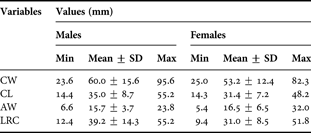
A total of 1573 individuals of Callinectes danae, consisting 756 females (735 non-ovigerous and 21 ovigerous) and 817 males, were used in the present study. The minimum, mean ± SD and maximum values of each measured biometric variable are presented in Table 1. The t-test showed that the mean sizes (CL, CW and LRC) were significantly larger in males (t = 10.2, 9.5 and 12.9, respectively; P < 0.05), except for AW (t = –3.0; P < 0.05).
Minimum, mean ± standard deviation (SD) and maximum values of each biometric variable evaluated for males (N = 817) and females (N = 756) of Callinetes danae at the Santa Cruz Channel, Brazil.
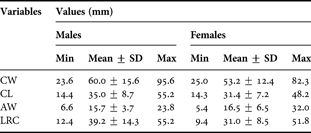
Min, minimum; Max, maximum; CW, carapace width; CL, carapace length; AW, abdomen width; LRC, length of right chelipod.
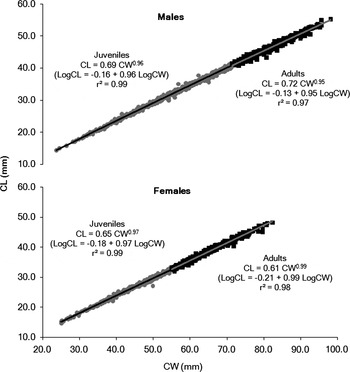
The dispersion of points and equations of the relationship CL versus CW (Figure 2) was allometrically negative for males (juveniles: b = 0.96, t = 16.5; adults: b = 0.95, t = 4.9; P < 0.05) and juvenile females (b = 0.97, t = 6.9; P < 0.05) with the exception of adult females that showed isometry (b = 0.99, t = 1.0; P > 0.05).
Regression between the variables carapace width (CW) and carapace length (CL) for males (N = 817) and females (N = 756) of Callinectes danae at the Santa Cruz Channel, Brazil.

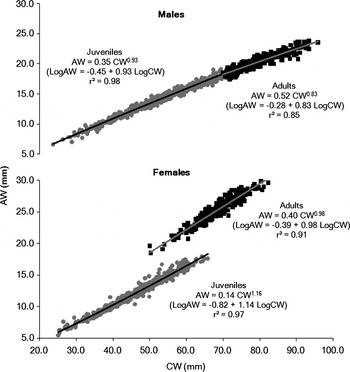
In the analysis of the relationship AW versus CW (Figure 3) it could be observed that juvenile females showed positive allometry (b = 1.16, t = 21.9) and adult females showed negative allometry (b = 0.98, t = 3.6). This indicates a higher growth rate of the abdomen during the juvenile phase (P < 0.05). However, males showed negative allometry (juveniles: b = 0.93, t = 13.5; adults: b = 0.83, t = 7.3) in the growth of the abdomen (P < 0.05).
Regression between the variables carapace width (CW) and abdomen width (AW) for males (N = 817) and females (N = 756) of Callinectes danae at the Santa Cruz Channel, Brazil.

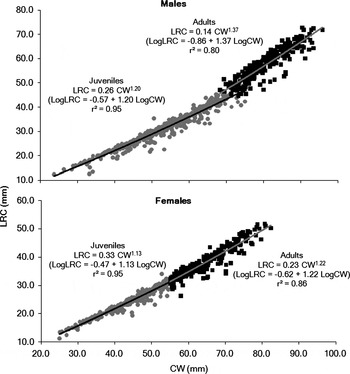
In the relation LRC versus CW (Figure 4), it was observed that males showed positive allometry, in which changes in the degree of allometry of the chelipods were more evident between the juveniles (b = 1.20, t = 15.6) and adults (b = 1.37, t = 8.0) (P < 0.05). Females showed differences in growth rates between juvenile and adult phases, which showed positive allometry (juveniles b = 1.13, t = 14.1; adults b = 1.22, t = 15.8) (P < 0.05).
Regression between the variables carapace width (CW) and length of the right chelipod (LRC) for males (N = 817) and females (N = 756) of Callinectes danae at the Santa Cruz Channel, Brazil.

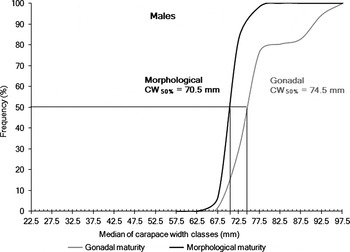
Regarding males (Figure 5), the size of CW50% at morphological maturity was estimated at 70.5 mm, but this size may vary from 68.3 (smallest adult male) to 75.0 mm CW (largest juvenile male). The size of the morphological CW100% was 82.5 mm. The size of gonadal CW50% was estimated at 74.5 mm CW, varying from 52.8 (smallest mature male) to 90.5 mm CW (largest immature male). The size of CW100% at the gonadal maturity was 97.5 mm.
Estimates of the morphological and gonadal CW50% of males of Callinectes danae at the Santa Cruz Channel, Brazil. N = 817.

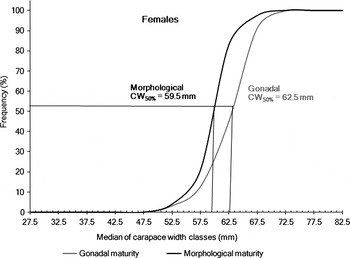
For females (Figure 6), the estimated size of the morphological CW50% was 59.5 mm, varying from 50.3 (smallest adult female) to 65.8 mm CW (largest juvenile female). On the other hand, the estimated size of the gonadal CW50% was 62.5 mm CW, ranging from 50.5 (smallest mature female) to 66.6 mm CW (largest immature female). The size of both morphological and gonadal CW100% was 72.5 mm.
Estimates of the morphological and gonadal CW50% of females of Callinectes danae at the Santa Cruz Channel, Brazil. N = 756.

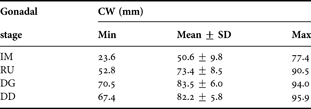
All four stages of testes maturity of male C. danae were observed in this study. Immature males had the smallest mean carapace width (Table 2) and sealed abdomen. Rudimentary males showed both sealed (47.1%) and unsealed (52.9%) abdomen. At the developing stage, the majority of males presented unsealed abdomen (97.4%), and at the developed stage, no male had the abdomen sealed to the sternum.
Minimum, mean ± standard deviation (SD) and maximum values of carapace width (CW) by gonadal stage of male Callinectes danae at the Santa Cruz Channel, Brazil. N = 817.
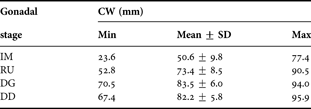
Min, minimum; Max, maximum; IM, immature; RU, rudimentary; DG, developing; DD, developed.
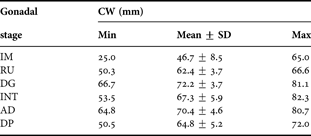
All six stages of ovarian maturity of female C. danae were observed in this study. In the immature stage, the females had triangular and sealed abdomen, closed gonopore and smaller average CW (Table 3), while females at other stages had circular unsealed abdomen and opened gonopore.
Minimum, mean ± standard deviation (SD) and maximum values of carapace width (CW) by gonadal stage of female Callinectes danae at the Santa Cruz Channel, Brazil. N = 756.
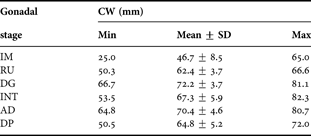
Min, minimum; Max, maximum; IM, immature; RU, rudimentary; DG, developing; INT, intermediary; AD, advanced; DP, depleted.
DISCUSSION
The present results provide additional information on the biometry, growth and reproduction of Callinectes danae in the Santa Cruz Channel, where this species of economic importance is heavily exploited.
Growth in crustaceans is discontinuous, with periodic changes of the exoskeleton during ontogeny (Teissier, Reference Teissier and Waterman1960). Their growth rates can change at different development stages, including immature and post-mature stages (Hartnoll, Reference Hartnoll and Bliss1982). This was observed here for C. danae, since juvenile females showed positive allometry and adult females showed negative allometry on the relation AW versus CW. Pinheiro & Fransozo (Reference Pinheiro and Fransozo1993) also observed allometric differences of the AW between juvenile and adult females of Arenaeus cribrarius (Lamarck, 1818) (Portunidae), although both phases showed positive allometry. Both juvenile and adult males of C. danae showed positive allometry on the relation LRC versus CW, but changes in the degree of allometry were clear between them, as observed by Pinheiro & Fransozo (Reference Pinheiro and Fransozo1993) for males of A. cribrarius.
It is well established that in Brachyura, the most appropriate variables to estimate the size of morphological maturity in males and females are the sizes of chelipod and abdomen, respectively (Giménez & Acevedo, Reference Giménez and Acevedo1982; Pinheiro & Fransozo, Reference Pinheiro and Fransozo1993). In the present study, the growth rate of the male chelipod was higher than in females, while the growth rate of the female abdomen was higher than in males. These secondary sexual characteristics are related to different reproductive roles of the sexes (Tsuchida & Fujikura, Reference Tsuchida and Fujikura2000). In males, large chelae are important in agonistic encounters, defence, capture of food, demarcation of territory and mating. For females, a large abdomen is important in the perpetuation of the species, since it enables securing and protecting the eggs during incubation (Hartnoll, Reference Hartnoll and Bliss1982; Castiglioni et al., Reference Castiglioni, Negreiros-Fransozo and Mortari2006). Thus, the adaptive significance of these structures becomes evident (Masunari & Swiech-Ayoub, Reference Masunari and Swiech-Ayoub2003).
According to Vermeij (Reference Vermeij1977), sexual dimorphism in size of the chelae reveals that females have smaller chelae than males of the same species and this difference is more pronounced in fast moving crabs such as Callinectes, as confirmed later by Gleeson (Reference Gleeson, Martin and Bauer1991) for C. sapidus Rathbun, 1896, and by Guerrero-Ocampo et al. (Reference Guerrero-Ocampo, Negreiros-Fransozo and Costa1998) for C. danae and C. ornatus (Ordway, 1863). Sexual dimorphism was also observed in Portunus pelagicus (Linnaeus, 1758) (Portunidae) by Fielder & Eales (Reference Fielder and Eales1972), Hepatus pudibundus (Herbst, 1785) (Aethridae) by Reigada et al. (Reference Reigada, Negreiros-Fransozo and Mantelatto1994) and A. cribrarius by Pinheiro & Fransozo (Reference Pinheiro and Fransozo1993).
Besides the differences related to sex and age, Baptista-Metri et al. (Reference Baptista-Metri, Pinheiro, Blankensteyn and Borzone2005) emphasize that time, place and environmental factors may also determine variations in the rate of growth of these organisms. For example, from studying specimens of C. danae collected at Paraná State (25oS and 48oW), in the south of Brazil, they observed that both males and females showed isometric growth in the ratio of wet weight versus CW, while Branco & Thives (Reference Branco and Thives1991) noted a negative allometric growth for the same relation, in a nearby population, at Santa Catarina State (27oS and 48oW). Although the relationship weight versus width was not evaluated in the present study, this example reinforces the need to study the reproductive biology of this species in several locations where knowledge about it remains scarce.
In this study, females reached maturity, both gonadal and morphological, at a CW smaller than males. In addition, the general mean size of females was smaller, except for the AW that provides an ample area to hold and protect the eggs during incubation (Hartnoll, Reference Hartnoll and Bliss1982). Males being larger than females in C. danae is a pattern that has been documented (Baptista-Metri et al., Reference Baptista-Metri, Pinheiro, Blankensteyn and Borzone2005). These sexual differences may be due to differential growth during puberty in males (Costa & Negreiros-Fransozo, Reference Costa and Negreiros-Fransozo1998), when energy is directed to somatic growth, which would allow them to protect the female during courtship and copulation, when her exoskeleton is still decalcified. In females, this energy is allocated to egg production (Hartnoll, Reference Hartnoll and Wenner1985; Mantelatto & Martinelli, Reference Mantelatto and Martinelli1999). This sexual dimorphism is more pronounced in aquatic crabs, such as Callinectes, than in semi-terrestrial and terrestrial ones (Pinheiro et al., Reference Pinheiro, Fiscarelli and Hattori2005). Moreover, it is likely that females cease their growth after reaching maturity, while males continue to grow, as Van Engel (Reference Van Engel1958) noticed for C. sapidus.
In addition to asynchrony of maturity between sexes, there is also an asynchrony between gonadal and morphological maturity. This pattern has been observed in Brachyura, for example, in both sexes of Necora puber (Linnaeus, 1767) (Portunidae) (González-Gurriarán & Freire, Reference González-Gurriarán and Freire1994), for females of C. danae (Barreto et al., Reference Barreto, Batista-Leite and Aguiar2006) and in males of A. cribrarius (Pinheiro & Fransozo, Reference Pinheiro and Fransozo1998). In the present study, morphological maturity was reached first. The appearance of the secondary characters occurs with the transition from the juvenile to the adult phase (Hartnoll, Reference Hartnoll1978), which may or may not have synchrony with gonadal maturity. The presence of rudimentary males and females that are physiologically immature, but with morphological characters of adults (unsealed abdomen in males, unsealed semicircular abdomen and opened gonopore in females) is also an evidence of such asynchrony.
Comparing the values of the CW50% obtained here with results from other localities of the Brazilian coast (Itacorubi mangrove (Branco & Thives, Reference Branco and Thives1991) and Lagoa da Conceição (Branco & Masunari, Reference Branco and Masunari2000), Santa Catarina; Shangri-lá Balneary, Paraná (Baptista-Metri et al., Reference Baptista-Metri, Pinheiro, Blankensteyn and Borzone2005)), some differences were noticed, while similar values were found with other regions (Sepetiba Bay, Rio de Janeiro State (Medeiros & Oshiro, Reference Medeiros and Oshiro1990), and Carrapicho and Botafogo Rivers, Pernambuco (Barreto et al., 2006—females only)). These variations in size at maturity of Brachyura have been reported for different spatial scales, and illustrate that variations in the life cycle of C. danae are linked to environmental factors such as water temperature and food availability (Wenner et al., Reference Wenner, Fusaro and Oaten1974; Annala et al., Reference Annala, Mckoy, Booth and Pike1980).
The determination of CW50% is a good estimate for the average size at which puberty changes occur (Wenner et al., Reference Wenner, Fusaro and Oaten1974; Freire et al., Reference Freire, Muiño, Fernández and González-Guirrirán1991; Barreto et al., Reference Barreto, Batista-Leite and Aguiar2006). There was an overlap in CW of juveniles and adults for both sexes, revealing a transition interval between the immature and mature phases. It is during this transition that crabs carry out changes that characterize puberty, and females probably copulate. This is supported by the high frequency of ovigerous females (depleted stage) in this size interval. However, the mean carapace width of ovigerous females was above the estimated CW50%. Despite the presence of eggs in the pleopods of female Brachyura being considered a sign of sexual maturity, this criterion is unreliable, as the extrusion of egg masses may have occurred months after the first gametogenesis (Mantelatto, Reference Mantelatto1995).
This is the first contribution towards understanding the sexual maturity of a C. danae population in north-east Brazil by using separate analyses for both sexes. Nonetheless, more studies are needed in order to comprehend the growth and sexual maturity of this species in the area.
ACKNOWLEDGEMENTS
This paper is part of the Master degree dissertation on Oceanography improved by the first author. We are sincerely thankful to all laboratory members who helped us during the sampling and the laboratory activities. We also wish to thank Dr Monica Ferreira da Costa (UFPE) for the important revision of the text, and Dr Tereza Cristina dos Santos Calado (UFAL) for important suggestions performed during the dissertation analysis, that were very useful for the refinement of this paper.