[T]he state is the unified symbol of actual disunity.
(Abrams Reference Abrams1988: 79)Nineteen years after the political transition, the success of the African National Congress in fulfilling what it conceived as its historical mission to ensure democracy and overcome racial divisions in South Africa (Jensen Reference Jensen, Hansen and Stepputat2001: 98) has become questionable in several respects. From increasingly loud challenges to the government emanating from outside state channels to enduring racial inequalities, it has become less clear what democracy is in the country, or what it has achieved. In this article, I will attempt to address the unhappiness surrounding post-apartheid governance by considering how the state is seen in Glendale, a village which revealed much disaffection but where there was no open, organized protest. I will also document, following Scott (Reference Scott1998), how the government itself ‘sees', while recognizing, with Abrams in the above epigraph, that the state is not a unified whole with a single vision. The visions that emerge, I suggest, become a basis for interrogating the paradoxes of the post-apartheid project of democracy and for considering the conditions of contemporary citizenship.
This article is based on ethnographic research conducted for my doctoral dissertation between 2007 and 2012 in the village of Glendale, where I focused on the relations and aspirations of twenty informants living there. I rely here on extracts taken from many discussions with multiple informants. My focus on visions and expectations of democratic rule in a village in KwaZulu-Natal Province contrasts in several respects with a vocal and vibrant debate about the post-apartheid state and protests in South Africa (Alexander Reference Alexander2010; Booysen Reference Booysen2007; Freund Reference Freund and Buhlungu2005; Neocosmos Reference Neocosmos2010; Pithouse Reference Pithouse2009; von Holdt Reference von Holdt2011; and others). While this literature records the growing incidence of protest and dissatisfaction with the state in many poorer areas in the country, its focus is on the character of such protests as ‘revolutionary’ and the efficacy of such protests in challenging the ruling party. Hence some contend that robust movements have developed out of protests that keep alive ‘politics' and reveal ANC authoritarianism and corruption, while others argue that these movements have little political coherence or sustained ambition beyond particular local squabbles, amounting to ‘popcorn politics' (Freund Reference Freund and Buhlungu2005). Much of this literature also suggests that a large part of the problem lies in the failure of government to provide infrastructure evenly, or to hear ordinary people's voices (stated most explicitly in Booysen Reference Booysen2007: 31), thus assuming that people's unhappiness requires no further investigation and that such sentiment is a reliable measure of the inadequacy of the state. Indeed, even if post-apartheid governance is failing in particular places, I emphasize that we require more than protest events to understand the character of that failure. At the very least, I argue, we need an understanding of people's expectations of the democratic state and how state practices might relate, at a micro-level, to meeting those expectations.
A central paradox of governance in Glendale lies in the fact that while the government has built houses, provided infrastructure (including paved roads, electricity and water from communal taps) and allocated substantial numbers of grants to people (some informants suggest as many as 70 per cent of the residents rely on grants), almost everybody living in the village emphasizes some kind of absence of the state, arguing specifically that the democratic administration is ‘invisible’ and ‘impersonal’. To explain this paradox of the ‘absence in presence’ of government in Glendale, I consider the operation of the democratic state at village level and varying expectations of how that state should function.
A number of recent ethnographies of South Africa suggest that the post-apartheid government has assumed a particular role in poorer communities beyond its constitutional obligations. Niehaus (Reference Niehaus2006) showed that the state is now regarded by many in Bushbuckridge as the provider of their livelihood, and Bank has argued in a study based in East London that there is ‘a desire for greater rather than less dependence on the state’ (2011: 242). In Cape Town, Robins (Reference Robins2002) showed how government's attempts to formalize housing were met by ‘reinformalization’ as a means of generating income, suggesting that the successes and failures of transformation policies need to be understood in relation to broader social contexts, including the labour market. In this article, I follow these observations, arguing that this felt absence of the democratic state and the desire for a greater presence of the government must be grounded in broader contemporary social conditions, specifically of extensive unemployment. This, in turn, enables a concluding engagement with recent attempts to reconsider the workings of the post-colonial state (Chatterjee Reference Chatterjee2011; Ferguson Reference Ferguson2009, Reference Ferguson2011).
INTRODUCING GLENDALE
Glendale is located in the Province of KwaZulu-Natal, about twenty-five miles inland on the banks of the Mvoti River. In the early nineteenth century, before Glendale was established as a village, it was a part of the area to which the Zulu-speaking Qwabe people fled after battles with the Zulu kings Shaka and Dingane (Mahoney Reference Mahoney2012: 21–46). A tiny village was founded in 1874 with the opening of a sugar mill, which was taken over by an Indian merchant family, the Paruks, in 1924. In 1969 the mill was purchased by the London Rhodesia company (Lonrho), which invested in infrastructural improvements in both the mill and the surrounding village in the 1970s and 1980s (Dubbeld Reference Dubbeld2013).
Until the end of apartheid, Glendale was largely inhabited by people of Indian descent, with the exception of a few white managers and their families. Africans did not live in the village, although many worked casually in the mill.Footnote 1 Glendale's racial composition and opportunities for employment changed dramatically with the closure of the mill in 1997. The majority of the one thousand Indian inhabitants of the village left Glendale. With them went the permanent clinic built by Lonrho and the grocery store in the area (its place now taken by several, more expensive, informal spaza shops). In 2002 a low-income housing settlement of four hundred houses was erected by the post-apartheid government. This settlement was significantly larger than the barrack houses once built by the mill. Many of these houses fell into disrepair after their residents left, and only about eighty are still inhabited by a combination of the remaining retired Indian mill workers and newer African residents.
The housing project was planned explicitly to enable Africans to live close to work. Whether the fact that the project went ahead after the mill's closure attests to the inflexibility of post-apartheid planners or to their ignorance remains unclear; but Glendale was remade as a government-produced village without work, becoming a quintessentially post-apartheid place. By this I mean that those living in Glendale today – whose numbers range from as few as six hundred to twice as many as that, depending on the time of year – enjoy democratic freedoms without immediate reference to racialized labour contracts, and frequently own the houses in which they live, but also have little prospect for permanent employment, largely depending on state social grants for survival.
VISIONS OF GOVERNANCE IN GLENDALE
Seeing the state
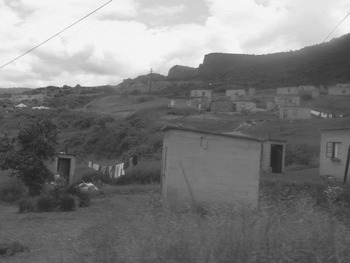
The government-built houses are small, rectangular one-room structures. In summer they offer little relief from the heat, and people sit outside their houses, moving from one side to the other as the day passes to avoid direct sunlight. Sitting outside these houses over the summer months of 2009–10, I asked my informants about how things had changed since apartheid and what they thought of the democratic government. Many answered that Glendale had been abandoned by this government, that Glendale is not seen. The longer I spent in the village, however, the more government-contracted water or electricity technicians I noticed, and the more I realized how integral government grants were for people's daily reproduction. This compelled me to push my informants further about what they took ‘abandonment’ to be, compared with their memories of the apartheid past.
Talking to Thulani, Themba and Peter one day, I was told emphatically that ‘after the new government came in, things are still the same, since we don't see any help’. Later in our conversation, however, the three unemployed men under thirty-five admitted that indeed things are a little better than before, since there was ‘no help at all in the past and now some people are getting some help’. Given the extent of government's involvement in social assistance, and a longer history of dubious interventions explicitly framed in terms of social support, I wondered about the word help. What exactly does it mean that we need more help, or help is not visible enough? Although all three of the men lived in government-given houses, they were adamant on this point. Themba concluded his reflection with ‘the one problem is that we need to see the government, we need them to come here and help us. … [I]f we get this help [from this government] and do not see it, then there will always be problems.’
Siphokazi, a 47-year-old woman who arrived in Glendale from the neighbouring Maphumulo District with her two now-teenaged daughters, explained that she and others felt neglected by government. She did emphasize one particular way, however, in which help became visible to her. ‘I saw the difference with the Mandela government because we black people were oppressed a lot. Our children were not getting grants, they were oppressed. Now I see things are better because even orphans are living better.’
A slightly older informant, 55-year-old Angelina, worked at the sugar mill and received one of the barrack houses when the mill closed in 1997. She does not receive a pension from that work, however, and looks after five of her grandchildren, relying on the Child Support Grant for income. She warns that while that grant is visibly helping people across the village, it is less clear ‘what people should eat if they have no child?’ Her complaint echoes critics who argue that the government social assistance system divides people into ‘deserving’ and ‘undeserving’ rather than treating all the poor as equally in need of financial assistance (Seekings Reference Seekings2008; Marais Reference Marais2011). She also tells me that ‘[former President] Thabo Mbeki never came to Glendale. [President] Zuma only stopped at Maphumulo, he did not come here. He should not rely on hearsay and talk about us in Glendale, as if he has seen the kind of life we are living.’
The problem for Angelina is not only with the logic guiding the distribution of social assistance. Because she does not see those she considers her leaders, she believes the social circumstances she and those around her experience are invisible to government. She assumes a reciprocal mode of seeing in which her not seeing leaders of government is an expression of their not seeing her. Malusi, a seventy-year-old man who worked casually for many years in the sugar mill before it closed, also emphasizes the importance of visibility by arguing that ‘you can't be happy with something you don't see, and therefore we can't be happy with our councillor, our municipality and our government’.
This idea of the reciprocity between being seen and seeing suggests a desire for a certain kind of gaze, one with emotional attachment. It is different from – but not necessarily antecedent to – ‘Cartesian perspectivalism’, what Jay identified as the dominant scopic regime of modernity (Jay Reference Jay and Foster1988: 5). This perspective entails a static, disembodied view of the world, and importantly for our context, an emotionally detached and one-directional gaze.
This sense of not being seen satisfactorily translates for those in Glendale into uncertainty and scepticism about the government's vision, and the discourses associated with that vision. For instance, Angelina argues ‘right now I don't even know what freedom is, what kind of animal it is, because I don't see it’. Makosi, a 55-year-old woman who came to Glendale some five years ago and lives with her husband in a government house (for which a distant relative has the title), told me, ‘My mind gets lost in the question of freedom since the change from apartheid. I can see things that freedom has helped me here and there, but you might see things the same as before even though you are free.’ In her formulation, then, the problem is that an abstraction such as freedom cannot really be seen; it is so abstract that one's mind gets lost, even if its concrete marks are visible ‘here and there’.
While Siphokazi acknowledges the concrete aid that the child support grant has brought, she also says that the government is not successful, as it does not always provide her with food when she needs it. She sees cracks developing in the houses that the new government built, and wonders to me about the durability of the government's promise of freedom when ‘she does not see people being assisted’. She believes the demands and needs of people in Glendale are out of sight of the government who are ‘now interested in other places’. Sixty-year-old Stembiso, who lived in neighbouring Mthandeni and worked at Glendale's mill before moving to a government house in Glendale in 2002, added that the government is ‘doing nothing’ to help people make a living, emphasizing that while ‘many people received houses, how are we to survive if we don't have anybody feeding us?’
People connect the fragility of their houses to their own fragility in daily reproduction, to which they believe the government ought to be attending more visibly. Bheki, a 47-year-old man living in a government-built house and one of the few in Glendale with regular work (albeit in KwaDukuza), phrased it a little differently:
The government has not succeeded because a lot of people are still living hard, some don't have houses, even those houses that were built here have not made us happy. Houses are built as if they were places to let, as if you are renting, you are moved from a place and they tell you to come live in a place that looks like it's a rental: the way the houses are so tiny, [and] not plastered.
Indeed, the fact that freedom does not appear to include a regular presence of government is troubling. The only regular presence – the instantiation of their freedom – are the houses that government built (Figure 1). But the fact that they are crumbling now, from the lack of maintenance or initial shoddy construction, suggests to people that ‘abandonment’ might be the best way to characterize their relationship with the government.
Government houses in Glendale, each with its electricity cable and outside toilet

The state sees
If Glendale is a product of peculiar post-apartheid configuration, how does the government see the village? While Glendale's residents speak of abandonment, does local government view Glendale as an emblem of the success of their project of transformation, or a mark of the constraints it faces? Such questions prompted me to seek out the local government.
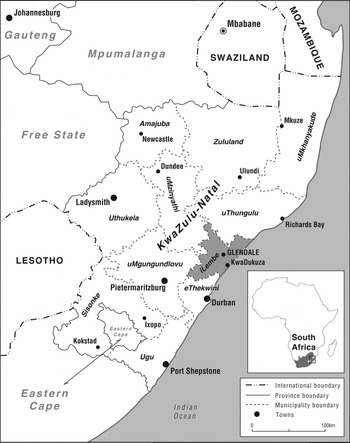
The offices of Ilembe District Municipality are in Kwadukuza (called Stanger until recently). The municipality is responsible for a large coastal area north of Ethekwini (Durban) and south of Zululand, and its offices are about twenty miles from Glendale (Figure 2). Soon after arriving at the offices I was introduced to the municipal manager, which caused me some surprise. I had walked into the offices anticipating the barriers of bureaucracy, but he was willing to talk to me immediately. His desk was cluttered and he seemed busy with thousands of different things, but was not flustered. I briefly described my interests and, as if he had focused on the key words, he grabbed a flash drive and promptly proceeded to transfer a number of files to it for my records. While he did this he was in the midst of taking a phone call, scanning the final presentation of a project, and then signing a cheque – I noticed out of the corner of my eye – for four million rand (around US$500,000). For him, Glendale dropped out of focus and what was critical in his self-presentation was the effectiveness of local government, its successes and challenges in confronting inequalities inherited from apartheid, and in the fostering of economic opportunities in the broader district. Handing the flash disk to me, he said, ‘This will give you what you need to know’, and told me to ‘drop by’ another time if I had more questions.
Map of municipalities in KwaZulu-Natal Province, highlighting Ilembe, where Glendale is located

If this initial interaction with a senior official in the very large, mostly rural, district left me doubtful about how this particular part of the government saw one small village, opening the disk left me both more amazed and more sceptical. Three hundred megabytes of data in one hundred and fifteen files certainly provided a ‘profile’ of the district. The largest files related statistical data from the entire country, with statistics on four thousand wards of each municipality being compared in a table in the categories ‘economic opportunities', ‘education’, ‘housing’, ‘demographics' ‘welfare’, ‘services', and ‘HIV/AIDS'. These statistics were assembled in several different Excel spreadsheets, ranking wards according to one or another of the indices. In the overall rankings, the larger Glendale area placed 1,568 out of 4,033 wards from worst to best, indicating ‘average’ problems in the comparative context of many areas with more severe problems. In the 65 wards of Ilembe District (of which he was manager), Glendale ranked twenty-fourth in its overall ‘poverty score’.
Other files on the flash drive included several more detailed assessments of the conditions in the municipality (such as comparing backlogs in access to water by ward), evaluations of the municipality's performance in the delivery of certain services, step-by-step charts for monitoring and evaluating conditions (making clear when interventions are necessary), GIS maps depicting different features of the area, strategies for local economic development, and broad spatial planning frameworks for the future development of each category listed above. There is even one flamboyant PowerPoint presentation prepared for a delegation from Zhanjiang in China. This showed parts of the district that might be sites for profitable economic investment (given inexpensive land, relatively good access to roads and an international airport, and – only by implication – cheap labour); it touted the district as a strategically positioned hub of future South African development.
The vision of the district municipality that governs areas like Glendale is thus one that sees aggregates and relative needs, but it is less able to recognize the conditions in which particular individuals live. It is not that Glendale or its people are invisible per se, but that the optic of the municipal government is attuned to a long-range view, and not focused on cracks developing in houses or on people doubting the durability of its commitments.
This is not to say that their municipal government has no sense of commitment. After reviewing the material he gave me, I went back a few weeks later to talk to the municipal manager again. Following a strangely warm welcome, we sat and talked for a couple of hours about a great many municipality initiatives. These included a plan to use wireless Internet – which people would access with their mobile phones – to better calibrate supply and demand for those who grew and sold fruit and vegetables in the area. Throughout our conversation, he displayed a resolute optimism that over the longue durée jobs would be created and people in the area would enjoy economic success that would make their choices more substantive and meaningful. In the short term, he was certain the national mandate that everybody had access to drinking water and a toilet by 2014 would be achieved in his municipality.
When I pushed him on Glendale he told me that he had already identified Glendale's ‘competitive advantage’ as its location in a ‘beautiful valley’, and the trick was now to produce a tourist-luring commodity like wine to attract people to visit the area, enjoy its splendour, and invest their money there. While that particular initiative seemed far-fetched, he imagined the role of the municipality as working directly with communities to improve infrastructure and foster economic opportunities. He certainly would not concede that he did not know what was going on across all the wards in the entire district, believing that this knowledge would lead to improvement. Indeed, his vision was one of managing poor populations to mitigate their excommunication from the labour market.
The vision of the municipality might be understood in the terms that James Scott (Reference Scott1998: 54–62) suggested, namely as an attempt to make the illegible of everyday life legible in a manner that enables governance – which in turn takes the form of a utilitarian logic that sees commercial success and labour productivity as an aspect of the same concern that governs public health. While such an analysis might appear plausible in some places, adopting it misses both the content and the form that shape the post-apartheid project. On the one hand, such an approach fails to recognize the particular progressive political project about redressing the past that motivates the vision of the municipal manager; and, on the other, it does not acknowledge the specific historical condition that has eliminated employment, so that the government's project has become less about streamlining public health, commerce and labour as about searching for possibilities for people to earn an income. Scott's analysis suggests a set of technologies that enable state domination, and yet it is less plausible here – when people are patently feeling the effects of being unable to find work – to consider these government technologies as ‘anti-political’. On this point, Ferguson's call not to dismiss governmental technologies as reactionary is apposite (2009, 2011).
Having said this, the vision of the municipality is one that accords with Cartesian perspectivalism, some of the dimensions of which I've elaborated above. By looking at objects, rather than becoming the object of a gaze, it forestalls a dialogue with people to whom it is supposed to be responsible. A related way of characterizing this vision might be as a kind of hyperopia, a long-sightedness unable to account for what individual people in each village in the district might say or think about government. When I put a similar charge to the municipal manager, he did not deny that participation was fundamental to the government's commitment to democratic transformation, and while his technical department was not charged with this responsibility, he was supposed to be informed by others in government who were tasked with seeing at close range and listening to people's voices: councillors.
The councillor: an aural impasse
Local government is not the exclusive domain of technical administrators; it also offers a role to elected councillors. Councillors are bound to wards of a district and their position depends directly on their capacity to address the interests of the inhabitants of their particular wards. Indeed, councillors are supposed to be able to understand and represent the people's voice, whether to the province or to the national government, and to the technical administrators. In order to do this, they are tasked with holding regular meetings and with constituting committees in their wards to ascertain opinions about policy and to bring local problems to the attention of others in government. It is through councillors, therefore, that the post-apartheid government claims to achieve ‘substantial’ democracy (through ‘tangible’ participation of its citizens).
People living in wards outside major metropolitan areas seldom encounter politicians from national government other than at important political or symbolic events. Technical administrators certainly do go to these areas, not to speak to people but rather to plan some infrastructural improvement. Although the President of the country may be the face of government to them, reinforced no doubt when they see his face on election posters, councillors are the government officials with whom they have regular contact. Often when people in Glendale talked about government, unless they explicitly mentioned the technical administrators, the President or the ruling party, they meant the councillor. And, perhaps unsurprisingly, they did not sing her praises.
My informants said that it was almost impossible to speak to her. They complained that she lived outside the village she was representing, in Kwadukuza (Stanger), and that she was not visible enough in Glendale, where meetings were held too infrequently. They were concerned that she had to be located (as opposed to being ever-present) when problems arose in the village. Nor was it easy to visit her, my informants said, because her house had a fence and dogs, and she would only meet by appointment. This meant that she was not hearing or seeing them, and thus was not a responsible leader. They felt she was only interested in collecting a salary.
Complaints about councillors as corrupt, self-enriching, or simply absent are common across South Africa (Alexander Reference Alexander2010; Booysen Reference Booysen2007; Pithouse Reference Pithouse2006). These complaints are serious in so far as weight is placed on the substantive character of democratic participation. While various initiatives over the past decade have sought to increase people's participation in decision making – from encouraging the formation of ward committees tasked with speaking to councillors to ‘citizen's voice’ programmes – the success of these has been understood as largely dependent upon the willingness of those involved to seriously ‘drive’ these initiatives (Piper and Deacon Reference Piper and Deacon2009; Smith Reference Smith2011). Despite the frequency of community complaints against councillors across the country, Alexander warns us not to elide the messiness of local politics and assume that the councillor is ‘bad’ and the people are ‘good’ (2010: 34). Following this advice, we can approach what the councillor says about Glendale as yet another vision of governance (without dismissing people's dissatisfaction with her approach).
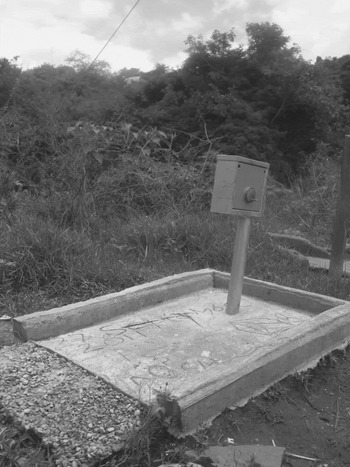
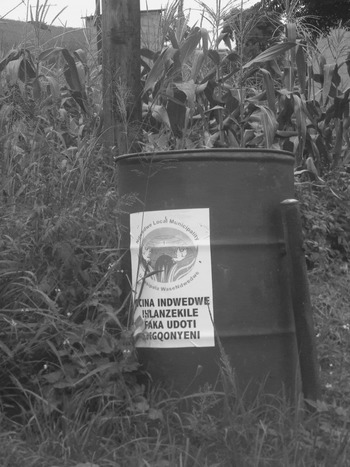
I met Ms Shezi at her house. She claimed to have moved away from Glendale only two years before after living there for almost a decade with her husband, who was involved in some aspect of sugar cultivation in the village. Despite having grown up in faraway Gauteng Province, she told me how she decided to run for election as councillor after the party nominated her, believing she might be able to improve conditions. But she soon realized there were ‘serious difficulties'. Yet she spoke of working hard to ensure that the running water and electricity that the municipality installed alongside the houses actually worked and had extensive reach. She also gave three examples of recent ‘improvements' in which she had a direct hand: speed bumps that controlled the speed of vehicles in the village and protected the predominantly pedestrian traffic, an improved water tap system that prevented water leaks from old taps (Figure 3), and rubbish bins that allowed people to dispose of their waste without burning it (Figure 4). At the outset of my fieldwork, many people had complained to me that the old water taps led to water running out prematurely, sometimes leaving the entire village without water for several days.
New water tap designed to prevent leakage

Public dustbins, put up all over Glendale in April 2010. Their signs read ‘Please keep Ndwedwe municipality clean. Put your rubbish in this bin’.

Elaborating on the ‘serious difficulties' Glendale faces, Shezi emphasized that not only were people poor, with the few women who work casually harvesting cane getting ‘paid peanuts, like my grandfather’, but her ‘hands-on’ initiatives in the village proved ineffective. She recounted one such initiative, a particular kind of ‘government provision’ she attempted to facilitate:
When I became a councillor in Glendale, I saw the way people were suffering. And I said to a few women, ‘Maybe if we make a group we can make a difference.’ At that time at the Royal Hotel in Durban there used to be meetings with America's people and they would bring food. So I tried to make a group to get that food for the people who don't have it, who are in poverty. But this failed because people in Glendale believed that I was trying to favour some people over others, and did not see it as an opportunity to benefit everybody.
Indeed, she emphasized that there was no coherent community in Glendale with which she could form a relationship. This, she claimed, was closely related to the poor quality of housing. While she said that while she did her best to intervene, it proved impossible to hold the construction company accountable. The housing, she argued, led directly to the fragmentation of community. Some people who had been granted houses simply left the house they were given and went elsewhere. Together with the deaths of owners and many people already moving around in search of work, a number of houses in the area were not occupied continuously, or necessarily occupied by their owners. One consequence of this, Shezi emphasized, was the inversion of government's providence: ‘those people who want to do wrong things [crime] find a house in Glendale easily, sleep there and put their wrong things [loot] into the empty house’.
One might question her calling certain people residing in the low-income houses ‘criminals', but many in the village used this label to describe others, including their neighbours. In Shezi's view, the inferior quality of housing, alongside the lack of employment, induced a mobility that corroded the community and made it very difficult for her to identify whom she was responsible for, especially when people ‘only come to meetings when there is food provided’. To her diagnosis of the lack of coherent community and the inadequacy of sustenance sufficient for a democratic dialogue, Shezi added that people in Glendale failed to understand the nature of the relationship between her, as their representative, and them, as the people:
they just know that the person who brings the service delivery to them is the councillor, and [assume] he or she has money. Because when they fight or burn our things, they say we are eating government money. They don't know that no money actually comes to the councillor…. They [people] come to the councillor who can't do anything about fighting, all those things. They are sick, they are coming to you, they tell you they need an ambulance, somebody stabbed somebody else. They just know the councillor doing everything.
Shezi's charge that the people don't understand how democracy works, what rule entails, and the capacities of rulers might be understood as an official's excuse for poor performance. Yet if we consider complaints people made about Shezi, the vision of the problems of governance she presents cannot be dismissed as entirely instrumental. Makosi's cousin, Mphumi, a 46-year-old woman who is married to Thokozani, concurred with several other informants that getting food sometimes becomes a real problem, even saying that ‘the stomach is something that wastes a lot of money’. Velaphi, a 32-year-old man aspiring to tertiary education, acknowledged that some things have improved, but maintained that the government should be far more accessible to the people in Glendale. He argued that what is needed is ‘a person, perhaps the councillor, to go around checking homes [to see] if there are people who have problems, or [at the very least to establish] a place in the village where people can go if they have any kind of problem’. He suggests that people need help in many areas of their lives, but that help is often ‘nowhere to be found’.
Thokozani is the same age as his wife Mphumi, and built a house for them to share with their son alongside the government houses in Glendale. He arrived in the village after a squabble with his relations in Mtandeni. Thokozani complains bitterly about the reluctance of the councillor to become involved in people's lives. He told me ‘it would be much better if a chief was ruling this place’. To illustrate this, he gave the example of the role a chief might play when somebody died: ‘If someone dies here a whistle would be blown calling people to bring a spade and a shovel, and especially so everybody would go to that house.’ That the councillor, or somebody else in the government, fails to take this role shows Thokozani that the village of Glendale and its people are not properly ruled and have been abandoned.
EXPECTATIONS OF TRANSFORMED RULE
When I asked the municipal manager about the position of councillors in local governance, and the difficulties accompanying them, he told me:
You find that the ward councillor … will advise us about the voice of the people, and emanating from that, the politicos make a decision about what direction we should be going in, and then we [as technocrats] pursue them. So, you will find that communication between the councillor at ward level, the portfolio committee, the executive committee, is extremely important to allow the flow of information. You will find the councillors being elected – we are a young democracy – on the basis of being able to speak in public, instead of somebody who has the interests of the people at heart. But that will mature: people will realize if they keep voting for that lady that is never there, then why waste our time – she is being paid to look after our interests.
In his rendition of what South African democracy is, and how it should work, much is expected of councillors: to be able to render lucid the voice of the people to others in government so that politicians can produce policies and technicians can implement them. The task of transparently rendering people's thoughts and desires is made more onerous by the fact that there is not a shared agreement between ‘the people’ and those in government about the jurisdiction of councillors or their precise role. Indeed, as we have already seen, it is not even clear to Shezi who the people she is representing are, due to what she understands as the corrosive mobility of people living in the area – a claim of corrosion likely, no doubt, to disturb the neat numbers of the municipal manager. Moreover, when the municipal manager presents the idea of the relationship between people and government – and the election of councillors in particular – as one that will ‘mature’, he is suggesting that the people may not know their interests now but will in the future, and thus that there are no structural impediments to improving governance.
The municipal manager enunciates an expectation of a democratic future that the people will achieve as they learn what government is and how to be better citizens. He applied that model of progress to the local economy, too, where he claimed that gradual, measurable improvement in people's lives would occur as technicians in the municipality managed to calibrate strategic opportunities and niche areas with the skills people learned.
Such a trajectory of ‘progressive realization’ is in stark contrast with what my informants in Glendale claim. Thokozani puts it fiercely:
The municipality is not doing anything here. The municipality is here but I don't see it. … The councillor is the same as someone who doesn't exist … this is my fifth year living here and I don't even know the councillor of this place, I have never heard her blow the whistle gathering people to a certain place so [that] we can talk … she is also a criminal together with some of the people living here. This [criminality] means this place is a bush … there is nothing civil about this place. There needs to be people in high places coming to sort out this place, because this place is not right. They must replace all people who call themselves something here. Because all these people from the councillor onwards, they are useless. They don't know how to respect the community.
Thokozani maintains there is no straight path towards a better future. Indeed, if anything, he emphasizes the estrangement of people from their rulers. In contrast to the idea that democratic citizenship entrenches ‘direct rule’ – while the problem with colonialism in Africa was its subjection of people through ‘indirect rule’ (Mamdani Reference Mamdani1996) – for Thokozani democratic citizenship has been characterized by the separation of rulers from people. He argues that a chief would be more directly visible to people, and more available to deal with their difficulties. For him, people in ‘high places' need to intervene to address the criminality of politicians and other elements in Glendale.
One way of understanding Thokozani's unhappiness with rule would be to examine ‘culturally informed’ understandings of governance. For instance, Max Gluckman wrote in African Political Systems that Zulu kingship had a ‘personal quality’ (Gluckman Reference Gluckman, Fortes and Evans-Pritchard1940a: 29, 44). By this he meant that the king was not a father only to his own family, but to the entire people. The king was thus supposed to be aware of the matters of his people, and rule as a paternal figure. This did not mean, however, that the king was uncontested – indeed, especially on his patrilineal side the king often faced challenges from would-be successors – but rather that the office of the kingdom, not the person who occupied it, was understood as stable. John and Jean Comaroff have argued in another context that this meant the chief ruled ‘with’ rather than merely ‘over’ the people, risking being deposed if he failed to understand the character of this collaboration with the people (Comaroff and Comaroff Reference Comaroff and Comaroff1997: 131).
Yet interpreting Thokozani's complaints in this way assumes that people have an unchanging cultural understanding of kingship, or that they have some memory of the exercise of Zulu authority that Gluckman discussed in 1940, a time when he had argued in a justly famous text that ‘Zulu’ and ‘European’ could not be understood as autonomous from one another, but were mutually dependent and co-constitutive (Gluckman Reference Gluckman1940b). Informants in their thirties, such as Thulani, claim quite directly that what they remember of the past is a time when ‘many doors were shut’. Even as he claims that a chief ruling Glendale would at least pay more attention to those living there than the contemporary government does, Thokozani recalls visiting the chief of the area where he was born – Mtandeni – to invite him to a ritual welcoming the ancestors into his new house. On that occasion he and his wife Mphumi were given river water to drink and told that the chief would not attend, but might send one of his izinduna (or lieutenants), who never showed up. Thokozani recounted this event with sadness, but never raised his voice or vented frustration in the way he did when he spoke about the councillor or the government. About the past, he did admit:
When I'm looking at the past with my own eyes I can say it was difficult, but it was also not difficult because we did not know anything. You hear people saying life was hard, but it was not hard because we did not know good things. I don't know how to explain it, life now is not as hard as it was before, but we did not notice it as much then. I'm thinking of a time when we used to go, as children, to buy things at the shop. The shopkeepers would take out bread and sugar water and tell us to be quiet, not to disturb any other customers. And we thought this was great. We did not see life because we were blinded so easily. It's hard to say that things are better now, because there is no work: even when we work sometimes we don't see the money.
Thokozani tacitly tells us of the mediation of the present in remembering the past, especially in times of a dramatic political change. It is a moment in which he admits that no nostalgia for the past can provide the grounds for complaints about the present or the basis for a better future. Ultimately he does not repeat the dilemma Jean and John Comaroff identify (1997: 127) as produced in post-colonies when a universal idea of citizenship composed of rational individuals appears to represent the future and ‘an anti-modern, ethnically based, pluralist political community in which people enjoy (or are denied) entitlements by virtue of putatively primordial characteristics' appears as belonging to the past.
Instead, Thokozani and many other informants in Glendale suggest that different kinds of domination are at work in past and present. Stembiso puts it succinctly in claiming that in the past they were abused ‘by life’ but there were job opportunities, but now it might even be worse as there are no jobs and nobody is concerned about them in Glendale, despite the presence of freedom.
SPECIFYING THE ESTRANGEMENT FROM DEMOCRACY AND THE DESIRE FOR MORE GOVERNMENT
The version of democratic freedom offered by the post-apartheid project led by the ANC offered two dimensions: liberal freedoms never enjoyed by the majority of South Africans prior to 1994, on the one hand, and a vision of freedom that depended upon addressing grave historical injustices for its realization on the other. For people in areas like those surrounding Glendale, democracy promised material improvements – through access to networks linking country and city – to waged work, to housing and infrastructure, and to a government committed to them. Yet by the time new houses and infrastructure brought a large new settlement of people to Glendale, the mill's closure meant waged work had already disappeared, leaving the government to administer the village of largely unemployed people within a much larger district with chronic worklessness. It took less than a decade, given shoddy construction, for freedom to become abstract and rights less tangible, and for the promise of a better future to fade – as freedom's only concrete instantiation, houses, began to fall apart.
In reading charged sentiments associated with social transformation in South Africa, Thomas Blom Hansen (Reference Hansen2005) offers an evocative discussion of what he calls the ‘melancholia of freedom’ from the standpoint of an Indian community in Chatsworth. This melancholia expresses, through public theatrical performance, a literally inexpressible nostalgia for apartheid racial community and, simultaneously, a loathing of that community through a public joking that shames elders as parochial exemplars of a backward Indianness. In Glendale, however, freedom appears less in reference to a nostalgia for the past and instead becomes tied to a fugitive future, with the increasing intangibility of freedom marking a perceived loss of this (qualitatively different) future. Indeed, as we have seen, even when chiefly rule is invoked as an alternative, the direct nature of that rule is not entirely dissociated from apartheid domination and what people appear to desire is a more direct relation with their leaders, but not in the form that this took in the past.
While this area was part of a broader region characterised by violent ‘ethnic’ conflict during the 1980s and early 1990s, local government election results (Independent Electoral Commission 2013) make clear that the ambivalence about rule is not about the return to ‘ethnic’ authority in any straightforward sense. While in 2006 Inkatha – the party purportedly representing the interests of isiZulu speaking peoples – received 35 per cent of the vote against the ANC's 51 per cent, the figures changed dramatically in the May 2011 election where, just after the bulk of this fieldwork was completed, the ANC received more than 75 per cent of the vote in the ward, against 9 per cent received by Inkatha.
What, then, are the specific conditions that couple freedom to the future and, simultaneously, produce a desire for a more direct, personal form of rule? For many in the South African countryside, a particular waged relation, however oppressive, did enable futures. For instance, Ferguson's early work (1990) in Lesotho documented how urban wages invested in rural cattle worked as a form of exclusively masculine retirement funds, and White (Reference White2010) has more recently shown how in Zululand wages enabled a security after death through investments by men in rural homes. While many of the unemployed in Glendale do have access to limited amounts of money through grants, neither their quantity nor their distribution (especially to the young mothers and to the elderly) make them especially suitable for future investment.Footnote 2 Indeed, the value of grants appears to be quite different from waged work in terms of what they enable socially.
In Marx's analysis in Capital, waged work assumes not only concrete value but becomes the basis of an abstract form of value that binds increasingly alienated social relations together. Waged work, he noted, was the foundation of an exploitative contract defining belonging in capitalist society. In a memorable passage on civil society he mentions it as a realm of ‘freedom, equality, property and Bentham (self-interest)’, but argues that the condition of possibility attaining these concepts are the ‘hidden abode of production’ characterized by the valorization of labour power as a precondition for producing surplus value (Marx Reference Marx1976: 280). Traditionally this passage has been read as an illustration of the exploitation that occurs within liberal society, where the privilege of the few depends on the sweat of the many. But we should notice, too, that in Marx's passage it is not the state that ensures citizenship – it is only an intermediary – but rather the sale and purchase of labour power. It follows, therefore, that the incapacity to buy or sell labour power might be decisive in the ability to participate in capitalist society at all.
It is plausible, then, that the absence of waged work in conditions of capital produces an estrangement from democratic citizenship amid a specifically post-Fordist instantiation of alienation, an alienation experienced from not working when work remains the basis of social value (Comaroff and Comaroff Reference Comaroff and Comaroff2002). The coupling of the loss of the promise of freedom and the loss of a future is closely related, in my reading, to this alienation, and the desire in Glendale for the increased presence of the state is not an imaginary produced by any cultural longing for a paternal figure, but an expression of people's objective lack of capacity to make a future and be democratic subjects in a society without work.Footnote 3
CODA
The state in South Africa is not a coherent institution, and may indeed, following Abrams, be a symbol of existing disunity. Many commentators have noted the diverse directions in which various offices of government and the ruling party are being pulled, and these interests and expressions only multiply when government is viewed at municipal level. Certainly it is possible to see elements of the government expressing elite class interests. One also does not need to look very hard to see unhappy communities and, in certain places, incompetent representatives or even corrupt councillors. In Glendale, I've shown, there is also a frustration with, and even antipathy towards, post-apartheid democracy.
In order to understand this, I have described and analysed visions that people and the government have of one another. Differences that many in the country have with the state go beyond explanations that privilege corruption, or the ruling party's lack of democracy, or the government's failure to hear people's voices (participatory government is not working, true –but we need to account for that). How the state sees and how the state is seen suggest difficulties at the very core of the post-apartheid project of democratic citizenship. These difficulties seem to centre on how the incapacity to find work may undermine the capacity to participate as a citizen.
Barchiesi (Reference Barchiesi2011: 23) has blamed what he calls the South African state's ‘normative fixation’ on the centrality of work but, in a society structured by commodity as value, the prominence of waged work is not a product of government decision, nor is it a matter that might be easily overcome by a change of policy direction. Rather, in so far as labour as value structures social life, and regular waged work is increasingly difficult to acquire, we might talk about a growing incapacity of both the government and its citizens to achieve freedoms as imagined in the 1994 transition. This incapacity is not identical to the ‘mutual impotence’ of the state and its subjects suggested by Mbembe (Reference Mbembe2001) in other parts of post-colonial Africa, for it is clear that the post-apartheid government has achieved more than banal spectacles looting state coffers. One of these achievements is the substantial increase in social security payments to those identified as the most vulnerable after 2000, a project consonant with the changing position of post-colonial governments identified by Chatterjee's most recent work (2011) and understood affirmatively by Ferguson (Reference Ferguson2009, Reference Ferguson2011).Footnote 4 These grants, as I noted above, have become materially indispensable for many in Glendale, but do not enable futures in the way that wages might, and for many become signs of their incapacity to achieve the freedom that the post-apartheid project promised. Amid the palpable absence of waged work – but where waged work has remained the basis of value – the only site of hope is the government, and hence people want more government. Yet the state's incapacity to create waged work leaves it able only to maintain people and not to facilitate a transformed future.
ACKNOWLEDGEMENTS
This article is based on research completed for my doctoral dissertation, with generous fieldwork funding provided by the International Dissertation Research Fellowship of the Social Science Research Council in New York. Its argument benefited from presentations at the African Studies Workshop at the University of Chicago, the Department of Anthropology and Sociology at the University of the Western Cape, and the Politics of Precarious Society Colloquium at the University of the Witwatersrand. I also want to thank the anonymous reviewers of this article, Ralph Austen, Jean Comaroff, Zebulon Dingley, Mark Geraghty, Kelly Gillespie, Fernanda Pinto de Almeida and Tracey Rosen for close readings and suggestions that undoubtedly improved it.