INTRODUCTION
Carisbrooke church is one of twelve churches on the Isle of Wight that were in existence by c 1100 (fig 1). Along with Arreton, Calbourne and Shalfleet, the church of Carisbrooke in the estate of Bowcombe is documented in Domesday Book. The existence of three others, Bonchurch, Freshwater and St Nicholas, can be inferred from the text.Footnote 1 Later documentation records that seven island churches were ‘given’ by William fitzOsbern to his abbey of Lyre in Normandy between 1067 and 1071.Footnote 2 In addition to Arreton and Carisbrooke, these churches were Godshill, Newchurch, Niton and Whippingham. Evidence of architectural sculpture indicates the presence of Brading church in the later eleventh century.Footnote 3 Carisbrooke church can be shown to have had ‘minster’ status. It is thus appropriate that the first piece of probable Anglo-Saxon stone sculpture to be identified on the Isle of Wight is located there.
Isle of Wight churches to c 1100. Image: authors.

LOCATION AND DESCRIPTION
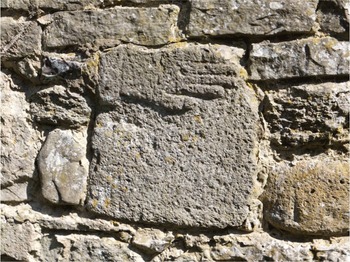
Embedded in the northern wall of the churchyard at Carisbrooke is a broken portion of a shallow bas-relief depicting a disembodied hand (fig 2). The stone is Quarr limestone and the surviving fragment measures 363mm long by 376mm high; its thickness is at least 20mm. The part carved in relief is 0.29m in length. The hand is obviously not in its original position, and must have come from a large panel.
The outstretched hand, executed in shallow relief at Carisbrooke, carved in Quarr limestone. The hand is 0.29m long, including the ‘sleeve’. Photograph: authors.

The carving has been in the wall since at least the late nineteenth century, when it was recorded by a local antiquary.Footnote 4 The wall is of coursed rubble; it is probably post-medieval in date, and contains no other architectural fragments so far as can be seen. The wall forms the boundary between the graveyard of St Mary’s church and Priory Farm to the north. The farm includes part of the site of the claustral range of Carisbrooke Priory and there is a scar where this formerly united with the upstanding north wall of the surviving church. The priory was founded in the mid-twelfth century to serve the interests of the Norman abbey of Lyre.Footnote 5 At the early dissolution of alien monasteries in 1415, the priory buildings and lands passed to the Charterhouse of Sheen.Footnote 6 As was often the case in the Norman period, the priory took over an existing minster church, which had an extensive parochia covering a substantial area of the western half of the island. The church contains no datable Anglo-Saxon fabric, the earliest being the thick south wall of the nave and its now redundant single-splayed window openings, probably of early Norman date. The north and east walls of the nave are also in the order of 1.09m thick, implying that they also form part of this late eleventh- or early twelfth-century fabric.
Although weathered, the hand clearly shows four outstretched fingers and a thumb, without much detail. It is wavy-edged at the wrist, so may have been hacked down. An incised line at the wrist marks a slight widening, as though for a sleeve. There is no apparent definition of the finger and thumb joints and no evidence of a crucifixion nail head or stigmata on the palm of the hand. As now set, the thumb is at the bottom; if from a crucifixion with the orientation reversed it is a right hand, as Christ’s right hand always displays an open palm, with the thumb uppermost. It would still be a right hand if portraying a single manus (or dextera) dei.
DATING AND CONTEXT
The Carisbrooke hand would appear to date from before c 1200 and is quite likely to be a piece of Anglo-Saxon sculpture.Footnote 7 We are grateful to several authorities for their assessment of the fragment. Dr Ron Baxter of the Corpus of Romanesque Sculpture in Britain and Ireland considers that it ‘is probably from an Anglo-Saxon rood … but it could be post-Conquest’.Footnote 8 Professor Rosemary Cramp suggests there ‘is not enough evidence from the hand alone to be sure of a pre-Conquest date’;Footnote 9 however, Elizabeth Coatsworth thinks that it is likely to be a pre-Conquest manus dei, and this is supported by David Stocker.Footnote 10
Such a date would not be out of context. Although no early medieval fragments were identified on the Isle of Wight when the Corpus of Anglo-Saxon Stone Sculpture volume was published in 1995,Footnote 11 three pieces have subsequently been recorded at Whippingham,Footnote 12 along with a possible fragment at Godshill.Footnote 13
While the dating of the Carisbrooke hand cannot be regarded as definitive, parallels can be cited from Anglo-Saxon stone sculpture to support this dating. In the first instance we cite some Anglo-Saxon roods that include examples from neighbouring Hampshire. We also consider some open hands sculpted in crucifixion images. Our third comparison is with sculpted images on late Saxon grave markers, where a hand can hold an item such as a small cross.
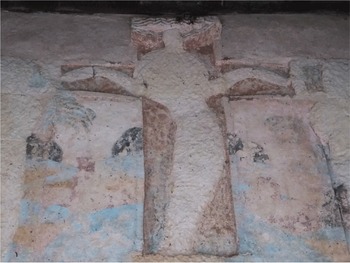
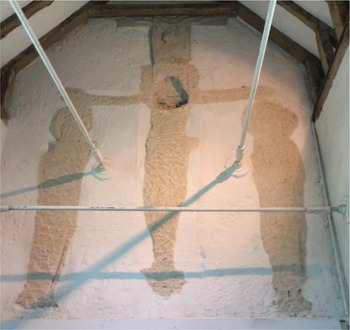
At 0.29m in length, the Carisbrooke hand is larger than life-size. If the hand formed part of a rood, a depiction of Christ on the Cross, then comparisons must be made with the larger surviving Anglo-Saxon stone examples of southern England. Two of these, both in Hampshire, have been all but destroyed by iconoclasts during or after the Reformation. Nevertheless, what has survived indicates their size and form. The Breamore rood once depicted Christ hanging from the Cross with a flexed body (fig 3). At Headbourne Worthy the rood depicts him in an upright position with arms outstretched (fig 4). Here we see a contrast between Christ in passion and Christ in triumph: two significant theological perspectives that reveal a conflict between the poverty and suffering of Christ, and the majesty of human kingship. The latter is considered a reforming vision. Both were common representations in art of the eleventh century, which was a period of major theological change.Footnote 14
Defaced rood at Breamore, Hampshire, showing Christ in agony on the cross with the hand of God pointing down from a cloud above. The Virgin Mary and St John flanked the central part of the rood. The rood is not in situ. When reassembled in its present location, the arms of Christ were transposed (Breamore 1). Photograph: authors.

The defaced rood at Headbourne Worthy, Hampshire, with the hand of God above the figure of Christ and flanked by two figures, the Virgin Mary and St John. The rood was constructed of Quarr stone from the Isle of Wight. The hand of God projects downwards from a string course that is part of the fabric of the Anglo-Saxon church, indicating that the rood is in situ above the western doorway to the nave (Headbourne Worthy 1). Photograph: authors.

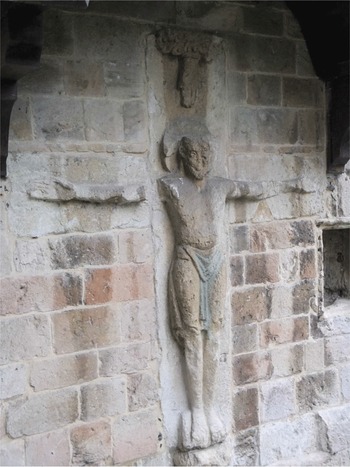
For some, however, a plurality of views and sculpted images was a prudent choice. This we see at Langford in Oxfordshire, where there are two roods that have not been defaced in the manner of Breamore and Headbourne Worthy. While one of these shows a triumphant Christ with arms outstretched, the other is analogous to the Breamore rood, with Christ in passion. The rood at Walkern in Hertfordshire would appear to be of the former type with a straight body, but the arms have not survived. The rood at Romsey Abbey also shows Christ with a straight body and arms, and with eyes wide open: a further representation of his triumph (fig 5).Footnote 15
The Anglo-Saxon rood at Romsey Abbey, Hampshire, depicting Christ triumphant on the cross with eyes wide open, a straight body and arms outstretched. The rood is not in situ, having been reassembled in the twelfth century with the rebuilding of the abbey (Romsey 1). Photograph: authors.

On the Carisbrooke hand there is no indication of palm piercing or a nail head. This suggests that if this image did indeed form part of a rood, it depicted a triumphant Christ. The Carisbrooke hand is a right hand. If it formed the extremity of a rood, then its present position is inverted. The length of the hand, not including the ‘sleeve’, implies that the putative rood could have been approximately 2.26m tall. This bears a direct comparison with the Romsey rood in terms of size (table 1).
Larger Anglo-Saxon roods in south-eastern England: data from Tweddle et al (Reference Tweddle, Biddle and Birthe Kjølbye-Biddle1995).

The hand of God, the manus dei, is always depicted as a right hand, the manus dexter. If the carving is interpreted as the manus dei, there are two possible contexts: the hand could have been part of a small stone sculpture of some kind, or it was the hand pointing down from heaven to a crucifixion scene as part of a rood.
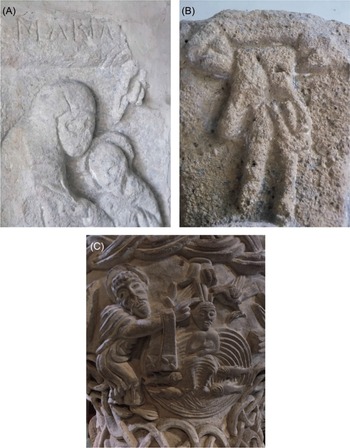
The hand of God appears in two main forms in Anglo-Saxon manuscript art and sculpture.Footnote 16 In the first form, the hand points with the first and second fingers, with the third and fourth fingers flexed in the blessing position. This pose can be seen on the stone panel at Inglesham in Wiltshire, with the manus dei pointing to the Christ child on Mary’s lap (fig 6a). Similar scenes can be seen at Launceston, Cornwall, and above a small stone rood at Wormington, Gloucestershire (fig 6b).Footnote 17 It is also the case with the fragmentary grave marker from Winchester New Minster.Footnote 18
The Hand of God in Anglo-Saxon and Romanesque sculpture: (A) detail of the Virgin and Child panel at Inglesham, Wiltshire, with the right hand of God in a blessing posture pointing to the Christ child; (B) Wormington, Gloucestershire, the manus dei above the rood; (C) the baptism of Christ on the bowl of the font at Castle Frome, Herefordshire, with John the Baptist to the left, the manus dei and the Holy Spirit above. Photograph: authors.

This form continued in use in twelfth-century stone sculpture, for example on the font of c 1140 from Castle Frome in Herefordshire (fig 6c), and the possibly slightly later tympanum at Elkstone, Gloucestershire, where it points down to Christ in Majesty.Footnote 19 It also features prominently in the Bayeux Tapestry, where it indicates the newly constructed Westminster Abbey in the scene depicting Edward the Confessor’s funeral.
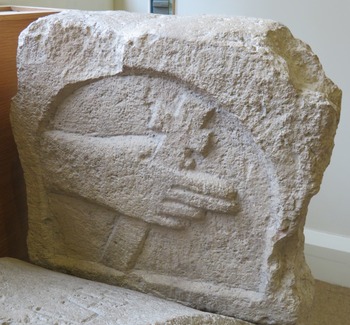
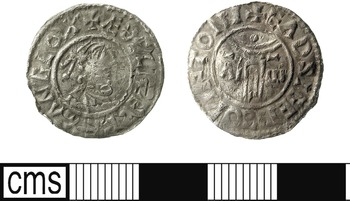
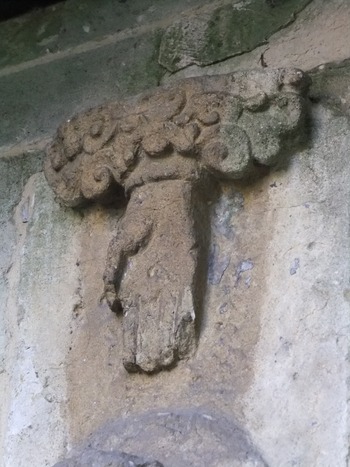
A second common pose has the hand with an open palm and straight fingers, which is more similar to the Carisbrooke hand. It is seen on the early eleventh-century grave marker from Winchester Old Minster (fig 7); in this instance holding a cross. A similar pose, but without a cross, is on the obverse of a series of silver pennies of Æthelred ii, minted by Eadsige at Winchester between 979 and 985 (fig 8).Footnote 20 Further examples of this form of the manus dei are to be found on the cross shaft at Harmston, Lincolnshire, and the slab at Newent, Gloucestershire.Footnote 21 In both of these examples the hand points to a crucifixion scene below. Nearer to the Isle of Wight is the manus dei at Romsey Abbey (fig 9). This is open-palmed and gestures down from a cloud to emphasise the importance of a large rood. Similar arrangements are apparent in the defaced roods at Breamore, Headbourne Worthy and Walkern.Footnote 22 If the Carisbrooke hand formed part of such an assemblage before being set in the churchyard wall, it is now 90 degrees in error of its original orientation.
Early eleventh-century grave marker from Winchester Old Minster, now in Winchester City Museum (Winchester (Old Minster) 2). Photograph: authors.

Coin of Æthelred ii minted by Eadsige at Winchester 979–85, found on the Isle of Wight. The manus dei is depicted on the reverse. Photograph: Frank Basford, reproduced courtesy of the Portable Antiquities Scheme.

The manus dei (right hand of God) with an open palm gesturing down from a cloud above the head of the figure of Christ at Romsey Abbey (Romsey 1). Photograph: authors.

Excavations by Martin Biddle of the Old Minster at Winchester produced a range of stone sculpture. One was the aforementioned grave marker composed of Bembridge limestone transported from the north of the Isle of Wight, and dating to the early eleventh century (fig 7).Footnote 23 The hand is in low relief and without any detail, as with the Carisbrooke hand. A second fragmentary grave marker of the late tenth or early eleventh century from the New Minster also holds a cross.Footnote 24
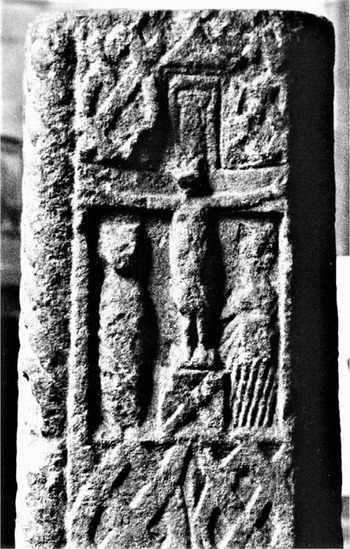
Other contemporary depictions of hands show them as part of more complex scenes. Notable is the larger of the two Jelling Stones (Denmark), which includes an elaborate crucifixion type scene with Christ’s hands outstretched (fig 10).Footnote 25 The runestones were erected between two large burial mounds, and the smaller one at least would seem to have functioned as a grave marker. The larger runestone was produced for Harald Bluetooth as a proclamation of Denmark’s conversion to Christianity in about 960 and as a memorial to his parents,Footnote 26 but there are no other images like it from England. A late ninth-century grave marker on Lindisfarne includes the depiction of two hands gesturing inwards to a cross (fig 10).Footnote 27 Also of relevance from Winchester, although not a grave marker, is the panel from the Old Minster probably dating from 1017–35, which may depict a scene from the Völsunga saga, with an outstretched right hand belonging to the wolf’s victim.Footnote 28 This is an architectural panel, rather than a grave marker; it does, however, raise the possibility that the Carisbrooke hand formed part of a more ‘secular’ scene.
Alternative compositions. Left: The reproduction of the Jelling stone from Jutland in Denmark in the Danish Church adjoining Regents Park, London. Christ is shown conquering death with a straight body, arms outstretched and eyes wide open. The painting of this stone provides a vivid impression of the appearance of much early medieval stone sculpture when first carved and painted. Photograph: authors. Right: The hands of God on an eleventh-century grave marker at Lindisfarne, Northumberland (Lindisfarne 37). Photograph: T Middlemass, copyright Corpus of Anglo-Saxon Stone Sculpture.

INTERPRETING THE CARISBROOKE HAND
While the grave marker from the Old Minster at Winchester is the closest parallel to the Carisbrooke hand in pose and rendering, it is unlikely that it derived from a similar grave monument. The extent of the flat surface below the Carisbrooke hand in its present position does not accord well with the form of known late Anglo-Saxon grave markers. Alternatively, it is possible that rotated through 180 degrees the sculpture depicts a right hand emerging from a feature that might represent the cuff-like end of a sleeve. This would make it an example of a rare, robed type of rood that was being revived in late Anglo-Saxon England; an example of which survives at Langford in Oxfordshire.Footnote 29 This interpretation would mean that there was a stone joint just above Christ’s wrists, whereas more typically a crosspiece of such a rood would extend all the way to the trunk of the figure, rather than terminating a short distance before the end of the sleeve. Also, if Christ was wearing a long-sleeved robe, it is unlikely to have extended over the wrist.Footnote 30 Alternatively, the feature may represent a binding. This would suggest that it formed part of a martyrdom of a saint such as St Andrew, but such examples are very rare survivals, and would be very unlikely in this instance.Footnote 31
The best comparison for the Carisbrooke hand is the large rood at Romsey, with an open-handed manus dei gesturing down to the figure of Christ (fig 5). The stylised cloud is missing at Carisbrooke, but the break above the cuff would preclude its survival.Footnote 32 The cuff can be seen as a parallel to that between the cloud and the hand at Romsey. The form of the Romsey hand is, however, different, with Carisbrooke rendered in a flatter low relief. A similar example for a manus dei in low relief above a crucifixion is the small example on the cross shaft at Harmston, Lincolnshire.Footnote 33
The Carisbrooke hand has its thumb parallel to the fingers rather than angled away. Different examples of these hand positions exist in smaller Anglo-Saxon stone sculpture and in broadly contemporary representations in other media. Hands flat but with the thumbs angled out are depicted on a stone from York Minster.Footnote 34 The figure of Christ at Dewsbury, Yorkshire, of the late eighth or early ninth century has the blessing hand facing out, with the thumb almost parallel with the fingers.Footnote 35 The slab at Newent, Gloucestershire, from the first half of the eleventh century, has a small manus dei above the crucifixion scene with the thumb at a slight angle to the fingers.Footnote 36
Two close parallels for the Carisbrooke hand position are found in northern England. The ‘Doomstone’ at Lindisfarne depicts two hands (fig 10).Footnote 37 As well as being in low relief, both flat hands depicted on this grave marker from the end of the ninth century have both thumbs parallel with the fingers. The crucifixion slab from Penrith, of probable tenth century date, has only the right hand of Christ remaining. It forms a very similar posture to that at Carisbrooke, with no gap between the thumb and index finger.Footnote 38 The small manus dei on the cross shaft at Harmston, Lincolnshire, appears to be of similar form (fig 11).Footnote 39
Detail of the Harmston cross shaft showing the manus dei as part of a crucifixion scheme, reproduced from Everson and Stocker (Reference Everson and Stocker1999, fig 199). Photograph: Paul Everson and David Stocker, copyright Corpus of Anglo-Saxon Stone Sculpture.

There is a similar variation in the depiction of flat-handed manus dei in other media dating from the late Anglo-Saxon period. The Benedictional of St Æthelwold includes an ascension scene (folio 64v); the hand of God reaching down is open but with the thumb at an angle to the fingers. The Benedictional was produced between 971 and 984, and probably towards the beginning of this period.Footnote 40 There is a similar depiction on the title page for St Luke in the York Gospels, dating from between 972 and 992.Footnote 41 The manus dei on the coins of Æthelred ii minted at Winchester 979–85 has been mentioned above. This has the hand of God with thumb parallel to the fingers, very similar to both the Carisbrooke hand and the Romsey rood manus dei.
Of all the cited examples, the Romsey manus dei, despite being carved in much higher relief, provides the best parallel for the Carisbrooke hand. A comparison of the dimensions of these two pieces of stone sculpture is presented in table 2. This comparison shows that the Carisbrooke hand is of similar dimensions to the Romsey 1 manus dei, but slightly larger. The Romsey 1 rood is 2.25m high. It can be inferred that a rood at Carisbrooke positioned below a manus dei would also have had similar but slightly larger dimensions to the Romsey 1 rood. These proportions are also suggested by table 1 above.
A comparison of the dimensions of the Romsey 1 manus dei and the Carisbrooke hand.

The interpretation of the Carisbrooke hand as probably forming a manus dei above a rood would suggest a late Anglo-Saxon rather than a post-Conquest date, when this iconography was only infrequently used.Footnote 42 This makes the sculpture older than the core of the present parish church which dates from the late eleventh or early twelfth century (see below). Assuming that the hand was a manus dei above a rood, some observations about its location within the fabric of an earlier Anglo-Saxon church building can be made by comparison with churches elsewhere. The Romsey rood is not in situ, as it has been repositioned in the external face of the west wall of the Romanesque south transept. The Headbourne Worthy rood is now protected by the western porch added to the Anglo-Saxon nave (fig 4). Thus, when constructed, the rood formed an external feature above the west doorway of the nave.Footnote 43 The former rood at Monkwearmouth, County Durham, was also in a western external wall, in the gable of a porch that was later heightened.Footnote 44 The rood at Walkern, Hertfordshire, was also on the outside of the church, but above a former south doorway of the nave.Footnote 45 The former roods at Bitton and Bibury, both Gloucestershire, and Barton on Humber, Lincolnshire, all formed part of the east wall of their naves above respective chancel arches.Footnote 46 The Breamore rood (fig 3) is not in situ, but would appear to have been relocated from over the former west doorway, which was inside a now demolished western chamber, or from over the chancel arch.Footnote 47 The putative Carisbrooke rood would thus have formed part of the fabric of the pre-Norman church in a prominent position, perhaps above a western doorway or over the chancel arch.
The location of roods in such prominent positions indicates that these sculptures must have been an important component of the celebration of the liturgy.Footnote 48 There appears to have been a ‘renewed emphasis on the theme of the Crucifixion in southern England in the tenth century, shown both by the new and impressive forms of monument’ and changes in the figures accompanying them.Footnote 49 The presence of the latter, such as the flanking figures of St John and Mary, is unknowable at Carisbrooke unless further evidence comes to light. The Regulis Concordia, a document dating from the 970s associated with Æthelwold, describes the ritual for the veneration of the Cross to be celebrated during the service of Nones on Good Friday.Footnote 50 With the centrality of the crucifixion in Christian theology, liturgy associated with the Cross occurred at other times of the year.Footnote 51 Many prayers were recited in front of a crucifix. This can be inferred from their headings of prayers in manuscripts, for example Ante crucem domini deprecation oratio sancta.Footnote 52
Crucifixes and crucifixion groups were however prominent for reasons other than the liturgy. They also had the function of reminding church-goers of the central truths of Christian belief, and in providing a focus for individual devotion.Footnote 53 One function of the latter was for personal protection, both physical and spiritual.Footnote 54 Barbara Raw itemises the understanding of Christ’s death offered by manuscript illustrations.Footnote 55 This can also be applied to the architectural sculpture of roods. Firstly, Christ’s death was not seen as an end in itself, rather it was Christ’s passing from death to life that was the significant event. Secondly, there was the emphasis on Christ’s two natures, being both God and Mary’s son. Thirdly, the reversal of the fall of man was instigated with Christ’s sacrifice. Lastly, the death of Christ on the Cross was closely linked to church sacraments. Meditation on Christ’s Passion was not primarily about the history of the event. Far more significant was its fundamental meaning: ‘By contemplating Christ’s death man, too, could pass through the door to the unseen world where Christ had preceded him.’Footnote 56
THE HAND AND THE MINSTER CHURCH AT CARISBROOKE
The interpretation of the Carisbrooke hand as an example of Anglo-Saxon stone sculpture can be seen in the context of Carisbrooke as a former minster church. The parochia (mother parish) of Carisbrooke can be reconstructed to include the parishes of Northwood, Gatcombe, Shorwell, Kingston and Chale in addition to the home parish of Carisbrooke (fig 12). It also included an extra-parochial area of Parkhurst Forest and detached portions of Brighstone, Shalfleet, St Nicholas and Wootton parishes. Here was a large, discrete segment of the Isle of Wight enclosed within north–south boundaries from the Solent to the English Channel. This accounted for an area of 9,724ha.Footnote 57
A reconstruction of the Carisbrooke parochia showing medieval church and chapel sites with parish boundaries from the first edition of the Ordnance Survey six-inch survey of 1862/3. Key for the detached areas of parishes: B Brighstone, C Carisbrooke, G Gatcombe, K Kingston, N St Nicholas, S Shorwell, Sh Shalfleet. Image: authors.

Domesday Book does not mention Carisbrooke. The entry for Bowcombe states: ‘The monks of Lyre hold the church of this manor, with 1 virgate of land.’Footnote 58 The place-name Carisbrooke does not enter the written record until ‘In the year of our Lord 1114, on the first of December, this agreement was made between the church of St Mary of Carisbrooke in the Isle of Wight and Almetus the priest of that church, and the church of St Andrew of Chale and Hugh Gernon who founded that church’.Footnote 59
St Mary’s, Carisbrooke, contains no datable Anglo-Saxon church fabric, the earliest being the south wall of the nave and its now redundant window openings of single-splayed form of probable early Norman date. This was cut though by the Transitional Norman arcade, which partially cut away the earlier windows.Footnote 60 The north and east walls of the nave would also appear to have formed part of this early Norman fabric.
It has been argued that the site of the church at the time of Domesday Book was not at Carisbrooke, but 2km to the south-west, at or near Bowcombe Farm.Footnote 61 However, no physical evidence has yet come to light to support this supposition. The recent identification of an enclosure of 3.78ha bounded by Carisbrooke High Street to the south and encompassing the church yard, Priory Farm house and the ‘crofts and tofts’ of the northern row of the village may be seen as a minster enclosure. It would appear that the Domesday place-name Bowcombe referred to the wider estate, as well as the site of Bowcombe Farm. Within this area, the minster church had been established alongside a significant east–west route-way following the lateral chalk upland of the island.
The Carisbrooke hand is also suggestive of the superior status of a church at Carisbrooke serving the Bowcombe estate and its wider parochia by the later eleventh century. A large rood would be in keeping with the status of a minster church. Alternatively, a grave marker could be appropriate for a minster church site that could continue to guard and retain its right to bury the inhabitants of its extensive parochia into the twelfth century. The agreement between St Mary’s, Carisbrooke, and St Andrew’s, Chale, in 1114 included the provision of a cemetery at Chale.Footnote 62 This would appear to have been the first instance in which the monopoly of the Carisbrooke minster on receiving bodies (and burial dues) from within its parochia was broken.Footnote 63
CONCLUSIONS
It is not possible to be categorical about the date of the Carisbrooke hand, but a pre-Conquest Late Anglo-Saxon date is by far the most plausible. Of the possibilities we have reviewed, the most persuasive interpretation is that of an open-handed manus dei that once descended from a cloud to point to a rood below. The presence of such sculpture at Carisbrooke church is apposite to the location of an Anglo-Saxon minster church.
AKNOWLEDGEMENTS
We are grateful to the following for answering queries and giving opinions on the Carisbrooke hand: Ron Baxter, Betty Coatsworth and David Stocker. We would also like to thank Derek Craig for liaising with Rosemary Cramp, for his comments on the pre-Conquest sculpture at Whippingham church and the possible example at Godshill, and for giving permission for the reproduction of the Harmston cross shaft and Lindisfarne ‘doomstone’ photographs. Frank Basford kindly provided the image of the coin of Æthelred ii. Thanks are also due to Betty Coatsworth, David Stocker and Alan Phillips for commenting on earlier drafts of this paper. We are grateful to our anonymous referees for their comments and suggestions on the content and presentation of our work. Finally, we would like to thank the vicar and churchwardens of Carisbrooke for providing kind and ready access on our various visits to the church.
SUPPLEMENTARY MATERIAL
To view supplementary material for this article, please visit https://doi.org/10.1017/S000358152100024X.