In recent years scholars have paid considerable attention to the way panel composition influences voting and outcomes in the US Courts of Appeals. Substantial evidence supports the conclusion that circuit judges are influenced by both ideological (Revesz Reference Revesz1997; Cross and Tiller Reference Cross1998; Sunstein Reference Sunstein2006) and personal characteristics (Farhang and Wawro Reference Farhang2004; Boyd, Epstein, and Martin Reference Boyd, Epstein and Martin2010; Kastellec Reference Kastellec2013) of their fellow panel members, a phenomenon known as panel effects. To date, this line of research has focused primarily on binary votes regarding who wins and loses a case. However, once a panel has agreed on a case outcome there is still important work left to be done. One judge is assigned to write the opinion explaining that result (Bowie, Songer, and Szmer Reference Bowie2014), and, if published, that opinion will become binding law within the circuit (Lee Reference Lee2003). How the author crafts a published opinion plays a key role in developing the law of the circuit (Hume Reference Hume2009; Haire, Moyer, and Treier Reference Haire2013). The dynamic nature of law is such that the meaning of each precedent ebbs and flows on the basis of how it is used over time. Each new opinion provides the opportunity to continue shaping the law of the circuit by molding the way past circuit opinions are used. Since the author plays the central role in selecting which circuit precedents to discuss and how, she potentially wields disproportionate influence. This article investigates whether, and to what extent, the author’s influence over such decisions is tempered by the need to craft each opinion with one’s colleagues’ preferences in mind.
Ideological panel effects on case outcomes manifest as different rates of conservative (or liberal) rulings from split panels and unified panels dominated by the same party. I extend this analytical framework to further distinguish between split panel opinions authored by a member of the panel majority and those authored by what Kastellec Reference Kastellec(2011) dubs a “counterjudge,” a judge who is the lone member of his party siting on a panel.Footnote 1 Panel effects influence opinion crafting to the extent that an author’s own ideology has a different impact on opinion content conditional on whether the relevant panel is unified, split but dominated by the author’s party, or split and the author is the counterjudge. Authors should have the greatest leeway to draft their ideologically preferred opinion when sitting on a panel with two ideological allies and the least leeway when the panel includes no such allies.
The core of a judicial opinion is using analogical reasoning to compare case facts to previous precedents. The myriad microdecisions an author makes about which precedents to cite, and how, combine to influence the continual development of law. On the one hand, favorably citing a precedent as relevant lends it continuing efficacy and potentially expands it to apply to a wider set of facts in the future (Hume Reference Hume2009). On the other hand, negatively treating a precedent by explicitly stating that it does not apply to the facts at hand narrows the future application of that precedent.Footnote 2 The ever-increasing number of precedents from which to choose suggests the possibility that a judge may make decisions about precedent on the basis of ideological preferences in addition to legal considerations. Research demonstrates that ideology does play a role in such decisions (Spriggs and Hansford Reference Spriggs and Hansford2002; Hansford and Spriggs Reference Hansford2006; Choi and Gulati Reference Choi2007; Hume Reference Hume2009; Hinkle Reference Hinkle2015; Niblett and Yoon Reference Niblett2015). Since panel effects dampen ideological voting, they may well dampen ideological development of circuit law as well. Exploring whether panel effects extend to opinion crafting both sheds light on the important question of author influence and provides insight into the complex relationship between panel effects and the development of legal doctrine.
Much of the existing theory regarding panel effects has been developed without addressing the role of legal doctrine (Tiller Reference Tiller2015). My empirical approach directly integrates the importance of law by focusing on the choices authors make concerning which binding circuit precedents to treat negatively (e.g., distinguish or criticize), which to cite favorably, and which to disregard completely. Specifically, I look for evidence of whether panel composition influences how authors make the key decisions that ultimately play a central role in shaping circuit law. Are authors guided by their own ideology to a different extent when one or both of their panel colleagues are from the opposite party? Are authors more deferential to precedents written by their panel colleagues? Using an original data set of search-and-seizure cases from 1953 to 2010, I provide evidence both that panel effects influence the use of precedent and that such decisions have a material impact on how circuit law develops.
Panel Effects and Precedent
The vast majority of circuit law is established by three-judge panels. Panel assignments rotate on a regular basis, resulting in each judge working with various combinations of his circuit colleagues. Sometimes a judge will sit with two like-minded colleagues, while other cases have to be resolved working with colleagues who have quite different ideological preferences. This institutional feature creates interesting variation in the output from different panel configurations. Most prominent is the robust finding in the literature that even a single judge can have an impact on case outcomes (see, e.g., Cross and Tiller Reference Cross1998; Sunstein Reference Sunstein2006; Boyd et al. Reference Boyd, Epstein and Martin2010; Kastellec Reference Kastellec2013; Beim, Hirsch, and Kastellec Reference Beim, Hirsch and Kastellec2016). Panels resolve cases by majority rule, yet empirical results consistently reveal patterns at odds with what the median voter theorem would predict (Kastellec Reference Kastellec2007). The primary explanations for these findings are strategic dissent avoidance to circumvent external review (Cross and Tiller Reference Cross1998; Kastellec Reference Kastellec2011; Beim et al. Reference Beim, Hirsch and Kastellec2016), strategic dissent avoidance to reduce workload and comply with a norm of consensus (Posner Reference Posner2008; Epstein, Landes, and Posner Reference Epstein, Landes and Posner2011; Fischman Reference Fischman2015), and internal deliberation leading to incorporation of a broader range of information (Kim Reference Kim2009; Spitzer and Talley Reference Spitzer2013).
Although the bulk of the literature on panel effects focuses on cases outcomes, there is some work that sheds light on the impact that panel configuration has on aspects of the opinion-drafting process. Haire et al. Reference Haire(2013) demonstrate that the presence of women and racial minorities on a panel can increase the number of legal issues discussed in the final opinion, although a panel majority is necessary to generate a significant effect. There is also empirical evidence that panels with members who have more divergent ideological preferences take longer to produce a final opinion (Bowie et al. Reference Bowie2014, 110). Such delay suggests that increased ideological diversity leads to increased negotiation over opinion content. These studies indicate that panel effects can manifest in opinion writing as well as in voting.
Exploring the role of panel effects on opinion drafting is important because of the key role opinion content plays in legal development. As Songer, Sheehan, and Haire (Reference Songer2000) note, “most judges consider opinion writing to be the most important part of their work because the court’s decision will make new law or clarify existing law for those in the legal community” (11). The details of a published opinion can have important implications for a range of future actors. Many people who will never end up in court may change their behavior in anticipation of how the opinion indicates a future conflict would be resolved. More directly relevant here, a range of future litigants will bring claims to court that may be controlled by that precedent. The effect of the precedent in such cases is not static. Studies have shown that how a precedent is used changes its impact over time (Hansford and Spriggs Reference Hansford2006; Westerland et al. Reference Westerland2010). When circuit courts treat Supreme Court precedents more frequently, either positively or negatively, that leads to an increase in the same type of treatment in later circuit cases (Westerland et al. Reference Westerland2010). Furthermore, when the Supreme Court narrows the scope of its own precedents through negative treatment, that also increases the probability that it will be narrowed even more in subsequent cases (Hansford and Spriggs Reference Hansford2006). These results, taken together, suggest that how a circuit uses its own precedents will influence the continued scope of those precedents. Specifically, I hypothesize that a precedent that is negatively treated (or favorably cited) more frequently in a given year will be negatively treated (or favorably cited) more frequently in the following year.
Decisions that influence the subsequent use of a precedent are important to study because the use of a precedent reflects the impact it has on legal doctrine. The development of law is nuanced, complicated, and difficult to measure. But citations and treatment provide an opportunity to measure this key concept in a way that is useful, if not perfect. Opinions that are favorably cited more often have a larger influence on legal policy than opinions that are cited less often (or not at all; Landes, Lessig, and Solimine Reference Landes1998). Admittedly, not all “favorable” (i.e., nonnegative) citations carry the same level of significance. Brief inclusion in a string citation indicates less influence than a more in-depth discussion of a case. However, in spite of such limitations, favorable citations can provide valuable insight (e.g., Klein and Morrisroe Reference Klein1999).Footnote 3 Academics have long viewed citations to their own work as a useful measure of scholarly influence (Margolis Reference Margolis1967). Arguably, such impact is even more consequential when the documents at issue constitute binding precedent. As a result, exploring the role panel effects play in decisions about the use of binding precedents ultimately sheds light on the dynamic process of legal development.
Authors and the Impact of Other Panel Members
The important role a counterjudge can play in who wins and loses suggests that similar panel effects might extend to how the majority opinion is crafted to influence the development of circuit law. Unlike voting, crafting an opinion is not an activity that divides power equally among the panel members. The responsibility of drafting an opinion to which the other panel members respond gives the author the potential to wield disproportionate power. Moreover, practical considerations and institutional norms dictate that the three members of a panel share opinion-writing duties equally across the subset of cases entrusted to the panel. As a result, over time almost all circuit judges will not only serve on both split and unified panels and find themselves in both the panel minority and majority, they will also be entrusted with authoring opinions under each possible panel configuration.
The author’s disproportionate power is the reason scholars have turned their attention to studying the process of opinion assignment. In the Supreme Court context a line of research has demonstrated that chief justices exercise their opinion-assigning power in an ideological and strategic fashion, even changing their vote to the majority in some instances in order to avoid ceding that power (Brenner and Spaeth Reference Brenner1986; Maltzman and Wahlbeck Reference Maltzman1996; Maltzman, Spriggs, and Wahlbeck Reference Maltzman2000). The power of assignment is valuable because the opinion author possesses a first-mover advantage in framing the scope and content of the legal rule (Murphy Reference Murphy1964; Maltzman et al. Reference Maltzman2000; Lax Reference Lax2007). We currently know less about the politics of opinion assignment at the circuit level, but what we know suggests assignment is done in a more collaborative fashion (Cheng Reference Cheng2008; Farhang, Kastellec, and Wawro Reference Farhang2015). Regardless of how opinions are assigned, circuit court authors have considerable power since they frame the legal rule set forth in the opinion and face considerably less input from their colleagues than occurs at the Supreme Court (Choi and Gulati Reference Choi2007). Rather than explore why opinions are assigned to particular judges, this article focuses on the question of whether panel configuration influences how the assigned author carries out that task.
While circuit judges possess a clear opportunity to exercise power when they draft an opinion, there are also very real limitations on that power. Most obvious is that the case outcome is generally determined in advance. Although the deliberative process is secret, we do know that it typically involves registering preliminary votes. Only after a tentative determination about the outcome of the case is one judge assigned to draft the majority opinion (Bowie et al. Reference Bowie2014, 62–65). Consequently, a major limitation on the parameters of how an author writes an opinion is that the outcome has been determined in advance. Any change to the case outcome after the majority opinion draft is circulated is unusual. During an interview, one circuit judge estimated that votes change after the preliminary vote at the conference “in maybe 8 or 9 percent of the cases” (99). Another obvious limitation is that a judge is constrained to write about the facts of a case and the legal issues they raise. The following discussion focuses on the discretion an author can wield within these constraints.
Even in the typical case in which votes on the outcome remain constant from the conference to the release of the finalized majority opinion, authors still exercise discretion about how to draft an opinion. As Kim Reference Kim(2009, 1343) notes, “the reasons that they [judges] give to justify their decisions are critical, for it is the content of opinions rather than the simple declaration of a winner that shapes the development of the law.” These reasons are primarily crafted by the opinion author. Although the other two judges on a panel retain the power to ask for changes or withdraw their support of a draft opinion, there is reason to expect that circuit judges give a fairly high level of deference to the author, at least compared to the Supreme Court (Choi and Gulati Reference Choi2007). The sheer magnitude of circuit court caseloads makes efficiency a necessity rather than a luxury. Faced with mandatory jurisdiction, increasing caseloads, and frequent lengthy vacancies in existing circuit court seats, circuit judges have limited resources to devote to the consideration of each case (Cheng Reference Cheng2008; Wood Reference Wood2012; Farhang et al. Reference Farhang2015). Furthermore, when an author includes a favorable citation to a binding precedent, legal doctrine may shield that decision from criticism. Beim and Kastellec Reference Beim(2014) note that counterjudges who are aligned with circuit law are in a stronger negotiating position. Similarly, authors, even counterjudge authors, who are aligned with a binding precedent can rely on stare decisis to support their ideologically preferred course of action.
Although concerns about efficiency, effort aversion, and legal doctrine may result in deference to the author, they may also result in deference by the author to the preferences of her panel colleagues. A central element in the various explanations for panel effects is avoiding separate opinions. According to whistleblower theory, dissenting opinions are avoided to reduce the probability of external review (Cross and Tiller Reference Cross1998; Kastellec Reference Kastellec2011; Beim et al. Reference Beim, Hirsch and Kastellec2016). Deliberative explanations incorporate judges’ general unwillingness to openly disagree with colleagues as one of the reasons they are open to being persuaded (rather than writing separately; Haire et al. Reference Haire2013; Spitzer and Talley Reference Spitzer2013). Finally, internal strategic explanations emphasize the extra time and effort required by separate opinions (Posner Reference Posner2008; Epstein et al. Reference Epstein, Landes and Posner2011; Fischman Reference Fischman2015). The shared element is the various benefits judges enjoy when they vote in a manner that prevents separate opinions. Panel effects on opinion writing may similarly be generated by authors working to avoid separate opinions.
There are two ways authors may reduce the probability of separate opinions. First, authors may accommodate revisions requested by other panel members after the draft majority opinion is circulated. Second, the author may anticipate the preferences of the other panel members and initially draft an opinion that is designed to satisfy their concerns. Deliberation about the content of an opinion would manifest as the first type of dynamic. Nonauthor panel members who are ideologically diverse may bring a wider range of information to the case and suggest the inclusion of additional circuit precedents or make a persuasive case for a different approach to discussing cited circuit law. Evidence from interviews of circuit judges indicates that quite a bit of bargaining over the content of published opinions does take place, in spite of their busy caseloads (Bowie et al. Reference Bowie2014, 93–99). Therefore, there is plenty of opportunity for nonauthors to weigh in about various nuances of an opinion, including the use of precedent. The fact that panels take a longer time to issue the final opinion when the panel is more ideologically diverse suggests that differing views on a panel may tend to generate more back-and-forth over the opinion content (110). Since precedents from the same circuit are binding as a matter of legal doctrine, nonauthors have a particularly strong doctrinal foundation for asking an author to incorporate such precedents (Beim and Kastellec Reference Beim2014; Tiller Reference Tiller2015).
In addition to the iterative circulation of opinion drafts, circuit judges discuss the fact that their initial drafts are constructed with the other panel members in mind (Bowie et al. Reference Bowie2014, 97–98). One interviewed judge reported that “if you are assigned to write the court opinion you will always take into account what the preferences of your colleagues are” (97). The motivation for such anticipation can be framed in strategic terms. Delays in getting one opinion finalized do not prevent an author’s writing obligations in other cases from piling up. The swiftest way to dispatch with an authorship assignment is to circulate an initial draft that satisfies both panel colleagues with minimal revisions. When a draft raises concerns for one or both of the nonauthors, more effort is required by the author whether the concerns are accommodated or whether they lead to the other judge writing a separate opinion. The presence of a separate opinion both delays the resolution of the case in general and creates additional work for the author of the majority opinion because it is typical to revise the majority opinion to address the arguments raised in the separate opinion (Epstein, Landes, and Posner Reference Epstein, Landes and Posner2013; Haire et al. Reference Haire2013; Bowie et al. Reference Bowie2014). Authors can minimize such complications by anticipating the preferences of their panel colleagues.
An author can craft an opinion to frame a legal rule narrowly or broadly. That framing can influence how many future cases will be controlled by the same reasoning. Yet gaining theoretical and empirical traction on such nuances poses serious challenges. These are mitigated by the central role of precedent in legal reasoning. In the abstract a judge’s task is to determine which previous cases are similar in important respects and which are not. In reality, the panoply of precedents available to apply in any given case potentially gives authors the opportunity to cherry-pick those which they prefer and ignore (or explicitly reject) other precedents (Cross et al. Reference Cross2010; Niblett Reference Niblett2010). According to the doctrine of stare decisis, all published circuit court opinions are binding within their own circuit (Barnett Reference Barnett2002; Lee Reference Lee2003). However, empirical research shows that judges’ own ideologies influence when and how they comply with stare decisis (Spriggs and Hansford Reference Spriggs and Hansford2002; Choi and Gulati Reference Choi2007; Hume Reference Hume2009; Niblett and Yoon Reference Niblett2015).
An author seeking to shape circuit law in accordance with his own preferences will seek to favorably cite ideologically proximate precedents and ignore or negatively treat ideologically distant precedents. If panel effects constrain how an opinion is crafted, the effect of the author’s ideology on citation and treatment decisions will be dampened when the panel is split compared to when the panel is unified. Such ideological dampening should be greatest when the author is the counterjudge because such a judge will be concerned about shaping an opinion amenable to two ideologically distant colleagues. A majority judge writing for a split panel will only have to accommodate the preferences of one such colleague. In short, if the way an author crafts an opinion is influenced by panel composition, each additional panel member from a party different from the author’s should increasingly dampen the impact of the author’s ideology. A judge writing to convince an ideologically distant panel member (or two) may not have the luxury of narrowing or ignoring those precedents located further away from herself.
Hypothesis 1. The effect of an author’s ideology on negative treatment and favorable citation decisions will have the largest magnitude when sitting on a unified panel and smallest when writing as a counterjudge.
Panel effects on opinion crafting could take other forms in addition to ideological dampening. An author’s deference to his panel colleagues may emerge on a personal level. Even after accounting for other factors, an author may be more deferential toward the precedents written by one of the other panel members. Evidence that an author is less likely to negatively treat, or more likely to favorably cite, such a precedent would indicate that the identity of the nonauthoring judges on a panel can influence the content of the opinion. Like ideological dampening, such a pattern may emerge as a result of either accommodation or anticipation. First, a nonauthor might be more likely to ask for inclusion of a precedent she wrote. Second, the author might initially seek out precedents written by nonauthors, anticipating that they will both have more information about such precedents and care more about whether they are discussed. Similarly, an author may choose to ignore rather than negatively treat an ideologically distant precedent written by a fellow panel member. As a result, authors may tend to produce opinions that are disproportionately deferential toward the precedents written by their fellow panel members.
Hypothesis 2. An author will be less likely to negatively treat, and more likely to favorably cite, a precedent written by a nonauthoring judge on the panel than one written by a nonpanel judge.
Analyzing the impact of nonauthors on opinion content requires controlling for other factors that influence decisions about precedent that may also be correlated with either author ideology or panel type. As discussed above, authors seek to maximize efficiency when crafting an opinion. One way to increase efficiency is to rely on precedents with which the author is already familiar. A judge will be most familiar with those precedents she actually wrote, making favorable citation more likely. Another goal is the pursuit of reputational benefits, which makes negative treatment of a precedent written by the author less likely. Finally, efficiency concerns may result in busier judges in circuits with higher caseloads ignoring more precedents because of the increased time pressures they face.
A number of features of a precedent reflect its strength in terms of legal doctrine. Judges may seek to employ stronger legal precedents to pursue a variety of goals: building professional reputation, increasing persuasiveness, preserving legitimacy of the legal system, disposing of cases efficiently, or fulfilling their perception of the appropriate judicial role (Hansford and Spriggs Reference Hansford2006; Posner Reference Posner2011). While I do not disentangle these goals, I do control for a variety of features of a precedent that legal doctrine suggests are applicable. Central to the process of analogical reasoning is the proposition that judges should apply relevant precedents (Schauer Reference Schauer1987; Aldisert Reference Aldisert1989). Precedents that are more similar to the panel opinion should also be more legally relevant (Hinkle Reference Hinkle2015, Reference Hinkle2016).
In addition to relevance, several other characteristics of a precedent indicate its doctrinal strength. Precedents accompanied by a dissenting opinion provide a less firm foundation since an alternate legal viewpoint is explicitly recorded (Johnson Reference Johnson1979; Posner Reference Posner2008). Precedents resolved per curiam reflect the judgment that the case is not particularly important (Hume Reference Hume2009; Hinkle Reference Hinkle2015). Conversely, en banc precedents are unusually strong since circuits only review the most important cases en banc, and such rulings benefit from the combined wisdom of a larger number of judges (Hume Reference Hume2009). A longer precedent may indicate more thorough and detailed legal analysis, or it may simply cover a wider array of legal topics. Whether precedent length reflects quality or complexity (and, therefore, applicability to a wider range of subsequent cases) it should be correlated with a higher probability of favorable citation (Black and Spriggs Reference Black2008; Hinkle Reference Hinkle2016).
Over time the strength of each precedent changes as well (Gerhardt Reference Gerhardt2008; Black and Spriggs Reference Black2013). This is due to the simple passage of time as well as the impact of subsequent cases that cite or treat a precedent. As a result, it is important to consider the age of a precedent and its legal strength at the time it is considered for inclusion in an opinion. The vitality of a precedent summarizes how its scope has been expanded or narrowed by subtracting the number of negative treatments of a precedent from the number of times it has been positively treated (Hansford and Spriggs Reference Hansford2006). The overall number of times a precedent has been cited and treated also reflects its strength (Hansford and Spriggs Reference Hansford2006). These dynamic variables help account for path dependency that can occur in citation practices. Cases that are cited more frequently tend to pick up momentum in terms of future cites not only because of efficiency concerns but also because each repeated use of a precedent contributes to its strength as a legal precedent. In fact, these patterns are precisely why it is important to examine whether panel effects affect how precedents are used.
Other features of the context within which the author makes citation decisions may also be relevant. Both the length of the opinion itself and the number of precedents available to choose from are important. A longer opinion can discuss more cases than a shorter opinion. Conversely, a larger available choice set gives the author more choices, which makes it less likely overall that any given precedent will be addressed.
Data and Research Design
Studying judges’ decisions regarding whether and how precedents are used requires identification of both a set of treatment cases to study and the relevant choice set of potentially applicable precedents that a judge may choose to treat negatively, ignore, or cite favorably (Hansford and Spriggs Reference Hansford2006; Niblett Reference Niblett2010).Footnote 4 Consequently, this study focuses on a subset of cases in one particular issue area: Fourth Amendment search-and-seizure law. This topic incorporates a discrete set of legal issues that are routinely raised in litigation. I identify relevant cases by locating all cases that cite the Fourth Amendment of the US Constitution. Using Lexis, I collected every such published circuit case from 1953 to 2010.Footnote 5 After excluding all opinions that do not address the merits or do not contain the word “search” or the word stem “seiz*” at least once, the resulting data set contains 12,792 cases.
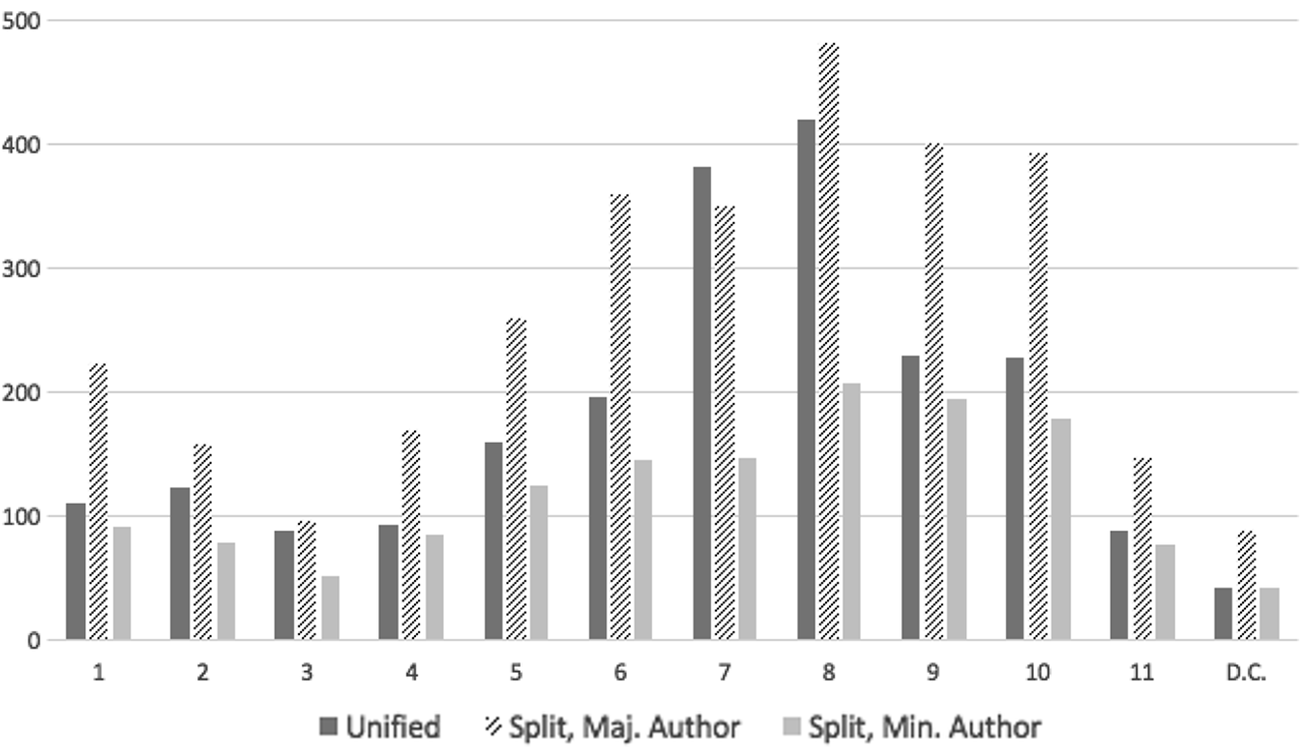
The empirical analysis evaluates citation patterns in authored panel opinions from 1990 to 2010 (n = 6,693).Footnote 6 Figure 1 illustrates the distribution of different panel types within each circuit. With the exception of the Seventh Circuit (where unified panels are most common), the modal panel type is a split panel with the opinion authored by a member of the panel majority. The cases in the data set from 1953 to 1989 and all en banc and per curiam cases are used only as precedents that may be cited. Since nonauthor panel members are most likely to police the use of binding precedent, I examine the use of published in-circuit precedents. This focus, although seemingly narrow, encompasses a wide swath of all citations. There is evidence that nearly half of all citations in circuit court briefs and opinions refer to published case law from the same circuit (Reagan Reference Reagan2006).
Distribution of panel type by circuit: published, authored opinions in search-and-seizure cases from 1990 to 2010 broken down by panel type and circuit.

For each treatment case, the choice set potentially includes every precedent from its own circuit from 1953 up to the day before the opinion in the treatment case was issued.Footnote 7 However, many of these precedents do not bear any relevance to the treatment case in spite of being within the same broad issue area. In order to narrow down the choice set in a practicable and objective manner, I follow the approach introduced in Hinkle (Reference Hinkle2015) and use cosine similarity scores to generate a similarity percentile measure that ranks every potential precedent in terms of its similarity to a particular treatment case (relative to all the other precedents in the choice set for that treatment case). This approach leverages the text of two opinions to calculate how similar they are as well as contextualizing that similarity in relationship to other precedents available at a particular time in a particular circuit.
The unit of analysis is a treatment case–precedent pair. There is an observation for each pair between a treatment case and every precedent in the top 50% of the similarity ranking for that particular treatment case. While setting any threshold is necessarily somewhat arbitrary, including the top half most similar precedents in the analysis has the benefit that it includes 99% of all negative treatments and 94% of all favorable citations. This demonstrates that using a precedent in the bottom half of the similarity ranking is remarkably rare. The decision of whether to negatively treat, ignore, or favorably cite a precedent in the top half of the choice set is modeled using a multinomial logit model. Shepard’s Citations is a legal publication that provides data on both the citation and treatment of precedents. Following Spriggs and Hansford (Reference Spriggs and Hansford2000), I classify the following Shepard’s treatments as negative treatments: “Distinguished,” “Criticized,” “Limited,” “Questioned,” “Overruled,” “Superseded,” and “Disapproved.” Any other type of reference to a precedent is classified as a favorable citation. Although this outcome variable is ordinal, some explanatory variables may make both negative treatment and favorable citation more likely than disregarding the precedent. For example, more similar precedents may be expected to be addressed more in general compared to less similar precedents. This pattern should manifest for both negative treatment and favorable citation. As a consequence, an ordered logit model is not appropriate in this context because the parallel slope assumption is likely violated (Borooah Reference Borooah2002; Hinkle Reference Hinkle2016). Since each treatment case appears in the data set every time it is paired with a precedent, I estimate robust standard errors clustered on the treatment case.
The panel type for each treatment case is classified into three discrete categories using the binary proxy for ideology of party of the appointing president. The baseline panel type is a unified panel, that is, one on which all three judges were appointed by a president from the same party. Indicator variables are included for split panel, majority author, which indicates the author has one ideological ally on the panel, and counterjudge author, which indicates the author has no ideological allies on the panel. Using a binary measure of ideology to empirically identify panel types that generate distinct theoretical predictions facilitates a simple and clear theoretical test. This is why using the party of the appointing president continues to be the dominant mode of analysis in the panel effects literature (see, e.g., Kim Reference Kim2009; Kastellec Reference Kastellec2011) even while continuous measures are increasingly used in the judicial politics literature more broadly.Footnote 8
My primary hypotheses call for estimating the effect of an author’s ideological distance to a precedent within each of the three panel types. Unlike panel type, there is no theoretical reason to reduce the distance between an author and precedent to discrete categories. Consequently, I use a more nuanced continuous measure of ideology, Judicial Common Space (JCS) scores.Footnote 9 Ideological distance is the absolute value of the difference between the JCS score of the authoring judge in the treatment case and the court median for the precedent. It has a theoretical range from 0 to 2, and higher values indicate greater ideological disparity. Ideological distance is interacted with panel type to examine whether an author’s ideology has a different impact conditional on the panel configuration. Additionally, there is an explanatory variable to indicate whether the precedent in question was written by one of the nonauthoring judges on the panel.
Control variables include a number of characteristics of the precedent: whether it was written by the author in the treatment case, how similar it is to the treatment case, whether there was a dissenting opinion, whether it was a per curiam opinion, whether it was decided en banc, its vitality,Footnote 10 the total number of times it has been previously cited and treated (within its own circuit), its age (and age squared), and its length (logged number of words; Spriggs and Hansford Reference Spriggs and Hansford2002; Hansford and Spriggs Reference Hansford2006; Hinkle Reference Hinkle2015). Similarity between two cases is quantified using the similarity percentile measure based on cosine similarity scores discussed above (Hinkle Reference Hinkle2015). The length of the treatment case (logged number of words) is also important to include in both models (Black and Spriggs Reference Black2008). In addition, I control for the logged number of available precedents and the caseload of the deciding court.Footnote 11
In addition to testing my primary hypotheses about panel effects, I begin the empirical analysis below with a test of the foundational hypothesis that decisions about precedent affect the development of circuit law. The models to test this basic premise include an observation for each panel precedent from 1990 to 2010 in each calendar year subsequent to when it was issued (through 2010). I estimate two models, one for negative treatment and one for favorable citation. The outcome variable is the annual count of each. Since these are counts that show evidence of overdispersion, I use negative binomial regression models. The primary explanatory variable in each model is simply the outcome variable from the previous year. The models control for both static and dynamic features of each precedent that may influence citation and treatment. Specifically, they control for whether the opinion was accompanied by a dissent, was issued per curiam, or was issued en banc as well as the opinion length, age, and age squared. Finally, I include the total number of cases in the data set from the relevant circuit in the relevant year to control for variation in the opportunity to reference a case. Examining the annual aggregation of how an opinion is used makes it possible to track its changing role in circuit law over time.
Results
Table 1 supports my foundational hypothesis that both negative treatments and favorable citations in 1 year will increase the number in the following year. Both relevant coefficients are positive and statistically significant.Footnote 12 Furthermore, the substantive size of these effects is notable, especially for particularly high levels of favorable citation. An opinion favorably cited zero times the previous year has a predicted count of only 0.24. An opinion must be favorably cited four times the previous year before the predicted count exceeds one. However, there are dramatic increases as the previous cite count increases from four. Eight favorable citations in a past year lead to nearly an equal number in the current year, and 10 previous citations leads to almost 18 cites in the current year. The trend continues to increase, and an opinion that has been favorably cited the maximum of 13 times the previous year generates a predicted count of 66 favorable citations. Negative treatments from the previous year range from only zero to five but also exhibit a substantively noticeable effect with the predicted number of negative treatments ranging from 0.014 to 2.34 at the minimum and maximum negative treatments in the previous year.
Effect of Negative Treatments/Favorable Citations from the Previous Year

Note.—Negative binomial regression estimates of the effect of negative treatments/favorable citations from the previous year (and a range of control variables) on the number of negative treatments/favorable citations of a precedent in each year. Robust standard errors are clustered on the circuit. N = 68,764.
* p < .05.
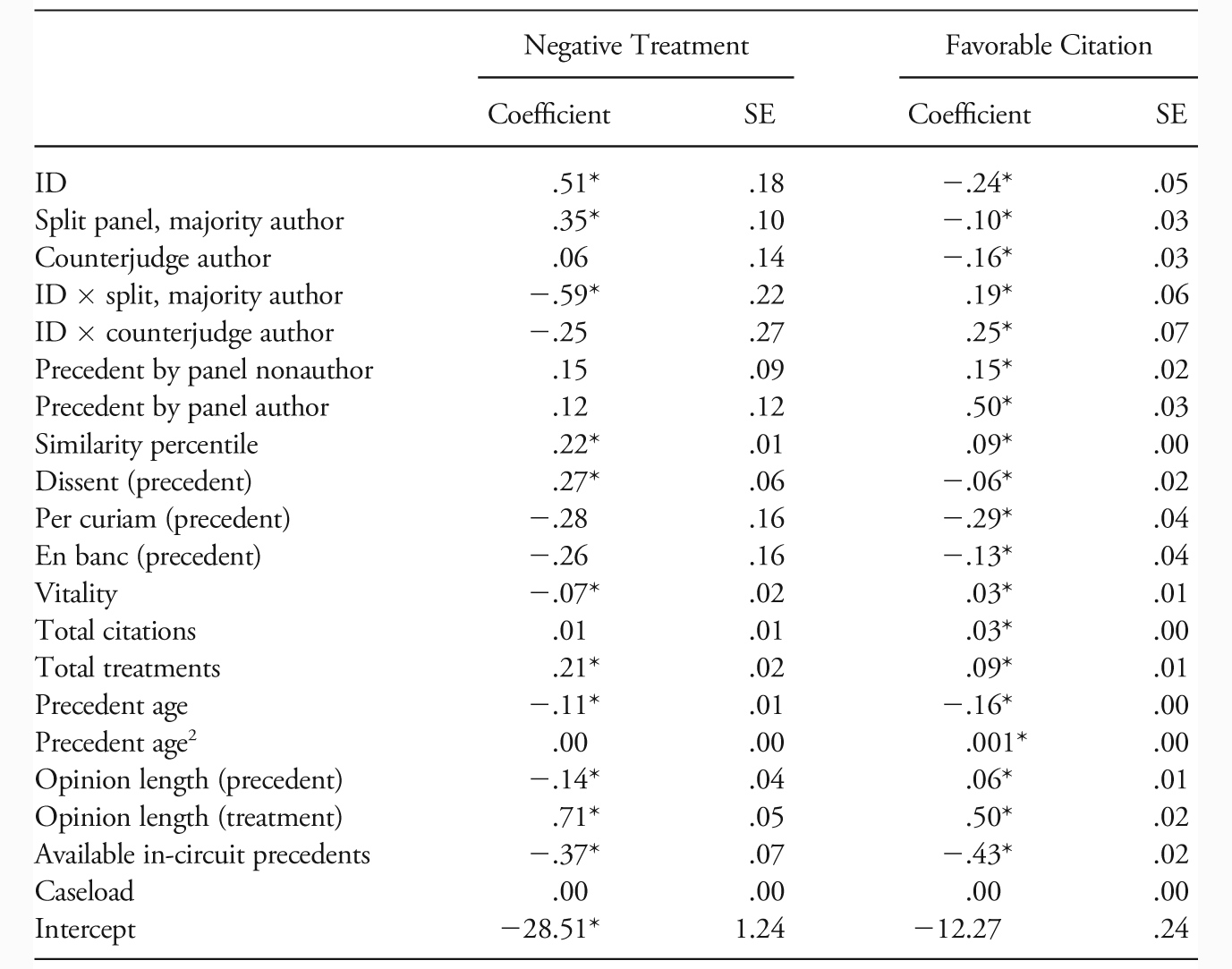
Having demonstrated the downstream effects of decisions about using binding precedents, I now turn to evaluate whether panel effects influence such decisions. The specific aspect of opinion writing I examine is whether the author decides to negatively treat, disregard, or favorably cite each binding circuit precedent. I look for evidence that panel composition conditions the author’s reliance on her own ideology in making these decisions. Table 2 sets forth the results of this analysis. When an author is writing for a unified panel, ideology plays the expected role. The author is more likely to negatively treat ideologically distant precedents and less likely to favorably cite such precedents. Both of these patterns are statistically significant. The opposite sign on the coefficients for ideological distance when it is interacted with the other two panel types indicates that, as hypothesized, the effect of an author’s ideology is dampened by the presence of colleagues appointed by a president from a different party. Furthermore, for the decision to favorably cite a precedent (rather than ignore it) the absence of any ideological allies on the panel appears to dampen the effect of the author’s ideology more than having one such ally on the panel.
Effect of Ideological Distance on Whether to Negatively Treat, Ignore, or Favorably Cite a Precedent

Note.—Multinomial logit regression estimates of the effect of ideological distance (ID), panel type, their interaction, and a range of control variables on the decision of whether to negatively treat, ignore, or favorably cite a precedent. The baseline outcome is ignoring a precedent. Robust standard errors are clustered on the treatment case. N = 3,197,420.
* p < .05.
While the results in the regression table provide preliminary evidence of panel effects in opinion crafting, more in-depth analysis is necessary to evaluate the significance of these effects. Exploring a combination of marginal effects and predicted outcomes sheds light on substantive as well as statistical significance. Such calculations require fixing most explanatory variables at set values. Using median values in the data set is often a sensible approach. However, here the research design includes a large number of precedents in the choice set for each case. The bulk of those will never be addressed. Since the primary focus is on negative treatment and favorable citation, I use the median values of those precedents that are actually discussed in some way rather than the median value of all precedents. For example, the median value of the similarity percentile in the entire data set is 75, but the median value for those precedents that are not ignored is 96. Focusing on the latter subgroup frames the marginal effects and predicted outcomes in terms of how the model influences the use of precedents most likely to make it into an opinion (without the loss of information that would occur if the choice set was narrowed substantially from the outset).
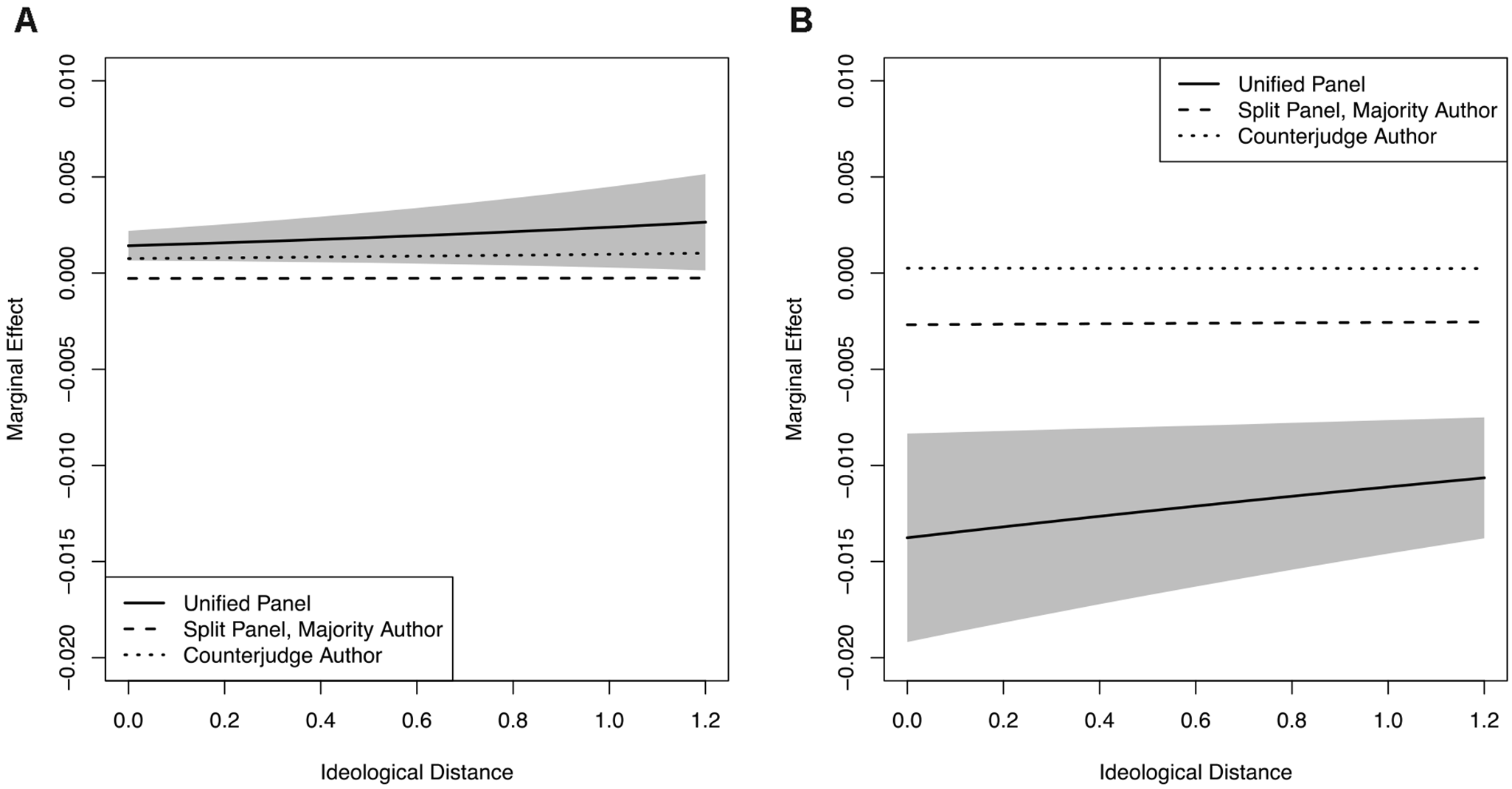
Figure 2 illustrates the marginal effect of ideological distance over its entire range for each different panel type. The same type of pattern emerges for both negative treatment and favorable citation. On unified panels the author’s ideology is statistically significant and in the expected direction. Moreover, with one exception, the effect of author ideology on unified panels has a significantly larger impact than on either other panel type. The statistical significance of the difference from the other panel types is evident when the estimated marginal effect of ideological distance for split panels with either a majority or counterjudge author falls outside the 95% confidence interval around the estimate for unified panels. The exception where this difference is not significant is the comparison to panels with a counterjudge author for the negative treatment decision. For both types of decisions and both types of split panels, the effect of ideological distance is dampened to the point that it is not significantly different from zero.
Marginal effects of ideological distance for each panel type. A, Marginal effect on negative treatment; B, marginal effect on favorable citation. All other variables are held at their median conditional on not being ignored. Shaded regions delineate the 95% confidence intervals when the panel is unified. Marginal effects for the other panel types are not statistically significant, so their confidence intervals are excluded for visual clarity.

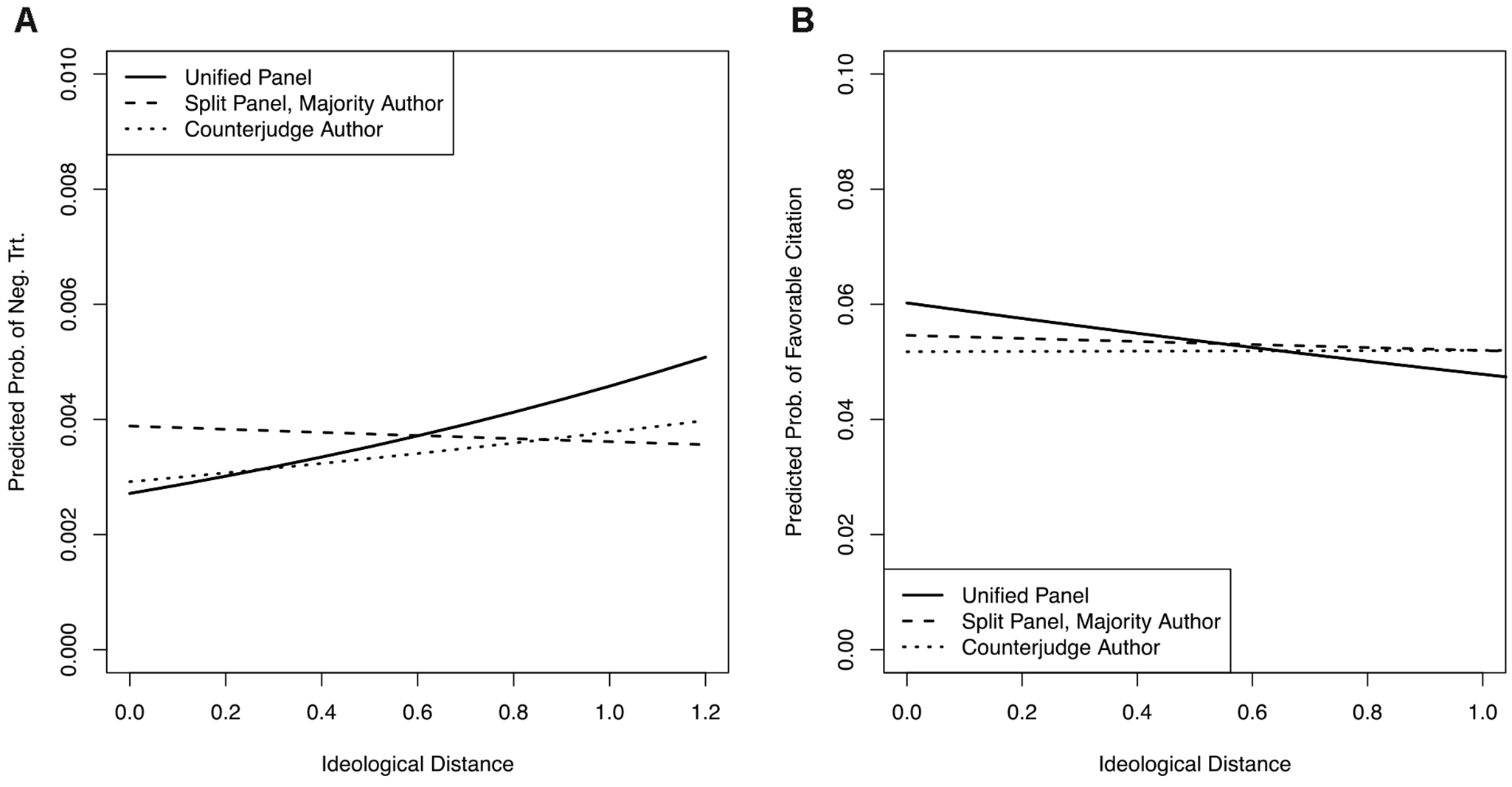
The marginal effects plots indicate that while the overall patterns are generally analogous for negative treatment and favorable citation, ideological distance has a bigger impact on decisions about favorable citation than those about negative treatment. To further investigate this difference, figure 3 shows the predicted probabilities of favorable citation and negative treatment for each panel type over the range of ideological distance. The microlevel of analyzing individual decisions about precedent can present challenges to evaluating the substantive impact of statistically significant effects. The large number of precedents in the choice set necessarily means that the baseline probability of negatively treating or favorably citing an average case is quite small (even when the “average” case is characterized on the basis of those precedents that are not ignored). The baseline predicted probability of negative treatment is 0.004, while the baseline predicted probability of favorable citation is 0.054. Note that figure 3A covers a much smaller range of the y-axis than figure 3B, in order to display the smaller predicted probabilities for negative treatment.
Predicted probability of negative treatment (A) and favorable citation (B) over the range of ideological distance for each panel type. All other variables are held at their median conditional on not being ignored.

For unified panels, figure 3 shows that moving ideological distance from zero to its highest value in the data increases the predicted probability of negative treatment by 0.0024 (from 0.0027 to 0.0051), an 89% increase. The same change reduces the predicted probability of favorable citation by 0.014 (from 0.060 to 0.046), a 23% reduction. Evaluating effect sizes at the case level is somewhat more intuitive. Because of the research design, the median number of binding precedents available for negative treatment or favorable citation is quite large: roughly 1,300. With a choice set of 1,300, the model predicts that a typical author will favorably cite 19 cases and negatively treat 0.9 cases from the most ideologically proximate quartile of the choice set, while favorably citing 17 cases and negatively treating 1.3 cases from the most distant quartile. Although these differences of two favorable citations and one-third of a negative treatment are not overwhelmingly large, they do indicate that the author’s ideology plays a measurable role for unified panels when microdecisions are aggregated to the case level. Moreover, it is important to bear in mind that for those additional precedents being favorably cited or negatively treated on the basis of ideology, such decisions aggregated across all citing cases in a given year can have a substantial impact on how that precedent is used in the following years.
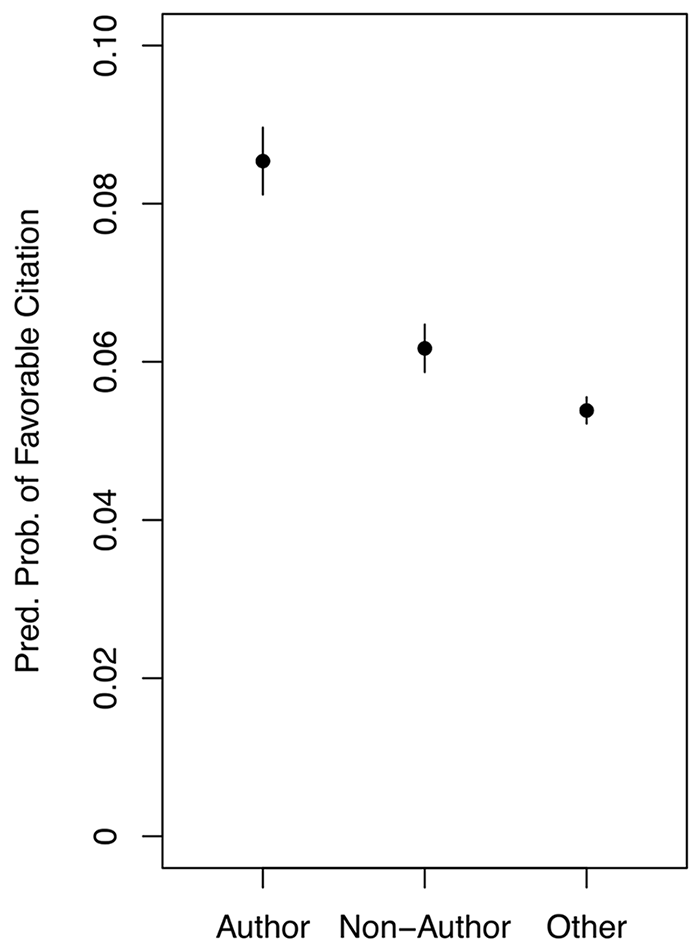
In addition to ideological dampening when the panel is not unified, there is evidence that authors are influenced by the identity of their panel colleagues. Even after accounting for numerous other factors, an author is significantly more likely to favorably cite a precedent written by a fellow member of the panel than one written by a judge who is not on the panel. However, the presence of the precedent author on the panel does not have a statistically significant effect on negative treatment. As illustrated in figure 4, the substantive size of the effect for favorable citation is somewhat modest; authors are most likely to favorably cite their own precedents.Footnote 13 Nevertheless, a precedent written by a nonauthor panel member has a 0.062 predicted probability of favorable citation, a 15% increase over the baseline probability of favorably citing a precedent written by a judge who is not serving on the relevant panel.
Predicted probability of favorably citing a precedent written by the author, a nonauthor panel member, and another judge not sitting on the panel. All other variables are held at their median conditional on not being ignored. Bars provide the 95% confidence interval for each estimate.

The control variables tend to have the anticipated effect on both negative treatment and favorable citation. Authors are more likely to favorably cite their own precedents. More similar precedents are more likely to be both negatively treated and favorably cited. The latter finding is consistent with the reality that negative treatment is often driven by the necessity of explaining why a precedent that appears to be quite similar is, in fact, not legally relevant. Precedents accompanied by a dissent are more likely to be treated negatively and less likely to be cited favorably. Both per curiam and en banc precedents are less likely to be cited favorably. The fact that en banc opinions are favorably cited less is somewhat strange. It might reflect a dynamic in which en banc cases produce greater legal certainty, thereby reducing subsequent litigation on the issues in question. The dynamic variables mostly reflect the expected patterns. Vitality, total citations, and total treatments all increase favorable citation, and vitality decreases negative treatment. Total treatments increases negative treatments. Precedent age has the anticipated nonmonotonic effect. Longer precedents are favorably cited more and treated negatively less. The latter result suggests opinion length is associated with greater legal quality rather than just addressing a greater number of issues. When authors write longer opinions, they are more likely to both favorably cite and negatively treat any given precedent. Finally, longer treatment opinions contain more negative treatments and favorable citations, and the more precedents available from which to choose, the less likely any is to be negatively treated or favorably cited.
Discussion and Conclusions
A long line of research on how circuit judges interact provides insight into the ways panel configuration influences case outcomes. Judges do not vote in consistent patterns regardless of who else is serving with them on a panel. To the contrary, the institutional context creates an environment in which judges influence one another. The evidence provided here indicates that such influence extends beyond the conference discussion when the three judges sit in the same room to discuss the resolution of the case face-to-face. Even after the assigned author has returned to her own chambers in her own city, the identity and ideology of the other two panel members continue to play a role. While authors undoubtedly exercise discretion in how they craft an opinion to reach a designated result, that discretion is not unconstrained. Moreover, whether and how authors exercise such discretion ultimately has a cumulative effect that shapes the course of law in each circuit.
The central contribution of this article is the finding that authors only rely on their own ideology to make negative treatment and favorable citation decisions about binding circuit precedent when the panel is fully staffed with their ideological allies. There is no evidence that authors with only one such ally rely on their own ideology, even though only one additional vote is needed to support the majority opinion. This pattern likely reflects the reality that a single disgruntled colleague can drag out the opinion-writing process by asking for revisions or by writing a separate opinion that prompts a response within the majority opinion. Consequently, ideological diversity on a panel is likely to lead to higher levels of both accommodation and anticipation. Accommodation occurs when another judge requests a revision to the draft majority opinion and the author is willing to make the change or able to negotiate a mutually acceptable revision. Anticipation occurs when the author on a split panel anticipates that behaving ideologically will simply generate requests for revision and, therefore, reins in his own ideology a priori in the interest of efficiency. Regardless of whether accommodation or anticipation is most frequent, they both lead to the observed consequence that unified and split panels result in different types of majority opinions. The author’s ideology is a significant predictor of how precedent is used in the former but not the latter.
Panel effects appear to operate on opinion crafting in a similar manner to how they influence case outcomes. Even the presence of a single judge has an effect. For both voting and opinion crafting this finding can likely be explained by some combination of deliberative and strategic effects generated by the institutional structure of circuit courts. Heavy caseloads, limited resources, and repeated collegial interactions all increase the utility of playing nicely. The similar patterns in voting and opinion crafting are also likely driven by the common influence of legal doctrine on both. In one of the most prominent studies of panel effects, Cross and Tiller Reference Cross(1998) examined case outcomes in an empirical context that directly mapped case outcomes to legal doctrine. By investigating the presence or absence of deference to an administrative agency in post-Chevron cases, they were able to study panel effects in a context that directly pitted each judge’s ideological preferences against the dictates of existing law. The data explored here provide similar insight. Not only is there evidence of panel effects on opinion crafting, but that evidence takes the form of directly juxtaposing the impact of ideology with the impact of the legal doctrine of stare decisis that makes all relevant in-circuit precedents binding. Like Chevron deference, stare decisis does not provide a definitive answer for every specific legal question. But it does provide a baseline expectation against which to measure the countervailing influence of ideological preferences.
The findings here should serve as a starting point for a more widespread analysis of panel effects on opinion crafting. Factors such as issue area, caseload, salience, and specialization may very well drive the extent of an author’s discretion and how much panel type constrains that discretion. Different hierarchical configurations of preferences may also lead to different types of panel effects on opinion crafting. In addition, different patterns might explain panel effects based on judicial characteristics such as sex and race. Panel effects might also manifest differently when a visiting or senior judge participates on a panel. The role of the opinion author and the influence exerted on the author by the other members of the panel might be different in these areas. Although there was no difference found here between split panels when the counterjudge was the author or not, different patterns may emerge when examining the role of female, minority, visiting, or senior authors. Theoretical grounds will be somewhat different, but the same reasons for looking at authorship and opinion content still apply. These are all issues ripe for elaboration.
This article is focused on the consequences rather than the causes of opinion assignment. But one of the implications of the findings here is that the question of what drives opinion assignment in the circuit courts might be more important in some contexts than others. Authors do wield considerable power, but that power is curtailed in the case of split panels. The corollary of any limits on an author’s discretion is the corresponding reduction in the importance of the opinion-assigning power. The implication is that the power of assigning authorship duties may not be quite as important in the institutional milieu of a circuit panel as it would be if authors were less constrained. This may provide part of the explanation for the finding of Farhang et al. Reference Farhang(2015) that the assignor’s ideology does not significantly predict opinion assignment on circuit panels. Contrary to what research at the Supreme Court level has shown, they find that opinion assignment on circuit panels appears to follow a collegial process in which the opinion assignors tend to grant requests made by their colleagues. The connections between opinion assignment and panel effects are complicated. Do authors defer in order to preserve their continued ability to request authorship assignments? Or are opinion assignors willing to grant requests knowing that efficiency concerns and oversight from other panel members will constrain any author from drifting too far from what his or her colleagues prefer? While this will be challenging to disentangle, it is a complexity well worth tackling in future work.