INTRODUCTION
Previous research has identified a range of factors that contribute to the word order change, e.g. direct object type (pronoun versus NP), semantic/pragmatic features, context/discourse-relatedness, Information Structure and intonation. These factors have not received equal attention in studies concerning different languages. In Slavic languages, for instance, word order permutations (also called scrambling) have been traditionally associated with Information Structure: the basic word order is SVO, but old/known/given objects may also appear in a preverbal position, yielding such structures as SOV, OSV or OVS (Firbas, Reference Firbas1964; Sgall, Hajičová & Panevová, Reference Sgall, Hajičová and Panevová1986;Yokoyama, Reference Yokoyama1986; among many others). In the Germanic tradition, on the other hand, direct object scrambling (or shift) has been accounted for by the semantic features of specificity, partitivity or definiteness (see De Hoop, Reference De Hoop1992; Diesing, Reference Diesing1997; Diesing & Jelenek, Reference Diesing and Jelenek1993; Holmberg, Reference Holmberg1999; Thráinsson, Reference Thráinsson, Baltin and Collins2001; Van Geenhoven, Reference Van Geenhoven1998; inter alia).Footnote 1 It appears that cross-linguistically one of the most discussed aspects of object scrambling has been its correlation with the loss of non-specific readings. It remains open, however, whether the same correlation exists in Slavic languages. Although the effects of definiteness/specificity on word order have been demonstrated in Russian (Avrutin & Brun, Reference Avrutin, Brun, Do, Dominguez and Johansen2001; Brun, Reference Brun, Franks, Gladney and Tasseva-Kurktchieva2005; Dyakonova, Reference Dyakonova2004), Serbo-Croatian (Ilić & Deen, Reference Ilić, Deen, van Kampen and Baauw2004), Czech (Biskup, Reference Biskup2006) and Ukrainian (Mykhaylyk & Ko, Reference Mykhaylyk, Ko, Antonenko, Bailyn and Bethin2008), more research is needed to ascertain the validity of the existing data and to corroborate proposed analyses.
The aim of this study is to investigate one word order transformation labelled direct object scrambling (SVO→SOV) and to identify its main properties in child and adult Ukrainian. Similarly to other languages exhibiting scrambling, Ukrainian permits objects to occur before the verb in an SOV structure that diverges in its interpretive possibilities from the basic SVO order. Specifically, the sentences below are well-formed and appropriate with both scrambled (1) and non-scrambled (2) direct objects (marked with the demonstrative pronoun tu ‘that.ACC’ and thus definite-specific).
(1) There is a book in Roman's bag. Why did he put it in there?
Vin tu knyžkubere v školy.he that book takes to school‘He is taking that/the book to school.’
(2) Vin beretu knyžku v školy.he takes that book to school‘He is taking that/the book to school.’
Structure (3), however, is degraded (if pronounced with neutral prosody): given that the direct object (optionally marked with the indefinite pronoun jakus' ‘some.ACC’) is non-specific, its appearance in a preverbal position makes the sentence infelicitous.
(3) Why is Roman's bag so heavy?
# Vin (jakus')knyžku tudy poklav.he some book there put‘He put some/a book in there.’
These language facts are interesting with respect to the syntax–semantics correlation in direct object scrambling and the representation of this correlation in child grammar. If there is any semantic prerequisite for scrambling, Ukrainian speakers should produce scrambled structures only in certain contexts. Furthermore, if there is any implicit constraint on scrambling, children should follow it by activating intrinsic grammar mechanisms. Based on a number of the studies mentioned above, it is possible to hypothesize the following constraint: Do not scramble indefinite/non-specific/non-partitive objects. This ‘scrambling rule’ has been shown at work in the grammar of speakers and learners of various languages (mostly Germanic), and this research will determine whether it is operative in a Slavic language – Ukrainian.
This article presents experimental data from forty-one monolingual children (2 ; 7–6 ; 0) and twenty adult native speakers of Ukrainian. The results of an elicited production task reveal that the SOV structure is present in child production from early stages (i.e. the age of 2–3 years). Children follow adult patterns by producing this structure only in definite or partitive contexts. However, children differ from adults in pronominal scrambling, and become target-like only at the age of four to five years. These findings point toward the complex nature of the syntax/semantics/phonology correlation in object scrambling and provide insights into the issue of its optionality. Although scrambling is optional in child speech, this optionality is mostly adult-like, which suggests that there is no impairment in child grammar with regard to syntactic properties, semantic features or relevant pragmatic principles. Crucially, the key factors affecting scrambling both in child and adult Ukrainian are the object type and its semantics.
The article is organized as follows. First, previous research on scrambling is briefly surveyed. Next, the relevant language data, some theoretical assumptions and predictions for child acquisition of scrambling in Ukrainian are presented. The subsequent section provides a detailed description of the experimental study and the main results. The article concludes with a discussion of the findings and their implications for language acquisition theory.
Previous experimental studies
Word order variations have been examined extensively in acquisition research (Hopp, Reference Hopp2005; Josefsson, Reference Josefsson, Johnson and Gilbert1996; Neeleman & Weerman, Reference Neeleman and Weerman1997; Otsu, Reference Otsu, Hoekstra and Schwartz1994; Schaeffer, Reference Schaeffer2000; Unsworth, Reference Unsworth2005; Westergaard, Reference Westergaard, Guijarro-Fuentes, Larranaga and Clibbens2008; inter alia). Some of previous studies have directly related scrambling to the semantic properties of the direct object, while others just mentioned the interpretational effects of word order change. Nevertheless, most studies focusing on production have shown that both child and adult language learners scramble in appropriate contexts, but that the rates of scrambling vary. This variability has received divergent explanations, ranging from children's cognitive immaturity to a lack of abstract features in their grammar.
Schaeffer (Reference Schaeffer2000) shows that two-year-old children acquiring Dutch scramble less often compared to older children and adults. She claims that the optionality of object scrambling at the early stage of acquisition results from the optional marking of specificity, which in turn depends on the acquisition of ‘the Concept of Non-Shared Knowledge’, which states that speaker and hearer knowledge are always independent. Under this view, young children lack pragmatic knowledge, which leads to the lack of a distinction between discourse-related (mentioned in the discourse, e.g. the tree) and non-discourse-related (part of long-term shared knowledge, e.g. the sun) object DPs. The object, then, is not constantly marked with the relevant feature, and the syntactic process of scrambling does not always take place.
However, a number of recent studies suggest that children do not have many difficulties with scrambling. It has been shown, for instance, that in Russian and Serbo-Croatian even the youngest children place most NPs in a target-like way; they are able to establish a mapping between a position for the scrambled object and specificity by the age of two to three (Avrutin & Brun, Reference Avrutin, Brun, Do, Dominguez and Johansen2001; Dyakonova, Reference Dyakonova2004; Ilić & Deen, Reference Ilić, Deen, van Kampen and Baauw2004). This mapping can thus be considered a part of an innate (or very early acquired) knowledge of the syntax–discourse interface rules. Furthermore, it has also been demonstrated that children can distinguish between ‘old’ and ‘new’ objects, and that they set their information structure in place early (De Cat, Reference De Cat, Beachley, Brown and Conlin2003; Reference De Cat2009; Gordishevsky & Avrutin, Reference Gordishevsky, Avrutin, van Kampen and Baauw2004).Crucially, studies on acquisition of Norwegian show that in child grammar, given information may occur in positions normally reserved for new information, but not the other way around (Anderssen, Bentzen, Rodina & Westergaard, Reference Anderssen, Bentzen, Rodina, Westergaard and Anderssen2010; Westergaard, Reference Westergaard, Guijarro-Fuentes, Larranaga and Clibbens2008). A pragmatic approach proposed by Schaeffer (Reference Schaeffer2000), however, is unable to account for these data. The lack of the concept of non-shared knowledge should cause children to treat new elements as given and known to the hearer. However, children did not overestimate the hearer's knowledge and did not move ‘new’ NPs leftwards.
These findings imply that syntactic–semantic factors might play a more important role in scrambling than knowledge of a certain pragmatic concept. However, more research on languages is needed in order to evaluate earlier proposals. The current article contributes to this discussion by presenting evidence from the acquisition of object scrambling in Ukrainian.
EXPERIMENTAL PRELIMINARIES: LANGUAGE FACTS
This article focuses specifically on one type of scrambling schematized as the placement of a direct object between the subject and the verb (or adverb): S(Adv)VO→SO (Adv)V. Focus on this type of word order transformation is justified given that the SOV structure is common in various languages, including Slavic, and exhibits distinctive properties, as has been shown in Dyakonova (Reference Dyakonova2009), Slioussar (Reference Slioussar2007) and Van Gelderen (Reference Van Gelderen2003) on Russian. In other Slavic languages, however, this phenomenon has not received sufficient treatment, although it appears to be quite a coherent type of scrambling, both syntactically and semantically.
Parallel data from Dutch and Ukrainian demonstrate interpretative correlates of this word order change: a loss of non-specific readings of the direct object in a scrambled position. Sentences from Dutch (4a) and Ukrainian (5a) with the adverb ‘twice’ are interpreted as ‘there are two throwing events of the same specific ball, but not one throwing event of two balls’. The latter reading is available only in the non-scrambled sentences (4b & 5b).
- (4)
(a) Het meisje heeft een baltwee keer gegooid.the girl has a ball.ACC two times thrown‘The girl threw a (certain) ball twice.’# ‘The girl threw a(some) ball twice.’
(b) Het meisje heeft twee keereenbal gegooid.the girl has two times a ball.ACC thrown‘The girl threw a(some) ball twice.’ (Unsworth & Helder, Reference Unsworth, Helder, Freitas and Gavarró2008)
- (5)
(a) Divčynka mjačykdviči kynula.girl ball.ACC twice threw‘The girl threw the/a certain ball twice.’# ‘The girl threw a (some) ball twice.’
(b) Divčynka dviči kynula mjačyk.girl twice threw ball.ACC‘The girl threw a (some) ball twice.’
Another property of Ukrainian that is also exhibited in many object-shift languages (see e.g. Richards, Reference Richards and Boeckx2006) is pronominal scrambling. Pronouns as contextually related and inherently referential elements show a strong tendency to scramble: they ordinarily must move both in Dutch and in Ukrainian. Thus in (6) and (7), the personal pronoun ‘her’ scrambles leftwards and cannot be left in its base position without infelicity if the sentence prosody remains the same.
(6) dat Marieke haar niet gezien heeft.that Marieke her not seen has‘that Marieke didn't see her’
(7) Marija jiji ne bačyla.Maria her not seen‘Maria didn't see her.’
In addition, other types of objects seem to behave similarly in both languages, e.g. definite and quantificational NPs scramble only optionally (De Hoop, Reference De Hoop and Karimi2003; Mykhaylyk & Ko, Reference Mykhaylyk, Ko, Antonenko, Bailyn and Bethin2008).
Thus, the core observation concerning Ukrainian is that object scrambling alters the sentence interpretation, restricting possible semantic properties of the object in preverbal position (see also Dyakonova, Reference Dyakonova2009, on Russian). This approach opens new perspectives for developing a unifying account of two phenomena that are usually treated independently, but could be reduced to one type. (While there remain obvious differences between Germanic and Slavic syntactic structures, the data presented above indicate some important parallels which cannot be ignored.)
Despite many similarities with object-shift languages, Ukrainian has some important features that set it apart from languages like Dutch and make its investigation more focused on factors specific to scrambling. First, unlike Germanic languages, Ukrainian has a type of scrambling which can be detected in structures without adverbs or negation. Furthermore, Ukrainian is an article-less language that has no obligatory surface marking of the semantic features involved in scrambling. As was noted in Mykhaylyk & Ko (Reference Mykhaylyk, Ko, Antonenko, Bailyn and Bethin2008), Ukrainian employs some lexical means with a function similar to that of determiners: e.g. demonstratives such as cej ‘this’ or toj ‘that’; the cardinal numeral odyn ‘one’; indefinite determiners jakyjs', byd'-jakyj, dejakyj, jakyj-nebud' ‘some/any/whichever’. However, all these lexical means are only optional (unlike articles), and they do not have the same semantics. In sum, Ukrainian word order encodes semantic distinctions which have been described in other languages (e.g. Dutch), but also has some properties specific to Slavic languages.
This article emphasizes those aspects of object scrambling which unify rather than distinguish this phenomenon in different languages and focuses on the potentially universal developmental stages in the acquisition of scrambling. Previous investigations of word order in child speech suggest two specific predictions with regard to the state of developing grammar. First, it can be predicted that even the youngest children (two-year-olds) should be able to scramble in principle (following Avrutin & Brun, Reference Avrutin, Brun, Do, Dominguez and Johansen2001; Barbier, Reference Barbier, Powers and Hamann2000; Dyakonova, Reference Dyakonova2004; Kornfilt, Reference Kornfilt, Lust, Suner and Whitman1994; Otsu, Reference Otsu, Hoekstra and Schwartz1994; Penner, Tracy & Weissenborn, Reference Penner, Tracy, Weissenborn, Powers and Hamann2000). Second, children will produce correct syntactic structures when provided with appropriate experimental contexts, i.e. they will scramble direct objects which are contextually defined as definite/partitive/specific (including pronouns); while indefinite/non-partitive/non-specific direct objects will not appear in a scrambled position (see e.g. Clahsen & Muysken, Reference Clahsen and Muysken1986; Unsworth, Reference Unsworth2005; and others). The experimental study presented in the following section tests these predictions and allows us to identify other factors affecting scrambling in Ukrainian.
METHOD
Participants
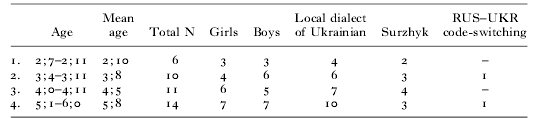
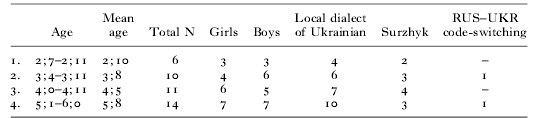
Participants for this experimental study were recruited and tested in summer of 2008 in the city of Vinnytsia and Vinnytsia region in Ukraine. They were divided in five age groups: two-, three-, four- and five-year-old children (N=41) and a control group of adults (N=20). The children were tested in two regular daycare centres on the outskirts of the city. They ranged in age from 2 ; 7 to 6 ; 0 (M: 4 ; 1). There were twenty-two boys and nineteen girls. The children belonged to a relatively similar middle-class socioeconomic milieu. With regard to the language use, the group is defined as ‘monolingual Ukrainian children’ because for most of them Ukrainian is a native and dominant language: it is used very often in their families and exclusively in daycare centres which they attend full time. However, since Ukrainian–Russian bilingualism is common in Ukraine, all participants had various amounts of exposure to Russian. Several children used a mixed Ukrainian–Russian sociolect called Surzhyk (N=12). Two children were active speakers of Russian, but since Russian–Ukrainian code-switching did not impede their conversation with the experimenter, they were included in the study. Information about four child groups is given in Table 1.
Child age groups
The fifth group was the adult control group that included twenty participants: thirteen females and seven males. They ranged in age from 18 to 61 (M: 41). All of the adult participants were native speakers of Ukrainian and fluent in Russian. Their educational level was higher than the level of secondary school.
Design and materials
The experiment consisted of an elicited production in a picture-description task. Children and adults followed exactly the same procedure. Participants had a short conversation with a silly puppet Tigger and the experimenter. Tigger would name an object in a picture presented in a folder and then would turn to the next page, but while looking at the second picture he would get confused, and the experimenter would solicit help from the participant. The participant had to describe the second picture, which was designed in such a way that it would trigger the use of a transitive construction with a direct object.
The design used in testing each age group manipulated only one factor, which is broadly defined as context or condition, determining the semantics of the direct object. Contexts were spelled out in the preamble and corresponded to different pictures. They made the direct object semantics unambiguous, and thus were meant to elicit certain responses from the participants. Recall that the main goal of this research was to define/verify semantic–pragmatic properties associated with scrambling in Ukrainian. Three semantic features were considered, i.e. definiteness, specificity as referentiality, and specificity as partitivity. It was impossible to create contexts in which all combinations of these features could be represented without radically changing lexical material in the experimental items. Therefore, a theoretically possible factorial design −2 (definite vs. indefinite)×2 (specific vs. non-specific)×2 (partitive vs. referential) – could not be implemented. Instead, in the modified design, the context manipulation was used with each age group separately. In addition, Age was incorporated as another independent variable that allowed us to test the use of scrambling as a function of age.
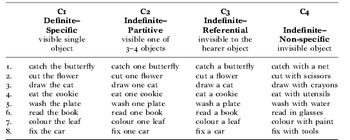
The stimuli consisted of thirty-two experimental items. They were short dialogues constructed with eight verbs: pijmaty ‘catch’, vyrizaty ‘cut out’, maljuvaty ‘draw’, jisty ‘eat’, myty ‘wash’, čytaty ‘read’, farbuvaty ‘colour’, remontuvaty ‘fix’. These verbs were used with eight objects (e.g. metelyk ‘butterfly’, kvitka ‘flower’, kotyk ‘cat’, pečyvo cookie', tarilka ‘plate’, knyžka ‘book’, lystok ‘leaf’, mašyna ‘car’) corresponding to the eight pictures (see the examples in Appendix A). They appeared in target sentences in four conditions, as shown in Table 2.
Items used in the experiment

Eight indirect objects were used in one of the conditions in order to elicit independent use of a direct object: sačok ‘net’, nožyci ‘scissors’, olivci ‘crayons’, ložky ‘utensils’, voda ‘water’, okuljary ‘glasses’, farby ‘paint’, instrumenty ‘tools’. Each participant received eight items counterbalanced in the four conditions (C1–C4). The relatively small number of items was due to the limited time available for the experimenter to administer the task and the short attention span characteristic of young children; thus, the whole experiment lasted 15–20 minutes on average.
The experimental items were presented in the following four context conditions: Definite–Specific (C1), Indefinite–Partitive (C2), Indefinite–Referential (C3) and Indefinite–Non-specific (C4) (see Table 2). Note that three conditions C1, C2 and C3 have the same lexical items, while one condition, C4, does not. This was necessary because we needed contrastive contexts: in the three specific conditions the direct object was introduced in the discourse, while in the Indefinite–Non-specific Condition it had to be imagined by the participant and could not be provided in the stimuli. The example of the stimuli used in four conditions (8–11) clarifies this issue. Importantly, all predicted syntactic structures in the following examples are assumed to have the most neutral prosodic contour, with the falling pitch accent on the final sentence constituent. It is also possible that other syntactic structures would be used provided they have a noticeable change in the sentence prosody.
(8) Condition 1: Definite/Specific/Partitive
exp (to the participant): ‘Tigger wants to see pictures in a book. He does not speak well and he is a bit silly and shy. He must be helped if he doesn't know what to say.’
exp (to Tigger): Dyvysia, Tyhre, ščo ce?
‘Look, Tigger, what is this?’
tigger: Lystočok
‘A leaf.’
exp: A koho ty bačyš na ciomu maliunku?
‘And who do you see in this picture?’
tigger: Ce Vini Pux
‘It's Winnie the Pooh.’
exp: Ščo vin robut' z cym lystočkom?
‘What does he do with the leaf?’
tigger: Ja ne znaju …
‘I don't know.’
exp (to the participant): Ty možeš dopomohty?
‘Can you help?’
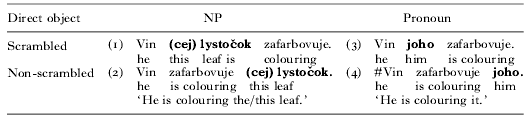
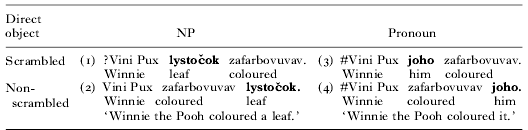
After hearing the last question the participant was expected to produce a sentence with a direct object. Two main answers were possible with respect to the form of the direct object: a sentence with the full NP (with or without the demonstrative pronoun) or a sentence with the personal pronoun. In addition, these direct objects could appear in a scrambled or non-scrambled position, as shown in Table 3 (the direct object is in bold).
Possible answers in C1
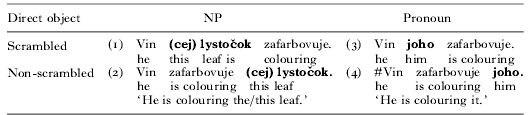
The prediction which follows from the theoretical assumptions of this study is that since the direct object is clearly defined in the discourse and thus is definite, it should be scrambled to a preverbal position, as shown in Table 3 (1). The use of a demonstrative pronoun (cej ‘this’ or toj ‘that’) is not required, but probable. However, since scrambling is considered to be optional in Ukrainian, the non-scrambled answer, 3 (2), was also plausible (although with a distinct prosody). Furthermore, since the question of the experimenter contains the lexical item ‘leaf’ (‘What does he do with the leaf?’), it was natural to use a pronoun to avoid repetition: e.g. ‘He colours it.’ Since pronouns are inherently referential, are discourse-related and are usually placed in preverbal position in Ukrainian, it was predicted that the scrambled answer with a pronoun, 3 (3), was another option for C1. The non-scrambled answer with a pronoun, 3 (4), was not predicted, but could be used under special prosodic conditions.
The second context is exemplified in (9). It contains a dialog similar to C1, but requires a set of three or four identical objects, which makes one of them indefinite–partitive.
(9) Condition 2: Indefinite/Specific/Partitive
exp: Dyvysia, Tyhre, ščo ce?
‘Look, Tigger, what is this?’
tigger: Lystočky: 1, 2, 3, 4.
‘Leaves: 1, 2, 3, 4.’
exp: A koho ty bačyš na ciomu maliunku?
‘And who do you see in this picture?’
tigger: Ce Vini Pux
‘It's Winnie the Pooh.’
exp: Ščo vin robut' z cymy lystočkamy?
‘What does he do with these leaves?’
tigger: Ja ne znaju …
‘I don't know.’
exp (to the participant): Ty možeš dopomohty?
‘Can you help?’
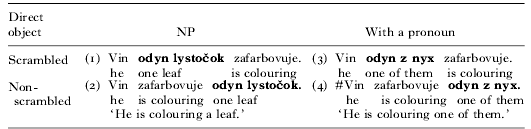
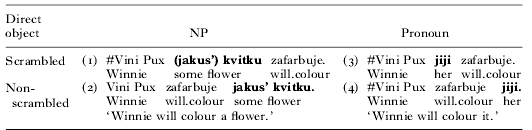
Predicted responses to this question are given in Table 4.
Possible answers in C2
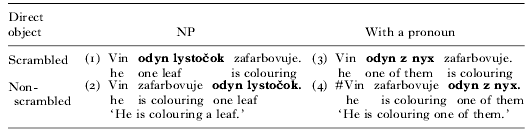
Even though the object NP is indefinite (the hearer might not notice which of the three leaves has been manipulated in the second picture), it is still present in the discourse and contextually defined, and thus the predicted answer is scrambled, Table 4 (1). However, a non-scrambled answer, 4 (2), is also possible. Furthermore, if a participant prefers to use a constituent with a pronoun ‘one of them’, such a structure is likely to be scrambled, as in 4 (3), while a non-scrambled answer, 4 (4), again requires distinct prosody.
In Condition 3, the stimuli (10) were the same as in C1, with only one crucial pragmatic difference: the puppet Tigger could not see the pictures.
(10) Condition 3: Indefinite/Specific/Referential
exp (to the participant): ‘Tigger left, so you will tell me about the pictures. Look, what is this?’
participant: Lystočok
‘A leaf.’
exp: A koho ty bačyš na ciomu maliunku?
‘And who do you see in this picture?’
participant: Ce Vini Pux
‘It's Winnie the Pooh.’
exp: Ščo vin robut' z cym lystočkom?
‘What does he do with the leaf?’
Possible responses (not to be analyzed): (see C1)
Tigger is coming and asking:
Os' i ja! Ščo ja propustyv? ‘Here I am! What did I miss?’
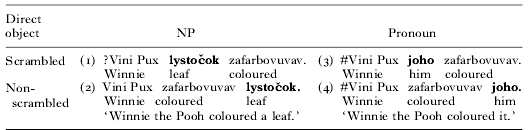
Since in this condition the hearer (Tigger) did not see any pictures, the participant was expected to take into account that the object is known only to himself, and thus it is specific–indefinite. In this case, the choice of a syntactic structure will depend on the role of specificity–referentiality in scrambling, which is to be defined. It is likely, though, that according to the principles of pragmatics, the speaker should use a neutral ‘all-new-information’ construction: SVO, Table 5 (2). Answers with a personal pronoun, 5 (3, 4), are pragmatically infelicitous in Condition 3.
Possible answers in C3
The last Condition, C4, differs from the previous C1–C3, as the discourse does not include any information about the direct object. The participant sees a picture of an instrument (means of performing some action) and a character depicted in the process of thinking. The experimenter is then questioning the participant about a possible application of this instrument, as shown in (11).
(11) Condition 4: Indefinite/Non-specific/Non-partitive
exp: Dyvysia, Tyhre, ščo ce?
‘Look, Tigger, what is this?’
tigger: Ce farby.
‘It's a painting set.’
exp: A ce xto?
‘And who is this?’
tigger: Ce Vini Pux.
‘It's Winnie the Pooh.’
exp: I ščo vin robyt'?
‘And what is he doing?’
tigger: Vin dumaie, ščo zrobyty z cymy farbamy.
‘He's thinking what to do with this paint set.’
exp: To ščo vin bude z nymy robyty?
‘So, what will he do with it?’
tigger: Ja ne znaju.
‘I don't know.’
exp (to the participant): Ty možeš dopomohty?
‘Can you help?’
Possible responses to the last question might differ: the participant is free to think about anything, but only sentences with a direct object were included in the data analysis. Some examples of possible syntactic structures are given in Table 6.
Possible answers in C4
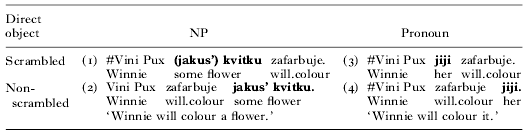
Crucially, since the direct object used by a participant is likely to be new both to the speaker and to the hearer and is not contextually defined, the prediction about its position is clear: the direct object cannot be scrambled. Thus, the answer in Table 6 (1) is not acceptable.
To summarize: the stimuli described above were designed to investigate factors that might contribute to scrambling in Ukrainian. To this end, four types of contexts were manipulated. The main predictions for this experimental study concerned two types of contrasts: between C1–C2 and C4 and between full NPs and pronouns. The first contrast was between C1–C3 and C4 in that object scrambling should not be possible at all in C4, as indefinite non-partitive direct objects do not undergo syntactic movement. In addition, the context in C3 was not likely to elicit scrambled responses for pragmatic reasons. Contexts in C1 and C2 were conducive to scrambling, and thus scrambled structures with full NPs or pronouns were predicted for these conditions. The second contrast was between two types of direct object: full NPs and pronouns. The former can appear in any context, while the latter are more plausible in C1 and C2, but would be inappropriate in C3 and C4. Furthermore, since scrambling of full NPs is optional in Ukrainian, participants were not expected to scramble them at a rate of 100 percent in any of the three possible contexts. On the other hand, if participants prefer to replace full NPs with personal pronouns in C1 (and maybe in C2), they were expected to use a scrambled structure in most of the cases.
Procedure
Children and adults followed the same procedure, but the adults were trained individually, while the children were first introduced to the task in a group of the same age. The experiment started with a short training session to familiarize participants with the task, and to make sure they recognized the main characters from the pictures: Winnie the Pooh, Piglet and Kangaroo. The training dialogues resembled the main items, but the pictures differed from those used in the experimental stimuli. After that, each participant performed individually in a separate room.
There were eight scenarios in the experiment. Each participant was assigned to one of four lists of stimuli and saw eight pairs of pictures presented in a pseudo-randomized order that elicited eight dialogues. If a participant could not answer a question or answered with one word, one more attempt was made, and all responses were recorded. Children who refused to talk after two repeated trials for several items were not included in the study. There were five such children (from the youngest age groups of two- and three-year-olds). All children were rewarded with a small gift for their participation. Most of them enjoyed the task, especially the interaction with the puppet. The experiment was recorded using a digital recorder, and the participants' responses to the main question were written down on a prepared score sheet. The responses were then coded as scrambled (1) or non-scrambled (0) and analyzed using a statistical program SPSS.
Data treatment
The data obtained from the experiment were analyzed statistically to determine how the use of scrambling depends on the context and the age of speakers. A few adjustments to the data became necessary in order to achieve this aim. First, since there were only eight stimuli per participant, and condition C4 was lexically different from conditions C1–C3, item-based analysis (F2) was not feasible. Therefore, all the data were analyzed using only a participant-based (F1) ANOVA. The unbalanced number of participants in each of the age groups (N=6, 10, 11, 14 and 20, respectively) made it impossible to conduct a fully matched factorial 4×5 ANOVA (Context×Age) using all the participants. Therefore, in order to define the semantic effects in scrambling (the main effect of the Context), each group was analyzed separately using 1×4 ANOVAs (Context conditions: C1, C2, C3, C4).
To assess the effect of Age on the production of scrambling, the data were adjusted using the following procedure. The two-year-old group was not included in the ANOVA's analysis because there were too few participants (N=6) in it and a high percentage of data (14·6%) was missing. The analysis of the remaining four age groups was based only on the data from ten participants (the number of three-year-old children) per group. To obtain this number, in each group that had more participants, only the youngest ten were selected. The adult group was treated in a similar way: only the five youngest women and five youngest men were selected. This procedure was used in order to obtain a dataset balanced by age and gender.
RESULTS
Total group results
The group results are presented as follows: first, they are described in terms of the used direct object type (full NPs or pronouns); next, the rates of total scrambling are defined for each condition and age group; and finally, pronominal scrambling is contrasted with full NP scrambling.
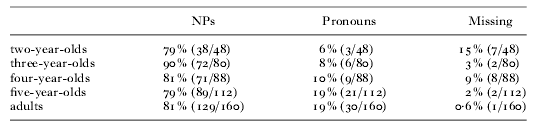
As shown in Table 7, in most of the answers direct objects were represented with full NPs (their use ranged from 79% for two- and five-year-olds to 90% for three-year-olds).
Answer types: % (N of structures/N of total items per age group)
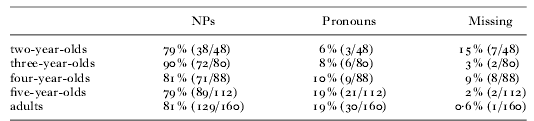
Pronouns were produced at a much lower degree, with a gradual increase in their use with age: two-year-olds used them only 6% of times, while five-year-olds and adults had 19% of pronouns in their responses. The distribution of pronominal direct objects differed across conditions, and it will be analyzed below (see Table 8). It should also be noted that the youngest group of children had a high rate of missing data: in 15% of tokens two-year-olds either did not produce any response or answered with one word, which made their dataset very limited.
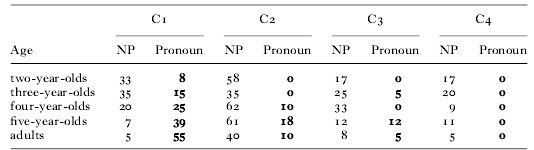
Scrambling per condition: NP vs. Pronouns (all participants), %
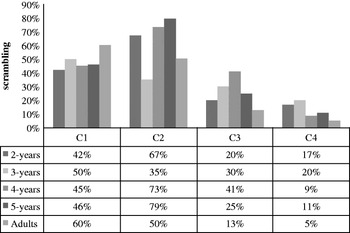
In the following presentation of scrambling, the scrambled structures with full NPs and pronouns are collapsed together. This is justified by the fact that the experimental design did not control for the use of pronouns and their numbers appeared to be very low for the three youngest age groups (only 3 to 10 tokens out of all data). Hence, Figure 1 presents the total percentages of scrambled structures produced in the four conditions by all participants split into five age groups.
Total scrambling per condition (all participants).

Overall, word order choice is not random for all groups of participants: the lowest rate of scrambling is in the Indefinite–Non-specific Condition (C4), as was predicted. The highest rates of scrambling are exhibited in the Indefinite–Partitive Condition (C2) (73% and 79% for three- and four-year-olds, respectively). The data also show apparent contrast between the Definite Condition (C1) and the Indefinite–Non-specific Condition (C4): the former elicited more scrambled structures than the latter in all age groups. The most puzzling data are obtained from the Indefinite–Specific Condition (C3), where the percentage of scrambling ranges from 13% for adults to 41% for four-year-olds.
The adult results are particularly important, as they demonstrate optionality in Ukrainian scrambling. None of the tested conditions triggered 100% of scrambled responses: with very few scrambled responses in the Indefinite–Non-specific Condition (5%) and in the Indefinite–Specific Condition (13%) and with half of responses scrambled in the Partitive Condition (50%) and the Definite Condition (60%). An ANOVA (for all 20 adults) confirmed a highly significant effect of Context (F1(3,57)=15·31, p<0·001). Importantly, this effect suggests that the high rates of scrambling in C1 and C2 are due to the object semantics defined by the context.
Among child groups, the group of two-year-olds deserves a separate analysis because these were the youngest children able to participate in the experiment, and, as was mentioned before, their dataset was the smallest one (6 children×4 conditions×2 items=48 tokens) with 15% of missing tokens. Notably, the results from the two-year-olds also show the predicted contrast between conditions: for instance, in C2 they produced 67% scrambled responses, while in C4 only one scrambled structure was produced (which amounts to 17%). The statistical analysis confirms a marginally significant effect of context on scrambling (F1(3,15)=3·19, p=0·0542). However, these results should be taken with some caution and need to be verified further with more children and probably with modified stimuli to make the task more age-appropriate. To summarize so far, the results suggest that even the youngest children relate scrambling to some contexts, but avoid it in others, confirming the role of context (and object semantics) in scrambling. However, a more detailed analysis is needed to define the role of object type in the use of scrambled structures.
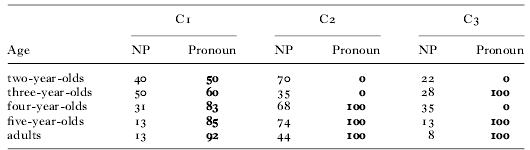
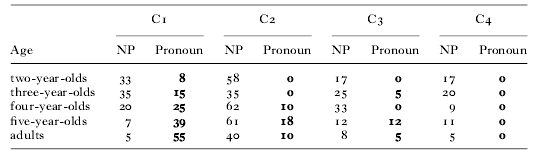
The distribution of scrambled structures with full NPs and pronouns depends on the condition and the age group. As shown in Table 8, adults preferred pronominal scrambling in C1: i.e. while the total scrambling in this condition was 60%, 55% of these structures contained pronouns. As to children, their use of pronominal scrambling ranged from only 8% (two-year-olds) to 39% (five-year-olds). These results show that two- to four-year-old children do not replace direct objects with pronouns, so most of their scrambling is full NP scrambling.
Further observation concerns the Indefinite–Partitive Condition (C2), in which the rates of pronominal scrambling are lower than the rates of full NP scrambling for all age groups: two- and three-year-olds scrambled only NPs, while other age groups had no more than 18% of pronominal scrambling (five-year-olds). This contrast suggests that the nature of scrambling in C1 might be different from scrambling in C2. The use of pronouns in C3 was very limited, and in C4 no pronouns were produced, as predicted.
The contrast between pronominal scrambling and full NP scrambling becomes even more obvious if the rates of such structures are derived from the total number of responses per condition. The results presented in Table 9 reveal that for three older age groups, whenever pronouns were used, they appeared in a preverbal position (the range is from 83% in C1 (four-year-olds) to 100% in C2 (four- and five-year-olds and adults). Younger children, on the other hand, scrambled pronouns similarly to the full NPs: 40% and 50%, respectively (two-year-olds) and 50% and 60%, respectively (three-year-olds).
NP Scrambling vs. pronominal scrambling (all participants), %
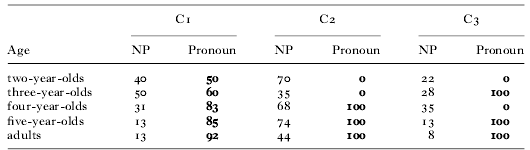
These results confirm the predicted contrast between the scrambling of full NPs and the scrambling of pronominal direct objects: the former is highly optional for all age groups, while the latter is not for the adults and older children.
Balanced results: age effects
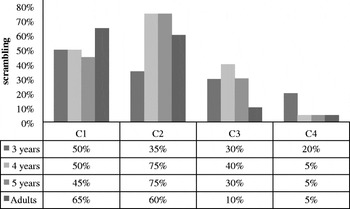
As discussed above, to allow us to assess the age effect in the production of scrambling, the data was restricted to a balanced subset, with ten participants in each of the four age groups. The mean percentage of total scrambled responses per condition and age group is given in Figure 2.
Total scrambling per condition (balanced group).

The balanced results look very similar to the total results presented in Figure 1: the highest rates of total scrambling were obtained in C2 (75% for four- and five-year-olds) and in C1 (65% for adults), and the lowest rates are shown in C4 (5% for the three older groups). Thus, these data also indicate a noticeable contrast in the rate of scrambling between C1–C2 and C4, suggesting an effect of the context on scrambling. Table 10 shows the statistical results for each of the age group separately.
Effects of context on scrambling for the balanced data

AVOVAs confirmed a highly significant main effect of context for the balanced data in the four- and five-year-old and adult groups (F1(3, 144)=18·61, p<0·001), but no effect of age (F1(3, 144)=0·51, p=0·677) and no interaction of age×condition (F1(9, 144)=1·58, p=0·126). Three-year-old children did not differ much in their rate of production of scrambled responses in C2–4, showing some deficit in their knowledge of rules that constrain scrambling in Ukrainian. From the age of four, however, the children are target-like in the production of scrambling and know rules which constrain syntactic movement in certain contexts, and the effect of the context becomes stronger with each succeeding age group. This fact definitely establishes that three- and five-year-old children know when scrambling is not possible (C4). Further analysis is needed to define which of the conditions triggers the highest rates of scrambling, C1 or C2, and whether C3 is conducive to scrambling. The dynamics of scrambling in these conditions has somewhat different patterns for each age group, but it is evident that there is a significant difference between C1–C2 and C4. The paired samples test confirms that conditions C1 and C4 exhibit significantly different rates of scrambling (t(29)=3·458, p<0·002), and the pair C2–C4 shows a highly significant difference (t(29)=7·215, p<0·000). On the other hand, the difference between C3 and C4 is not significant (t(29)=0·254, p=0·801), although variations in the scrambling rates suggest that there are other factors involved, and they will be discussed below.
Individual results
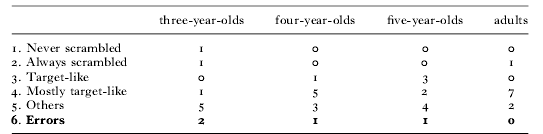
Individual patterns are defined as follows: (1) participants who never scrambled; (2) participants who always scrambled; (3) target-like participants (two scrambled structures in C1 and two scrambled structures in C2, but no scrambled structures in C4); (4) mostly target-like participants (at least one scrambled structure in C1 and at least one scrambled structure in C2, but no scrambled structures in C4); (5) others (various number of scrambled structures in C1–C2, but no scrambled structures in C4); errors (at least one scrambled structure in C1 and/or C2 and at least one scrambled structure in C4). C3 was excluded from this analysis because scrambling in this condition depends more on pragmatic factors than on semantic features. The language background has not been considered either, as the use of Surzhykvs, a local dialect of Ukrainian, involved certain phonological and lexical distinctions without noticeable difference in the word order.
Individual results of the balanced group of participants are summarized in Table 11. Overall they confirm the group results, testifying that speakers' grammar is not random, but that scrambling is optional for most of them.
Patterns of scrambling (balanced group), N
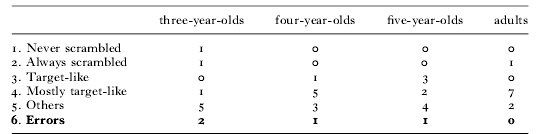
It appears, that seven adult participants followed a predicted pattern of scrambling, confirming that the syntactic movement of an object is applied only in definite and partitive contexts, but not in indefinite non-specific contexts. Two other participants scrambled at various rates, but they did not violate the constraint noted above. The only error was produced by a participant who scrambled in all conditions, and thus we cannot make any generalization based on his grammar.
Children's individual results were analyzed for each age group separately, considering only the balanced data of ten participants per group. Table 11 shows that three-year-olds differ from four- and five-year-olds in that their individual responses are the most diverse. Furthermore, there were no children in this age group who behave in a target-like way, and only one child was mostly target-like. The individual results from older children exhibit well-defined patterns in the distribution of scrambling. Only one child in each group made errors, and among others most children were either target-like or mostly target-like.
This summary shows that participants from all the age groups exhibit a certain variability with regard to the distribution of scrambling across conditions. It is evident, however, that the number of possible patterns decreases with age: three-year-olds exhibited five patterns of scrambling distribution, four- and five-year-olds can be grouped into four patterns, and adults had the most consistent distribution arranged in only three patterns.
DISCUSSION
Factors contributing to scrambling
Once again, we see that optionality and variability are the core properties of scrambling in Ukrainian. Movement of a direct object to preverbal position has been claimed to be optional, and it remains so even in carefully constructed contexts. Neither adults nor children produced scrambled responses at the highest rates in any of the tested contexts, suggesting that there is no inherent syntactic motivation to make scrambling of a direct object obligatory. However, scrambling is not random but is constrained by implicit rules. One such rule was defined as follows: Do not scramble indefinite–non-specific direct objects. It appears that even the youngest children exhibit knowledge of this constraint.
The results obtained from the Indefinite–Non-specific Condition (C4) are crucial for establishing possible constraints on scrambling and for verification of children's knowledge of them. The data in Figure 2, particularly, indicate that the contexts from this condition trigger very low rates of scrambling, and that the rates are exactly the same for four-year-olds, five-year-olds and adults (5%). This is what was predicted: since indefinite non-specific objects are not defined by the previous context, they cannot appear in a preverbal position. Starting from the age of four, children understand this grammar rule and behave in an adult-like way. Three-year-olds, however, differ from older age groups and, as was mentioned above, from two-year-olds as well, so these age differences deserve a separate discussion (see below).
This study also allows us to define a number of other factors contributing to scrambling in Ukrainian. Scrambling is a complex phenomenon, and it goes beyond just the semantic features of definiteness or specificity. Other important factors that contribute to the use of scrambled structures are object type (full NP vs. pronoun), contextually defined direct object semantics, the structure of the NP (availability of a quantificational lexical element), and pragmatic principles (speaker's knowledge and hearer's knowledge might differ), and I now turn to the discussion of each of these factors.
Personal pronouns are always scrambled by adults, presenting the only instance of a 100% scrambling rate in the experimental results. However, it appeared that children treat pronouns in a different way. First, young children (two- to three-year-olds) preferred to use full NPs in sentences where older children and adults produce pronouns, consistent with similar observations by de Villiers, Cahillane & Altreuter (Reference De Villiers, Cahillane, Altreuter, Deen, Nomura, Schulz and Schwartz2006) and Spenader, Smits & Hendriks (Reference Spenader, Smits and Hendriks2009) for English and Dutch. Next, children leave pronouns in a postverbal position more often than adults. It is puzzling why pronominal scrambling would be more difficult to acquire than the scrambling of full NPs. However, this finding is not totally unexpected. As was shown in studies on Norwegian, even older children do not perform obligatory syntactic movement of pronouns: children aged 4 ; 5–5 ; 6 have 81% of unshifted pronouns, and those aged 6 ; 1–7 ; 0 have 31% of unshifted pronouns (Anderssen, Bentzen & Rodina, Reference Anderssen, Bentzen and Rodina2009). Crucially, in Ukrainian, a pronoun in situ does not make a sentence ungrammatical, but requires a distinct prosody in order to make it sound natural: the sentence-final pronoun cannot be stressed. It is possible that children use the prosody associated with pronouns in situ more readily than adults.
In previous studies, mentioned above, it has been shown that the scrambled direct object usually has a specific interpretation. However, the details of this syntax–semantic interaction have not been made clear. Since Ukrainian does not have obligatory lexical elements to mark NP-related semantics (such as articles), context becomes very important for the assignment of semantic features. Context defines the direct object semantics as definite, partitive or specific (including combinations of these features), and only then can the syntactic movement be applied. According to this view, the indefinite–non-partitive non-specific objects cannot undergo scrambling. This was the main prediction of the study described above and, notably, this prediction was confirmed by the low rates of scrambling in the Indefinite–Non-specific Condition. If an object has not been mentioned in the context, it should not be scrambled. This constraint is operative in the grammar of adult speakers and four- to five-year-old learners of Ukrainian. The results also show that the Definite Condition triggers the highest rates of scrambling for all age groups. This is partly due to the high use of personal pronouns in this condition.
The results from two other conditions, Indefinite–Partitive and Indefinite–Specific, are more complicated. Partitive objects are scrambled at a high rate, which confirms the main prediction: all contextually defined direct objects have a prerequisite for movement. However, it is possible that there are additional factors contributing to the use of scrambled structures in partitive contexts. Direct objects in this condition usually include the word ‘one’, that clearly marks object semantics as specific/partitive, and this lexical marker might facilitate the process of syntactic movement. It is likely that the lexical element ‘one’ is perceived by speakers as a quantifier that restricts a set of involved individuals to only one individual; so the NP is moved over the verb to mark the scope of quantification. Occasional use of the focus-marking adverb til'ky ‘only’ with the direct object in this condition suggests that the semantics of such NPs is ‘one and only one individual from the set introduced in the discourse’.
The results from the Indefinite–Specific Condition reveal that referential contexts do not support scrambling. Based on the adult data (showing no evident contrast between C3 and C4), we can conclude that specificity (as referentiality) does not have a strong effect on scrambling. Although the contexts were set in such a way that the direct object was contextually defined, and the speaker was able to make this association, the hearer was not familiar with the object. Therefore, according to the syntax–semantics rules, syntactic movement might occur, while according to the pragmatics rules (speaker's and hearer's beliefs might differ) – it should not.
The Indefinite–Specific condition (C3) also seems to provide the most substantial evidence for a difference between children and adults: children scramble more than adults. A possible explanation of this might be that children lack pragmatic knowledge and scramble objects whose reference is unknown to the hearer, while adults take into account the hearer's beliefs and use the basic structure. However, careful consideration of the available data shows that in most of the scrambled responses children used an ‘adult’ technique: they introduce the object in the first phrase, and scramble it in the second one. For instance, ‘There was a butterfly, and Winnie the Pooh him caught’. If we exclude all cases of this ‘pragmatically correct’ scrambling and analyze the remaining data, it is likely that even the youngest children will behave in an adult-like manner in the Indefinite–Specific Condition. If so, the pragmatic-deficit hypothesis in the acquisition of scrambling can be ruled out. This is indeed the case: the means of scrambling in C3 for three-, four- and five-year-olds and adults (15%, 30%, 0%, 5%, respectively) differs considerably from the means in C1 and C2 (see Figure 1 above).
Thus it appeared that even young three-year-old children followed the rules of pragmatics most of the time and did not scramble indefinite-referential direct objects. It should be mentioned that this result does not necessarily contradict the claims about the role of referentiality/specificity in scrambling (particularly in studies on Dutch). It is possible that it may be due to the terminological differences clarified by Unsworth (Reference Unsworth2005) : the feature involved in scrambling is specificity defined as partitivity, rather than specificity defined as referentiality (in terms of Fodor & Sag, Reference Fodor and Sag1982).
The developmental path in the acquisition of scrambling
The statistical analysis of the data showed no Age effect in scrambling. This suggests that even the youngest children (around the age of three) are mostly target-like in that they perceive the difference between the contexts and are able to relate syntactic movement to the direct object semantics. Nonetheless, there are some aspects of scrambling that take time to acquire: pronominal scrambling is adult-like only for four- and five-year-olds, and the scrambling patterns become more restricted and regular at the age of five. Suggestions concerning the possible role of prosody in imperfect pronominal scrambling have been mentioned above, but because this experimental study did not control for the use of pronouns, further investigation is needed.
The scrambling patterns were additionally analyzed with regard to individual data from different age groups. This analysis suggests that young children exhibit considerable variability in the use of scrambled structures across conditions. Apparently, their grammar is still in formation, and their general language skills might be at different levels, resulting in large variability among two- to three-year-olds. As they achieve a certain level of proficiency in their knowledge of Ukrainian grammar, they become more alike and show less individual variability. It can also be suggested that the variability in word order patterns correlates with the variability of the prosodic contours found in the speech of young children (Balog & Snow, Reference Balog and Snow2007; Behrens & Gut, Reference Behrens and Gut2005; Prieto & Vanrell, Reference Prieto, Vanrell, Trouvain and William2007; Snow & Balog, Reference Snow and Balog2002). If scrambling and prosodic means are two available options, children might explore the latter at length before they settle down with an option which is more efficient and confirmed by the input.
At first glance, the developmental path in the acquisition of scrambling might seem to have a U-shape: two-year-olds know constraints on scrambling; three-year-olds overuse scrambling in the Indefinite–Non-specific Condition; and four- to five-year-olds behave mostly adult-like. However, the data from two-year-olds are very limited, and the data from three-year-olds still show a clear contrast between the scrambling of definite and indefinite–non-specific objects, suggesting that they also follow the main scrambling rule. Three-year-olds did use some scrambled structures with indefinite–non-specific direct objects, i.e. four sentences (20%). This result might indicate that they do not know features involved in the syntactic movement, and thus overuse scrambling. However, it appears that in three out of four ‘erroneous’ sentences, children added the indefinite pronoun jakyjs' ‘some’, which indicates that they have knowledge of the object semantics, but still perform an unnecessary syntactic movement. It should be mentioned, however, that since the number of items per participant was quite low, the final conclusion concerning this age group cannot be made at this point as it requires more substantial data.
CONCLUSIONS
The results of the experiment presented in this article reveal the main factors contributing to scrambling in Ukrainian. Even though scrambling is a multi-faceted phenomenon, and hence might be influenced by different aspects of the grammar, the strategy employed in this study has allowed us to identify some of these aspects. The same experiment conducted with children and adults investigated only one type of word order change – direct object scrambling. The examination of SOV structures shows that the direct object is consistently placed in a preverbal position only in some contexts. Both children and adults scramble more in definite and partitive contexts than in indefinite and specific-referential contexts. This suggests that the context defining the object semantics is one of the key factors contributing to scrambling. Another aspect of scrambled structures revealed in the experiment described above is the object type. Pronominal direct objects are scrambled more often than full NPs, especially in definite contexts, where use of pronouns appears to be the most natural. However, this conclusion concerns only adult grammar, in which pronominal scrambling is mandatory, while full NP scrambling is optional. In child grammar, on the other hand, both types of scrambling are optional. Since children are mostly adult-like in other aspects of scrambling, i.e. they rarely overuse syntactic movement in indefinite non-partitive contexts, consideration of cognitive factors seems to be unmotivated. Instead, the linguistic factors, e.g. sentence prosody, are to be investigated in further research.