The assessment of attachment is perhaps one of the most challenging and controversial issues in investigating the role of this important psychological construct in interpersonal relationships across the transition from childhood to adulthood. While there have been many measures reported in the literature (Wilson & Wilkinson, Reference Wilson and Wilkinson2012), the Inventory of Parent and Peer Attachment (IPPA; Armsden & Greenberg, Reference Armsden and Greenberg1987a) is the most widely used self-report measure of attachment in adolescents (Wilson & Wilkinson, Reference Wilson and Wilkinson2012). In their development of the original version of the IPPA, Armsden and Greenberg (Reference Armsden and Greenberg1987a) argued the need for a self-report assessment tool that would go beyond assessing parental attachment to examine possible peer attachment relationships and that could assess both behavioural aspects of attachment and ‘affectively toned cognitive expectancies’ (Armsden & Greenberg, Reference Armsden and Greenberg1987a, pp. 431), which partly comprise internal working models. Importantly, the IPPA was developed separately, and with a different relationship focus, to the self-report, categorical measures of adult romantic attachment that were beginning to emerge around the same time (e.g., Bartholomew & Horowitz, Reference Bartholomew and Horowitz1991; Hazan & Shaver, Reference Hazan and Shaver1987).
The original version of the IPPA consists of a 28-item parent scale and a 25-item peer scale. Both of these scales can be broken down to Communication (Parent = 10 items, α = .91; Peer = 8 items, α = .87), Trust (Parent and Peer = 10 items, α = .91 for both), and Alienation (Parent = 8 items, α = .86; Peer = 7 items, α = .72) subscales. Importantly, there is a substantial body of research showing that the IPPA, and its variants, are associated with key psychological outcomes across the age span of adolescence (e.g., Armsden & Greenberg, Reference Armsden and Greenberg1987a; Armsden, McCauley, Greenberg, Burke, & Mitchell, Reference Armsden, McCauley, Greenberg, Burke and Mitchell1990; Bradford & Lyddon, Reference Bradford and Lyddon1993; Laible, Carlo, & Raffaelli, Reference Laible, Carlo and Raffaelli2000; Lapsley, Rice & FitzGerald, Reference Lapsley, Rice and Fitzgerald1990; Natarajan, Somasundaram, & Sundaram, Reference Natarajan, Somasundaram and Sundaram2011; Wilkinson & Walford, Reference Wilkinson and Walford2001; Wilkinson, Reference Wilkinson2004).
Despite its apparent popularity, relatively few studies have used the original items or subscales of the IPPA. Soon after its publication, various modifications began to appear in the literature, including the substitution of separate Mother and Father scales for the combined Parent scale (Armsden & Greenberg, Reference Armsden and Greenberg1987b), the use of short forms of various lengths and changes to the response categories used for each item (e.g., Raja, McGee, & Stanton, Reference Raja, McGee and Stanton1992), and translation to languages other than English (e.g., Noom, Dekovic, & Meeus, Reference Noom, Dekovic and Meeus1999). In terms of specific modifications to the IPPA, Raja, McGee, and Stanton (Reference Raja, McGee and Stanton1992), in their study of psychological wellbeing in 935 New Zealand adolescents, employed a 12-item short form for each of the Parent and Peer scales. Items were selected based on the highest item loadings for each of the subscales from the original factor analyses from Armsden and Greenberg (Reference Armsden and Greenberg1987a). However, the response scale for each item was reduced from five alternatives to four. Paterson, Field, and Pryor (Reference Paterson, Field and Pryor1994), in another study of New Zealand adolescents, employed a full version of the IPPA although they separated the Parent scale into Mother and Father scales, as had been suggested in an unpublished revision to the IPPA (Armsden & Greenberg, Reference Armsden and Greenberg1987b). Noom et al. (Reference Noom, Dekovic and Meeus1999), in their study of Dutch adolescents, applied all of these modifications and created a 12-item short form of the IPPA with separate Mother and Father scales and a 4-point response scale.
Other short forms have also been employed. For example, Laible, Carlo, and Raffaelli (Reference Laible, Carlo and Raffaelli2000), in a study of 89 U.S. adolescents, used a 12-item short form but retained the original combined Parent scale and used a five-item choice format for the response scale. Buist, Deković, Meeus, and van Aken (Reference Buist, Dekovic, Meeus and van Aken2004) employed 10-item modified versions of the IPPA Parent scale to examine mother, father, and sibling attachment in Dutch adolescents. Reducing the IPPA even further, Meeus, Osterwegel, and Vollebergh (Reference Meeus, Osterwegel and Vollebergh2002) used six-item versions of the IPPA scales to assess mother, father, and peer attachment in samples of Turkish, Moroccan, and Dutch adolescents. In a longitudinal study of 285 Dutch families, Buist, Reitz, and Dekovic (Reference Buist, Reitz and Dekovic2008) used a 10-item version of the IPPA Parent scale that was modified to assess attachment relationships among all family members (target adolescent, mother, father, and younger sibling), generating 12 different scales. There have also been a number of studies reporting modified versions of the IPPA for use with children (e.g., Gullone & Robinson, Reference Gullone and Robinson2005; Nickerson & Nagle, Reference Nickerson and Nagle2005) and for use with non-English speaking samples, including Turkish- (Gunaydin, Selcuk, Sumer, & Uysal, Reference Gunaydin, Selcuk, Sumer and Uysal2006), Chinese- (Liang, Hou, & Tian, Reference Liang, Hou and Tian2006), Italian- (San Martini, Zavattini, & Ronconi, Reference San Martini, Zavattini and Ronconi2009), Dutch- (Noom et al., Reference Noom, Dekovic and Meeus1999), and Malay- (Zulkefly & Wilkinson, Reference Zulkefly and Wilkinson2011) speaking adolescents.
Despite the proliferation of these various versions of the IPPA there have been few attempts to establish their psychometric properties. In one of the first studies attempting to replicate the factor structure of the IPPA Parent scale originally reported by Armsden and Greenberg (Reference Armsden and Greenberg1987a), Vignoli and Mallet (Reference Vignoli and Mallet2004) conducted three studies using a version of the IPPA for French-speaking adolescents. In their first study, they used the full 28-item version of the parent scale with separate items for mothers and fathers, with a sample of 289 14- to 15-year-olds. Using exploratory factor analysis (EFA) they claimed support for a three-factor solution similar to Armsden and Greenberg's (Reference Armsden and Greenberg1987a) for the father items, but had more difficulty supporting the same three factors for the mother items. In response, Vignoli and Mallet created a 14-item short form that produced an acceptable fit for both mother and father items to the three-factor model. In their second study, using a similar but independent sample of 206 adolescents, they conducted a confirmatory factor analysis (CFA) on the 14-item short form and found the best fit for their hypothesised three-factor model (Communication, Trust, and Alienation) for both mothers and fathers. Their third study replicated these CFA results with a sample of older adolescents, although they did not conduct a multi-sample CFA comparison of the age group data.
Pace, San Martini, and Zavattini (Reference Pace, San Martini and Zavattini2011) conducted a CFA on 25-item, Italian versions of the Maternal, Paternal, and Peer IPPA scales with a large (n = 1,059) sample of adolescents aged between 13 and 18 years. They concluded that the traditional three-factor model (Communication, Trust, and Alienation) was the best fit for all three scales. They did note, however, that the high correlations (r = −.61 to −.77) between the factors within each relationship scale suggest that they are poorly differentiated. This suggests that there may be a higher-order attachment security–insecurity factor (Mikulincer & Shaver, Reference Mikulincer and Shaver2007) implied in the models, although they did not explicitly evaluate this. Although Pace and colleagues (Reference Pace, San Martini and Zavattini2011) did not examine the factor structure across age or gender, they did examine differences in means for the scales for these groupings. They found no substantial age differences but did report that males generally report more positive attachment to parents and females to peers.
Overall, the literature on the IPPA and its modified versions reveals that while a number of studies have looked at differences in IPPA scale scores between boys and girls (e.g., Duchesne & Larose, Reference Duchesne and Larose2007; O’Koon, Reference O’Koon1997; Wilkinson, Reference Wilkinson2004, Reference Wilkinson2006) and between younger and older adolescents (e.g., Buist et al., Reference Buist, Dekovic, Meeus and van Aken2004; Laible et al., Reference Laible, Carlo and Raffaelli2000; Wilkinson, Reference Wilkinson2006), no study has examined whether the factor structure of the IPPA varies by sex and age.
The Present Study
Despite the many different versions of the IPPA there has been no validation of the factor structure of an English language short form that uses the separate Maternal, Paternal, and Peer scales. Further, to our knowledge there is no attempt in the literature to examine if the factor structure of the IPPA varies between younger and older adolescents and between boys and girls. Based on previous research indicating high correlations between the IPPA subscales (Pace et al., Reference Pace, San Martini and Zavattini2011), a three-factor model with an underlying single, higher-order factor for all three of the IPPA scales (Maternal, Paternal, and Peer) is proposed. The lower-order factors are argued to be consistent with the Trust, Communication, and Alienation subscales originally found by Armsden and Greenberg (Reference Armsden and Greenberg1987a), while the higher-order factor is proposed to represent an underlying security–insecurity dimension. Given the evidence that attachment functions in both parental and peer relationships in adolescence tend to vary by age and gender (Friedlmeier & Granqvist, Reference Friedlmeier and Granqvist2006; Goh & Wilkinson, Reference Goh, Wilkinson and Pearce2007; Hazan & Zeifman, Reference Hazan, Zeifman, Bartholomew and Perlman1994; Markiewicz, Lawford, Doyle & Haggart, Reference Markiewicz, Lawford, Doyle and Haggart2006) the structure of the IPPA scales across these demographic variables will also be examined for invariance.
While no significant differences are predicted in relation to the measurement structures, differences in scale scores in relation to both sex and gender will be explored. The existing evidence on these differences is somewhat contradictory. With regard to gender differences, for example, Wilkinson (Reference Wilkinson2004) found that boys reported lower overall IPPA scores for parental attachment than do girls, but in a later study found no sex differences when using separate mother and father scales (Wilkinson, Reference Wilkinson2006). Duchesne and Larose (Reference Duchesne and Larose2007) also found no sex difference for parental attachment, but Pace et al. (Reference Pace, San Martini and Zavattini2011) found that boys scored higher on parental security than do girls. For peer attachment the literature is more consistent, with most studies finding that girls report higher security than boys (e.g., Gorrese & Ruggieri, Reference Gorrese and Ruggieri2012; Pace et al., Reference Pace, San Martini and Zavattini2011; Wilkinson, Reference Wilkinson2006).
The evidence with regard to age differences in attachment as measured by versions of the IPPA is also inconsistent (Gorrese & Ruggieri, Reference Gorrese and Ruggieri2012). For example, Wilkinson (Reference Wilkinson2006) found that older adolescents reported more secure peer attachment than younger adolescents, but no differences in either mother or father attachment security. Pace et al. (Reference Pace, San Martini and Zavattini2011), on the other hand, found no age differences for either maternal or peer attachment but found that older adolescents reported less paternal attachment than younger adolescents.
Method
Participants
The data employed in this study were collated from three surveys conducted with high school students in the Australian Capital Territory between 2007 and 2011. In the final data set there were responses from 1,025 participants (638 females and 387 males) between the ages of 13 and 18 years (mean = 16.79, SD = 0.86). Participants were predominantly from upper to middle socio-economic status (72.5%) and the majority (76%) identified their ethnic background as European-Australian.
Methods and Measures
Surveys were completed in classroom settings by students who had volunteered to participate and who had been briefed about the purpose of the research. A variety of measures of different constructs were employed in the three studies, but only the IPPA data will be presented here.
The Inventory of Parent and Peer Attachment — 45
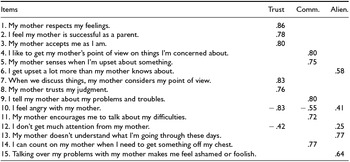
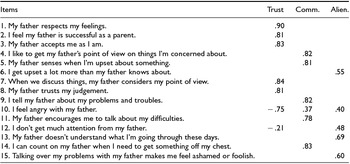
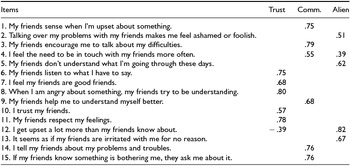
Based on the original IPPA (Armsden & Greenberg, Reference Armsden and Greenberg1987a), the IPPA-45 is a short form that has 15-item scales assessing maternal, paternal, and peer quality of attachment relationship. Using the original factor analysis loadings and item content from Armsden and Greenberg's (Reference Armsden and Greenberg1987a) study as a guide, five items were selected from each of the Trust, Communication, and Alienation subscales for the three relationship types. The items for the resulting Maternal and Paternal scales were the same except for the substitution of the appropriate relationship name. Respondents were asked to rate each item on a scale from 1 (almost never or never) to 5 (always or almost always). The items of the IPPA-45 are presented in Tables 1, 2 and 3.
IPPA-45 Items and Lower-Order CFA Factor Loadings for the Maternal Scales

Note: Comm. = Communication, Alien. = Alienation.
IPPA-45 Items and Lower-Order CFA Factor Loadings for the Paternal Scales

Note: Comm. = Communication, Alien. = Alienation.
IPPA 45 Items and Lower-Order CFA Factor Loadings for the Peer Scales

Note: Comm. = Communication, Alien. = Alienation.
Results
Prior to analyses the data were screened for normality, linearity, multicollinearity and singularity. Examination of the distributions for the items revealed some variation from normality but no major violations. Four cases with missing data were excluded from the analyses. Six cases were identified as multivariate outliers using a criterion of Mahalanobis distance with p < .001 and were deleted.
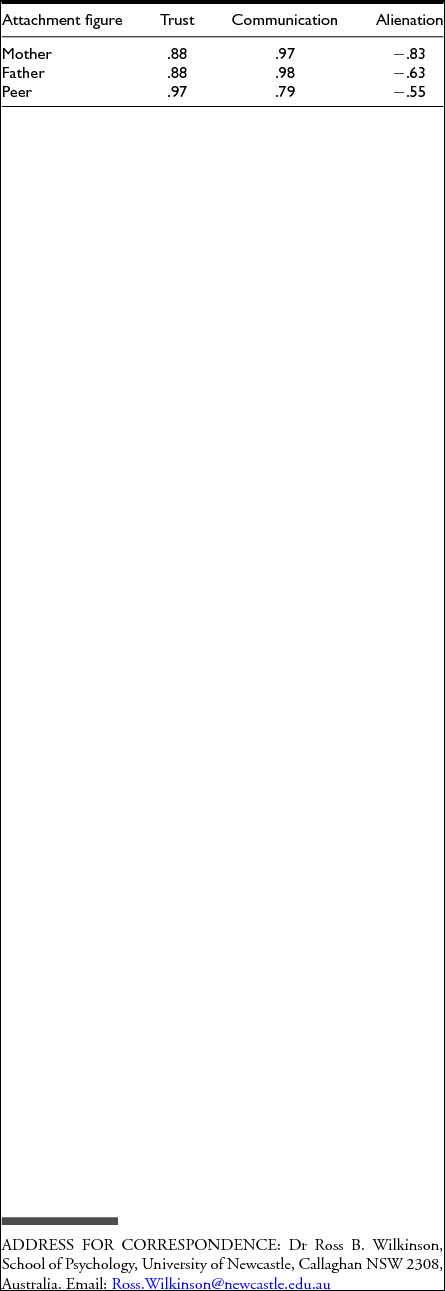
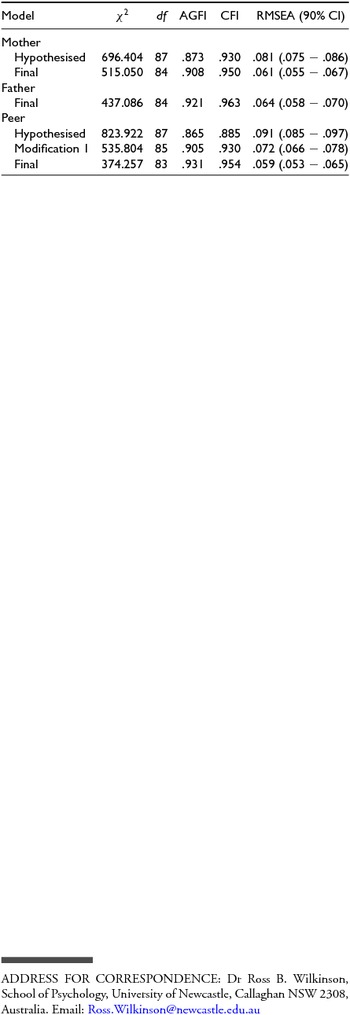
Second-order confirmatory factor analyses (CFA) using maximum likelihood estimation were conducted using the SPSS AMOS 20 implementation of structural equation modelling (SEM). In order to identify the proposed models, the variances of the residuals for the higher-order factor were fixed to be equal. For each model evaluated, the chi-squared, AGFI, CFI, and RMSEA values are reported. Model evaluation occurred as a stepwise process. First, the hypothesised model was evaluated, then model fit statistics and modification indices were examined to determine whether acceptable changes could be made to enhance the model fit. When further changes did not significantly improve the model fit then the final model was evaluated. Tables 1, 2, 3, and 4 present the standardised regression weightings for the subscale items in the final models and Table 5 presents the fit statistics for the Mother, Father, and Peer models. Note that the structure of the Father measurement model was restricted to be the same as the Mother measurement model in order to facilitate comparison of the loadings generated by the scales. Further, because a number of participants declined to fully complete the Paternal scale of the IPPA, the sample size used in its model estimation was smaller (N = 980) than that used for the Maternal and Peer scales.
Second-Order Factor Loadings for the Mother, Father, and Peer Measurement Models

Fit Statistics for the Second-Order Measurement Models

Note: AGFI = Adjusted Goodness of Fit Index, CFI = Comparative Fit Index, RMSEA = Root Mean Square Error of Approximation.
The hypothesised measurement model for the IPPA Mother scale was not an acceptable fit (Table 5), with the AGFI below .90, the CFI below .95, and the RMSEA above .80 (Byrne, Reference Byrne2010). From the modification indices, three cross-loading regression paths (from Trust to items 10 and 12 and from Communication to item 10) were identified and successively added to the model. These modifications significantly improved model fit compared to the hypothesised model, Δχ2 = 181.35, df = 3, p < .05. The fit statistics (Table 5) indicated that this final model was an acceptable fit. The final structure for the Mother measurement model was applied to the Father data and produced acceptable fit statistics without further modification.
The hypothesised measurement model for the Peer data initially produced poor model fit statistics. Modification indices indicated the freeing of two regression paths, one from Trust to item 12 and one from Communication to item 4. The resulting model (modification 1) was a significant improvement in the model, Δχ2 = 288.12, df = 2, p < .05, but was still not an acceptable fit. Inclusion of correlated error terms between items 7 and 10 and items 10 and 11 further significantly improved the model, Δχ2 = 161.547, df = 2, p < .05, and resulted in an acceptable model fit (Table 5).
Overall, with some minor modifications, the short-form versions of the IPPA scales produced lower-order measurement models consistent with the full-item versions of the IPPA scales originally published by Armsden and Greenberg (Reference Armsden and Greenberg1987a). Of note, however, are the quite high loadings on the higher-order factor (Table 4), particularly for the Trust and Communication Scales, for all three measurement models.
Model Invariance
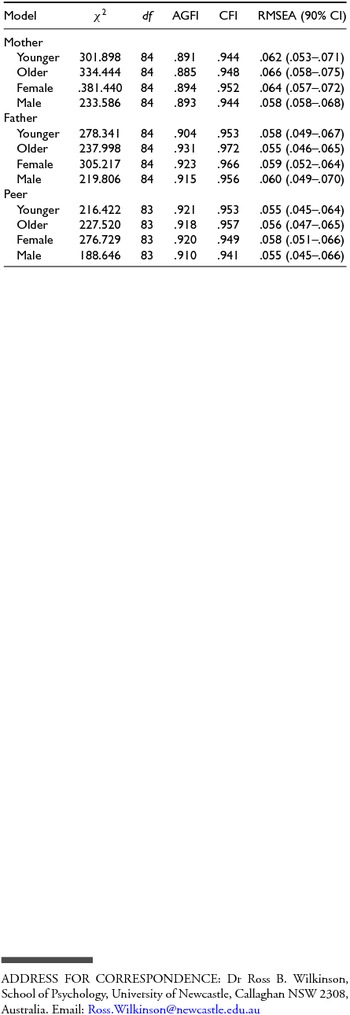
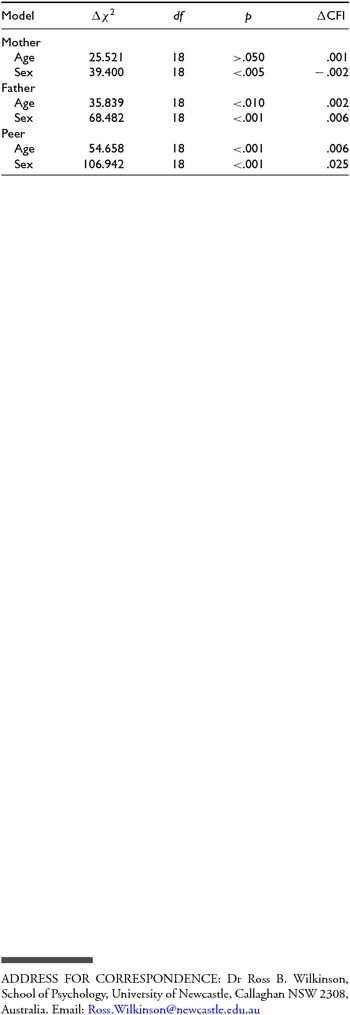
In order to evaluate the robustness of the measurement models with regard to different groups of adolescents, a series of multi-group analyses were conducted comparing the fit of the structural models for males versus females and for younger versus older adolescents. Factor weights for all the final models were set to be invariant. For the Peer measurement models, the correlated error terms were also set to be invariant. Following the procedure recommended by Byrne (Reference Byrne2010), configural models for each group were evaluated first (Table 6) and then the chi-squared and CFI values for the invariant models were compared to them. Using the criteria that chi-squared differences with a probability less than <.01 (Byrne, Reference Byrne2010) and ΔCFI greater than .01 (Cheung & Rensvold, Reference Cheung and Rensvold2002) indicate non-invariance, only the measurement models of Peer Attachment for boys and girls appear to differ (Table 7).
Fit Statistics for the Separate IPPA-45 Age and Sex Configural Models

Note: AGFI = Adjusted Goodness of Fit Index, CFI = Comparative Fit Index, RMSEA = Root Mean Square Error of Approximation.
Evaluation of IPPA-45 Measurement Model Invariance for Older Versus Younger and Female Versus Male Adolescents

Note: CFI = Comparative Fit Index.
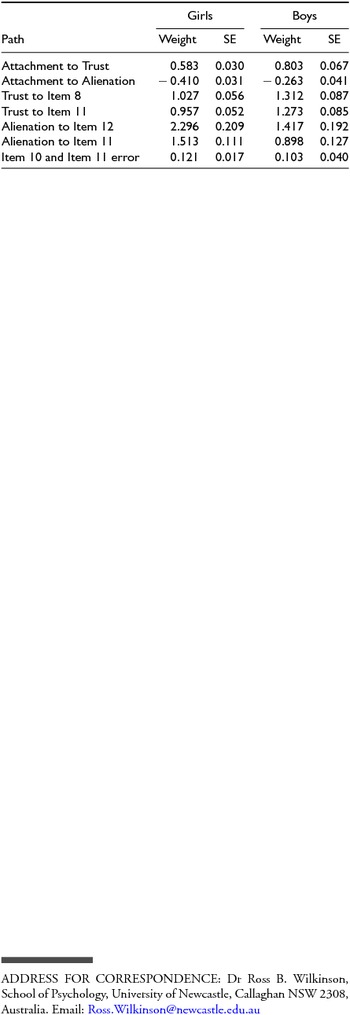
To locate differences in the Peer Attachment measurement model for boys and girls, the iterative procedure outlined by Byrne (Reference Byrne2010) was followed. Each subscale, then each factor weighting and error covariance was examined for noninvariance sequentially, cumulatively fixing path weightings until the sources of difference were identified. Table 8 presents the paths that were considered non-invariant between the two samples. The weight from the higher-order factor of Attachment to the lower order factor of Trust was significantly higher for boys than for girls, while the reverse was the case for the weight from Attachment to Alienation. Both item 8 (‘When I am angry about something, my friends try to be understanding’) and item 11 (‘My friends respect my feelings’) loaded more highly on Trust for boys than for girls. Items 11 and 12 (‘I get upset a lot more than my friends know about’) loaded more highly on Alienation for girls than for boys. The covariance between the error terms for items 10 (‘I trust my friends’) and 11 was significantly higher for girls than for boys.
Standardised Regression Weights for Significantly Different Paths in the Girl and Boy Peer Multi-Group Analyses.

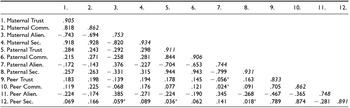
Scale Intercorrelations
Scale scores were created by reverse coding and averaging the items associated with each subscale as appropriate, including cross-loading items. Internal consistencies (Cronbach's α) for the resulting scales range from the acceptable (Peer Alienation = .748) to high (Maternal Security = .934; see Table 9). Intercorrelations between all 12 of the IPPA scales and subscales were also examined (Table 9). As would be expected, the correlations within each relationship type are generally high (−.653 to .944). An exception to this is the relatively low correlations evinced by the Peer Alienation subscale with the other Peer measures, which are lower than the similar correlations with the Maternal and Paternal scales. Across relationship types the correlations are moderate (.385) to non-significant (.018). It is particularly noteworthy that the correlations between the different overall measures of attachment security for each relationship type are low.
Intercorrelations for Maternal, Paternal, and Peer Scales and Subscales
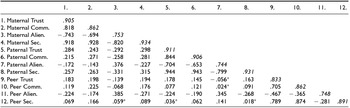
Note: Cronbach's α coefficients in italics on the diagonal. *p < .05.
Mean Differences
Table 10 reports the 12 subscale and three IPPA-45 scale scores by age and sex. In order to examine possible differences, a series of split-plot analyses of variance were conducted with Relationship Type (Maternal, Paternal, Peer) as the within-subjects factor and Sex (Boys, Girls) and Age Group (Younger, Older) as between-subjects factors. Because of the higher loadings on the overall security factor and high intercorrelations between the subscale scores for the Maternal and Paternal measures, it was decided to primarily focus analyses on the Security scores for each relationship type. However, because the Alienation subscales scores, particularly for the Peer measure, are less correlated with Security, the Alienation scores were also analysed separately as a dependent variable. Note that for all analyses the assumption of sphericity was violated and thus the Greenhouse-Geisser adjusted statistics were checked to confirm the unadjusted results. Follow-up tests were assessed with Bonferroni adjustments of alphas as appropriate.
Sex by Age and Total Sample Means and Standard Deviations for the IPPA-45 Scales

For the overall attachment security scores there was a significant main effect for Relationship type, F(2, 1952) = 63.04, p = .001, ηp2 = .115. Follow-up tests reveal that the mean for Maternal Security (M = 3.51) was significantly higher than for Paternal Security (M = 3.17), t(979) = 11.61, p < .001, and that Peer Security (M = 3.36) was also significantly higher than Paternal Security, t(979) = 5.86, p < .001. Maternal security was also significantly higher than Peer Security, t(1024) = 5.91, p < .001. There was also a significant sex main effect such that girls (M = 3.41) reported higher security scores than boys (M = 3.23), F(1,976) = 29.52, p < .001, ηp2 = .029. These main effects, however, were qualified by significant two-way and three-way interactions.
There was a significant though weak Relationship Type by Sex interaction, F(2,1952) = 44.33, p < .001, ηp2 = .007. Follow-up analyses revealed that while there were no significant sex differences for Maternal Security or Paternal Security, adolescent girls (M = 3.56) reported significantly higher Peer Security scores than boys (M = 3.01), t(1024) = 18.51, p < .001. Further, there was a significant interaction between Relationship Type, Sex, and Age Group, F(2, 1952) = 7.13, p = .001, ηp2 = .017. Decomposition of the three-way effect reveal that although the Relationship Type by Age Group interaction was not significant for girls, F(2,1210) = 0.37, p = .691, it was significant for boys, F(2,742) = 9.28, p < .001, ηp2 = .024. Follow-up analyses of this interaction revealed that although there was no significant Age Group difference in either Maternal or Paternal Security, older boys reported significantly higher Peer Security than younger boys (M = 3.15; M = 2.95), t(385) = 3.144, p = .002.
For the Alienation subscale there was a significant main effect for Relationship Type, F(2,1962) = 57.21, p < .001, ηp2 = .055. Adolescents reported significantly higher scores for alienation with fathers (M = 2.79) than with either mothers (M = 2.53) or peers (M = 2.45), t(984) = 8.63, p < .001 and t(984) = 11.28, p < .001 respectively. The difference between mother and peer scores was also significantly different, t(1025) = 2.97, p < .004. This main effect, however, is qualified by a significant Relationship Type by Sex interaction, F(2,1962) = 7.33, p = .001, ηp2 = .007. Follow-up analyses reveal that while there were no significant sex differences in either Maternal or Peer Alienation, adolescent females (M = 2.88) reported significantly higher scores for Paternal Alienation than did adolescent males (M = 2.64), t(983) = 4.35, p < .001. There was also a significant though weak Sex by Age Group interaction for Alienation, F(1,981) = 7.93, p = .005, ηp2 = .008. Follow-up tests reveal that while there was no significant age difference in overall alienation scores for girls, older boys (M = 2.63) reported significantly higher scores than younger boys (M = 2.47), t(371) = −2.35, p = .019.
Discussion
The primary goals of this study were to establish that the structure of an English language, 45-item short form of the IPPA that assesses Mother, Father and Peer relationships would be similar to that previously reported in the literature, could incorporate an underlying global security factor for each relationship, and that the measurement models would be similar irrespective of the adolescent's age or gender. The results of the confirmatory factor analyses generally supported the hypothesised models, indicating that the IPPA-45 Maternal, Paternal, and Peer scales have a factor structure consisting of three lower-order factors and a single, higher-order factor. The lower-order factors form subscales equivalent to the Trust, Communication, and Alienation subscales originally reported by Armsden and Greenberg (Reference Armsden and Greenberg1987a), albeit with a number of cross-loading items not included in the original IPPA scoring. Importantly, multi-group analyses found that the measurement structure for the Mother and Father items were invariant across the age range of adolescence and gender. There was some evidence of minor differences in the measurement model for the Peer attachment items for males and females, mainly in the measurement of Trust and Alienation and the relation of these subscales to the overall Peer Security factor.
The second-order factor analysis confirms the view that there is an underlying insecurity-security factor and the high loadings of the lower-order factors on this suggest that for the Maternal and Paternal scales there is little distinction between the subscales. However, the situation appears different for the Peer subscales. While the Trust and Communication factors load highly on the higher-order Security factor, the Alienation factor loads less highly. Using the unweighted scoring of the subscales further enhances this difference, with relatively weaker relationships between the Trust and Communication subscales and Alienation. Unsurprisingly, this suggests that the nature of adolescent peer attachment relationships is somewhat different to parental attachments. It should be stressed, however, that the overall measurement structures were similar for all three relationship types.
Overall, the results for the CFAs here are consistent with findings with regard to studies examining French (Vignoli & Mallet, Reference Vignoli and Mallet2004) and Italian (Pace et al., Reference Pace, San Martini and Zavattini2011) versions of the IPPA, offering support for the view that the measure works in similar ways across Western samples of adolescents. Some preliminary work with a Malay version, however, indicates that this may not be the case in non-Western samples of adolescents. In a study with 2,064 14- to 16-year-old Malay-speaking adolescents, Zulkefly and Wilkinson (Reference Zulkefly and Wilkinson2011) found quite a different subscale factor structure for all three relationship scales of the full IPPA. For the Maternal and Paternal scales, the items did not form the traditional Communication, Trust, and Alienation subscales but were best described as forming Security, Anxiety, and Content subscales. The Peer items coalesced into two factors best described as Secure and Content. Similar to Western versions, however, a higher-order, global factor was supported for all three measures. Clearly, further work is needed to establish how, and if, the IPPA works as an appropriate measure of quality of attachment across other non-Western samples of adolescents.
In the current study it is noteworthy that the measurement structures were invariant across age and gender for maternal and paternal relationships. There is existing research examining changes in adolescent attachment formation, demonstrating that the reliance on attachment targets for different aspects of attachment varies for both these demographic factors. A number of studies have argued that attachment functions (such as safe haven, and secure base) transfer away from parents and towards peers across the adolescent period (e.g., Hazan & Zeifman, Reference Hazan, Zeifman, Bartholomew and Perlman1994; Markiewicz et al., Reference Markiewicz, Lawford, Doyle and Haggart2006). Indeed, quite significant sex and age differences are evident in the patterns of attachment functions associated with different attachment targets in adolescence (Friedlmeier & Granqvist, Reference Friedlmeier and Granqvist2006; Goh & Wilkinson, Reference Goh and Wilkinson2010).
There were some minor differences evident in the Peer Attachment measurement structures for boys and girls. These differences centred on somewhat greater loadings on trust items for boys and greater loadings on alienation items for girls. While these differences are not large, they do suggest that either different strategies or relationship partnerships may be operating in peer relations for boys and girls and that such relationships may serve different purposes (Johnson, Reference Johnson2004). A potential problem with the IPPA Peer Attachment scale is that it is not relationship specific and respondents may answer items in reference to a range of ‘friends’, such as clique members, friends, best friends, or romantic partners (Wilkinson, Reference Wilkinson2008). There is considerable evidence that adolescent girls report more romantic partner involvement than adolescent boys, and that there are significant differences in interactions in male and female friendship networks (Brown, Reference Brown, Lerner and Steinberg2004). As such, differences in peer attachment emphasis are likely to be reflected in responses to questionnaire items and may be a product of differences in the type of relationships that may be referenced by respondents. If researchers are focusing on specific peer relationship types, then modifications should be made to the instructions for respondents so that items are responded to with regard to the specified relationship (e.g., best friend, boy/girlfriend).
While there are no major differences reflected in the measurement structure of the IPPA-45, some do appear more substantially in relation to the averaged scores for the different scales and subscales. Overall, it is apparent that in the adolescent attachment network, maternal relationships are the most secure, followed by relationships with peers and then fathers. However, there are both gender and age differences to this pattern. The data presented here reveals that compared to girls, boys generally reported either higher (for younger boys) or similar (for older boys) security with regard to peer attachment. This pattern is consistent with the delayed expansion of the social and attachment network for adolescent boys compared to girls (Goh & Wilkinson, Reference Goh and Wilkinson2010; Heaven, Reference Heaven2001).
The results for the Alienation analysis were somewhat different to that of the overall security scores, with highest scores for fathers then mothers and peers. However, there were sex differences in this pattern that indicated that adolescent girls in particular reported more alienation with regard to their father than did boys. Irrespective of relationship type, however, older boys indicated more attachment alienation compared to younger boys, while girls reported similar scores regardless of age. These results are consistent with the literature reporting gender differences in conflict with parents as adolescents age (Wilkinson, Reference Wilkinson, Noller and Karantzas2012). Given that adolescent girls typically develop more quickly than boys in the early stages of adolescence (Heaven, Reference Heaven2001), their level of parental dissatisfaction/alienation may also peak earlier than boys (Freeman & Almond, Reference Freeman and Almond2010).
A somewhat unresolved issue, and one not addressed empirically here, is the status of the IPPA as a measure of specific attachment constructs rather than quality of relationship. Although Armsden and Greenberg (Reference Armsden and Greenberg1987a) deliberately avoided an a priori conceptualisation when devising the IPPA, a number of authors have commented on the IPPA's ability to tap into the traditional attachment individual difference dimensions of anxiety and avoidance (Mikulincer & Shaver, Reference Mikulincer and Shaver2007). Brennan, Clark, and Shaver (Reference Brennan, Clark, Shaver, Simpson and Rholes1998) found that the IPPA subscales of Communication and Trust were strongly correlated with their measure of attachment avoidance. This finding, combined with the fact that the IPPA scales do not appear to particularly discriminate anxiety from avoidance, led Mikulincer and Shaver (Reference Mikulincer and Shaver2007) to conclude that the IPPA ‘. . . measures general attachment insecurity fairly well, with a special emphasis on avoidance’ (p. 93). Wilkinson (Reference Wilkinson2011) reported the relationship of the IPPA-45 scales and a general short form of the revised version of the Experiences in Close Relationships questionnaire (ECR-R-GSF). Both the Maternal and Paternal scales were only weakly correlated with attachment avoidance (−.384 and −.313 respectively), although these relationships were somewhat higher than with attachment anxiety (−.249 and −.181 respectively). There was a more substantial correlation of the Peer scale with both avoidance (−.596) and anxiety (−.440). Overall, these results seem to confirm the view that anxiety and avoidance are not differentiated in the IPPA-45, and any emphasis on avoidance (Mikulincer & Shaver, Reference Mikulincer and Shaver2007) would appear to be slight.
When comparing the IPPA to other measures of attachment, it is worth bearing in mind that the IPPA was deliberately designed to assess attachment in specific classes of relationships rather than general attachment orientations. Attachment may be considered at different levels with specific working models, domain level working models, and overall global attachment (Collins & Read, Reference Collins, Read, Bartholomew and Perlman1994; Overall, Fletcher, & Friesen, Reference Overall, Fletcher and Friesen2003). The IPPA is clearly more focused on attachment at the specific level for Mother and Father relationships and domain level for Peer relationships. Traditional self-report measures, such as the Experiences in Close Relationships scale (Brennan et al., Reference Brennan, Clark, Shaver, Simpson and Rholes1998), are targeting global- or domain-level working models, depending on whether respondents are asked to rate items in reference to romantic partners or relationships in general. Research that has looked at the associations between specific relationship attachment ratings and global ratings has typically found the relationships to be weak to moderate. For example, Jerga, Shaver, and Wilkinson (Reference Jerga, Shaver and Wilkinson2011), in a study of bereavement in over 370 young adults, reported weak correlations (.21 to .26) between general ECR attachment scores and attachment anxiety and avoidance scores for specific relationships. If comparisons are to be made, then, between IPPA scores and other measures of attachment it is important to consider both the level of specificity and nature of relationships being referenced.
While it is argued that the results of the current study appear to be robust in that they are consistent with results from studies using other versions of the IPPA, it is certainly the case that replication with other samples is necessary. In particular, the current study primarily drew on ethnically Anglo-European participants with a relatively high socio-economic status. Given recent evidence in relation to the full IPPA (e.g., Grant et al., Reference Grant, O’Koon, Davis, Roache, Poindexter, Armstrong and McIntosh2000; Zulkefly & Wilkinson, Reference Zulkefly and Wilkinson2011), studies examining the structure of the IPPA-45 with less advantaged adolescents, as well as those from different cultural backgrounds, are warranted. It would also be useful to explore how the IPPA-45 as a self-report instrument compares with the assessment of attachment using other modalities, such as interview and observational studies. Recent studies in the area of adult attachment, however, have highlighted the complexities in how relationships between different measurement strategies appear to be played out (Roisman, Reference Roisman2009; Roisman et al., Reference Roisman, Holland, Fortuna, Fraley, Clausell and Clarke2007).
In conclusion, Armsden and Greenberg's (Reference Armsden and Greenberg1987a) development of the original IPPA, as well as the many subsequent versions of this measurement tool, have made major contributions to our understanding of the nature and importance of particular attachment relationships in adolescence. The IPPA-45, as a refinement of this approach, demonstrates sound psychometric properties when used with either boys or girls and across the age range of this major developmental period and is a potentially useful short-form for either research or clinical use. It is clear, though, that any one instrument can neither fully tap either the range of attachment relationships in adolescence, nor the complexities of the underlying changes in attachment processes that are in progress. Other relationships, such as best friendships and emerging romantic relationships, also impact on the quality of relationships with others in the interpersonal network and on psychological health and adjustment (Wilkinson, Reference Wilkinson2010). It remains important, however, to fully investigate the soundness of any measure of attachment relationships in order to be confident of our conclusions and further our understanding of the role of close interpersonal relationships in adolescent psychological health and development.