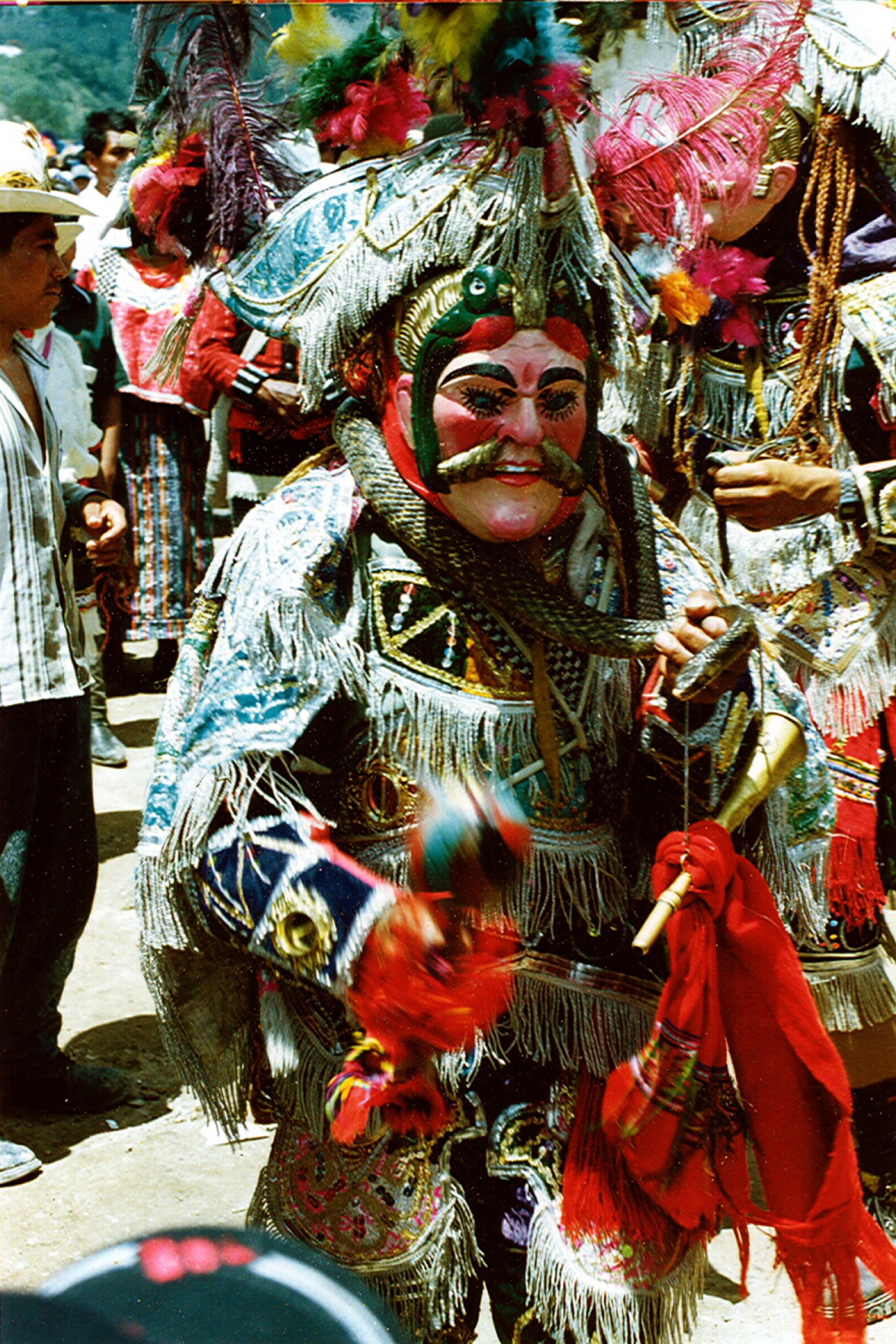
It seemed to me a simple question. “What happens in this dance-drama? What is the storyline, the narrative?” I am met by puzzlement. The dancer explains that each such dance has its own set of instruments, its own special costumes and masks. For this one they use a simple, one-man marimba and the costumes come from the nearby town of Chichicastenango.
We are in Joyabaj, Quiché in the Guatemalan highlands and I am talking with Manuel Tiin, a dancer in the town's Baile de culebra or “Serpent Dance.” Manuel's father, Don Eugenio, is the work's mayordomo, or spiritual steward—a ceremonial prayer maker and cultural conservator of the traditions that surround the performance. I had seen the performance a few times by now, but the storyline was still unclear to me. I reframed my question. “It seems that the action of this play takes place on a cattle plantation, that there are eight Mayan cattlemen, a black domestic servant, and a pair of Ladino work bosses.” “Yes, that's right,” he says, “and the plantation owner and his wife, and also a healer diviner from Chichicastenango.”
“And can you tell me what the story is, what the action represents?”
He tells me that, this year, by the grace of God, he is able to participate in this baile, this dance-drama, and that now the people are very pleased, because earlier this month when they first brought out the dance they did not have any serpents, but this week they have three. When they bring them out and dance with them the people are very happy. In this town there are twelve separate confraternities and they dance for each one. It takes a bit of money. Many of the local men have to leave for the coast to earn money. Many others, he notes, have gone to find work in Providence, Rhode Island.
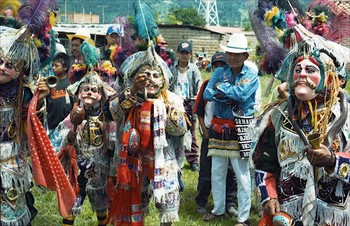
During a break in the dance, the cattlemen hold up their serpents. The man in the white hat is the troupe's ajq'ij ceremonialist and ritual prayer maker.

I am frustrated by his wandering digressions, which never seem to answer my questions. We talk for more than an hour, touching on many subjects, yet no matter how I circle back to the question, I am unable to get a clear narrative account from him of what transpires within the play. Nor from his father. Nor from any of the other dancers in the troupe.
THE DISINTEGRATY OF NARRATIVE IN K'ICHE' MAYA THEATER
The Serpent Dance is but one of many traditional theaterworks that are still performed in Joyabaj. The presentation of these masked dance-dramas is a devotional activity among Maya traditionalists throughout the highlands, part of the cult of Catholic saints. The contents of these performances represent a rich and tangled history of interethnic dialogue and social commentary. A hybrid expressive form, elaborated across multiple generations, the bailes borrow liberally from both Spanish colonial and pre-Christian native forms of festival diversion and entertainment, straddling the twin domains of ritual practice and popular entertainment.
I should say that there is, indeed, a latent narrative embedded in the Baile de la culebra, and I will sketch it out presently. The storyline, however, was both unheralded and poorly understood by all but a few in the community. The action of the play is chaotic and self-similar throughout, and passing onlookers can easily misrecognize what is being represented. One might be inclined to dismiss the notion of narrative altogether, or simply say that in this instance the storyline has been forgotten, but I believe that my informants' inattentiveness to plot reflects a culturally patterned orientation to such dance works in general, an alternative structuring principle that broadly underlies them as a social practice, rather than a lack of specific knowledge on their part alone.
Observing the Baile de la culebra in August 2000 marked an emotional low point in my fieldwork, a thoroughly frustrating encounter with cultural richness and difference in which the fragmentary entanglements of history, content, and practice embedded in the work seemed all but impenetrable. I watched the complete play through more than a dozen times in the course of the week-long feria, or patron saint's fiesta, as well as the subsequent octavo, a reprise celebration that starts a full week after the mass and runs for another five days. Muffled behind their wooden masks, the players' speeches were all but inaudible, swallowed up by the din of the crowd and the amplified music of other nearby and competing dance troupes. Straining to make sense of it all, I found the loopy, percussive melody of the little one-man marimba maddening. The performance seemed to encompass a series of distinct vignettes or quasi-narrative episodes, but the linkage between them remained obscure, swamped by the players' continual ludic byplay and the monotony of their rustic choreography. Physically, the fieldwork was difficult. Though still in the highlands, the town is lower and hotter than others in the K'iche'-speaking region. During performances, women and children were apt to take up all the available shade, so that, standing in the sun as the performers danced, I often found myself stupid with heat. I had been to the feria in Joyabaj twice before, but had as yet made few connections in the town. There was a double shift of dancers, mornings and afternoons, but whether they were dancing or attending from the sidelines, I found the members of the troupe much given over to drinking kuxa, a clandestine aguardiente distilled in the region and sold throughout the highlands. Communication was difficult.
This was at the end of a year of comparative research, spent partly in Rabinal, to the east, and partly in the western highlands. Some of the dances I had worked with were scripted; others relied on improvisation. Some were performed in Spanish and others in K'iche' or Achi. I was intrigued by the way they carried forward complex references to history, ritual, and cultural knowledge, all sedimented and transformed, cross-referencing one another and continually intercut with disruptive, ludic humor. While each dance-drama is an independent work, the product of a complex genealogy of creative invention, slavish reproduction, and historical accretion, collectively they constitute a ubiquitous corpus of indigenous theaterworks that have been key to shaping and sustaining notable continuities in Mayan cultural expression throughout the highlands.
Rather than relying on fixed texts, most traditional K'iche'-language performances have been passed down orally and are structured around long, improvisational monologues, delivered by a principal character and enlivened with boisterous interjections by the others. The Spanish-language plays, by contrast, do rely on written texts, but these are closely held by the dance's maestro, or teacher, who will rarely let others see or copy the heirloom manuscript. Whether scripted or improvisational, the social authority to bring out or direct a particular baile is treated as a kind of property right, not to be infringed upon. Interestingly, the social authority to direct a baile is often signaled with Spanish loan words, even in relation to the orally transmitted, native language monologues. Terminology varies from town to town, but the director, mayordomo (steward) or autor (manuscript owner) of a dance will generally be called the work's dueño (or owner), as well. Some contemporary dance troupes espouse a collaborative, committee-type structure, but the ownership principle remains in effect, as they alone bear the socially recognized authority to bring out the dance in their community.
Prior to the modern era, scribal literacy was a jealously guarded trade among the Maya (personal communication, Gaspar Pedro Gonzalez). State-sponsored public education did not exist. An individual who could read and write would be able to supplement his income by helping to prepare letters or legal documents such as wills or land titles for his neighbors. The monetary value of the skill could be measured in its scarcity, which provided a disincentive for teaching others how to read (nor was there much practical call for mastering K'iche'an orthography). Nevertheless, for Mayan dancers in the late nineteenth and early twentieth centuries, when the Spanish-language bailes were efflorescent, the public demonstration of one's relative fluency in Spanish through participation in a baile could be seen to increase a person's cultural capital, positioning the individual as a cultural, political, and economic intermediary between indigenous monolinguals and their Ladino neighbors. The interplay of these two factors doubtless contributed to the convention whereby a native dance-master in possession of a text could expect to be well paid by the players for teaching them their individual parts, yet would do so without allowing any coherent, integrated copy of the text as a whole to leave his hands. Over the course of the past fifty years such scribal exclusivity has been relaxed, as has the importance of performing one's competence in Spanish. Nevertheless, the Maya tend to venerate the written word, and ownership of an heirloom manuscript remains an important token of legitimacy in the social production of the Spanish-language theaterworks. The relationship between such texts and their fulfillment in actual performance, however, is less tightly integrated than one might, at first, presume.
Among the Maya the bailes are treated not as texts, but as cultural artifacts. In the parlance of the dancers, they are “brought out” each year, rather than read or performed. Their artifactuality is physically grounded in the material culture of the bailes, their antique masks and traditional costumes, and in the sensory return of their associated music and choreography. In the spiritual dimension, the artifactuality of the bailes is grounded in the conservative curation of the social conventions and ceremonial costumbre that accompanies their enactment.
There is an obligatory cycle of porob'al sacrifices, in which copal incense, candles, tobacco, and other material are burned by a formally trained ajq'ij, or ritual prayer maker, who initiates the troupe's preparations and accompanies their successive rehearsals. In these the ajq'ij invokes the day lords of the Maya calendar, the santos, or sacred images of the Catholic saints, the deceased ancestors of the community, and the rajawalab' of the region (the personified spiritual forces of specific hills, springs, and other natural landmarks), asking their permission for the dance to proceed and that all should go well for the dancers. All of these supernatural forces are felt to be co-participating witnesses to the dancers' actions, including the dead, as the spirits of those who have danced in the past are awakened and resident in the masks (see Hutcheson Reference Hutcheson2003: 315–20, and ch. 14, passim).
The performances must thus be seen as acts of restoration and return, memory works whose iterative presence in the public space each year links personal experience with the past and with communal aspiration, the concrete desire to bring them out again. Through dance the past is made present again, becomes available once more for participants and onlookers alike. And yet this presence necessarily remains an open one. The concept or potentiality of any theaterwork is realized in its performance, but each performance is unique, as well, a specific instantiation of the cultural artifact's latent or abstract possibility. The iterative presence of the bailes in the public space each year makes them performative vehicles for the reinstantiation of cultural memory.
Teasing out the significant slippages, displacements, and accretions in such memory works is a complex task. Little nuggets of the past become embedded in them over time, but as this layering of history arises through performance, such inclusions become fixed in the general matrix of the work with little regard for their specific points of origin. What I came at length to understand about the Baile de la culebra helped open up for me the way that memory and replication operate in structuring Mayan performance more broadly, replacing narrativity with something else, the mimetic reproduction of comparable figures, bits, and tropes within a familiar framework of ritual participation. But here I am getting ahead of myself. The problem I encountered in Joyabaj seemed fundamentally strange to me. If the dancers were not concerned with storytelling, what was it they were set on doing? The Maya I spoke with there and elsewhere seemed to suffer from a kind of narrative disability. Everything seemed to tumble out jumbled.
So here was my problem. In Western thought the origins of theater, dance, and poetry lie in mimesis, the reproduction or replication of speeches, gestures, social interactions, and prior known events within a newly set off fictive world, an as-if world made open through performance to the observation and assessment of an attentive audience. The model comes to us from Aristotle, who argued that such “copy making” of the world could be developed as a noble form of communicative behavior, tragic drama. At its most fundamental level, theatrical action is a form of embodied quotation that objectifies the speeches, gestures, and events it stages. In the words of Richard Schechner, it is “twice behaved behavior” (Reference Schechner1993: 1). Such mimesis is communicative, it is presented and received, and one normally expects that the onlookers' reception of such fictive stagings would indeed be the point. The players undertake to represent and thus convey through their expressive actions something deliberate and meaningful to their observing audience.
Paradoxically, in the dance-dramas of the K'iche' one often encounters a kind of representational disjuncture in which the performative intentions of the players are only partially accessible to their viewers. Instead of representation through drama, Mayan theater exhibits a concern with mimetic reproduction as a means of reinstantiation, wherein familiar, well-known theaterworks are once again brought out within the festival space in acts of renewal and return. Many of the traditional plays are carefully scripted and their texts do encode overarching narratives. In performance, however, the thread of narrativity is often broken, unattended to, or otherwise disordered by the spontaneous interjection of burlesque improvisation and transgressive byplay. Crucially, however, the resultant disintegraty of narrative is neither produced for, nor directed to, the audience. It is neither deliberate nor unintended, but arises in the performative gap between the work's enactment as ritual action and its presentation as public entertainment. The chaotic nature of the Baile de la culebra as I encountered it points to a general difference in the way such highland Maya dance-dramas are structured as compared to Western drama.
In the West we are inclined to think of theaterworks as texts that have been brought to life by means of performance and interpretation. Within this paradigm, text is thought to encapsulate the irreducible core of any theaterwork, while its live performance is regarded as a matter of variable, even ephemeral, elaboration. In asking Manuel and the others for a storyline I was looking for a pathway into their play, a way to understand its meaning. In Mayan theaterworks, however, we often seem to be dealing with a chaos of decoupled fragments. Objective narrativity, the meaningful emplotment of enacted elements in a causal sequence or configuration of events, is of little importance to the dancers, who are concerned instead with the concrete actualities of each work's enactment. From our perspective this pragmatic concreteness, wrapped up as it is in the intricacies of choreographic sequence and the sociality of participation, has the effect of displacing narrative content in favor of form. Their manner of objectifying the work is on a different footing from our own. They are not concerned with telling a story, but with fulfilling a ritual obligation to properly enact each portion of the dance. That is to say, the problem of understanding narrative structure in the dance-dramas of the highland Maya is a problem for us, rather than for the maize farmers and traditionalists who produce them. Their understanding of the structure of these theaterworks subscribes to a different set of priorities, which is, of course, what makes their performances interesting from an anthropological perspective.
SOCIAL CONTEXT AND FICTIVE SETTING
The town of Joyabaj is in the Guatemalan highlands and the dancers I worked with there are culturally conservative K'iche' Maya, many of them subsistence maize farmers from the nearby village of Laguna Seca. The center of Joyabaj is a bustling place, spread along a meandering ridgeline, flanked with deep ravines. It had once lain on the royal highway connecting Guatemala with Mexico, but now it is at the end of the pavement, far off the beaten path. It would be wrong to cast the town as a forgotten Shangri-la. The region is poor and many men look elsewhere for seasonal employment, but there is a spirit of cautious rural self-sufficiency in Joyabaj that helps it sustain an elaborate expressive culture, despite its accelerating integration with the national and global economies. Indeed, where other communities increasingly have trouble meeting the expenses associated with traditional saint's day celebrations, remittances from sons and families who have emigrated to the States help to fund such activities in Joyabaj.
This cultural conservatism is especially notable in the town's robust tradition of bailes, which is second only to Rabinal. The Baile de la culebra is one of many traditional bailes in the local repertoire, which also includes the famous Palo volador (an aerialists' performance dating to the pre-Columbian period), the historical Baile de la conquista de Guatemala, and a mute version of the widely popular Baile de venados, or “deer dance.” There are at least two other traditional plays that I have not yet seen. On the twenty-fourth of December they are said to perform an improvisational bull play known as Toro ruch, or Toro de petate, and for Corpus Christi they present a burlesque satire of the Spanish called Los Corunes. Most popular of all is the Baile de los compadritos, a social farce about a group of Mayan cattlemen working at a local hacienda, which I shall discuss at length below. The masks and costumes for the Baile de los compadritos are supplied by a local morería, an artisans' workshop that produces and rents material used in such bailes, and the work is presented simultaneously by multiple dance troupes each year during the patron saints' fiesta. In August 2000 three separate troupes performed the Compadritos, jostling with the Culebra group for space in front of the Virgin's processional altar, each with their own marimba and saxophone accompaniment in an exuberant and overlapping chaos of alegría, the joyful merriment such occasions strive to produce.
The central importance of dance in all of these performances cannot be overstated. The masked dance-dramas are true theaterworks, with characters, speeches, and plotlines (ostensibly, at least), but the devotional sacrifice they represent is actualized by dancing. Non-social, gender-segregated dance is an essential component of Maya ritual practice, taking various forms in different communities across the highlands. A full discussion of unmasked ritual dance would take us far afield from this paper, but it is worth noting that during the feria in Joyabaj a group of successful indigenous businessmen dance in the coheteria, a loose sodality dedicated to the production and display of elaborate homemade fireworks. Clutching cloth-wrapped bundles of long-stemmed rockets to their bellies, the men dance for hours on end, day after day, in a open circle in front of the church, swaying and bobbing to the music of pop marimba orchestras brought in from the capital. The final pyrotechnic display, on the evening before the Virgin's mass, is only the capstone to a weeklong commitment on their part. Wearing the men's ceremonial traje of Joyabaj—bright red jackets, white cotton trousers, and folded black woolen loin covers held in front by red sash belts—their extended ritual performance harkens back to the round dance mitotes of the early contact era.
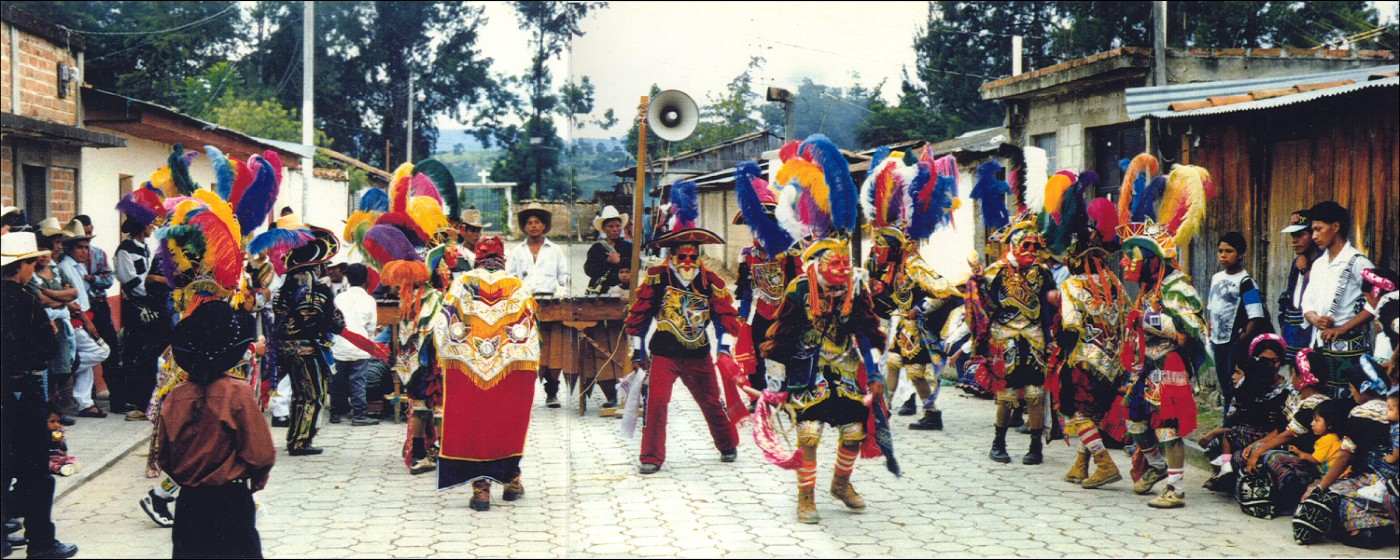
The Baile de los compadritos in Joyabaj, Quiché.
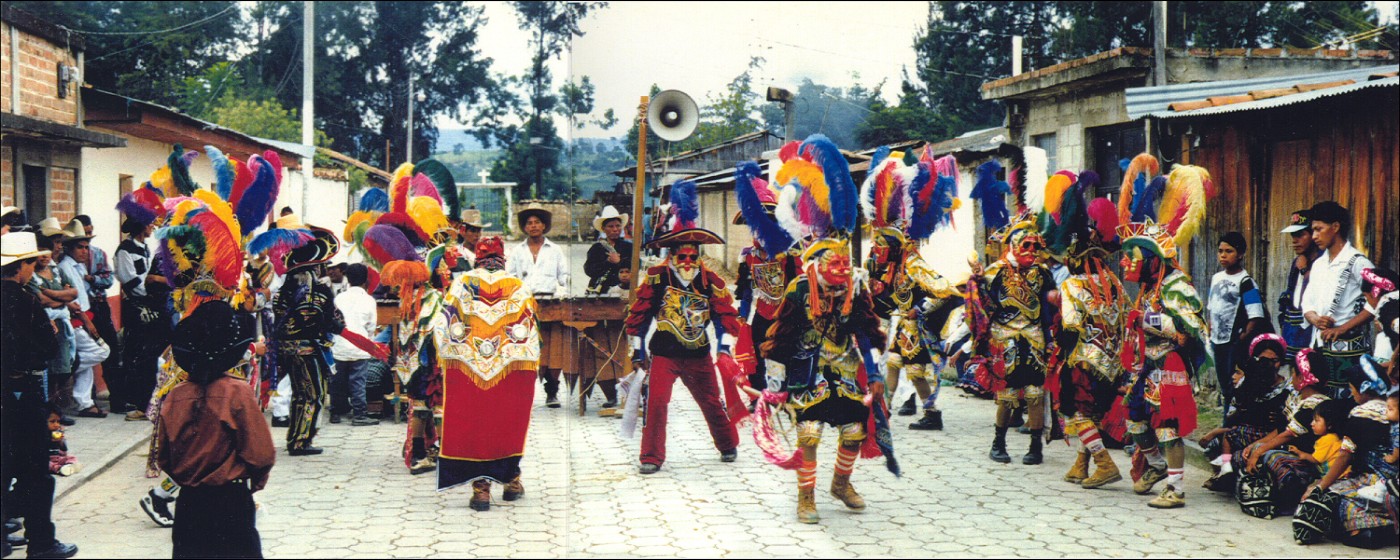
The Baile de la culebra partakes of this cultural dedication to dance, but it does so in a curiously literary way, reproducing different elements of historical and social practice within a storyline that has all but been forgotten, so that the elements themselves stand forth as abstract and decontextualized cultural tokens. It is a multi-layered work of intercultural parody and ritual play, a social farce that represents or reproduces the familiar events and activities of the patron saint's day festival wherein it is enacted, yet which restages these activities within the dramaturgic setting of the aforementioned Baile de los compadritos (or “dance of the boon companions” which is often presented alongside it. And within this borrowed, fictive world the dance restages yet another dance, involving live and poisonous snakes, from which the Baile de la culebra takes its name. It is thus a nested theaterwork, a play performed in the course of a festival which in its action reproduces that fiesta so as to stage within the fictive setting of another play a game-like ritual of serpent handling and mimetic clowning known elsewhere in the region as tz'ul or patzkar. The complex layering of play within play within festival play suggests a history of dramaturgic innovations and ellipses that calls into question many conventional distinctions between ritual and theater, textuality and memory, narrativity and happenstance.
Cattle ranching has been important to the region since the early colonial era and a regional cattle fair is held each year during the fiesta patronal (the yearly celebration of the town's patron saint). Some local Maya still pursue part-time work as hired hands on Ladino-owned cattle ranches in the region. Many more depart for several months each year to labor as cane-cutters at sugar plantations on the coastal plain, or head to the capital to work in the textile industry. Despite such migrations, however, many of the men who perform in the local dance-dramas speak only a limited, halting form of Spanish. The local dialect of K'iche' is distinctive, as well, and despite their labor circulation within the national territory, the identity and worldview of the dancers remains strongly anchored to Joyabaj.
In common with the Baile de los compadritos, the action of the Baile de la culebra is nostalgically set on a cattle hacienda of the early post-independence or late colonial era. In terms of staging, characters, masks, and costumes, the two plays are nearly identical and both were probably first performed early in the twentieth century, prior to the democratic revolution of 1946. The two are variations on the “little bull dance” theme (Edmonson Reference Edmonson1997; García Escobar Reference García Escobar1989; Paret-Limardo Reference Paret-Limardo1963b), which is popular throughout the Guatemalan highlands, and in both the formal speeches are given in Spanish. The cuaderno, or playbook of the Baile de los compadritos, which the owner of the local morería permitted me to copy, contains 139 separate speeches of varying length, together with staging directions, and fills twenty-five typed and folded half-sheet pages.
Intrigued by the two plays' similarities, I asked repeatedly if the Baile de la culebra, too, had such a text, and to take the players at their word, it seems that it may indeed have once been rooted in such a manuscript. Yet if a long text version did once exist, it has now long since been lost. The former mayordomo or steward of the dance was said to have died in the violence of the early 1980s. Only a handful of men now living had performed the work in their youth and most of the dancers involved in the work's revival were substantially unlettered. Therefore, the play had been reconstructed in part from memory, but also in part through the application of culturally familiar structuring principles.
THE PRESENT MANUSCRIPT AND STRUCTURE OF THE PLAY
After my repeated questions on the matter, Manuel and his father did present me with a text for the dance, written in unschooled Spanish on a single sheet of fresh, clean paper, folded in two so as to form a four-page booklet. They said it was a copy of an older manuscript, which they had back home in their rural hamlet. If this was indeed the case, the unseen original might have once been an individual player's papel or theatrical “side,” a sheet or booklet containing the speeches of a single character, produced as an aid to memorization but not including the speeches of any other player. I suspect, however, that the text they gave me was not copied from an older document, but had been newly produced to satisfy my curiosity and to serve as a legitimating material token for the work they were presenting. For the dancers that year, the presumed absence of a now-lost former manuscript was not regarded as particularly limiting, because the social and spiritual importance of the dance was never deeply rooted in textual dialogue and narrative development to begin with. Rather, their performance was seen as a ritual action whose proper execution was a matter of doing, rather than of representing. Nevertheless, the presumed historic memory that there once had been such a text continued to inform the players' regard for the dance, enhancing its status as cultural capital. Production of a new manuscript text and its transmission to the gringo ethnographer may thus have been meant to further and fulfill the social restoration of the work. Happily, it also provides us with a roadmap to the cultural logic and structure of the play.
The title page announces the bona fides of the autor and establishes his authority to produce the play:
Don Salvador Tiño, he wrote this story before, who knows how many years it was when this Baile de culebra began. When the church did this in the past, he came to do his part for all the people of the town. Those who are found in the town are the members of the religious confraternities and the mayor of the indigenous community and the other people. He said that yes, he knows this dance, a serpent dance. So then the people said that yes, they wanted to know this Baile de culebra.
Don Salvador Tiño—together with his brother, Don Miguel Tiño.
Don Miguel Tiño, he plays the little marimba.
Here the names of the two brothers serve as a kind of signature or legalistic validation to the paragraph above. Annotations of this sort are a common feature in such dance texts, where they often function as cultural property titles, marking cultural “ownership” of a dance and exclusive rights to its stewardship. It would not be unusual for such information to be copied over in transcription, yet the grammar and syntax in the statement itself seems equivocal. It presents a retrospective third-party description of Salvador Tiño's relation to the dance and the community, rather than a first-person statement of authority or intention, as we might expect to find in a historical document.
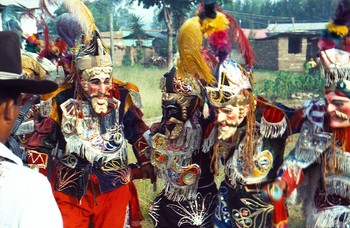
In common with other variations on the Bull Dance theme, including the Baile de toritos, the Baile de los compadritos, and the Baile de los Mexicanos, the Baile de la culebra begins with two paired lines of dancers facing one another across the four-sided dance space in front of the marimba player. The characters in each line are hierarchically ranked in descending order counting away from the marimba player, the principal authority for the troupe who instructs the players in their roles and choreography. The order of the dancers in the two files roughly corresponds to the social status of the characters they represent and, to a lesser extent, to the relative seniority, experience, and competence of the individual performers. On the marimba player's right, the plantation owner Juan Antonio dances with his wife, a Mayan shepherdess who is played by a man in a traditional straw hat, huipil, and intricately dyed and woven skirt. Hailed as Patrón by his K'iche' mozos, or hired hands, Juan Antonio is figuratively commensurate with the town's patron saint for whom the dance is enacted. His sun-burnt mask is the same one worn by Pedro Alvarado in the Baile de la conquista. He carries a sword and is said to be well known in the folklore of Joyabaj. His pretty young wife is attended by Chiliano, a Negro cook and domestic servant whose jet-black mask sports a golden (non-Mayan) beard. On the marimba player's left, and facing the Patrón and his wife, are Juan Antonio's administrative assistants: Ramón, the caporal or labor boss of the plantation, and the secretario or plantation bookkeeper—“he who bears or conveys the plans.” Like the Patrón, the Secretary and Ramón are both Ladinos, and can be identified as such by their trousers and boots, as well as their admiralty-style hats.
From left to right, the Patrón Juan Antonio, his negro servant Chiliano, the Secretary, and First Cattleman bow to the marimba player.

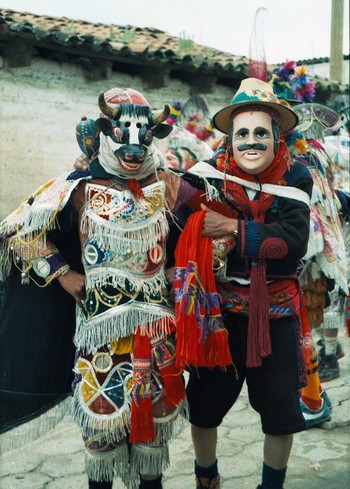
Hierarchical symmetry is important in such dances and the structural counterpart on this side to the black cook, Chiliano, would be The Maxeño, an indigenous shaman and healer who wears the ceremonial garb of Chichicastenango. However, as The Maxeño's role in the formal narrative is restricted to a single episode (albeit the highlight of the dance), for most of the performance he moves freely among the other performers or dances facing the marimba player, across the dance space and alongside the Bull, whose formal participation is likewise restricted to a single episode. The subsequent vaqueros, or “cattlemen,” are unnamed Mayan laborers, as indicated by their tasseled knickers and heavily decorated tri-corned hats. They, too, are ranked in descending order. Facing one another, the First and Second Cattlemen are distinguished by quetzal-figure hair bands that appear on their masks, like those of the Mayan princes in the Baile de la conquista. They are flanked by the Third and Fourth Cattlemen, who are followed in turn by a pair of long-nosed and ridiculously grinning cattlemen clowns known as First Caxuxa and Second Caxuxa. The Caxuxas are followed by two young shepherds, who are played by little boys about six or eight years old. The name Caxuxa may be derived from a popular South American dance step of the late nineteenth century, but it can also be heard as a punning and slightly slurred reference to kuxa, the locally produced clandestine moonshine which the Maya consume to famous excess, especially during important fiestas, such as the feast of the Virgin of the Assumption, for whom the dance is performed. Lastly, the Bull, when not engaged in a formal bullfight, moves about freely among the other dancers, harassing them with his horns and generally playing for laughs.
The Maxeño, a healer and shaman-diviner from the town of Chichicastenango, poses with the Bull.

Regardless of whether the manuscript was copied, invented, or reconstructed from memory, it crisply lays out the conceptual structure of the performance in a series of short declamatory speeches, delivered by one or another of the principle characters at the beginning of each numbered section. The first of these is pragmatically directed to maestro, the troupe's marimba player and director/choreographer, and the second to hacienda's Patrón, Juan Antonio. The remaining five speeches are addressed to the First Cattleman.
If the manuscript had been copied from an individual player's side, it might have belonged to the secretary, who manages the plantation payroll, or to Ramón, the caporal, who oversees the cattleman. Their social station is intermediary between that of the Patrón and his eight mozos, the Cattlemen. However, the specific individual(s) who would utter the lines are not identified in the text. Moreover, the work's storyline or narrative is nowhere spelled out in the script. Rather than conveying or developing a narrative, per se, the formal speeches serve to announce each new vignette and function as a cue to the musician and the dancers to keep everyone on the same page, so to speak. Within this episodic structure, the players are left free to improvise their own pratfalls, jokes, and bits of byplay. In practice, each vignette or episode ends when all of the participants have taken a turn at the principal activity to which the episode is dedicated, but the dancers make little effort to dramatize or convey any overarching narrative to their audience. In the performances I saw, the speeches were made by different characters at different times, or repeated in one form or another by several, which again suggests that the text I received was a schematic recollection of the work as a whole, rather than a historically derived text or document.
The speeches in the text are numbered one through seven, and marginal notations, vertically inscribed alongside the latter five speeches, indicate the principle episodes, vignettes, or choreographic segments of the dance: esal són, chocolatías, culebrita, lista, and torito. We will take up each of these presently, using the sparse, enumerated lines of text as orienting guideposts to open up the structural logic of the piece. Curiously, the numbers in the text are at times aligned with the first line of a given speech and at other times with a speech's final line, which again suggests that the numbering was added after the page was written, rather than copied from a source text. The five named segments are discrete units and may be presented independently of one another. The two initial speeches were not so labeled, but together they form a conceptually redoubled introductory pair. In practice the dancers generally hewed to the sequence given in the text, but at times they elected to omit one or another episode, or presented them out of order, so as to better coordinate the duration and overall pattern of the dance with the ritual activities of the confraternities for whom they performed.
The first speech serves a pragmatic function, announcing the devotional purpose of the dance and initiating the action with an implicit request for the marimba player to strike up the first dance tune:
(1) With permission, maestro, I am going to dance in the center of the field, for the feast of the Virgin Mary of the Assumption is coming. Viva Tata Dios! (Long live God the father).
The second speech pivots from pragmatic announcement to fictive representation, as the speaker addresses the owner of the hacienda:
(2) Good day, Juan Antonio. Do me a favor. Please come with me to gather together all of our companions.
The numbering suggests that each of these speeches would occasion a separate round of dancing, but in practice they are conceptually linked with one another. The first relates to the formal entrada, a standard feature of highland Maya dance-dramas in which the dancers take the field and, each in turn, present themselves within their roles through a series of solo dance steps, as the others continue to dance in place. The second round restages this as a fictive narrative event, in which each of the characters within the play is invited to participate in just such a dance as the one that they, as dancers, are in fact presenting. Despite this conceptual shift, there is little to distinguish the two in terms of their choreography. The opening sequence is taken up with an introductory series of paseas, or dance steps, in which each of the dancers works his way up and down the central aisle of the dance space, individually crossing back and forth to perform separate vueltas, or dance rotations, with each of the other dancers in turn. Each such solo choreographic circuit is regarded as a devoción, an act of sacrifice and prayer on the part of the featured dancer, and the structure of the choreography ensures that all of the performers are afforded equal time and equal status as celebrants and co-participants in the work. Indeed, this business of performing one's devotion through dance is the principle concern of the participants and far outweighs any interest they might have in dramaturgy, presentation, or theatrical performance, as we generally understand them. This is made explicit in the analogous portions of the Baile de toritos and Baile de los Mexicanos, in which each of the characters pronounces his devotion to the saint with a pledge of flowers, candles, fruit, or other offerings, such as are commonly presented to the holy saints' images during actual highland vigils. The second round of dancing, in which Juan Antonio and his companion go to greet each of the others, largely restages the choreographic salutations of the first set of vueltas, but with minor adjustments to hint at the implicit narrative. Thus, Juan Antonio and his companion salute each character in turn and improvise a dialogue with them, inviting them to participate in the celebration of the virgin.
The third speech foregrounds the sacred quality of such dancing as the Patrón is invited to formally initiate the act of dancing in a ceremonial manner in honor of the saint:
(3) Good day, Juan Antonio. Please do me a favor. You are going with me to appear in a són [a ritual dance].
An alternate gloss of the text's unschooled and misspelled Spanish, “aseme un fabor tebas coymingo asalir hen el són,” could be “please help me to bring out or produce the són.” The marginal notation that accompanies this speech, esal són, restates the idea in compressed form. Esal is derived from the transitive K'iche' verb stem esaj, meaning “to reveal, bring out, or represent” a thing, here modified with an agentive particle (-l) suffix. The action is applied to the Spanish word son, whose literal meaning would be “sound,” or perhaps “sweet sound,” but in K'iche' usage són refers specifically to ritual dance music. The annotation thus reinforces the text, and signals that the ceremonial production and representation of ritual dance will now get underway.
This subtle commingling of dramatic representation with ritual undertaking deserves further note, for I believe it informs and underlies much of K'iche' Mayan theaterwork, far beyond the specific case at hand. In English we use the word “performance” to signify the execution of an action in the real world as well as the mimetic reproduction of such an action in drama. Thus, we can speak of the performance of a car, an athlete, or a bureaucrat, measuring the quality of their respective actions in the world with reference to an established framework of expectations. But we can also speak of performances that are dramatic, comedic, or ritualistic in nature—taking performance as an act of replication and representation. In the West we tend to hold these two dimensions of performance apart, but it seems to me that the Maya collapse them together in a form of earnest presentation that we might term enactment. Verisimilitude is of little concern; their emphasis is on doing the thing, on actually saying the lines and performing the choreography, rather than on producing an effective representation directed to a receiving audience. Action and speech does take place between the performers, but without regard to their communicative potential vis-à-vis the public. The participants say their parts, but often no one beyond the dancer they are immediately addressing can hear or understand them. Thus, while the bailes are carefully enacted, they are not presented, and their representational function is fundamentally a matter of instantiation, rather than communication.
Though the action of the Baile de la culebra is ostensibly set on a cattle-ranching hacienda, the activities performed within play can also be recognized as a self-reflexive and self-essentializing reproduction of the actual fiesta within which the dancers themselves are performing. Or better, the play can be understood as a kind of a meta-pragmatic reproduction of conventional K'iche' Mayan festival behaviors, which are staged or reenacted within the play in a heightened, abstracted, and deliberately nostalgic mode using stock characters from the local dance-drama tradition. In Rabinal, across the ridgeline of the Sierra Chuacús from Joyabaj, the Baile de los costeños employs a similar strategy, reproducing the local cattle fair, a visit to an inn, participation in a saint's vigil, and other features of festival activity that are familiar in that town (Mace Reference Mace and Kinkead1985).
In the Baile de la culebra the players restage the performance of bailes themselves, as a traditional component of such festivals, and they do so with specific reference to a now rarely seen but once quite widespread form of improvisational clowning known as tz'ul or patzkar. The word patzka refers to rumpled clothing (Mace Reference Mace1970: 20), and the performers generally appear in tattered old clothes and wear crudely carved, unpainted masks. Cook suggests that it may also be derived from pitzkay, meaning “somersault” (2000: 251, n. 53). In Spanish, the performances are simply called gracejos, meaning “clowns.”
In 2000, 2003, and 2005, I was able to observe tz'ul and patzkar dances in Chuisuc and San Miguel Totonicapán, Santa Elena de la Cruz Quiché, and Rabinal, Baja Verapaz. Due to their improvisational character, the performances I witnessed have come, through time, to take on different costumes, forms, and contents in each of the regions I visited, and though reported descriptions of tz'ul performances vary greatly over time and space, their commonalities remain clear, as we shall see.
Among the K'iche' this type clowning performance can securely be traced to the late Post-Classic Period, but their inception is doubtlessly much older. In the Popol Vuh, a contact-era document that recounts ancient K'iche' myth and history, we read that the hero twins, Hunapu and Xbalanque, disguise themselves as acrobats and entertainers, as “vagabonds, with rags before and rags behind, and rags all over too” (Tedlock Reference Tedlock1996: 132). With their true identities concealed, they amuse the lords of Xibalba with a number of entertaining dances, including tz'ul itself. Snakes are not mentioned in the Popol Vuh, but such performances often do feature episodes of serpent handling and jugglery, as is celebrated in the Spanish title of the work (see the descriptions in Cook Reference Cook2000: 53–55, 171–82; Guzman Anleu Reference Guzman Anleu1965; Mace Reference Mace1970; Ordóñez Chipín Reference Ordóñez Chipín1970; Termer Reference Termer1928). The players in Joyabaj do not wear tattered clothing, but fictively restage such a traditional snake dance as one among many related activities common to the patron saint's festival in their town. As though to underscore the point, the dancers I saw made a little sing-song of the dance's Spanish title, Baile de la culebra, which they chanted along with the marimba when they arrived at that part of the performance. Termer reports that in the 1920s the patzkar dancers around Totonicapán would sing, “Ay, que bonita la fortuna” (meaning “Ah, how pretty the fortune, or luck”). In 1958, a man from Cubulco told Carroll Mace that when he had seen the dance in Joyabaj, they sang a somewhat fuller verse: “Ay, que bonita la culebra, el que ganó Adán y Eva” (1970: 105), or “Ah, how pretty the serpent, he who deceived Adam and Eve.”
But before we arrive at the mimesis of tz'ul, the players set the stage for it by reproducing another quintessentially Mayan festival activity, the preparation of a ceremonial beverage made from ground, boiled maize and cacao. Chiliana, the Negro cook, approaches the lead vaquero:
(4) Good day, First Cattleman. Do me a favor. Please come with me to gather together all our companions. We are going to make a few little chocolate maize drinks. Such is the order of Señor Juan Antonio.
Boiled maize and chocolate beverages have been a staple of Mayan feasting since at least the early Pre-Classic Period (Reents-Budet Reference Reents-Budet1994: 75–79) and they still play a prominent role in the religious celebrations of Rabinal. The spiced maize drink I was served in Joyabaj was flavored with chili, rather than cacao, but in the Culebra performance the dancers circle around an imaginary central cauldron and pantomime the stirring and preparation of the ceremonial atole, as they chant in unison “choc'lat, choc'lat, choc'lat.” The vignette is iconic, rather than narratory, part of the festive mise en scène that the dancers are restaging, but the work's next episode does entail a fully worked out narrative. This fifth portion is the mimesis of tz'ul, the episode that gives the larger work its name, and its narrative emplotment points to the historical importance of the work as an example of transculturated indigenous literature.
As part of the celebration, the dancers propose to have a bullfight and Juan Antonio agrees to provide the bull. The hacienda owner also proposes that the men go on a serpent hunt, so they will be able to perform the traditional serpent dance (see Termer Reference Termer1928). Such performances were once ubiquitous in highland Maya festivals, especially in conjunction with Easter Holy Week, close to the end of the dry season, when the fields are being ready for planting. Patzkar dancers still make paschal performances in a handful of small communities in Totonicapán, and though they do not always employ snakes today, it is clear that they did so prior to the 1980s. Closer to Joyabaj, tz'ul is still performed with snakes in nearby Santa Cruz Quiché in celebration of the feast of Santa Elena. In the Baile de la culebra Juan Antonio's labor boss addresses the lead vaquero:
(5) Good day, First Cattleman Do me a favor. Please come with me to gather together all our companions. We are going to look for a little serpientita, in the pasture of Juan Antonio, that weighs dos arrobas [an archaic measure of about fifty pounds], to play with in the fiesta of August.
The First Cattleman dances with a mazacoate (deer snake) constrictor.

Prior to the actual fiesta, the participating dancers, themselves, go on just such a serpent hunt, as do tz'ul performers in other towns and villages. In early July they perform a Mayan ceremony in which they petition the mundo, or “holy earth,” for permission to do so. Then they scour the hillsides and rocky areas until they find one or several serpents, which are kept in a sack near the marimba throughout the performance (see also Cook Reference Cook2000: 172, 178). In the year I saw them, the dancers failed to acquire any serpents for the first round of performances, leading up to the 15 August Mass, a cause for much embarrassment. In explanation they pointed to an argument one of them was said to have had with his wife. The dancers in such bailes are supposed to perform in a state of ritual purity, ensured and demonstrated by sexual abstention throughout the proceedings, and the alleged marital discord was said to have displeased the mundo. Following the Mass, however, the dancers performed a second ceremony and were then successful in their hunt, returning for the octavo, a week afterwards, to perform again. This time they had three snakes: a mazacoate or “deer snake,” which is a large constrictor, and two cantiles, which are small but poisonous pit vipers. A dancer from Momostenango gave me the stagecraft secret. To prevent their biting, the mouths of the serpents are carefully sewn shut, but as they need to be able to drink water throughout their long captivity, these stitches are kept somewhat loose so the serpents can easily flick and extend their tongues, tasting the air. It is possible that this traditional bit of preparation was omitted in the dance I saw, since the dancers were exceedingly careful to carry the snakes by their necks, pinching them tightly just behind the jaw and supporting the weight of their bodies with their other hand.
Franz Termer (Reference Termer1928) and Carroll Mace (Reference Mace1970: 80, 81) suggest that the serpent-handling activity in these performances is derived from pre-Columbian rituals that marked the onset of the rainy season. Traditionally performed during Holy Week, when the fields were being readied for planting, the ritual focus of tz'ul and patzkar dances would be directed to ensuring fertility in the coming year. There is a pretty logic to the act. After such performances the captive serpents are released and, as snakes do, they will phallically penetrate the ground, carrying with them the erotically charged and fertilizing powers generated in the dance. In the Baile de la culebra such serpent handling has been seasonally displaced. It is no longer a springtime fertility rite, per se, but is reenacted as a quintessentially Mayan ritual practice within the larger narrative.
Within the narrative of the dance, when the cattlemen in the pasture encounter the snakes they pick them up and dance with them in turn, but when their Ladino master, Juan Antonio, takes one up he is suddenly “bitten” and falls to the ground, seemingly dead. Carroll Mace never saw the dance in Joyabaj, but an informant in 1958 gave him a compressed synopsis of the scene: “They bring out serpents of that thickness … with sones. There are plenty that dance. It has recitations in Spanish. They are dancing more or less as in a samba. They don't have the mouths [of the snakes] closed. Pregnant women [mujeres interesantes] are the ones that look after the snakes. One dies, Juan Antonio, the lazy man. There is always punishment in the world. He does not want to work. They cover the body of Juan Antonio and he dies” (Mace Reference Mace1970: 105, n. 145, my translation).
To protect his rented costume the dancers spread a woven grass mat on the ground for him to lie on and then circle around the body, lamenting his apparent death. The ensuing hubbub provides an opportunity for the plantation secretary to steal away, all but unnoticed, with the beautiful young wife of Don Juan Antonio. The cattlemen send for The Maxeño, a traditional shaman and healer from Chichicastenango, to bring the Patrón back to life. To do so the shaman places one of the serpents on the body. In the serpent dances observed by Franz Termer in the 1920s, the dancers would often put the snakes they danced with inside their clothes, but in Joyabaj they were content to simply let them wriggle over the body of the prostrate Patrón, who held them tightly without letting them go free. By means of The Maxeño's secreto, or magical charm, a second fictive snakebite acts as counter-venom to the first, and Juan Antonio springs back to life as though from a coma. When he does so, however, he quickly discovers his wife's infidelity. He turns to The Maxeño and asks him to perform a divination ceremony in order to learn where the adulterers have fled. The elusive couple scampers ahead of the Patrón and his shaman, who has to repeat his divination in the four corners of the dance space before catching them at last at the end of the line of dancers.
This little narrative takes the form of a play within the play, though the plot is not articulated in the text and may actually have been poorly understood by some of the dancers. The story is unevenly shared within the community and circulates independently of the performance, its intricate details overshadowed by the presence of the snakes, so that while the dancers act it out, they do not elaborate the plot or refer to it in the speeches that structure the dance. Instead, the tale is presented in fragments and in pantomime, in stock mimetic references and involuted jests unfolded in the course of long and static episodes. If one is unfamiliar with the various tropes and characters the play presents, one can readily mistake the action, projecting onto it one's own presumptions and misrecognitions (cf. the description in Nelson Reference Nelson2009:3). The story is a multilayered borrowing, a condensation of the K'iche' Mayas' dramaturgic canon, now collapsed into a new, remembered, and forgotten whole. I learned the details of it sotto-voce from the sponsor and financial backer of the troupe, an indigenous lawyer and former mayor of the town who is active in a local association dedicated to Mayan cultural revitalization. Having seen it in his youth, he grasped the story as a whole, while the dancers seemed to grasp it in discrete yet muddled fragments. Again, the players' emphasis was on the work's enactment, on doing, rather than presenting a story. When the cattlemen crowd around the body of the prostrate Juan Antonio, they inadvertently screen him from view, so that members of the audience—who inevitably crowd in closely to peer over the players' shoulders—can scarcely see the serpents as they wriggle over him. In this confusion, the flight of his wife and her lover really does go unnoticed by the crowd.
The intricacies of the original plot may be beyond recapturing, but the themes of marital discord and personal shortcomings must once have been more fully developed. Mace's informant said of Juan Antonio's revival, “He repents of having said the things, and that is when they remove the snakes” (Mace Reference Mace1970: 105, n. 145, my translation). To a K'iche' traditionalist, the very fact that Juan Antonio is bitten in the play would raise suspicions of sexual transgressions on his part, as tz'ul performers are supposed to observe a strict dieta, forgoing sex for twenty days beforehand and twenty days afterward.
Like the serpent-handling episode that precedes it, the scandalous elopement of the amorous couple recreates a second feature of traditional tz'ul performances, in which a female character known as Xinula is said to represent unbridled and irresistible sexuality (Cook Reference Cook2000: 180–182). As with the Baile de culebra, the structure of tz'ul performances is grounded in mimetic clowning, rather than in narrative per se, and consists of a number of separate competitive, agonistic, and erotic episodes in which the male characters turn somersaults, fight with one another, and attempt to seduce and/or defend the female character. Xinul is a K'iche' slang term for a Spanish lady or for a Maya woman who dresses like a Ladina. The erotic transgressions of the character Xinula are burlesque parodies of licentious Spanish/Ladino behavior.
Throughout the performance in Joyabaj the speeches the players make to one another are all but inaudible—they are made to each other, not to the audience—and the improvised byplay of the characters continually disrupts the presentation of each vignette or episode, so that the dance takes on a chaotic but selfsame monotony throughout. We are witness, nonetheless, to a Spanish-language theaterwork that may at one time have been scripted, which does enclose a complicated plot within its larger episodic structure, and which draws together elements of common festival behavior in mimetic reproduction of the setting of its own (re)presentation.
The word tz'ul may be related to its Yucatecan homophone, ts'ul, meaning “foreigner,” a possible reference to a pre-conquest tradition of itinerant, semiprofessional performers, but it may also be derived from the Kaqchikel tz'ulej, a verb which the Calepino of Francisco de Varea (Reference Varea1699) tells us means to cuddle, to embrace, or to sleep together, two beneath one blanket with legs intertwined. Edmonson also records the verb tzulunik, from Domingo Basseta's lexicon of 1698, meaning “to make love to” (Edmonson Reference Edmonson1965: 136). In contemporary tz'ul performances the erotic activity that surrounds the Xinul “Spanish lady” is often more suggested than explicit, as the men compete at “dancing” with her, but ethnographic descriptions of tz'ul performances from early in the twentieth century describe them as an extended orgy of simulated copulation and exaggerated or obscene sexual gestures (Termer Reference Termer1928), sometimes involving partial nudity (Saquic Calel Reference Saquic Calel1970). In Momostenango, Garrett Cook reports that one of the tz'ul performers he saw there in the 1970s manipulated the handle of his whip in a phallic manner and used it to lift the skirt of the female character (2000: 174, 232, n. 45). In a performance I attended in Santa Cruz Quiché, several of the men lay on their backs on the ground, beckoning to Xinula to walk over them so they could look up her skirts. The man who played the part would pause and courtesy as he did so, bringing his/her genitals close to the face of the prostrate lover. The explicitness of the action made the teenaged K'iche' girls watching at the sidelines blush and hide their faces. In the Baile de culebra, as in all of the other Bull Dance variations, the demurely dressed wife of the Patrón is thus recast as a ladinized and erotically hyper-charged Mayan shepherdess. The mythological aspects of the character appear to have deep roots in Maya tradition. Cook (ibid.: n.p.) has linked the Xinula character to the highly eroticized mythology surrounding María Magdalena, or “Mrs. Vagina,” that Tarn and Prechtel report in Santiago Atitlan (Tarn and Prechtel Reference Tarn, Prechtel and Gossen1986: 177). In the performances I saw she ran away on some occasions with the Secretary, on others with the black cook, Chiliano, and on yet others with the labor overseer, Ramón. Throughout the whole performance, the other characters continually engaged her with erotic byplay, fondling her or carrying her off to dance with every chance they had.
In tz'ul performances, the partner of Xinula is the Mam, or ritual “year bearer” of the divinatory calendar. He is a humorous, derisible grandfather figure who parodies the cultural authority of a shaman-diviner. Ideally, the dance troupe should be made up of twenty performers, or two groups of twenty who perform on alternate days, and the ceremonial proceedings that consecrate each season's enactment of tz'ul suggest that they once represented the diverse qualities and characteristics of the twenty day lords of the divinatory calendar (Cook 2000:182) In terms of social hierarchy, the Mam is a structural complement to Juan Antonio, the plantation owner in the Baile de la culebra, in that both may be read as dueños, or “owners and masters,” of the mundo. And, as in the Culebra, the licentious transgressions of the Spanish/Mayan shepherdess are enacted across ethnic lines. In Santa Cruz Quiché the males who vie for her attention wear masks that have been painted white, thus signaling that they are blancos. They dress in scruffy urban street clothes and are called mamarrachos, or “jerks” (Ordóñez Chipín Reference Ordóñez Chipín1970). In Totonicapán they dress as rumpled K'iche' farmers but are referred to as mu's, a somewhat derogatory term for Ladinos whose literal meaning is “pretty” or “dandy,” but which is punningly close to mo'x, meaning “crazy, insane.” Though it is not apparent in their texts, the same kind of transgressive, erotic competition can be seen in performances of the Baile de los compadritos and other toritos variants throughout the highlands. By cuckolding the old man, the dancers in each case upend the conventions of social order in a carnivalesque inversion of permissible relations and behaviors.
In Santa Cruz Quiché, the structure of tz'ul is game-like, in that free improvisation takes place within the formal, rule-bound structure of its choreography. The activity is filled with agonistic competition, but without celebrity or recognition. There is no final winner and no one takes a bow. The performance contains a number of independent segments in which the male characters aggressively take each other on, not only competing to seduce Xinula, but mashing avocados and tomatoes in each others' masks, taunting and wrestling one another in a king-of-the-hill type competition, and continually flogging each other with whatever comes to hand (often their rumpled jackets). Similarly, in Totonicapán, the patzkar dancers taunt one another and do tumbling tricks, lashing one another's legs with bull whips as punishment for their sexual transgressions. The tz'ulab' dancers Cook worked with in Momostenango described a complex sequence of choreographic vueltas, or dance turns, interspersed with episodic skits, including a seed-scattering dance called sikoj (pepinar in Spanish), erotic competition for the Xinula, a fatal bullfight sketch, somersaulting and leapfrogging acrobatics, and serpent handling, throughout the whole of which the dancers were continually whipped and disciplined by the lead dancer, Nab'e Mu's, who represents both an irascible Ladino and the Mam, or calendrical “year bearer” (Cook Reference Cook2000: 53–55, 171–82).
While stylized and formalistic, these agonistic displays of contrary behavior seem meant to burlesque daily life. In Totonicapán, the patzkar costumes point to rural culture in a nostalgic mode, but when I saw the tz'ul in Santa Cruz, the players wore a variety of modern urban uniforms. There was a soccer jersey, a sailor's suit, and a striped jail uniform. One man wore a construction workers' hardhat emblazoned with a punning jab at a local politician, another wore a jacket that read “cable guy” (painted on in English), while a third wore a doctor's lab coat with the notice, “free medical exams today—women only,” scrawled in Spanish across his back. Some carried parasols; others carried baby dolls, which they used to thrash the other men. Many wore sunglasses over their masks. There were also two men wearing the ceremonial garb of Chichicastenango, to parody K'iche' traditionalists. Amongst eight or so separate episodes of chaotic competition, the rivalry to seduce the woman character was enacted twice in different forms while the serpent-handling interlude occurred only once, about half way through (in 2000 they had two constrictors). Most importantly, however, their contrarian behavior and agonistic competitions are not structured as a narrative, but rather as an improvisational game. It is the choreography, with its circulations, partnered crossings, and dance rotations, that maps beginning-middle-end for each separate segment. A similar pragmatic structure governs the present day enactment of the Baile de culebra, but at some point in time the serpent play and sexual themes of tz'ul were apparently recast in a literary mode, mimetically extracted, fixed in narrative, and projected into the fictive yet orderly social world of the rustic hacienda.
The parody of interethnic relations is carried forward in the subsequent vignette, when the Patrón's administrative secretary goes from dancer to dancer, making a list of their names in his book:
(6) Good day, First Cattleman. Do me a favor; come with me to gather together all of our companions. We are going to make a list. Such is the order of Señor Juan Antonio.
This vignette is a mimetic reenactment of the annual hiring fair that takes place at the close of the actual fiesta in Joyabaj, in which labor bosses arrive from the coast to sign up sugarcane cutters for the coming season. Each of the cattlemen responds to his request with a slapstick malapropism, which the secretary dutifully inscribes in his book, using the back of the dancer as his writing table. The episode is discontinuous with the elaborate tz'ul and patzkar episode outlined above, but ripe with pratfalls, mimicry, and satire. The spontaneous byplay between the performers in this and other portions of the dance is improvised on the fly, with each performer contributing their own disruptive gags and jokes, but the central presence of the secretary—the agentive figure who knows how to write—subtly folds the parody of the work back on the act of authorship itself, and the power that it represents.
The dance closes with a comic bullfight in which each dancer, in turn, takes a pass with the bull, who has been leaping and clowning about with the others throughout the entire performance. While formal bullfights are rare today in Guatemala, a jaripeo, or bull riding competition remains a highlight of the feria among Ladinos in Joyabaj.
(7) Good day, First Cattleman. Do me a favor. Come with me to gather together all our companions. We are going to look for a little bull in the pasture of Juan Antonio, that has two horns, to play with in the August fiesta.
In the Baile de los compadritos and other bull plays, the Patrón would be fatally gored in such a moment, but since he has already been once snake bit and returned to life, in the baile Culebra he simply dances cape work with the bull, as he and the others restage the rustic diversion of playing with bulls—perhaps with a mimetic bow to the Compadritos itself—and thus merrily conclude their mimesis of the fiesta for the glory of Maria, La Virgen de la Asunción.
A SOCIAL HISTORY OF THE SERPENT DANCE OF JOYABAJ
The little manuscript cuaderno that Manuel and his father presented to me points to a once more fully realized performance that straddled the conventions of Mayan ritual clowning and Spanish/Ladino theater, an experiment in dramaturgy that is locally remembered, yet inadequately documented. The heyday of Spanish-language Mayan theater in Guatemala spans the period from the liberal revolt of 1871 to the democratic revolution of 1944. There were doubtless many such experiments during this time, of which the most well known today are the ubiquitous Spanish-language deer dances and “little bull” plays (toritos) whose self-similar yet diverse and locally unique manuscripts have been collected and published by Guatemalan folklorists (Edmonson Reference Edmonson1997; Carlos Rene García Escobar Reference García Escobar1989; Jensen Reference Jensen1977; Paret-Limardo Reference Paret-Limardo1963a, Reference Paret-Limardob). The unpublished Baile de los compadritos text that I obtained in Joyabaj follows the literary norms of its day, and it is reasonable to assume that there may have been local inspiration, as well, for a separate scripted play, the Baile de la culebra. The fixation of such works in text (and necessarily in Spanish, as this was the language of formal education) would have entailed a process of structural as well as linguistic translation, as indigenous patterns of ritual participation, festival diversion, and ceremonial dance were re-expressed within the narrative conventions of Spanish literacy.
Expansive as it is, our reading of the players' little manuscript remains both tentative and incomplete. Was there ever a more fully realized script? Short of discovering an extant manuscript, we may not ever know. As a burlesque farce it may have always been largely a matter of inspired improvisation, elaborated by the players of a different generation who worked within a commonly held knowledge of the dance-drama tradition in both its scripted and unscripted forms.
The sparse and episodic structure of the current players' one-sheet manuscript may, in part, reflect the mnemonics of a largely oral culture that relies on association as a prompt to memory, rather than textual citation—on likenesses rather than arguments. Among the culturally conservative K'iche' and Achi I have worked with memory is often organized thematically, rather then linearly. It is not unusual to hear a person speak in short order of an event which occurred a week ago, a similar event from ten years before, and a like event that is anticipated in the future, without distinguishing between the three either in terms of time frame or causality. In the course of fieldwork with a score of different dance troupes, I have encountered perhaps three individuals who promptly responded to the question “What happens in this dance-drama?” with an answer keyed to narrative emplotment. Though these individuals were all aligned with the traditionalists of their respective communities, the formal education of the men exceeded seven years of schooling each, or more than twice that of middle-aged K'iche' as a whole. Their education doubtless predisposed them to the Western logic of my question, while their unlettered co-participants were inclined to make order of the world in terms of correspondences, rather than developments. Rather than reenacting a story, the dancers were quite content to reproduce familiar gags and vignettes without regard for their structural integration.
In part, this may be related to the phenomenology of memory. The Greeks who developed Western tragic theater recognized two distinct kinds of memory: mnene, in which an image or sensation pops into mind, almost unbidden, and anamnesis, in which one's knowledge of the past is recollected with deliberation. The one is experiential and intimate; the other can be crosschecked as a matter of record. For most participants in the Baile de la culebra, their memory of the work is physical rather than literary, derived from their participation and from witnessing the dance before (along with others of its type), rather than from storytelling. They may as individuals be taught and prompted to recite certain lines, but few among them have access to, or might be inclined to read, the full text. An analogy could be made to the memory non-musicians like myself may have of musical works. I generally recall an instrumental piece in scattered parts, rather than from start to finish. Some musical phrases stick with me; others are laid aside or forgotten altogether. I might jump back and forth to different portions of the work, or bring in, inadvertently, some related themes or passages from other pieces altogether. Where a trained musician might recognize and thus recall the underlying structure of the piece, my unschooled recollection of it would be rather different from the annotated score, built up through mnemonic sensory association, rather than from an objective understanding of the composition's formal structure and dynamics.
It would be a mistake, however, to attribute the disordered and particulate nature of highland performances to a lack of formal education alone. Or worse, to presume that historically high levels of illiteracy have somehow left the Maya conceptually impaired. I believe we are dealing with a broader issue, which is the cultural construction of time itself; or better put, the way one's place in time is conceptualized through correspondences and likenesses, rather than through anamnesis and narrative emplotment. Western models of causality and explanation rely strongly on narrative, but the traditional divinatory practice of the highland Maya stresses a patterned correspondence between time, temperament, and fate. Explaining one's nature and best course of action is dependent on identifying one's nawal, the spiritual co-essence of one's day of birth, rather than retracing one's actions or coming to terms with one's history, as we might be inclined to do. Rather than deriving one's identity as a product of history, one's potentiality in any action is determined or shaped by the spiritual qualities of the day lord who governs one's birth as well as the day on which one acts. The mnemonics K'iche' shaman-priests rely on in counting the days of the ritual calendar and divining for their clients are built around punning wordplay and metaphoric references to ritual practice (Tedlock Reference Tedlock1992: 107–26), rather than by reference to myth or narrative. Homophonic correspondences between otherwise dissimilar words are interrogated for the excess meanings and relationships they may encode—a tactic I found dancers in Rabinal likewise use to interpret the temperaments and secret identities of the supernatural ancestor spirits that populate their deer dances (Hutcheson Reference Hutcheson2003: 398–401). Similarities and resonances between disparate items lead to productive double understandings. Moreover, history is traditionally understood by the K'iche' as a process of accumulation and imbrication, of overlapping influences; time is dialectical in that one's present acts and circumstances are seen to correspond with prior events—not to be determined by them, but to be meaningfully similar and different from other like events and days (Tedlock Reference Tedlock1992: 200–3). A cultural preference for recognizing and reproducing forms and types, as opposed to telling stories, seems to operate in much of highland Maya performance, where it works against narrative by prompting the mimetic production of impromptu non-sequiturs. The disruptive force of mimicry and comic buffoonery may nonetheless be richly meaningful, playing against a host of familiar associations and cultural memories.
The apparent disintegraty of narrative in the Baile de la culebra, and in highland Maya theater more generally, may thus be in part a product of transculturation, in which indigenous models of structure and ontology have been re-inscribed within a literary form predicated on linear development and dramatic emplotment. The Mayan concern with divination—and with fate as the expression of identity, rather than the consequence of action—tends to disorder the linear development of narrative accounts. They are not traditionally predisposed to view the world in terms of historical causality, but rather by reference to a typology of correspondences and recognitions. The mimetic reproduction of an idealized feria, which is the common strategy of all the bull dance variations as well as the Baile de los costeños in Rabinal, proceeds from the extraction and reproduction of isolated elements, rather than of dramatized actions and sequences of actions.
Beyond these questions of structure and representation, how might we best locate the inception of the Baile de la culebra within our own conception of history? The florescence of Spanish-language Mayan dance-drama appears to span the period from the Liberal revolution of 1871 to the fall of the dictator Ubico in the October revolution of 1944, a duration of several generations during which doctrinal oversight by the Catholic church was largely absent from the highlands and the indigenous cofradías (Catholic sodalities dedicated to the cult of holy saints images) had a relatively free hand in organizing popular religious expression (Garrard-Burnett Reference Garrard-Burnett1998: 56–59). Though there appear to have been antecedents (Hill Reference Hill1993), this was the period in which the most well-known and successful morerías in Totonicapán, Quetzaltenango, and Chichicastenango were established (García Escobar Reference García Escobar1987; Muñoz Reference Muñoz1993). The manuscript dates of many of the published venados, toritos, and conquista manuscripts fall within this window, as well. These were the generations of innovation when new manuscripts and versions of the popular themes were proliferating. Their very ubiquity made them iconic markers of traditional folclor, as they passed, over time, from being new creative acts to classic artifacts of culture—dances that the ancestors had done.
We know from Franz Termer's research that improvisational tz'ul performances were still quite common in the 1920s, but evidence suggests that because of their aggressive sexuality and serpent handling they were increasingly facing suppression by Ladinos throughout the 1920s and 1930s, as were other flamboyant aspects of Mayan expressive culture. In the 1920s, for example, a national edict, citing safety, reduced the permissible number of descending “flyers,” or costumed aerialists, on the Palo Volador from four to two. At the same time, in an effort to modernize the labor force, indigenous men in many regions of the country were forced to stop wearing their traditional dress, and many elder K'iche' have told me of how they and their parents were driven to perform their porob'al (incense burning) ceremonies at night or in ravines and hidden places to avoid being jailed or fined. Several factors were at work in this. To begin with, the relative isolation of the highlands was giving way to greater economic integration and ever-increasing penetrability, especially under Jorge Ubico, whose national road-building campaign was largely carried out with conscripted Maya labor. Ladino aspirations in the period were marked by two separate yet intertwined tendencies: a desire, on the one hand, for greater economic opportunity, global integration, and cultural modernization, and, on the other, popular adoption of an increasingly racialized model of identity that presumed indigenous inferiority vis-à-vis Ladinos (Grandin Reference Grandin2000: 126–29; Hale Reference Hale2006: 26, 157). While Spanish American colonial society had been organized within a complex hierarchy of caste that attempted to account for the offspring of mixed unions within a multiplicity of ethnicities and social classes, including an indigenous elite that benefited from the separation of Maya and Ladino governmental structures (Grandin Reference Grandin2000: 26–53), in early twentieth-century Guatemala the discourse of race became more polarizing. Within this framework, traditional Mayan cultural practices were increasingly seen as an impediment to modernization and economic development. Moreover, with the formal apparatus of Catholic oversight at its nadir in the highlands, Mayan costumbre within the cult of Catholic saints became increasingly syncretic and, as such, was clearly regarded by the Ladino community as nothing less than witchcraft. Faced with a national discourse of modernization and assimilation, the relative structural and cultural autonomy of the highland Maya was coming to an end.
Religious and cultural intolerance for traditional Mayan practices accelerated throughout the middle of the twentieth century. Viewed by Ladinos through the narrow prism of “traditional folklore,” the expressive culture of the Maya entered a period of crystallization in which its conservators attempted to preserve the past by reproducing the bailes and their related rituals precisely and without error (Hutcheson Reference Hutcheson2003: 89–97, 105–18). This magical desire to reanimate the past has contributed to the cultural marginalization of the bailes tradicionales, which are being superseded today by the popular, non-narrative disfraces performances, whose elaborate costumes mimetically reference global media images.
I believe, however, that we can recognize a creative early response to the assimilationist arguments of the Ladino mainstream in the dramaturgic innovation of the forgotten and remembered Baile de la culebra. Like their Ladino neighbors, the indigenous population in the early twentieth century was also concerned with maintaining or establishing a viable footing in the modern world, but they hoped to achieve social parity, rather than cultural assimilation. Economically successful K'iche' leaders in Quetzaltenango, for example, sought to maintain the structural autonomy and independence they had enjoyed in earlier generations while simultaneously working to demonstrate their civic and social legitimacy in relation to the Guatemalan state (Grandin Reference Grandin2000: 160–97).
I believe that the creative reframing of tz'ul activity within the Baile de culebra reflects an experimental moment in K'iche' Mayan dramaturgy in which Ladino opposition to the sexually explicit themes of traditional tz'ul performances was neutralized through recourse to Spanish conventions of narrative and stagecraft. By restaging tz'ul as a nostalgic component of festival culture, embedded in an overarching narrative structure, the author of the work recast a socially repressed and pagan ritual as a reasonably acceptable comic farce. In common with the other Mayan-authored dances of its day the play carried forward ancient themes of fertility, sacrifice, and social renewal, but made these newly modern, written and scripted in the national idiom. The creative impetus for such a work must have come from a member of the indigenous elite, perhaps an alcalde (mayor) or other member of the local governance, someone who was literate in Spanish and sufficiently well acquainted with Ladino cultural products that they might wish to preserve and reinvigorate the expressive culture of the Maya within a new transculturated form. The work's revival in the year I saw it was funded by just such a person, an indigenous lawyer and former mayor of the town. Following the violence of the counter-insurgency war, he had lived in the capital for many years, but he returned to Joyabaj in the wake of the 1996 peace accords to serve his community as a legal advocate and cultural booster. His patronage paid for the dancers' meals, their costume rentals, and the marimba player's fee, as well as the all-important cycle of Mayan ceremonies and sacrifices that attend such ritual theaterworks. It was his literary education that permitted him to reconstruct for me the storytelling aspects of the work as a whole, while the dancers who actually brought the work out were more attentive to the representation and reinstantiation of familiar stock characters and humorous bits of side play. This should come as no surprise. Charting the uneven dissemination of competing cultural models and interpretations within the Maya population, differentiated along the twin axes of economic and educational class difference, requires increased ethnographic attention, but such difference has doubtless always been a factor in the evolution and elaboration of Mayan expressive culture. In the present generation, then, the dance, decoupled from its now-lost Spanish manuscript, may not be a degenerated shadow of its former self so much as an authentic reinstantiation of the erotic, agonistic, and chaotic contents of tz'ul performances elsewhere in the highlands.