INTRODUCTION
Disturbed relational abilities, affective dysregulation, and lack of behavior control are considered to be the core dimensions of borderline personality disorder (BPD) (Skodol et al., 2002). Dysfunctions in the neural systems for affect regulation, behavior regulation, and social cognition are assumed to account for the neurobiological foundations of the disorder (Linehan, 1996).
Neuropsychological studies have found differences related to functions of the prefrontal cortex in patients with BPD compared with healthy controls, including executive functions such as decision making and planning (Bazanis et al., 2002; Lenzenweger et al., 2004). Some neuroimaging studies show specific differences related to the volume and function of the orbitofrontal cortex and the amygdala (Donegan et al., 2003; Soloff et al., 2003; Tebartz van Elst et al., 2003).
According to the somatic marker hypothesis, decision making is a process that depends both on conscious and unconscious processes, and it is influenced by bioregulatory marker signals that express themselves in emotions and feelings. Defects in emotion and feeling are proposed to play an important role in impaired decision making (Damasio, 1996). The amygdala, the ventromedial prefrontal cortex, and the insular/somatosensory cortices are proposed to be substrates in the somatic marker circuitry (Damasio, 1996). However, this hypothesis has been challenged by the view that decision-making processes are more related to executive functions and the dorsolateral prefrontal cortex (Fellows & Farah, 2005; Manes et al., 2002).
The Iowa Gambling Task (IGT) is an experimental neuropsychological task designed to study the integration of emotion and cognition in decision processes (Bechara et al., 1994). It simulates real-life decision making with uncertainty concerning premises and outcome as well as reward and punishment. Impaired performance has been found in patients with bilateral damage to the ventromedial prefrontal cortices and in patients with bilateral amygdala damage (Bechara et al., 1994, 1999). Studies have also shown impairments in individuals with substance dependency (Bechara, 2003) and in women with bulimia nervosa (Boeka & Lokken, 2006). One study comparing suicide attempters, individuals with affective disorders, and healthy controls found impairments in suicide attempters but not in individuals with affective disorders (Jollant et al., 2005), whereas another study found impairments in individuals with major depression (Must et al., 2006). Considering behavioral characteristics of patients with BPD in light of findings indicating dysfunctions in both the amygdala and the orbitiofrontal regions, we expected that patients with BPD would perform disadvantageously on the IGT compared with healthy comparison subjects.
METHOD
The sample consisted of 20 patients with BPD and 15 healthy comparison subjects. Patients recruited through in- and outpatient settings were required to fulfill the Diagnostic and Statistical Manual of Mental Disorders, Fourth Edition (DSM-IV) (American Psychiatric Association, 2000) criteria for BPD and be between 18 and 40 years of age. The average scores on the Global Assessment of Functioning (GAF) (American Psychiatric Association, 2000) were 49 for symptoms (SD = 8) and 43 for disability (SD = 10). A total of 12 patients were diagnosed with comorbid depression, 10 with posttraumatic stress disorder, 10 with an anxiety disorder other than posttraumatic stress disorder, 7 with another personality disorder, and 7 with substance abuse. All but one patient were taking psychotropic medications.
The comparison subjects were recruited among non–health-care employees at the hospital, students having practicum at the hospital, or among friends and relatives of the staff of the hospital. Selection criteria for the comparison subjects were no history of contact with psychiatric services, no history of psychotropic medication, and no history indicating psychiatric disorders or substance abuse. Exclusion criteria for the entire group were a history of head trauma or epilepsy and ongoing severe substance abuse. The study was approved by the Regional Committee for Medical Research Ethics, and the subjects were provided with a complete description of the study before a written informed consent was obtained. The study was completed in accordance with the guidelines of the Helsinki Declaration.
A computerized version of the IGT was used (Bechara et al., 1999). Starting with a $2,000 loan of fake money and with the instructions to win as much money as possible, the subjects were told to choose one card at a time from one of four decks (A, B, C, D). Immediately after every choice, the subjects received a financial reward, although in some cases they also received a financial punishment. Two of the decks (A, B) were disadvantageous and resulted in immediate large rewards, and also resulted in higher punishment at unpredictable points. The other two decks (C, D) were advantageous and resulted in immediate modest rewards, but lower punishment as well. In the long run, choosing from the advantageous decks would result in a net gain, while choosing from the disadvantageous decks would result in a net loss. The subjects were informed that some (but not which) decks were more advantageous and were warned to keep away from the disadvantageous decks. The score on the IGT was defined as the number of choices from the advantageous decks minus the number of choices from the disadvantageous decks over 100 trials. Because each deck contained only 60 cards, the subjects could not complete the task choosing exclusively from one deck. The subjects were neither informed about the number of trials nor about the size of the decks.
Diagnoses were established using the structured clinical interviews for Structured Clinical Interview for DSM-IV Axis I Disorders (SCID-I) (First et al., 1997b) and Structured Clinical Interview for DSM-IV Personality Disorders (SCID-II) (First et al., 1997a). Depression was measured with the Hamilton Depression Rating Scale (DRS) (Hamilton, 1967). For an indication of intellectual functioning, Block Design and Similarities from Wechsler Adult Intelligence Scale-III (Wechsler et al., 2003) were administered. A prorated IQ was obtained using the sum of scaled scores from the two subtests multiplied by 11/2.
RESULTS
Because seven of the BPD patients also had a substance use disorder (SUD), which is associated with reduced performance on the IGT, we divided the patients into two groups: “BPD” and “BPD/SUD”. A series of one-way analysis of variance were conducted to compare the three groups across the demographic variables. A one-way analysis of covariance followed by pairwise post hoc comparisons (t-tests) was conducted to determine whether the results on the net-IGT score differed between the three groups using prorated IQ and results on the Hamilton DRS as covariates. The α level was set at .05 for the IGT results and, to reduce the probability of a type II error, at .20 for the demographic variables.
Table 1 displays the means and standard deviations on the demographic variables for the three groups. The groups were statistically similar in terms of age [F(2,32) = .42; p = .661]. Differences were found regarding educational level [F(2,32) = 2.89; p = .070], mothers' educational level [F(2,30) = 5.68; p = .008], and fathers' educational level [F(2,30) = 2.92; p = .069]. The analysis also showed differences with respect to Block Design performance [F(2,32) = 7.99; p = .002], Similarities performance [F(2,32) = 12.85; p < .001], prorated IQ [F(2,32) = 13.68; p < .001], and Hamilton DRS score [F(2,32) = 19.32; p < .001]. In the combined samples, there were significant correlations between net total IGT score and prorated IQ (r = −.44; p = .009) and between net total IGT score and Hamilton DRS score (r = −.40; p = .016).
Demographic and clinical characteristics and Iowa Gambling Task performance of patients with borderline personality disorder, patients with borderline personality disorder and substance use disorder, and healthy comparison subjects

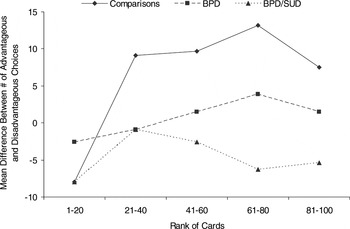
The mean and standard deviation of the net total score is presented for each group in Table 1. Using prorated IQ and Hamilton DRS as covariates, we found a significant group effect [F(2,30) = 4.51; p = .019] with regard to the net total score over all 100 trials. The effects of the covariates were nonsignificant for IQ [F(1,29) = 0.50; p = .657] and for depression [F(1,29) = 0.10; p = .755]. Post hoc t tests revealed significant differences between the healthy comparisons and the BPD group [t(26) = 2.60; p = .015], between the healthy comparisons and the BPD/SUD group [t(20) = 4.27; p < .001], and between the two patient groups [t(18) = 2.32; p = .032]. The mean and standard deviation of the net scores for every block of 20 trials is presented for each group in Table 1 and Figure 1.

Changes in mean difference between advantageous and disadvantageous choices during the Iowa Gambling Task for patients with borderline personality disorder (BPD), patients with BPD and substance use disorder (SUD), and healthy comparison subjects (net intermediate scores in blocks of 20 trials).
DISCUSSION
To our knowledge, this is the first study to report impairments in decision making in patients with BPD using the IGT. Patients with BPD made fewer advantageous choices on the IGT than did healthy comparison subjects. Patients with BPD and substance abuse performed worse than patients with BPD without substance abuse. These results elaborate the findings from earlier studies of executive functions in BPD (Bazanis et al., 2002). In our healthy control sample, we found the same response pattern as in previous research, with the first block serving as a learning period, and with predominantly advantageous choices thereafter. The reduced performance in the last block among the healthy controls is most likely an effect of the tendency of healthy controls to “empty” one of the advantageous decks and as such be induced to change behavior during this block. The response pattern of the BPD/SUD group shares several characteristics with the pattern found in patients with ventromedial lesions (Bechara, 2003), whereas the response patterns of the BPD group lies somewhat in between the other two groups with an indication of positive development over the blocks. A possible explanation to these findings is that the patients in the BPD group need more experience to learn from their own behavior and gain behavior control, which might be the basis for decision-making difficulties.
The finding that patients in the BPD/SUD group performed worse than patients in the BPD group is not surprising, given that reduced performance has been found in patients with substance dependency (Bechara, 2003). Thus, this finding might be explained by comorbidity alone. Another, equally plausible, explanation could be that BPD patients who also abuse substances represent a more severe subgroup of BPD patients and that the substance abuse is merely a result of a more severe lack of behavior control.
One way of interpreting these findings involves affective dysregulation. According to the somatic marker hypothesis, various cerebral regions are involved in decision making, in particular the orbitofrontal cortex and the amygdala (Bechara et al., 1999; Damasio, 1996). The results of this study could, therefore, seem to give behavioral support to the findings that both the amygdala and the orbitofrontal cortex show reduced volume and functional differences in BPD (Donegan et al., 2003; Soloff et al., 2003; Tebartz van Elst et al., 2003). Contrary to patients with ventromedial prefrontal damage in whom emotional changes involve a flattening of emotional responses (Damasio, 1996), patients with BPD show an intensified affective reactivity. A crucial question to arise from these findings is whether any dysregulation of the affective systems could result in dysfunctional decision-making abilities. However, reduced IGT performance has also been associated with dorsolateral and dorsomedial lesions (Fellows & Farah, 2005; Manes et al., 2002), and studies devoted to the association between IGT performance, executive functions, and working memory in this group would be of great interest.
Another possible explanation involves impulsivity as the other core dimension of BPD. The decision-making deficits observed in this study may be related to impulsiveness rather than affectivity. However, such a hypothesis finds scarce support in earlier findings: no relation has been found between impulsiveness and decision making in suicide attempters (Jollant et al., 2005) or in patients with BPD (Bazanis et al., 2002). Another possible explanation is offered by Berlin et al. (2005) who report that patients with BPD might show a hyperresponsiveness to reinforcers, a phenomenon that probably relates to the amygdala system.
Although both the indicator of general intelligence and degree of depressive symptoms were significantly correlated with IGT performance in the combined samples, this finding could not explain the differences between the patient groups and the healthy controls. These results do not correspond with the findings of Must et al. (2006), who reported impairments in individuals with major depression, but are in accordance with Jollant et al. (2005) who did not find any differences in the performance between their healthy comparison subjects and individuals with affective disorders. The impact of depression is of particular interest, because major depression and BPD probably share some of the same neurobiological substrate, yet our results indicate that some dysfunctions might be specific to BPD independent of depressive symptoms.
As there are several methodological limitations to this study and the results it presents are preliminary in nature, generalization should be done with caution. Given the high comorbidity of DSM-IV axis I and II disorders in BPD, comorbidity was not a criterion for exclusion except for severe ongoing substance abuse. The average GAF scores indicated that the patients were moderately affected as far as both disability and symptoms are concerned. Hence, our sample would be representative for patients in secondary care. The limited sample size made it difficult to effectively analyze the effect of different comorbid disorders. Further studies should be done with larger samples and eventually with clinical comparison subjects to explore this topic.
Most of the patients in our sample were receiving psychotropic medication, and no steps were taken during this study to reduce the possible influence of the medication, nor was it possible to check possible influences. In future studies, the effect of medication should be taken systematically into consideration.
Studies similar to ours, in which ecologically valid neuropsychological measures such as the IGT are used, can expand our understanding of the behavioral characteristics of various psychiatric disorders. This study contributes to the understanding of BPD by empirically challenging the difficulties seen in clinical settings regarding decision making in those patients.
In conclusion, this study reports deficits in decision making in patients with BPD compared with healthy comparison subjects as measured with the IGT. These deficits can be related to both the behavioral characteristics of affective dysregulation and/or impulsivity, and to proposed dysfunctions and reduced volume of the orbitofrontal cortex and/or the amygdala. Further studies should be undertaken to specify the relative influence of various clinical characteristics, in particular affective dysregulation, impulsivity, and substance abuse in the appearance of these decision-making deficits. Such studies should also focus on investigating the changes in IGT performance over blocks and the association between IGT performance and other neuropsychological functions, in particular executive functions and working memory.
ACKNOWLEDGMENTS
We thank the study participants and research nurse Gro Steensohn for assisting us with the data collection. This research was supported by a grant from Sørlandet Hospital HF and the Southern Norway Regional Health Authority. The content of this manuscript and the manuscript itself have never been published either electronically or in print.