A Tribute to Professor Joseph Kayle Perloff
Born in New Orleans, Dr Perloff enrolled in Tulane University and graduated with a Bachelor of Arts in English literature. He served in the United State Navy in the Pacific.
After World War II, Dr Perloff decided to go to medical school and obtained premedical credentials at the University of Chicago. He entered Louisiana State University School of Medicine and graduated in 1951. Following graduation, he spent 3 years at the Mount Sinai Hospital in New York as an intern and resident in Pathology and Medicine, where he met her wife Margie. He was awarded a Fulbright Fellowship to the Institute of Cardiology, National Heart Hospital, London, where he worked with Dr Paul Hamilton Wood, and learned the skill of physical examination of the heart and circulation. Now he is widely known as the father of physical examination. Dr Paul Wood is famous as nominator of the Eisenmenger syndrome and Wood unit for pulmonary vascular resistance.
After returning from England, Dr Perloff completed a medical residency at Georgetown University Medical Center in Washington, DC, followed by a National Institute of Health-sponsored fellowship in Cardiology. After rising to full professor in 1970, he accepted the position as the Chief of the Cardiovascular medicine at the University of Pennsylvania School of Medicine in Philadelphia. In 1977, he relocated to the University of California, Los Angeles, and later in 1983, he was named to the newly endorsed Streisand/American Heart Association Chair as Professor of Medicine and Pediatrics.
Dr Perloff gave an American Heart Association lecture in 1972 entitled “The Pediatric Congenital Cardiac Becomes a Post-Operative Adult: The Changing Population of Congenital Heart Disease”. The lecture appeared in Circulation as the first publication on what was destined to become a new cardiovascular subspecialty – CHD in adults. Few cardiologists could deal with this evolving field. Therefore, Dr Perloff was soon joined by Dr John Child and Dr David Skorton, who together established the UCLA Adult Congenital Heart Disease Center in 1978.
Dr Perloff has enjoyed worldwide acclaim as a visiting professor and lecturer. He received numerous national and international awards: an Honorary degree on occasion of the 650th anniversary of the founding of Charles University in Prague; International Symposium on Adult Congenital Heart Disease, Santorini, Greece, was held in honour of Dr Perloff; the Laennec Society Commemorative lecture, Hakone, Japan; named lecture at the Japanese Society for ACHD Tokyo; Carl J Wiggers Memorial lecture of the American Heart Association; The UCLA School of Medicine’s highest academic honour – The awards of extraordinary Merit; and Lifetime Achievement Award American College of Cardiology.
Dr Perloff is the author of 13 editions of three books, 250 journal articles, and over 90 chapters. The books include the Clinical Recognition of Congenital Heart Disease, 6th edition; Congenital Heart Disease in Adults, 3rd edition; Physical Examination of the Heart and Circulation, 4th edition.
He made a great contribution not only at the national and international Congress but also at the meeting of Japanese Cardiac Society, visiting Japan six times, including twice to The Congress of Japanese Society for Adult Congenital Heart Disease.
Finally, we extended our sincere appreciation to Professor Joseph K. Perloff for his enormous contribution to our Society. His legacy is not only that of a master of children, teacher, and researcher, but he is quite literally credited with fathering an entire field of medicine, that of adult CHD. His contributions to cardiology are incredible; they will keep guiding and leading us forever, giving us an everlasting pioneering spirit.
Dr Perloff will continue to show us a way to the future, and we will always share his dream.
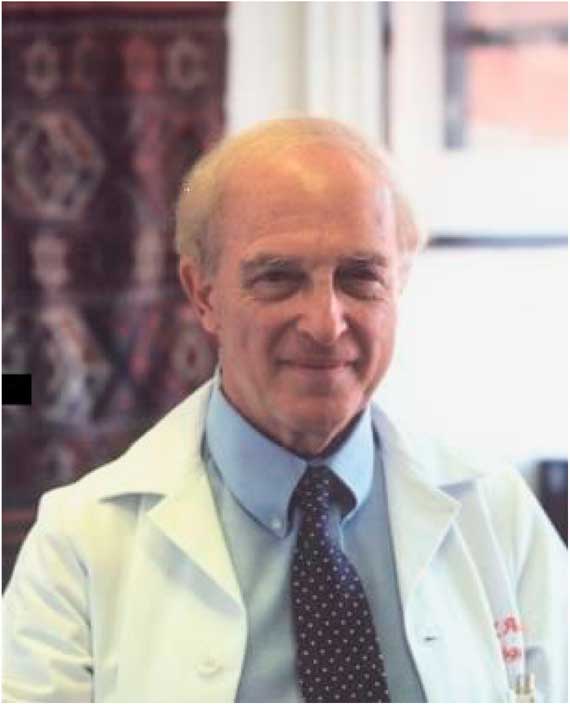
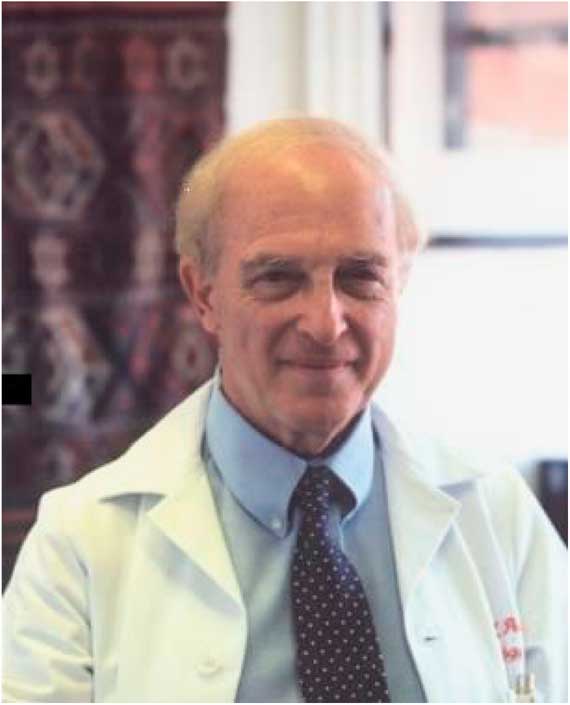
We extend our sincere appreciation to Professor Joseph K. Perloff for his enormous contribution to Cardiology especially ACHD field (Fig 1).
Joseph K. Perloff, MD (December, 1924 to 8 August, 2014).
Aortic dilation in Marfan syndrome, Turner syndrome, bicuspid aortic valve, and coarctation of the aorta is well recognised, and these disorders are consistently associated with the ascending aortic and/or para-coarctation medial abnormalities.Reference Niwa, Perloff and Bhuta 1 – Reference Mckusick 3 CHD such as single ventricle, persistent truncus arteriosus, transposition of the great arteries, hypoplastic left heart syndrome, and tetralogy of Fallot are also associated with aortic medial abnormalities, aortic dilatation, and aortic regurgitation.Reference Niwa, Perloff and Bhuta 1 Aortic medial abnormalities – the so-called cystic medial necrosis – reach their severest form in Marfan syndrome and annuloaortic ectasia, and are prevalent and qualitatively similar but seldom quantitatively as marked in a wide variety of CHDs with a wide age range.Reference Niwa, Perloff and Bhuta 1 This aortic medial abnormality possibly reflects a common developmental fault that weakens and attenuates the aortic wall. These CHDs with aortic dilatation are often associated with decreased elasticity and increased stiffness of the aorta.Reference Seki, Kurishima and Kawasaki 4 – Reference Chong, Wong and Chiu 6 These aortic pathophysiological changes are negatively influencing on the systemic ventricular function because of the increased afterload and ventricular hypertrophy.Reference Senzaki, Iwamoto and Ishido 5
Historical perspective
In 1928, Maude AbbottReference Perloff 7 mentioned in her textbook of CHD that “the presence of a bicuspid aortic valve appears to indicate, at least in a portion of the cases in which it occurs, a tendency for spontaneous rapture”. In 1972, McKusickReference Mckusick 3 reported that the association of bicuspid aortic valve and cystic medial necrosis is more than coincidence, and cystic medial necrosis was defined as follows:Reference Erdheim 8 non-inflammatory smooth muscle cell loss; fragmentation of elastic fibres; and accumulation of basophilic ground substance within cell-depleted areas of the medial layer of the vessel wall. Edwards et alReference Edwards, Leaf and Edwards 9 reported that among 119 necropsy specimens with aortic dissection, 11 were from bicuspid aortic valve (9%). Roberts et alReference Roberts and Roberts 2 also reported that among 186 necropsy specimens with aortic dissection, 14 were from bicuspid aortic valve (7.5%) with a mean age of 52; they also found severe degeneration of the elastic fibre in the aortic wall in 90% of them. High incidence of bicuspid aortic valve among patients with aortic dissection suggests a causative relationship between bicuspid aortic valve and aortic dissecting aneurysm. Hahn et alReference Hahn, Roman and Mogtader 10 and Nistri et alReference Nistri, Sorbo and Marin 11 reported that there is a high prevalence of aortic root enlargement in bicuspid aortic valve, which occurs irrespective of altered haemodynamics, suggesting that both bicuspid aortic valve and aortic root dilatation may reflect a common developmental defect. It has been recognised that patients with aortic valve disease have a tendency to dilate aortic root followed by dissection, and those harbour cystic medial necrosis in the aortic media. Bicuspid aortic valve was the first non-syndromic CHD in which aortic dissection and dilation were reported.Reference Reid 12 In 2001, Niwa et alReference Niwa, Perloff and Bhuta 1 reported that aortic medial abnormalities – the so-called cystic medial necrosis – are prevalent in a wide variety of CHDs with dilated aortic root. After that, progressive aortic dilatation and regurgitation in various types of CHD regardless of intracardiac repair have been continuously reported.Reference Larson and Edwards 13 – Reference Egan, Phillips and Cook 30
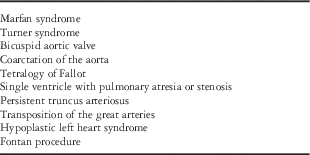
CHDs associated with aortic dilatation (Table 2)
Bicuspid aortic valve and the Ross procedure
Aortic dissection is found to be nine times more prevalent in bicuspid aortic valve patients than in those with tricuspid valve.Reference Larson and Edwards 13 Aortic dilation begins during childhood in bicuspid aortic valve patients, regardless of the presence of aortic stenosis.Reference Gurvitz, Chang and Drant 14 Histologic abnormalities in the ascending aorta in bicuspid aortic valve patients are similar to those found in Marfan syndrome patients.Reference Niwa, Perloff and Bhuta 1
From recent report on the Ross procedure,Reference de Sa, Moshkovitz, Butany and David 15 in 118 patients with the Ross procedure with a mean age of 34 years and a follow-up of 44 months (bicuspid aortic valve in 81%), diameter of the sinuses of valsalva increased from 31±0.4 to 33±0.5 mm. In 13/118 (11%), the diameter ranged from 40 to 51 mm, and 7/118 (6%) developed moderate aortic regurgitation, and three (3%) required aortic valve replacement. The predicted probability of no or trivial aortic regurgitation decreased from 63% in the early postoperative period to 24% after 16 years.Reference Elkins, Thompson and Lane 16 The most common cause for the failure of the Ross procedure has been reported to be pulmonary autograft dilation.Reference David, Omran and Ivanov 17 Dilation of the pulmonary autograft after the Ross procedure occurs because of an intrinsic abnormality of the pulmonary root in patients with congenital aortic valve disease.
Coarctation of the aorta
Isner et alReference Isner, Donaldson and Fulton 18 examined by light microscopic features of coarctation segment in 33 patients, with ages ranging from 1 day to 15 years, and found cystic medial necrosis, deletion, and disarray of elastic tissue in all 33 specimens. Remarkable finding observed is this pathological abnormality is found as early as in a neonate, and it suggests cystic medial necrosis in the aortic wall in coarctation of the aorta is possibly intrinsic.
Tetralogy of Fallot
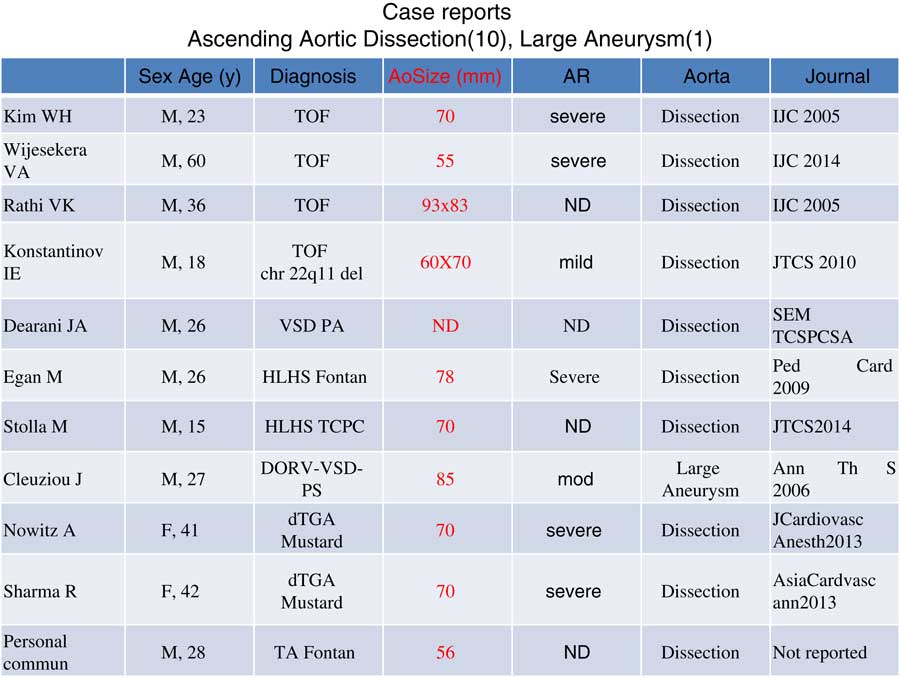
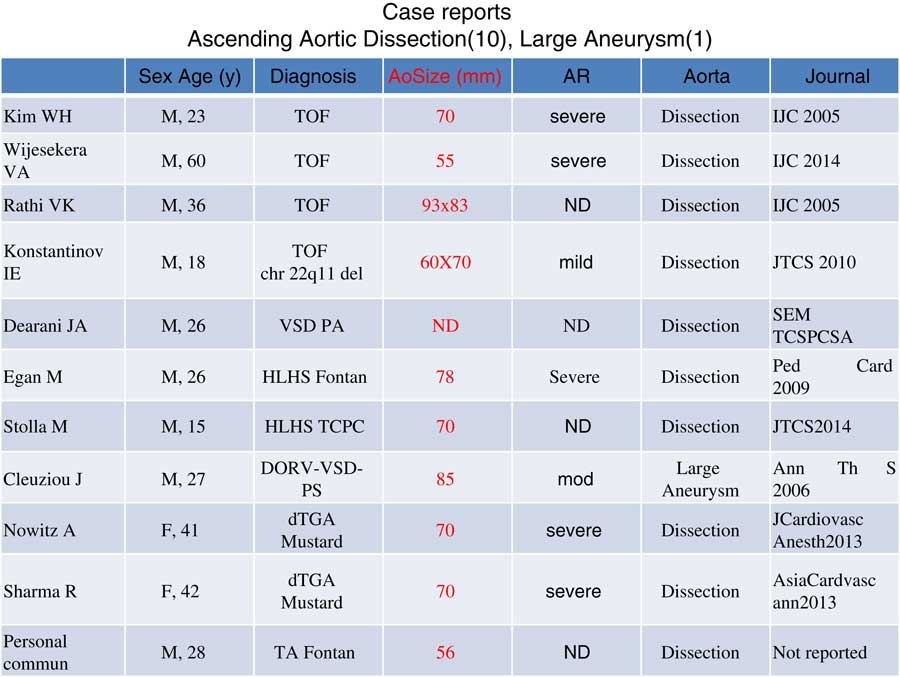
Among the cyanotic CHD, tetralogy of Fallot was the first in which aortic dilation was recognised.Reference Niwa 19 , Reference Rieker, Berman and Stansel 20 Aortic dilatation is a well-known feature of unrepaired tetralogy of Fallot and correlates well with severity of right ventricular outflow tract stenosis, and is greatest in tetralogy of Fallot and pulmonary atresia. Aortic regurgitation in unrepaired tetralogy of Fallot imposes volume overload on both ventricles.Reference Capelli, Ross and Somerville 21 A significant subset of adults late after repair of tetralogy of Fallot exhibits progressive aortic root dilatation that may lead to aortic regurgitation and predispose to dissection and rapture. The aortic dilatation relates medial abnormalities coupled with previous long-standing volume overload of the ascending aorta (right to left shunting through malalignment type ventricular septal defect). This dilatation and histological abnormalities have been found from as early as infants.Reference Tan, Davlouros and McCarthy 22 Overall, 15% of repaired tetralogy of Fallot in adults have been reported to have a dilated aortic root.Reference Niwa, Siu and Webb 23 Different from the Marfan syndrome, aortic aneurysm and dissection/rapture were, rarely as low as five cases, reported in tetralogy of Fallot (Fig 2). This is possibly because histological abnormality in the aorta in tetralogy of Fallot is less severe than those of Marfan syndrome.Reference Niwa, Perloff and Bhuta 1
Case reports. Ascending Aortic Dissection (n=10), Large Aneurysm (n=1).
Complete transposition of the great artery with arterial switch operation
Aortic dilation and aortic regurgitation are well-known complications after arterial switch operation in complete transposition of the great artery.Reference Losay, Touchot and Capderou 24 , Reference Marino, Wernovsky and McElhinney 25 Freedom from aortic regurgitation and aortic valve replacement was 69 and 97% at 15 years, respectively.Reference Losay, Touchot and Capderou 24 Neo-aortic valve regurgitation was severe in 3.7% and trivial to mild in 81% at mid-term follow-up.Reference Marino, Wernovsky and McElhinney 25 Cystic medial necrosis is observed in both neo-aorta and pulmonary artery in neonate; therefore, histological aortic abnormality in transposition of the great arteries is one of the causes of this aortic dilatation.Reference Takeuchi, Imai and Takanashi 26 Progressive dilation of the neo-aortic root becomes out of proportion to somatic growth, and the incidence of aortic regurgitation increases with age. Previous pulmonary artery banding, older age at repair, and presence of ventricular septal defect are the risk factors for aortic regurgitation.Reference Schwartz, Gauvreau and del Nido 27
Hypoplastic left heart syndrome
Neo-aortic root dilation and aortic regurgitation after staged reconstruction for hypoplastic left heart syndrome are known complications, and these progress over time. CohenReference Cohen, Marino and McElhinney 28 followed 53 patients with hypoplastic left heart syndrome after Fontan procedure for 9 years and found neo-aortic root progressively dilated out of proportion to the body size, with 98% having a z-score >2 at most recent follow-up. Neo-aortic regurgitation was present in 61%. Therefore, difference of arterial histology may be one of the causes of this regurgitation.
Other CHDs
Dilated aortic root is found in the majority of operated truncus arteriosus patients; however, none has dissection or rapture.Reference Carlo, McKenzie and Slesnick 29 In this disorder, anatomical truncal valve abnormality and regurgitation is common, and therefore, the role of dilatation of the aorta on truncal valve regurgitation is unclear. Aortic dissection after CHD is found in patients with Fontan,Reference Egan, Phillips and Cook 30 but the incidence of aortic dissection in CHD other than bicuspid aortic valve and coarctation of the aorta is extremely rare, which are different from Marfan and related genetic disorders.
Pathophysiology and cause of aortic dilatation
Histopathological abnormalities in various CHDs
In a study by Niwa et alReference Niwa, Perloff and Bhuta 1 , in 88 (10 different diagnoses) CHD patients with dilated aorta with age of 3 weeks to 81 years (32±6 years) (48 male and 40 female patients), surgical biopsy aortic specimens were obtained, and cystic medial necrosis in the aortic media was observed in all of these patients (Table 1).
CHDs associated with aortic dilatation in adults.

Cause of aortic dilatation in CHD (Table 1) and histology of the aortic media
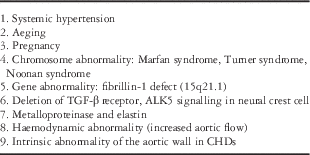
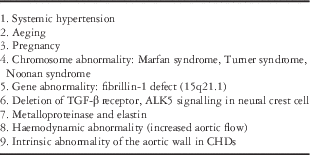
Independent variables that alter the structure of ascending aortic media include Marfan syndrome, annuloaortic ectasia or Turner syndrome, and systemic hypertension,Reference Carlson, Lillehei and Edwards 31 ageing,Reference Schlatmann and Becker 32 and pregnancy,Reference Monalo-Estrell and Barker 33 and others (Table 2). Marfan syndrome is characterised by a defect in the chromosome 15 gene that codes for fibrillin-1,Reference Dietz and Pyeritz 34 in the absence of which elastin is more readily degraded by metalloproteinase.Reference Bonderman, Gharehbaghi-Schnell and Walleneck 35 Deletion of TGF-β receptor has a relation to aortic dilatation.Reference Wang, Nagy and Larsson 36 The genetic fault in Marfan syndrome apparently impairs aortic medial elastic fibres more extensively than impairment in CHD, and the incidence of ascending aortic dilatation, dissection or rapture is higher and the degree of aortic root medial lesions is greater in the former than in the latter.
Variables alter structure of ascending aortic media.
Genetics in aortic dilatation in CHD
On comparing patients with A-P phenotype (R-L cusp fusion) bicuspid aortic valve with R-L phenotype (R-N cusp fusion), the former is more common in men and has a larger stiffer at the sinus of Valsalva and smaller at the ascending aorta and aortic arch than the latter.Reference Schaefer, Lewin and Stout 37 This aortic shape difference is possibly due to inborn error of the aortic wall than due to haemodynamic effect.Reference Jackson, Petrini and Caidahl 38 Therefore, bicuspid aortic valve phenotype can predict elastic properties of the ascending aorta and has potential impact on clinical outcomes.
Overall, 50.9% prevalence of fibrillin-1 gene polymorphisms or mutations is found in tetralogy of Fallot patients with dilated aorta and there is more than eight times risk for aortic dilation in patients with these variants.Reference Chowdhury, Mishra and Balakrishnan 39 In 10/93 (10.8%) patients with chromosome 22q11.2 partial deletion without conotruncal abnormality, aortic dilation is found,Reference John, McDonald-McGinn and Zackai 40 and chromosome 22q11.2 partial deletion may be one of the risk factors of aortic dilatation.Reference Niwa, Siu and Webb 23
Aortic root dilation and aortic elastic properties
ChongReference Chong, Wong and Chiu 6 , in a study conducted on 67 children with 8.3 years after tetralogy of Fallot repair, observed aortic dilation (z-score >2) in 61–88% of them; moreover, significantly increased stiffness, reduced strain, and distensibility of the aorta were observed in aortic dilators. Senzaki et alReference Senzaki, Iwamoto and Ishido 5 , in a study comparing 38 repaired tetralogy of Fallot patients with 55 controls, reported that the former had higher characteristic of impedance and pulse wave velocity, lower total peripheral arterial compliance, higher arterial wave reflection, and also observed that the increase in aortic wall stiffness was closely associated with the increase in the aortic root diameter. Therefore, central and peripheral arterial wall stiffness is characteristically increased after tetralogy of Fallot repair. Abnormal arterial elastic properties have negative impact on left ventricle and provoke aortic dilatation, and it may induce left ventricular hypertrophy, systolic, and diastolic dysfunction of the left ventricle. Furthermore, in repaired tetralogy of Fallot patients, increased augmentation indices have been reported.Reference Cheung, Ou and Wong 41
In patients after arterial switch operation, decreased aortic elasticity and distensibility are confirmed by increased pulse wave velocityReference Murakami, Nakazawa and Momma 42 and increased stiffness index.Reference Sievers, Lange and Arensman 43
These aortic pathophysiological abnormalities are observed in the other types of CHD with aortic dilatation. These characteristics induce aortic dilation and aortic regurgitation,Reference Seki, Kurishima and Kawasaki 4 , Reference Senzaki, Iwamoto and Ishido 5 and increased pulsatile load on left ventricle followed by decreased cardiac output, and also provoke decreased coronary blood flow that may negatively influence on the left ventricular function.Reference Niwa 44 Aortic regurgitation may also develop and progress due to stiffness of aortic root.
We can recognise this pathophysiological abnormality of the aorta and abnormal aortoventricular interaction as a clinical entity “Aortopathy”.
Conclusions
A subset of adult patients with CHD exhibits ongoing dilatation of the aortic root and reduced aortic elasticity, which may relate to intrinsic properties of the aortic root. This new concept of aortic dilatation is shifting a paradigm of aortic dilatation from so called post-stenotic dilatation to primary intrinsic aortopathy. These aortic dilatation and increased stiffness can induce aortic aneurysm, rapture, and aortic regurgitation, but also provoke left ventricular hypertrophy, reduced coronary artery flow, and left ventricular failure. We can recognise this association of aortic pathophysiological abnormality, aortic dilation, and aortic–ventricular interaction as a new clinical entity – “Aortopathy”.
Acknowledgement
The author thanks Marjolie Perloff MA, PhD and Jamil Aboulhosn MD, PhD, for providing photos and data on him, Joseph Perloff MD.
Financial Support
This research received no specific grant from any funding agency, commercial or not-for-profit sectors.
Conflicts of Interest
None.