INTRODUCTION
Autism spectrum disorders (ASD) are complex neurodevelopmental disorders characterized by impairments in communication and social interaction, and by the presence of restricted and repetitive behaviors. Language delay is among the key features of ASD (American Psychiatric Association, 1994). Large-scale studies on vocabulary development (Anderson et al., Reference Anderson, Lord, Risi, DiLavore, Shulman and Thurm2007; Charman, Drew, Baird & Baird, Reference Charman, Drew, Baird and Baird2003; Luyster, Kadlec, Carter & Tager-Flusberg, Reference Luyster, Kadlec, Carter and Tager-Flusberg2008; Luyster, Lopez & Lord, Reference Luyster, Lopez and Lord2007) have shown that, as a group, preschool-aged children with ASD are delayed in their early language ability compared to their typically developing counterparts. For example, in a sample of 134 children with ASD, only 15% were labeling objects when they were two years old, whereas 50% of typically developing children showed this ability much earlier, at age 1;2 (Charman et al., Reference Charman, Drew, Baird and Baird2003). However, all of these studies documented extreme variability with regard to vocabulary development in ASD, with some children demonstrating age-appropriate vocabulary. Into school age, some children with ASD possess unimpaired or even superior language skills, especially with respect to their vocabulary (Kjelgaard & Tager-Flusberg, Reference Kjelgaard and Tager-Flusberg2001; Tager-Flusberg, Reference Tager-Flusberg2006).
It is not yet known why children with ASD vary enormously in their abilities to learn words, and whether, for instance, this is linked to child characteristics such as receptive language level, different mechanisms employed during word mapping, or whether it may be influenced by variation in the language input they receive. In this study, we broached these questions by examining two facets of the use of social cues for early word learning in turn: First, are children with ASD able to make use of social cues to map a novel word, and do they display referential understanding of words learned in this way? Second, do parents of children with ASD provide similar cues when labeling objects as those provided by parents of typically developing children (TYP)? To explore these questions we compared the behavior of English- and French-speaking parent–child dyads, focusing on child word learning in Experiment 1 and on parental labeling behaviors in Experiment 2.
Social cues, such as gazing at, pointing to, showing, or moving an object when labeling it, can play an important role in word learning, by guiding children to links between words and their intended referents. The relevance of social cues has been established in previous research with TYP children, both in terms of the child's word mapping – the associative process by which a label and object are paired, introducing the word into a child's lexicon (Baldwin, Reference Baldwin1991; Carey & Bartlett, Reference Carey and Bartlett1978) – and with respect to the cues parents naturally produce when introducing novel object labels to their children (Callanan, Reference Callanan1985; Zammit & Schafer, Reference Zammit and Schafer2011). Despite the clear pertinence of social cues to word learning, studies to date have not examined whether children with ASD display referential understanding of words they have learned by using social cues, which is essential for robust vocabulary knowledge. Moreover, the cues parents spontaneously provide when labeling objects, the natural context in which children would be able to benefit from social cues, has yet to be explored in detail with respect to children with ASD.
Word-mapping studies have examined children's relative reliance on perceptual versus social cues to map a novel word to an object. This is done by introducing multiple novel objects and rendering one more perceptually salient, either due to its physical properties or by virtue of its proximity (the child is holding it), and having an adult speaker label one of the objects using social cues, for example by pointing and gazing at it. Children's ability to learn a novel label for an object is investigated under two experimental situations: one where social and perceptual cues coincide, that is, the object labeled is the one in the child's attentional focus, and a second where these cues conflict, namely, the object labeled is not the one in the child's focus of attention. Thus the second, conflict, condition tests for reliance on social cues specifically, since to learn the label the child needs to shift his or her attention away from a perceptually salient object and follow the speaker's social cues to a less salient object. In typical development, reliance on perceptual versus social cues for word learning shifts over the first two years of life; infants aged 1;1 rely predominantly on perceptual cues, but by the age of about 1;7 infants will follow speakers' social cues to map a label to an object even when this conflict with more perceptually salient referents (Baldwin Reference Baldwin1991; Reference Baldwin1993; Hollich, Hirsh-Pasek & Golinkoff, Reference Hollich, Hirsh-Pasek and Golinkoff2000).
A number of studies have investigated the use of social cues for word mapping in children with ASD, but their results are inconsistent. Early studies highlighted impairments in the ability of children with ASD to use social cues to map the referent of a novel label under the conflict condition just described (Baron-Cohen, Baldwin & Crowson, Reference Baron-Cohen, Baldwin and Crowson1997; Parish-Morris, Hennon, Hirsh-Pasek, Golinkoff & Tager-Flusberg, Reference Parish-Morris, Hennon, Hirsh-Pasek, Golinkoff and Tager-Flusberg2007; Preissler & Carey, Reference Preissler and Carey2005). For instance, two-year-old TYP children were able to follow social cues (speaker's gaze in this case) to map a novel label to an intended object. On the other hand, profoundly language-impaired children with ASD (mean chronological age of 9;2, verbal age equivalent of slightly over two years) incorrectly mapped the label to an object in their own focus of attention (Baron-Cohen et al., Reference Baron-Cohen, Baldwin and Crowson1997). It is important to note that these studies tested children with marked language delays and used relatively modest social cues in combination with two repetitions of the label.
In contrast, recent studies with more closely matched groups (with respect to both language ability and age range) reported that children with ASD can make use of social cues to learn labels. Luyster and Lord (Reference Luyster and Lord2009) found similar performance between ASD and TYP children in their use of social cues to map novel labels, even when they conflicted with perceptual salience. This was observed in a context where social cues were amplified to be more salient by including additional repetitions (9 in total) of the novel label and by using facial direction and posture in addition to eye-gaze. In line with these findings, Norbury, Griffiths, and Nation (Reference Norbury, Griffiths and Nation2010), using an eye-movement task, found that children with ASD with age-appropriate receptive vocabularies used eye-gaze to successfully map a novel label to an intended object out of an array of three objects, similarly to their TYP peers. However, the TYP children appeared to be more sensitive to the informativeness of the speaker's face; they looked to the face when gaze was referentially informative more so than children with ASD. The authors suggested that TYP children use the social cue of gaze as a marker of speaker's intent that guides their mapping of novel words, whereas children with ASD may use eye-gaze as an associative learning cue – gaze to an object makes it more salient, but doesn't necessarily convey information about the speaker's referential intent.
Consequently, even given similar reliance on social cues when they conflict with perceptual information in highly able children with ASD, it is unclear if they fully comprehend the referential intent of these social cues, as put forward by Norbury et al. (Reference Norbury, Griffiths and Nation2010). One way to assess the understanding of referential intent is to see if, beyond mapping a novel label to an indicated object, social cues lead the learner to extend that label to other representations of the object or to view it as symbol for that ‘kind’ of an object, as proposed by Csibra and Gergely (Csibra, Reference Csibra2010; Csibra & Gergely, Reference Csibra and Gergely2009). To date, word learning studies employing social cues have not considered the question of referential understanding per se, although such generalization has been investigated with respect to other cognitive biases characteristic of typical word learning (Swensen, Kelley, Fein & Naigles, Reference Swensen, Kelley, Fein and Naigles2007; Tek, Jaffery, Fein & Naigles, Reference Tek, Jaffery, Fein and Naigles2008).
One study that has examined referential understanding in children with ASD did so outside the context of social interaction. Preissler (Reference Preissler2008) investigated referential generalization in a study with low functioning children with ASD and severe language delays (mean age of 7;6, range of 5;2 to 9;5). Children were given repeated experience with pairing a novel label with a black-and-white line drawing of a novel object. They were then presented with the line drawing and its real, previously unseen, referent object, and were asked to show the experimenter the ‘novel label’. In the study, selection of the line drawing was taken to reflect that the child associatively linked the label to the drawing itself, whereas choosing the real object was taken to indicate referential understanding via extension of the label to other referents of the same kind. Of the children with ASD, 55% selected the associative option (drawing alone), while 45% made a choice including the real object (Preissler, Reference Preissler2008). In a different experiment using the same task, all TYP children aged 1;6 and 2;0 made a choice including the real object (Preissler & Carey, Reference Preissler and Carey2004). Preissler (Reference Preissler2008) interpreted these findings as demonstrating that lower-functioning children with ASD learn novel word–drawing relationships associatively, whereas TYP children as young as 1;6 interpret labels referentially. Yet almost half of the children with ASD in Preissler's sample exhibited referential understanding, but characteristics related to individual differences within the ASD group were not explored in this study. Given that language level has been shown to play an important role in word-mapping tasks, it is possible that children with ASD who have more age-appropriate language abilities are the ones who display referential understanding. Moreover, the use of enhanced social cues in word-mapping tasks may facilitate referential understanding, similar to their effect on word mapping itself (Luyster & Lord, Reference Luyster and Lord2009). We investigated these possibilities in Experiment 1 in children with ASD who were matched with TYP children on receptive language abilities. Specifically, we examined whether participants make use of enhanced social cues (i.e. clear gaze, pointing, and body posture towards intended referent as well as alternating eye contact between child and referent) to map novel labels, and whether they display referential understanding of labels learned in this way.
Turning to our second question, it is also essential to know whether children with ASD are likely to receive social cues in their language input, similar to those received by TYP children. It is well established that parent–child communication style plays an important role in child language development (McDuffie & Yoder, 2010; Markus, Mundy, Morales, Delgado & Yale, Reference Markus, Mundy, Morales, Delgado and Yale2000; Swensen, Naigles & Fein, Reference Swensen, Naigles and Fein2007; Tomasello & Farrar, Reference Tomasello and Farrar1986; Tomasello & Todd, Reference Tomasello and Todd1983; Zammit & Schafer, Reference Zammit and Schafer2011). Accordingly, researchers have explored how parents introduce novel object labels to TYP children. Mothers of two- to three-year-olds tend to label and point to an object when introducing a novel label for it (Callanan, Reference Callanan1985). Furthermore, Booth, McGregor, and Rohlfing (Reference Booth, McGregor and Rohlfing2008) found that two-year-olds were better at mapping novel labels when more non-verbal cues (e.g. gazing, pointing at, moving, showing) were provided in combination with the label. Parent labeling strategies have also been shown to influence later vocabulary development in TYP children. For instance, Zammit and Schafer (Reference Zammit and Schafer2011) reported that increased communicative acts and iconic gestures used during a labeling task by mothers of infants aged 0;10 were positively associated with later word learning. Similarly, Pan, Rowe, Singer, and Snow (Reference Pan, Rowe, Singer and Snow2005) indicated that maternal lexical diversity and the total number of pointing gestures provided by mothers at one year of age was related to higher child expressive language scores at two years of age.
Correspondingly, studies have begun to investigate cues provided by parents during interaction with their children with ASD (Brigham, Yoder, Jarzynka & Tapp, Reference Brigham, Yoder, Jarzynka and Tapp2010; Siller & Sigman, Reference Siller and Sigman2002; Reference Siller and Sigman2008; Watson, Reference Watson1998). In a seminal study, Siller and Sigman (Reference Siller and Sigman2002) analyzed the interaction between caregivers and children with ASD, children with developmental delays, and TYP children during play episodes. Results showed that caregivers in all three groups tended to follow the child's lead during the play interactions, maintaining the child's focus of attention. Importantly, the more parents maintained rather than redirected child's attention, the higher the language outcomes of their children with ASD up to sixteen years later. Similarly, Watson (Reference Watson1998) reported that mothers of children with ASD and mothers of TYP children produced verbalizations related to their child's focus of attention at similar frequencies. Finally, Brigham et al. (Reference Brigham, Yoder, Jarzynka and Tapp2010) found that child attention to objects was facilitated when parents of preschool children with ASD used multiple verbal and non-verbal cues to maintain, rather than redirect, their child's attention. It was also shown that the frequency of non-verbal cues and verbal productions were similar across groups.
Previous studies on ASD have not examined cues provided during labeling episodes specifically, or addressed whether parental cues vary according to the child's language level. This is an important question to explore because for TYP children, Gogate, Bahrick, and Watson (Reference Gogate, Bahrick and Watson2000) reported that mothers of infants aged 0;5 to 0;8 taught words by combining verbal labels with multiple non-verbal cues. However, this communicative style changed with the advancement of child language: mothers of one- to two-year-olds used fewer multiple cues concurrently. Based on these findings, Gogate et al. suggested that “as infants' lexical development … increases, maternal multimodal naming decreases” (2000: 891). Accordingly, in Experiment 2 we examined parental labeling behaviors to children with ASD and their relationship to child language level.
EXPERIMENT 1
In this experiment we explore whether children with ASD are able to use social cues in the service of word learning and, if so, whether they demonstrate referential understanding of these words. More specifically:
1. Can children with ASD use social cues to map novel labels to objects? If so, is this related to higher language ability? Based on the findings of recent studies (Luyster & Lord, Reference Luyster and Lord2009; Norbury et al., Reference Norbury, Griffiths and Nation2010), we expected that children with ASD would successfully follow social cues to map novel labels to objects. In addition, we predicted a positive relationship between language ability and the successful use of social cues for word mapping.
2. Do children with ASD display referential understanding of novel labels (via generalization to photographs) and is this also related to higher language ability? To date, this has not been investigated in a task that required the use of social cues. We expected that, similar to a matched TYP group, children with ASD would successfully generalize learned labels to other instances (photographs) of the target object. Finally, again, we expected a positive relationship between language ability and successful referential generalization.
METHOD
Participants
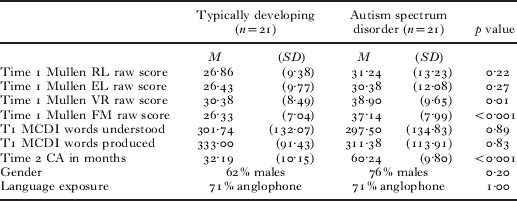
Experiments 1 and 2 were part of a larger longitudinal study on word learning conducted in Montreal, Quebec. Experiment 1 was conducted at the first visit of the longitudinal study (Time 1), while Experiment 2 reported below was conducted six months later (Time 2). Twenty-three children diagnosed with ASD and twenty-three TYP children participated in Experiment 1. These dyads had either English or French as the dominant language, as reported by parents. In both Experiments, 1 and 2, the performance of anglophone and francophone participants did not differ significantly. Therefore, the data of anglophone and francophone participants were collapsed for all analyses.
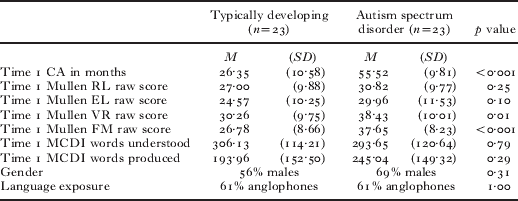
Children were recruited through a university research database, local children's hospital autism clinic, autism organizations, daycares, therapy programs, and advertisements in family magazines. All participants were screened with the Modified Checklist for Autism in Toddlers (M-CHAT; Robins, Fein & Barton, Reference Robins, Fein and Barton1999) for ASD symptoms; participants in the ASD group met ASD criteria by failing any three items, or two of six critical items on the screener, while participants in the TYP did not meet this criteria. For participants with ASD, diagnostic confirmation was obtained via clinical judgment and scores within the ASD range in the Autism Diagnostic Observation Schedule – Module 1 or 2 (ADOS; Lord, Rutter, DiLavore & Risi, Reference Lord, Rutter, DiLavore and Risi1999). ASD and TYP participants were selected to have similar language abilities at study entry; the groups did not differ with respect to receptive or expressive language raw scores on the Mullen Scales of Early Learning (MSEL; Mullen, Reference Mullen1995), or on the number of words understood or produced by parent report on the MacArthur-Bates Communicative Development Inventory: Words and Gestures (MCDI; Fenson, Marchman, Thal, Dale, Reznick & Bates, 2007) as seen in Table 1. As a consequence of matching as closely as possible on language, we had a very large range of ages in both groups, and the ASD group was older due to the language delay present in most cases. Thus, in Experiment 1, the age range of the ASD group was 3;01 to 6;02, and that of the TYP group was 1;02 to 4;09. In addition, given the uneven IQ profiles common in preschool children with ASD (Black, Wallace, Sokoloff & Kenworthy, Reference Black, Wallace, Sokoloff and Kenworthy2009; Joseph, Tager-Flusberg & Lord, Reference Joseph, Tager-Flusberg and Lord2002), they also had more advanced non-verbal (visual reception and fine motor) skills than the TYP group. The overall profile of the sample should be borne in mind. However, with respect to individual differences in performance, we focused on both receptive and expressive language abilities, which we measured with composite scores incorporating both the MSEL and MCDI (described below). This was motivated by previous findings that language level differentiated children who were able to map labels when social and perceptual cues conflicted (Baron-Cohen et al., Reference Baron-Cohen, Baldwin and Crowson1997; Luyster & Lord, Reference Luyster and Lord2009; Norbury et al., Reference Norbury, Griffiths and Nation2010; Parish-Morris et al., Reference Parish-Morris, Hennon, Hirsh-Pasek, Golinkoff and Tager-Flusberg2007; Preissler & Carey, Reference Preissler and Carey2005), and by reports that parents adapt cues they provide during interaction to their child's language level (Gogate et al., Reference Gogate, Bahrick and Watson2000). Receptive language was particularly relevant to Experiment 1, which measured comprehension of a novel label (Norbury et al., Reference Norbury, Griffiths and Nation2010), and expressive language was particularly relevant to Experiment 2, as parents are more accurate in their assessment of their child's expressive skills (Luyster et al., Reference Luyster, Kadlec, Carter and Tager-Flusberg2008), and may be more likely to adapt communication to this overt behavior. This project received ethics approval from both the university faculty and the university health centre (needed to access hospital records). Parental consent was obtained from parents of all dyads involved in the study.
Participant characteristics

note: There were no significant differences between groups with respect to Mullen receptive language or expressive language scores, MCDI words understood or words produced, gender, or language exposure.
Materials
Familiar objects
Four pairs of familiar objects (e.g. a book and a crayon) were used to ensure that participants could complete the task of indicating an object choice. Familiar objects were chosen based on words commonly found in the early vocabularies of children (Fenson et al., Reference Fenson, Marchman, Thal, Dale, Reznick and Bates2007).
Novel objects
Eight novel objects in four pairings were used in word-mapping trials. Each pair was selected to have one more perceptually interesting (e.g. plastic tube filled with stars, moons, and colorful beads) and one less perceptually interesting ‘boring’ object (e.g. green plastic toothbrush travel tube), for use in a word-mapping paradigm developed by Hollich et al. (Reference Hollich, Hirsh-Pasek and Golinkoff2000), as reported in Parish-Morris et al. (Reference Parish-Morris, Hennon, Hirsh-Pasek, Golinkoff and Tager-Flusberg2007). Some of the interesting objects were decorated to make them more salient. All objects were safe to play with and their names are typically unknown by young children (Fenson et al., Reference Fenson, Marchman, Thal, Dale, Reznick and Bates2007), which was confirmed by parents. The objects were between 10 cm and 30 cm in length, with width and height varying from 3 to 10 cm. All object pairs were roughly similar in size. Initial salience trials were used to verify that children found one object more interesting than the other one. Figure 1 provides an example of a pair of novel objects used in the study.
Examples of the novel objects used in Experiment 1. notes: These two objects were used in the word-mapping task as a pair. The object on the left contained colorful sparkles that floated in liquid and was used as an interesting object, while the one on the right served as a boring object.
Novel labels
Eight novel labels in both English and French were obtained via parallel norming studies in each language. Two-syllable non-words for English and French were established by WordGen, a nonword generator (Duyck, Desmet, Verbeke & Brysbaert, Reference Duyck, Desmet, Verbeke and Brysbaert2004) that measures how common two-letter combinations are based on a language's orthography. Eighteen nonwords that were moderately likely in both English and French were selected for the norming study, since highly likely nonwords could be confused with existing real words and those with very low likelihood would not be plausible labels. They were recorded as spoken by native speakers of English or Quebecois French for separate norming studies with ten adult native speakers of each language. Participants rated each word on a five-point scale of word-likeness in their native language. The eight nonwords with the highest word-likeness ratings in each language were used as novel labels in our word-mapping task. Mean ratings were similar across languages. The nonwords we used to label the pairs of novel objects in both English and French were ‘rathom, commif’, ‘fental, garrif’, ‘boker, fomite’, and ‘kassif, remope’.
Photographs
For the referential generalization task, we used two photographs, one color and one black-and-white, of each of the eight novel objects. The background of the photographs was either black or white to provide appropriate contrast.
Procedure
The procedures for Experiment 1 were completed at a university lab during the first visit (Time 1) of our longitudinal study. The entire session was conducted in either English or French according to the family's dominant language. The experimental procedures consisted of the word-mapping task and referential generalization task as described below. In addition, children were administered the Mullens Scales of Early Learning (MSEL; Mullen, Reference Mullen1995) in English, or a standardized translation of the MSEL to Quebec French, developed for use in our lab by a licensed speech language pathologist and a master's student in speech language pathology who were native speakers of Quebec French, as appropriate. The MSEL is a comprehensive, standardized measure of development, of which four subscales were administered: receptive language, expressive language, visual reception, and fine motor skills. In addition, parents filled out the MacArthur-Bates Communicative Development Inventory: Words and Gestures (MCDI; Fenson et al., Reference Fenson, Marchman, Thal, Dale, Reznick and Bates2007), which provides a comprehensive evaluation of the child's vocabulary and early communication skills in its English version, or a normed Quebec French adaptation of this inventory, Les Inventaires MacArthur-Bates du développement de la communication (IMBCD; Trudeau, Frank & Poulin-Dubois, Reference Trudeau, Frank and Poulin-Dubois1997). Children sat on their parent's lap or on a booster seat at a table facing the experimenter. If preferred, tasks were administered at a child-size table. Breaks and snacks were given whenever required.
Word-mapping task
We employed Parish-Morris and colleagues' word-mapping paradigm (2007, Experiment 2) but enhanced the social cues provided while labeling, as described below, based on observations made with nine pilot participants who were typically developing. Before starting the experiment, the novelty of objects was assured by asking the parent if their child was familiar with any of our novel object stimuli. If the child was familiar with any of the objects, a different novel object was substituted.
There were two conditions of the word-mapping task: coincident and conflict. In the coincident condition, social and perceptual cues agreed; the experimenter gazed and pointed at the interesting object while labeling it. In the conflict condition perceptual cues conflicted with social cues; the experimenter gazed and pointed at the boring object while labeling it. Two trials of each condition were presented in a block at the beginning or end of the lab session, approximately one and a half hours apart. Order of condition was counterbalanced across participants.
On each trial, children were first presented with two familiar objects to verify that they could indicate an object on demand, for example “Where is the book?” Then a pair of novel objects was given to the child to play with for 30 seconds. If the child's preference for one of the objects was not clear, the experimenter would ask him/her to indicate their preference: “Which one do you like better?” The preferred object was considered the interesting object for the remainder of that trial. The novel objects were placed on the table in front of the experimenter, to her/his left or right and out of reach of the child. In the training phase, the experimenter gazed and pointed at one of the novel objects and labeled it with a novel label two times while leaning toward it: “Look at the kassif, it is a kassif.” The experimenter then paused and looked at the child to obtain his/her eye contact and then alternated gaze and pointed again at the target object while labeling it another two times: “See the kassif, it is a kassif”, for a total of four repetitions of the label.
Word mapping test
Immediately after the labeling demonstration we conducted three test phases to assess knowledge of the novel label. Participants saw both novel objects on the table in front of them but out of reach. The experimenter looked directly at the child. In the test phase, the child was asked to indicate the referent of the novel label just heard: “Where's the kassif?” In the new-label phase, he/she was asked to indicate the referent of a new, previously unheard novel label: “Where is the remope?” Finally, in the recovery phase, the child was asked to indicate the originally labeled object again: “Where's the kassif?”
Referential generalization test
Immediately following each trial of the word-mapping task, the child was presented with a 9-inch by 15-inch poster-board with four photographs affixed to it (one color and one black-and-white photo of each of the pair of novel objects just presented). The child was asked to indicate the photographs of the object that was labeled in the training phase: “Do you see any kassifs here?” If the child indicated only one of the two correct photographs of the target object, the experimenter provided one general prompt (e.g. “Are there any other kassifs?”) before completing the trial. The child passed this task only if he/she indicated both of the correct photographs of the target object, that is, both the color and black-and-white versions of it. Any other type of response was considered a fail, including the selection of any of the non-target photographs (alone or in combination with a correct photograph), or selection of only one target photograph. Therefore, if the child selected all four photographs their response was considered a fail.
Analyses
Non-parametric tests were conducted, given that data were not normally distributed and therefore violated the assumptions of parametric tests. Specifically, Mann–Whitney U tests for continuous variables, and Pearson's χ2 (chi-square) tests for categorical variables, were conducted for between-group comparisons. Median scores are reported in the text as is conventional for non-parametric tests; however, in the tables we provide means and standard deviations of variables for ease of interpretation. Effect size for Mann–Whitney tests is reported with Pearson's correlation coefficient r, which can be calculated for non-parametric contrasts, unlike Cohen's d. As for d, r values of 0·1 are considered small effects, 0·3 medium effects, and 0·5 large effects (Cohen, Reference Cohen1988; Field, 2005). In addition, Kendall's τ (tau) test was used to test for non-parametric correlations between two continuous variables where one or more of these was non-normally distributed (e.g. between language abilities and task performance).
To examine the variables of expressive and receptive child language, we calculated expressive and receptive composite scores that incorporated both direct assessment of language skills on the MSEL (z-scores of raw scores) and parent report of vocabulary on the MCDI (z-scores of total number of words), as recommended by Charman (Reference Charman2004). The z-scores were calculated separately for each group (TYP, ASD) as they were used to examine within-group individual differences, and the MSEL and MCDI z-scores were averaged together to compute the composite score. The MCDI and the MSEL z-scores were significantly correlated for both TYP (receptive r = 0·75, expressive r = 0·89) and ASD groups (receptive r = 0·78, expressive r = 0·91), indicating high reliability between sources of language assessment.
Participants' data was included in the analysis only if they passed at least two of four familiar object trials, indicating that they could comply with the response demands of the task. All forty-six participants met this inclusion criterion and had valid data from both trials of both the conflict and coincident conditions. Since it is well established in the literature that children with ASD succeed in word mapping when perceptual and social cues coincide (Baron-Cohen et al., Reference Baron-Cohen, Baldwin and Crowson1997; Luyster & Lord, Reference Luyster and Lord2009; Parish-Morris et al., Reference Parish-Morris, Hennon, Hirsh-Pasek, Golinkoff and Tager-Flusberg2007; Preissler & Carey, Reference Preissler and Carey2005), we viewed the coincident condition as a baseline condition. Thus we focus specifically on the conflict condition as the experimental condition, as this manipulation provided a clear test of social cues: Can children use social cues to map a novel label to an object when they conflict with the perceptual salience of another novel object?
RESULTS
Word-mapping test
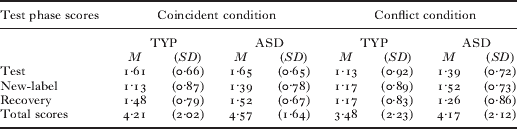
The dependent measure was the number of phases (test, new label, and recovery) where participants selected the correct object. For the test and recovery phases, this was the target object that had been labeled during the training phase; for the new label phase this was the other novel object present. Consequently, there were three phases which the child could pass or fail on each trial, and two trials were administered per condition (coincident or conflict), resulting in a maximum possible word-mapping score of six. Table 2 summarizes children's performance in the three test phases of the coincident and the conflict conditions.
Children's performance in the three test phases of the coincident and the conflict conditions
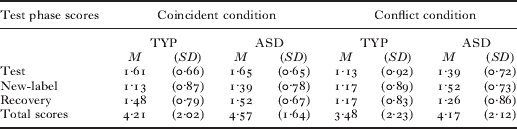
notes: TYP: typically developing children; ASD: autism spectrum disorders. A maximum score of two can be achieved in each test phase. A maximum score of six can be achieved in total scores of each condition.
As expected, no significant group difference was found between children with ASD (Mdn = 5) and TYP children (Mdn = 5) on total scores in the coincident condition (U = 244, p = 0·64, r = − 0·07), demonstrating that groups were similar in mapping novel labels to objects when perceptual and social cues coincide. For the conflict condition as well, no significant group difference was found between groups on total scores (U = 214·5, p = 0·26, r = − 0·17), demonstrating that children with ASD (Mdn = 5) were similar to TYP children (Mdn = 4) in using social cues to map novel labels to objects even when they conflict with perceptual salience.
To investigate whether the number of children in each group succeeded in mapping the novel word at a rate greater than chance, we conducted binomial tests, separately for the coincident and conflict conditions. The probability of selecting the labeled object by chance on each phase of each trial was 0·5, as there were two objects to choose from. However, we had two trials of each condition, so the joint probability of selecting the labeled object on both trials of a phase, and thus obtaining a score of 2, by chance, was 0·25. For the coincident condition test phase, 17/23 participants with ASD and 16/23 TYP participants obtained scores of 2 (succeeding on both trials); both groups succeeded at a greater than chance rate (ps < 0·001). For the coincident condition new-label phase, 13/23 participants with ASD and 10/23 TYP participants obtained scores of 2; both groups succeeded at a greater than chance rate (ps <0·05). For the coincident condition recovery phase, 14/23 participants with ASD and 15/23 TYP participants obtained scores of 2; both groups succeeded at a greater than chance rate (ps < 0·001). For the conflict condition test phase, 12/23 participants with ASD and 11/23 TYP participants obtained scores of 2; both groups succeeding at a greater than chance rate (ps <0·05). For the conflict condition new-label phase, 15/23 participants with ASD and 11/23 TYP participants obtained scores of 2; both groups succeeded at a greater than chance rate (ps <0·05). Finally, for the conflict condition recovery phase, 12/23 participants with ASD and 10/23 TYP participants obtained scores of 2. The ASD group performed at a rate greater than chance (p < 0·01), whereas the p value for the TYP group was 0·05.
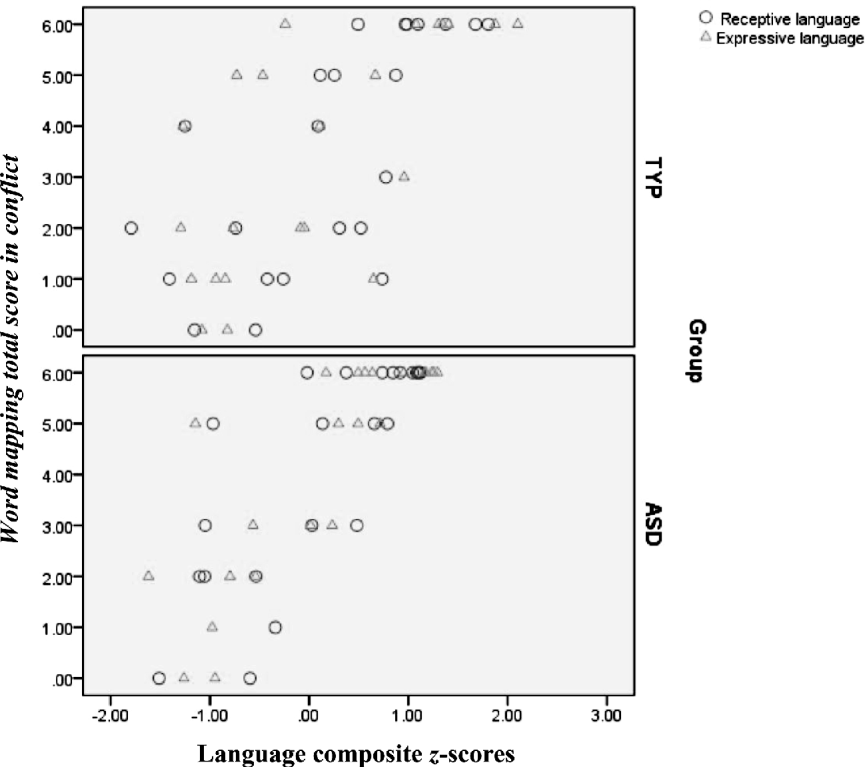
Non-parametric correlations were conducted to assess the relationship between word-mapping total scores in the conflict condition and language composite scores. Results showed a statistically significant positive correlation for children with ASD between conflict condition word-mapping total scores and both expressive (τ = 0·70, p < 0·001) and receptive (τ = 0·67, p < 0·001) language composite scores. Similar relationships were found for the TYP group between word-mapping total scores in conflict condition and both expressive (τ = 0·56, p < 0·001) and receptive (τ = 0·59, p < 0·001) language composite scores. The scatterplots in Figure 2 summarize these results for both groups. Since age ranges were large in both groups, parametric partial correlations were also conducted between conflict condition total scores and language composite scores controlling for chronological age. These relationships remained significant when age was partialled out for the ASD group for both expressive (r = 0·80, p < 0·001) and receptive language (r = 0·75, p < 0·001). For the TYP group, removing the variance due to age reduced the strength of correlations; though receptive language remained significant (r = 0·45, p < 0·05), expressive language did not (r = 0·42, p = 0·05).
Scatterplots showing the relationship between word mapping in the confict condition and Time 1 receptive and expressive language composite scores.
Referential generalization test
We limited our examination of referential generalization to the situation where social cues were required to accurately map the novel label: the conflict condition. Participants' data was included in analyses only if they passed at least two of the three testing phases (test, new label, and recovery) of the preceding word-mapping trial, in order to ensure that they had in fact mapped the novel label. Since a number of trials were excluded by this criteria, only the first valid photograph trial of each conflict condition was included in the analysis. Of the forty-six participants, fourteen children (6 ASD and 8 TYP) had no valid trials in the conflict condition, leaving a sample size of thirty-two participants (17 ASD, 15 TYP). For each photograph trial, children's choice of photographs was coded into one of two categories; pass or fail. pass is indicated by the selection of both photographs of the target object (color and black-and-white), which we operationalized as indicating referential generalization in this task. fail is indicated by the selection of only one or none of the photographs of the target object, or selection of any photographs of the non-target object. Nine of seventeen ASD participants and eight of fifteen TYP participants passed the task. As suggested by these similar proportions of participants passing, a chi-square test revealed that referential generalization did not differ between groups (χ2 (1,32) = 0·00, p = 1).
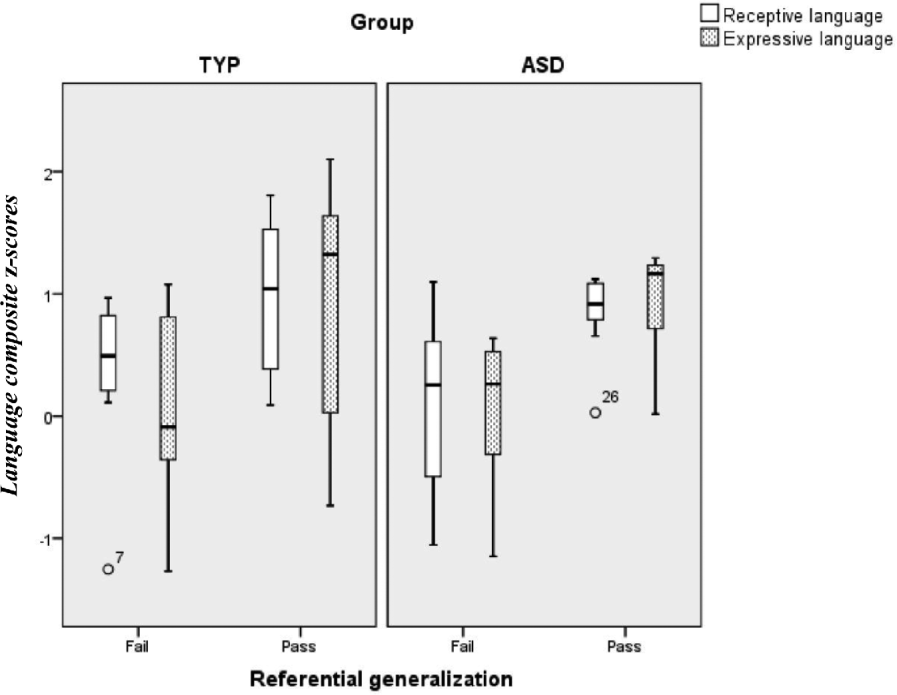
Mann–Whitney U tests were conducted to assess potential differences in language composite scores between children who passed or failed the referential generalization task in each group. In the ASD group, passers had higher expressive (U = 8·00, p = 0·01, r = − 0·65) and receptive (U = 12·00, p = 0·02, r = − 0·56) language composite scores than failers. The pattern was similar in the TYP group, but did not reach significance for expressive (U = 12·00, p = 0·06, r = − 0·48) or receptive (U = 14·00, p = 0·10, r = − 0·42) language composite scores, despite medium effect sizes. Figure 3 summarizes these results with respect to expressive and receptive language composite scores. Once again, to see if these differences in language ability could be explained by differences in age, we conducted the same analyses comparing passers and failers with respect to their age. Passers and failers did not differ reliably with respect to their age, in both the ASD group (U = 20·05, p = 0·13, r = − 0·36) and the TYP group (U = 14·00, p = 0·10, r = − 0·42), though effect sizes were moderate.
Boxplots for T1 receptive and expressive language composite scores for participants who passed or failed the referential generalization task.
DISCUSSION
Our word-mapping findings from Experiment 1 corroborate recent reports that some children with ASD can use social cues to learn novel words even when these cues conflict with perceptual salience (Luyster & Lord, Reference Luyster and Lord2009; Norbury et al., Reference Norbury, Griffiths and Nation2010); in our sample these were children with ASD who had expressive language ages of approximately 2;06 and higher. This ability was positively related to both receptive and expressive language composite scores (which incorporated many non-vocabulary related language skills from the Mullen Scales of Early Learning) in both groups. This finding is in contrast to earlier studies that suggested that children with ASD with severe language delays use non-verbal social cues to learn a novel label only when social and perceptual cues coincide, that is, when the intended object was already in the child's focus of attention (Baron-Cohen et al., Reference Baron-Cohen, Baldwin and Crowson1997; Preissler & Carey, Reference Preissler and Carey2005). A number of methodological factors appear to facilitate the successful use of social cues for word mapping. First, in studies where children with ASD succeed at this task they were very well matched to a TYP comparison group with respect to language level (i.e. similar ranges of language levels and not simply the mean score), and had a maximum age difference of a few years, as opposed to six or seven years, which was the case in early studies. Second, studies where success was observed employed enhanced contextual supports, including additional repetitions of the novel word and multiple non-verbal social cues (clear gaze, pointing, and body posture towards the intended referent, as well as alternating eye contact between child and object in our study).
Yet even for children with ASD who have less-impaired language skills and are able to use social cues to learn novel labels, it has been suggested that they may not fully understand the referential significance of gaze cues (Norbury et al., Reference Norbury, Griffiths and Nation2010). However, our novel finding with respect to the generalization of newly learned labels provides preliminary evidence that our sample with ASD, who were matched on language abilities and had higher non-verbal abilities than the comparison group, do display some aspects of referential understanding. Specifically, our task required extending a novel label for an object, learned using social cues in the word-mapping task, to two different two-dimensional representations of it, both a color and black-and-white photograph. This placed high demands on children, since explicit responses were required, yet approximately half of both our ASD and TYP groups demonstrated the ability to generalize a novel label to other instances of the same kind. The higher non-verbal skills and/or chronological age of the ASD group may have contributed to their success on this task. The IQ and neuropsychological profiles of children with ASD who perform equivalently on tasks deserve attention in future research as they may provide insight into alternate strategies to obtaining the same outcome.
Using a different test of referential understanding where labels ascribed to drawings had to be extended to real objects, Preissler (Reference Preissler2008) concluded that children with ASD lack referential understanding and learned label–drawing pairings associatively. It is possible that it is easier to generalize from three-dimensional objects to two-dimensional photographs, as in our study. This would be consistent with Mirenda and Locke's (Reference Mirenda and Locke1989) hierarchy of symbol transparency; they established that for individuals with autism and other developmental disorders, real objects are the easiest to recognize, followed by color photographs and then black-and-white photographs. However, even in Preissler's (Reference Preissler2008) study, close to half of the ASD participants displayed referential understanding, though they did so less consistently than a TYP comparison group from a different study that was grossly matched on mean language age (Priessler & Carey, Reference Preissler and Carey2004). The same methodological differences described above may explain the divergent conclusions drawn here. Further study is required to assess the extent to which the type of referential understanding we tapped in Experiment 1 reflects, or develops into, a full-blown grasp of speaker's communicative intent. Similarly, the proposal that apprehending communicative intent leads children to generalize labels to other instances of the same kind (Csibra, Reference Csibra2010) should be explored in future work.
EXPERIMENT 2
Experiment 1 established that the children with ASD in our study used social cues to map words and extended those words referentially. In Experiment 2 we extend our investigation to examine what social cues may generally be produced for children with ASD during labeling interactions with their parent, and whether these cues are similar to those provided by parents of TYP children. In particular:
1. What types of non-verbal cues are provided by the caregivers of children with ASD while labeling objects? We expected parents of children with ASD to be similar to parents of TYP children in their labeling behaviors, given similarities observed during play interactions, such as similar frequency of verbal and non-verbal cues produced by parents across groups (Brigham et al., Reference Brigham, Yoder, Jarzynka and Tapp2010; Siller & Sigman, Reference Siller and Sigman2002).
2. Do parental cues to children with ASD vary as a function of the child's language level? We predicted that the use of parental cues would decrease as child language skills increase, in line with the findings for TYP children by Gogate et al. (Reference Gogate, Bahrick and Watson2000).
METHOD
Participants
Twenty-one children diagnosed with ASD and twenty-one TYP peers along with one of their parents (38 mothers, 4 fathers) participated in Experiment 2. ASD and TYP participants had similar receptive language raw scores on the MSEL (Mullen, Reference Mullen1995) at study entry (Time 1). Experiment 1 was conducted at the first visit of the longitudinal study, while Experiment 2 was conducted approximately six months later. Groups were matched on language scores obtained at Time 1 because this data was not available at Time 2. It is possible that the groups experienced different trajectories of language growth over the six months between study visits; however, our analyses in Experiment 2 pertained to parental labeling behavior. Due to differences in participation at each visit and subsequent matching procedures there was some but not complete overlap in the samples included in each experiment: Twenty-nine children (18 ASD; 11 TYP) overlapped between Experiments 1 and 2. Table 3 provides detailed participant characteristics for Experiment 2. Recruitment and characterization procedures were the same as those described above in Experiment 1.
Participant characteristics
notes: There were no significant differences between groups with respect to Mullen receptive language or expressive language scores, MCDI words understood or words produced, gender, or language exposure.
Procedure
The data analyzed in Experiment 2 were collected both at the first visit (Time 1) of our longitudinal study and at the second visit, approximately six months later (Time 2). During the first visit, language skills were assessed with the MSEL (Mullen, Reference Mullen1995) and the MacArthur-Bates Communicative Development Inventory: Words and Gestures (MCDI; Fenson et al., Reference Fenson, Marchman, Thal, Dale, Reznick and Bates2007) in either French or English, based on the child's dominant language. Analyses made use of composite language scores which were z-scores incorporating both of these measures; see Experiment 1 results section for details. Time 1 language data was used as an indicator of child language level because no language measures were collected at Time 2.
The second visit took place at our university lab or at the participant's home, according to parents' preference. Parent–child dyads were seated on the floor on a blanket. They engaged in two interactive tasks not described here (free play and book reading) that took approximately 20 minutes. Therefore, they had already been interacting when presented with our labeling task. An experimenter handed the parent a brown bag containing two novel objects with their labels, fep and baddiv, specified on a piece of paper, and two familiar objects. Then, the experimenter asked the parent to “Teach your child the names of these objects as you normally would. Some will be things you know. Others will be new, and for those use the name you find in their bag. Introduce them one at a time, putting each object to the side when you're done.” Interactions did not have time restrictions because the purpose of the experiment was to observe the natural behaviors demonstrated during parent–child interaction. We will refer to the interaction with each of these four objects as an episode. On average, the four episodes of the labeling task combined lasted four minutes (M = 3·74 min, SD = 1·80). The task was videotaped for later coding and analysis.
Coding
Parental cues during labeling were coded using Final Cut Pro software, where video files can be annotated with markers that indicate the timing of different target behaviors, described in detail below. Parent behaviors during the labeling task were coded by the second author and by a trained research assistant. For each participant, four labeling episodes were coded, which comprised those of the two familiar and the two novel objects. We developed the following coding scheme to analyze parental cues.
Non-verbal cues
Non-verbal cues that accompanied parents' first verbal production of the label were examined for each episode. As our intention was to examine natural labeling behaviors, we provided parents with no specific instructions, beyond that they should use the labels provided to label the novel objects. This resulted in substantial variation in behavior after the first time the label was introduced. For example, some parents remained focused on the target object, whereas others played with the target object in combination with other objects they had already labeled; some parents gave the object to their child after labeling it, while others did not. Therefore, we focused on the first label, in order to compare a similar situation across participants. Cues were divided into: (a) showing the object; (b) object movement; (c) gazing at the object; (d) pointing to the object; and (e) any other cue used by the parent. These cues were selected for analysis based on the most common cues described in the literature (McDuffie, Yoder & Stone, Reference McDuffie, Yoder and Stone2006) and by reviewing the behaviors observed in four interactions from our sample. The cue ‘pointing to the object’ was observed extremely rarely in our task so it was removed from further analysis, leaving four non-verbal cues that we report. We investigated possible group differences in the production of each of these cues, and also computed a mean number of non-verbal cues each parent used (out of four) across episodes for use in correlations. We use the mean number of cues rather than total number of cues over the four episodes because the mean is representative of what would occur in a given episode. Finally, to examine the use of multiple non-verbal cues at the same time (Booth et al., Reference Booth, McGregor and Rohlfing2008), we computed the proportion of episodes in which multiple (more than one) cues were produced.
Verbal labeling
The number of times parents produced the verbal label was coded for 30 seconds for the familiar objects and 60 seconds for the novel objects, based on calculations of the time parents tended to take to introduce each type of object. We also computed the mean number of verbal labels each parent used across episodes for use in correlations.
Attentional synchrony
This variable was examined based on the coding scheme developed by Siller and Sigman for a free-play interaction (2008: 1695), where maternal labels were classified as synchronized or unsynchronized depending on whether the child was already attending to a toy 1 second prior to the parent's provision of a label for that object. Given the nature of our task, in which parents were specifically asked to introduce labels to their children, they naturally directed the interaction to some extent. Therefore, the distinction we made was between labeling episodes of attentional synchrony, where the child was looking at the target object when the parent uttered the object label, and had been doing so continuously for 1 s leading up to the label, and episodes where this criterion was not observed. We calculated the proportion of episodes, out of the four labeling episodes analyzed, where attentional synchrony was observed, allowing us to examine how often parents provide object labels when their child is already attending to the object.
Inter-rater reliability was calculated for 20% of participants. For each parental cue (gaze, show, movement, and other) Cronbach's alphas were calculated. Results ranged from 0·79 to 0·94. For frequency of verbal labeling, a Pearson product moment correlation was calculated. Results showed high agreement between raters (r = 0·97, p < 0·001). For attentional synchrony, Kappa coefficients showed an agreement of 0·92.
RESULTS
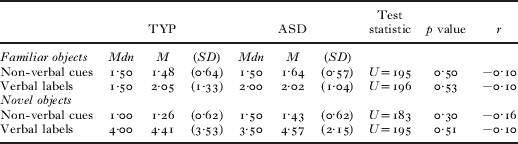
As for Experiment 1, non-parametric tests were conducted, given that data were not normally distributed. Tests were applied as outlined in the results section of Experiment 1. There were no group differences in the treatment of novel objects or the treatment of familiar objects, as reported in Table 4. Therefore, we collapsed data across object type to have more trials to analyze and thus a better representation of each dyad's behavior.
Data for familiar and novel objects
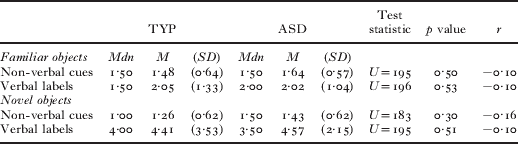
note: TYP: typically developing children; ASD: autism spectrum disorders.
Non-verbal cues
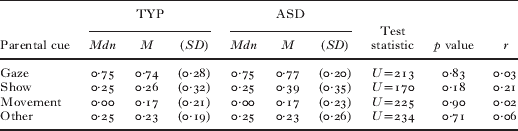
Table 5 provides the mean proportion of labeling episodes where parents used each non-verbal cue in combination with the first label. Results showed that the most frequently used cue by parents in both groups was gaze to the object. Mann–Whitney U tests showed no statistically significant differences in the use of any cue between groups. However, inspection of means and the effect size showed that there was a small to medium size effect, whereby parents of children with ASD tended to produce more shows in combination with the first label.
Mean proportion of parental non-verbal cue use
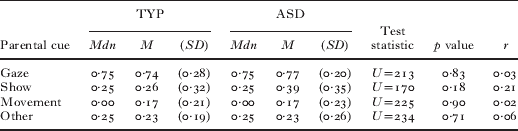
notes: TYP: typically developing children; ASD: autism spectrum disorders.
A Mann–Whitney U test was conducted to compare the mean number of non-verbal cues per episode across groups. Results showed no significant difference between parents in the TYP group (Mdn = 1·25, M = 1·37, SD = 0·49) and parents in the group of children with ASD (Mdn = 1·50, M = 1·54, SD = 0·51) (U = 189, p = 0·41, r = − 0·13).
Finally, we examined the use of multiple non-verbal cues, or the use of more than one cue in combination. Groups did not differ with respect to the proportion of episodes where multiple cues were produced (TYP: Mdn = 0·25, M = 0·36, SD = 0·29; ASD: Mdn = 0·50, M = 0·45, SD = 0·31) (U = 183, p = 0·32, r = − 0·15).
Relationship between child language level and non-verbal cues
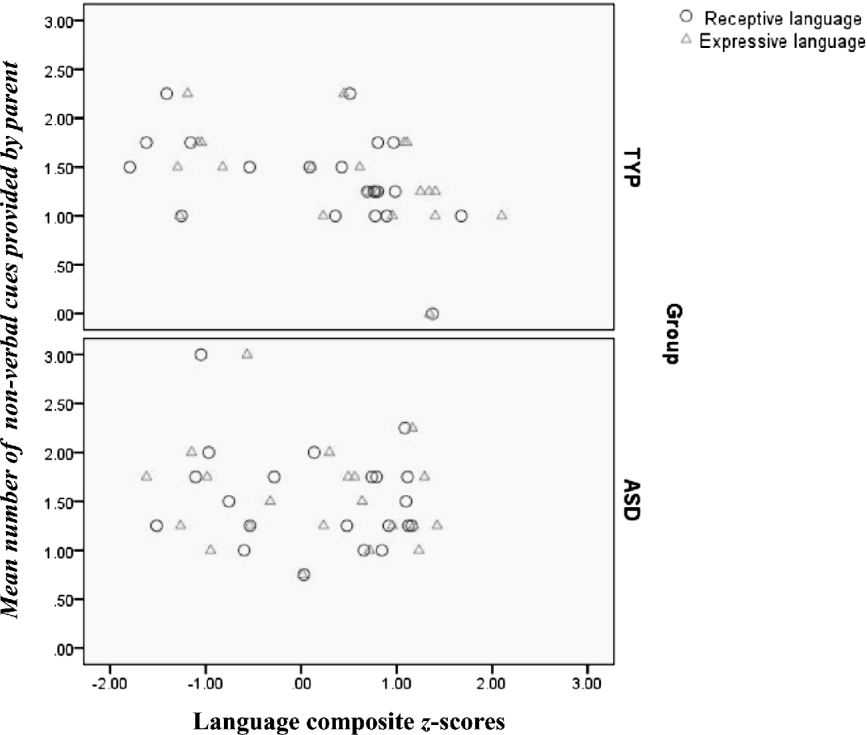
Non-parametric correlations were conducted to examine the relationship between the mean number of non-verbal cues produced per episode by parents in combination with the first label they provided for the object, and child language ability, as measured six months earlier (Time 1) by receptive and expressive language composite scores. For TYP children only, parents used fewer non-verbal cues while labeling for children who had higher Time 1 expressive language abilities (τ = −0·38, p = 0·02) and receptive language abilities (τ = −0·35, p = 0·04). These relationships did not hold for participants with ASD (correlation with expressive language: τ = −0·13, p = 0·42; with receptive language: τ = −0·09, p = 0·58). The scatterplot in Figure 4 summarizes the relationship between mean number of non-verbal cues provided with first label and expressive language composite scores as well as with receptive language composite scores for both groups.
Scatterplot showing relationship between mean number of parental non-verbal cues used with first label and Time 1 receptive and expressive language composite scores.
Verbal labeling
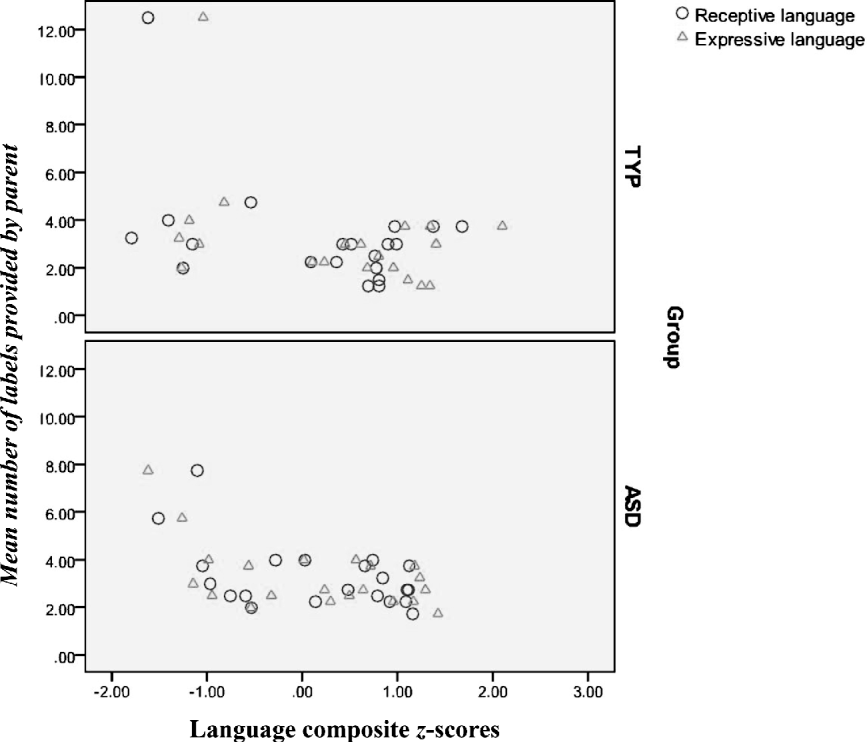
A Mann–Whitney U test was conducted to compare the mean number of labels parents provided across groups. Results showed no significant difference between parents in the TYP group (Mdn = 3·00, M = 3·23, SD = 2·32) and parents in the group of children with ASD (Mdn = 2·75, M = 3·30, SD = 1·38) (U = 189, p = 0·43, r = − 0·12).
Relationship between child language level and verbal cues
We examined the relationship between the mean number of verbal labels produced by parents and their child's language skills, as measured by composite scores obtained six months earlier at Time 1. Non-parametric correlations showed that parents of children with ASD who used more labels had children with marginally lower expressive language skills (τ = −0·32, p = 0·05). The relationship with Time 1 receptive language skills did not reach significance (τ = −0·30, p = 0·06). For parents of TYP children, the relationship between their use of labels and their children's expressive (τ = −0·17, p = 0·30) and receptive language was not significant (τ = −0·12, p = 0·48). Figure 5 depicts these relationships.
Scatterplot showing relationship between mean number of labels provided by parent and Time 1 receptive and expressive language composite scores.
Attentional synchrony
A Mann–Whitney U test did not show significant differences between TYP children (Mdn = 1·00, M = 0·93, SD = 0·14) and children with ASD (Mdn = 1·00, M = 0·89, SD = 0·20) (U = 234, p = 0·67, r = 0·07), with both groups of parents generally labeling objects when they were already in the child's focus of attention.
DISCUSSION
Parental cues used to introduce object labels were strikingly similar across ASD and TYP groups. This result is in line with previous reports that parents of children with ASD and parents of TYP children exhibit similar behaviors while interacting with their children (Siller & Sigman, Reference Siller and Sigman2002; Watson, Reference Watson1998). The cue parents in both groups were most likely to use while labeling objects was gaze at the object. Regardless of deficits in joint attention (Adamson, Bakeman, Deckner & Romski, Reference Adamson, Bakeman, Deckner and Romski2009) reported in children with ASD, it might be that parents make use of this cue because it is the most conventional cue available to refer to an object. Furthermore, our findings in Experiment 1, as well as those of Norbury et al. (Reference Norbury, Griffiths and Nation2010) suggest that eye-gaze can be beneficial as a social cue for word mapping, even for children with ASD. Results also indicated that parents in both groups tended to provide labels when their child was already attending to the target object, as found by Siller and Sigman (Reference Siller and Sigman2002) for a range of indicative behaviors (such as showing, pointing, verbalizing). The one trend towards a difference between groups was that parents of children with ASD tended to produce more shows in the context of labeling, which may be related to the effort required to gain their child's attention.
While these results provide further evidence of similarities in parental behaviors during interaction, we also uncovered a different pattern in each group with respect to adaptation of parental cues to child language level. While we replicated the finding that parents of TYP children provide fewer non-verbal cues in combination with a label when their child has higher levels of receptive and expressive language (Gogate et al., Reference Gogate, Bahrick and Watson2000), this relationship was not found for the ASD group: parents in the ASD group accompanied the first verbal label with multiple cues to introduce object labels even if their child exhibited higher language skills. Since the use of multiple cues has a facilitative effect for attention in children with ASD (Brigham et al., Reference Brigham, Yoder, Jarzynka and Tapp2010), parents in the ASD group may have provided multiple cues because they were aware, consciously or implicitly, of the advantages of multimodal input. Additionally, parents in the ASD group may have needed to use more non-verbal cues in order to maintain their child's attention toward the objects regardless of child language level, due to the deficits children with ASD exhibit in attention following more generally (Adamson, McArthur, Markov, Dunbar & Bakeman, Reference Adamson, McArthur, Markov, Dunbar and Bakeman2001; Sigman, Mundy, Sherman & Ungerer, Reference Sigman, Mundy, Sherman and Ungerer1986).
However, parents in the ASD group were sensitive to their child's language level by using fewer verbal labels during the entire labeling episode when their child had higher expressive language skills. It could be that parents were aware of the facilitative effect of the repetition of verbal labels in increasing child attention toward novel objects, as reported by McDuffie et al. (Reference McDuffie, Yoder and Stone2006), and applied this specifically when their children had smaller vocabularies. Given the attention-following difficulties mentioned above, parents of children with ASD may be relying preferentially on repeated verbal labels to boost the likelihood that children with lower language levels will learn a label, as they may hear labels even when not attending visually.
GENERAL DISCUSSION
In this study, we addressed the use of social cues for word learning in autism spectrum disorders from two perspectives. Our starting point was an investigation of the ability of children with ASD to follow social cues to map novel labels, and of their referential understanding of those labels. Similar to TYP children of the same receptive language level, children with ASD were able to learn novel labels by relying on enhanced social cues in situations where these conflicted with perceptual salience. Furthermore, a novel finding was that children with ASD did not differ from TYP children in their ability to referentially generalize the learned novel label to other representations of the object – photographs in this case. Both of these abilities were positively related to children's receptive and expressive language levels.
To complement our investigation of children's word-learning abilities, we also explored the nature of cues that are available in their primary word-learning environment. Non-verbal cues parents provide when labeling objects have been shown to play an important role in their child's word learning in typical development (Booth et al., Reference Booth, McGregor and Rohlfing2008; Tomasello & Farrar, Reference Tomasello and Farrar1986); this may also be the case for children with ASD. Ours is the first study to examine the cues parents provide to their children with ASD specifically in the context of naturalistic object labeling. We found that parental cues used to introduce object labels were similar in type and rate across ASD and TYP groups. In addition, we examined adaptation of parental cues to child language level and found that parents of children with ASD are sensitive to this, in particular with their use of verbal labels. They produced more repetitions of labels when their child had lower language skills, potentially to facilitate acquisition of the word in children who have difficulty doing so. This diverged from the manner in which parents of TYP children adapted their interaction to their child's language level, with increased use of non-verbal cues in combination with a label when their child had lower language skills, in line with Gogate et al. (Reference Gogate, Bahrick and Watson2000).
How do the findings of this study help us understand the extreme heterogeneity in vocabulary development observed across children with ASD (Anderson et al., Reference Anderson, Lord, Risi, DiLavore, Shulman and Thurm2007; Charman et al., Reference Charman, Drew, Baird and Baird2003; Luyster et al., Reference Luyster, Lopez and Lord2007; Reference Luyster, Kadlec, Carter and Tager-Flusberg2008), and what may facilitate vocabulary development in children with ASD who are struggling? Exploration of individual differences in performance in these experiments, as well as comparison with contrasting findings, offers some instructive points and avenues for further exploration. In Experiment 1, we uncovered potentially surprising and sophisticated word-learning abilities in children with ASD, in that they were able to make use of social cues to map novel labels and to extend them to other representations of the target object, which we took as an indicator of referential understanding. We have noted, however, that the amplified social cues and constrained setting of our word-mapping task, and others with similar findings (Luyster & Lord, Reference Luyster and Lord2009; McDuffie et al., Reference McDuffie, Yoder and Stone2006), likely bolstered the performance of participants with ASD. This discrepancy points to a potential explanation for reduced vocabulary acquisition via social routes in ASD: normally the social cues used may not be able to compete with other perceptually salient, or preferred, stimuli. In positive terms, this finding underscores that children with ASD are not categorically insensitive to social cues, and encourages the use of natural social cues and supports in intervention for language delays in this population. A specific application for language intervention is Brigham et al.'s (Reference Brigham, Yoder, Jarzynka and Tapp2010) finding that parent initiations including three or more parent behaviors or social cues were more likely to lead to sustained object attention on the part of children with ASD than initiations that included one or two behaviors. In Experiment 2, we found that children with ASD receive similar social cues from their parents in contexts of object labeling, as other studies have reported for parent–child interaction more generally (Siller & Sigman, Reference Siller and Sigman2002; Watson, Reference Watson1998). This suggests that diminished input does not contribute to the variability in vocabulary development observed in children with ASD.
Results from both experiments emphasize that it is essential to consider developmental level, which varies enormously across children with ASD of the same age, when postulating mechanisms that underlie language learning in this population in both research and applied domains. For instance, whereas early studies conveyed the idea that children with ASD were essentially blind to social cues, more recent studies (Luyster & Lord, Reference Luyster and Lord2009; Norbury et al., Reference Norbury, Griffiths and Nation2010), including our own, have found that higher-functioning children with ASD are able to make use of social cues to learn novel labels, and that they demonstrate referential understanding of newly learned words. This is especially important given the changing face of language impairment in ASD. While earlier studies estimated that about half of children with autism remain non-verbal (Lord & Rutter, Reference Lord, Rutter, Rutter, Taylor and Hersov1994), more recent estimates suggest that only 9% remain completely non-verbal (Hus, Pickles, Cook, Risi & Lord, Reference Hus, Pickles, Cook, Risi and Lord2007), and, in some samples, approximately half of children with ASD exhibit language impairment while a similar proportion displays either unimpaired or borderline language skills as measured by standardized tests (Kjelgaard & Tager-Flusberg, Reference Kjelgaard and Tager-Flusberg2001). Consequently, as highlighted by Luyster and Lord (Reference Luyster and Lord2009), it is important to understand language development trajectories and potential across the entire autism spectrum. A productive focus for future work is to examine if and how the positive relationship found in Experiment 1 between language abilities and referential generalization in early development relates to individual differences in language processing later in life. A growing body of research has documented the central role of formal language level in determining the performance of school-aged children and adolescents with ASD. This is observed across situations, even those with minimal language demands, ranging from false belief tasks (Fisher, Happé & Dunn, Reference Fisher, Happé and Dunn2005; Happe, 1995), to referential communication (Nadig, Vivanti & Ozonoff, Reference Nadig, Vivanti and Ozonoff2009), to the processing of words in sentential context (Brock, Norbury, Einav & Nation, Reference Brock, Norbury, Einav and Nation2008; Norbury, Reference Norbury2005).
Limitations and future directions
This study had some limitations that should be considered. First, provision of word learning using social cues and parental cues were measured in two different tasks, at different times, with only partially overlapping samples. In the future, it would be ideal to measure children's acquisition of words introduced by the parent, as well as their referential understanding of those words, in the same situation to directly relate these constructs. Additionally, the retention of newly learned words over time is a crucial factor that is starting to be explored (Norbury et al., Reference Norbury, Griffiths and Nation2010), and should be investigated further. Similarly, referential generalization should be assessed with a delay and in circumstances that are more realistic outside of the lab. Finally, a consequence of the timing of experimental sessions was that, for Experiment 2, language scores were obtained six months earlier than the testing session. It would have been ideal to have a concurrent language sample. However, this provided an earlier snapshot of language abilities that parents still demonstrated sensitivity to at the time of the labeling task. One of the strengths of this study is that we investigated two facets of the word learning process with a reasonable sample size for detailed studies on developmental disorders employing well-matched groups; however, our power remained low and findings are in need of replication. Based on Cohen's (Reference Cohen1988) recommendations, to achieve the suggested power of 0·8 (80% chance of detecting an effect if one actually exists) at an alpha level of 0·05 in a two-tailed test for a group difference with a medium effect size, the required sample size would be sixty-four participants in each group (Faul, Erdfelder, Lang & Buchner, Reference Faul, Erdfelder, Lang and Buchner2007). In addition, this is the first experimental study on language development in children with ASD to include non-English-speaking children; francophone participants were included in both groups. No linguistic differences were predicted for the use of social cues for reference by children, or the provision of social cues by parents, and none was found, so participants were collapsed across language in this study. Targeted cross-linguistic work and research examining situations of bilingual or multilingual acquisition in children with ASD are called for in future investigations.
Because parents are the first and primary source in exposing children to novel labels, identifying specific cues that are favorable for vocabulary acquisition in both typically developing children and children with ASD will allow them to use these strategies at early ages to foster word learning in daily interactions. In contrast to what are perhaps common assumptions about children with ASD, here we found they learned object labels via social cues and were able to generalize them. We also presented the first evidence that parents of children with ASD provide similar verbal and non-verbal cues when introducing novel objects to their child as do parents of typically developing children, and that they adapt this behavior to their child's language level. This study adds to the body of knowledge on word learning and parent–child interactions in children with ASD, furthering our understanding of the variation in lexical acquisition in this population.