The plebiscite is an attack on freedom itself.
George Sand (Reference Sand1871: 306, authors’ translation)
On 24 October 1955 Jean Baptiste Ngô Đình Diệm, the first president of South Vietnam, hailed the result of the referendum of the previous day. The plebiscite in which the people ‘took such an enthusiastic part’, he argued, ‘constitutes an approval of the policies pursued’ (Chapman Reference Chapman2006: 380). This ‘approval’ was echoed by the US government: ‘The Department of State is gratified that according to reports the referendum was conducted in such an orderly and efficient manner and that the people of Viet-Nam have made their choice unmistakably clear’ (Brownell Reference Brownell1963: 158). The result was indeed ‘clear’, but mistaken: 600,000 voters supported Diệm, even though the registered number of electors was 450,000 (Karnow Reference Karnow1997: 239). Differently put, the referendum question had an endorsement level of 133%!
There is nothing new about such votes. Rulers with questionable democratic credentials have long felt impelled to submit issues to citizens in referendums. They have included Napoléon Bonaparte, his nephew Louis Napoléon, Adolf Hitler, Benito Mussolini, Baby and Papa Doc’ Duvalier, Ayatollah Ruhollah Khomeini, Bashar al-Assad and Nursultan Nazarbayev (Altman Reference Altman2011: 88). Sometimes referendums prompt comic incredulity from outsiders. In 2002, on the eve of his forced displacement from power, Saddam Hussein was re-endorsed by the Iraqi public with an affirmative vote of 100%. It was the second referendum held to endorse him as president since he had seized power from his patron Hasan al-Bakr in 1979. On the previous occasion, 15 October 1995, Iraqi voters were given ballots with the question, ‘Do you approve of President Saddam Hussein being the President of the Republic?’ The following day, Izzat Ibrahim of the Baath Revolutionary Command Council, established in 1968, declared that the turnout had been 99.5%, and that the incumbent had received 99.7% of some 8.4 million valid votes cast. Officially, just over 3,000 people voted against him, 45 in Baghdad (Altman Reference Altman2011: 92). More generally, in the developing world ‘referendums have been utilized primarily by authoritarian regimes’ (Marques and Smith Reference Marques and Smith1984: 103). Recently, referendums have been used and championed by Vladimir Putin, who backed and probably helped organize the plebiscite in Crimea in March 2014.Footnote 1
One puzzle, given that most of these votes are anything but fair and free, is simple. Why do authoritarian or totalitarian regimes submit issues for plebiscitary approval? What is the reason for such a seemingly futile exercise?Footnote 2 The answer to this question, we believe and argue, is that referendums are mechanisms for ‘proving’ unity and generating support or loyalty for a leader or a regime in a way that legislative elections cannot. By obliging the voters to turn out, sometimes at gunpoint, a totalitarian or authoritarian regime signals that it controls the population.
Definitions
Referendums are defined as ‘any popular vote on a policy issue’ (Qvortrup Reference Qvortrup2017: 142). When dealing with dictatorships, however, scholars have sometimes used the term ‘plebiscite’, defined as an instrument that allows a government ‘to appeal to people to express themselves with a yes or a no’ (Fimiani Reference Fimiani, Jessen and Richter2011: 231); the term is especially common in French-language political science (e.g. Guillaume-Hoffnung Reference Guillaume-Hoffnung1987). The etymology of plebiscites is plain (plebs, the common citizens + sciscere, to vote or resolve). Our focus here is on ‘popular votes’ in which the entire electorate is asked to endorse or reject a resolution put by a dictator. These plebiscites include both votes on policy issues – for example, on children’s rights in Azerbaijan in 2009 – or endorsing continued rule by a named individual – such as the 1996 question on whether Kyrgyzstan’s President Askar Akayev should remain in office. These top-down plebiscites are obviously very different from the bottom-up referendums held in many states of the US and in Switzerland and Italy.Footnote 3 To borrow from semiology (Barthes Reference Barthes1964), in an authoritarian regime, the signifier ‘referendum’ conjures up an image of intimidation and control (the signified), such as voting at gunpoint in Iran (Marques and Smith Reference Marques and Smith1984), or Mussolini’s plebiscites when voters put pre-marked ballots in transparent ballot boxes under the watchful eye of representatives of the regime (Leonetti Reference Leonetti1929). By contrast, in a democratic state the signifier ‘referendum’ conjures up free political debate, robust exchanges of views and public deliberation: the characteristics found in the debates over whether to endorse the Good Friday Agreement in both parts of Ireland in 1998, whether Scotland should become an independent country in 2014 and perhaps to a lesser degree in the 2016 referendum on whether the UK should remain in the European Union. These referendums are not our object of inquiry. Rather, we are interested in ‘repressive integrationist referendums’ (RiRs) – that is, votes with 99% or more support expressed on policy issues or on the continuation of a current regime.
Plebiscites in autocratic regimes
Though there has been extensive research on the use and function of elections in autocratic regimes,Footnote 4 plebiscites in autocratic states have not been subjected to equivalent focus within political science. While they superficially resemble elections, there are important differences, which explain why they are exploited by autocratic rulers. The legal and political theorist Carl Schmitt (Reference Schmitt1988 [1923]: 34), who became an apologist for the Nazi regime, stressed that the plebiscite enables a ‘single trusted representative [to] decide in the name of the same people’. Unlike elections, which several candidates or parties contest, a referendum, a vote on one issue, ensures, ‘[first] homogeneity and second – if need arises – the elimination or eradication of heterogeneity’ (1988 [1923]: 9). A plebiscite, even one blatantly not in conformity with democratic standards of fairness, provides an opportunity for the autocrat to demonstrate that he (it is rarely a she!) has the confidence of the people, whereas an election – of necessity – reveals some measure of disunity. This distinction has recently been alluded to in research on referendums in post-Soviet states, such as Kazakhstan, Belarus and Uzbekistan, where rulers used referendums rather than elections to consolidate their power and to signal that they were above the rough and tumble of competitive politics. In the words of Donnacha Ó Beacháin, ‘The president has, deus ex machina, come as a founding father, to guide the nation through the first generation of independent statehood. How can this living divinity be reconciled with the image of political battling with mere mortal mediocrities to distinguish himself?’ Plebiscites in which the people may applaud the hero are preferred to elections, which theoretically could depict the president as one of many potential aspirants for office (Ó Beacháin Reference Ó Beacháin2011 218–19). They are qualitatively different from elections because they allow universal acclamation of the autocrat rather than a mere mandate. For in a parliamentary election, the political parties, as partial entities by definition, cannot represent la volonté générale, but of necessity represent one of several ‘volontés particulières’. Whereas an election to an assembly advertises disunity, a referendum potentially signifies the opposite, at least if the initiator or leader receives a mandate from all the people.
The use of plebiscites in autocratic regimes
Perhaps plebiscites are cheaper and easier to organize than they once were. We have not investigated this matter, but we do have some evidence about their frequency. Figure 1 shows that the number of referendums in autocracies has increased over the last 80 years or so compared with the 19th century. In particular, there was a mushrooming of incidence in the early 1970s. The all-time per-decade high coincided with the breakdown in post-colonial representative governments.
Referendums in Autocracies per Decade, 1800–2012 Source: C2D database www.c2d.ch/inner.php?table=dd_db (2017) and Qvortrup (Reference Qvortrup and Qvortrup2014). Note: Selection criteria: countries that scored between 6 and 10 on the Polity IV Autocracy Index.

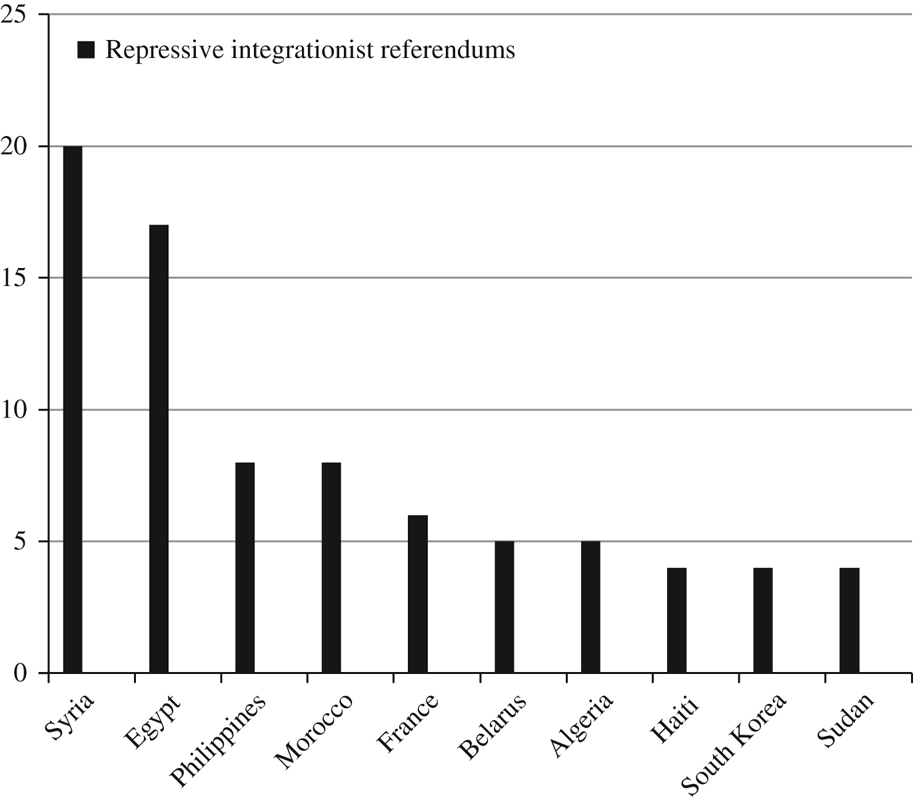
While there was a slight drop-off in the 1980s, the absolute number rose again in the 1990s. And after a fall in the early 2000s, in 2014 referendums were held in Egypt in January and in parts of Ukraine (Crimea in March 2014 and Donetsk and Luhansk Oblast in May of the same year). The average number of plebiscites per autocratic regime is 5.8. But the standard deviation of 21.3, indicates that a handful of regimes have been frequent holders of plebiscites, especially in Syria and Egypt (and to a lesser extent the Philippines and Morocco), and that others have held referendums on rare occasions. Most autocratic regimes hold fewer than a handful of plebiscites. Figure 2 illustrates the high users (and abusers) of referendums.
Repressive Regimes with More than Three Plebiscites, 1800-2012 Source: C2D database www.c2d.ch/inner.php?table=dd_db (2017) and Qvortrup (Reference Qvortrup and Qvortrup2014). Note: Excluding countries with fewer than three referendums. The breakdown of the other countries are: Austria, Cuba, Ethiopia, Gabon, Honduras, Libya, Mali, Mauritania, Nepal, Portugal, Qatar, Romania, Somalia, Tajikistan, Tunisia, Turkey, Uruguay, Yemen all one. Bangladesh, Benin, Bulgaria, Central African Republic, Chile, Equatorial Guinea, Ghana, Greece, Iraq, Italy, Mexico, Myanmar, Niger, Pakistan, Poland and Spain all two.

Previous research
As an instrument of choice by repressive governments, one would expect plebiscites to have received more coverage in the political science and political economy literature. However, this institutional device is not discussed in seminal works and surveys (see e.g. Brooker Reference Brooker2014; Ezrow and Frantz Reference Ezrow and Frantz2011; Gandhi Reference Gandhi2008; Newell Reference Newell2016; Tullock Reference Tullock1987; Wintrobe Reference Wintrobe1998, Reference Wintrobe, Boix and Stokes2007). In one canonical survey, Juan Linz referred briefly to the use of elections and plebiscites to test the effectiveness of totalitarian parties, but did not distinguish the two (Linz Reference Linz2000: 92). Similarly, referendums in autocracies are largely overlooked in the survey literature about democratic referendums (Butler and Ranney Reference Butler and Ranney1993; LeDuc Reference LeDuc2003; Qvortrup Reference Qvortrup2005). Aside from one article published in the 1930s (Zurcher Reference Zurcher1935), plebiscites in autocratic and totalitarian regimes have not been the subject of study in our discipline’s mainstream journals, though they have been discussed by historians (see below). Although recent scholarship has suggested that certain non-democratic governments are more stable than others (Geddes Reference Geddes1999), continuing an older debate on the supposed greater durability of left-wing as opposed to right-wing dictatorships, and though research on varieties of authoritarianism continues apace (see e.g. Falleti Reference Falleti2011; Wahman et al. Reference Wahman, Teorell and Hadenius2013), comparative or theoretical inquiry on plebiscites in dictatorships has been virtually non-existent. The notable exception is considered below (Chehabi and Linz Reference Chehabi and Linz1998). Yet it is certainly puzzling that dictators such as Ngô Đình Diệm, whose roles are unrestrained by the shackles of accountability (Gandhi and Przeworski Reference Gandhi and Przeworski2006), and who are sometimes said to rule ‘by commands and prohibitions’, often resort to plebiscites (Brooker Reference Brooker2014). It demands explanation.
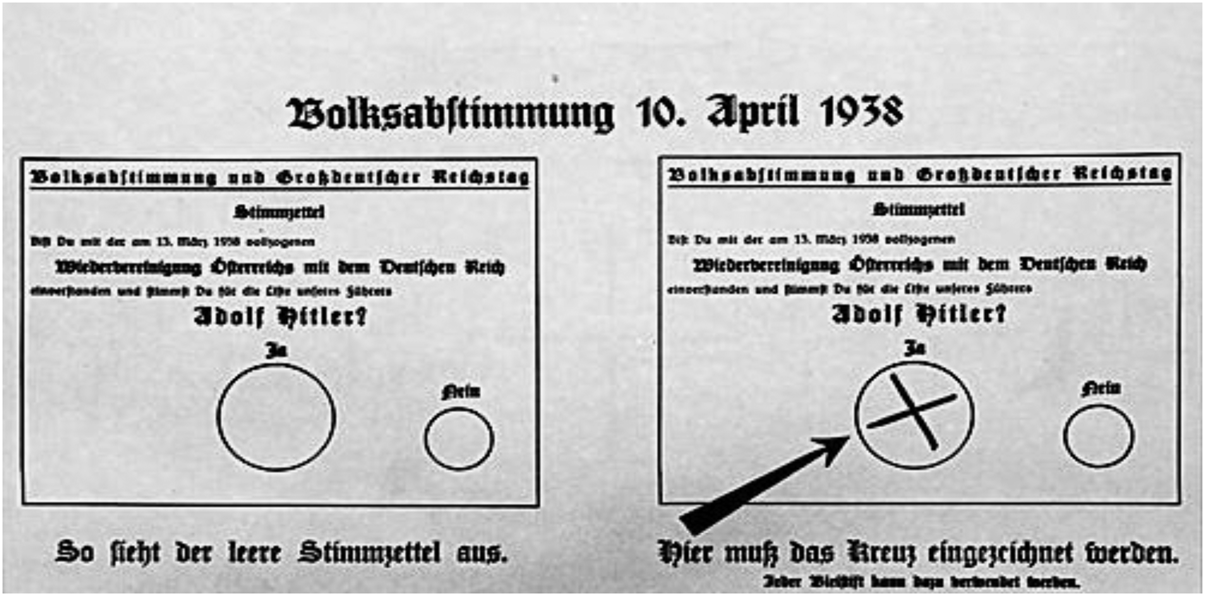
Before World War II, plebiscites were often alluded to by prominent scholars of social and political inquiry such as Robert Michels (Reference Michels1925: 43) and Eric Voegelin (Reference Voegelin1940). But this work generated few hypotheses or empirical investigations. Plebiscites were mentioned in the burgeoning literature on totalitarianism after World War II (e.g. Friedrich and Brzezinski Reference Friedrich and Brzezinski1965), and most recently by Paul Brooker (Reference Brooker2014), but referendums in dictatorships have generally been overlooked as a distinct subject of study. Among historians, particularly those specializing in Nazi Germany and Fascist Italy, this neglect has begun to be remedied (see Figure 3). Beginning with Otmar Jung (Reference Jung1995), and exemplified in the works of Frank Omland (Reference Omland2010, Reference Omland2011), historians have provided detailed accounts of the referendums held under Hitler.Footnote 5 Similar research has been carried out in Italy (above all see Fimiani Reference Fimiani2010). Yet in both cases, historians of these regimes concede that ‘until now, the problem of plebiscites … has only been dealt with marginally’ (Corni Reference Corni2011). A related and emergent literature now exists that focuses on ‘hybrid’ polities (Diamond Reference Diamond2002), sometimes called ‘illiberal democracies’ (Zakaria Reference Zakaria1997), and sometimes ‘competitive authoritarian regimes’ (Levitsky and Way 2002). The latter type in particular refer to dictatorships that hold genuine elections, but arguably the two types shade into one another: illiberal democracies and competitive authoritarian regimes have elections though they do not necessarily hold referendums, except perhaps to consolidate ‘constitutional’ change. We are concerned here with insincere referendums – where it cannot be credibly argued that they are intended to discover and follow the preferences of citizens.
Ballot Paper for the Anschluss Plebiscite Source: Dokumentationsarchiv des österreichischen Widerstandes, Vienna, Austria. Note: The specimen on the left shows an empty ballot paper. The specimen on the right shows where ‘you must put your cross’. Note also that the box for ‘Ja’ (‘Yes’) is considerably larger than the box for ‘Nein’ (‘No’).

Here we propose a framework and testable hypotheses for understanding referendums in autocratic regimes. Induction from single-country case studies suggests that dictators seek plebiscitary approval for a variety of reasons: to be able to prove to the outside world that the regime enjoys popular support – or more convincingly, perhaps, to demonstrate that the regime is able to organize ‘support’ and enforce high levels of approval (Noble Reference Noble1976); or, in other cases, probably the majority, referendums are held for internal reasons to prove to the population that the regime is in control. Maurice Latey (Reference Latey1969: 145) observed that severely authoritarian states used the referendum ‘as a means of demonstrating [and] … indoctrinating the people and of testing … control over them’. For example, in Nazi Germany, instructions issued by the National Socialist Party (NSDAP) required local authorities, responsible for the running of the referendum, to alert the Gauleitung (local party leader) if anyone requested an absentee ballot. The reason given in the instruction was ‘to prevent Marxist or other politically unreliable elements from using absentee ballots to avoid voting’ (quoted in Archives: KSH 9/26 NSDAP Ordgruppe Schleswig to Schleswig Magistrates, 6 November 1933). Other case studies from Iran (Marques and Smith Reference Marques and Smith1984), East Germany (Jessen and Richter Reference Jessen and Richter2011) and Egypt (Blaydes Reference Blaydes2006; Koehler Reference Koehler2008) suggest that authoritarian regimes use referendums to identify supporters and flush out opponents. Those who fail to express their support for the regime may suffer individual punishment, or collective punishments for their families, work colleagues or members of their housing associations (Jessen and Richter Reference Jessen and Richter2011: 109). That referendums may be used as control mechanisms does not, however, tell us when they are likely to be used, and what logic they follow. Why is it, for example, that several plebiscites have been held in Syria and the Philippines, but not in North Korea and the People’s Republic of China?
Aristotle distinguished ‘kingship’ from ‘tyranny’, among other criteria, by insisting that kings rule over ‘willing subjects’ and in the general interest, whereas tyrants rule over ‘unwilling subjects’ and in their own interests (Aristotle 1905; O’Leary Reference O’Leary1989: 42–5). Are referendums intended to manufacture ‘willing subjects’? It is plainly conceivable that dictators, under certain circumstances, may successfully seek the support of the people in a plebiscite; and that ‘willing subjects’ may give their consent; arguably, that is what happened in Bangladesh in 1977 when Major General Ziaur Rahman sought and won ratification of his military coup (Rashiduzzaman Reference Rashiduzzaman1978). But what may puzzle some is that plebiscites are sometimes held in established totalitarian regimes, where it is often thought that rule is over ‘unwilling subjects’.
Modelling
The classic view of the difference between democracy and dictatorship in political science (e.g. Friedrich and Brzezinski Reference Friedrich and Brzezinski1965) is that dictators stay in power through repression. However, there is a problem with this way of thinking. Rule by repression alone creates a problem for the autocrat. Repression breeds fear on the part of a dictator’s subjects, and this fear makes the citizenry reluctant to signal displeasure with the dictator’s policies. This fear on their part in turn breeds fear on the part of the dictator, since, not knowing what the population thinks of his policies, he has no way of knowing what they are thinking and planning, and, of course, what he suspects is that what they are thinking and planning is his overthrow. The problem is magnified the more the dictator rules through repression and fear. The more his repressive apparatus stifles dissent and criticism, the less he knows how much support he really has. Paranoia is the natural state of dictators (see also Strauss et al. Reference Strauss, Kojeve, Gourevitch and Roth1991).
Consequently, our starting point is that dictators do not rule by repression alone but also through policies meant to generate support or loyalty, as in Ronald Wintrobe’s (Reference Wintrobe1990, Reference Wintrobe1998) model. Through this loyalty/repression framework, the use of plebiscites can be explained in several ways. First, as repression: the dictator organizes a plebiscite to show that he is in control and therefore aims to dampen opposition to his policies. Second, as affirmation of loyalty or support: it gives the population an opportunity to demonstrate their loyalty to the dictator. And it shows to some who may be wavering that other people are more than willing to demonstrate their loyalty to the dictator.
But which kinds of regime are more likely to organize a plebiscite? Of the types that can be derived from Wintrobe’s general model, the most obvious candidates are regimes in which loyalty is low: ‘tinpots’ and ‘tyrannies’. In totalitarian regimes, with high repression and high loyalty, there are other institutionalized mechanisms for building loyalty that provide many opportunities for the people to demonstrate their loyalty. Mass parties such as the Communist or the Nazis also control totalitarian regimes, and in the former Soviet Union and elsewhere the Communist Party controlled jobs, perquisites such as access to specialized medical care and rationed goods as well as providing an ideology. The system functioned not just by repression but by exchange. The Party provided jobs and perquisites in exchange for loyal support, as well as providing a normative mission. The slogan of the Nazi SS was ‘My honour is my loyalty’. Totalitarian regimes typically have other means, such as elections, or the promise of promotion within the party, to promote loyalty. The Chinese Communist Party still functions this way, albeit in a decentralized fashion, in which those provinces and municipalities which provide economic growth get rewarded with advancement and more funds from the Party (for a detailed description, see Xu Reference Xu2011). Consequently, referendums are less necessary within such regimes than in other dictatorships. Many of the subjects in contemporary Communist China are far from ‘unwilling’ subjects, nor was there any lack of willing subalterns in Nazi Germany (Hitler was initially quite popular) or in the Soviet Union under Stalin at least (see Wintrobe Reference Wintrobe1998 for details).
Tinpots, who exercise low repression and receive low loyalty, and tyrants, who exercise high repression and experience low loyalty, rule mostly by repression. Loyalty matters less, especially outside the dictator’s immediate entourage. There is no mass party and no mechanism to discover what policies the population might prefer, and the policies implemented are therefore more likely to deviate from the preferences of the population even if the dictator wanted to satisfy their preferences. Control in regimes like these is sometimes called ‘sultanistic’ (following Linz) to denote the absence of a mass party or ideology or other basis for power other than the ruler himself. So, to the extent that the plebiscite is a demonstration of control, the greatest need for perceived control arises in sultanistic (tinpot or tyrannical) regimes.
Developing this logic, we suggest that the higher the perceived distance between the policies of the dictator and the preference of the median voter, and the higher the level of repression, the greater the probability that a referendum will be held. This reasoning also implies that, all other things being equal, there will be more rigged referendums in places where the population is heterogeneous, and where their preferences are dispersed (because the variance of preferences is high). Thus, there may be good reason to expect more plebiscites in countries with high levels of ethnic fractionalization, because in such places, no matter what policy he may adopt, a dictator is bound to displease a large fraction of the population. In addition, if the dispersion of preferences is the result of national, ethnic, religious or linguistic cleavages, then the preferences may tend to be strongly held, and the dictator may find it difficult to obtain trans-group loyalty. The average distance between the preferences of members of the population and the policies of the dictator will be large even if the dictator tries to implement the preferences of the median voter.
The most likely users of plebiscites are therefore tinpots or, especially, tyrants – that is, regimes that have low levels of loyalty. As already suggested, plebiscites function as a means of repression, to exact public submission, to identify or gauge dissent, and to signal the weakness of dissent to the opposition. We therefore reasoned that a totalitarian regime has little reason to use plebiscites, since it has alternative mechanisms to achieve repression and loyalty. But that said, at the beginning of their regimes, totalitarians may execute plebiscites to establish hegemony or domination: a referendum to establish an Islamic Republic was held in Iran in March 1979 (approved by 92%), and to endorse the new constitution in the following December (approved by over 99%).
Another possible factor explaining the occurrence of plebiscites could be that regimes believe, for ideological and foreign policy reasons, that they need to show that they are using democratic mechanisms. For example, it has been hinted in the case study literature in the Philippines under Ferdinand Marcos that plebiscites were intended to assure his allies in Washington that he had democratic legitimacy (Noble Reference Noble1976). The aforementioned plebiscite in Vietnam (1955) was like this, as were votes held by other US-allied dictatorships in Chile (1978, 1980 and 1988) and Turkey (1982). Extrapolating from such cases, we hypothesize that plebiscites with 99% support are likely to be held in countries that were US allies after World War II.
Recapitulating and our derived hypotheses
Our dependent variable is referendums in autocracies in which the regime officially gets an official endorsement by 99% or more of the votes cast (repressive integrationist referendums, or RiRs). While it is true that even referendums in autocratic regimes may reflect a certain genuine level of popular support, especially in totalitarian regimes,Footnote 6 genuinely winning the support of 99% or more in a poll held in an autocratic regime usually suggests that the regime deliberately rigged the result (Altman Reference Altman2011). Of course, this cut-off is somewhat arbitrary. Why not 90% or 95%? Our answer is pragmatic: the line has to be drawn somewhere, and that 99% is so extreme that this number signifies that all opposition is futile. Further, empirical research has shown that only one referendum achieving 99% approval has ever been held in a democratic country, namely in Iceland in 1944 (Altman Reference Altman2011: 88). Otherwise, all agree that 99% endorsements are indicative of authoritarianism and dictatorship rather than pluralism and democracy.Footnote 7
In the light of our modelling, we expect RiRs to be correlated with higher levels of ethnic (and possibly religious and linguistic) diversity. An affiliation to an ethnic or kinship group is an emotional bond, which competes with devotion to the regime, its ideology and its incumbents, so we expect RiRs to occur in states with higher levels of ethnic diversity. Hence:
Hypothesis 1: RiRs (with support recorded at 99% or over) will tend to take place in autocratic states with high levels of ethnic fractionalization.
Alternative explanations may account for the incidence of repressive integrationist referendums, such as ‘sultanism’, geographic location or communist ideology. The most elaborate earlier research has suggested that sultanistic regimes turn to plebiscites to prove their democratic legitimacy, and implied, as does our model, that referendums were ‘rare in communist countries’ (Chehabi and Linz Reference Chehabi and Linz1998: 19).Footnote 8 All these propositions, however, have not been subjected to empirical, let alone statistical, testing. We therefore hypothesize that sultanistic (tinpot or tyrannical) regimes will make frequent use of repressive referendums. Hence:
Hypothesis 2: RiRs are likely to take place in sultanistic (tinpot or tyrannical) regimes.
Given that autocratic countries allied to the US have been reported to be anxious to show that they enjoy popular support, Hypothesis 3 warrants testing:
Hypothesis 3: RiRs are likely to take place in countries allied to the United States after 1945.
Lastly, we want to assess if referendums were held within the first year of a regime’s arrival in power, as with Napoleon in 1800 and in Iran in 1979; hence:
Hypothesis 4: RiRS are likely to take place within a year of the regime coming to power (concessio imperii referendums).
Data and methods
The analysis here is focused on autocratic states, polities that score between 6 and 10 on the Polity IV index of autocracy – we shall not second-guess the latter’s codings, though we are aware of debates over their merits. Other research pertaining to the same issue (Qvortrup Reference Qvortrup2017) has focused exclusively on Freedom House data because this index combines both civil liberties and political freedoms, and the same justification is used in recent scholarship on ‘democracy in decline’ (Diamond and Plattner Reference Diamond and Plattner2015). For this reason, the data will also be tested using Freedom House scores, focused on ‘not-free’ states. (Polity IV and its limitations are discussed in Munck and Verkuilen Reference Munck and Verkuilen2002; the Freedom House index is discussed by Tilly Reference Tilly2007). However, our main analysis uses Polity IV because this index – its perceived shortcomings notwithstanding – has a longer reach (it begins in 1800).
The data set on plebiscites is based on a comprehensive list of all the 162 referendums held in authoritarian and non-democratic states between 1800 and 2012. The data are predominantly based on the C2D data set compiled by the Center for Research on Direct Democracy, and the cases reported by David Altman et al. (Reference Altman, Donovan, Hill, Kersting, Morris and Qvortrup2014). RiRs were only included if the vote took place in a country that scored between 6 and 10 on the Polity IV index in the year when it was held. To corroborate the findings, the same calculations were carried out using the Freedom House index. Countries were included if they scored either 6 or 7 on the 1–7 Freedom House scale – that is, repressive or ‘autocratic’. The latter analysis covered the years 1973–2010 because Freedom House data are not available before 1973.
We operationalized a sultanistic (tinpot or tyrannical) regime as one where the ruler is president for life and not subject to term-limits. In the data set, a dictator was denoted by a dummy variable with the value of 1 if the ruler had governed continuously for a 10-year period without term-limit requirements, or where the term-limits had been abolished. We are using this dichotomized dependent variable because we appreciate that it is difficult to graduate levels of repression quantitatively. Moreover, by dichotomizing the dependent variable, we are able to use logistic regression, which in turn will enable us to calculate Wald-scores, which measure the probability of the RiRs occurring. Data on constitutional provisions for term-limits derive from Constitution-Finder.Footnote 9
The figures for fractionalization are based on a data set compiled by Alberto Alesina et al. (Reference Alesina, Devleeschauwer, Easterly, Kurlat and Wacziard2003). Aside from the difficulties attached to all fractionalization indices (Laitin and Posner Reference Laitin and Posner2007), the figures are imperfect indicators because they are a snapshot of the fractionalization at a particular time (the 1980s). This fact naturally limits the explanatory power of this independent variable. Nevertheless, it provides a reasonable approximation of ethnic fractionalization applied to plebiscites held after 1980. The measure is, for the same reason, less suitable for the plebiscites held in the earlier period, and because demographic and territorial changes have impacted on the levels of ethnic fractionalization in different states. Following Rein Taagepera (Reference Taagepera2008), however, we propose to do more than merely explain when plebiscites occur in authoritarian regimes; we also want to make predictions as to when such votes will be held. Using Wald-scores, a feature of logistic regression models, we are, as we hinted in the previous paragraph, able to forecast when plebiscites will be held. To measure if the regime held a concessio imperii vote, we have included a dummy (Concessio Imperii dummy) with the value 1 if a plebiscite was held within the year of the regime’s seizure of power and the value 0 if no such vote was held in the first year of the regime’s rule.
Results
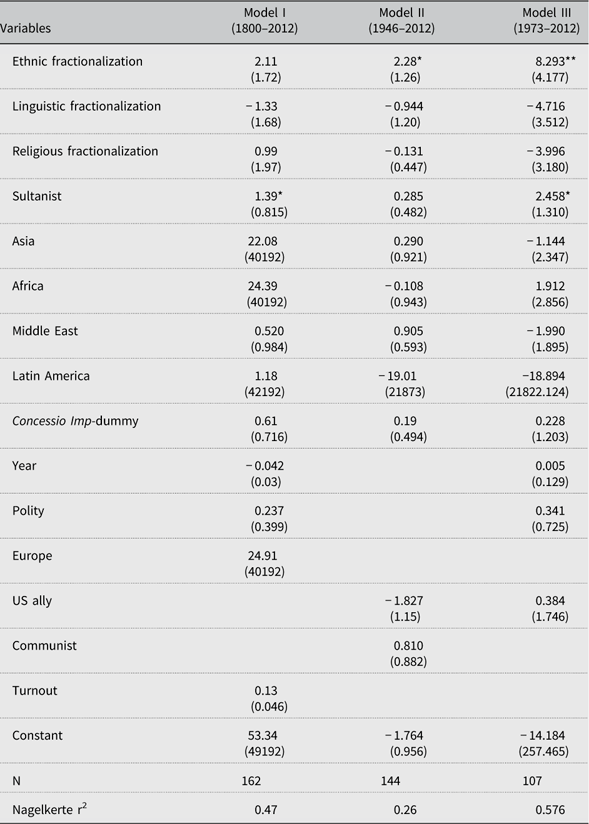
Analysing all 162 cases from 1800–2012, using logistic regression, we find that only one variable is statistically significant, namely sultanism (Table 1). This finding corroborates Hypothesis 2 but raises question marks over the other hypotheses. With a Wald-score of 2.917, we can predict that the probability of a RiR taking place is almost three times higher in a sultanist regime than in regimes that do not fall into this category. The explanatory value of this model is relatively high with a Nagelkerte r-squared of 0.47 and is consistent with our model as with other conjectures such as Houchang Chehabi and Juan Linz’s (1998) argument that plebiscites often occur in countries with sultanistic regimes. Sultanistic rulers ‘exercise power … unencumbered … by any commitment to an ideology or value system’ (Chehabi and Linz Reference Chehabi and Linz1998: 7). The personalist rooting of power means that he needs sources of loyalty other than those enjoyed by a communist ruler endorsed by a vanguard party, an absolute monarch anointed by God, or a theocracy (see Brooker Reference Brooker2014: 97). A sultanist ruler may periodically need to demonstrate that the ‘people’ trust his stewardship, and to provide an opportunity for the intelligence services to identify who fails to turn out to vote or to support the regime. This finding as regards sultanism as a predictor for RiRs is not present in Model II, but reappears in Model III, where the sultanism dummy is statistically significant at the p < 0.10 level and has a Wald-score of 3.5). The explanation may be that sultanistic regimes were relatively uncommon in the period after World War II when many countries regained their independence from former colonial masters. Most of the dictators who came to power between 1946 and 1973 were too new to need to acquire the legitimacy that can be conferred by a plebiscite.
Determinants of 99% Referendums (Polity IV)

Notes: * statistically significant at p > 0.10; ** statistically significant at p > 0.05. Wald-scores Model I (included for statistically significant variables only) sultanist: 2.917; Wald-scores Model II: ethnic: (3.273); Wald-scores Model III: ethnic fractionalization: (3.943), sultanist: (3.521).
There are no indications that ethnic fractionalization – as hypothesized by Hypothesis 1 – is a strong predictor of RiRs when we consider all the cases between 1800 and 2012. This may, of course, be because of the measure chosen. The data on ethnic fractionalization are based on figures obtained after 1973.Footnote 10 It would have been surprising if the ethnic fractionalization of the present day predicted the plebiscites of yesteryear.
What is remarkable, however, is how strong the predictor ethnic fractionalization is in Models II and III. When we limit the analysis to the period 1946–2012 (Model II), a period covering the Cold War and the period after the fall of Communism, we find that ethnic fractionalization becomes a potent variable with a coefficient of 2.28, statistically significant at the p < 0.1 level, and a Wald-score of 3.273, indicating that for every unit increase in the ethnic fractionalization in an autocratic state the probability that a RiR will be held increases almost three-fold. This corroborates Hypothesis 1, at least in the period after 1945. The significance of the ethnic fractionalization variable may help explain why no referendums have been held in ethnically homogeneous states such as North Korea and the People’s Republic of China (where the Han Chinese are widely reportedly to number above 95% of the population), even aside from the fact that those systems are based on strong Communist parties. There have, however, been many referendums in ethnically divided places, such as the Philippines and Syria (which are also religiously and linguistically divided). The data may also help explain why RiRs have been common in post-Soviet successor states in Central Asia such as ethnically diverse Kazakhstan and, to a lesser extent, Uzbekistan and Turkmenistan. There is, however, no law-like relationship we can confirm in this case: ethnically homogeneous Egypt (Copts are now likely less than 10% of the population) and Belarus have held large numbers of referendums. These and other outliers may be explained by the alternative hypothesis.
Model III corroborates these findings. Again, ethnic fractionalization is the best predictor, with a coefficient of 8.293 (statistically significant at the 0.05 level), and with a Wald-score of 3.943. Overall, in the post-1946 era, we can conclude that for every unit increase in the level of ethnic fractionalization there is a three-fold increase in the probability that a RiR will be held. This is a significant finding that can be placed alongside the finding that such votes tend to take place in sultanistic regimes. We have come some way in explaining – and predicting(!) – when plebiscites are likely to take place in autocratic regimes.
Other hypothesized factors are less empirically impressive. There is no general support for the hypothesis that referendums are held to confer power – concessio imperii-style to a dictator, and there is likewise no support for the hypothesis that RiRs are more likely to take place in countries that were allied to the USA during the Cold War. Hypotheses 3 and 4 are falsified by the data.
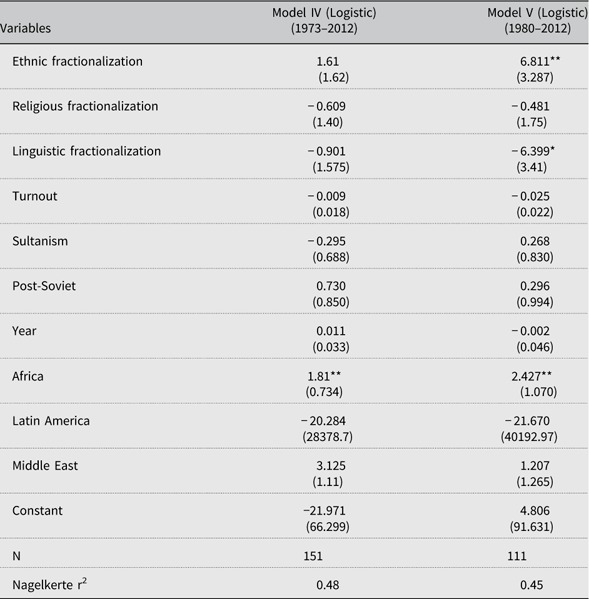
Autocratic states can be defined in different ways. While Polity IV provides nuanced and refined criteria, a more parsimonious measure, based on fewer categories, may be deemed more trustworthy when measuring autocracy (Reich Reference Reich2002), such as the Freedom House index. To render the hypotheses in this article plausible, binary logistic regressions were run using Freedom House data for the period 1973–2012. As Table 2 shows, the statistical evidence supports some of the same trends, though the findings in Model IV give reasons to be cautious. In Model V, the coefficient for ethnic fractionalization is positive and statistically significant at the p < 0.05 level and with a Wald-score of 4.295, which – in line with Models II and III – suggests that a unit increase in the measure of ethnic fractionalization leads to a four-fold increase in the probability that a RiR will be held. However, this finding is not present in Model IV. It appears that ethnic fractionalization is less important in a period that covered the full timespan 1973–2012 than the period that covers 1980–2012. Given that nationalism visibly re-emerged as a potent force in the 1980s, the findings in Model IV can thus be seen as an outlier that may be explained by the relative absence of ethnicity as a potent political discourse in the 1970s.
Determinants of 99% Referendums in Non-Free States (Freedom House Measure)

Notes: * statistically significant at p < 0.10; ** statistically significant at p < 0.05. (a) Dependent variable: Yes percentage; (b) Dependent variable: Repression-plebiscite dummy. Wald-scores Model IV: Africa: 6.131; Middle East: 7.810. Wald-scores Model V: Ethnic fractionalization: 4.295, Linguistic fractionalization: 3.515; Africa: 5.144.
Unlike the Polity models, both Freedom House models suggest that plebiscites are more likely to take place in authoritarian regimes in Africa and the Middle East. The findings regarding the Middle East (including Iran) coincide with referendums held in Islamic regimes that introduced Sharia law, such as Qatar, Sudan and Pakistan (Otto Reference Otto2009). We may speculate that these regimes, notwithstanding their presumed religious homogeneity, wanted to achieve unity behind the regime’s new policy. The statistical findings are also compatible with earlier suggestions that referendums were held in the wake of the Islamic Revolution in Iran to show the world that the new regime enjoyed widespread popular support.
Unlike the Polity models, however, the coefficients for sultanistic regimes are not statistically significant. It is difficult to explain this difference; one possible explanation is that sultanistic plebiscites were more common in the 1950s and 1960s. Both Model IV and Model V also show that the dummy for Africa is positive and significant at p < 0.05. This might be explained by the prevalence of African dictatorships in the late 1970s – for example, Marian Ngoubi in Congo Brazzaville, Francisco Macías Nguema in Equatorial Guinea and Jafar al Numeiri in the Sudan, all of whom held plebiscites. While more specific empirical evidence is needed to corroborate and explain this link, the finding fits results reported from the late 1970s and onward, which shows that autocratic regimes in Africa had often conducted rigged referendums (Kersting Reference Kersting2014).
Conclusion
Analyses of 162 referendums held in autocratic (as defined by Polity IV) and the non-free states (as defined by Freedom House) support the hypothesis that there is a positive statistical relationship between ethnic fractionalization and a yes-vote above 99%. The article also shows strong correlations between 99% referendums and sultanistic governments. Formally, the results corroborate the theoretical framework discussed above. Consistent with this model, and the statistical evidence presented, we have corroborated the inductive evidence from earlier case studies suggesting that autocracies use referendums to intimidate and control the population. There is significant evidence that the plebiscite in an autocratic regime is a distinctive mechanism for tightening the grip on the population, particularly in ethnically divided places and in sultanistic regimes. Of course, plebiscites may have other effects, intended or unintended, such as mobilization to inculcate values espoused by the regime. That the plebiscite in a dictatorship is a mechanism of control is further suggested by reports of voting administration: for example, transparent ballot boxes for ‘No’ votes (as in Italy), voting at gunpoint (as in Iran), or even reports of efforts to force re-educated political prisoners to endorse the regime’s proposals (as in Germany in 1934). Seen through this prism, the paradox of plebiscites dissolves. The puzzling propensity of dictators to submit themselves, or their policies, to the ‘vote’ becomes a rational way of organizing the regime’s support and disorganizing its potential opponents. In the light of these findings, one philosopher’s throwaway remark about plebiscites has been corroborated, albeit by rationalist means of which he would have disapproved, ‘The plebiscite is not a method by which “mass man” imposes his choices upon his rulers; it is a method for generating a government with unlimited authority to make choices on his behalf. In the plebiscite the “mass man” achieved release from the burden of individuality; he was emphatically told what to choose’ (Oakeshott Reference Oakeshott1991 [1962]: 379).
Acknowledgements
The authors are grateful for earlier comments by Mark Beissinger, Princeton University.