Introduction
When families can no longer cope, many people with dementia spend the end of their lives in long-term residential care facilities ranging in quality from simply excellent to what one Australian report labeled “execrable” (Rosewarne et al., Reference Rosewarne, Opie, Bruce, Doyle, Ward and Sach1997b). Most will be at a stage of impairment where it is difficult or impossible to understand what is happening and why, instead of family or friends, they are surrounded by and dependent on care staff (Australian Institute of Health and Welfare, 2012). The staff themselves will be of varying quality, usually rushed and often poorly paid and supported, accorded low status and minimally trained (Beck et al., Reference Beck, Ortigara, Mercer and Shue1999; Edberg et al., Reference Edberg, Bird, Richards, Woods, Keeley and Davis-Quarrell2008; Daly and Szebehely, Reference Daly and Szebehely2012). Despite this, for good or ill, care staff can be the most prominent part of the resident's social world, with interactions ranging from a brief smile or sharp reprimand to empathically providing or forcibly undertaking intimate personal care. It is a symbiotic relationship and the work can involve highly emotional human interactions as well as physical and technical demands. What staff do and the way they do it affects resident well-being and behavior, and what residents do affects staff well-being and behavior (Berg et al., Reference Berg, Hallberg and Norberg1998; Holst et al., Reference Holst, Edberg and Hallberg1999; Wells et al., Reference Wells, Dawson, Sidani, Craig and Pringle2000; Edberg et al., Reference Edberg, Bird, Richards, Woods, Keeley and Davis-Quarrell2008; Daly and Szebehely, Reference Daly and Szebehely2012). This literature review, and an associated review on interventions (Bird et al., Reference Bird, Anderson, Macpherson and Blair2015), is intended to shed light on the first part of this dynamic relationship (i.e. how staff influence resident well-being and behavior), using data published in peer-reviewed journals over the last 20 years.
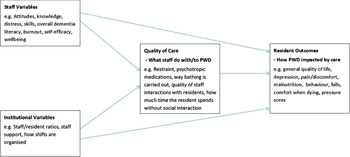
That is, we examine the link between staff variables which predict or are associated with QOC and the onward link with resident QOL, which is much more broadly defined than in most reviews (see Figure 1). The ideal is for studies which link all three components in the same model but they must have at least two of them. We have this narrow focus on staff predictors because, as noted, they are the most critical component of care and individual staff often become highly skilled with their own residents, so we need to know what is possible from within their own resources. Equally, for the sake of planning interventions, we need to know which staff variables to target and which not to in the many facilities where existing hands-on carers are the only available agent for change. Because we are reviewing studies with at least two of: adjustable staff variables, QOC, and QOL; we exclude many studies which look only at other common predictors of QOL in residential dementia care. These include physical environment, type of facility and, predominantly, fixed resident variables like age, level of impairment, dependence, and factors which are themselves QOL measures such as depression. However, they will be represented to some extent in this review because many eligible studies do include this type of control variable or alternative candidate predictor, and appear in full in Appendix B listing all included studies.
Relationships between variables.

Broad definitions: Staff variables, quality of care, quality of life
We examine staff variables associated with, or preferably predictive of, QOC and/or physical and emotional well-being of residents. We are solely interested in staff factors that are genuinely variable: that is, potentially capable of change following interventions at the individual or collective staff level. While staff age or gender or ethnic background may be of general interest, they are not adjustable; level of skill, attitude, and similar within-staff factors are what is salient to this review. We also look at potentially adjustable within-facility staff variables, such as level of emotional support for staff, the way shifts are organized, staff ratios, but not at broad facility level variables such as type of unit (for example Special Care Units (SCU) vs. nursing home), which is not an accurate enough variable and is an area already heavily reviewed with equivocal results (e.g. Rosewarne et al., Reference Rosewarne, Bruce and Mckenna1997a; Chappell and Reid, Reference Chappell and Reid2000). We do look at relevant care characteristics sometimes associated with SCUs, if measured, but our interest is in what staff actually do rather than the broad label applied to where they do it.
We look at QOC because this is a missing intermediary in many studies between staff variables and resident well-being; a kind of black box. If a given adjustable staff characteristic is associated with resident well-being, we need to know what staff with this characteristic are actually doing to make life better for residents so it can be replicated. The absence of information may be because some aspects of care are difficult and time consuming to measure, but this review includes studies which gather this information by systematic observation. We define QOC as anything which is done to or with the resident, such as restraint, the way showering is carried out, how staff communicate, or lack of humane contact with residents. However, there must be a measure of care or absence of care. There are many papers reporting high prevalence of a condition, for example, undetected pain or challenging behavior, and it could be argued that this is a proxy for poor care but this is simply an assumption. Unless there is a measure to determine level of care such as, in these examples, frequency of pain assessment or level of staff skills in toileting residents, we cannot use the study.
Because QOL means many things and we are interested in whether similar staff variables predict a wide range of resident outcomes, we define it more broadly than most reviews. The defining feature is that it represents the resident's state. We do include studies using QOL scales but look equally at direct medical/physical and psychosocial experience such as pressure sores, end of life comfort, depression, social engagement; and, on the assumption that it is often a manifestation of distress, challenging behavior.
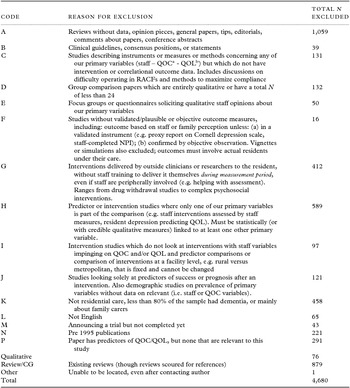
For all of these variables, we require validated or clearly objective measures, something more than staff perception, or single questions abstracted from an existing measure. See Table 1 for more detail on exclusion criteria and in the Methods Section.
Criteria for exclusion of studies

We acknowledge that the terms used in this review, such as challenging behaviors, are limited by the papers we have included and what has been published historically.
In summary, our aim was to answer the following research question: Is it possible to determine which aspects of residential care staff experience, practice, belief, or deployment it would be profitable to target in interventions aimed at improving the way care is carried out and, as a consequence, improving the lives of people with dementia in their care? To do this, we use the existing peer-reviewed literature from 1995 to February 2015 to examine associations between staff variables, QOC, and QOL – broadly defined – for residents.
Method
Ethical considerations
Since this review examines readily available literature, the Human Research Ethics Committee of The Australian National University confirmed that ethical approval was not required.
Search strategy
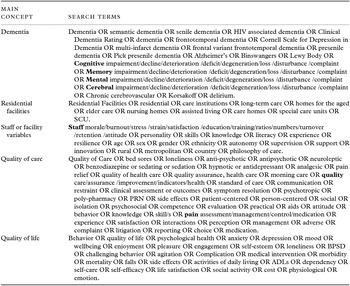
We searched six online databases: MEDLINE, EMBASE, PsycINFO, Cochrane Campbell Collaboration, PubMed, and the Cumulative Index to Nursing and Allied Health Literature (CINAHL). Search terms were developed by two of the authors (MB and KA) and were added to from the MESH Thesaurus, Emtree Thesaurus, and the Thesaurus of Psychological Index Terms. Prior to the initial search, the terms were reviewed by our regular consultative committee, comprising a consumer representative, industry representatives, and an expert in workforce and management change. Further adjustments to the search terms were made where indicated from initial searches and readings. The overall search strategy used was as follows: Dementia AND Setting AND Staff/Facility variables AND (QOC OR QOL) but see Table 2 for the full lists of terms under each heading. We also used truncation (for example, cogniti$ to cover terms like cognition and cognitive) and proximity operators, to find terms that were adjacent or near each other (for example, memory adj2 (imp$ or declin$ or deterior$ or deficit$ or degenerat$ or los$ or disturb$ or complain$). To identify any potentially overlooked publications, the reference lists from retrieved publications were manually searched. The review protocol was registered with PROSPERO prior to data extraction (Anderson et al., Reference Anderson, Bird, MacPherson and Blair2014).
Search terms

We used only the existing peer-reviewed literature for our review. We did not canvass work in progress, nor contact authors for more detail. We relied solely on studies available to everybody with access to an academic library from January 1995 to February 2015.
Inclusion criteria
Only studies involving long-term residential aged care for people with dementia were included, in which candidate predictors consisted only of adjustable staff variables with the potential to affect QOC and/or QOL for residents. Examples of relevant predictor variables and outcomes appear in Figure 1. Studies with fewer than 25 participants and/or mainly qualitative data were excluded, as were papers not in English or from before 1995. Table 1 summarizes the main criteria, and shows the number of studies excluded under each.
Participants: Facilities, residents, and staff
The cross-sectional or prospective studies we included took place in facilities where at least 80% of the sample had a diagnosis of (any type of) dementia or whose scores on cognitive impairment measures were consistent with dementia. Residential care was defined as any facility where people with dementia are looked after on a permanent basis and could include traditional nursing homes, SCU/dementia specific units, integrated units, group homes, and assisted living (provided the level of care was clearly comparable to nursing homes). Day care, acute care, and similar were excluded. Home type was not a variable of interest but we do show the facilities involved in the summary tables and whether they were balanced for type. Staff could be any worker directly involved in the care of residents, ranging from aides with minimal training to registered nurses (RN). Allied health were included if directly involved in daily care, usually activity staff.
Screening the studies
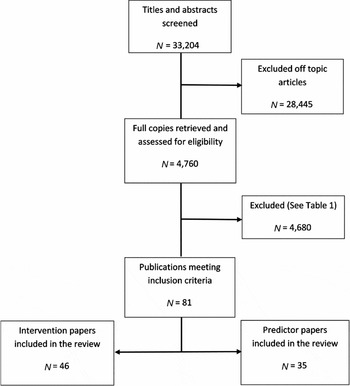
All titles and abstracts (N = 33,204) initially identified were independently screened by two of the authors (KA and SM) for obviously off-topic papers. For the 4,760 that appeared potentially relevant, the abstracts and then full papers were examined by MB and KA against the inclusion criteria and most were excluded. The final number of included papers were 81 papers, 46 presented in an associated publication on staff interventions aimed at resident well-being (Bird et al., Reference Bird, Anderson, Macpherson and Blair2015), and 35 in this review. See Figure 2 for this process. Table 1 shows the reasons for exclusion. The most common were that none of the candidate or controlling predictors were adjustable staff/staff related or QOC variables, that less than 80% of the sample had dementia, that only one part of the model in Figure 1 was present, or that the sample was too small or data were qualitative only.
Flow chart of study selection process.

Risk of bias and quality appraisal
Risk of bias was independently assessed by two of the review authors (MB and KA), with any discrepancies resolved by a third (SM). We used the CHARMS Checklist (Moons et al., Reference Moons2014), specifically designed to assess bias in prediction modeling. Appendix A shows the criteria against which studies were graded for bias, and the sign test score (Critical appraisal: Notes and checklists, 2015). In line with the sign scoring criteria, ++ refers to high quality studies, + acceptable, and 0 unacceptable.
Note that we also looked at quality of other aspects of methodology, for example, how prospective studies have handled attrition with this frail population, where more than half the participants can be lost to longer term follow up (Chappell and Reid, Reference Chappell and Reid2000), and adequacy of analysis. A rating note will appear for each study in detailed summaries in Appendix B, and also the short summary in the text.
Data collection and synthesis
Extracted data was entered into Eppi-Reviewer 4 by one of the authors, with a second validating the entries of the first by: independently evaluating the papers; checking for errors, omissions, or inconsistencies; and highlighting required changes for discussion and referral to a third author if necessary. The Eppi-Reviewer 4 file was developed, modified and piloted based on the Cochrane Consumers and Communication Review Group Data Extraction (Cochrane Consumers and Communication Review Group, 2013). Data entered included: reference details, publication type, population recruitment and description, setting, study aims, design, start date and end date or study duration, risk of bias, age, sex, severity of dementia, functional level, all other within-resident controlling variables, all candidate predictor variables – including non-staff or non-QOC variables, outcomes, validity and reliability of tools used, handling of missing data, results, effect sizes if any, confidence, and overall quality of the study.
Results
General comments on the studies
Concordance with figure 1
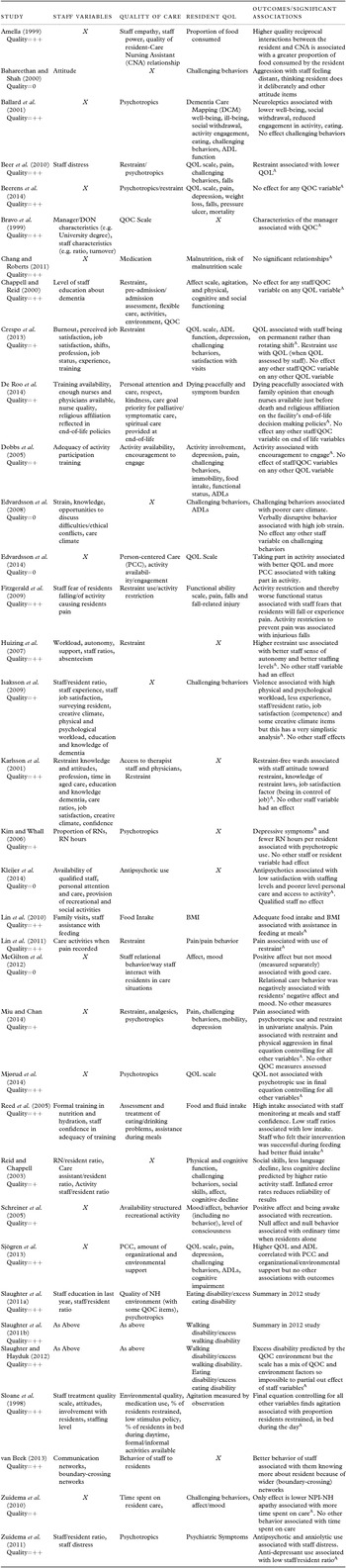
Detailed summaries for each study appear in Appendix B. A précis of this information is in Table 3; it shows, where present, the staff candidate predictor measures, the QOC measures (QOC – either predictors or outcomes), and/or the resident outcomes representing QOL. Table 3 does not present the many alternative candidate predictors, usually fixed within-resident control measures which tend in many cases to swamp the staff/QOC variables, but also adjustable variables like physical environment. They are recorded in full in Appendix B but their presence can be inferred in Table 3 by A in the right column, which means that non-staff/non QOC variables have significant associations with the outcome.
Précis predictor results

+AIndicates that candidate predictors which are not a staff or quality of care variable had a significant effect, most commonly within-resident control variables but also sometimes physical environment or facility type. See Appendix Table (B. summary of predictor studies) for details.
Table 3 shows that less than a third of included studies have all three basic components of the model in Figure 1. A majority are missing either staff variables or QOC variables. The most common resident QOL outcomes were challenging behavior, aspects of mood, pain, malnutrition/limited food intake, falls, and QOL scales. The most common QOC outcome variables were restraint and psychotropic medication. Many studies fed in multiple outcome variables.
Quality of studies
Appendix A, based on the CHARMS checklist (Moons et al., Reference Moons2014), shows varied levels of bias. However, studies are also categorized in the text and Appendix A for quality where prospective studies are higher than cross-sectional because they allow greater directional prediction. High quality regression in cross-sectional studies where analysis reduces candidate variables to the few that best fit the model is next. Finally, studies where only correlation or t-test or χ 2 comparisons are made, which produce many preliminary significant associations, few of which would fit a full regression model.
Types of measure
Predictors
As can be seen from Appendix B, there are a wide range of staff candidate predictors, many using existing instruments such as attitude scales, others using more within-facility observations, for example, number of staff with nutrition training. QOC predictors (or outcomes where there is no QOL measures) range from easy to measure variables like restraint to quality of staff interactions based on systematic observation. Some have abstracted single questions from existing instruments for QOC and failed to validate their use. Outcome measures are all validated instruments, or validated within a study. The most used measures in large data set studies derive from instruments associated with the Minimum Data Set (MDS: Hawes et al., Reference Hawes, Morris, Phillips, Fries, Murphy and Mor1997) and a common feature is that, of necessity, variables tend to be very simple broad-brush, for example, staff ratios or, for QOC, whether activity is provided, with no clinical detail and no independent guarantee that this is the case on the ground.
Main analysis
Predictors of quality of life
Of the 33 studies included, five were long-term prospective (conducted over 10 to 12 months), two were short-term prospective (conducted over only a few months), and the remainder were cross-sectional. Effect sizes are reported where the authors provided enough information measure (“d” values with d small ≥ 0.20, medium ≥ 0.50, large ≥ 0.80). A lack of commonality amongst predictor variables combined with some authors failing to provide sufficient statistics to calculate effect sizes, restricted the use of meta-analysis. Detailed analyses of QOL findings are presented below; a summary of the main findings can be found in Box 1.
Summary of main quality of life findings
Challenging behavior
There is a consistent finding that staff factors are associated with challenging behaviors but poor reporting of results, in particular, absence of data required to determine effect sizes, makes it difficult to comment on the relative influence of these variables. With regard to QOC associations with challenging behavior, no conclusions at all can be drawn because of the contradictory results and the fact that no meta-analysis was possible because of even poorer data reporting.
Mood/Affect/Apathy
There is sufficient evidence to add to the general argument that the way staff relate to and interact with those in their care impacts on resident mood. Tentative findings of a relationship between low mood and psychotropic medication may merit further attention.
Pain/physical discomfort
Strong associations were found between resident pain and QOC variables (restraint and psychotropic use) and also personal care events. However, causal direction cannot be determined from the available cross-sectional studies.
Functional capacity
Whilst the results were mixed, on balance, it does appear that more humane care contributes to better functional capacity. Particular credence can be given to the results in this area since they have been captured longitudinally in prospective studies.
Quality of life scales
Most studies found that no staff or QOC variables were associated with or predictive of QOL when assessed by QOL scales and where there were exceptions, results were too mixed for conclusions to be drawn. In addition, residents consistently self-rated better QOL than proxy raters.
Dying peacefully
Only one study (Dee Roo et al., Reference De Roo2014) examined this QOL outcome. Only family perceptions of having enough nurses present and religious affiliation influenced dying peacefully. The long-term prospective nature of the study makes the findings particularly credible.
Challenging behavior
Most studies that investigated staff predictors of challenging behavior were either cross-sectional, of poor quality, or both. The first study implicating staff attitudes was a short-term prospective study by Bahareethan and Shah (Reference Bahareethan and Shah2000). It had methodological limitations, including a small sample and making inferences about results whilst failing to report any statistics, but found a very large, association between aggression and low scores on staff attitudes to residents (d = 1.805). In a cross-sectional study, Sloane et al. (Reference Sloane, Mitchell, Preisser, Phillips, Commander and Burker1998) linked high resident agitation with poor staff attitudes toward visitors and residents (d = 0.567). In another cross-sectional study, Edvardsson et al. (Reference Edvardsson, Sandman, Nay and Karlsson2008) found verbal disruption was more common in facilities where staff were under strain (d = 0.240), and wandering, and escape and restless behaviors were more prevalent in units where the caring climate was rated as poor by staff. There was insufficient information for effect sizes. The same applied to Isaksson et al. (Reference Isaksson, Aström, Sandman and Karlsson2009), who found that feelings of competence were associated with reductions in challenging behaviors, as were creative environments that foster risk taking, and having staff with professional experience working with older people. Results were inconclusive for QOC predictors of challenging behavior. Antipsychotic use was significantly associated with challenging behaviors in Kleijer et al. (no effect size possible, Reference Kleijer2014) but not related to the use of any psychotropic drug in another (Ballard et al., Reference Ballard2001); restraint use in Sloane et al. (d = 1.100, Reference Sloane, Mitchell, Preisser, Phillips, Commander and Burker1998) but not Chappell and Reid (d = 0.080, Reference Chappell and Reid2000); and staffing ratios in Isaksson et al. (no effect size possible, Reference Isaksson, Aström, Sandman and Karlsson2009) but not Reid and Chappell (RN d = 0.054, Care Aide d = 0.150, Reference Reid and Chappell2003). It should be noted that significant results were only found in cross-sectional studies, so it is impossible to determine causal direction.
Mood/affect/apathy
This QOL outcome measure featured in around a third of the included studies. In the only long-term prospective study (Chappell and Reid, Reference Chappell and Reid2000), more positive affect was seen when expert panels had rated the facility as being a “gold standard” (d = 0.207) in QOC, and, counter-intuitively, when facilities have poorer assessment procedures (d = 0.248). In a high quality but cross-sectional study, a greater proportion of happy and interested facial expressions were observed during recreational activities (d = 121.282 and d = 101.874, respectively, Schreiner et al., Reference Schreiner, Yamamoto and Shiotani2005), and apathy occurred less frequently when staff spent more time on personal care (d = 0.350, Zuidema et al., Reference Zuidema, De Jonghe, Verhey and Koopmans2010). In a study that was good clinically but poor methodologically, McGilton et al. (Reference Mcgilton, Sidani, Boscart, Guruge and Brown2012) found that the demonstration of empathetic and reliable behaviors by staff also had positive associations with affect (d range: 1.388–1.907). Although less weight should be given to this study, these are very large effect sizes.
Low mood/affect was also related to high use of medications in a simplistic, cross-sectional study by Kleijer et al. (Reference Kleijer2014), so causal direction is unknown but Kim and Whall (Reference Kim and Whall2006) also found a relationship between psychotropic use and low mood (d = 0.685) in a short-term prospective study.
Pain/physical discomfort
Pain as a QOL outcome was only represented in two studies. They found that restraint use was significantly correlated with pain (d = 0.928, Lin et al., Reference Lin, Lin, Shyu and Hua2011; d = 0.604, Miu and Chan, Reference Miu and Chan2014). A random effects meta-analysis shows a summary OR of 3.76 (CI 2.14−6.59: Q=1.19, p = 0.276), suggesting a medium to large effect (See Figure 3).
Forest plot for pain and restraint.

Psychotropic use was also associated with pain (d = 0.327, Miu and Chan, Reference Miu and Chan2014) and residents were in more pain during bathing and when they were being given assistance during transfer (d = 1.738 and d = 1.869, respectively, Lin et al., Reference Lin, Lin, Shyu and Hua2011).
Functional capacity
Results for predictors of functional capacity were mixed and some contradict current practice recommendations. For example, greater restraint use was correlated with less expressive language decline in Chappell and Reid (d = 0.283, Reference Chappell and Reid2000), and in Reid and Chappell (Reference Reid and Chappell2003) having a greater ratio of nursing aides to residents was correlated with more language decline (d = 0.423). Along more traditional lines, these studies showed that greater flexibility in care was associated with less decline in social skills (d = 0.248, Chappell and Reid, Reference Chappell and Reid2000), and higher activity worker ratios was linked to less social, cognitive, and language decline (d range: 0.385–0.477, Reid and Chappell, Reference Reid and Chappell2003). Cross-sectionally, residents in units with higher levels of person-centered care were better able to perform ADLs (d = 0.154, Sjögren et al., Reference Sjögren, Lindkvist, Sandman, Zingmark and Edvardsson2013) and using a global measure of the quality of the dementia care environment, Slaughter and Hayduk (Reference Slaughter and Hayduk2012) concluded that a better environment tended to delay disability progression (d = 0.508).
Quality of life scales
In a superior longitudinal study by Mjørud et al. (Reference Mjørud, Røsvik, Rokstad, Kirkevold and Engedal2014), people taking anxiolytics had lower QOL scores (d = 0.501) but this did not apply to overall psychotropic use in a cross-sectional study by Beerens and colleagues (self-rated QOL d = 0.014, proxy rated QOL d = 0.026, Reference Beerens2014). Use of restraint in a cross-sectional study by Beer et al. (Reference Beer2010) was associated with self-reported lower QOL (d = 0.477), but not in another by Beerens et al. (self-rated d = 0.012, proxy rated d = 0.061, Reference Beerens2014), and only when assessed by staff or family in another (d = 0.643 and d = 0.495, respectively, Crespo et al., Reference Crespo, Hornillos and De Quirós2013). Person-centered care was associated with higher QOL scores in Sjögren et al. (Reference Sjögren, Lindkvist, Sandman, Zingmark and Edvardsson2013), though only when QOL was rated by carers.
Dying peacefully
A study conducted by De Roo and colleagues (Reference De Roo2014) found that, despite extensive measures of staff factors and QOC, the only influences on dying peacefully were family perceptions of having enough nurses present in the last week (d = 0.980) and religious affiliation influencing end of life decisions (d = 0.899).
Quality of care as the outcome measure
QOC analyses are presented below, with Box 2 summarizing the main findings.
Summary of main quality of care findings
Restraint
Staff variables generally considered positive (e.g. autonomy, concern for residents) can have negative effects, that is, more restraint. Collectively, the findings suggest that staff empathy towards residents is not enough; to see reductions in restraint use, staff must have greater knowledge around the dangers of restraint and restraint use regulations.
Psychotropic use
Though it is impossible to determine causal direction, it is possible to infer that the more staff you have and the more qualified they are, the less psychotropic medications will be used. Staff distress and less care and attention given to residents were also linked to greater reliance on psychotropic medications.
Food/Fluid Intake and malnutrition
The quality of staff care, monitoring and assistance at mealtimes has important associations with fluid and food intake and BMI.
Activity provision
Allaying staff concerns that residents would fall or be in pain if they engaged in activities and assisting staff to encourage residents to engage in activities could, in turn, lead to better QOC in areas like neuroleptic use.
General staff behavior towards residents
Although limited to two studies, the results demonstrated that staff factors can impact on the QOC provided to residents with follow-on implications for resident affect and mood.
Quality of care scales
Only one study (Bravo et al., Reference Bravo, De Wals, Dubois and Charpentier1999) used a general QOC measure, finding that the only significant staff variable was whether or not the Director of Nursing was a trained nurse.
Restraint
In the only longitudinal study on restraint use as an outcome of staff variables, Fitzgerald et al. (Reference Fitzgerald, Hadjistavropoulos and Macnab2009) found very strong relationships between restraint use and staff fearing that residents will fall or be in pain (d = 1.795 and d = 2.268). In a cross-sectional study by Karlsson et al. (Reference Karlsson, Bucht, Eriksson and Sandman2001), staff in restraint-free wards were more negative about restraint (d = 2.388) and more knowledgeable about regulations around its use (d = 1.993). Furthermore, staff showed greater job satisfaction on a factor called “to be in control of the job” (d = 0.500). In contrast, Huizing and colleagues (Reference Huizing, Hamers, De Jonge, Candel and Berger2007) found that higher staff ratios and staff feeling they have more autonomy were detrimental in that they are associated with increased restraint use (d = 1.846 and d = 0.920).
Psychotropic use
The three studies investigating associations between staff factors and psychotropic use were cross-sectional. They found significant relationships between greater actual or satisfaction with staffing levels and lower psychotropic drug use (d = 0.023, Kim and Whall, Reference Kim and Whall2006; no effect size possible, Kleijer et al., Reference Kleijer2014; antipsychotics d = 0.151 ns, anxiolytics d = 0.591 ns, hypnotics d = 0.412 ns, antidepressants d = 1.125, Zuidema et al., Reference Zuidema, De Jonghe, Verhey and Koopmans2011). The Kim and Whall (Reference Kim and Whall2006) study also found that having fewer RN hours in particular is associated with increased use of psychotropic drugs, though this effect was very small. Using a combined effect size for the different psychotropic medications from Zuidema et al. (Reference Zuidema, De Jonghe, Verhey and Koopmans2011) with the effect size from Kim and Whall (Reference Kim and Whall2006), a random effects meta-analysis, shown in Figure 4, suggested a relatively small effect of staff variables on psychotropic use (d = 0.289, CI:−0.246−0.825), though differences in these effect sizes were substantial (Q = 25.3, p = 0.001).
Forest plot for staff factors and psychotropic use.

Perhaps unsurprisingly, Zuidema et al. (Reference Zuidema, De Jonghe, Verhey and Koopmans2011) also found that staff distress is linked to the use of antipsychotics (d = 0.279), and Kleijer and colleagues found (Reference Kleijer2014) that the less care and attention staff show residents, the more antipsychotic drugs are used (d = 0.689).
Food/fluid intake and malnutrition
Cross-sectional designs were used in the studies investigating staff factors associated with food and fluid intake and malnutrition. Following stepwise regression involving many institutional and resident variables, Lin et al. (Reference Lin, Watson and Wu2010) demonstrated an important association between a lack of feeding assistance and low food intake (d = 0.504) and reduced body mass index (BMI) (d = 0.351). Reed et al. (Reference Reed, Zimmerman, Sloane, Williams and Boustani2005) found significant relationships between staff monitoring intake and actual food (d = 0.519) and fluid intake (d = 0.702). Also demonstrating the impact of staff on resident food intake, Amella (Reference Amella1999) found that residents consumed a greater proportion of food during positive reciprocal interactions with carers (d = 1.633). Chang and Roberts (Reference Chang and Roberts2011) found that the number of medications that residents were on was not significantly related to malnutrition nor risk of malnutrition (d = 0.194).
Activity provision
Staff fears about residents falling or experiencing pain, already described above with regard to restraint, was also linked to restriction of activity in one of the high quality prospective studies (d = 1.795 and 2.268, respectively, Fitzgerald et al., Reference Fitzgerald, Hadjistavropoulos and Macnab2009), which in turn led to reduced functional ability and more injuries because of falls.
Higher encouragement by staff to involve residents in activities was linked to greater involvement in activities in a cross-sectional study (d = 0.646, Dobbs et al., Reference Dobbs2005) and lower engagement in activities was predictive of higher use of neuroleptics in a longitudinal study by Ballard et al. (d = 0.699, Reference Ballard2001).
General staff behavior towards residents
Two cross-sectional studies examined the way staff behave towards residents as the primary outcome, obtained by systematic observation. van Beek et al. (Reference Van Beek, Wagner, Frijters, Ribbe and Groenewegen2013) found that the more extensive the communication network among staff, the better staff behaved towards residents (range d: 0.554–0.747). McGilton et al. (Reference Mcgilton, Sidani, Boscart, Guruge and Brown2012) found that the way staff carry out care affects resident affect and mood (Negative RBS scores: DMTP sadness range d: 1.388–1.912; Anxiety/fear range d: 1.666–3.371; Sadness range d: 1.388–1.907; Anxiety/fear morning care range d: 1.124–1.462).
Quality of care scales
On a general measure of QOC, Bravo et al. (Reference Bravo, De Wals, Dubois and Charpentier1999) found that the only significant staff variable was whether or not the Director of Nursing was a trained nurse (d = 0.699).
Discussion
We searched the peer-reviewed literature from the last 20 years for prospective or cross-sectional studies in long-term residential care which provide data on direct predictors of or associations between adjustable staff variables and QOC and thence to QOL. In order to cover the field more adequately, we have included studies of good clinical but not necessarily methodological purity; quality of each study is indicated in Appendix A using the Sign Method (Critical appraisal: Notes and checklists, 2015). We have taken a wide view of what comprises QOL; it encompasses a range of physical, emotional, and psychiatric conditions. We have also defined QOC by what is actually done to or with the resident. Commonly used proxies for poor care such as depression, pain, or pressures sores are regarded as QOL variables because they represent the resident's state.
Summary of and comment on main findings
Evidence based on the small proportion of studies which addressed the research question suggests the following.
Some individual and collective staff factors (attitude to residents, strain, professional experience, and a caring climate) are associated with but not necessarily predictive of challenging behaviors. No other candidate variable had significant associations with challenging behavior. Results for associations between challenging behaviors and more generic QOC measures (restraint, psychotropic use, staff ratios), were too mixed or poorly reported to draw any conclusions. No prospective studies found significant effects for these variables.
It does not follow that other variables, for example, minimizing restraint, staff experience, or availability of specialized supervision in how to avoid being assaulted whilst bathing residents (Sloane et al., Reference Sloane2004) are not important. It is just as likely to be the paucity of high quality prospective studies – something which applies to all the comments in this section. The same scarcity also means that it is impossible to determine causal direction. A high proportion of difficult residents is just as likely to lead to poor staff attitudes and high strain (Sloane et al., Reference Sloane, Mitchell, Preisser, Phillips, Commander and Burker1998; Edvardsson et al., Reference Edvardsson, Sandman, Nay and Karlsson2008), as poor staff scores on these factors leading to challenging behavior. Reduction in behavior is just as likely to lead to staff feeling competent (Isaksson et al., Reference Isaksson, Aström, Sandman and Karlsson2009) as feeling competent is likely to reduce behavior.
The skills of staff interacting with residents has associations with and may be predictive of resident mood, and similar variables (e.g. empathy and flexibility in care, taking time over care, person centered care) are associated with less decline in functional status, in effect delaying excess disability. These were consistent findings. Only one study looked at staff behavior toward residents as a QOC outcome in its own right, finding that wider communication networks within the facility improve staff/resident interactions (van Beek et al., Reference Van Beek, Wagner, Frijters, Ribbe and Groenewegen2013).
Staff variables also have associations with adequate food and fluid intake in advanced dementia. Lin et al. (Reference Lin, Watson and Wu2010) showed an association between minimal feeding assistance, low intake, and low BMI. Whether or not assistance is provided could be regarded as a within-facility staff variable but the way staff undertake the task is also important, with high-quality reciprocal interactions with the resident, rather than just feeding a mouth, associated with higher food intake (Amella, Reference Amella1999). These were cross-sectional but high quality studies with strong effects.
Unfortunately, staff variables generally thought to be positive do not necessarily lead to positive outcomes, especially with physical restraint. Though staff in restraint-free wards have better knowledge about its use (Karlsson et al., Reference Karlsson, Bucht, Eriksson and Sandman2001), facilities with better staff ratios and a greater sense of autonomy are associated with increased restraint (Huizing et al., Reference Huizing, Hamers, De Jonge, Candel and Berger2007). Of particular note is the prospective study by Fitzgerald et al. (Reference Fitzgerald, Hadjistavropoulos and Macnab2009), which found a large effect size linking staff concern about residents falling or being in pain to greater use of restraint and general restriction of activity, and a consequent increase in pain, and physical de-conditioning. This was a very strong study that covers staff variables, QOC, and QOL consequences and the result appears to be the consequence of well-intentioned staff believing that they are keeping residents safe but being ill-informed about the harmful effects of restraint and inactivity. Activity in its own right may also be important; Ballard et al. (Reference Ballard2001) showed that activity engagement predicted lower use of antipsychotics.
Restraint as a QOC predictor in its own right is associated not only with falls, injury, and de-conditioning but also strongly associated with pain (Lin et al., Reference Lin, Lin, Shyu and Hua2011; Miu and Chan, Reference Miu and Chan2014). These findings are noteworthy because of the quality of these cross-sectional studies, the strength of the effect and the fact that, though causal direction cannot be determined it is intuitively more likely that restraint leads to pain, rather than pain leading to restraint.
The cross-sectional studies looking at factors in antipsychotic or psychotropic drugs prescription are more consistent with general assumptions that staff variables commonly regarded as negative are associated with greater use (Kim and Whall, Reference Kim and Whall2006; Zuidema et al., Reference Zuidema, De Jonghe, Verhey and Koopmans2011; Kleijer et al., Reference Kleijer2014). These are low staff levels (including number of RNs), RN hours, staff distress about resident agitation, and low levels of care and attention. Causal direction is, of course, unknown but it has been shown for example that staff pressure influences the decision of medical practitioners to prescribe (Wood-Mitchell et al., Reference Wood-Mitchell, James, Waterworth, Swann and Ballard2008; Zuidema et al., Reference Zuidema, De Jonghe, Verhey and Koopmans2011). In general, these high quality studies suggest that the less staff you have and the less qualified and skilled they are, the more likely it is that psychotropic medications will be used.
Psychotropic medication itself as a QOC predictor of QOL is associated in one study with pain (Miu and Chan, Reference Miu and Chan2014) and in two others with low mood (Kim and Whall, Reference Kim and Whall2006; Kleijer et al., Reference Kleijer2014). Causal direction between psychotropics and pain cannot be inferred, given that low recognition and treatment of pain in dementia in residential care means that people with dementia and in pain are more likely to be on antipsychotics than analgesics (Kovach et al., Reference Kovach, Griffie, Muchka, Noonan and Weissman2000).
No conclusions could be drawn about resident outcomes when assessed by QOL scales such as the QUAL-AD, and we cannot recommend their use for this purpose. This was mainly because few studies that used these measures had significant effects and those that did had widely contradictory results, including the fact that self-report by residents about their own QOL was consistently higher than when family or staff reported as proxies. There was also evidence that self-report and proxy report were affected by different factors. Residents who were depressed or of lower cognitive status tended to self-rate low QOL; their relatives’ low proxy ratings were associated with increasing dependence and staff low proxy ratings with increasing dependence, low cognitive status and lack of permanency in staff shifts (Crespo et al., Reference Crespo, Hornillos and De Quirós2013).
Summary: broad findings
In summary, despite relatively few studies of very mixed quality, we are able to provide collective and quite strong evidence for what is intuitively obvious. Where staff treat and interact empathically and humanely in care, there is a relationship with better lives for residents, at least in affect, delayed functional dependence, and better food intake. At a within-facility level, where staff are encouraged to assist feeding people with severe dementia, there is increased intake of both food and liquid, with clear health implications.
On the other hand, unlimited empathy about the risk of residents falling or being in pain is not enough. Staff need to know about the dangers of restraint which now have been shown in this review to include increased pain as well as reductions in activity, and increases in falls and de-conditioning.
Though it is possible to conclude that dementia-specific QOL instruments appear inadequate as measures of QOL for this type of literature, no other conclusions can be drawn about other variables or measures because of the severe limitations of the existing literature. There are not enough studies looking at potentially adjustable predictor variables, not enough high quality prospective longitudinal studies to determine causal direction of associations between candidate predictors and outcome, and not enough studies which, in the same analysis, cover adjustable staff variables, the effects on QOC, and carry-over to QOL of residents. These issues will be discussed in the next section.
General comments and limitations
Limited number of studies
There are several reasons why we found so few relevant studies. First, many excellent studies were excluded because they had a wide range of candidate predictors, which are fixed or not likely to change, for example, level of dementia, age, education level, ethnic and social background, or even staff variables such as age or gender. We contend that there is a gross imbalance in favor of studies that concentrate largely on such variables, and often show little clinical awareness. It may be a function of the easy availability of very large data sets using standard assessments such as the MDS, itself a very useful epidemiological tool but often rather broad brush. To be clinically useful on the ground in residential care, predictors need to be potentially modifiable within staff and thus available to improve lives of residents.
Second, two thirds of studies were excluded because they covered only one of the three components of the model in Figure 1, for example, associations solely between staff variables (e.g. the relationship of attitude with strain). We believe that all future studies investigating which adjustable variables would merit attention to improve QOL for residents must include both staff characteristics and care characteristics. The papers which have QOC as an outcome variable make the assumption that it automatically improves QOL. The papers that miss it out and treat it as a kind of black box provide no information about what good care is. The papers that miss out staff variables provide no information about what interventions to try with them.
The number of included studies was finally reduced by our focus on staff variables, which we undertook because they are the most critical human component of care, and the way they behave and feel affects how residents behave and feel (Berg et al., Reference Berg, Hallberg and Norberg1998; Holst et al., Reference Holst, Edberg and Hallberg1999; Wells et al., Reference Wells, Dawson, Sidani, Craig and Pringle2000; Daly and Szebehely, Reference Daly and Szebehely2012).
Shortage of prospective studies
Our findings would have had much greater clinical utility if more studies had been longitudinal. Only prospective studies enable identification of genuine predictor variables, rather than associations between variables. For example, the high quality study by Mjørud (Reference Mjørud, Røsvik, Rokstad, Kirkevold and Engedal2014) found that number of antipsychotic drugs was significantly correlated with QOL at baseline but the effect disappeared once the prospective analysis was applied at ten months. A cross-sectional study would have recorded the Time 1 effect as definitive. Thus, our conclusion about challenging behavior is that there is an association with some important staff variables but it is impossible to say, for example, whether staff attitude is a causal factor, or the behavior affects attitude. There is therefore no information about whether interventions should be directed at attitude or the behavior. Similarly, causal direction between staff variables and psychotropic use. Though the direction of effect can sometimes be assumed by logic or supporting literature, for example, staff stress about challenging behavior is likely to make them press for antipsychotics (Zuidema et al., Reference Zuidema, De Jonghe, Verhey and Koopmans2011), mostly they cannot.
It is disappointing that so few studies, some of which expended large effort and financial resources on multiple measures, followed up longitudinally. This may be a function of the sheer difficulty of doing long-term prospective studies, especially with this frail and unstable population, where attrition rates of 40% or more are common (e.g. Chappell and Reid, Reference Chappell and Reid2000). Participants are lost usually to death but also transfer, severe illness. Because of chronic turnover, multiple staff are also often lost and whole nursing homes can be lost to studies at follow-up because of management change or research fatigue (Jordhøy et al., Reference Jordhøy, Kaasa, Fayers, Ovreness, Underland and Ahlner-Elmqvist1999; Mody et al., Reference Mody2008). Others fail to report attrition rates at all, let alone reasons for withdrawals (e.g. Bahareethan and Shah, Reference Bahareethan and Shah2000). Some studies over-sample in order to cover this, but then have to deal with different baseline characteristics among survivors. However, cross-sectional studies remain a very poor alternative.
Further limitations
The usual limitations associated with conducting systematic literature reviews apply to this review, such as the problem of non-significant findings remaining unpublished, along with additional limitations relating to the exclusion criteria. The decision was made to be more inclusive around the staff variables and QOC and QOL, thereby increasing the potential for clinical utility from the findings, but this came at the cost of restricting studies to only those that had a large proportion of residents with dementia. Clinically interesting papers looking at potentially adjustable staff variables and QOC/QOL for all residents in residential care (regardless of cognitive status) were excluded, since it could not be determined if it was really the residents with dementia who would benefit from changes or only those without.
Conclusions
This review found that relationships do exist between potentially adjustable staff variables and QOC and onwards to QOL. Notably, where staff treat and interact empathically and humanely in care, there is a relationship with better affect for residents, delayed functional dependence and better food intake. These findings raise further practical questions regarding how we can increase empathic staff interactions.
Many prospective studies also included predictors of QOL that are notionally changeable, for example, depression, or agitation, and normally found that Time 1 predicts Time 2 for such variables (e.g. Chappell and Reid, Reference Chappell and Reid2000), suggesting they rarely change without intervention. Our associated review of staff interventions is relevant here (Bird et al., Reference Bird, Anderson, Macpherson and Blair2015). For this review, such studies were included where there were also staff candidate predictors, our main area of interest, and it means that, where there are staff effects, common within-resident predictor variables are controlled for.
It is important to note, that the piecemeal nature of the studies included in this review and the associated findings greatly curb our ability to make firm recommendations about which variables to target with interventions. Few studies have looked at the whole chain of influence from staff variables to QOC and on to QOL. In addition, few studies examine potentially adjustable staff variables and when they have, studies have been largely cross-sectional, limiting inferences about causality. If we want to be able to make clear and practical recommendations to clinicians on the ground regarding priority areas for interventions, these limitations need to be addressed in future well-designed, prospective studies.
Conflict of interest
None.
Description of authors’ roles
K. Anderson and M. Bird contributed to the development of the search protocol, review of papers for inclusion, data extraction, and the writing and revision of this manuscript. K. Anderson also undertook the literature search, developed the Eppi-reviewer 4 form, and conducted the statistical analysis. S. MacPherson was involved in the original screening of abstracts, searched for and collated all included papers, and conducted a final check of the facts and figures. A. Blair was involved in the initiation and conceptualization of this review and revised the manuscript.
Acknowledgments
This project was funded through the NHMRC Partnership Centre on Dealing with Cognitive and Related Functional Decline in Older People (CDPC). We want to express our great appreciation for the timely guidance provided by the members of our consultative committee: Jennifer Henderson (Consumer Dementia Research Network); Meredith Gresham (Hammond Care); Jan Van Emden (Helping Hand); Katrina Radford (Griffith University). We also want to acknowledge the assistance that Suzanne Hannan (Southern NSW LHD Library Manager) provided with the initial search strategy.
Supplementary Material
To view supplementary material for this paper, please visit http://dx.doi.org/10.1017/S1041610216000570.