INTRODUCTION
In species that aggregate for reproduction, the location and boundaries of aggregations, the distribution of animals within these, and movement within and between aggregation sites are the result of both the ecological characteristics of the available habitat and of social factors (Reynolds, Reference Reynolds1996; Coulson, Reference Coulson, Schreiber and Burger2002; Krause & Ruxton, Reference Krause and Ruxton2002). While the specific factors that influence seasonal migration and habitat selection patterns in humpback whales (Megaptera novaeangliae, Borowski, 1871) are not well understood, these animals aggregate during winter months in areas where mating-related behaviour and calving is observed (Clapham & Mead Reference Clapham and Mead1999). The physical characteristics common to the known preferred habitats include tropical and sub-tropical waters, typically with temperatures of 24–28°C, depths of <100 m and low slopes (Zerbini et al., Reference Zerbini, Andriolo, Da Rocha, Simões-Lopes, Siciliano, Pizzorno, Waite, DeMaster and VanBlaricom2004; Rasmussen et al., Reference Rasmussen, Palacios, Calambokidis, Saborío, Dalla Rosa, Secchi, Steiger, Allen and Stone2007; Oviedo & Solís, Reference Oviedo and Solís2008). Locations that have this combination of oceanographic characteristics are frequently separated by wide expanses that are of a dramatically different nature from that typically used by humpbacks for breeding.
Social factors, including male display and female mate choice, frequently lead to a high local density of individuals and give the humpback whale mating system many of the characteristics of a lek (Clapham, Reference Clapham1996, Reference Clapham, Mann, Tyack, Connor and Whitehead2000). These factors may result in a small number of areas with high whale density, even within broad areas of suitable habitat (Reeves et al., Reference Reeves, Swartz, Wetmore and Clapham2001; Matthiopoulos et al., Reference Matthiopoulos, Harwood and Thomas2005). Relatively low levels of small-scale fidelity have been shown within breeding habitats, with considerable short-term, small-scale movements (Mattila et al., Reference Mattila, Clapham, Vásquez and Bowman1994; Cerchio et al., Reference Cerchio, Gabriele, Norris and Herman1998; Wenzel et al., Reference Wenzel, Allen, Berrow, Hazevoet, Jann, Seton, Steiner, Stevick, López Suárez and Whooley2009; Kennedy et al., Reference Kennedy, Zerbini, Vásquez, Gandilhon, Clapham and Adam2013). However, in spite of the absence of physical barriers and the low apparent cost of transit, on a larger scale some limitation in exchange has been observed even between breeding areas that are segregated by only a few hundred kilometres (Urbán et al., Reference Urbán, Jaramillo, Aguayo, Ladrón de Guevara, Salinas, Alvarez, Medrano, Jacobsen, Balcomb, Claridge, Calambokidis, Steiger, Straley, vonZiegesar, Waite, Mizroch, Dalheim, Darling and Baker2000). Few individuals have been documented using breeding grounds that are separated by more than hundreds of kilometres, resulting, in many cases, in genetically distinct populations (Olavarría et al., Reference Olavarría, Baker, Garrigue, Poole, Hauser, Caballero, Flórez-González, Brasseur, Bannister, Capella, Clapham, Dodgemont, Donoghue, Jenner, Jenner, Moro, Oremus, Paton, Rosenbaum and Russell2007; Rosenbaum et al., Reference Rosenbaum, Pomilla, Mendez, Leslie, Best, Findlay, Minton, Ersts, Collins, Engel, Bonatto, Kotze, Meÿer, Barendse, Thornton, Razafindrakoto, Ngouessono, Vely and Kiszka2009; Baker et al., Reference Baker, Steel, Calambokidis, Falcone, Gonzalez-Peral, Barlow, Burdin, Clapham, Ford, Gabriele, Mattila, Rojas-Bracho, Straley, Taylor, Urban, Wade, Weller, Witteveen and Yamaguchi2013). However, a small number of cases of such inter-breeding-ground exchange have been reported globally (Chittleborough, Reference Chittleborough1959, Reference Chittleborough1965; Darling & McSweeney, Reference Darling and McSweeney1985; Darling & Cerchio, Reference Darling and Cerchio1993; Salden et al., Reference Salden, Herman, Yamaguchi and Sato1999; Calambokidis et al., Reference Calambokidis, Steiger, Straley, Herman, Cerchio, Salden, Urbán, Jacobsen, vonZiegesar, Balcomb, Gabriele, Dalheim, Uchida, Ellis, Miyamura, Ladrón de Guevara, Yamaguchi, Sato, Mizroch, Schendler, Rasmussen, Barlow and Quinn2001; Pomilla & Rosenbaum, Reference Pomilla and Rosenbaum2005; Stevick et al., Reference Stevick, Neves, Johansen, Engel, Allen, Marcondes and Carlson2010, Reference Stevick, Allen, Engel, Félix, Haas and Neves2014; Kaufman et al., Reference Kaufman, Coughran, Allen, Burns, Burton, Castro, Childerhouse, Constantine, Franklin, Franklin, Forestell, Gales, Garrigue, Gibbs, Jenner, Paton, Noad, Robbins, Slooten, Smith and Stevick2011).
We report on four instances of individuals identified in both the Cape Verde Islands and in Guadeloupe in the south-eastern Caribbean. These two breeding and calving sites are separated by an ocean basin and >4000 km.
Breeding aggregations in the North Atlantic
Within the North Atlantic there are two generally recognized winter mating and calving areas for humpback whales. The vast majority of individuals winter off the West Indies. While the entire arc of suitable habitat spans about 2000 km from the Turks and Caicos to Aruba, there are no obvious discontinuities in habitat or distribution (Swartz et al., Reference Swartz, Cole, McDonald, Hildebrand, Oleson, Martinez, Clapham, Barlow and Jones2003). Thus, this area is generally considered to represent a single breeding population (NMFS, 1991; Palsbøll et al., Reference Palsbøll, Allen, Bérubé, Clapham, Feddersen, Hammond, Hudson, Jorgensen, Katona, Larsen, Larsen, Lien, Mattila, Sigurjónsson, Sears, Smith, Sponer, Stevick and Øien1997; Smith et al., Reference Smith, Allen, Clapham, Hammond, Katona, Larsen, Lien, Mattila, Palsbøll, Sigurjónsson, Stevick and Øien1999).
The most heavily used habitats are in the waters of the Dominican Republic (Whitehead & Moore, Reference Whitehead and Moore1982; Mattila et al., Reference Mattila, Clapham, Katona and Stone1989; Mattila et al., Reference Mattila, Clapham, Vásquez and Bowman1994). Humpback whales are also found in lower concentrations off Puerto Rico and throughout the Lesser Antilles south to Venezuela and the Leeward Dutch Antilles, though considerably less is known about the distribution, abundance and movement patterns of humpback whales in these waters (Mattila & Clapham, Reference Mattila and Clapham1989; Debrot et al., Reference Debrot, De Meyer and Dezentjé1998; Mignucci-Giannoni, Reference Mignucci-Giannoni1998; Romero et al., Reference Romero, Hayford and Romero2002; Swartz et al., Reference Swartz, Cole, McDonald, Hildebrand, Oleson, Martinez, Clapham, Barlow and Jones2003; Acevedo et al., Reference Acevedo, Oviedo, Silva and Bermudez-Villapol2008; Debrot et al., Reference Debrot, Esteban, Bervoets, Hoetjes and Scheidat2013).
On the eastern margin of the North Atlantic basin the only known winter breeding area is associated with the Cape Verde Islands (Reiner et al., Reference Reiner, dos Santos and Wenzel1996; Hazevoet & Wenzel, Reference Hazevoet and Wenzel2000; Wenzel et al., Reference Wenzel, Allen, Berrow, Hazevoet, Jann, Seton, Steiner, Stevick, López Suárez and Whooley2009; Ryan et al., Reference Ryan, Wenzel, López Suárez and Berrow2014). Prior to the work reported here, no individual had been observed to occur in both areas.
METHODS
Humpback whales were identified by natural markings on the ventral surface of the flukes (Katona et al., Reference Katona, Baxter, Brazier, Kraus, Perkins, Whitehead, Winn and Olla1979). Photo comparison was done using standard methods (Katona & Beard, Reference Katona and Beard1990; Allen et al., Reference Allen, Carlson and Stevick2011). Comparison of identification photographs was made by the North Atlantic Humpback Whale Catalogue (NAHWC), an internationally collaborative central database for fluke identification photographs collected throughout the North Atlantic Ocean (Katona & Beard, Reference Katona and Beard1990).
For this analysis, individuals from two areas in the West Indies were treated separately. Most of the individuals identified in the south-eastern Caribbean region have been photographed off Guadeloupe. Individuals identified from the Cape Verde Islands were compared with these whales from Guadeloupe, and also from the largest concentration areas in the West Indies, located in the waters of the Dominican Republic.
Photographs from the Cape Verde Islands were collected primarily by an international collaboration that included dedicated sampling surveys and collection of photographs from ecotourism vessels. The majority of photographs from Guadeloupe were taken by ecotourism operators and recreational boaters. A small proportion was taken during dedicated research operations. Photographs from the Dominican Republic have come from extensive, dedicated research efforts and from ecotourism.
Skin biopsy samples were collected using standard methods (Ryan et al., Reference Ryan, McHugh, Boyle, McGovern, Bérubé, Lopez-Suárez, Elfes, Boyd, Ylitalo, Van Blaricom, Clapham, Robbins, Palsbøll, O'Connor and Berrow2013). DNA was extracted by a silica-based method using filter purification, following the manufacturer's protocol (DNeasy kit for blood and tissue, Qiagen, Valencia, CA, USA). Sex was determined from extracted DNA as described by Bérubé & Palsbøll (Reference Bérubé and Palsbøll1996a, Reference Bérubé and Palsbøllb).
RESULTS
Photographs of 195 individual whales identified in the Cape Verde Islands, mostly in the vicinity of Boa Vista, were compared with those of 242 collected off Guadeloupe and 2377 collected from the Dominican Republic. The Cape Verde sample was collected between 1991 and 2014, though only three individuals were identified prior to 1999. The Guadeloupe sample was collected between 2004 and 2014 and the Dominican sample from 1973 to 2014. While the samples from Boa Vista and Guadeloupe largely overlap in time, the majority of the Dominican sample is from earlier decades. Given the open population, this may influence the probability of resightings. However, 414 individuals were identified from the Dominican Republic during the decade corresponding to the Guadeloupe sample.
The mean sighting date for the individuals photographed off the Cape Verde Islands is 11 April, and for Guadeloupe 3 April. Few whales are seen in either area before March. In contrast, abundance of whales in the Dominican Republic peaks during February, declining through March, with few animals remaining by April (Whitehead & Moore, Reference Whitehead and Moore1982; Mattila et al., Reference Mattila, Clapham, Vásquez and Bowman1994).
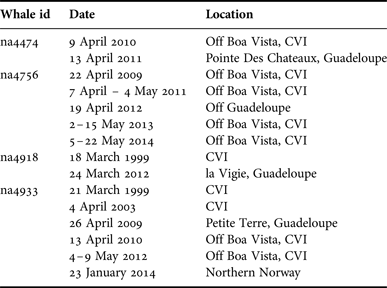
Four individuals were identified in both the Cape Verde Islands and off Guadeloupe (Table 1). None of the resighted individuals were in both areas during the same year. The resighted individuals were all photographed within about 60 km of one another in Guadeloupe. Individuals that were seen in more than 2 years (na4756 and na4933) made a return movement from the Cape Verde Islands to Guadeloupe. In both cases the animal was seen in the Cape Verde Islands in the year following the sighting in the Eastern Caribbean, in one case it was also seen in the Cape Verde Islands during the preceding year. No individuals from the Cape Verde Islands were resighted in the Dominican Republic, despite the sample size being an order of magnitude larger there than in Guadeloupe.
Sighting histories of humpback whales identified in both the Cape Verde Islands and off Guadeloupe.

One of the resighted individuals, na4933, was also photographed in the feeding area off Tromsø, Norway. The great-circle transit distances from Tromsø to Guadeloupe and to Samana Bay in the Dominican Republic are nearly identical at 7900 km. The corresponding distance to the largest concentration in Silver Bank, Dominican Republic is 7770 km. In contrast, the migratory distance from Tromsø to Boa Vista is 6600 km.
Two of the whales are classified as males. One was confirmed to be male by molecular results from a skin biopsy sample. That and another individual were seen in competitive groups and one of these was identified as a singer, both roles associated with males (Clapham et al., Reference Clapham, Palsbøll, Mattila and Vásquez1992; Darling et al., Reference Darling, Jones and Nicklin2006).
DISCUSSION
The level of exchange that occurs between breeding habitats represents a balance of the fitness costs that result from leaving an established, familiar area, including missed mating opportunities, energy expended in searching and transit, and the exposure to greater risk (Danchin & Cam, Reference Danchin and Cam2002; Bonte et al., Reference Bonte, Van Dyck, Bullock, Coulon, Delgado, Gibbs, Lehouck, Matthysen, Mustin, Saastamoinen, Schtickzelle, Stevens, Vandewoestijne, Baguette, Barton, Benton, Chaput-Bardy, Clobert, Dytham, Hovestadt, Meier, Palmer, Turlure and Travis2012), and the benefits, including accessing superior resources (Clapham & Zerbini, Reference Clapham and Zerbini2015), the discovery of superior habitats and the avoidance of close inbreeding (Rabouam et al., Reference Rabouam, Thibault and Bretagnolle1998; Schjorring, Reference Schjorring2002; Delgado et al., Reference Delgado, Bartoń, Bonte and Travis2014). In this instance we observe very different patterns in individuals from the Dominican Republic and Guadeloupe, two breeding concentrations that are separated by less than 1000 km, with comparable distances to migratory destinations and between which there is a nearly contiguous area of suitable habitat. There is virtually no information available on movement between the south-eastern Caribbean and other habitats within the West Indies. The results of a comprehensive comparison examining movement rates between the south-eastern Caribbean and other parts of the West Indies are not yet available. The single published observation is an individual identified in both Dominica and Puerto Rico (Stevick et al., Reference Stevick, Carlson and Balcomb1999).
Most previous findings of inter-breeding-area exchange in humpback whales are based on only a single instance, often from large samples, and have represented undeniably rare events. Three cases were documented between Japan and Hawaii during a single study (Calambokidis et al., Reference Calambokidis, Steiger, Straley, Herman, Cerchio, Salden, Urbán, Jacobsen, vonZiegesar, Balcomb, Gabriele, Dalheim, Uchida, Ellis, Miyamura, Ladrón de Guevara, Yamaguchi, Sato, Mizroch, Schendler, Rasmussen, Barlow and Quinn2001). However, those results included resightings between individuals from widely separated regions off both Hawaii and Japan, contrasting with the small scale of the re-sighting locations reported here, and were based on a much larger sample of identified individuals (Salden et al., Reference Salden, Herman, Yamaguchi and Sato1999; Calambokidis et al., Reference Calambokidis, Steiger, Straley, Herman, Cerchio, Salden, Urbán, Jacobsen, vonZiegesar, Balcomb, Gabriele, Dalheim, Uchida, Ellis, Miyamura, Ladrón de Guevara, Yamaguchi, Sato, Mizroch, Schendler, Rasmussen, Barlow and Quinn2001).
The resightings reported here contrast to the lack of resightings discovered between the Cape Verde Islands and the Dominican Republic, in spite of the order of magnitude larger sample size from that area. Even in species with long lifespans, the resighting rate will be influenced by changing population, and many of the whales identified in the Dominican Republic were photographed decades before those in Guadeloupe. However, about 200 more whales were identified in the Dominican Republic than Guadeloupe during the 10 years covered by the Guadeloupe sample.
Humpback whales of both sexes have previously been observed to move between distant breeding sites (Darling & Cerchio, Reference Darling and Cerchio1993; Salden et al., Reference Salden, Herman, Yamaguchi and Sato1999; Pomilla & Rosenbaum, Reference Pomilla and Rosenbaum2005; Stevick et al., Reference Stevick, Neves, Johansen, Engel, Allen, Marcondes and Carlson2010, Reference Stevick, Allen, Engel, Félix, Haas and Neves2014), though a male bias in gene flow has been noted (Rosenbaum et al., Reference Rosenbaum, Pomilla, Mendez, Leslie, Best, Findlay, Minton, Ersts, Collins, Engel, Bonatto, Kotze, Meÿer, Barendse, Thornton, Razafindrakoto, Ngouessono, Vely and Kiszka2009; Baker et al., Reference Baker, Steel, Calambokidis, Falcone, Gonzalez-Peral, Barlow, Burdin, Clapham, Ford, Gabriele, Mattila, Rojas-Bracho, Straley, Taylor, Urban, Wade, Weller, Witteveen and Yamaguchi2013). Thus having two of these whales identified as males in behavioural roles associated with reproductive activity is not unexpected.
It seems highly unlikely that an individual would take the time during the height of the breeding season to swim directly between these breeding areas in the same year. Rather, this almost certainly reflects a difference in choice in migratory destination in the different years. Canada is the only migratory destination that has previously been documented for a humpback whale from Guadeloupe (Rinaldi et al., Reference Rinaldi, Sears, Stevick and Carlson2009). In addition, two satellite-tagged humpback whales from Guadeloupe were tracked on migration towards feeding areas in the eastern North Atlantic (Kennedy et al., Reference Kennedy, Zerbini, Vásquez, Gandilhon, Clapham and Adam2013). The few migrations documented from other parts of the south-eastern Caribbean include movement to the Gulf of Maine, Canada, Greenland and Norway (Stevick et al., Reference Stevick, Carlson and Balcomb1999; Bérubé et al., Reference Bérubé, Rew, Cole, Swartz, Zolman, Oien and Palsbøll2004; Robbins et al., Reference Robbins, Allen, Clapham and Mattila2006). All whales from the Cape Verde Islands that have been identified in a northern feeding area to date have migrated to Norway or Iceland (Jann et al., Reference Jann, Allen, Carrillo, Hanquet, Katona, Martin, Reeves, Seton, Stevick and Wenzel2003; Wenzel et al., Reference Wenzel, Allen, Berrow, Hazevoet, Jann, Seton, Steiner, Stevick, López Suárez and Whooley2009). The sighting of one of these individuals in Norwegian waters, coupled with the tag results from Guadeloupe and the previous identification of a whale from the south-eastern Caribbean off Norway (Bérubé et al., Reference Bérubé, Rew, Cole, Swartz, Zolman, Oien and Palsbøll2004) suggests some possibility of migratory affinity of individuals from Guadeloupe to eastern North Atlantic feeding areas. The later mean sighting dates in Guadeloupe than in the Dominican Republic also suggest an affinity for eastern feeding destinations, as whales from these regions have been identified later in the season in the Dominican Republic (Stevick et al., Reference Stevick, Allen, Bérubé, Clapham, Katona, Larsen, Lien, Mattila, Palsbøll, Robbins, Sigurjónsson, Smith, Øien and Hammond2003).
The social factors driving this difference between groups are not clear. The migratory distance from these feeding grounds does not provide an obvious explanation for the use of Guadeloupe rather than the Dominican Republic by individuals that also use the Cape Verde Islands. Humpback whales do not necessarily migrate between seasonal habitats that are closest, nor to those that are most similar in longitude (Robbins et al., Reference Robbins, Dalla Rosa, Allen, Mattila, Secchi, Friedlaender, Stevick, Nowacek and Steel2011). The shortest migration route from foraging sites off Norway and Iceland to Guadeloupe is nearly identical to, or very slightly longer than, the corresponding distance to the major habitats in the Dominican Republic, providing no particular incentive for whales from Norway to migrate to one of these locations rather than the other, especially when the shorter distance would bring whales to an area with a higher density of conspecifics.
These four instances of change in individual migratory destination between the Eastern Caribbean and the Cape Verde Islands, and in some cases return, especially from modest sample sizes, have implications for management of humpback whales across the region. Both the Cape Verde Islands and the south-eastern Caribbean were sites of extensive 19th century whaling (Reeves et al., Reference Reeves, Swartz, Wetmore and Clapham2001, Reference Reeves, Clapham and Wetmore2002), and the whales in these area are relatively under-studied today.
Designing effective conservation efforts and interpreting the conservation implications of observed abundance and distribution patterns requires an understanding of population units and the extent and patterns of movement between these (Taylor, Reference Taylor, Dizon, Chivers and Perrin1997; Clapham & Zerbini, Reference Clapham and Zerbini2015). Based on analogy from other areas, the aggregation sites on the eastern and western margins of the ocean basin would be anticipated to represent discrete population units, with few if any individuals switching migratory destination between these areas. There are genetic markers in humpback whales from the eastern North Atlantic that are not known from the Dominican Republic (Valsecchi et al., Reference Valsecchi, Palsbøll, Hale, Glockner-Ferrari, Ferrari, Clapham, Larsen, Mattila, Sears, Sigurjónsson, Brown, Corkeron and Amos1997), which could support this contention. Humpback whales have been identified in varying numbers in a nearly continuous band extending from the Turks and Caicos to South America, and the animals that aggregate for breeding in the entire West Indies chain are currently treated as a single population (NMFS, 1991; Smith et al., Reference Smith, Allen, Clapham, Hammond, Katona, Larsen, Lien, Mattila, Palsbøll, Sigurjónsson, Stevick and Øien1999).
The differences in movement patterns of individuals from Guadeloupe and the Dominican Republic observed here, however, are at odds with the idea that the West Indies region is used by a common group of individuals with similar movement patterns. These findings suggest that there may well be more than one behaviourally distinct population group within the West Indies with boundaries as yet not known, and potentially a higher level of exchange between the Cape Verde Islands and some portion of the West Indies than other parts. More broadly, they argue that considerable caution is warranted in any assumptions regarding the number, boundaries and status of population units based on spatial separation or proximity alone.
ACKNOWLEDGEMENTS
This study would not be possible without the hard work and dedication of the numerous researchers who collaborate on humpback whale study in the North Atlantic Ocean. Hundreds of photographers have pooled their data to make the NAHWC possible, and countless staff and students have spent untold hours comparing photographs. The assistance of J. Allen and T. Fernald was invaluable. Fieldwork in the Cape Verde Islands was conducted under permit from the General Directorate of Environment (DGA) and with logistical support from the National Institute of Fisheries (INDP) of Cape Verde. Special thanks to P. Whooley for his contribution to field work. Naturalia provided photographs from Boa Vista, and both Seaturtle Sailing Catamarans and Scubacaribe provided logistics and facilitated humpback whale monitoring activities off Boa Vista since 2010. More than 35 individuals contributed photographs to the OMMAG network in Guadeloupe. Dedicated tagging studies that made a critical contribution to field data collection from Guadeloupe were conducted under the direction of N. Gandilhon. N. Ward has provided enthusiastic encouragement for humpback whale studies in the Eastern Caribbean over many years.
FINANCIAL SUPPORT
The NAHWC is funded by donors and an anonymous foundation. IWDG research in Cape Verde was supported by the Karl Meyer and Island Foundations, Bord Ischaigh Mhara, Heritage Council, Crossing the Line Films and Cape Verde Development. Field work in Guadeloupe was funded by the Université des Antilles et de la Guyane (Guadeloupe), The BREACH Association (Guadeloupe), Biologie des Organismes Aquatiques et Ecosystèmes (UMR BOREA), the Centre de Neurosciences (Université Paris Sud, Paris) and the National Marine Mammal Laboratory (NOAA, USA).