Introduction
Child homicide is a serious social problem in Australia and internationally. The death of a child from violence or neglect is a signal event which goes to highlight the critical issues of safeguarding young people and developing effective social policy. While child homicide remains relatively uncommon, each death emphasises the need to continue to work to reduce the risk of harm to all children in the future.
While children and young people are occasionally killed by strangers or acquaintances, the great majority of fatalities occur as a result of maltreatment in the familial environment (Bennett, Hall, Frazier, Patel, Barker, & Shaw, Reference Bennett, Hall, Frazier, Patel, Barker and Shaw2006; Crittenden & Craig, Reference Crittenden and Craig1990; NSW Child Death Review Team, 2003; Strang, Reference Strang1996). Any discussion of child homicide must begin with acknowledging that both the nature and outcomes of such maltreatment – particularly neglect (Dubowitz, Reference Dubowitz2007) – exist along a continuum: fatal maltreatment is but the ultimate manifestation of a far wider social problem (Brandon, Reference Brandon2009). In Australia, as elsewhere, it is generally accepted that official statistics underestimate the incidence of child fatalities caused by caregiver maltreatment (Alder & Polk, Reference Alder and Polk2001; Frederick, Goddard, & Oxley, Reference Frederick, Goddard and Oxley2013; Herman-Giddens et al., Reference Herman-Giddens, Brown, Verbeist, Carlson, Hooten, Howell and Butts1999; Palusic, Wirtz, & Covington, Reference Palusic, Wirtz and Covington2010; Strang, Reference Strang1996).
Lawrence (Reference Lawrence2004) properly argues that each case of child homicide should be treated with at least the same level of seriousness as homicide amongst the adult population. She developed her typology of child fatal assault in order to conceptualise more explicitly the extent of this problem. In doing so, Lawrence (Reference Lawrence2004) noted that in the future “the typology will need to be revised to account for new forms of the social problem” (p. 843). This paper constitutes an attempt to update Lawrence's typology, based upon a contemporary analysis of the research literature and other available evidence. The primary focus of our updated typology is on the developmental stages and life narratives of victims.
Defining the Problem
Researchers have had much difficulty in shaping both the nature and extent of the problem of child homicide. Although child homicide is an overarching term which describes the act of the killing of a child by another person or persons (Alder & Polk, Reference Alder and Polk2001), difficulties occur when attempts are made to break the term down into its constituent categories. This is particularly important inasmuch as the deaths of the majority of children – especially younger children and infants – need to be considered within the previously-cited continuum of parental or caregiver maltreatment. As such, the fatal event may be (1) the culmination of a pattern of chronic maltreatment, or (2) difficult to pinpoint as resulting primarily from the abuse or neglect that was occurring in the child's life.
Maltreatment is a wide-ranging term which covers all forms of violent, abusive and neglectful behaviour towards children and young people. Defined by the World Health Organisation (2010) to include “physical and/or emotional ill-treatment, sexual abuse, neglect, negligence and commercial or other exploitation”, in Australia fatal maltreatment is typically used in a domestic context, thus tending to differentiate it from extra-familial child homicide. Familial maltreatment is inherently more difficult to categorise as parental and caregiver abuse and neglect occur across a spectrum, with those rare fatal events being but the ultimate manifestation of a broader problem.
Subsumed under the term maltreatment are a host of subcategories, the most common of which are abuse, assault, and neglect. Lawrence (Reference Lawrence2004) provides a typology of fatal assault which includes abuse but ostensibly excludes neglect. Other studies have developed select categories which provide variations on Lawrence; all are subject to potential confusion due to overlap and/or exclusivity (for example, see Nielssen, Large, Westmore, & Lackersteen, Reference Nielssen, Large, Westmore and Lackersteen2009; NSW Child Death Review Team, 2003; Oberman, Reference Oberman and Spinelli2003; Sidebotham, Bailey, Belderson, & Brandon, Reference Sidebotham, Bailey, Belderson and Brandon2011).
These subcategories of maltreatment are complex and interwoven. It has been standard research practice for neglect to be placed in opposition to abuse, with the former defined as an act of omission and the latter as an act of commission (Connell-Carrick, Reference Connell-Carrick2003; Straus & Kantor, Reference Straus and Kantor2005). Yet, as Lawrence and Irvine (Reference Lawrence and Irvine2004) correctly note, such a dichotomy is at best tenuous. Neglect and abuse are often interwoven in the one scenario: for example, the violent assault of an infant also involves an aspect of neglect if the perpetrator subsequently fails to obtain proximate medical assistance for the child. Further, fatal neglect can involve both acts and omissions: for instance, the placing of an infant unrestrained in a motor vehicle by an alcohol-affected caregiver, who then crashes the car and kills the child, is an example of so-called supervision neglect involving a combination of acts and omissions on the part of the perpetrator. Finally, the lives of many children who die are beset by both abuse and neglect, regardless of whether a specific form of maltreatment can be identified as the ultimate cause of their death.
The definition of “child” for the purposes of understanding child homicide also remains unclear, with various studies encompassing victims from different age groups (Alder & Polk, Reference Alder and Polk2001; Crittenden & Craig, Reference Crittenden and Craig1990; Ewigman, Kivlahan, & Land, Reference Ewigman, Kivlahan and Land1993; Lyman et al., Reference Lyman, McGwin, Malone, Taylor, Brissie, Davis and Rue2003; US Advisory Board on Child Abuse & Neglect, 1995). The following typology has been developed so as to encompass all potential manifestations of violence and maltreatment toward children under the age of 18 years. It is an attempt to order a heterogeneous class of events into pertinent categories (Lawrence, Reference Lawrence2004). We follow Alder and Polk (Reference Alder and Polk2001) and Neilssen and colleagues (Reference Nielssen, Large, Westmore and Lackersteen2009) in using child homicide as an all-embracing term to describe the death of a child at the hands of another. Child homicide has the twin advantages of incorporating all child deaths involving violence or maltreatment, and of emphasising that the killing of a child ought to be treated no differently from that of an adult person.
It is suggested that fatal maltreatment is the best general descriptor for those categories of child homicide which mostly take place in the familial environment. Referring to Finkelhor and Dziuba-Leatherman's (Reference Finkelhor and Dziuba-Leatherman1994) three broad classes of child victimisation, while familial maltreatment affects a significant percentage of children, in its rarer fatal mode it qualifies as child homicide, a subset to be categorised on the same level as those non-familial examples of the phenomenon.
A Revised Typology of Child Homicide
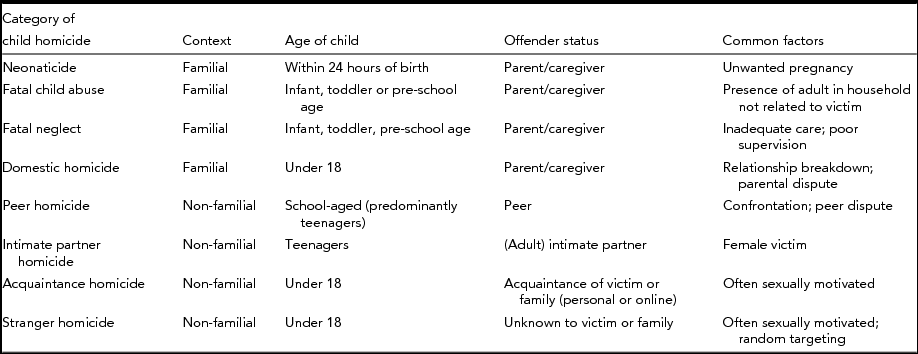
Lawrence's typology of fatal assaults in children developed six categories: neonaticide; fatal child abuse, “battered baby” or non-accidental injury; family dispute and murder-suicide; psychiatric illness of offender; fatal sexual assault; and teen fatal assault (Reference Lawrence2004). Following on from this, a revised typology of child homicide is suggested, containing eight categories: neonaticide; fatal child abuse; fatal neglect; domestic homicide; peer homicide; intimate partner homicide; acquaintance homicide; and stranger homicide.Footnote 1 Lawrence's additional “familial versus non-familial” differentiation (Reference Lawrence2004, p. 843) is here incorporated into the eight categories, with the first four essentially familial and the last four non-familial (see Table 1).Footnote 2 This revision of Lawrence's (Reference Lawrence2004) typology formulates eight distinct types of child homicide that are defined by key features such as the age of the victim, the context in which the homicide occurs and the status of the victim in terms of his or her relationship with the offender. These updated categories have been refined to (1) as far as possible be independent of the offender's state of mind, (2) reflect the wide spectrum of potential maltreatment in familial child homicide, and (3) acknowledge the fact that the overarching point of variation observed in non-familial child homicides is the relationship between offender and victim.
Classification of types of child homicide and defining characteristics.

With this in mind, we assert that any typology of child homicide has to attempt to find some middle ground between being overly specific (thus not allowing for the unique circumstances that come together to form the life narrative of each child who dies) and being insufficiently precise (which can lead to confusion when a fatal event appears equally germane to two or more categories). It also has to take into account the fact that maltreatment occurs on a spectrum (Sidebotham et al., Reference Sidebotham, Bailey, Belderson and Brandon2011) whereby it is sometimes unclear as to whether (1) the fatal event was ultimately caused by maltreatment, or (2) that the maltreatment qualifies as unlawful.
The typology illustrated in Table 1 and explicated below is underpinned by the conviction that the various developmental stages of children, considered in tandem with concurrent contextual/familial situations, are fundamental to understanding why each individual child died, and to how similar deaths might be prevented in the future. As with Lawrence (Reference Lawrence2004) the scenario around the child's death is paramount, but here greater emphasis is placed upon applying potential scenarios to categories which reflect the various developmental stages in children aged 0 to 17 years. It has been argued elsewhere that “developmental victimology” is a potentially key concept in the study of the heterogeneous nature of childhood victimisation (Finkelhor & Dziuba-Leatherman, Reference Finkelhor and Dziuba-Leatherman1994, p. 178). From a future prevention perspective, Reder and Duncan (Reference Reder and Duncan1999) emphasise the need to bear in mind the “complex interactional scenarios” (p. 121) that children experience in the context of their wider social networks and environmental circumstances.
Neonaticide
Following Brookman and Nolan (Reference Brookman and Nolan2006), the term neonaticide is defined as “the killing of a new-born infant within twenty-four hours of the birth” (p. 876). It is necessary to differentiate neonaticide from infanticide. The latter, while typically defined as the killing of an infant under one year of age (Jenny & Isaac, Reference Jenny and Isaac2006), has in some cases been used to describe any killing which takes place shortly after birth (Sidebotham et al., Reference Sidebotham, Bailey, Belderson and Brandon2011).
The category of neonaticide is intended to address scenarios involving unwanted pregnancies, where an attempt is made to conceal the birth by disposing of the foetal remains. It is the category of fatal maltreatment most likely to escape the attention of authorities, due to the typically isolated circumstances of the event and the possibility of the pregnancy passing unnoticed outside of the immediate family environment. For this reason neonaticide, while no doubt a relatively rare event (Strang, Reference Strang1996), is likely the most difficult category of child homicide to quantify.
Although most studies have explicitly categorised mothers as the perpetrators of neonaticide (Lawrence Reference Lawrence2004; Putkonen et al., Reference Putkonen, Amon, Eronen, Klier, Almiron, Cederwall and Weizmann-Henelius2011; Spinelli, Reference Spinelli2001), there is anecdotal evidence to show that fathers, stepfathers and other male associates of the mother are often complicit in the commission of these acts.Footnote 3
Fatal Child Abuse
In Lawrence (Reference Lawrence2004), the category of “fatal child abuse, battered baby or non-accidental injury” (p. 844) appears to have been developed to encompass maltreatment that occurs in the familial environment, is perpetrated by a parent or caregiver, and typically involves younger, pre-school-aged children. The key consideration in the revised category of fatal child abuse set out here is the physical and emotional vulnerability of infants, toddlers and pre-school children, who are almost totally reliant upon their primary caregivers – parents, step-parents or parent substitutes – for protection and sustenance.Footnote 4 Research continues to show that children in these age groups are the most susceptible to serious maltreatment in the home, especially in domestic situations where unrelated male adults are present (Cavanagh, Dobash, & Dobash, Reference Cavanagh, Dobash and Dobash2007; Schnitzer & Ewigman, Reference Schnitzer and Ewigman2005). The category of fatal child abuse thus describes violent deaths perpetrated by a parent or caregiver against a victim who is wholly reliant upon them for care and protection. Adults (especially males) living in the household who are not related to the victim constitute a major risk factor in fatal child abuse (Schnitzer & Ewigman, Reference Schnitzer and Ewigman2005).
Care should be taken in drawing attention to any clear division between chronic patterns of violence and “one-off assaults” (Lawrence, Reference Lawrence2004, p. 847), as it is frequently impossible to determine with any certainty that an ostensible one-off attack was not preceded by other acts of abuse. References to terms such as “shaken baby syndrome”, “Munchausen's syndrome by proxy” (also known as “fabricated or induced illness”) and “battered child syndrome” should be avoided due to the inherent difficulty in establishing the exact mechanism of injury in many cases of infant abuse (Biron & Shelton, Reference Biron and Shelton2005) and documented problems with the use of syndrome evidence in legal and research settings (Freckelton, Reference Freckelton2005; Richards et al., Reference Richards, Bertocci, Bonshek, Giaggrande, Gregson, Jaspan and Wade2006). Finally, the term “infanticide” is also unhelpful due to confusion around the age category that it refers to (Sidebotham et al., Reference Sidebotham, Bailey, Belderson and Brandon2011) and its often inappropriate use as a gendered term specific to female perpetrators only (Browne & Lynch, Reference Browne and Lynch1995).
Fatal Neglect
Being a typology of fatal assault, Lawrence's study did not include neglect. However, it is widely acknowledged that neglect, as a form of maltreatment that has to date received less attention from researchers than assault or abuse (McSherry, Reference McSherry2007), is the key variable in many maltreatment deaths, especially amongst infants and very young children (Brookman & Nolan, Reference Brookman and Nolan2006; NSW Child Death Review Team, 2003). As others have acknowledged, neglect-related fatalities are likely to constitute a major part of the cohort of maltreatment deaths that are currently attributed to natural or accidental causes (Irenyi & Horsfall, Reference Irenyi and Horsfall2009). Moreover, fatal neglect needs to be considered using the same developmental framework as for other forms of child maltreatment involving violence (Lawrence & Irvine, Reference Lawrence and Irvine2004).
Definitions of neglect may be both narrow – for the purposes of legal protection for families – or broad – when there is a need for risk to be identified and services to be provided (Watson, 2005). However, Dubowitz (Reference Dubowitz2007) points out that “the quest for a single, simple definition of neglect must continue to be appropriately elusive; the heterogeneity of neglect demands consideration of an array of contextual variables” (p. 603). As with fatal child abuse, in fatal neglect it is often difficult, if not impossible, to differentiate between chronic neglect and supervision neglect or what McSherry (Reference McSherry2007) terms the “event specific crisis” (p. 609).
From the perspective of reducing child mortality, there are compelling reasons why neglect should be considered in concert with other forms of violence or abuse as part of a holistic approach to studying child homicide, not least because they often co-exist within the same family environment and form part of the overall life narrative of the child who has died. Nonetheless, it can be acknowledged that extreme neglect – essentially neglect which results in death – is a rare event in terms of a typology of child homicide (Sidebotham et al., Reference Sidebotham, Bailey, Belderson and Brandon2011). In the majority of cases, underlying neglect will be identified in association with apparent natural or accidental death. It is a matter for case-specific investigations and reviews to determine the extent to which neglect contributed to the fatality (Connolly & Doolan, Reference Connolly and Doolan1997). It can additionally be acknowledged that there are many sub-types of death, such as those resulting from inadequate supervision or infant co-sleeping, which will continue to prove difficult to categorically define as fatal neglect, with the specific circumstances of the case and the victim's life narrative always having to be taken into account.
Domestic Homicide
This category is the equivalent of Lawrence's (Reference Lawrence2004) “family dispute and murder-suicide” in that the immediate circumstances of the familial environment – characterised by a breakdown in the parental relationship and/or acute mental illness in one or both parents – is the standard precipitating factor (p. 844). Whereas victims of fatal child abuse are most commonly infants, toddlers, and pre-school-aged children, domestic homicide can impact upon children of any age (Mouzos (Reference Mouzos2000)). In contrast to fatal child abuse, the category of domestic homicide includes child victims of all ages and more often involves the use of weapons such as knives or firearms (Kunz & Bahr, Reference Kunz and Bahr1996). Although, once again, patterns of chronic maltreatment may be present in the family, domestic homicide is characterised by an obvious critical event – what Lyman et al. (Reference Lyman, McGwin, Malone, Taylor, Brissie, Davis and Rue2003) term the “angry impulse” (p. 1064) – in which the perpetrator acts overtly (and usually suddenly) to end the life of one or more family members. This is thus a category of child homicide where intent to kill is implied in the context of the offence type.
Caution should be used when making any attempt to group the perpetrators of domestic homicide according to gender (Mouzos, Reference Mouzos2000). Nielssen et al. (Reference Nielssen, Large, Westmore and Lackersteen2009) confirm that these acts can involve either male or female perpetrators, including cases where the perpetrator subsequently suicides. Although parents and step-parents are most commonly involved in these incidents, extended family members are also included here as potential perpetrators of homicide in a domestic context.
Peer Homicide
The category of peer homicide accounts for those deaths which occur in lethal peer-to-peer confrontations, most commonly on school premises or in other public places. For the purposes of this category, a peer is defined as a person of similar age, developmental level or social status. Lawrence's (Reference Lawrence2004) “teen fatal assault” (p. 845) is amended here to account for the fact that children under thirteen years of age may be involved in this category of death (both as victims and aggressors).Footnote 5
Whereas previously the concept of teen fatal assault has been defined on the basis of the age of the victim (Finkelhor, Reference Finkelhor, Kaufman Kantor and Jasinski1997; Lawrence, Reference Lawrence2004), here peer homicide focuses more specifically on developmental context and the specific relationships and interactions which are characteristic amongst teen and pre-teen children. Furthermore, this revised typology removes the ambiguity of the previous teen fatal assault category by diverting homicides involving adult perpetrators to other primary categories, such as acquaintance homicide and intimate partner homicide.
Intimate Partner Homicide
Some children die at the hands of adult intimate partners. Lawrence (Reference Lawrence2004) incorporates intimate partner homicide only incidentally into those teen fatal assaults that involve “boyfriends” (p. 845). Typically, the victim is a female young person in the 15– 17 year age group. The category of intimate partner homicide most frequently involves female victims and male offenders, and there can sometimes be a significant age difference between the older male offender and the teenage female victim.Footnote 6
Acquaintance Homicide
There are cases where children are killed by perpetrators known to – but not intimately connected with – either the victim or their family (such as a neighbour, a family friend, or someone who has interaction with the child in an on-line context). Acquaintance homicide is different from both domestic homicide – where there is an unambiguous familial association – and stranger homicide – where there is no prior association whatsoever between offender and victim. Boudreaux, Lord and Jarvis (Reference Boudreaux, Lord and Jarvis2001) suggest a potential distinction between familial, acquaintance and stranger homicides, with acquaintances likely fitting into a class of perpetrators who do not select a random victim. Although there is no overarching developmental limitation to this category of child homicide, such cases usually feature older (school aged) victims and sexually motivated offenders.
Stranger Homicide
As with acquaintance homicide, stranger homicide is a category which does not have an obvious equivalent in Lawrence (Reference Lawrence2004); her typology is limited to a general distinction between familial and non-familial killings. Stranger homicide involves those child deaths that occur at the hands of an adult who is unknown to them. The two most characteristic scenarios underpinning stranger homicide are abductions (often with a sexual motivation on the part of the perpetrator) and “mass murder” events (most commonly involving firearms). Though thankfully rare, both of these scenarios nonetheless have some precedent in Australia.Footnote 7
Notes on Excluded Categories
The categories of “psychiatric illness of offender” and “fatal sexual assault” as present in Lawrence (Reference Lawrence2004) are omitted from the typology of child homicide outlined above.
In the former case, while there is no doubt that perpetrator mental illness is a common theme in child homicide, for the purposes of categorisation it is better considered as a secondary variable. This is because (1) it is a factor which could potentially be present in any of the categories set out herein, (2) it has limited application to a typology that focuses primarily upon the developmental stages of children, and (3) the psychiatric illness of the perpetrator is often difficult to specify with certainty and can only be implied from a hindsight review of the available evidence, particularly in cases where the perpetrator suicides. The exclusion of this category does not in any way deny the importance of psychiatric disorder to the etiology of many child deaths; rather, it is set aside on the basis of giving precedence to a developmental typology, and to avoid as far as possible classifications based upon “retrospective analysis of motive or impulse” (Stroud & Pritchard, Reference Stroud and Pritchard2001, p. 255).
Fatal sexual assault is also more properly considered as a secondary factor in a typology of child homicide. As Lawrence has previously noted, this category is problematic because in such cases the nature and extent of the sexual assault is unlikely to be reported as part of the cause of death (Reference Lawrence2004). Indeed, the cause of death will almost inevitably be distinct from the sexual motivations of the perpetrator. Furthermore, clear evidence of sexual assault may be difficult to adduce (Mouzos, Reference Mouzos2000). When sexual assault is clearly present, the case will nonetheless fit more appropriately within one of six of the primary categories set out herein (neonaticide and fatal neglect excluded).
Child Death Review and Research
While it is fair to say that the media in Australia, as elsewhere, is equally aggressive in its reporting on both familial and non-familial child homicide, there is a widespread tendency for media organisations both here and internationally to overstate the risk of – and, consequently, to heighten societal fear of – harm to children at the hands of strangers (Kitzinger, Reference Kitzinger and Critcher2006; Robinson, Reference Robinson2008). Yet it remains clear that most violent or dangerous situations faced by children, and thus most child homicides, occur at the hands of someone known to them, ordinarily a parent or step-parent, with murder by person or persons unknown to the victim very rare (Alder & Polk, Reference Alder and Polk2001; Connolly & Doolan, Reference Connolly and Doolan2007; Strang, Reference Strang1996). Indeed, it has been well established in the academic literature that children are fatally harmed most frequently within the familial environment by parental figures (Yardley, Reference Yardley2014).
Children under five years of age are the most at-risk cohort in all jurisdictions, with infants under one year especially vulnerable in the fatal maltreatment categories (Neilssen et al., Reference Nielssen, Large, Westmore and Lackersteen2009). This requires continued consideration of intervention strategies aimed at reducing maltreatment experienced by children in these younger age groups (Overpeck, Brenner, Trumble, Trifiletti, & Berendes, Reference Overpeck, Brenner, Trumble, Trifiletti and Berendes1998). Yardley (Reference Yardley2014) calls for more focused attention on these types of well-established “trends and commonalities in the characteristics of child victims and the parents who kill them” (p. 310). Not only are children under one year of age more than seven times more likely to be killed than older children, but parents who kill their children also tend to (1) suffer from mental illness, and (2) be mothers with children on child protection registers or men with histories of violence and/or previous convictions for violent offences (Yardley, Reference Yardley2014).
In an Australian context, it is also important to recognise that there are trends in child death generally which pose unique challenges to researchers and policy makers. In particular, certain Australian jurisdictions experience a disproportionate number of fatalities amongst young people in rural and remote areas, as well as disproportionate numbers of deaths amongst the Aboriginal and Torres Strait Islander population (Khalidi, Reference Khalidi2012).
Brookman and Nolan (Reference Brookman and Nolan2006) have suggested, with specific reference to the problem of neglect, that researchers sometimes overlook the issue of “blurred boundaries” (p. 876) between neglect and accidental or natural death when deciding if a child fatality should be categorised as homicide. It must be reiterated that, with respect to those categories specific to maltreatment in the familial environment, it will be difficult, in a significant number of cases, to establish a definitive cause of death, or indeed to establish that the death qualifies as maltreatment-related.
The importance of distinguishing between primary categories and secondary factors should also be emphasised. While some child homicides, particularly those categories which most resemble adult homicides, can be relatively simple to classify, those involving fatal maltreatment may be difficult or impossible to categorise unequivocally. For instance, while the most extreme cases of fatal neglect tend to stand out due to the causal connection between the neglect and the death, in many other fatal cases neglect may be present yet its role in the child's death unclear. Suicide is one example of a mode of death for which neglect may often be a critical secondary factor (Jenny & Isaac, Reference Jenny and Isaac2006). Similarly, for the categories of fatal child abuse and fatal neglect it will be sometimes difficult to prove that violence or neglect occurred to the extent of being ultimately responsible for the death (Herman-Giddens et al., Reference Herman-Giddens, Brown, Verbeist, Carlson, Hooten, Howell and Butts1999). Co-existing social factors such as poverty must also be taken into account (McSherry, Reference McSherry2007).
The relationship between collating and categorising child deaths and conducting research with a view to evidence-based prevention is a vital one. With reference to the child death review process, the American Academy of Pediatrics (2010) has stated that:
Ultimately, the purpose of child fatality review is to identify effective prevention and intervention processes to decrease preventable child deaths through systematic evaluation of individual child deaths and the personal, familial, and community conditions, policies, and behaviours that contribute to preventable deaths. (p. 593).
For these and other reasons, it is desirable that review practices involve surveillance of the entire subset of child deaths for a specific jurisdiction. As such, patterns and trends which may intersect across category, location, age, gender and other variables are more likely to be recognised and assessed. This is especially vital in those categories of child homicide that come under the sub-heading of fatal maltreatment, where prevention strategies with respect to the appropriateness of parental care, for instance, may transcend definitive categorisation by manifesting as relevant to all child deaths, not just those involving maltreatment.
Schnitzer and colleagues (Reference Schnitzer, Covington, Wirtz, Verhoek-Oftedahl and Palusic2008) identify child death review teams as likely the most promising surveillance approach in fatal child maltreatment. Research studies in child homicide and fatal maltreatment are often based upon examining cohorts of deaths which have been pre-identified as such, as when Sidebotham et al. (Reference Sidebotham, Bailey, Belderson and Brandon2011) review all notified cases of child maltreatment within a catchment area. A surveillance approach whereby all deaths of children and young people are reported on allows for subsequent specialised reviews and analyses of individual and group deaths to consider those fatalities in terms of wider patterns of causation and risk. This is especially useful to any consideration of the nebulous boundaries between maltreatment-related and accidental or natural deaths, where the question of whether a fatality resulted from criminal maltreatment does not outweigh the goal of finding ways to reduce child death in all of its variant manifestations. This is the ultimate purpose of the child death review process (American Academy of Pediatrics, 2010).
When practicable, morbidity data too should be incorporated into child homicide research and review, to allow comprehensive overviews of patterns of violence and neglect in the jurisdiction in question, and to help direct future research into injury and fatality prevention. Brandon et al. Reference Brandon, Bailey, Sidebotham, Belderson, Hawley, Ellis and Megson2012 point out that the United Kingdom “is unusual in combining reviews of cases where children are seriously injured through maltreatment with cases where children die” (p. 44) (hence the term used is “serious case review”). It should be self-evident that information from serious non-fatal (or near-fatal) cases is vital in preventing future deaths: the question “why did this child survive?” is equally as important as the question “why did this child die?” While reporting of near-death cases will by nature not be as consistent, especially with regards to neglect, the concept of serious case review is a preferable strategy to child death review and should be more widely adopted in other jurisdictions, including Australia.
In relation to serious case review in the United Kingdom, Yardley (Reference Yardley2014) further explores critical arguments that recommendations may fail to address the broader social issues and related risk factors that motivate child abuse and neglect, such as poverty, domestic and substance abuse, and mental health issues (for example, see Brandon et al., Reference Brandon, Bailey, Sidebotham, Belderson, Hawley, Ellis and Megson2012). Yardley (Reference Yardley2014) warns against the danger of putting too much emphasis on serious case reviews and failures of processes and professional agents, which could result in the neglect of both serious social issues and society's responsibility to guard children against harm. While these perspectives are valid, they do not always fully acknowledge the inherent difficulties in, and impracticality of, the immediate prevention or control of such social problems. These problems clearly need to be addressed by long term goals in the effort to prevent fatal child maltreatment; however, we argue that the matter of immediate prevention requires a different focus which serious case reviews draw attention to. These provide the capability to identify context-specific risk factors that can help isolate critical points of disruption along the continuum of child abuse and neglect. Identifying these crucial opportunities for disruption can lead ultimately to the prevention of child homicide.
Conclusion
Child homicide is a diverse phenomenon requiring complex interventions. Here, a typology of child homicide has been developed which takes into account the different developmental stages in children aged 0–17 years, the need to find appropriate middle ground between being overly specific and insufficiently precise, and the practical problem of combing case-specific analysis with suitable group classifications for research and policy work.
Child homicide constitutes the ultimate manifestation of the broader social problem of violence and maltreatment involving child victims. As such, review processes which incorporate the categorisation of child homicide into a jurisdictional surveillance of all child deaths are crucial for identifying and preventing homicide and fatal maltreatment, and for developing research and policy that seeks to reduce child mortality and morbidity in all of its variant manifestations. Furthermore, child death research and review which is expanded to incorporate serious (non-fatal) cases is important in terms of further developing our ability to reduce potentially fatal abuse and neglect and thus child homicide.