Introduction
Chronic rhinosinusitis is one of the most common diseases in ENT practice. Patients with chronic rhinosinusitis suffer from various symptoms, such as nasal obstruction, rhinorrhoea, post-nasal drip, cough, sputum, facial pain, headache, and qualitative and quantitative loss of smell, due to respiratory and olfactory dysfunction.
Pharmacotherapy and sinonasal topical treatments are the first choice for relief of chronic rhinosinusitis symptoms.Reference Fokkens, Lund, Mullol, Bachert, Alobid and Baroody1–Reference Hummel, Whitcroft, Andrews, Altundag, Cinghi and Costanzo3 Surgical management, especially functional endoscopic sinus surgery (FESS), is indicated and performed on patients with chronic rhinosinusitis that is refractory to medication and conservative topical treatment.Reference Fokkens, Lund, Mullol, Bachert, Alobid and Baroody1, Reference Rosenfeld, Andes, Bhattacharyya, Cheung, Eisenberg and Ganiats2 Appropriate post-operative management, including evaluationReference Tsuzuki, Hinohira, Takebayashi, Kojima, Yukitatsu and Daimon4 and treatmentReference Senior, Kennedy, Tanabodee, Kroger, Hassab and Lanza5, Reference Rudmik and Smith6 under endoscopy, is very important for maintenance of the therapeutic benefit of FESS post-operatively in chronic rhinosinusitis patients. Early detection of worsening lesions in the sinonasal area is of great importance in the successful treatment of chronic rhinosinusitis.
Eosinophilic chronic rhinosinusitis was reported as a form of intractable chronic rhinosinusitis in 2001.Reference Haruna, Otori, Yanagi and Moriyama7 Recently, the number of patients with severe eosinophilic chronic rhinosinusitis in Japan has significantly increased. The characteristics of eosinophilic chronic rhinosinusitis include: bilateral nasal polyposis (chronic rhinosinusitis with nasal polyps), olfactory disorders in the early stage, blood eosinophilia, severe eosinophilic infiltration of the sinonasal mucosa and nasal polyps, predominance of lesions in the ethmoid sinuses and olfactory clefts as observed on computed tomography (CT), a lack of response to macrolide therapy, a good response to corticosteroids, and recurrence of eosinophilic inflammatory nasal polyps.Reference Ishitoya, Sakuma and Tsukuda8 These diagnostic criteria are based on the multicentre Japanese Epidemiological Survey of Refractory Eosinophilic Chronic Rhinosinusitis study.Reference Tokunaga, Sakashita, Haruna, Asaka, Takeno and Ikeda9
In contrast, chronic rhinosinusitis that predominantly affects the maxillary sinus is effectively treated with macrolides, and with a lower likelihood of recurrence is thought to have a good clinical course. This is classified as non-eosinophilic chronic rhinosinusitis. The clinical course of eosinophilic chronic rhinosinusitis and non-eosinophilic chronic rhinosinusitis is thought to differ substantially. Therefore, differentiating eosinophilic chronic rhinosinusitis from non-eosinophilic chronic rhinosinusitis is critical for analysis of its pathogenesis.
This study aimed to link the operative findings during FESS (operating score) with pre- and post-operative findings, and to estimate the post-operative course in patients with chronic rhinosinusitis undergoing FESS. For the sake of convenience and to facilitate evaluation, the severity of FESS operative findings was scored as the operating score. Correlations between the operating score and pre- and post-operative examination results were analysed separately for patients with eosinophilic chronic rhinosinusitis and non-eosinophilic chronic rhinosinusitis. In this paper, the usefulness of the operating score as a predictor of post-operative clinical course in patients with chronic rhinosinusitis is discussed.
Materials and methods
Patients
Between January 2007 and December 2015, 291 adult patients with chronic rhinosinusitis (174 men and 117 women; median age of 52 years (range = 21–80 years)), who had undergone bilateral primary FESS, were retrospectively enrolled in this study. FESS was performed under general anaesthesia in all patients. Patients with tumour-associated disease, trauma or history of any previous sinonasal surgery were excluded from the study. The study utilised a case series design and conformed to the regulations of the Hyogo College of Medicine ethics committee (approval number: 1512). This study was performed in accordance with the principles of the Declaration of Helsinki.
Diagnosis
We diagnosed eosinophilic chronic rhinosinusitis when the total score of the following 4 items was 11 points or more: (1) bilateral lesions (3 points); (2) nasal polyps (2 points); (3) dominant ethmoid sinus involvement or pansinusitis on CT (2 points); and (4) blood eosinophil count of 2–5 per cent (4 points), 5–10 per cent (8 points), or 10 per cent or more (10 points). Scoring was carried out according to the criteria reported in the Japanese Epidemiological Survey of Refractory Eosinophilic Chronic Rhinosinusitis study.Reference Tokunaga, Sakashita, Haruna, Asaka, Takeno and Ikeda9
Patients were divided into two groups: eosinophilic chronic rhinosinusitis (n = 210, 126 men and 84 women; age range = 21–79 years) and non-eosinophilic chronic rhinosinusitis (n = 81, 48 men and 33 women; age range = 22–80 years). The profiles of the patients with eosinophilic chronic rhinosinusitis and non-eosinophilic chronic rhinosinusitis, results of blood examination (concentration of eosinophils (percentage) and non-specific total immunoglobulin E levels (IU/ml)), mean olfactory recognition thresholds (assessed using a T&T Olfactometer; Daiichi Yakuhin Sangyo, Tokyo, Japan) and sinonasal CT score were compared (Table I).
Patient profiles

Data presented as medians (ranges), unless indicated otherwise. P-values indicate comparisons between eosinophilic chronic rhinosinusitis (ECRS) and non-eosinophilic chronic rhinosinusitis (non-ECRS). *n = 210; †n = 81. ‡Indicates significant difference. M = male; F = female; IgE = immunoglobulin E; CT = computed tomography
Operating score
In order to facilitate evaluation of the severity of FESS and to estimate post-operative prognosis during FESS, we devised a scoring system for intra-operative endoscopic findings, using the so-called operating score, based on our previous post-operative endoscopic scoring system for the sake of convenience.Reference Tsuzuki, Hinohira, Takebayashi, Kojima, Yukitatsu and Daimon4 Operative findings were determined on the monitor during FESS by three expert rhinologists using a 4-mm diameter rigid endoscope (degrees of 0 and 70; Karl Storz Endoscopy, Tokyo, Japan).
The operating score is based on the operative findings in the sinuses (sinus score) and olfactory clefts (olfactory cleft score) on both sides (Table II). The sinus score is determined based on mucosal scores (mucosal score: normal (0 points), oedema (1 point) and polyps (2 points); range = 0–20 points), and retained secretions scores (contents score: none (0), mucous (1) and viscous (2); range = 0–20 points) in the maxillary, anterior and posterior ethmoid, frontal and sphenoid sinuses. The olfactory cleft score is based on mucosal scores (normal (0), oedema (1) and polyps (2); range = 0–20 points) at the nasal septum, middle turbinate, superior turbinate, superior nasal meatus and ostium of the sphenoid sinus (sphenoethmoidal recess). The operating score was a summation of sinus and olfactory cleft scores (range = 0–60 points). According to the operating score, the severity of operative findings was classified in terms of three grades: mild (0–20 points), moderate (21–40 points) and severe (41–60 points). We statistically analysed the operating score in relation to the pre-operative olfactory recognition threshold and sinonasal CT imaging score (CT score), as well as post-operative endoscopic appearance (endoscopic score).
Operating score chart

R = right; L = left
Post-operative endoscopic score
The post-operative endoscopic appearance of the operated sinuses and olfactory clefts was scored as follows: 0 points (normal condition), 1 point (sinus only partially observable because of the presence of polyps, oedematous mucosa and/or discharge) and 2 points (sinus unobservable as it was completely filled with thickened mucosa, polyps and/or discharge).Reference Tsuzuki, Hinohira, Takebayashi, Kojima, Yukitatsu and Daimon4 When the polyps occupied and prevented observation of the posterior part of the sinuses, the scores for the posterior part of sinuses that had been operated on were counted as 2 points. The percentage of the total score relative to the maximum possible score for operated sinuses was rated as the endoscopic appearance score (percentage). Sinuses that had not been operated on were excluded from scoring.
In order to investigate the post-operative changes in endoscopic appearance score over time, we divided post-operative follow up into two time periods: patients followed up for less than 12 months after FESS were defined as having short-term follow up, and those followed up for 12 months or more after FESS were defined as having long-term follow up in this study. Short-term and long-term endoscopic appearance scores after FESS were analysed separately. For the analysis, 242 patients (eosinophilic chronic rhinosinusitis, n = 179; non-eosinophilic chronic rhinosinusitis, n = 63) and 210 patients (eosinophilic chronic rhinosinusitis, n = 154; non-eosinophilic chronic rhinosinusitis, n = 56) were available for short-term and long-term endoscopic appearance scoring, respectively.
Computed tomography score
To evaluate the degree of chronic rhinosinusitis, sinonasal CT findings were assessed using the scoring system of Lund and Mackay.Reference Lund and Mackay10 The maxillary, frontal, anterior and posterior ethmoid, and sphenoid sinuses were scored as 0 points (no opacification), 1 point (partial opacification) or 2 points (complete opacification). The ostiomeatal complex was scored as 0 points (not opaque) or 2 points (with opacification). The CT score was the summation of the score at each site. The maximum possible total CT score was 12 points per side (bilateral range = 0–24 points).
Olfactory evaluation
To evaluate olfactory acuity, the T&T Olfactometer recognition threshold test, which is covered by health insurance in Japan, was used, as we have reported previously.Reference Takebayashi, Tsuzuki, Oka, Fukazawa, Daimon and Sakagami11 The T&T Olfactometer test consists of five odorants: (1) β-phenyl ethyl alcohol, which smells like a rose; (2) methyl cyclopentenolone, which smells like burnt caramel; (3) isovaleric acid, which smells like sweat; (4) γ-undecalactone, which smells like peach; and (5) skatole, which smells like rubbish (waste material) (Daiichi Yakuhin Sangyo, Tokyo, Japan). Recognition thresholds for each odorant were obtained and averaged as the mean recognition threshold.
The severity of olfactory dysfunction was categorised into five classes according to the mean T&T Olfactometer recognition threshold: normosmia (1.0 or less), mild hyposmia (1.2–2.4), moderate hyposmia (2.6–4.0), severe hyposmia (4.2–5.4) and anosmia (5.6–5.8). We were able to obtain olfactory threshold data from 234 patients (eosinophilic chronic rhinosinusitis, n = 180; non-eosinophilic chronic rhinosinusitis, n = 54). The remaining 57 patients (eosinophilic chronic rhinosinusitis, n = 30; non-eosinophilic chronic rhinosinusitis, n = 27) were excluded from olfactory analysis because they did not have time to be examined at their visits.
Statistical analysis
Correlations between operating scores and pre-operative CT score, olfactory recognition threshold and post-operative endoscopic appearance score were separately analysed for the eosinophilic chronic rhinosinusitis and non-eosinophilic chronic rhinosinusitis groups using Spearman's product correlation test. Comparisons of results between groups were analysed using the Mann–Whitney U test. Comparisons of changes in scores over time were analysed using the Wilcoxon signed-rank sum test. Data are presented as median values, unless otherwise indicated. All p-values are two-sided, and values of p < 0.05 were considered to indicate statistical significance. All statistical analyses were performed using Stat Flex version 6.0 software (Osaka, Japan).
Results
Patient profiles
Pre-operative data of eosinophilic chronic rhinosinusitis and non-eosinophilic chronic rhinosinusitis groups were compared statistically (Table I). There were no significant differences in age and gender between the two groups. Concentrations of eosinophils and total non-specific immunoglobulin E in the eosinophilic chronic rhinosinusitis group were significantly higher than those in the non-eosinophilic chronic rhinosinusitis group (p < 0.0001). The CT score and level of olfactory dysfunction were more severe in the eosinophilic chronic rhinosinusitis group than in the non-eosinophilic chronic rhinosinusitis group, as has also been previously reported.Reference Oka, Tsuzuki, Takebayashi, Kojima, Daimon and Sakagami12, Reference Saito, Tsuzuki, Yukitatsu and Sakagami13
In terms of the severity of olfactory dysfunction, in eosinophilic chronic rhinosinusitis patients (n = 180), olfactory recognition thresholds indicated normosmia in 3 per cent (n = 5), mild hyposmia in 14 per cent (n = 25), moderate hyposmia in 12 per cent (n = 22), severe hyposmia in 18 per cent (n = 32) and anosmia in 53 per cent (n = 96) of patients. In non-eosinophilic chronic rhinosinusitis patients (n = 54), mild, moderate and severe hyposmia was observed in 24 per cent (n = 13), 17 per cent (n = 9) and 19 per cent (n = 10) of patients, respectively, and anosmia in 41 per cent (n = 22).
Operating score, computed tomography score and olfaction
Operating scores were significantly correlated with sinonasal CT scores and olfactory recognition thresholds pre-operatively in both groups (Figure 1). In the eosinophilic chronic rhinosinusitis group, the operating score had positive correlations with CT score (n = 210, rS = 0.615, p < 0.001) and olfactory recognition threshold (n = 180, rS = 0.420, p < 0.001). Similarly, in the non-eosinophilic chronic rhinosinusitis group, the operating score showed positive correlations with CT score (n = 81, rS = 0.672, p < 0.001) and olfactory recognition threshold (n = 54, rS = 0.527, p < 0.001).
Correlations between operating (OP) scores and pre-operative scores. Operating scores showed significant correlation with both computed tomography (CT) scores and olfactory recognition thresholds pre-operatively in both eosinophilic chronic rhinosinusitis (a & b) and non-eosinophilic chronic rhinosinusitis (c & d) groups. rS = Spearman's rank correlation coefficient

Group differences in operating score
Differences in sinus score, olfactory cleft score and their summation as the operating score (median, ranges) between the eosinophilic chronic rhinosinusitis (n = 210) and non-eosinophilic chronic rhinosinusitis (n = 81) groups were compared using the Mann–Whitney U test (Figure 2).
Difference in operating (OP) scores between eosinophilic chronic rhinosinusitis (ECRS) and non-eosinophilic chronic rhinosinusitis (non-ECRS) groups. Operating scores (a), sinus scores (b) and olfactory cleft (OC) scores (c) in the eosinophilic chronic rhinosinusitis group (n = 210) were significantly higher than those in the non-eosinophilic chronic rhinosinusitis group (n = 81).

Sinus score, which is a summation of mucosal and contents scores, was significantly higher in the eosinophilic chronic rhinosinusitis group (median of 16.0 points, range = 0–36 points) than the non-eosinophilic chronic rhinosinusitis group (median of 9.0 points, range = 0–30 points; p < 0.001).
Analysis of the subcomponent factors of sinus score indicated that mucosal score was significantly higher in eosinophilic chronic rhinosinusitis (median of 12.0 points, range = 0–20 points) than non-eosinophilic chronic rhinosinusitis patients (median of 7.0 points, range = 0–20 points; p < 0.001). However, the contents score was not significantly different between eosinophilic chronic rhinosinusitis (median of 3.0 points, range = 0–20 points) and non-eosinophilic chronic rhinosinusitis patients (median of 2.0 points, range = 0–20 points).
In individual sinus analyses, in the eosinophilic chronic rhinosinusitis group, the median values for all sinuses were 4.0 points, except for the sphenoid sinus (median of 1.0 point). In the non-eosinophilic chronic rhinosinusitis group, the values for the anterior ethmoid, posterior ethmoid, maxillary, frontal and sphenoid sinuses were 4.0, 3.0, 4.0, 2.0 and 0 points, respectively.
Olfactory cleft score was also significantly higher in the eosinophilic chronic rhinosinusitis group (median of 12.0 points, range = 0–20 points) than in the non-eosinophilic chronic rhinosinusitis group (median of 4.0 points, range = 0–20 points; p < 0.001). In analyses of each individual olfactory cleft site, the superior meatus had the highest olfactory cleft score in both groups.
Consequently, the operating score in the eosinophilic chronic rhinosinusitis group (median of 26.5 points, range = 0–51 points) was significantly higher than that in the non-eosinophilic chronic rhinosinusitis group (median of 14.0 points, range = 0–50 points; p < 0.001). In severity analysis, mild, moderate and severe operating scores were found in 32 per cent (n = 67), 57 per cent (n = 120) and 11 per cent (n = 23) of eosinophilic chronic rhinosinusitis patients, respectively. In contrast, in non-eosinophilic chronic rhinosinusitis patients, mild operating scores (63 per cent, n = 51) were predominantly observed, over moderate (35 per cent, n = 28) and severe operating scores (3 per cent, n = 2).
Operating score and post-operative endoscopic score
Next, we investigated whether the operating score correlated with short- and long-term endoscopic appearance scores using Spearman's product correlation test, to study the usefulness of the operating score as a predictor of post-operative course following FESS. The endoscopic appearance score was evaluated over the short-term (median of 3 months, range = 2–11 months) and long-term (median of 12 months, range = 12–48 months) after FESS.
In both groups, the operating score showed significant correlations with both short- and long-term endoscopic appearance score (Figure 3). In the eosinophilic chronic rhinosinusitis group, the operating score had positive correlations with short-term (n = 179, rS = 0.358, p < 0.001) and long-term endoscopic appearance scores (n = 154, rS = 0.383, p < 0.001). In the non-eosinophilic chronic rhinosinusitis group as well, the operating score showed positive correlations with short-term (n = 63, rS = 0.354, p < 0.01) and long-term endoscopic appearance scores (n = 56, rS = 0.317, p < 0.05).
Correlation between operating (OP) scores and post-operative endoscopic appearance (E) scores. The operating scores in both eosinophilic chronic rhinosinusitis (a & b) and non-eosinophilic chronic rhinosinusitis (c & d) groups showed significant correlation with the endoscopic appearance score both in the short and long term. rS = Spearman's rank correlation coefficient

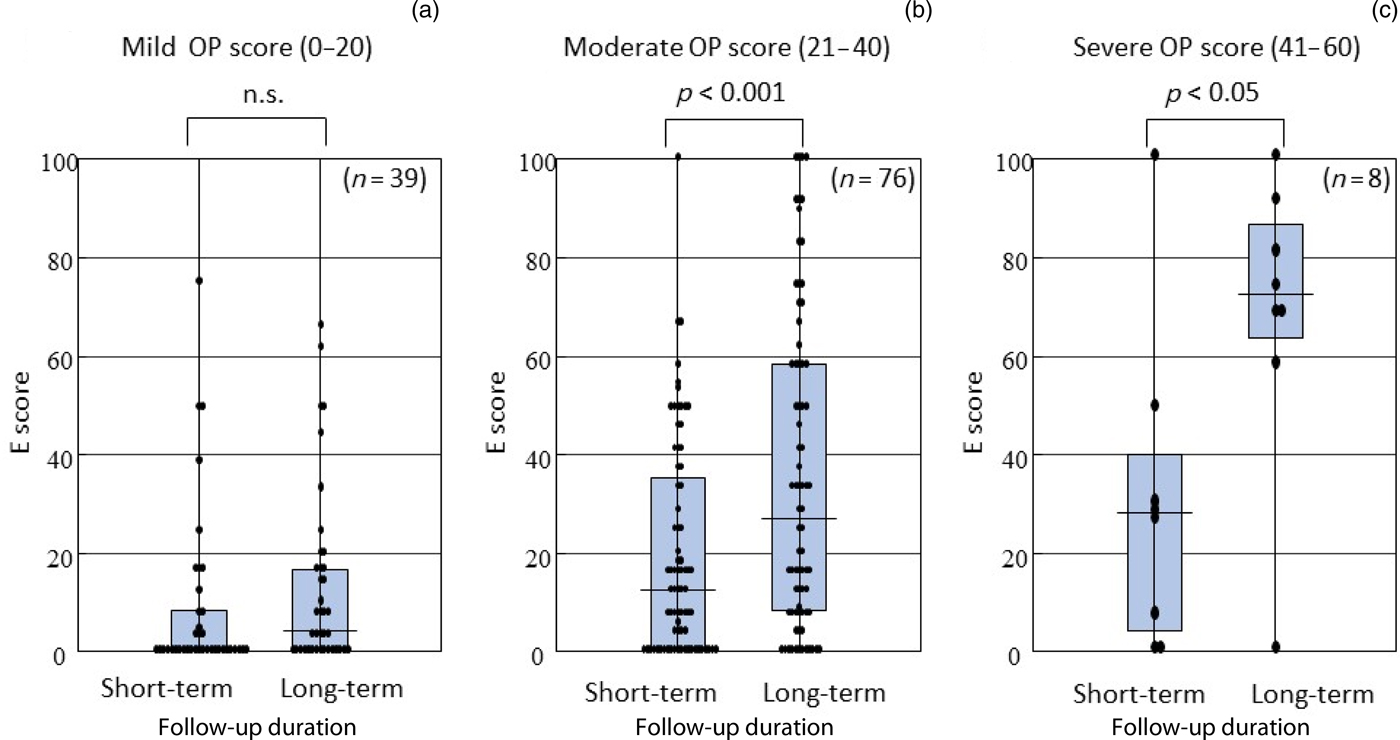
The time course of changes in post-operative endoscopic appearance in relation to mild, moderate and severe operating scores was studied. A total of 161 long-term follow-up patients (eosinophilic chronic rhinosinusitis, n = 123; non-eosinophilic chronic rhinosinusitis, n = 38) in whom short-term endoscopic appearance score data were also available were analysed. In eosinophilic chronic rhinosinusitis patients with mild operating scores (n = 39), the short-term endoscopic appearance score (median of 0 per cent, range = 0–75 per cent) was maintained over time (long-term endoscopic appearance median score of 4.2 per cent, range = 1.0–66.7 per cent). In contrast, in eosinophilic chronic rhinosinusitis patients with moderate operating scores (n = 76), endoscopic appearance score significantly worsened over time (short-term endoscopic appearance median score of 12.5 per cent, range = 0–100 per cent; long-term endoscopic appearance median score of 27.1 per cent, range = 0–100 per cent), as in patients with a severe operating score (n = 8) (short-term endoscopic appearance median score of 28.2 per cent, range = 0–100 per cent; long-term endoscopic appearance median score of 72.5 per cent, range = 0–100 per cent) (Figure 4). In the non-eosinophilic chronic rhinosinusitis group, on the other hand, there were no significant differences between short- and long-term endoscopic appearance scores in each group.
Changes in post-operative (post-op) endoscopic appearance (E) scores over time in relation to the severity of operating (OP) scores in the eosinophilic chronic rhinosinusitis group. Differences in short- and long-term endoscopic appearance scores in (a) mild (n = 39), (b) moderate (n = 76) and (c) severe (n = 8) operating score subgroups of eosinophilic chronic rhinosinusitis patients were analysed. Note that the endoscopic appearance scores in the mild operating score subgroup were maintained post-operatively, whereas the endoscopic appearance score worsened significantly over the long term in the moderate and severe operating score subgroups. n.s. = no significance

Discussion
This study demonstrated that operative findings during FESS for chronic rhinosinusitis reflect the pre-operative severity of rhinosinusitis and olfaction dysfunction, and predict the post-operative course following FESS. Despite intensive investigation, we could not find previous reports linking the endoscopic findings on FESS for chronic rhinosinusitis to the patient's pre-operative condition and post-operative results. We also found a significant difference in operating scores between eosinophilic chronic rhinosinusitis and non-eosinophilic chronic rhinosinusitis patients. The anterior ethmoid sinus, maxillary sinus and superior meatus were found to be the most inflamed sites in both eosinophilic chronic rhinosinusitis and non-eosinophilic chronic rhinosinusitis cases. Analysis of the time course of post-operative endoscopic appearance relative to the severity of the operating score suggested that eosinophilic chronic rhinosinusitis patients with severe operative findings require prolonged treatment after FESS.
Pre-operatively, patients with eosinophilic chronic rhinosinusitis had more severe eosinophilia, olfactory dysfunction and CT scores compared to those without eosinophilic chronic rhinosinusitis, as has been reported previously.Reference Oka, Tsuzuki, Takebayashi, Kojima, Daimon and Sakagami12–Reference Hashimoto, Tsuzuki, Okazaki and Sakagami14 Unexpectedly, analysis of the patients in this study for whom we could acquire olfaction data indicated that normosmia was only present in the eosinophilic chronic rhinosinusitis group and not in the non-eosinophilic chronic rhinosinusitis group. In contrast, a higher percentage of anosmic patients was observed in the eosinophilic chronic rhinosinusitis group as compared to the non-eosinophilic chronic rhinosinusitis group. Analysis only of patients with olfactory dysfunction, including those with mean olfactory recognition thresholds of 1.2 or more, indicated a significant difference between eosinophilic chronic rhinosinusitis and non-eosinophilic chronic rhinosinusitis patients (p = 0.01973). This suggests that olfactory dysfunction is more severe in eosinophilic chronic rhinosinusitis than in non-eosinophilic chronic rhinosinusitis.
The pathogenesis of olfactory disorders due to chronic rhinosinusitis with nasal polyps is thought to result from a simple disturbance of airflow in the olfactory clefts.Reference Seiden and Duncan15 Severe eosinophilic infiltration of the sinonasal and olfactory mucosa in eosinophilic chronic rhinosinusitis is also a likely cause of olfactory dysfunction.Reference Kern16–Reference Lavin, Min, Lidder, Huang, Kato and Lam18 We believe that eosinophilic infiltration of the olfactory cleft mucosa makes treatment difficult.
We previously reported a significant correlation between the severity of chronic rhinosinusitis, as indicated by radiological findings (CT score), and olfactory recognition threshold pre-operatively in patients with chronic rhinosinusitis.Reference Saito, Tsuzuki, Yukitatsu and Sakagami13 In both eosinophilic chronic rhinosinusitis and non-eosinophilic chronic rhinosinusitis groups in our previous study, anosmic patients tended to show severe rhinosinusitis, and patients with milder olfactory dysfunction displayed milder rhinosinusitis.Reference Saito, Tsuzuki, Yukitatsu and Sakagami13 In particular, inflammation of the olfactory cleft and ethmoid sinus had strong effects on olfactory dysfunction. This study was the next step towards assessing the actual relationship between operative findings and pre-operative examination data. Thus, this study demonstrated that operating scores in chronic rhinosinusitis correlated significantly with pre-operative CT score and olfactory recognition threshold. These data, which indicate that patients with more severe rhinosinusitis and olfactory dysfunction pre-operatively are likely to have more severe operative findings during FESS, are useful for the peri-operative management of chronic rhinosinusitis.
Regarding our operating score, the endoscopic operative findings at each site were scored in terms of three grades (0, 1 and 2 points) to unify our system with previously reported scores, such as the rudimentary endoscopic scoring systems for the nasal cavity by Lund and Kennedy (Lund and Kennedy score),Reference Lund and Kennedy19 our previously reported operated sinuses and olfactory clefts score (endoscopic appearance score),Reference Tsuzuki, Hinohira, Takebayashi, Kojima, Yukitatsu and Daimon4 and the radiological scoring system by Lund and Mackay.Reference Lund and Mackay10 The operating score clinically focuses on the paranasal sinuses and olfactory clefts, which are the most relevant sites in terms of surgery for chronic rhinosinusitis. The paranasal sinuses include the maxillary, anterior and posterior ethmoid, frontal, and sphenoid sinuses. The olfactory clefts consist of an area of olfactory neuroepithelium surrounded by the nasal septum up to the canopy (as the medial to superior wall), middle turbinate, superior turbinate, superior nasal meatus (as the lateral wall), and ostium of the sphenoid sinus (as the posterior wall).Reference Hummel, Whitcroft, Andrews, Altundag, Cinghi and Costanzo3, Reference Lavin, Min, Lidder, Huang, Kato and Lam18, Reference Leopold, Hummel, Schwob, Hong, Knecht and Kobal20 Furthermore, the operating score correlated significantly with the ‘gold standard’ scoring system by Lund and Mackay,Reference Lund and Mackay10 and the olfaction test, which is the most common test covered by health insurance in Japan. Consequently, it is justifiable that the operating score, which focuses on clinically relevant sites and indicates the condition of the sinonasal area, is a valid score for use during FESS in patients with chronic rhinosinusitis. Yet, the operating score requires further validation in future multicentre studies to confirm its utility and relevance during FESS.
The operating score in the eosinophilic chronic rhinosinusitis group was significantly worse than that in the non-eosinophilic chronic rhinosinusitis group. In terms of the severity of the operating score, a moderate operating score was predominantly observed in the eosinophilic chronic rhinosinusitis group (57 per cent), whereas mild operating scores predominated (63 per cent) in the non-eosinophilic chronic rhinosinusitis group.
Analysis of the subcomponents of the sinus score indicated that the presence of eosinophilic chronic rhinosinusitis with larger and more widely extensive polyps resulted in higher mucosal scores compared to non-eosinophilic chronic rhinosinusitis cases. As expected, chronic rhinosinusitis with more sinus contents resulted in higher contents scores. Although it was previously reported that viscous secretions were predominantly observed in eosinophilic chronic rhinosinusitis cases and mucopurulent contents in non-eosinophilic chronic rhinosinusitis cases,Reference Ishitoya, Sakuma and Tsukuda8 we did not find a significant difference in the contents score between eosinophilic chronic rhinosinusitis and non-eosinophilic chronic rhinosinusitis groups in our study. One reason for this could be that the contents score was comparatively lower than the mucosal score in this study.
Analysis showed that the other operating score subcomponent, olfactory cleft score, was significantly higher in the eosinophilic chronic rhinosinusitis group than the non-eosinophilic chronic rhinosinusitis group, because polypous lesions in the olfactory cleft were also predominantly observed in eosinophilic chronic rhinosinusitis cases,Reference Ishitoya, Sakuma and Tsukuda8 as with the mucosal score component of the sinus score. In a radiological analysis using quantitative measures of olfactory cleft opacification, polypous lesions were thought to be the most influential factors on post-operative course.Reference Soler, Pallanch, Sansoni, Jones, Lawrence and Schlosser21 In the subcomponent analysis, the anterior ethmoid and maxillary sinuses in the sinus score and superior meatus in the olfactory cleft score showed the worst operative findings in both groups. Future studies should analyse sinus and olfactory cleft scores to investigate the influence of the operative finding subcomponents on recrudescent inflammation and olfactory prognosis in patients with chronic rhinosinusitis.
Besides surgery, appropriate post-operative treatment is also very important for maintaining the sinonasal condition.Reference Tsuzuki, Hinohira, Takebayashi, Kojima, Yukitatsu and Daimon4, Reference Senior, Kennedy, Tanabodee, Kroger, Hassab and Lanza5 Although CT imaging is the gold standard examination for assessing the sinonasal area, endoscopy is routinely used as a simple, useful and predictable low-cost diagnostic tool, and does not involve radiation exposure.Reference Senior, Kennedy, Tanabodee, Kroger, Hassab and Lanza5
Several post-operative endoscopic scores have been developed, such as the Lund and Kennedy score,Reference Lund and Kennedy19 its modificationReference Psaltis, Li, Vaezeafshar, Cho and Hwang22 and the Peri-Operative Sinus Endoscopy scoring system.Reference Wright and Agrawal23 These scores generally focus on the condition of the nasal cavity, although Peri-Operative Sinus Endoscopy scoring includes the middle meatus (maxillary sinus), the ethmoid cavity (ethmoid sinus) and the secondary sinuses (frontal sinus and sphenoid sinus). We also previously proposed the endoscopic appearance score as a simple post-operative endoscopic evaluation method to diagnose sinonasal disease in the early stage, so that regular follow up of these patients can be performed.Reference Tsuzuki, Hinohira, Takebayashi, Kojima, Yukitatsu and Daimon4
The endoscopic appearance score expresses the physical findings of each sinus and olfactory cleft operated on relative to the maximum possible score (when visualisation of the operated sinuses and olfactory clefts is completely obstructed by lesions). The endoscopic appearance score had a high level of interclass reliability, and strong significant positive correlations with previously reported scoring systems.Reference Lund and Mackay10, Reference Lund and Kennedy19 However, the endoscopic appearance score has limited reliability when recurrent nasal polyps interfere with endoscopic observation of the posterior part of the operated sinuses. In this study, long-term endoscopic appearance scores in eosinophilic chronic rhinosinusitis patients with moderate and severe operating scores worsened significantly over time after FESS, whereas the endoscopic appearance score was well maintained in patients with mild operating scores. These data suggest that the operating score might reflect the post-operative course in patients with chronic rhinosinusitis, particularly in patients with eosinophilic chronic rhinosinusitis, indicating that patients with more severe operative findings should be carefully treated for a longer time after FESS.
• Early appropriate evaluation of sinus condition is crucial for successful chronic rhinosinusitis management
• Operating scores, indicating operative findings, were worse in eosinophilic than non-eosinophilic chronic rhinosinusitis cases
• Anterior ethmoid sinus and superior meatus had the worst operative findings in both eosinophilic and non-eosinophilic chronic rhinosinusitis cases
• Operating scores correlated with pre-operative sinonasal computed tomography and olfactory dysfunction severity, and post-operative endoscopic appearance
• Operating scores can provide useful information for peri-operative management of chronic rhinosinusitis
• Operating score could be used to predict post-operative course
There were some limitations to our study in terms of patient follow up. Although we recommended regular post-operative observation, and tried to examine every patient's olfactory acuity and to follow the endoscopic appearance score for as long as possible, we could not follow up all the patients in this study. There might have been some patients who did not visit us when they felt comfortable, and/or who visited us only when their symptoms made them very uncomfortable. Further, the number of follow-up visits by individual patients decreased over time after FESS. Therefore, accurate statistical evaluation of the longer-term therapeutic effects became difficult. In addition, as the olfaction tests covered by health insurance in Japan have methodological (odour pollution and painful injection) and environmental (poor compliance) problems, the collection of olfactory data was also hindered.Reference Oka, Tsuzuki, Takebayashi, Kojima, Daimon and Sakagami12 Easier and quicker methods are desired to encourage wider adoption of olfactory evaluation in Japan.
Conclusion
This study suggested the usefulness of evaluating the operative findings as a predictive prognostic scoring system during FESS in patients with chronic rhinosinusitis. Peri-operative management, including post-operative treatment under endoscopy, is also very important for maintaining the improvement achieved by FESS for chronic rhinosinusitis. In future, morphological and molecular biological research is required to identify factors that influence the post-operative course of chronic rhinosinusitis.
Acknowledgements
We gratefully acknowledge the help of our technical assistants, Ms Yumi Kida and Mrs Midori Tanide. This work was supported by Grants-in-Aid for Scientific Research (KAKENHI; numbers JP25462671 and JP16K11220) from the Japan Society for the Promotion of Science, and the Practical Research Project for Rare/Intractable Diseases from the Japan Agency for Medical Research and Development.