I. INTRODUCTION
Could we model friendship as a form of altruism or vice versa? When the decision maker (DM) listens to a friend and shares her reflections and musings over a pleasant or painful event, does the DM allocate time using the same ledger employed when she allocates time to help a stranded stranger? Do both acts belong to the same genus, calling it the “assistance of others”?Footnote 1
But first, preliminary definitions:
Friendship-and-love: A choice engenders a friendship-and-love satisfaction when it involves reflecting with friends on experiences. This satisfaction may arise even without the presence of others, e.g., when the DM reflects, with the help of a picture regarding a past experience, or imagines the prospects of an imagined future self.
Altruism: A choice engenders an altruistic satisfaction when the DM allocates some resources to another individual who is, in addition to other constrains, of greater need than the self.
There are diverse theories of love (Nussbaum Reference Nussbaum2015; McCloskey Reference McCloskey2006) as well as of altruism (Khalil Reference Khalil2001, Reference Khalil2004). While they are important, we cannot discuss them unless we answer the question posed above: Is the friendship-and-love satisfaction commensurable with the altruism satisfaction, or, does friendship-and-love promote the same objective function as altruism?
This question should challenge theorists interested in reciprocity and experimentalists interested in laboratory experiments regarding cooperation (e.g., Smith and Wilson Reference Smith and Wilson2019; Sugden Reference Sugden2018; Dhami Reference Dhami2016). These theorists and experimentalists usually assume that both friendship and altruism lie along the same continuum under the name “pro-social preferences” (see Khalil and Marciano Reference Khalil2021a, Reference Khalil2021b). Even moral philosophers often discuss altruism and friendship together, as expressive of our kindred spirit (e.g., Nussbaum Reference Nussbaum2001).
The standard economist discusses altruism and friendship as ultimately indistinguishable choices. While they could be different, the difference is similar to the different preferences toward fruits, vacations, homes, and so on. If we follow the axioms of rational choice (see Gilboa Reference Gilboa2012), all these preferences can be placed into bundles, and the bundles ordered into a consistent unidimensional function informing the DM of what is the optimal bundle, given relative prices and other constraints. This allows the DM to substitute altruistic activities and time spent with friends—all are the subject of relative prices. All are reducible to a unidimensional ledger. For the standard economist, this ledger is substantive satisfaction, understood as pecuniary interest, which is the common currency of all preferences.
The standard economist’s picture would quickly crumble if we found that the friendship-and-love preference leads to a utility ledger incommensurable with the ledger accommodating altruism, viz., the economist’s substantive satisfaction. While substantive satisfaction includes altruism and the interests of anyone deemed important to the DM, we might find that it cannot include friendship-and-love.
Indeed, this paper argues that the friendship-and-love utility and altruism utility belong to two ledgers of satisfaction that are incommensurable.Footnote 2 The same model cannot accommodate friendship, on one hand, and altruism, on the other. When the DM listens to a friend’s pains, the DM’s preference cannot be benevolence defined as the preference to improve well-being, such as when the DM volunteers time at a hospital.
The difference is not the result of familiarity. The hospital patients could be as familiar as the friend. Further, this difference does not arise from the nature of the pain. It could be the case that the patient’s pain is emotional, while the friend’s pain is physiological. The difference lies elsewhere, which is what this paper shall prove.
When the DM listens to the friend’s pain, he adopts the pain as his own. The DM immerses himself with the friend’s experience and consequently he feels the friend’s pain together—while no transfer of substantive goods has to take place. The critical feature is for the DM to be present in toto, i.e., as totally dedicated to hearing the friend’s suffering. This is not the defining feature of benevolence informing altruism. The DM, in the role of the altruist, may choose to hide his identity from the beneficiary—as the critical feature is the transfer of substantive goods between the two. That is, the altruist act does not necessarily require the altruist to immerse himself in the beneficiary’s pain—although it could be the case if the altruist and the beneficiary happen to be friends as well.
To keep the analysis clear, this paper assumes that the two individuals involved in an altruist act are not friends. When the DM helps the victims of a flood or a pandemic, he is not trying to build friendship-and-love with the victims. The DM is simply advancing the well-being of the other—similarly to actions that the DM undertakes to advance self-interest. Both acts, self- and other-interest, are motivated by benevolence—as opposed to malice, envy, and ill-will—as both advance well-being.
The continuum of self- and other-interest is a major feature of Adam Smith’s ([1759] Reference Smith, Raphael and Macfie1976) theory of social conduct in The Theory of Moral Sentiments (hereinafter TMS) (see Khalil Reference Khalil1990a). Smith advances the concept of “sympathy” (and implicitly “empathy”) to express such a continuum and, equally important, the judgment of choices—whether they are proper (Part I, TMS) and meritorious (Part II, TMS). This paper goes further to see if Smith’s TMS can help shed light on the main question: What is the criterion demarcating benevolent preferences—i.e., self-interest and other-interest (altruism)—that promote well-being, from friendship-and-love utility?
Smith ([1759] Reference Smith, Raphael and Macfie1976, pp. 13–16) offers the criterion in his discussion of “mutual sympathy” in an orphaned chapter at the outset of TMS. While many Smith scholars note the concept of “mutual sympathy,” few highlight and value its importance—Robert Sugden (Reference Sugden2002) being one exception. Smith’s concept of mutual sympathy expresses the nature of friendship-and-love. The DM enjoys the friendship-and-love satisfaction when she reflects upon what is being consumed, while she and the loved one are mutually involved. In contrast, Smith’s concept of sympathy (along with empathy) facilitates the expression of altruism (other-interest) and self-interest. The DM enjoys the satisfaction afforded by the pursuit of interests in a direct way—i.e., there is no need for reflection on the mutual union with people, even those who receive assistance from the DM.
In the friendship-and-love satisfaction, it is the utility of bonding that affords solace, which is one kind of happiness. This paper calls such utility “transcendental satisfaction” (see Khalil Reference Khalil2019a, Reference Khalil2022). In the altruism and self-interest satisfaction, it is the utility in the standard economist’s sense, what this paper calls broadly “substantive satisfaction.”
This paper advances the thesis that the two genera of satisfaction are greatly different. It expresses its thesis in the most generic sense when it employs the “substantive/transcendental distinction” terminology. It expresses its thesis in a more specific sense when it employs the “altruism/friendship distinction” terminology. As much as altruistic utility is one form of substantive satisfaction, friendship-and-love utility is one form of transcendental satisfaction.
Section II lays down the framework, allowing us to distinguish the nature of satisfaction question from another question, the nature of decision making. Sections III and IV address the primary research question of this paper, the nature of satisfaction. Is friendship as expressed by mutual sympathy reducible to altruism, i.e., substantive satisfaction? Sections V and VI address the secondary research question regarding the nature of decision making: Does judgment as expressed by sympathy-and-empathy facilitate the socialization of the individual—as if the impartial spectator expresses pre-given social norms that shape and even manipulate individual choices? Section VII concludes.
II. THE FRAMEWORK
The Orphaned Chapter
As stated above, Smith lays out his analysis of friendship in an orphaned and rather short chapter in TMS: chapter 2 of Part I on “mutual sympathy.” This chapter is orphaned not only because Smith scholars generally do not appreciate its importance but also because he himself never uses his discussion of friendship in the rest of TMS. To wit, he forgets that he was discussing mutual sympathy (friendship) and not sympathy when he responds to David Hume’s critique of his concept of sympathy. This is strange, given that Hume quotes from this orphaned chapter when expressing his critique (see Khalil Reference Khalil2021a).
In the orphaned chapter, Smith analyzes the DM’s satisfaction when the DM shares a consumption, viz., reading a book with another individual. This sharing can be limited to social interaction as when one goes to a ball à la Gary Becker’s (Reference Becker1974) theory or, before Becker, à la Hume’s theory (Sayre-McCord Reference Sayre-McCord2013): one goes to a party in order to amplify substantive satisfaction via the mirroring and, hence, the amplification of the emotions of others who are in a good mood.
Smith, however, stresses that reading a book together could be more than mirroring substantive satisfaction. Reading together involves mutual sympathy if it involves the merging of two selves into a union. Such a union amounts to another source of satisfaction, the transcendental kind.
In other words, mutual sympathy is exactly the experience of consumption where two individuals stand internally to each other, how Smith defines the satisfaction that friendship affords, i.e., transcendental satisfaction. Smith proceeds in chapter 2 by distinguishing the satisfaction of friendship from substantive satisfaction—as this paper shall discuss.
Substantive Satisfaction: Sympathy-and-Empathy as Judgments
Regarding substantive satisfaction, Smith ([1759] Reference Smith, Raphael and Macfie1976, p. 67) distinguishes between two kinds of judgment related to substantive satisfaction. In both varieties, the impartial spectator is not an actual external individual or the crowd, but rather the DM acting as a monitor of his choices, as an inner voice. In one kind of judgment, in Part I of TMS, the inner voice focuses on whether the act is proper in the sense of being proportional to the stimulus—what Smith calls the “propriety of action” judgment. In the other kind of judgment, in Part II of TMS, the inner voice focuses on whether the act is the outcome of meritorious preferences in the sense of being benevolent regarding well-being—what Smith calls the “merit of action” judgment.
The propriety-of-action judgment, i.e., the issue of proportionality, inquires whether the pitch of the reaction is proportional or an overreaction. The standard economist should immediately recognize that this inquiry employs rational choice (Khalil Reference Khalil2010). However, the economist may not recognize it, as she takes for granted that the DM acts rationally, i.e., reacts proportionally to the incentive, while Smith undertakes a great effort to show the mechanics of sympathy that produces such a result.
The merit-of-action judgment, i.e., the issue of benevolence, inquires whether the incentive of the DM, who is supposed to act as a “benefactor,” merits the gratitude of the beneficiary. Smith is concerned with non-meritorious gratitude. While the beneficiary experiences a benefit from a choice taken by the DM, the benefit could be an unintended consequence. Or the DM’s motive is not benevolence but rather self-interest, self-aggrandizement, or, worse, malevolence, such as ridicule, malice, and schadenfreude.
The concern with the merit-of-action indicates that Smith cannot be consequentialist. If the DM’s motive is self-interest, the choice is non-meritorious and, hence, non-praiseworthy. If the DM’s motive is self-aggrandizement, the choice is also non-praiseworthy. If the DM’s preference is malice, as in the case of schadenfreude, but the impact only accidentally was positive, the act is likewise non-praiseworthy. The impartial spectator—and consequently the beneficiary—in these three cases simply cannot empathize with such acts, as they are insincere (see Khalil and Feltovich Reference Khalil and Feltovich2018) and, in the case of malevolence, actually intended to harm the beneficiary (and only accidentally benefited her).
Smith did not use the term “empathy,” as it was introduced into the English language much later, by Edward B. Titchener (Reference Titchener1909) at the start of the twentieth century. Nonetheless, this paper uses it to strictly denote what Smith meant by the “merit-of-action” judgment. That is, the impartial spectator can empathize with the DM’s act only if the impartial spectator judges that the DM’s act is sincere and, further, is meritorious in the benevolence sense.
In contrast, Smith used the term “sympathy” to denote the propriety-of-action judgment—as well as to denote diverse fellow-feelings. This paper uses the term “sympathy” to strictly denote what Smith meant by the “propriety-of-action” judgment. That is, the impartial spectator can sympathize with the DM’s act only if the impartial spectator judges that the DM’s act is proper in the proportionality sense.
Terminology: The Varieties of Fellow-Feelings
This paper employs the term “fellow-feeling” as the rag-bag term encompassing any kind of transmission of feeling between two or more decision makers (DMs). As such, it encompasses “mutual sympathy,” on the one hand, and “sympathy-and-empathy,” on the other. The core thesis of this paper is that these two genera of fellow-feeling are radically different.
The term “fellow-feeling” needs careful dissection. Earlier Smith scholarship, prior to the 1976 variorum Glasgow edition of TMS, has centered on the so-called Adam Smith Problem. In this literature (see Khalil Reference Khalil1990a), scholars have focused on how to account for benevolence (altruism) in the world of Homo oeconomicus, i.e., the world of self-interested DMs. The so-called Adam Smith Problem is rooted in a supposed self/other dichotomy. This paper shall show that the proposed two genera of fellow-feelings—viz., mutual sympathy and sympathy-and-empathy—rather imply that the self/other dichotomy is a misleading entry point to the study of human motives (see Khalil and Marciano Reference Khalil2021a, Reference Khalil2021b).
This paper shall show that mutual sympathy can be about the self-love—when the DM accepts her own flaws—and about the other—when the DM loves a friend despite his flaws. Likewise, the paper shall show that sympathy-and-empathy can be about self-interest or about other-interest (altruism). Thus, the self/other dichotomy is not a useful first approximation.
Meanwhile, this paper refines Smith’s term “sympathy” into two different meanings—(i) “empathy,” and, (ii), in a strict sense, “sympathy”:
-
(i) As already indicated above, the term “empathy” is the fellow-feeling mechanism behind the merit-of-action judgment in Part II of TMS—instead of the term “sympathy” that Smith employs generically.
-
(ii) The term “sympathy” is the fellow-feeling mechanism behind self-command, the moderation of excitement, or propriety understood as the proportionality of the reaction, what the economists call “choice,” to the stimulus, what the economists call “incentive.” Smith uses the term “sympathy” repeatedly in this specific sense in Part I of TMS, i.e., as the fellow-feeling mechanism behind the propriety-of-action judgment.
Judgments contra Motives
For Smith ([1759] Reference Smith, Raphael and Macfie1976, p. 67), as mentioned above, sympathy-and-empathy make up a genus of fellow-feelings assisting the judgments of choices, viz., “propriety of action” and “merit of action” judgments. This genus stands in contradistinction to another genus of fellow-feelings concerning the motives behind the choices. These motives, as defined earlier, correspond to the economist’s inputs that give rise to “preferences” or “utility”—whose judgment is another matter.
As judgments, sympathy-and-empathy assist the DM in making the best choice, given the utility function and the constraints—irrespective of the utility under focus. The utility under focus can be substantive or transcendental. With respect to substantive utility or satisfaction, sympathy assists the DM in taking choices obeying the command of propriety and, hence, which are rational; empathy assists the DM in taking choices that are benevolent, i.e., well-intentioned, and, hence, which merit praise.
In contrast, mutual sympathy is not a judgment but rather a motive or input in the utility function, producing the transcendental friendship-and-love utility or satisfaction.
The sympathy-and-empathy judgments are taken by the DM or principal to evaluate or judge the choices of the self. So, they are self-judgments where the DM, at first approximation, disregards the barrage of social opinion, public approval, or public scorn. Of course, actual spectators or fellow beings do watch and pass opinions on the DM’s choices—and such opinions influence the DM’s actual choices. However, Smith recognizes this influence at secondary if not tertiary approximation.
Self-Judgment
The dispute among theorists, to be clear, is not whether social norms and opinions matter. It is rather about what matters at first approximation. For Smith, it is the self-judgment of the DM, which supposes that the DM is ultimately autonomous of the tribunal of social opinion and norms. And only then, at second approximation, a theorist expounding the primacy of individual autonomy proceeds and explains social opinions and norms in terms of self-judgments—as Smith does (Smith [1759] Reference Smith, Raphael and Macfie1976, pp. 156–161; Khalil Reference Khalil2009).
For Smith, the self-judging, autonomous DM seeks the assistance of an imagined impartial spectator who must be, given the theoretical starting point, a proxy of the DM himself. That is, Smith would commit a contradiction if he posited the impartial spectator as ultimately the tribunal of actual spectators. While “judgment” is central in TMS, as pointed out by the influential “Introduction” to the variorum edition (Smith [1759] Reference Smith, Raphael and Macfie1976), this judgment is not that of the tribunal of social opinion that supposedly socializes the decisions of the DM at first approximation.
Mutual Sympathy contra Sympathy-and-Empathy
As stated above, it is imperative to distinguish between two genera of fellow feeling: mutual sympathy, on one hand, and sympathy-and-empathy, on the other. In Smith’s sense, “mutual sympathy” is the fellow-feeling functioning as an input that produces a satisfaction, what is called today “objective,” “output,” or “utility.” In contrast, “sympathy-and-empathy” are judgments, not inputs in the utility function—if we follow Smith’s characterization of the propriety-of-action and merit-of-action (Smith [1759] Reference Smith, Raphael and Macfie1976, p. 67). Sympathy-and-empathy are the fellow-feelings assisting the DM in judging and recommending the best choice according to two different criteria: the propriety contra the merit-of-action mentioned above.
In many places, Smith uses the term “sympathy” to denote fellow-feeling per se. But he turns around and uses the same term in diverse specific senses—such as “mutual sympathy” acting as an input in the utility function, as the judgment of propriety-of-action, or as the judgment of the merit-of-action. Smith did not explicitly and sharply distinguish the terminology of “mutual sympathy” and “sympathy”—even in the short and orphaned chapter 2. This situation may explain why Smith scholars tend either to ignore his concept of “mutual sympathy” or, at best, fold it under the robe of his more well-known concept of “sympathy” (e.g., Roberts Reference Roberts2015, ch. 6).
However, as suggested above, there is one exception. Sugden (Reference Sugden2002) highlights the importance of mutual sympathy: it expressly stands for human sociality in the sense of friendship-and-love. For Sugden, indeed, mutual sympathy regards the makeup of preferences. It is not about self-judgment.
Sugden’s Social Theory
While Sugden offers an original reading of mutual sympathy, he overinflates the prevalence of mutual sympathy in characterizing everyday social life. In fact, he considers it to be the key entry to TMS to the extent that sympathy-and-empathy are sub-concepts derived from mutual sympathy. He effectively conflates mutual sympathy with sympathy-and-empathy in a direction that is opposite to the rest of the literature. While the literature generally regards mutual sympathy as one instance of sympathy-and-empathy, Sugden regards sympathy-and-empathy as instances of mutual sympathy.
The direction of Sugden’s conflation can be characterized as a “romanticization view” of decision making: the DM is first and foremost motivated by mutual sympathy giving rise to transcendental satisfaction. Such transcendental satisfaction is the basis of what can be called “love-based sociality.” In this case, the pursuit of substantive satisfaction is modeled as a moment or an example of the greater pursuit, the pursuit of mutual sympathy, whereas the love-based human sociality is almost the singular sociality that is operative.
Put differently, Sugden effectively disallows a domain of interaction, called here “interest-based sociality,” that can stand independently of love-based sociality. For Sugden, the interest-based sociality, i.e., substantive satisfaction, is ultimately derived from the supposedly dominant mutual sympathy that is at the origin of transcendental satisfaction.
To advance the proposed thesis that interest-based sociality stands independently of the love-based sociality does not rule out the ubiquity of transactions that are composite of both socialities. It is possible for a merchant and a customer to form deep friendship. Also, it is possible for two people who are friends for a long time to start a business partnership. The two can, with the help of institutions, keep each kind of transaction separate from the other.
Of more complication is when the two socialities are amalgamated into a system of transaction such that one cannot distinguish the interest-based from the love-based aspect. These are structures of exchange that are expressly created to amalgamate the two kinds of sociality. We find such structures in communities such as families, bands, tribes, small-knit communities, and churches. The members of such communities help each other out of duties defined by a strict network of reciprocal obligations—whereas such obligations express altruism (interest-based sociality) and bonding (love-based sociality). Elias Khalil and Alain Marciano (Reference Khalil2021b) call such an exchange structure “camaraderie and grant.” The grants act partially as loans presupposing repayment, on one hand, and as tokens of family, friendship, and love, on the other. Marcel Mauss’s ([1922] Reference Mauss1990) concept of the “gift” expresses such a camaraderie-and-grant structure of exchange (Khalil and Marciano, Reference Khalil2021a).
Smith uses the term “benevolence,” especially in Part VI of TMS, to denote camaraderie and grant, i.e., the amalgamation of altruism and bonding. In this sense, benevolence is the goodwill that serves as the basis of altruism and as the basis of love. In this discussion, he calls such amalgamation “habitual sympathy” (Smith [1759] Reference Smith, Raphael and Macfie1976, pp. 220–221).Footnote 3
To keep matters simple, however, this paper abstracts from habitual sympathy, camaraderie, and Mauss’s concept of the gift. It uses the term “benevolence” in the strict sense of goodwill regarding interest-based sociality such as self-interest and other-interest (altruism). While communities such as families, tribes, and ethnic-based communal bonding are important forms of the blending of the two types of socialities, we need at first approximation to delineate the two kinds of socialities in order to understand such blending.
Put differently, the major thesis of the paper is that we must acknowledge, at first theoretical cut, two different kinds of socialities in the pure sense: mutual sympathy as expressing pure love-based sociality, and mutual interest as expressing pure formal contracts, i.e., interest-based sociality. Only then we can understand the amalgamation of these two forms as they are exemplified in social solidarity and camaraderie groupings facilitated by gifts as characterized by Marcel Mauss ([1922] Reference Mauss1990). We may interpret Smith’s “habitual sympathy” as about camaraderie or social solidarity, i.e., expressing the amalgamation of the two pure types of sociality (Smith, [1759]Reference Smith, Raphael and Macfie1976, pp. 220–221).
Indeed, Smith goes further in Part VI; he dismisses social communities based on the amalgamation of love- and interest-based socialities (Smith [1759], Reference Smith, Raphael and Macfie1976, p. 222; see Khalil Reference Khalil2021c). He regarded them as obstacles to the advancement of market-mediated contracts, i.e., interest-based sociality. It seems that, in Part VI, Smith has forgotten his early chapter on mutual sympathy. In this orphaned chapter, Smith argues that love-based sociality is still necessary in civil societies, co-existing with interest-based sociality.
As another clarification, the amalgamation of the love- and interest-based socialities should not be confused with what can be called “instrumental friendship.” Instrumental friendship includes employer-employee contracts, and merchant-patron and other forms of cooperation that also include niceties, politeness, and courtesy. Such niceties, however, express superficial “friendship” in the sense that the niceties are not what define the interest-based sociality. Instrumental friendship seems to resemble the Ciceronian concept of necessitudo (see Rowland Reference Rowland1970). One may translate the Ciceronian concept as “necessary association”—suggesting that the association is interest-based, aimed to satisfy substantive needs. Indeed, Smith ([1759] Reference Smith, Raphael and Macfie1976, p. 222) uses the term “necessary association” to denote groupings that are based on mutual interest, as is the case with common defense, which differs from mutual sympathy, the pure form of friendship-and-love (see Khalil Reference Khalil2021c).
Sugden’s social theory does not recognize the proposed fundamental delineation of mutual sympathy (loved-based preferences) and mutual interest (interest-based preferences). Sugden’s social theory expressly, at first approximation, does not only conflate the interest- and the love-based preferences but also elevates the love-based sociality as the dominant one of the two. Such an elevation appears to be consistent with his broader intellectual project regarding, first, the reconstruction of the prisoners’ dilemma as a game-generating cooperation, and, second, the account of spontaneous order. Although Sugden’s broader intellectual project is not the focus of this paper, it suffices to state that Sugden (Reference Sugden1993, Reference Sugden2003) promotes the game-theoretic approach of Michael Bacharach (Reference Bacharach, Gold and Sugden2006). Bacharach argues that the prisoners’ dilemma in general should be seen as about a framing or reasoning type, rather than purely about preferences—not to mention substantive preferences. As such, the prisoners have a “team reasoning” frame entailing the choice of the cooperation rather than the cheating strategy as the rational strategy. Sugden (Reference Sugden2018, ch. 10) advances the notion of “mutual benefit” that ensures cooperation in the prisoner’s dilemma, whereas mutual benefit is a manifestation of team reasoning. The emphasis on mutual benefit and team reasoning, which can be found in his other work (e.g., Sugden Reference Sugden1993, Reference Sugden2003), can be read as the recognition of substantive satisfaction, i.e., as if it stands independently of transcendental satisfaction. However, Sugden (Reference Sugden2002, p. 86) presents substantive satisfaction, which he calls “instrumental benefits,” as basically a by-product of the more fundamental love-based sociality. That is, Sugden presents DMs as members of families, tribes, communities, temples, and nations, in the first approximation—and such approximation shapes and determines “instrumental benefits.”
The primacy of love-based sociality in Sugden’s thought is confirmed when he deals with his other concern, spontaneous order. Sugden (Reference Sugden1989, Reference Sugden2018) advances the Hayekian view of the social order as spontaneous in the sense that it is based on social norms rather than on rational design. In a concluding paragraph, Sugden (Reference Sugden2002, p. 86) intimates such a Hayekian view. Sugden sums up his reconstruction of Smith’s fellow-feelings as the foundation of human sociality. Such sociality is not the outcome of instrumental benefit and, corollary, rationality, but rather the outcome of basic innate “tendencies and moral sentiments” that “motivate us to participate in society, and to abide by the constraints that social life imposes on us.” In other words, the “complex moral sentiments of benevolence and justice” that constitute human sociality are not based on instrumental benefit or rationality but on innate psychological tendencies that lead us to interact with other people. This entails the obfuscation of the two genera of preference—as if the interaction with other people follows some harmonic music, as Daniel B. Klein and Michael J. Clark (Reference Klein and Clark2011) put it. The fact that the social order affords instrumental benefit to the individual is a by-product—i.e., the instrumental benefit should not be the entry-point to understand the constitution of sociality and, corollary, the social order.
The concluding paragraph of Sugden’s (Reference Sugden2002) paper that highlights “mutual sympathy” cements the view of Sugden: the entry point to understand human sociality and the resulting economic system is love-based preference, viz., the innate psychological processes behind the moral sentiments.Footnote 4
Two Faces of Human Sociality: Community contra Society
If we maintain the altruism/friendship distinction, we must distinguish the interest-based sociality that informs altruism from the love-based sociality that informs friendship. This paper offers a reconstruction of chapter 2 of Smith that buttresses the proposed altruism/friendship distinction and more broadly the differentiation of two genera of human sociality. This differentiation vindicates Ferdinand Tönnies’s ([1887] Reference Tönnies, Harris, Harris and Hollis2001) distinction between Gemeinschaft and Gesellschaft, translated as “community” and “civil society,” respectively. While the interest-based sociality corresponds to Gesellschaft, i.e., society, the love-based sociality corresponds to Gemeinschaft, i.e., community:
-
1. Interest-Based Sociality (Society): Is human decision making basically the outcome of individual rational decisions independent of social norms—and, in fact, can social norms be modeled as short-hand heuristics based on rational decision making? Or, is human decision making ultimately the outcome of pre-existing social/cultural norms? These questions pertain to the interest-based sociality: How are societies organized to facilitate the production-and-allocation of resources?
-
2. Love-Based Sociality (Community): Are humans basically motivated by friendship-and-love or, more broadly, longing, which stands apart from substantive satisfaction? This question pertains to the love-based sociality: How are communities organized to provide solace and sense of belonging to its members?
The conflation of the two genera of human sociality is widespread. While this paper cannot cover the history of this conflation, it shows how they differ through a critical reading of the Smith’s chapter 2.
Two Orthogonal Questions: What Is Decision Making? What Is Satisfaction?
We should distinguish two orthogonal questions: the process of decision making contra the nature of satisfaction. The decision-making question asks: Do people make decisions according to rational choice or according to scripted roles dictated by norms? Rational choice theory stresses the level of the individual DM and, hence, can be called the “individualization view” in contradistinction to the “socialization view” that, at first approximation, emphasizes the role of social/cultural norms.
The debate between the individualization and socialization views is often conflated with the debate concerning the nature of satisfaction. The latter debate asks: Is the objective or set of preferences geared to maximize well-being, which falls within the scope of interest-based sociality, or do people seek the meaning of life, friendship, and fondness in general, which falls within the scope of love-based sociality?
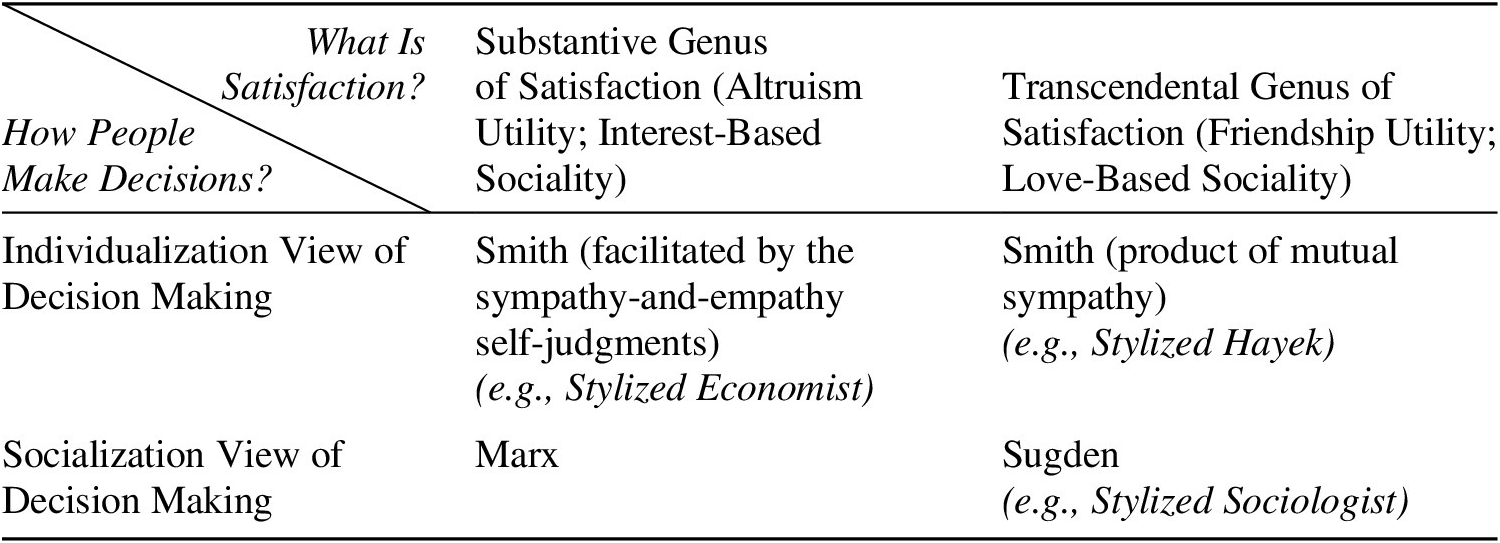
It is often the case that the individualization view is amalgamated with the exclusive emphasis on substantive satisfaction, as is the case with the stylized economist’s approach. Also, it is often the case that the socialization view is amalgamated with the exclusive emphasis on transcendental satisfaction, as is the case with the stylized sociologist approach. Analytically, though, this amalgamation should not mean that the two positions entail each other. These positions rather express different answers along the two orthogonal questions.
Table 1 lays out the two orthogonal questions in the most succinct manner.
The Decision-Making Question contra the Satisfaction Question

The second and third vertical columns differ regarding the primary research question: What is satisfaction? This question is about the nature of preferences: Does transcendental satisfaction differ qualitatively from substantive satisfaction? The second and third horizontal rows differ regarding the secondary research question: How do people make decisions? This question is about judgments: Do people judge their decisions as proper and meritorious based on individual calculation of wellbeing or based on pre-given social/cultural norms?Footnote 5
The two axes are somewhat uneven. The vertical axis asks about the “views” concerning decision making, whereas the theorist must choose at first approximation between the individualization and the socialization views. The theorist can also articulate some mixture of the two.Footnote 6 In contrast, the horizontal axis is not about views but rather about the nature of satisfaction. The theorist need not choose one genus over the other or a mixture of the two. A theorist, such as Smith, adopts both. Smith, to be clear, does not adopt a mixture of both but rather adopts the recognition that they stand for co-existing, but separate, genera of human sociality.
Aside from the stylized economist and the stylized sociologist, theorists such as Friedrich Hayek and Karl Marx can be roughly approximated to adopt opposite positions along the matrix laid out in Table 1. Although this paper is neither on Friedrich Hayek nor on Karl Marx (see Khalil Reference Khalil1990b, Reference Khalil1992a, Reference Khalil1996, Reference Khalil1997a), we may use distilled versions of their approaches insofar as that sharpens the proposed matrix.
The classification of Hayek’s approach along the decision-making question, viz., as a methodological individualist, should not be controversial. However, the classification of Hayek’s approach regarding the satisfaction question, viz., as a romanticist, requires a clarification. For Hayek, the DM is not primarily motivated by substantive benefit but by entrepreneurial activity. While entrepreneurship differs from friendship-and-love, they share a common thread; insofar as the pursuit of an imagined portrayal of a future self can be seen as a form of bonding, entrepreneurship and more broadly the pursuit of aspiration enhance the transcendental satisfaction action (see Khalil Reference Khalil2019b, Reference Khalilforthcoming; Khalil, Aimone, Houser et al. Reference Khalil2021). At least according to one interpretation of Hayek (Lavoi Reference Lavoie1991), the DM is not a calculator of costs and benefits. The DM is rather a creator of opportunities by imagining and acting according to a willed reality, a Nietzchean theme (Nietzsche Reference Nietzsche2006; Khalil Reference Khalil1997b, Reference Khalil2005). Hayek (Reference Hayek2010) vehemently criticized behaviorist theories of sensation and vision. For him, the DM senses the world and organizes it according to a gestalt that affords a wholistic assessment of the visual or, more generally, the sensory field.
In contradistinction to Hayek, the stylized Marx adopts a socialization view regarding the decision-making question. Marx adopts a substantivist view regarding the satisfaction question—which is in line with his class-based interest explanation of historical change (Marx and Engels [1846] Reference Marx and Engels1998). It is also in line with his economic theory, where he commences Das Capital with the market with its enormous world of commodities produced by the relentless drive of capital to valorize. The production-and-allocation mechanism appears to take place as a result of individual decision making, but actually such decisions reflect the market forces of supply and demand that are regulated at a deeper level by what Marx calls “social labor.” The social labor concept epitomizes the social character of production in any social formation. Even in a market-centered system, appearing as operating according to individual-level decisions, production operates according to socialized individuals. The individuals, though, are not conscious of their socialized nature and, hence, the socialized nature of production-and-allocation returns with a vengeance, what Marx calls “commodity fetishism.” That is, commodity fetishism asserts the sociality of decision making despite the self-perception of the DMs that they are autonomous actors (Khalil Reference Khalil1990b; see also Khalil Reference Khalil1992a, Reference Khalil1992b, Reference Khalil1992c). On the other hand, the whole market system produces wealth that secures the sufficient goods for the subsistence of the laboring class as capital operates to valorize its own mass. In this picture, Marx advances no analytical tools other than the production of wealth that satisfies the substantive satisfaction afforded by the use value of the world of commodities.
Given the orthogonality of the two questions in Table 1, Hayek and Marx are consistent. Sugden is also consistent when he upholds a socialization view with respect to the decision-making question like Marx but adopts a romanticization view with respect to the satisfaction question like Hayek. However, Sugden seems to suggest, without using the terms developed in this paper, that the socialization view of decision making necessarily entails subscribing to the love-based human sociality, which concerns the nature-of-satisfaction question.
One may deduce these two questions from Sugden’s two proposals:
First Proposal: Sugden (Reference Sugden2002, p. 71) proposes that the “real distinctiveness of Smith’s account” of fellow-feeling is “mutual sympathy”—which is about the nature of satisfaction.
Second Proposal: Sugden (Reference Sugden2002, p. 73) proposes that, “for Smith, the psychology of fellow-feeling and the correspondence of sentiments is tightly linked with that of approval and disapproval”—which is about the nature of decision making.
While Sugden’s first proposal corresponds to his romanticization view, his second proposal corresponds to his socialization view.
The following four sections study mutual sympathy regarding the nature-of-satisfaction question, which prepares us to assess Sugden’s first proposal. The succeeding three sections examine sympathy-and-empathy regarding the nature of decision making, which prepares us to assess Sugden’s second proposal.
III. THE PRIMARY RESEARCH QUESTION: WHAT IS THE NATURE OF SATISFACTION?
What Is So Unique about Friendship-and-Love?
Smith ([1759] Reference Smith, Raphael and Macfie1976, pp. 13–16) discusses mutual sympathy in the orphaned chapter 2. Smith dedicates two additional short chapters on friendship and love, calling them the “social passions” (Smith [1759] Reference Smith, Raphael and Macfie1976, pp. 31–33, 38–40). As detailed elsewhere (Khalil Reference Khalil2021c), these two additional chapters are relevant to Smith’s views on love, and specifically the cost of excessive love. However, they are not directly relevant to the primary research question. Further, Smith examines friendship, virtue, and the nature of communal solidarity such as tribalism (Smith [1759] Reference Smith, Raphael and Macfie1976, pp. 219–224). As again detailed elsewhere (Khalil Reference Khalil2021c), this examination is relevant to debates regarding the rise of the commercial society that may entail the retrenchment of communal solidarity, i.e., love-based sociality. However, again, this examination is not directly relevant to the primary research question.
The primary research question is whether friendship utility qualitatively differs from substantive satisfaction. Smith ([1759] Reference Smith, Raphael and Macfie1976, pp. 13–16) addresses this question in the orphaned chapter 2.
In the said chapter 2, as mentioned above, mutual sympathy has nothing to do with judgment—whether the sympathy- or empath-facilitated judgment. Mutual sympathy is rather about satisfaction, i.e., utility.
Furthermore, from the first paragraph of chapter 2 (Smith [1759] Reference Smith, Raphael and Macfie1976, pp. 13–14), Smith makes it clear that mutual sympathy is about a genus of satisfaction that differs from substantive satisfaction. He pointedly criticizes the utilitarian theorists of his age—who are, as presumed by the editors of the variorum edition of TMS, Thomas Hobbes and Bernard Mandeville (Smith [1759] Reference Smith, Raphael and Macfie1976, p. 14n1)—for reducing the satisfaction that mutual sympathy affords to substantive satisfaction.
In the first sentence of the second paragraph of chapter 2, Smith continues the idea of the first paragraph: namely, the pleasure of friendship cannot be reduced to substantive satisfaction. For Smith, neither the pleasure when enlivened by corresponding pleasure of others, nor the pain when there is no such correspondence, arises “altogether” from dynamics related to the usual, substantive satisfaction. For “a man,” he states that, “though both the one and the other, no doubt, do in some measure” involve the substantive dimension of emotions resulting from sympathy or the lack of sympathy, “[n]either does his pleasure seem to arise altogether from the additional vivacity which his mirth may receive from sympathy with theirs, nor his pain from the disappointment he meets with when he misses this pleasure (Smith [1759] Reference Smith, Raphael and Macfie1976, p. 14; emphasis added).
To understand this quote, we must read it considering the distinction between two genera of pain—a distinction that Smith does not clearly draw so far. First, there is the substantive pain if the original emotion that we are sharing with a friend is about a painful event, such as the loss of money in a venture. Second, there is the transcendental pain, i.e., friendship disutility, when the friend snubs us and does not listen to our original emotion—irrespective of whether the original event is pleasurable or painful.
In that quote, Smith moves quickly, indeed too quickly, between the two genera of utility. In the first part of the quote, the original emotion is non-painful, i.e., pleasurable, which gives rise to pleasure in the substantive sense. And the act of mutually sharing it with a friend is additionally pleasurable, which gives rise to pleasure in the transcendental sense. In the second part of the quote, the disappointment refers to the case when the friend does not even want to enter mutually in the original experience—irrespective of whether the original experience is pleasurable or painful.
We may illustrate the difference between the two genera of utility via “the telling of a joke.” When one tells a joke and others laugh, one’s substantive pleasure is enhanced. And if no one laughs, one’s substantive pleasure simply does not rise. This source of satisfaction simply captures the “social interaction” à la Becker (Reference Becker1974). The other source is when the exchange is not Beckerian interaction, but the sharing of an event in our life with a friend. If the friend mutually feels what we feel—irrespective of whether our original feeling is pleasurable or painful—we experience the pleasure of friendship, positive transcendental utility. But if the friend ignores us when we share the event, we feel disappointment, i.e., negative transcendental utility.
This distinction of the two genera becomes clearer when Smith continues and focusses only on the case when the original event is pleasurable, i.e., at the substantive level. An example of this case is when “we have read a book or a poem so often that we can no longer find any amusement in reading it by ourselves, we can still take pleasure in reading it to a companion” (Smith [1759] Reference Smith, Raphael and Macfie1976, p. 14). The reading contributes to substantive pleasure: how the exciting impressions of a new listener enliven our own but old and faint excitement, while the silence of the new listener “disappoints us”—along the substantive dimension:
The mirth of the company, no doubt, enlivens our own mirth, and their silence, no doubt, disappoints us. But though this may contribute both to the pleasure which we derive from the one, and to the pain which we feel from the other, it is by no means the sole cause of either; and this correspondence of the sentiments of others with our own appears to be a cause of pleasure, and the want of it a cause of pain, which cannot be accounted for in this manner. (Smith [1759] Reference Smith, Raphael and Macfie1976, p. 14)
He confirms that “sympathy,” by which he means Becker’s (Reference Becker1974) sense, surely involves fellow-feeling along the substantive metric. But Smith quickly qualifies the confirmation: such sympathy cannot be the only operative exchange, as it cannot explain why one would share a painful event with a friend. As he states the issue:“The sympathy [i.e., mutual sympathy], which my friends express with my joy, might, indeed, give me pleasure by enlivening that joy: but that which they express with my grief could give me none, if it served only to enliven that grief” (Smith [1759] Reference Smith, Raphael and Macfie1976, p. 14; emphasis added).
The issue, and here is the core criterion, is that if the fellow-feeling among friends is only about amplifying the original feeling à la Beckerian dynamics, why do friends share grief with each other, which may lead to the amplification of grief? What is paradoxical is that the sharing of grief leads to a pleasurable emotion: the positive feeling of transcendental satisfaction. The fact that people share, and friends welcome, their sad feeling signifies that the fellow-feeling among friends is more than the sheer substantive excitement à la Beckerian dynamics.
Smith hence concludes that there must be another, non-substantive satisfaction at play. Beside the substantive dynamics, the sharing of grief and the sharing of joy must give rise to “another source of satisfaction”: “Sympathy [i.e., mutual sympathy], however, enlivens joy and alleviates grief. It enlivens joy by presenting another source of satisfaction; and it alleviates grief by insinuating into the heart almost the only agreeable sensation which it is at that time capable of receiving” (Smith [1759] Reference Smith, Raphael and Macfie1976, p. 14).
Smith immediately, in the third paragraph of chapter 2, explicitly states that it is puzzling that we are more anxious to sit down with friends when our passions are sad than when they are joyful—something that is anomalous if all that matters is substantive satisfaction: “It is to be observed accordingly, that we are still more anxious to communicate to our friends our disagreeable than our agreeable passions, that we derive still more satisfaction from their sympathy with the former than from that with the latter, and that we are still more shocked by the want of it” (Smith [1759] Reference Smith, Raphael and Macfie1976, p. 15).
In the fourth paragraph of chapter 2, Smith continues to note: we seek friends, and our friends welcome us, in times of trouble only because the sweetness of friendship utility must always be positive—and sufficiently positive to compensate the original feeling of sadness:
How are the unfortunate relieved when they have found out a person to whom they can communicate the cause of their sorrow? Upon his sympathy they seem to disburthen themselves of a part of their distress: he is not improperly said to share it with them. He not only feels a sorrow of the same kind with that which they feel, but as if he had derived a part of it to himself, what he feels seems to alleviate the weight of what they feel. Yet by relating their misfortunes they in some measure renew their grief. They awaken in their memory the remembrance of those circumstances which occasioned their affliction. Their tears accordingly flow faster than before, and they are apt to abandon themselves to all the weakness of sorrow. They take pleasure, however, in all this, and, it is evident, are sensibly relieved by it; because the sweetness of his sympathy more than compensates the bitterness of that sorrow, which, in order to excite this sympathy, they had thus enlivened and renewed. The cruelest insult, on the contrary, which can be offered to the unfortunate, is to appear to make light of their calamities. To seem not to be affected with the joy of our companions is but want of politeness; but not to wear a serious countenance when they tell us their afflictions, is real and gross inhumanity. (Smith [1759] Reference Smith, Raphael and Macfie1976, p. 15)
Smith affirms the distinctiveness of the transcendental friendship utility in the sixth and last paragraph of chapter 2: “[T]he pleasure which we find in the conversation of one whom in all the [painful] passions of his heart we can entirely sympathize with, seems to do more than compensate the painfulness of that sorrow with which the view of his situation affects us” (Smith [1759] Reference Smith, Raphael and Macfie1976, p. 16).
However, still, why does friendship utility differ from substantive satisfaction? Let us define “friendship” as nostalgia involving two or more people, and “nostalgia” as friendship that involves the self alone when the DM takes the self as a “friend” (see Khalil Reference Khalil2021b). To view friendship-as-nostalgia allows us to speculate that friendship is always pleasurable because it permits the DM to reflect and muse, which produces pleasure even when the shared emotion is grief. The reflection and musing allow the two selves (either two persons or, in the case of nostalgia, one person divided between the past self and the present reflective self) to become internal to each other.
In contrast, Beckerian dynamics does not involve reflection and musing because the Beckerian dynamics keeps the two selves external to each other. Examples of Beckerian dyanamics, where selves remain external to each other, include when the DM helps the victims of earthquake, when the DM and the other consume a comedy show together, when the DM and the other are part of a herd in the market, or when the DM and the other participate in a mob behavior in panic. Such Beckerian interactions do not give way to bonding, friendship, and love.
Put tersely, Smith’s reasoning solves the anomaly of sharing sad events with friends. Smith reasons that the utility of friendship, i.e., transcendental satisfaction, must differ from substantive satisfaction. That is, transcendental satisfaction cannot be reduced to substantive satisfaction because, otherwise, we cannot explain seeking friends in times of grief.
Is Fellow-Feeling All about Mutual Sympathy?
Sugden is excited about his discovery of the critical role of mutual sympathy and the importance of friendship-and-love, to which he dedicates many pages (Sugden Reference Sugden2002, pp. 71–73, 79–84). However, he does not allow for sympathy-qua-judgment as something that exists distinctly apart from mutual sympathy.
Sugden ignores not only Smith but also the massive Smith scholarship stressing the role of sympathy-as-judgment (e.g., Montes and Schliesser Reference Montes and Schliesser2006; Haakonssen Reference Haakonssen2006; Cockfield et al. Reference Cockfield, Firth and Laurent2007; Hanley Reference Hanley2009; Fricke and Føllesdal Reference Fricke and Dagfinn2012; Brown and Fleischacker Reference Brown and Fleischacker2014; Schliesser Reference Schliesser2017). This literature was spawned by the above mentioned “Introduction” to the variorum edition of TMS that highlights the role of sympathy-qua-judgment.Footnote 7
Sympathy-as-judgment highlights the existence of substantive satisfaction. This does not exclude the possibility of judging transcendental satisfaction, as actually Smith([1759] Reference Smith, Raphael and Macfie1976, pp. 38-40; Khalil, Reference Khalil2021c) undertakes. However, when Smith discusses sympathy-as-judgment in Part I of TMS, he focuses on the judgment of whether substantive satisfaction is proper, i.e., not excessive in its pitch.
As distilled in Table 1, sympathy is the fellow-feeling underpinning the interest-based sociality. It facilitates the judgment and enforcement of reactions that are proportional (rational) with respect to the incentives. And as Smith shows and Sugden exposes, mutual sympathy is not judgment about action but rather a characterization of a particular utility, transcendental satisfaction, that typifies love-based sociality.
IV. THE PRIMARY RESEARCH QUESTION: RAMIFICATIONS OF THE SUBSTANTIVE/TRANSCENDENTAL SATISFACTION DISTINCTION
Smith vs. Becker
To recapitulate, Smith explains love, i.e., mutual sympathy, as the particular satisfaction that arises when two DMs, in the example of reading a book together, allow themselves to amalgamate and interpenetrate each other. Sugden focuses on Smith’s example and even marshals his own examples of the pleasure of friendship as a result of taking a walk together, eating together, and so on. However, Sugden misses the anomaly posed and solved by Smith. Hence, Sugden misses the punchline: why we must distinguish substantive from transcendental satisfaction. Instead he advances a romanticization view, viz., one that regards the primacy of transcendental satisfaction, which leaves hardly any room in the toolkit for the necessary concept needed to recognize the distinct existence of substantive satisfaction.
Becker (Reference Becker1974) also misses the substantive/transcendental satisfaction distinction but in the opposite direction. Similarly to the stylized neoclassical economist who reduces all utility to the unidimensional substantive satisfaction, Becker leaves hardly any room in the toolkit for the concept necessary to recognize the distinct existence of transcendental satisfaction (see also Becker Reference Becker1978). The reduction of all utility to substantive satisfaction has a perilous implication for Becker’s theory of altruism: no DM would want to be a friend with a “nice guy”—the ever sympathetic other. The “nice guy” would sympathize with the DM’s sadness and, in turn, the DM would feel even sadder—leading to the escalation of sadness if we take the implication of Becker’s social interaction dynamics to its logical conclusion. So, the “nice guy” is ironically doomed if he is not quarantined from society. This is the implication that Smith raised in his objection to a substantive rendition of friendship.
Incidentally, R. Douglas Bernheim and Oded Stark (Reference Bernheim and Stark1988) also point out the same anomaly facing Becker’s theory of altruism.Footnote 8 While Bernheim and Stark provide a different theory of altruism, the problem of how to model friendship stands. Smith tries to solve the problem by distinguishing the transcendental friendship utility from substantive satisfaction. The fact that sharing the original feeling of sadness leads to pleasure, i.e., positive transcendental utility (friendship-and-love), explains why “nice guys” who comfort their friends need not be quarantined. The sympathy with the sadness of friends does not lead to the escalation of sadness.
Sugden (Reference Sugden2002, p. 72) thinks that Smith solves the problem—i.e., why sympathy with the sadness of friends does not lead to the escalation of sadness—by showing that friendship amounts to “correspondence of sentiments.” But the “correspondence of sentiments” is insufficient to solve the problem-as it can amount to Becker’s social interaction from which Smith tries to escape.
A clearer conceptual departure from Becker’s theory is to affirm Smith’s substantive/transcendental satisfaction distinction. A framework built on this distinction can lead us only to posit a fellow-feeling with interest-based sociality—and judged by “sympathy-and-empathy”—to be radically different from another fellow-feeling—call it “mutual sympathy.” While the former underpins substantive satisfaction, the latter underpins transcendental satisfaction.
Put differently, irrespective of terminology, the fellow-feeling called “mutual sympathy” is the primitive input responsible for the love-based sociality juxtaposed to the interest-based sociality—i.e., following Tönnies’s ([1887] Reference Tönnies, Harris, Harris and Hollis2001) juxtaposition of Gemeinschaft and Gesellschaft. As Benedetto Gui (Reference Gui2000) and Gui and Sugden (Reference Gui and Sugden2010) develop the argument, economists hardly, if ever, focus on the study of community in the sense of love-based sociality. But Sugden, as stated above, dissolves the independent foundation of interest-based sociality altogether and makes it a moment or an illustration of the only supposed sociality, the love-based sociality.
How Ubiquitous Is the Love-Based Sociality?
The nurturing of interpersonal relationships, i.e., relations based on friendship-and-love, is important for taking care of the vulnerable segments of the community, including children, the elderly, the unemployed, and so on (see Putnam Reference Putnam2001). In fact, friendship along with a solidarity structure acting as a social security safety net are the basis of transactions whose central cement is the gift. The gift exchange has played a much greater role than the contract-based market exchange in the history of communities (Khalil and Marciano Reference Khalil and Marciano2018).
The desire for friendship, love, and companionship is part of a broader yearning. It is the yearning that is satisfied by having pets in one’s life. It is also satisfied by cherishing symbols of one’s life journey, such as geographical locations, rivers, trees, buildings, hills, and streets. Bonding with an old dwelling, a childhood neighborhood, or a place that evokes nostalgia allows the current self to reminisce the past self that is elemental for nurturing transcendental identity (see Margalit Reference Margalit2004; Said Reference Said2000). That is, the bonding with a past self, as epitomized by memory, is as important as nurturing contemporaneous friendship.
Friendship is an important human pursuit. It is the basic ingredient of love and the desire to belong to a community. With friendship-and-love, the individual experiences a pleasure that arises from transcending her own skin, uniting with a memory as expressed in an object or an individual, and producing a pleasure other than substantive pleasure.
Smith: Between Hanley and Sugden
As noted above, Smith discusses love beyond the orphaned chapter 2. However, this discussion is limited to the cost of love or the shortcoming of communal solidarity in the face of the rise of the commercial society. This discussion does not advance any conceptual distinctions. This is unlike Smith’s ([1759] Reference Smith, Raphael and Macfie1976, p. 67) distinction, noted above, between “propriety of action” and “merit of action” judgments. This distinction between the two judgments, sets, according to Smith, respectively, Part I and Part II apart. Such a distinction is insightful and bold—which explains why Smith scholarship focuses on the fellow-feelings associated with these judgments, i.e., sympathy-and-empathy. Such fellow-feelings are about interest-based preferences. Meanwhile, the fellow-feeling associated with love-based preferences, i.e., mutual sympathy, is usually folded as elaboration of sympathy-and-empathy—if not totally overlooked.
Put differently, if we continue to ignore the independence of the orphaned chapter 2 and, the corollary, the importance of mutual sympathy, Smith’s project would be limited to the theoretical distinction between the two kinds of judgments: “propriety of action” judgment (Part I) and the “merit of action” judgment (Part II). While the propriety-of-action judgment is about the execution or command of interest-based choice that is carried out by the sympathy mechanics, the merit-of-action judgment is about the content (the preferences) of the interest-based preferences that is carried out by the empathy mechanics. In either case, there is no necessary discussion of why love-based preferences are different from interest-based preferences—i.e., the primary research question of this paper.
If we exclude the orphaned chapter 2, Smith’s project would be hand-in-glove with the stylized economist’s outlook insofar as it is concerned with the proportionality of the action, i.e., propriety-of-action judgment. Smith’s propriety-of-action judgment provides the micro-micro mechanics of how rational action is executed (Khalil Reference Khalil2010, Reference Khalil2017c). Indeed, this is the characterization of Smith’s overall project à la Ryan Patrick Hanley (Reference Hanley2017). Hanley argues that Smith’s overall project is to ground social order on considerations of interest and caring about the interest of others, to free it from love and emotional bonding. For Hanley, Smith’s project is hand-in-glove with the Enlightenment project in general.
While Hanley (Reference Hanley2017) is correct that Smith’s project resembles the projects of many Enlightenment figures in the sense of establishing the social order on interests, not love, Smith nonetheless acknowledges love-based human sociality in chapter 2.Footnote 9
An accurate picture of Smith’s world is the one that combines Sugden and Hanley. While Smith recognizes love-based sociality as Sugden exposes, it does not detract from his celebration of the interest-based sociality as Hanley exposes.
V. THE SECONDARY RESEARCH QUESTION: WHAT IS THE NATURE OF DECISION MAKING?
Khalil (Reference Khalil1990a, Reference Khalil2017c) has reviewed elsewhere the second question, the nature of decision making (see Table 1). We address it again, considering Sugden’s rendition.
Let us start with Smith’s characterization of “impartial spectator” as the “tribunal within the breast”:
But though this tribunal within the breast be thus the supreme arbiter of all our actions, though it can reverse the decisions of all mankind with regard to our character and conduct, and mortify us amidst the applause, or support us under the censure of the world; yet, if we enquire into the origin of its institution, its jurisdiction we shall find is in a great measure derived from the authority of that very tribunal, whose decisions it so often and so justly reverses. (Smith [1759] Reference Smith, Raphael and Macfie1976, p. 129)
After some qualifications, this quoted paragraph suggests that the origin of the institution of the impartial spectator is ultimately the tribunal of public opinion. Indeed, Sugden (Reference Sugden2002,p. 83) relies on this paragraph to argue that, for Smith, the impartial spectator is, in the final analysis, the internalized tribunal of social opinion.Footnote 10
This quoted paragraph confirms Sugden’s rendition. It is clearly in favor of a socialization view of decision making: the DM subjects her decisions to the judgment of the impartial spectator, who ultimately derives jurisdiction from the sentiments of others.Footnote 11
However, Sugden commits one troubling error. Smith deleted the above quoted text in the sixth and final edition of TMS. In the variorum 1976 edition, which Sugden uses for his paper, the texts that belong to all previous five editions are printed in a smaller font than the usual-sized font reserved for the final text of the sixth edition.
Noteworthy, in the “Introduction” to the variorum edition of TMS, D. D. Raphael and A. L. Macfie warn the readers exactly about the same deleted text that Sugden quotes without reservation:
At this stage [i.e., by the second edition of TMS] Smith still retained the view that conscience begins with popular opinion. He says, in the revision for edition 2, that the jurisdiction of conscience ‘is in a great measure derived from the authority of that very tribunal, whose decisions it so often and so justly reverses’. But by the time he came to revise the work again for edition 6, Smith had become even more sceptical of popular opinion and replaced the passage just quoted by the statement that ‘the jurisdictions of those two tribunals are founded upon principles which, though in some respects resembling and akin, are, however, in reality different and distinct’ (III.2.32). The judgement of the real spectator depends on the desire for actual praise, that of the imagined impartial spectator on the desire for praiseworthiness. Smith maintains the distinction in other parts of the new material added to edition 6, especially in his treatment of self-command. (Raphael and Macfie, “Introduction,” in Smith [1759] Reference Smith, Raphael and Macfie1976, p. 16)Footnote 12
It seems that Sugden has overlooked the font. In any case, when Smith replaced the above quoted paragraph in the sixth edition, he does not seem to have changed his position. He was putting his anti-socialization view in clearer and crisper language. The text in the sixth edition, which replaced the deleted one, is unequivocal in distinguishing two kinds of judges or two kinds of impartial spectators: the first is the real impartial spectator, what he calls the “man without”; the second is the imagined impartial spectator, what he calls the “man within the breast” or “conscience.”
For Smith, the “jurisdiction of the man without, is founded altogether in the desire of actual praise, and in the aversion to actual blame.” In contrast, the “jurisdiction of the man within, is founded altogether in the desire of praise-worthiness, and in the aversion to blame-worthiness.” He continues:
But though man has, in this manner, been rendered the immediate judge of mankind, he has been rendered so only in the first instance; and an appeal lies from his sentence to a much higher tribunal, to the tribunal of their own consciences, to that of the supposed impartial and well-informed spectator, to that of the man within the breast, the great judge and arbiter of their conduct. The jurisdictions of those two tribunals are founded upon principles which, though in some respects resembling and akin, are, however, in reality different and distinct. The jurisdiction of the man without, is founded altogether in the desire of actual praise, and in the aversion to actual blame. The jurisdiction of the man within, is founded altogether in the desire of praise-worthiness, and in the aversion to blame-worthiness; in the desire of possessing those qualities, and performing those actions, which we love and admire in other people; and in the dread of possessing those qualities, and performing those actions, which we hate and despise in other people. (Smith [1759] Reference Smith, Raphael and Macfie1976, pp. 130–131)
Smith continues to highlight the difference between the “man without” and the “man within”:
If the man without should applaud us, either for actions which we have not performed, or for motives which had no influence upon us; the man within can immediately humble that pride and elevation of mind which such groundless acclamations might otherwise occasion, by telling us, that as we know that we do not deserve them, we render ourselves despicable by accepting them. If, on the contrary, the man without should reproach us, either for actions which we never performed, or for motives which had no influence upon those which we may have performed; the man within may immediately correct this false judgment, and assure us, that we are by no means the proper objects of that censure which has so unjustly been bestowed upon us. (Smith [1759] Reference Smith, Raphael and Macfie1976, p. 131)
Sugden’s socialization view relies exclusively on the “man without”—the man whom Smith dismisses. Sugden cannot trace his view to Smith. Smith advances an individuation view, a view that gives autonomy to the “man within,” i.e., to the irreducible role of conscience in decision making.
VI. THE SECONDARY RESEARCH QUESTION: SMITH’S CRITIQUE OF THE LOOKING-GLASS THEORY OF THE SELF
Smith explicitly criticizes what came to be known later as the “looking-glass” theory of the self, as associated with the work of George Herbert Mead, which came later to be called “symbolic interactionism” (Mead Reference Mead and Morris1934; Reynolds and Herman-Kinney Reference Reynolds and Herman-Kinney2003; see Khalil Reference Khalil1990a). Looking-glass theory is simply a more refined version of the socialization view of decision making. The theory reasons that the individual decides on one action rather than another depending on how others evaluate it because the individual ultimately sees the self and its desires through the eyes of others. That is, the preferences, opinions, and beliefs of others act as a mirror through which one acquires his own preferences, opinions, and beliefs.
Smith makes a statement that seems to insinuate the looking-glass theory of the self:
Nature, when she formed man for society, endowed him with an original desire to please, and an original aversion to offend his brethren. She taught him to feel pleasure in their favourable, and pain in their unfavourable regard. She rendered their approbation most flattering and most agreeable to him for its own sake; and their disapprobation most mortifying and most offensive. (Smith [1759] Reference Smith, Raphael and Macfie1976, p. 116)
Sugden (Reference Sugden2002, p. 76) makes full use of the above quote to support his interpretation of Smith as an advocate of the looking-glass theory of the self, as do others (e.g., Dupuy Reference Dupuy2004, Reference Dupuy2006; Barbalet Reference Barbalet, Cockfield, Firth and Laurent2007).
If Smith had not continued beyond the above quoted paragraph, there would be a reasonable ground for the socialization interpretation advanced by Sugden and others. However, Smith immediately qualifies and even refutes what he had just stated. In the next paragraph, he argues that the individual desires not only the approval of others but also to be “what ought to be approved of” or to be “what he himself approves of in other men.” Smith asserts that the desire to be worthy of approval is the stronger of the two, at least in “every well-formed mind.” This excludes for Smith “the weakest and most superficial of mankind”:
But this desire of the approbation, and this aversion to the disapprobation of his brethren, would not alone have rendered him fit for that society for which he was made. Nature, accordingly, has endowed him, not only with a desire of being approved of, but with a desire of being what ought to be approved of; or of being what he himself approves of in other men. The first desire could only have made him wish to appear to be fit for society. The second was necessary in order to render him anxious to be really fit. The first could only have prompted him to the affectation of virtue, and to the concealment of vice. The second was necessary in order to inspire him with the real love of virtue, and with the real abhorrence of vice. In every well-formed mind this second desire seems to be the strongest of the two. It is only the weakest and most superficial of mankind who can be much delighted with that praise which they themselves know to be altogether demerited. A weak man may sometimes be pleased with it, but a wise man rejects it upon all occasions. But, though a wise man feels little pleasure from praise where he knows there is no praise-worthiness, he often feels the highest in doing what he knows to be praise-worthy, though he knows equally well that no praise is ever to be bestowed upon it. To obtain the approbation of mankind, where no approbation is due, can never be an object of any importance to him. To obtain that approbation where it is really due, may sometimes be an object of no great importance to him. But to be that thing which deserves approbation, must always be an object of the highest. (Smith [1759] Reference Smith, Raphael and Macfie1976, p. 117)
Smith continues to make this point clearly in another paragraph that succeeds the one just quoted—just in case the reader is not clear about his point: “To desire, or even to accept of praise, where no praise is due, can be the effect only of the most contemptible vanity” (Smith [1759] Reference Smith, Raphael and Macfie1976, p. 117).
So, Smith unequivocally rejects the looking-glass theory of the self. For him, the chosen action of normal people cannot be exclusively the quest after the praise of others. Otherwise, they would be vain, concerned mostly if not exclusively with the applause of spectators.
While one may reject the looking-glass theory, one may welcome it at secondary approximation in order to explain how people learn what is the judicious judgment. Such learning takes place by observing the judgment of others, usually through gossip and tattletaling. Still, at first approximation, this should not mean that the DM is socially constructed. Otherwise, if the DM is at first approximation the product of social norms, we would be unable to account for the rise of protest movements, rebellions against stale norms, and so on. We would be unable to explain why the DM may rebel against social conventions and norms that he came to believe to be misguided in light of new information, antiquated in light of new division of labor, and so on.
VII. CONCLUSION
This paper proposes that the question of human sociality becomes difficult to answer if we do not keep in mind that there are two orthogonal questions. The first pertains to the nature of decision making as to whether the DM is ultimately autonomous or ultimately the product of pre-existing social norms. How a researcher thinks of Smith’s mechanics of sympathy-and-empathy expresses how such a researcher models the nature of decision making question. The second pertains to the nature of satisfaction as to whether it is exclusively substantive, exclusively transcendental, or can consist of both genera. How a researcher thinks of Smith’s love-based sociality (mutual sympathy) and its relation to interest-based sociality expresses how such a researcher models the nature of satisfaction question.
As for the second question, this paper proposes that utility consists of both genera: the substantive and the transcendental. Thus, friendship, insofar as it amounts to transcendental satisfaction, cannot stem from altruism insofar as it amounts to substantive satisfaction. While transcendental satisfaction is the constitution of love-based sociality, substantive satisfaction is the constitution of interest-based sociality.
To highlight the concepts involved in the substantive/transcendental distinction, we clarified how this distinction is unrelated to the first question, namely, the distinction among views concerning the nature of decision making. To clarify the difference between the two questions, the paper of Sugden (Reference Sugden2002) served as a great background.
Sugden is one of the few Smith scholars, or perhaps the only Smith scholar, to highlight transcendental satisfaction, by calling it the “bond of society.” Sugden did not use the term “transcendental” satisfaction. But his paper is motivated by the discovery of Smith’s mutual sympathy and how important it is for the uncovering of the bond of society, the love-based sociality.
However, Sugden (Reference Sugden2002) errs in two regards. First, he conflates the question regarding the nature of satisfaction, which sets the two socialities apart, with the question regarding the nature of decision making, which sets the socialization view and rational choice view apart. Second, he dissolves the interest-based sociality into the love-based sociality. This is effectively a repudiation of Tönnies’s ([1887] Reference Tönnies, Harris, Harris and Hollis2001) Gemeinschaft/Gesellschaft distinction.
Sugden seems to suppose that if he made the case for the socialization view regarding the decision-making question, he has also made the case for the primacy of love- over interest-based sociality.
Table 1 demarcates the two questions. The fact that one advocates the socialization view does not entail the romanticized view. The case of Marx illustrates this point. Also, the fact that one advocates the individuation view (methodological individualism) does not entail the primacy of interest- over love-based sociality. The case of Hayek illustrates this point.
Once the two questions are demarcated, we can see that the characterization of Smith’s position with respect to decision making, namely as advancing the individuation view, does not entail the thesis regarding the nature of satisfaction. As for such thesis, Smith recognized two genera of satisfactions, the interest- and love-based preferences. But how the two genera of preferences are connected is a question better left to another forum (see Khalil Reference Khalil2021a, Reference Khalil2021b).