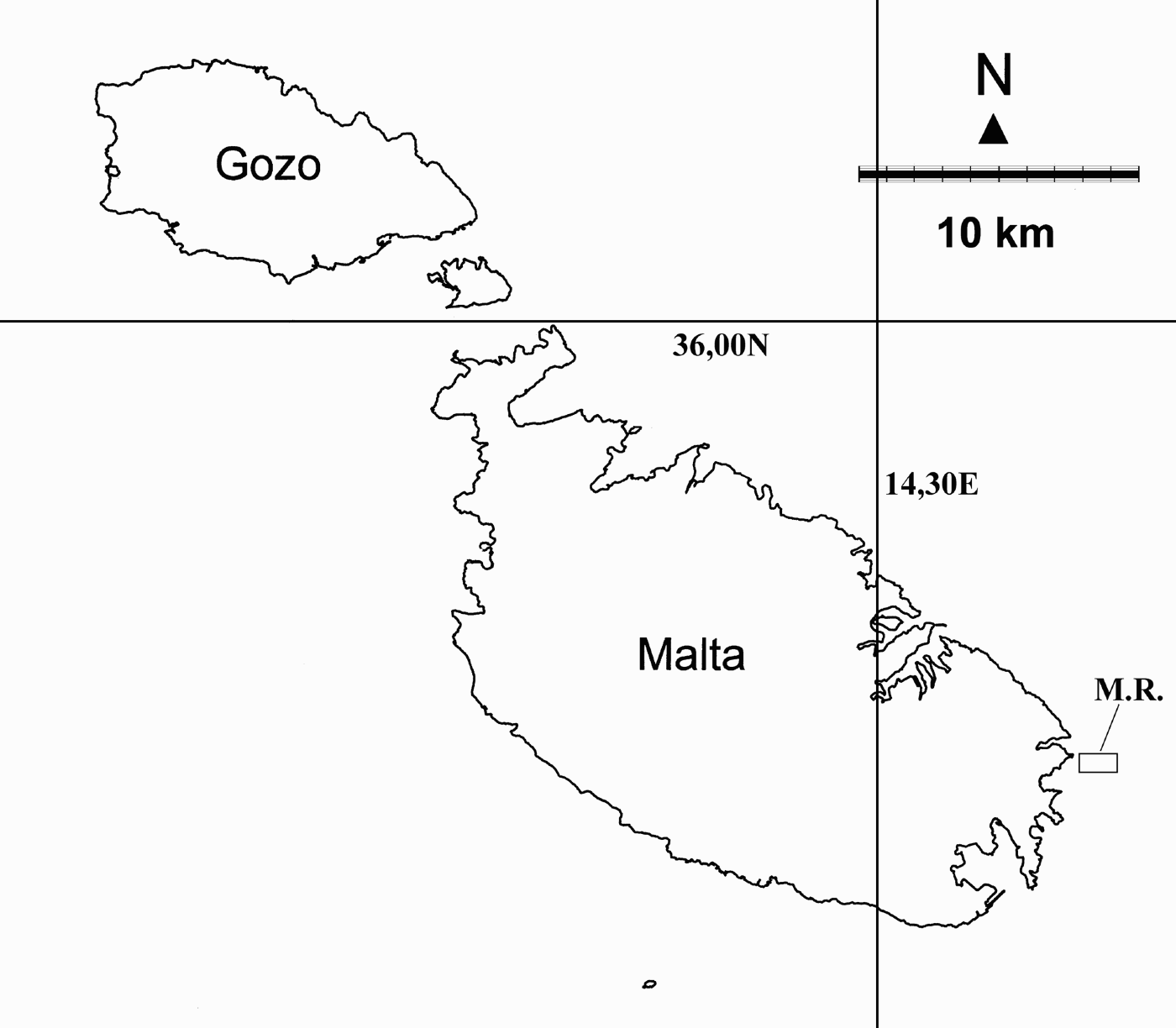
In August 2007, a female Selene dorsalis was caught at night by means of a traditional trammel net at a depth of 18 m on the Munxar Reef, in shallow waters off the south-eastern coast of the island of Malta, central Mediterranean (Figure 1). This is the first time this species has been recorded in the Mediterranean Sea, with its native range consisting of tropical and subtropical waters of the east Atlantic, from the Cape Verde Islands and Senegal to South Africa, and being generally a rare species in waters north of 18°N (Smith-Vaniz, Reference Smith-Vaniz, Whitehead, Bauchot, Hureau, Nielsen and Tortonese1986). The specimen was identified by T. Schembri, from the Department of Biology of the University of Malta, and various measurements were taken, following the FAO procedures (Agger et al., Reference Agger, Bagge, Hansen, Hoffman, Holden, Kesteven, Knudsen, Raitt, Saville and Williams1974).
Location of Munxar Reef (denoted by ‘M.R.’) in the Maltese Islands, site of collection of the Selene dorsalis specimen.

MATERIAL EXAMINED
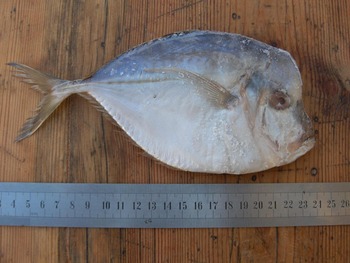
Selene dorsalis (Figure 2), 158.1 mm SL, Munxar Reef (Malta), 35°88′N–14°44′W, depth: 18 m, 12 August 2007.
Selene dorsalis specimen caught in coastal waters off the Maltese Islands.

SPECIMEN DESCRIPTION
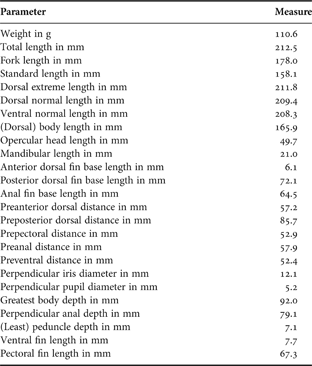
The specimen examined was a female weighing 110.6 g, with a total length of 212.5 mm. The distinctive characters were coincident with those given by Smith-Vaniz & Berry (Reference Smith-Vaniz, Berry, Fischer, Bianchi and Scott1981) and are reported in Table 1.
Morphometric and meristic data of the specimen of Selene dorsalis recorded in the Maltese Islands.

The African moonfish individual exhibits two dorsal fins, as has been reported for specimens of the same species caught in the Gulf of Cadiz (Juarez et al., Reference Juarez and Silva2006) and in the Canary Islands (Castro-Hernandez, Reference Castro-Hernandez2001). The first dorsal fin has four spines preceded by three smaller ones (not very apparent) and separated from the fin. There are three other spines between the first and the second dorsal fins. The second dorsal fin presents one spine and 23 soft rays. Second dorsal fin lobe only slightly elongated, contained 9.8 times in fork length, which is consistent with the range given by Smith-Vaniz & Berry (Reference Smith-Vaniz, Berry, Fischer, Bianchi and Scott1981), i.e. 7.2–10.1 times. Pelvic fin relatively short, becoming nearly rudimentary (2.7 times smaller than the upper jaw length). The anal fin has two reabsorbed spines, followed by one spine and 20 soft rays.
The body shape is short, deep (its depth being 1.93 times its fork length), extremely compressed and silvery with a light metallic bluish cast dorsally, a faint dusky opercular spot and a narrow black area on the top of the caudal peduncle. Head profile rounds at the top and slopes sharply through a slight concavity in front of the eye to a blunt snout with the lower jaw protruding. Eye moderately small, with head length 3.96 times its diameter, compared with the range of 3.3–4.2 given by Smith-Vaniz & Berry (Reference Smith-Vaniz, Berry, Fischer, Bianchi and Scott1981). Upper jaw short, expanded at the posterior end, and ending far below and about under the anterior margin of the eye. Lower jaw had a narrow irregular band tapering to an irregular row posteriorly. Fins are clear, with olive-yellow tints on the second dorsal, anal, pectoral and caudal fin lobes. Pelvic fins are white.
Scales are small, cycloid and smooth to the touch and cover most of the lower half of the body but are absent anteriorly on most of the area from the pelvic fin base to the junction of curved and straight portions of lateral line. Scutes in the straight part of lateral line are weak, being too inconspicuous to count.
DISCUSSION
Selene dorsalis is a demersal fish species, with young of less than 3 cm fork length occurring near the surface; juveniles may be found in bays and river mouths (Smith-Vaniz & Berry, Reference Smith-Vaniz, Berry, Fischer, Bianchi and Scott1981). The species generally forms schools, is carnivorous (feeding on small crustaceans and other fish) and is found within a depth-range of 20–100 m (Smith-Vaniz, Reference Smith-Vaniz, Whitehead, Bauchot, Hureau, Nielsen and Tortonese1986). The species is described as resilient, with a minimum population doubling time of less than 15 months (Smith-Vaniz, Reference Smith-Vaniz, Whitehead, Bauchot, Hureau, Nielsen and Tortonese1986). It is known by a series of different common names, including African moonfish, Atlantic moonfish, Guinean moonfish, African lookdown, shiner and pompano.
The African moonfish is a subtropical eastern Atlantic species which is common off the Cape Verde Islands and from Senegal to South Africa (Smith-Vaniz & Berry, Reference Smith-Vaniz, Berry, Fischer, Bianchi and Scott1981; Seret, Reference Seret1990), being fished on a commercial basis by means of pelagic and bottom trawls, especially off Ghana (Smith-Vaniz & Berry, Reference Smith-Vaniz, Berry, Fischer, Bianchi and Scott1981). The species is replaced by Selene setapinnis in the western Atlantic (Froese & Pauly, Reference Froese and Pauly2008). Bianchi (Reference Bianchi1992) lists the species as one of the four most common ones within shallow water assemblages from Angola to Benguela. Despite being considered rare north of 18°N (Smith-Vaniz, Reference Smith-Vaniz, Whitehead, Bauchot, Hureau, Nielsen and Tortonese1986), the species has established itself in waters around Portugal and Madeira—in fact, the species was first recorded from such waters by Smith-Vaniz & Berry (Reference Smith-Vaniz, Berry, Fischer, Bianchi and Scott1981), with its presence being recently confirmed by Wirtz et al. (Reference Wirtz, Fricke and Biscoito2008).
Selene dorsalis is not listed amongst the ninety exotic fish species list in the CIESM Atlas of exotic species in the Mediterranean (Fish; Golani et al., Reference Golani, Orsi-Relini, Massuti, Quignard and Briand2004), since the atlas includes exotic fish species for which at least three distinct published records exist. This may suggest that the S. dorsalis individual recorded in the central Mediterranean may simply constitute a vagrant (occasional adult visitor) or casual individual, rather than a member of a well-established population. The current record may be indicative of a ‘range expansion’ by the species, as postulated by Mori & Vacchi (Reference Mori and Vacchi2002), which may be the direct consequence of the well-documented warming of the Mediterranean Sea, rendering it more congenial to (sub) tropical species (Bianchi, Reference Bianchi2007). Entry of S. dorsalis into the Mediterranean could have been mediated by the ship ballast water-transport of larvae or juveniles of the species, as this constitutes one of the major avenues of proliferation of non-indigenous species (Galil, Reference Galil, Davenport and Davenport2006), besides through the unaided dispersal of adult specimens. The displacement of the northern limit of the native range of the species, due to local-warming of water masses, is also hinted at by Juarez & Silva, Reference Juarez and Silva2006, after successive records of S. dorsalis from the Canary Islands, Spain (Castro-Hernandez, Reference Castro-Hernandez2001), Moroccan waters (Baddyr & Guenette, Reference Baddyr, Guénette, Guénette, Christensen and Pauly2001) and the Gulf of Cadiz, Spain (Juarez & Silva, Reference Juarez and Silva2006).
Within the Mediterranean, S. dorsalis could potentially be described as an ‘unestablished alien’ (defined by Occhipinti-Ambrogi & Galil, Reference Occhipinti-Ambrogi and Galil2004, as ‘an alien lacking self-maintaining populations outside its natural range, either because it were unable so far to settle, or is too newly arrived’), since the new species record being reported in this paper is not supported, to date, by other similar records elsewhere in the Mediterranean. Alternatively, the individual recorded could constitute a casual Atlantic entry, although the progressive northward spread of the species, as recorded in literature, might suggest the ‘unestablished alien’ status as being more plausible. Comprehensive ichthyological censuses are necessary to establish conclusively the current status of S. dorsalis in the Mediterranean Sea.
One-third of the exotic fish species recorded in the Mediterranean listed by Golani et al. (Reference Golani, Orsi-Relini, Massuti, Quignard and Briand2004) originate from Atlantic regions, most being from tropical, rather than boreal, regions of the Atlantic. In fact, just three of the ninety recognized (established) exotic fish species in the Mediterranean are of boreal origin (Golani et al., Reference Golani, Orsi-Relini, Massuti, Quignard and Briand2004). Of the exotic fish species of Atlantic affinity, just four have established populations in the Mediterranean basin, as testified by their being regularly caught. Conversely, according to the same authors, more than a dozen ‘lessepsian’ fish migrants are of commercial importance in the Mediterranean, suggesting that the physico-chemical characteristics of the basin are more congenial to Indo-Pacific and Erythrean introductions.
To date, at least fourteen exotic fish species have been reported from coastal waters off the Maltese Islands and the broader (including waters around the Pelagian Islands and between Sicily and Tunisia) Malta Channel in the central Mediterranean (Sciberras & Schembri, Reference Sciberras and Schembri2008; Azzurro et al., Reference Azzurro, Schembri, Piermarini, Scarpato and Andaloro2008). Of these, just four (Seriola sp., Seriola fasciata, Seriola carpenteri and Pisodonophis semicinctus) have an Atlantic (tropical, in many cases) affinity.
ACKNOWLEDGEMENTS
We are grateful to Mr R. Ghiller, the fisherman who was responsible for capturing the described specimen, to S. Cammerino for storing the specimen, as well as to Professor P.J. Schembri and Mr Titian Schembri for their invaluable guidance and assistance and to Professor A. Occhipinti-Ambrogi and Dr B. Galil for their help in gleaning the necessary literature.