

1. Introduction
A decade ago, Hornberger & Johnson proposed that the Ethnography of Language Planning and Policy (ELPP) offers a useful way to understand how people create, interpret, and at times resist Language Planning and Policy (LPP) across layered ideological and implementational spaces. Comparing their ethnographic work in Philadelphia where two successive district administrators interpreted the same U.S. educational policy in ways that alternately closed down or opened up spaces for bilingual education programs, and in Bolivia where faculty and Indigenous students in an innovative intercultural bilingual education master's program constructed and negotiated spaces for Indigenous rights and Indigenous education surpassing those envisioned in national multilingual language policies, Hornberger & Johnson suggested that the ethnography of LPP is an apt methodological approach to slice through layers of ideological and implementational LPP spaces to uncover and foreground indistinct voices and unintended consequences in the quest for implementing more robust and successful multilingual education (Hornberger & Johnson Reference Hornberger and Johnson2007).
Five years earlier, Hornberger (Reference Hornberger2002) had offered a plea for language users, educators, and researchers to fill up and wedge open ideological and implementational spaces for multiple languages, literacies, identities, and practices to flourish and grow rather than dwindle and disappear. The opening and filling up of ideological and implementational spaces for multilingual education was an ethnographic insight inspired by the emergence of alternative multicultural discourses Chick (Reference Chick2001) had observed opening up among teachers in South Africa in the wake of post-apartheid multilingual language policies. In Hornberger's ethnographic examination of multilingual language policies in South Africa and Bolivia, she argued that language educators, language planners, and language users urgently need to fill ideological and implementational spaces for multiple languages, literacies, and identities in classroom, community, and society as richly and fully as possible before they close in again (Hornberger Reference Hornberger2002). Later, comparing South African and Bolivian experiences with the creative responses of local educators to U.S. No Child Left Behind policies, she went on to suggest that implementational spaces carved out from the bottom up can wedge ideological spaces open even when top-down policies begin to close them (Hornberger Reference Hornberger, García, Skutnabb-Kangas and Torres-Guzmán2006b).
With roots going back to the 1980s and 1990s, ethnographic research in LPP had been gathering momentum since the turn of the millennium. Paralleling and influencing sociopolitical, epistemological, and strategic paradigm shifts in LPP research since World War II (Ricento Reference Ricento2000), research methods in LPP embraced an expanding repertoire, from methods favoring large-scale census, survey, and self-report questionnaires to inform problem-solving language policies at national or regional levels in the 1950s–1960s; to economic, legal, and political analyses aimed at reforming structures of unequal access in the 1970s–1980s; to ethnographic on-the-ground methods directed toward illuminating the complexities of enacting LPP in local contexts, beginning in the late 1980s (Hornberger Reference Hornberger, Hult and Johnson2015). Earlier LPP studies that focused on describing top-down processes of national language planning were criticized for underlying positivist orientations and for not giving due consideration to sociopolitical context (Ricento Reference Ricento2000; Johnson & Ricento Reference Johnson and Ricento2013). Critical approaches were in turn seen as falling short in accounting for multilayered processes of language planning and as underestimating the agentive role of local actors and how their practices relate to language policies on the macro-level (Davis Reference Davis, Huebner and Davis1999).
At the same time, ethnographic research—whether in homes and communities, classrooms and schools, government and other institutions, online and social network sites, or other settings—had increasingly taken language, communication, and discourse practices into account in explicit ways, in recognition that social actors’ ways of being, doing, and knowing are intimately tied to and indeed constructed by their ways of communicating. The convergence of these two trends over several decades at the end of the 20th century led to the emergence and burgeoning of empirical research and programmatic statements in what has come to be known as the ethnography of language planning and policy (alternatively glossed as language policy and planning) (Canagarajah Reference Canagarajah and Ricento2006; Hornberger & Johnson Reference Hornberger and Johnson2007; Johnson Reference Johnson2009; Hornberger & Johnson Reference Hornberger, Johnson and McCarty2011; McCarty Reference McCarty2011; Hornberger Reference Hornberger, Hult and Johnson2015).
Early ethnographic LPP studies in education illuminated paradoxical tensions within communities (Hornberger Reference Hornberger1988 on Quechua and bilingual education in Peru) or across LPP levels (Davis Reference Davis1994 on multilingual education in Luxembourg); local classroom-level resistance to official LPP (Canagarajah Reference Canagarajah1995, Reference Canagarajah1997); the power of community involvement in bilingual education (Freeman Reference Freeman1998); paradoxical unintended consequences (Jaffe Reference Jaffe1999 on Corsica); positive side effects (King Reference King2001 on Quichua in Ecuador); or covert underlying motivations (Schiffman Reference Schiffman1996, Reference Schiffman2003 on Tamil in Singapore) in LPP (for more examples, see Johnson Reference Johnson and Ricento2013: 46). An accelerating trajectory of ethnographic LPP research since 2000 has focused in turn on themes of reclaiming the local in language policy (Canagarajah Reference Canagarajah2005), imagining multilingual schools (García, Skutnabb-Kangas & Torres-Guzmán Reference García, Skutnabb-Kangas and Torres-Guzmán2006), schools saving Indigenous languages (Hornberger Reference Hornberger2008), educators and students engaging in heteroglossic practices in heritage language education (Blackledge & Creese Reference Blackledge and Creese2010), educators negotiating language policy in schools (Menken & García Reference Menken and García2010), informal, everyday language policymaking (McCarty Reference McCarty2011), and Indigenous LPP across time, space, and place (Hornberger & McCarty Reference Hornberger and McCarty2012).
These methodological and thematic trends in LPP research are reflected in five key journals which have helped shape the LPP field, and which are the focus of our review here. Two mainstay LPP academic journals launched in the 1970s were the International Journal of the Sociology of Language (IJSL), edited by intellectual giant and internationally recognized founder of the language planning field, Joshua Fishman; and Language Problems and Language Planning, reflecting the problem-solving orientation characteristic of LPP research at the time and still with us, though the problems and their solutions are understood in arguably more nuanced and complex terms. Emblematic of the field are Fishman's IJSL and his Contributions to the Sociology of Language book series, offering encyclopedic documentation of multilingual national contexts and the fate of language policies therein. Three newer LPP-oriented journals—Language Policy, Current Issues in Language Planning, and the Journal of Language, Identity and Education—joined these publications in 2000, infusing intellectual energy into the field with increased attention to critical, postmodern, complexity, and globalization theoretical perspectives and more contributions from ethnographic and discourse analytic methodological approaches.
Our focus here is on ethnographic LPP research studies since 2000 as reported in these five LPP-related journals (and selections from a handful of others), but before delving into our review, we briefly introduce its two constituent fields: LPP and ethnography. Then, after a quick look back at the beginnings of LPP ethnography at the end of the 20th century, we take up discussion of the work since 2000, focusing primarily on education settings since this is where the bulk of the work has been carried out. The literature we review also reflects the increasingly explicit emphasis in LPP research on an underlying advocacy for multilingual and heteroglossic language policy and practices—part of and contributing to the ‘multilingual turn’ in language education research and practice more generally (May Reference May2013).
Throughout, we draw on and develop the notion of ideological and implementational LPP spaces as scalar, layered policies and practices influencing each other, mutually reinforcing, wedging, and transforming ideology through implementation and vice versa. This view of LPP spaces as layered and scalar refers to permeation across and indexical relationships among different LPP spaces and levels, originally articulated in LPP as the metaphorical onion (Ricento & Hornberger Reference Ricento and Hornberger1996) and consonant with recent formulations in discourse analysis, linguistic anthropology, and sociolinguistics that move beyond binary analytic categories like macro vs. micro or structure vs. agency to employ alternative concepts such as cross-event speech chains and trajectories, stratified indexicality, and spatiotemporal scales (Wortham Reference Wortham2005; Blommaert Reference Blommaert2007; Wortham Reference Wortham2008; Jie & Blommaert Reference Jie and Blommaert2009; Hult Reference Hult2010). Along these lines, our review highlights how common-sense wisdom about the perennial gap between policy and practice is reframed and given nuance through ethnographic LPP research that identifies and explores intertwining dynamics of top-down and bottom-up LPP activities and processes, monoglossic and heteroglossic language ideologies and practices, potential equality and actual inequality of languages, and critical and transformative LPP research paradigms.
1.1 LPP
Haugen is often credited as originator of the term ‘language planning’, which he defined as ‘the activity of preparing a normative orthography, grammar, and dictionary for the guidance of writers and speakers in a non-homogeneous speech community’ (Haugen Reference Haugen1959: 8) and used to describe efforts to develop a standardized register of Norwegian in the modern period. This focus on intentionality of language planning efforts continued to define subsequent work in the emerging field, with scholars conceptualizing the enactment of language planning as ‘deliberate,’ ‘organized,’ and ‘managerial’ (see, e.g., Rubin & Jernudd Reference Rubin and Jernudd1971; Fishman Reference Fishman1973; Karam Reference Karam and Fishman1974). Crucially, this understanding of language planning efforts envisioned an inherently top-down endeavor, whereby governmental institutions or other authoritative bodies would undertake large-scale linguistic behavioral change of some community (Fishman Reference Fishman, Ohannessian, Ferguson and Polomé1975).
In his highly influential book Language planning and social change, Cooper (Reference Cooper1989) follows those before in seeing language planning as an intentional act, but, significantly, expands the scope of previous conceptualizations. Using historical examples such as grassroots efforts to eliminate sex-bias in everyday language practices (e.g., advocating for humanity in place of mankind) as a part of the U.S. feminist movement of the 1960s, Cooper shows how conceptualizations of language planning can move beyond the top-down, macro-level contexts that had previously dominated the field to encompass bottom-up, micro-level efforts to affect wider social change as well.
Much research over the past three decades has also sought to define language policy, although no one definition has yet come to the fore (Ricento Reference Ricento2006). While some early work positioned language policy as the codified, neutral output of language planning, a groundbreaking paradigm shift was Tollefson's (Reference Tollefson1991) incorporation of power, social structure, and ideologies through his multilevel historical-structural analyses of language policy, as he sought to clarify how language planning too often contributes to and reinforces language inequality. Johnson (Reference Johnson and Ricento2013) argues this conceptualization can be traced back to work by Kloss (Reference Kloss1977) and Ruíz (Reference Ruíz1984) on orientations in language planning, which first connected ways of thinking and talking about language to the ways societies seek to shape and control language use and language users.
The boundaries between language planning and language policy are difficult to define (Shohamy Reference Shohamy2006) and likely will not be any less so in the near future (see, e.g., García & Menken Reference García, Menken, Menken and García2010). It is in the context of this complexity, however, that we see the benefit of an integrated LPP concept and framework. By situating planning processes and policy as inherently interrelated in a way that does not require one to foreground the other, LPP goes beyond simply circumventing the lack of agreement on each concept to underline the emergent nature of what cannot be captured by describing the two phenomena separately. Its usefulness lies in its ability to call attention to the dynamic ways in which language planning and language policy are each able to give rise to the other while simultaneously highlighting their interrelatedness. For these reasons, we contend that as a conceptual framework, an integrated notion of LPP aids us in ‘pursu[ing] fuller understanding of the complexity of the policy–planning relationship and in turn of its insertion in processes of social change’ (Hornberger Reference Hornberger and Ricento2006a: 25).
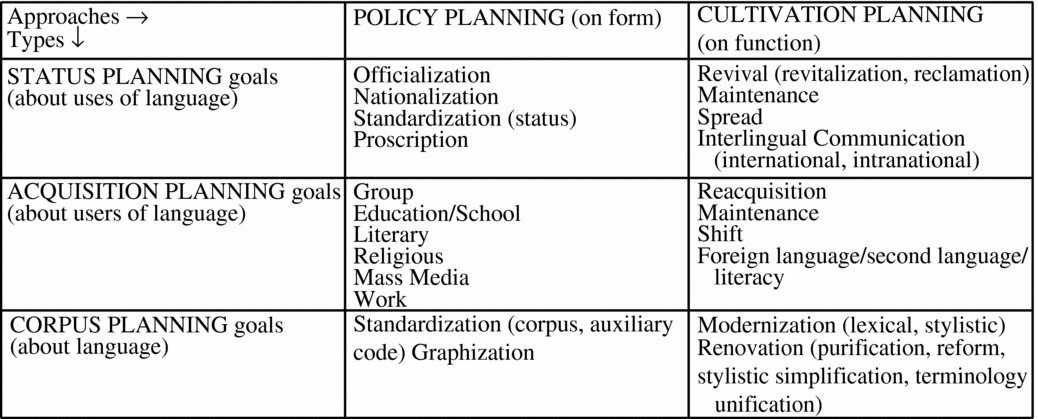
To this end, Hornberger's (Reference Hornberger1994, Reference Hornberger and Ricento2006a) six-dimensional LPP integrative framework (see Figure 1) provides an invaluable heuristic for both conceptualizing and researching the multiple and interconnected relationships among the goals of LPP activity that have been described across the literature over the decades (cf. Ferguson Reference Ferguson, Fishman, Ferguson and Gupta1968, Stewart Reference Stewart and Fishman1968, Nahir Reference Nahir1984, Hornberger Reference Hornberger1994). Building on an earlier four-dimensional model proposed by Haugen (Reference Haugen and Cobarrubias1983), this framework interweaves goals of status, acquisition, and corpus types of LPP with those of policy and cultivation approaches to LPP. The status and corpus planning types along the framework's vertical axis are taken from Kloss's (Reference Kloss1969) early distinction between planning efforts directed toward the allocation of functions of language and the structure of languages, respectively. Acquisition planning—Cooper's (Reference Cooper1989) contribution—speaks to efforts that influence the distribution of languages and/or their speakers. The horizontal axis of the framework comprises Neustupný’s (Reference Neustupný and Fishman1974) distinction between policy planning addressing matters of nation and society and cultivation planning addressing matters of language/literacy, or sociological/macroscopic and anthropological/microscopic approaches to language planning, respectively. In an array highlighting the multiscalar and multilayered nature of LPP activities and processes, specific LPP goals, then, are found at each intersecting domain of planning approaches and types, serving as a ‘range of choices available within those parameters’ (Hornberger Reference Hornberger and Ricento2006a: 30).
Language planning and policy: An integrative framework of approaches, types, and goals
LPP research has thus gone through a series of theoretical and methodological shifts over the years. Research paradigms that could strike a balance between attention to structure and agency were called for and provided by scholars advocating for an ethnographic approach to the study of LPP (Canagarajah Reference Canagarajah2005, Reference Canagarajah and Ricento2006). Ricento & Hornberger (Reference Ricento and Hornberger1996) introduced the metaphor of the LPP onion to highlight the multiple layers of LPP—composed of agents, levels, and processes—moving away from solely top-down understandings of LPP in order to describe how the different layers ‘permeate and interact with each other in a variety of ways and to varying degrees’ (Ricento & Hornberger Reference Ricento and Hornberger1996: 402). Hornberger & Johnson (Reference Hornberger and Johnson2007), in turn, argued that ethnography enables researchers to slice through the layers of the onion to reveal ideological and implementational spaces in which local actors implement, interpret, resist, and transform policy initiatives.
1.2 Ethnography
Ethnography is not just a methodological toolkit that encompasses participant observation, interviews, and document collection, though these methods are mainstays of ethnographic research. With origins in the field of anthropology, ethnography is crucially guided by an ontological and epistemological stance that views human life as created through people making sense of their own lives. Instead of imposing a priori research assumptions or hypotheses, an ethnographer strives to gain understanding by spending time with participants, collecting multiple interpretations from various sources, and looking for recurring patterns while attending to what is being left out. This ethnographic lens enables rich description of a community or a group of people on the ground by making explicit and portraying ‘what its various members know only tacitly and understand individually’ (Wolcott Reference Wolcott, Spindler and Spindler1987: 41–42).
In keeping with this ethnographic foundation, several traditions have expanded the role of the ethnographer and the implications/contributions of ethnographic inquiry beyond its origins in anthropology. Critical, postmodern, and feminist ethnographic orientations have particularly illuminated ethnography's potential to connect cultural description and interpretation to analysis of power dynamics, engage with reflexivity of the research process and product, and support social justice and participant empowerment. A critical interpretive approach in bilingual education research was seen as one that aims to ‘reveal the links between local discourse practices (bilingual or monolingual), the everyday talk and interactional routines of classrooms and the wider social and ideological order’ (Martin-Jones Reference Martin-Jones and Heller2007: 171). Researchers distinguished critical ethnography with its attention to and examination of the ‘origins and constitutive processes of macrostructural forces’ that cause and maintain social inequalities (Anderson & Irvine Reference Anderson, Irvine, Lankshear and McLaren1993: 85) from interpretive ethnography whose focus is on describing and interpreting the production and negotiation processes of cultural meanings. In other words, critical ethnography particularly attends to the interrelationships between cultural practices and social structures that maintain and reproduce societal inequalities.
Work in educational linguistics, sociolinguistics, and linguistic anthropology carved out a view of ethnography as a democratic and counter-hegemonic theoretical paradigm (Hymes Reference Hymes1980b; Blommaert Reference Blommaert2009). Johnson (Reference Johnson2009) argues that the ethnography of LPP, in particular, follows this tradition of ethnographic research on language diversity, which is largely influenced by Hymes's (Reference Hymes1964, Reference Hymes and Fishman1968) ethnography of communication. While earlier ethnographers had observed linguistic practices as a vehicle for understanding culture, leaving analysis of language per se to theoretical linguists, for Hymes, ethnography enabled the study of language as inextricably linked to social life. He argued that language is situated social activity, meriting the in-depth, multilayered analysis of ethnographic research.
In a thorough reading of Hymes's oeuvre, Blommaert notes that the ethnographic study of language proposed by Hymes carries epistemological and ontological implications for the ethnographic endeavor:
There is no way in which knowledge of language can be separated from the situatedness of the object at a variety of levels, ranging from microscopic to macroscopic levels of ‘context’ and involving, reflexively, the acts of knowledge production by ethnographers themselves (Blommaert Reference Blommaert2009: 266).
For Hymes, ethnography ‘would be a science “of the people”’ (Blommaert Reference Blommaert2009: 258), abstaining from a priori theorizing and rather focusing on the lived experiences and meanings of those it studied. As such, ethnography could complexify, rather than simplify, social experiences and meanings, constituting a counter-hegemonic paradigm ‘that destabilized accepted views by allowing different voices to speak: a science that constantly calls into question the status of “truth”’ (Blommaert Reference Blommaert2009: 258). Hymes's counter-hegemonic paradigm was deeply guided by a concern to illuminate, contest, and transform linguistic inequalities in society (see also Hymes Reference Hymes and Hymes1980a). In calling for ethnographic monitoring for bilingual education, for example, Hymes not only emphasized the cumulative and comparative nature of ethnography across space and time but also its critical and collaborative potentials responsive to the goals and values of local communities.
Various ethnographic traditions have highlighted the activities of the researcher as not only describing and interpreting the social world but also as acting on and influencing that world in various ways (Canagarajah Reference Canagarajah and Ricento2006; Hammersley & Martyn Reference Hammersley and Martyn2007). Reflexivity, ‘directing one's gaze at one's own experience’ (Foley Reference Foley2002: 473), has spurred ethnographers’ examination of the contingent and power-wrought nature of researcher-participant relations, interpretation, and representation practices (Fabian Reference Fabian1983; Clifford & Marcus Reference Clifford and Marcus1986; Skeggs Reference Skeggs, Atkinson, Coffey, Delamont, Lofland and Lofland2001). Researchers have also recognized the potential of ethnography to not only produce nuanced and locally grounded knowledge and theory but also empower participants (Lather Reference Lather1986) and contribute to greater social justice (Hymes Reference Hymes1980b, Reference Hymes1996). Within the field of education, ethnographic monitoring (Hymes Reference Hymes and Hymes1980a; see also De Korne & Hornberger Reference De Korne, Hornberger, Martin-Jones and Martin2017), community-based action research (McCarty et al. Reference McCarty, Romero-Little, Warhol and Zepeda2009), culturally responsive and decolonizing methodologies (Chilisa Reference Chilisa2012; Smith Reference Smith2012; Berryman, SooHoo & Nevin Reference Berryman, SooHoo and Nevin2013a; Hill & May Reference Hill and May2013) and practitioner research (Cochran-Smith & Lytle Reference Cochran-Smith and Lytle2009) are some methodologies guided by the understanding of researchers as social actors who can address social inequalities and of research as an endeavor which can engage with participant needs and goals as well as include participants in research processes.
Although this latter stance diverges from traditional interpretive ethnography, these methodologies still share the principles of respect and embracing of an insider perspective from which they build potential collaborative social actions. In her recent essay on ethnographic research in LPP and inspired by both Wolcott and Hymes, McCarty (Reference McCarty, Hult and Johnson2015) puts this as the threefold enterprise of ethnography: not only a way of seeing through the lens of cultural interpretation and a way of looking grounded in long-term, participant observation but also a way of being that incorporates a humanizing, democratizing, and anti‐hegemonic moral stance toward social inquiry.
2. Ethnography of LPP: Intertwining dynamics
Along this line of ethnographic scholarship and through an accumulated understanding of LPP as a complex enterprise involving various and layered language planning types and language policy processes, an increasing number of LPP scholars began to conduct ethnographic research in LPP around the turn of the millennium. Hornberger & Johnson (Reference Hornberger and Johnson2007, Reference Hornberger, Johnson and McCarty2011) charted a role for what they called the ethnography of language policy as a way to illuminate different layers of the LPP onion (Ricento & Hornberger Reference Ricento and Hornberger1996), and to highlight the opening up and closing down of implementational and ideological spaces in educational LPP (see also Hornberger Reference Hornberger2002, Reference Hornberger2005, Reference Hornberger, García, Skutnabb-Kangas and Torres-Guzmán2006b; Johnson Reference Johnson2009, Reference Johnson2010). This research paradigm has become a promising theoretical and methodological framework, whose burgeoning literature of empirical research is reviewed here. An ethnography of LPP approaches LPP activities and goals as scalar, multilayered, and complex phenomena, and examines different language planning types (corpus, status, and acquisition planning) and language policy processes (creation, interpretation, and appropriation of policies), attending to both policy texts and policy discourses as well as on-the-ground policy practices (Mortimer Reference Mortimer2013). LPP ethnographies unite a critical focus on the power of LPP activities to both exacerbate and transform inequalities with an ethnographic focus on individual agency and the complexities of local processes of policy interpretation and implementation.
The ethnography of LPP in its classic form is based on long-term engagement with participants and the methods of participant observation, interview, and document collection; and although the contexts and modes of data collection may have expanded and diversified since ethnography's early days, that triumvirate of methods is still the solid ground of ethnographic research. In this work, the holistic and emic account ethnographers strive for is achieved by systematic, iterative analysis and comparison of insights gained from long-term, intensive participant observation documented in fieldnotes and/or (video)recording; from focus group or individual interviews, including semi-structured interviews, life-histories, re-storyings, multi-generational interviews, retrospective interviews, diary- and photo-based interviews, in-depth interviews, and youth counter-narratives; and from documents, including macro-policy texts as well as local materials, online media, and in some cases survey questionnaire data.
While contexts of ethnographic LPP research span family language policy decisions in home and family settings, worship, and/or youth group activities in religious congregations and social communities, workplaces and markets, institutions and government agencies, online and social network sites, and others, the bulk of LPP ethnographic research, and of the work reviewed here, encompasses educational settings. Ethnographies of LPP yield nuanced and layered accounts of the ways children, parents, communities, and educators take up, resist, and transform language education policy initiatives in contexts around the world as varied as: bilingual/trilingual/multilingual education programs, Indigenous and heritage language immersion classrooms, second- and foreign-language teaching classrooms, Indigenous and immigrant/refugee families’ engagements with or resistance to restrictive language education policies and practices, and teachers’ enactment of school language policies in highly regimented environments.
Hornberger & Johnson (Reference Hornberger and Johnson2007, Reference Hornberger, Johnson and McCarty2011) argued that adopting an ethnographic paradigm for the study of LPP offers at least four potential promises. First, it offers opportunity for thick description (Geertz Reference Geertz1973) of language planning in local contexts by illuminating ‘how people make, interpret, and otherwise engage with the policy process’ (Levinson & Sutton Reference Levinson, Sutton, Sutton and Levinson2001: 4), which cannot be assumed a priori of the inquiry. Second, by tracing relationships across various layers of language planning activities, the ethnography of LPP supersedes limitations of critical approaches that tend to focus on macro-level policies (Hornberger & Johnson Reference Hornberger and Johnson2007). Third, an ethnographic paradigm of LPP research can reveal ‘covert motivations, embedded ideologies, invisible instances or unintended consequences of LPP’ (Hornberger & Johnson Reference Hornberger, Johnson and McCarty2011: 275). Finally, and crucially, the ethnography of LPP carries the potential to illuminate and inform implementational and ideological spaces as they are pried open or closed down by policy texts and practices at every level of LPP activity (Hornberger Reference Hornberger2002, Reference Hornberger, García, Skutnabb-Kangas and Torres-Guzmán2006; Hornberger & Johnson Reference Hornberger and Johnson2007; Johnson Reference Johnson2009).
The so-called policy–practice or policy–implementation gap that has long plagued policy studies is made very visible in LPP ethnography, with researchers repeatedly pointing to the need to look at political processes across scales (Ricento & Hornberger Reference Ricento and Hornberger1996; Hornberger & Johnson Reference Hornberger and Johnson2007; Menken & García Reference Menken and García2010) and especially to take into account local ideologies and practices that may contradict intended policy. Here, we highlight a series of intertwining dynamics that give nuance to the age-old and ever-elusive policy–practice gap. Drawing on ethnographic research published in the five LPP journals presented in the introduction––IJSL, Language Problems and Language Planning, Language Policy, Current Issues in Language Planning and the Journal of Language, Identity and Education––as well as selected articles from the Anthropology & Education Quarterly, International Journal of Bilingual Education and Bilingualism, Journal of Multilingual and Multicultural Development, Language & Education, TESOL Quarterly and others, we consider how the ethnography of LPP helps us understand gaps from policy to practice in terms of four intertwining dynamics: top-down and bottom-up LPP activities and processes; monoglossic and heteroglossic language ideologies and practices; potential equality and actual inequality of languages; and critical and transformative LPP research paradigms. Consistent with the bulk of the work in ethnography of LPP, we focus primarily (though not exclusively) on research in educational settings and from a stance of advocacy for multilingualism and heteroglossic practices. Our effort is to explore to what extent the promises formulated by Hornberger & Johnson (Reference Hornberger and Johnson2007, Reference Hornberger, Johnson and McCarty2011) and others are in fact reflected and fulfilled in the recent few decades of ethnographic LPP research.
2.1 Top-down and bottom-up LPP activities and processes
The intertwining dynamic between on-the-ground LPP practices and top-down language policies can both open and close spaces favorable for minoritized languages and multilingualism. Various LPP ethnographies with a focus on grassroots LPP initiatives and LPP appropriation—the uptake and recontextualization of policy elements by micro-level actors (Levinson & Sutton Reference Levinson, Sutton, Sutton and Levinson2001; Johnson Reference Johnson and Ricento2013)—describe bottom-up LPP activities and processes led by various LPP actors with the potential to influence LPP across contexts and layers. We consider here how current research has methodologically and analytically approached the scaled relationships and interactions across micro- and macro-level LPP.
Several case studies offer examples of grassroots LPP appropriation along a continuum of support for Indigenous languages beyond or in spite of macro-policy intent (Hornberger Reference Hornberger1997). Bottom-up language planning for Indigenous languages in educational contexts may make use of economic and practical resources top-down policy provisions for economic and practical resources to put Indigenous languages in school (Ferguson Reference Ferguson2010), present an explicit alternative to top-down policies created by outsiders in international education development contexts (Nagai Reference Nagai1999), or even develop Indigenous language education in spite of lack of top-down policy support (Patrick, Budach & Muckpaloo Reference Patrick, Budach and Muckpaloo2013).
Implementational and ideological spaces created by top-down language policies that promote Indigenous or vernacular language maintenance or revitalization are not necessarily powerful enough to overcome societal discourses, language ideologies, or the ‘force of history’ (Hornberger Reference Hornberger1998: 445). Drawing on ethnographic research in Latin American countries, Mortimer (Reference Mortimer2013), Zavala (Reference Zavala2014) and Limerick (Reference Limerick2015) describe cases of top-down policies favorable to the expanded use of the Indigenous languages Guaraní, Quechua, and Quichua in schools of Paraguay, Peru, and Ecuador respectively. These policies open up potential implementational spaces for multilingualism which nevertheless get closed down at the local level given dominant representations of who and what constitutes speaking an Indigenous language, often associated with ‘ruralness and . . . ignorance’ (Mortimer Reference Mortimer2013: 76), ‘the past,’ and the ‘other’ (Zavala Reference Zavala2014: 4), or in the case of Ecuadorian Indigenous leaders in intercultural bilingual education, speaking ‘like the state’ in Quichua in ways that paradoxically distances them from their own constituents who speak the language on a daily basis (Limerick Reference Limerick2015).
Ethnographic research sheds light on the myriad contextual factors that influence interpretation and appropriation of top-down governmental policies favoring minoritized language use in education. Across postcolonial contexts such as Mexico, Jamaica, Kenya, and Peru, as teachers negotiate such policies, they must constantly make sense of the role of high stakes testing in dominant languages (Valdiviezo Reference Valdiviezo2013 in Peru; Nero Reference Nero2014 in Jamaica), the diverse composition and fluency of the student body (Jones & Barkhuizen Reference Jones and Barkhuizen2011 in Kenya), the local relevance of top-down Indigenous literacy (Paciotto Reference Paciotto2004 in Mexico) and their own proficiency in languages of instruction (Jones & Barkhuizen Reference Jones and Barkhuizen2011), alongside their diverse aspirations for their students, communities, and languages. Moreover, Nero (Reference Nero2014) and Valdiviezo (Reference Valdiviezo2013) show how teachers negotiate the weight of dominant language ideologies, be they ideologies of linguicism (Phillipson Reference Phillipson, Skutnabb-Kangas and Cummins1988; Skutnabb-Kangas Reference Skutnabb-Kangas, Skutnabb-Kangas and Cummins1988) in Jamaica or discourses of castellanización ‘hispanicization’ in Peru, in ways that both include and exclude minoritized languages and cultures in education. Thus, while macro-level policy support may be essential for minoritized and Indigenous language maintenance and use, it is not necessarily sufficient.
Reciprocally, where macro-level support is lacking and top-down restrictive language policies seek to close implementational and ideological spaces for multilingualism, ethnographies of LPP emphasize actors’ agency in negotiating restrictive top-down policies, at times countering policies’ stated goals. Ethnography of LPP has the capacity to demonstrate how it is that the interpretation and appropriation of top-down language policy is not necessarily predicated on the intentions of the policy, but rather depends greatly on the agency of local actors. For example, educational ethnographies of LPP offer cumulative insights to the understanding of educators as policymakers––not only educational officials at national, regional, and school district layers of policymaking but also school principals, administrators, classroom teachers, and others (Ricento & Hornberger Reference Ricento and Hornberger1996; Menken & García Reference Menken and García2010). Goodman's (Reference Goodman2014) ethnographic findings on the implementation of an English-as-medium-of-instruction policy in a private Ukrainian university where Russian was the predominant language showed that despite numerous pedagogical challenges—such as the negotiation of language vs. content expertise, considerable anxiety about their English language skills, difficulties in obtaining textbooks and other print resources in English, and the necessity of adjustments to speaking pace, discipline, and general classroom discourse—teachers (and students) not only crafted solutions to the challenges but also saw teaching and learning in English as a worthwhile opportunity that, along with learning (through) Russian, Ukrainian, and other foreign languages, offered a means toward a more prosperous future.
Within the context of language education policy in the No Child Left Behind Act of 2001 in the United States, Johnson (Reference Johnson2010) explains how actors in the School District of Philadelphia successively closed and opened spaces for additive bilingual education (see also Johnson & Johnson Reference Johnson2015), while Paciotto & Delany-Barmann describe how Illinois teachers ‘corrected’ a top-down transitional bilingual education state policy by creating an alternative policy that promotes dual immersion education (Paciotto & Delany-Barmann Reference Paciotto and Delany-Barmann2011: 226) and Langman (Reference Langman2014) shows how Texas educators allowed for translanguaging and transcultural practices for science teachers serving English language learners (ELLs) within content area classes. Together, these studies transcend rigid views of policy imposition or policy resistance (see also Jaspers Reference Jaspers2015), instead providing nuanced and complex accounts of the negotiation of top-down LPP. In doing so, they invite us to consider the ephemerality of policy negotiations and gains (Johnson Reference Johnson2010), the long and challenging road to crafting dual language education programs (Paciotto & Delany-Barmann Reference Paciotto and Delany-Barmann2011), and teachers’ policy contestations, often below the level of their awareness, which can, however, be re-engaged for more conscious teacher policymaking efforts (Langman Reference Langman2014).
A running thread among ethnographies of bottom-up LPP is local actors’ thoughtful, committed and creative involvement in crafting spaces for minoritized language use. Bottom-up language planning can take the shape of speakers’ daily language practices and strategic communicative choices in Tutchone language revitalization efforts in the U.S. (Ferguson Reference Ferguson2010), intercultural bilingual educators’ professional and personal trajectories (Hornberger Reference Hornberger2014b), and tensions and yearnings experienced by Native American youth (McCarty & Wyman Reference McCarty and Wyman2009; McCarty et al. Reference McCarty, Romero-Little, Warhol and Zepeda2009). Bottom-up LPP activities are also often spearheaded by academic–community partnerships, where symmetrical relationships among researchers and community members (Nagai Reference Nagai1999) and conditions for inclusion and participation of a heterogeneous group of community members are not givens but are instead consciously negotiated, as in the case of Truku language revitalization programs in Taiwan (Lin & Yudaw Reference Lin and Yudaw2013).
Bottom-up LPP studies underscore how artifacts, semiotic resources, writing, and Indigenous multimodal literacies can be mobilized to support co-participatory development of authentic educational materials for bilingual intercultural education (BIE) in Mexico (Léonard, Gragnic & González Reference Léonard, Gragnic and González2013) and of storybooks based on Cree elders’ oral histories (Schreyer Reference Schreyer2008); to facilitate intergenerational bonding and dialogue and potentially shape language use in urban Inuit families (Patrick et al. Reference Patrick, Budach and Muckpaloo2013); and to contribute to raising the status of the Cree and Tutchone languages in their respective speech communities by the use of place names and linguistic landscapes with an Indigenous language matrix (Schreyer Reference Schreyer2008; Ferguson Reference Ferguson2010). Moreover, Lin & Yudaw (Reference Lin and Yudaw2013) show how choices regarding the type of semiotic resources to be used may frame who can participate in community-based language revitalization initiatives and how, while also providing a detailed example of grassroots LPP negotiation leading to a re-centering from use of print literacy and the Romanized alphabet to use of local resources such as seeds, agricultural tools, and embodied knowledge (in contrast to top-down imposition of Indigenous literacy; see Paciotto Reference Paciotto2004).
Studies inspired by a micro-level LPP lens also document and describe bottom-up processes and dynamics in family settings (Ren & Hu Reference Ren and Hu2013), businesses (Kekvapil & Nekula Reference Kekvapil and Nekula2006), and non-governmental organizations (NGOs) (Manley Reference Manley2008). Together, this work underscores how NGOs that attend to young Andean migrant adults’ pressing economic and social needs can also become non-threatening spaces for minoritized language use and promotion within wider discriminatory contexts (Manley Reference Manley2008), how multinational companies manage linguistic and communicative ‘problems’ in English-Czech-German multilingual work spaces (Kekvapil & Nekula Reference Kekvapil and Nekula2006: 316), and the roles grandparents and younger siblings play in the language use and socialization patterns of children in Chinese-English bilingual families in Singapore (Ren & Hu Reference Ren and Hu2013).
Important to an understanding of the top-down/bottom-up dynamic, studies of bottom-up LPP activities and processes have served to highlight how implementational activities in one LPP level or layer, e.g., an Inuit family literacy center (Patrick et al. Reference Patrick, Budach and Muckpaloo2013) or BIE teacher workshops (Léonard et al. Reference Léonard, Gragnic and González2013), can and do influence language education and choices across other LPP levels, e.g., homes and classrooms, respectively. Moreover, Schreyer describes how promising Cree language planning activities started as a ‘serendipitous outcome’ (Schreyer Reference Schreyer2008: 458) of land planning activities in Cree territory in Canada, showing the possibilities of joint language planning across diverse disciplines. Reciprocally, Nagai (Reference Nagai1999) describes a case in which a collaboratively developed vernacular educational model in Papua New Guinea was recognized at the national level by the government as a model school for vernacular education and also as a formal elementary school. Nevertheless, one of the remaining challenges in bottom-up LPP work, as described by Léonard et al. (Reference Léonard, Gragnic and González2013), is how to reconcile and make heard solutions developed at the grassroots level with regional and national planning. This observation points to an important lingering question in ethnographic LPP research, that is, how can ethnographic research findings inform LPP decision-making and processes not only on particular research sites but also beyond those sites. In this regard, future ethnographic LPP research would do well to reflect on how ethnographers (can) engage in research dissemination and advocacy, and on the possibilities and constraints of different modalities and strategies of research dissemination across a range of audiences (cf. Hult & Johnson Reference Hult and Johnson2015, appendices on Public Engagement and the LPP Scholar).
A related and ongoing challenge for researchers is how exactly to bridge across LPP layers from micro-level ethnography to macro-level LPP (and back) in systematic and principled ways, and research reviewed here approaches this challenge through methodological arguments for particular analytical or implementational approaches. A number of researchers adopt multi-sited ethnographic and discourse analytic methods informed by (critical) social theory with the goal of illuminating micro-level and macro-level LPP connections and disconnects in systematic and principled ways. For example, using ethnographic methods and communicative event chain analysis, Mortimer is able to meticulously trace circulating models of personhood and language ideologies in ‘policy texts, educators’ formulations of policy, and their practices in the classroom’ (Mortimer Reference Mortimer2013: 72) across time and space. Looking analytically across ‘policy text, policy talk and practices’ (Reference Mortimer2013: 94), she makes evident the connections (and disconnects) between policy documents and actors’ interpretations at different levels, including parents, school teachers, supervisors, principals, and district and national educational officials. Moreover, this linguistic anthropological analysis allows Mortimer to observe the indeterminacy of LPP processes of interpretation, since at each link in the chain of communicative events that constitutes policy implementation, meaning is not pre-defined, and thus there is opportunity for change.
Valdiviezo (Reference Valdiviezo2013) combines horizontal and vertical approaches to account for conceptual shifts and enduring or evolving language ideologies through time (horizontal approach), alongside the complexities of LPP appropriation in a specific context composed of global, national, and local spaces (vertical approach). She argues for the value of such multidirectional and multidimensional study of LPP to support educational innovation and transformation. Social theory (Johnson & Johnson Reference Johnson and Johnson2015), the concept of interpretive repertoires (Zavala Reference Zavala2014), and analysis of processes of policy text and discourse recontextualization (Johnson Reference Johnson2011) are also employed alongside ethnographic analysis to describe how language policy discourses institutionalize and legitimize language practices and ideologies which are in turn negotiated at diverse levels by diverse actors.
Moreover, researchers on language education policies in the European Union (Jaspers Reference Jaspers2015; Pérez-Milans Reference Pérez-Milans2015a; Relaño Pastor Reference Relaño Pastor2015) advocate for a sociolinguistic ethnographic lens which attends to both situated meaning-making practices of LPP negotiation and ‘the larger historical, political and socio-economic configurations that shape (and get shaped by) such practices’ (Pérez-Milans Reference Pérez-Milans2015b: 101), attending to interactional examination of how policies are taken up and negotiated in relation to distinct sociolinguistic and institutional regimes across scales of time and space. Kekvapil & Nekula propose the use of language management theory in order to ‘demonstrate the dialectical relationship between micro and macro language planning’ (Kekvapil & Nekula Reference Kekvapil and Nekula2006: 307), where macro-level planning both influences and results from micro-level planning, though the levels or scales under analysis are not as ambitious as in previous studies described. Hult (Reference Hult2012) draws on nexus analysis of policy discourses and the diverse interpretations of those policies by preservice teachers in his exploration of how the globalization of English comes to be localized and continuously negotiated in Swedish educational policy and practice.
Lin & Yudaw (Reference Lin and Yudaw2013) introduce cultural-historical activity theory (CHAT) as a heuristic to help describe micro LPP tensions, contradictions, and dynamics and to point to possible solutions, a heuristic which the authors claim also has the potential to conduct analysis across LPP layers. Goodman (Reference Goodman2014) takes an ecology of language approach in her 2010–2011 ethnographic study of the impact on pedagogy of a newly introduced English-as-medium-of-instruction (EMI) policy in a private university in eastern Ukraine where Russian was the predominant medium of instruction. Placing the EMI policy in its geographical, historical, and political context, she explains that the sharp rise in EMI programs in EU tertiary education can be attributed to the Bologna Process, a series of multinational educational reforms with the goal of creating a barrier-free European Higher Education Area characterized by ‘compatibility and comparability’ among the higher education systems of Europe; she clarifies further that Ukraine was at the time aspiring to membership of the EU and had participated in the Bologna Process since 2005.
Ethnography of LPP slices across ideological and implementational LPP layers and spaces to illuminate the interpretation and appropriation of top-down language policy. The ethnographic lens gives nuance to the policy–practice gap, demonstrating complex scalar relationships and interactions across LPP layers and spaces that depend not only on the intentions of the policy but also the agency of local actors, their daily language practices, strategic communicative choices, and collaborative relationships, as well as on the larger societal and historical discourses and ideologies in which they are embedded.
2.2 Monoglossic and heteroglossic language ideologies and practices
Ethnographic LPP research has contributed to the growing questioning in sociolinguistic and applied linguistic research of a monoglossic view of language as fixed category, in favor of a view of language practices as heteroglossic, fluid, and multilingual (Makoni & Pennycook Reference Makoni and Pennycook2007; Blackledge & Creese Reference Blackledge and Creese2010, Reference Blackledge and Creese2014). Here we present ethnographic examples that complicate our understandings of the intertwining dynamic of monoglossic and heteroglossic language ideologies and practices.
Across various settings, a number of ethnographic LPP studies foreground the tension between heteroglossic language practices on the ground and the monoglossic ideologies often espoused by top-down language policies. Many studies have been conducted in U.S. school settings, including language instructional programs, English-medium schools, and bilingual programs, where standardized and codified monoglossic norms and identities are imposed through school policies. These studies show how such policies are often at odds with students’ heteroglossic language practices and identities, and how students and teachers sometimes find ideological and implementational spaces to subvert the imposed norms. Drawing on Wu's year-long ethnography in a multilingual, multiracial charter school in a northeastern U.S. city where Mandarin is taught to all students as either a heritage or foreign language, Wu & Leung (Reference Wu and Leung2014) focus on the Mandarin heritage language learning experiences of a group of seventh–eighth graders with Chinese and/or Indonesian heritage whose communicative repertoires encompass multiple varieties of Chinese. The authors describe how these non-Mandarin Chinese heritage students struggle with Mandarin as an imposed identity, showing interactions in which students actively engage in disrupting and dismantling conventional notions of Chinese; they go on to offer an ethnographic vignette of a lesson incorporating productive classroom exercises of linguistic rescaling that helped the students critically examine the diversity of Chinese languages.
In two years of ethnographic research in kindergarten and first-grade classrooms in an English-medium school of a New Latino Diaspora community, Link (Reference Link2011) explores how the children and their teachers shape the ways language policy unfolds in the school. Through ethnographic examples of teachers’ and students’ talk about, use and performance of Spanish in this English-only school, she argues that what ‘lies at the intersection of language ideologies and policies within the classroom is a particular kind of ideological and implementational space (Hornberger Reference Hornberger2002), informally sanctioned by teachers, developed and maintained by students and one that shows great potential for envisioning students from diverse cultural and linguistic backgrounds as resources for their classmates and teachers’ (Link Reference Link2011: 102). Langman's (Reference Langman2014) study of science teachers in Texas also documented how the teachers utilized this ideological and implementational space in the classroom by taking a translanguaging and transcultural approach in engaging students with the curricular contents, in contrast with official educational policies that ‘seek to codify what constitutes language and what constitutes success in secondary school without taking students as cultural beings into account’ (Langman Reference Langman2014: 183). Chaparro's (Reference Chaparro2017) ethnographic research in a new Spanish–English bilingual education public school program in Philadelphia shows how kindergarten children socialized each other through everyday interaction into both languages and also into ways of communicating that went beyond the linguistic codes imagined in the school's two-way bilingual education policy.
Informed by a year-long, 2009–2010 ethnography of undocumented newcomer adolescents in a U.S. suburban high school focusing on their English as a second language (ESL) classes but also situated within her ten years of ethnographic involvement in the community, Allard (Reference Allard2015) considers how these students’ lived experiences differ from those of students who arrive in childhood and she underlines that, by virtue of their age and time in the U.S., newcomer adolescents are excluded from policies such as the DREAM (Development, Relief, and Education for Alien Minors) Act and DACA (Deferred Action for Childhood Arrivals), which envision only those undocumented students whose trajectories of growing up and being educated in the U.S. produce a unity of experience with American identities, aspirations, and roots. Her ethnography depicts how the experience of newcomer adolescents differs from that imagined trajectory yet at the same time shows agency in, for example, their border crossing and their need to prioritize work over formal education. Further, in the context of their studies, work, and lives in an English-speaking environment, they express transnational identities including heteroglossic multilingual language practices such as frequent phone conversations with relatives and friends in Mexico, consuming Spanish-language media, and associating mainly with other Spanish speakers. She highlights how immigration and language education policies exclude consideration of these dimensions of difference and she ‘calls for educational interventions that respond more directly to undocumented newcomers’ unique circumstances’ (Allard Reference Allard2015: 479).
This perennial gap between monoglossic policies and heteroglossic practices in school is also prominent in various parts of the world. In Europe, Weber (Reference Weber2009) highlights the fluid linguistic and ethnic identities of transnational students in Luxembourg, ill-served by the language education policies that enforce monolingual identification with Luxembourgish. Based on her year-long ethnographic study in a university-level sociolinguistics class in Indonesia, Zentz (Reference Zentz2015) examines the role of local usage of English and the fluid positionality of students in regard to English, where sometimes they are the ‘top English experts’ (e.g. street level English in Indonesia; Zentz Reference Zentz2015: 59) and sometimes they are the novices (e.g. the classroom). In exploring the ‘local meaningfulness of English,’ she notes how ‘institutional language policies are simultaneously subverted by and influential in local language hierarchies’ (Zentz Reference Zentz2015: 64).
Groff (Reference Groff2017) offers a multilayered overview of India's language-in-education policies on languages to be taught and used as media of instruction, arguing for the addition of status-planning goals of legitimization, minimization, and protection to existing LPP analytical frameworks in order to account for policies affecting India's linguistic minorities. Her ethnographic examination of what actually happens in education for linguistic minorities in the Kumaun region of Utterakhand, however, highlights pluralistic language practices common in multilingual contexts that go beyond the implementation of official language and education policies, leading her to conclude that ‘at the classroom level, ideological space for multilingualism provides some implementational space not afforded in official policy’ (Groff Reference Groff2017: 157).
Moving beyond the classroom, Cadier & Mar-Molinero (Reference Cadier and Mar-Molinero2012) investigate language policies and practices in various workplaces in Southampton, U.K., and reveal a contrast between ‘de facto multilingualism’ in everyday language practices and ‘default monolingualism’ in institutional language policies that reinforce the use and learning of English (Cadier & Mar-Molinero Reference Cadier and Mar-Molinero2012: 162). Analyzing implicit language policies in media broadcasting in three minoritized languages—Basque, Irish, and Sámi––Kelly-Holmes, Moriarty & Pietikäinen (Reference Kelly-Holmes, Moriarty and Pietikäinen2009) show how homogenizing, monolingual, standard norms followed in the media do not reflect heteroglossic practices in reality. In an ethnographic analysis of the Canadian government's policy shift away from supporting cultural minorities toward promoting economic development via discursive construction of the notion of a homogeneous rural francophone community that produces ‘authentic’ cultural commodities, da Silva & Heller (Reference da Silva and Heller2009: 98) document how such a construction is at odds with the historic and contemporary mobility and fluidity of francophone Canadian identities.
Many linguistically minoritized groups face the dilemma of claiming their rights to maintain their linguistic practices, while at the same time they promote purist or standard language ideologies that have oppressed them in the first place. Recognizing this dilemma, Jaffe (Reference Jaffe and McCarty2011) writes that ‘even though we can analytically deconstruct foundational myths and ideologies related to languages and identities as bounded, isomorphic entities, it does not mean that these ways of conceptualizing language are not meaningful to people as they go about constructing a minority identity in the contemporary world’ (Jaffe Reference Jaffe and McCarty2011: 221–222). These dilemmas may surface even when/where meso-level policies recognize the value of promoting multilingualism. Zavala (Reference Zavala2014) explores a top-down policy in Apurímac, Peru, that opens up ideological spaces for valuing Quechua, while other layers of LPP processes obstruct the space. She notes that the policy favors essentialist ideologies of language and identity, which, though carrying a certain logic for granting Indigenous rights for a stigmatized people, nevertheless have the effect of excluding and disempowering those who do not fit the purist ideal. Analyzing the language ideology of the intellectual elite of the Mapuche language community in Chile for their potential influence upon top-down language planning processes in the community, Lagos, Espinoza & Rojas (Reference Lagos, Espinoza and Rojas2013) argue that the standard language ideology of the elites is heavily influenced by their training in European institutions, and is a hindrance to language revitalization efforts, focusing predominantly on corpus planning and standardization. In a similar vein, Sallabank (Reference Sallabank2010) looks at the revitalization efforts around Guernesias, an Indigenous language in Guernsey, U.K., and questions the purist language ideologies found in many educational programs, and often involved in the revitalization and standardization efforts of many other endangered languages. She argues for the adoption of polynomie or multi-standard norms that worked well in the language planning case in Corsica (Blackwood Reference Blackwood2008; Jaffe Reference Jaffe, Creese, Martin and Hornberger2008; Adrey Reference Adrey2009).
Studies explicitly evaluating or proposing alternative policy possibilities that go beyond monoglossic ideologies argue for the inclusion of multiple voices and practices from the local that will impact language planning in broader contexts. Discussing multi-normative and polycentric multilingual practices found in hip hop and stand-up comedy performances in Cape Town, South Africa, Williams & Stroud (Reference Williams and Stroud2013) suggest that language policies should engage with convivial linguistic citizenship, where ‘everyday linguistic practices that enhance speaker agency at the level of the local (private and parochial) also contribute to ‘acts of citizenship’ and a more equitable speaker presence in the official, wider sphere of the public realm’ (Williams & Stroud Reference Williams and Stroud2013: 293). Similarly, McCarty et al. (Reference McCarty, Romero-Little, Warhol and Zepeda2009) examine the everyday heteroglossic language practices of Indigenous youth in the U.S. through a multi-sited ethnographic study and recognize youth as de facto policymakers, deeply engaged in Indigenous language reclamation. They make a plea to directly involve youth in language planning processes through projects such as community-based action research.
Drawing on Hornberger's (Reference Hornberger2005) ideological and implementational spaces, and defining them respectively as the dominant ways of understanding language in local settings and the ways these understandings are enacted in classroom practice, Flores & Schissel (Reference Flores and Schissel2014) analyze ethnographic data from two Philadelphia bilingual elementary classrooms in terms of the ideological and implementational spaces created by teachers and students in the context of standards-based reforms, and show that the reforms are the biggest barrier to creating heteroglossic ideological and implementational spaces. They argue that what is needed is to create both ideological spaces that move away from monoglossic language ideologies and implementational spaces that provide concrete tools for enacting a heteroglossic vision in the classroom.
Foregrounding the intertwining dynamics of monoglossic and heteroglossic language ideologies and practices, the ethnography of LPP studies discussed here demonstrate how ideologies of clearly bounded languages impact not only top-down monolingual policies but also grassroots language revitalization efforts. At the same time, these studies also show how monoglossic ideologies are being challenged by heteroglossic linguistic practices in local communities, calling for the involvement of local voices in language planning. Although the findings presented here are in themselves powerful in revealing the taken-for-granted ideologies around monolingualism, these ideas are sometimes not easily translated into or taken up in actual LPP decision-making processes, due to the very fact that monoglossic ideologies are so deeply entrenched in every sector of the society and educational domain. On this note, the following sections discuss the role of ethnographies of LPP in exposing deep-seated sociolinguistic hierarchies of inequality and the monoglossic ideologies underlying them, and a transformative research paradigm in LPP that highlights the role of LPP researchers and local policy actors in confronting these inequalities and ideologies through collaborative LPP processes.
2.3 Potential equality and actual inequality of languages
Another intertwining dynamic in the ethnography of LPP is the glaring power differences among languages in society in the face of the linguistic dictum that all languages are potentially equal—what many linguists and sociolinguists recognize as the potential equality and actual inequality of languages (Hymes Reference Hymes1992, Reference Hymes1996; De Korne & Hornberger Reference De Korne, Hornberger, Martin-Jones and Martin2017). Indeed, the so-called potential equality of languages is rarely, if ever, a reality when relationships between languages, their uses, and theirs users are critically examined (Haugen Reference Haugen1973).
Reviewed here are selected ethnographic studies that bring to light the inequality of languages made visible by policy. Many studies position ethnography as a means to extend understandings of colonial, majoritized languages as reproducers of linguistic and social inequality to include a more nuanced view of the potential for multilingual language policies to open spaces for greater equality. For instance, advocating for bottom-up analyses of LPP, Vavrus (Reference Vavrus2002) shows that analysis of the sociopolitics of English in relation to Swahili in Tanzanian language education policy does not necessarily mean the teaching of English should be abandoned, but it should certainly enhance inquiry into what teaching English implies. Drawing on ethnographic LPP research in South East Asia, Taylor-Leech (Reference Taylor-Leech2008) portrays the complex ecology of postcolonial language diversity and plurilingual national identity in East Timor, where the language of national identity, Tetum, is held in great appreciation by many, yet Portuguese—the former colonial language, Indonesian—the occupation language, and English—the global language par excellence, are considered ‘complete’ languages for wider communication, thereby undermining the status of Tetum for its use in education or other domains such as the legal system (Taylor-Leech Reference Taylor-Leech2008: 167–168, 171). Her study provides a case for understanding LPP as ‘niched activities’ (Taylor-Leech Reference Taylor-Leech2008: 174) that involve careful planning, focused allocation of resources, and an awareness of the sociohistorical processes in which LPP develops.
Uncovering the nature of LPP as niched or scalar, multilevel activities contributes to understanding the language equality and inequality dynamic. Grounded in their ongoing ethnographic project in the northwestern U.S., Johnson & Johnson (Reference Johnson and Johnson2015) offer a theoretical model for analyzing how agency and power are (unequally) exercised across LPP levels and processes as not all actors at all levels exhibit the same amount of leverage. They propose more research following LPP arbiters—that is, certain language policy actors who have singular power to affect all subsequent decisions—in order to better understand how specific individuals exert their agency in LPP implementation and its impact on minoritized students, families, and communities. Foreshadowing these ideas, Valdiviezo's (Reference Valdiviezo2009) work with Quechua and Spanish in Peru reveals the agency of individuals in LPP activities at the teaching level. Her ethnographic work exposes the prescriptiveness and vagueness of bilingual intercultural language education policies as she explores largely unnoticed actions by bilingual intercultural teachers as they navigate, contest, and transform those policies in their teaching. Jaspers (Reference Jaspers2015), also directing our attention to the role of teachers in LPP activities, focuses on the implementation of a Dutch-only medium of instruction policy in a vocational school in French-dominant Brussels, where teachers implemented the school's Dutch-only policy while also validating students’ varied linguistic repertoires and employment expectations; his ethnographic work shows, however, that those same openings for linguistic diversity in school spaces simultaneously socialized pupils into a broader sociolinguistic hierarchy of inequality. Saxena (Reference Saxena2014) studies the ways societal structures explain the unequal prestige of languages in Brunei and the agentive and strategic roles that individuals play in changing these structural arrangements. All together, these ethnographies offer different views, in different contexts, of scalar, multilayered LPP processes and activities as they expose and negotiate equality and inequality among languages.
Migration, conflict, and displacement are processes that affect and are affected by LPP initiatives, generally exposing the potential equality and actual inequality of languages. Jones (Reference Jones2012) describes the effect of intertribal conflict in the process of language education policy implementation in a school in Kenya. She shows how Sabaot language and identity were both strengthened and threatened by the teachers through their micro-level language planning decisions, many times supporting Sabaot as a language that could help children in future intertribal clashes, while at other times supporting Kiswahili and English as languages that would be better suited to avoid future conflicts. Curdt-Christiansen (Reference Curdt-Christiansen2009) discusses how Chinese immigrant families in Quebec ponder the different linguistic markets to which English, French, and Chinese languages are linked. Her ethnographic study explores how parental attitudes toward languages acted as invisible language planning, where parents associated the opportunity to learn the majoritized languages and becoming multilingual with access to equal opportunities. Drawing on their ethnographic work, Tunger et al. (Reference Tunger, Mar-Molinero, Paffey, Vigers and Barlog2010) call our attention to the missing provisions for immigrant minoritized languages in officially bilingual regions of Spain, Switzerland, and Wales, showing how governments plan for long-term migration, expecting immigrants to learn the dominant language as a step toward integration while not considering the local minoritized languages nor the immigrants’ multilingual repertoires.
Ethnographies of LPP explore how, in the policy interpretation and appropriation process, linguistic markets to which languages are connected many times counteract the desired objectives of equality and parity between languages. Bekerman's (Reference Bekerman2005) ethnography in a Hebrew–Arabic bilingual school in Israel elucidates how locally desirable bilingual equality/symmetry policies fall into a sociopolitical context that discourages learning Arabic, where the school's language policies unintentionally do disservice to the minoritized populations. For instance, Bekerman indicates how the introduction of English lessons in the bilingual school constantly points to the fragile situation of Arabic, positioning it as a language that does not allow global participation, and though official, is not Israel's lingua franca. In the Caribbean context, Nero (Reference Nero2014) explores the interpretation and appropriation of language education policy in three schools. Her study reveals the tension between teachers’ attitudes and practices toward Jamaican Creole and Standard Jamaican English, where English is positioned as a job market language, while Creole is considered a ‘problem’ (Nero Reference Nero2014: 239) or not even a language. Chaparro's (Reference Chaparro2017) aforementioned LPP ethnography in a Philadelphia public school showed how the new bilingual education program, though forged out of a desire for equity in a gentrifying context bringing together middle class, mostly white families and low-income Latino families, was nevertheless enmeshed in a system of class and race privilege. Though the children's language proficiencies grew over the year, Chaparro's analysis reveals how race and class impacted their language learning trajectories, schooling experiences, and eventual outcomes through processes of what she calls raciolinguistic socialization.
Even where multilingual education policy may position languages as potentially equal, ethnographic research often reveals underlying language ideologies that undermine that goal, reinforcing the actual inequalities of languages. In a critical ethnography of language policy in a Nepali multilingual school, Phyak (Reference Phyak2013) examines ideological and implementational resistance to multilingual education policy, where English outweighed minoritized languages by being positioned as an ‘educated’ and ‘civilized’ language (Phyak Reference Phyak2013: 135). Addressing the commodification of English in Spain, Relaño Pastor (Reference Relaño Pastor2015) looks into the resistance to the elitism associated with English in a working-class school in Madrid. In her work, students rejected speaking English since it positioned them as ‘posh,’ ‘rich,’ or ‘good’ rather than as working/middle class or as ‘favorites’ in relation to the teacher and the rest of the students (Relaño Pastor Reference Relaño Pastor2015: 145–146). Based in Paraguay, Mortimer (Reference Mortimer2013) shows how the appropriation of particular ideologies devaluing the Guaraní speaker are not always expressed in policy texts, but are present in parents’, children's, and educators’ talk. Drawing from her ethnographic research, Mortimer illustrates how policy texts are interpreted by educators, many times closing implementational spaces for Guaraní to become a language of instruction. Yet, there can also be resistance to longstanding un-equalizing ideologies. For instance, exploring how youth language ideologies and practices in U.S. Native American languages relate to pressures to learn English, Romero-Little et al. (Reference Romero-Little, McCarty, Warhol, Zepeda, Ramanathan and Morgan2007) report how youth valued their heritage language as an integral part of their identity and school success when compared to English. Thus, ethnographic research illustrates the complex, and many times contradictory ideologies that LPP promotes, and the ways actors live, appropriate, and reinterpret these policies.
The sample of studies presented here show the way ethnography has contributed to lay bare language inequalities so that they can be tackled through LPP (Hornberger & Hult Reference Hornberger, Hult, Spolsky and Hult2008). Migratory processes, language ideologies, multiple and multilayered actors, linguistic markets, and the negotiation of identities and personas, are among the dimensions uncovered in exploring the dynamic intertwining of the potential equality and actual inequality of languages. In all these cases, ethnography of LPP has also served as an activist call to engage in transformative practices where myths about language, literacy, and education can be deconstructed and discussed (Hornberger Reference Hornberger, Hult and Johnson2015).
2.4 Critical and transformative LPP research paradigms
A final dynamic in the ethnography of LPP emerges with the shift away from the earlier prescriptive LPP paradigm toward intertwining critical and transformative LPP research paradigms. At the origin of the LPP field, Haugen's conceptualization centered the object of study as a prescriptive application of LPP; that is, the ‘practical application of linguistic knowledge . . . attempt[ing] to guide the development of a language in a direction desired by the planners’ (Haugen Reference Haugen1959: 8). Hymes's ethnographic monitoring—as ‘a paradigm for researching multilingualism in support of social justice’ (De Korne & Hornberger Reference De Korne, Hornberger, Martin-Jones and Martin2017: 247)—and Cooper's questioning of ‘Who plans what for whom and how?’ (Cooper Reference Cooper1989: 31, emphasis in original) helped to foreground the turn toward critical LPP ultimately articulated by Tollefson (Reference Tollefson1991).
Hymes saw bilingual education as fundamentally transformative of education and society in its potential to undermine schools’ latent function of defining some people as inferior ‘on the seemingly neutral ground of language’ (Hymes Reference Hymes and Hymes1980a: 110); he foretold bilingual education programs and policy would be claimed to fail based on quantitative evaluations that would say little about what was being evaluated or even what was being measured. To safeguard against such failed policy outcomes, he proposed ethnographic rather than summative monitoring of bilingual education programs the purpose of which would be to describe actual communicative conduct in programs at their outset, and ongoing; analyze the emergent communicative patterns and their social meanings in the course of program implementation; and importantly, evaluate both programs and policy in terms of those social meanings with regard to both countering educational inequities and advancing social justice.
In this vein, ethnographic monitoring has been taken up by van der Aa (Reference van der Aa2012) working with primary school teachers in Barbados in a policy context mandating Barbadian English as medium of instruction, to appreciate and foster Creole speaking children's heretofore misrecognized verbal artistry in narrative storytelling; Hornberger (Reference Hornberger2014a) in collaboration with colleagues in South Africa implementing groundbreaking programs introducing Indigenous African languages SeSotho sa Leboa and isiZulu as medium of instruction in higher education contexts; De Korne (Reference De Korne2016) with Indigenous language teachers and activists working in school and non-formal contexts to revitalize Isthmus Zapotec in Mexico; and Hornberger & Kvietok Dueñas (Reference Hornberger and Kvietok Dueñas2017) with Indigenous Kichwa bilingual teachers seeking to strengthen their language pedagogy in Alto Napo, Peru.
This critical shift has expanded to attend to the ways that ethnographic research on LPP itself can be applied within a research context for the purpose of transformation, taking up methodological approaches such as engaged LPP or practitioner-researcher collaborations in order to effect change explicitly aimed at language development and speakers’ empowerment. This, of course, follows in the tradition of ethnographic monitoring insofar as such methods are centered on the potential for collaboration between the ethnographer and the community; transformative LPP research very purposefully moves the locus of action toward the community to decenter the ethnographer and privilege local actors in affecting the social change they strive for. It is also closely aligned with what Johnson centers as the goal of his ELPEAR (Educational Language Policy Engagement and Action Research) methodological framework, defined as ‘an approach that promotes epistemic solidarity between researchers and educators and critical interrogation of power imbalances in policy processes’ (Johnson Reference Johnson and Ricento2013: 170).
In an early example of this focus on ‘epistemic solidarity,’ Nagai (Reference Nagai1999) situates her research in the postcolonial context of Papua New Guinea within the methodological framework of participatory action research (PAR). Utilizing this approach to subvert ‘the typical asymmetrical relationships between the expatriate researcher and the local indigenous people’ (Nagai Reference Nagai1999: 195), she works with Indigenous locals to develop school curricula in ways that enable them to plan and implement their own ideas as opposed to the ideas of historically more powerful outsiders. In the end, ethnography of LPP through PAR helps Nagai to develop the same kind of thorough, objective descriptions researchers might often be more comfortable doing while at the same time avoiding what she sees as a problematic positioning of her participants as devoid of agency in the LPP processes under investigation. Patrick et al. (Reference Patrick, Budach and Muckpaloo2013) present a piece of their larger action research-based project in an urban Inuit community in Canada, documenting how collaboration with a family literacy program helped both parents and researchers better understand how Indigenous literacy skills can be fostered through interaction with culturally relevant material. Similarly, Lin & Yudaw (Reference Lin and Yudaw2013) employ CHAT in their research on community-based Truku language revitalization in Taiwan in order to ‘develop more robust theory of language planning and methods to help capture complexity, variation, and construction in community-based LPP’ (Lin & Yudaw Reference Lin and Yudaw2013: 452). Building on sociocultural theory, the authors argue that a CHAT framework calls attention to ‘mediation and locates the space of agency by re-examining the role of certain cultural artifacts (e.g. literacy) in LPP praxis’ (Lin & Yudaw Reference Lin and Yudaw2013: 440), helping revitalization researchers recognize agentive moves made by community-based LPP actors. Thus, they contend that their work demonstrates how CHAT can foster dialogue between revitalization project collaborators such that the voices and agency of less prominent stakeholders are more faithfully incorporated. While their analysis takes place at the level of grassroots negotiations of language revitalization, the CHAT model holds the potential for analyzing ‘the role of “artefacts”, “divisions of labour”, and “rules” and their interrelationships in mediating our LPP processes’ across LPP layers (Lin & Yudaw Reference Lin and Yudaw2013: 451).
In keeping with this trend, and inspiring an entire thematic issue of Language Policy (Davis Reference Davis2014a), the proposed methodology of engaged language policy and practices (ELP) is touted as ‘a more explicitly transformative approach’ than one of mere ‘conceptualization, documentation, and reporting’ (Davis Reference Davis2014b: 95). Taking strong cues from ethnographic monitoring as well as the Freirean notion of ‘conscientização’ (Freire Reference Freire and Ramos1970), Davis's conceptual piece argues that this kind of ‘engaged approach suggests that the researcher/facilitator takes seriously her/his position as learner in the act of dialogue’ (Davis Reference Davis2014b: 91, emphasis in original), explicitly shifting the role of the researcher from observer-descriptor to participant. The ethnographic pieces included in the issue follow in this vein. Engaged ethnography in Vietnam and Nepal is employed to encourage Indigenous and minority youth to aid in ‘transforming inequitable language policies’ (Phyak & Bui Reference Phyak and Bui2014: 115). Comparative research on LPP that targets immigrant students in Toronto and Madrid in terms of engaged pedagogy, encouraging the development of ‘professional development seminars with educational practitioners, preservice teachers, teacher educators, and policymakers, as well as workshops with students and parent groups’ is seen as a way of promoting discourse across policy layers in order to promote transformative schooling processes (Schecter et al. Reference Schecter, García Parejo, Ambadiang and James2014: 141). Ethnographers working with teachers in ‘collaboratively unpacking language ideologies and developing a locally meaningful approach to . . . policy’ encourages teachers’ critical inquiry of the role of English in education in Nicaragua (Coelho & Henze Reference Coelho and Henze2014: 146). An ethnographic account of a teacher collective in Northern California confronting top-down language policies that sideline students’ various needs in favor of more standardization offers evidence that an engaged approach can help researchers understand how such stakeholders ‘enact agency as they negotiate the curricular and testing/assessment policy mandates within the context of an authoritarian policy environment’ (Pease-Alvarez & Thompson Reference Pease-Alvarez and Thompson2014: 176). Researchers actively engaging teachers with language policy as a form of professional development may enable teachers to ‘recognize and advocate for [student language practices] as legitimate forms of language employed by legitimate participants in education’ (Langman Reference Langman2014: 199).
Still other ethnographic accounts of LPP describe how researchers strive for transformation in their engagements, albeit in more context-specific approaches. Berryman et al. (Reference Berryman, SooHoo and Nevin2013a) propose a paradigm of culturally responsive methodologies for qualitative research with marginalized populations, focusing on a number of polarities between traditional methodologies and those termed culturally responsive, including, crucially, the need to ‘resist essentialism and generalizations’ in favor of ‘holistic contextualization’ (Berryman et al. Reference Berryman, SooHoo, Nevin and Berryman2013b: 17). The authors take as one of their core foundations Linda Tuhiwai Smith's (Reference Smith1999, Reference Smith2012) decolonizing methodologies, a research stance ‘concerned not so much with the actual technique of selecting a method but much more with the context in which research problems are conceptualized and designed, and with the implications of research for its participants and their communities’ (Smith Reference Smith2012: ix).
It is from this orientation toward decolonization and cultural responsiveness that Māori scholar Russell Bishop (Reference Bishop, Denzin and Lincoln2005) describes in great detail a Kaupapa Māori approach that ‘positions researchers in such a way as to operationalize self-determination in terms of agentic positioning and behavior for research participants’ (Bishop Reference Bishop, Denzin and Lincoln2005: 115). Enacting this approach, Hill & May (Reference Hill and May2013) adhere to Kaupapa Māori research principles (KMR) in their work as two non-Indigenous scholars researching English teaching in Māori-language-medium schools in Aotearoa/New Zealand. In many ways reminiscent of the frame of PAR and ELP, insofar as these approaches center ‘the devolvement of power from the researcher(s) to the research group’, KMR goes further by regimenting researcher engagement into five ‘culturally embedded’ principles—initiation, benefit, representation, legitimation, and accountability—with the stated goal of ensuring ‘protect[ion of] the rights and sensitivities of the Indigenous peoples being studied’ (Hill & May Reference Hill and May2013: 57, 62). In doing so, the authors argue for not only an Indigenous voice in ethnographic research on LPP but also their empowerment as speakers through acknowledging the legitimacy of planning goals defined by a traditionally marginalized community.
Critical and transformative ethnographies of LPP are thus concerned with the cultural and linguistic well-being of communities and push ethnographers of LPP to reflect on their positionality. Dwelling in academic and practical inquietude as to the usefulness of the research in light of the community's language planning efforts and interests (Fishman Reference Fishman1991), ethnographers constantly reflect on their honesty, patience, and humility toward the research endeavor and participants (Hinton Reference Hinton, Hinton and Hale2001; Hornberger Reference Hornberger2013; SooHoo Reference SooHoo and Berryman2013). In other words, a critical and transformative ethnographer of LPP can often ask: Are my efforts helping to support the interests and needs of a (minoritized) community? How may I inadvertently reproduce unequal power dynamics in doing so?
With a shift to more critical and transformative ethnographic research on LPP, the field has begun to move away from what had previously been a predominant focus on the prescriptive application of LPP, through a recognition of the agency of more micro-level policy stakeholders in the critical turn, and ultimately toward research on the ability to bring LPP stakeholders into active roles in affecting the LPP processes and goals that shape their own circumstances. The caveat here is that while transformative LPP research has considerable potential to redefine relations of power in research, it also entails critical researcher reflexivity and vigilance along the way. There is a danger that reciprocal and collaborative relationships may obscure the considerable social privilege researchers often enjoy in the research setting and/or their role in potentially harmful decision-making processes. KMR's principles geared toward ensuring protection of research participants’ rights and sensitivities suggest that continual researcher self-evaluation is not only good research practice, but essential to conducting transformative LPP research in a manner which aims first and foremost to ‘do no harm’ (Erickson Reference Erickson2016).
3. Conclusion and critical evaluation of ELPP
Drawing on a creative and expanding range of conceptual, analytical, and methodological frameworks—including, for example, ethnography of communication (van der Aa Reference van der Aa2012), ecology of language (Goodman Reference Goodman2014), discourse analysis (Johnson Reference Johnson2011; Mortimer Reference Mortimer2013; Zavala Reference Zavala2014), CHAT (Lin & Yudaw Reference Lin and Yudaw2013), sociolinguistic ethnographies (Jaspers Reference Jaspers2015; Pérez-Milans Reference Pérez-Milans2015a; Relaño Pastor Reference Relaño Pastor2015), language socialization (Ren & Hu Reference Ren and Hu2013; Chaparro Reference Chaparro2017), language management theory (Kekvapil & Nekula Reference Kekvapil and Nekula2006), and nexus analysis (Hult Reference Hult2012)––we have seen that ethnographers of LPP are particularly adept at tracing relationships across and within layers of language planning activities. Studies with a micro-level and bottom-up LPP lens, for example, illuminate LPP processes beyond macro-level policies (McCarty et al. Reference McCarty, Romero-Little, Warhol and Zepeda2009; Ferguson Reference Ferguson2010; Hornberger Reference Hornberger2014b), exploring connections and disconnects across the LPP layered onion (Léonard et al. Reference Léonard, Gragnic and González2013; Patrick et al. Reference Patrick, Budach and Muckpaloo2013), often making visible unintended consequences and covert ideologies (Bekerman Reference Bekerman2005; Curdt-Christiansen Reference Curdt-Christiansen2009; Lin & Yudaw Reference Lin and Yudaw2013), as well as the crafting of ideological and implementational spaces in support of multilingualism and social justice (Nagai Reference Nagai1999; Schreyer Reference Schreyer2008).
Ethnographies of LPP foreground the deeply embedded influences of monoglossic ideologies across various LPP levels, not only upon language policies that explicitly promote the monolingual use of dominant languages (Weber Reference Weber2009; Cadier & Mar-Molinero Reference Cadier and Mar-Molinero2012; Langman Reference Langman2014) but also upon policies that promote bi/multilingualism and the revitalization of minoritized languages (da Silva & Heller Reference da Silva and Heller2009; Kelly-Holmes et al. Reference Kelly-Holmes, Moriarty and Pietikäinen2009; Sallabank Reference Sallabank2010; Lagos et al. Reference Lagos, Espinoza and Rojas2013; Zavala Reference Zavala2014; Zentz Reference Zentz2015; Groff Reference Groff2017). The ethnographic approach to LPP also highlights heteroglossic practices on the ground, which are often made invisible in public domains, and such recognition and discussion of de facto heteroglossia in itself becomes a critical opportunity to open up ideological and implementational spaces and in turn narrow down the policy–practice gap in LPP (McCarty et al. Reference McCarty, Romero-Little, Warhol and Zepeda2009; Link Reference Link2011; Williams & Stroud Reference Williams and Stroud2013; Wu & Leung Reference Wu and Leung2014; Allard Reference Allard2015; Chaparro Reference Chaparro2017).
Embedded ideologies that inform the systemic inequality of languages are made visible as official, state and/or school policies offer the opportunity to open multilingual implementational and ideological spaces for greater equality between languages, while at the practical level some languages are placed in minoritized positions and perceived as disadvantageous (Bekerman Reference Bekerman2005; Phyak Reference Phyak2013) or non-prestigious (Curdt-Christiansen Reference Curdt-Christiansen2009; Saxena Reference Saxena2014). Additionally, the ethnographic studies presented here show how the unequal exercise of power in LPP is not just a top-down or bottom-up process, but a layered series of activities that involve different actors at the same or different policy levels, complex allocations of resources, and sociohistorical contexts of inequality (Taylor-Leech Reference Taylor-Leech2008; Johnson & Johnson Reference Johnson and Johnson2015).
Predicated on explicit and meaningful participation with actors in the research context, critical and transformative approaches to ethnographic LPP research lay the groundwork for the thick description that comes with both the inclusion of emic and etic perspectives and the necessary negotiation of any discrepancies between them. As Nagai (Reference Nagai1999) and others demonstrate, this stipulated reflexive interaction with actors at the more micro levels of LPP activities also assures that researchers look beyond often more salient and eclipsing macro-level policies in any given context. This research stance can't help but illuminate constituent ideologies that construct LPP activities that often go under-analyzed or overlooked by virtue of their predominantly hegemonic, top-down orientation (e.g. Pease-Alvarez & Thompson Reference Pease-Alvarez and Thompson2014). Methodological approaches centering critical analysis and social transformation also enable ethnographers of LPP to both understand and potentially inform the ways ideological and implementational spaces are variously opened or closed by policy texts or planning activities. Hill & May's (Reference Hill and May2013) use of KMR alludes to this ability, highlighting how devolving the locus of control in LPP research toward the local, and oftentimes marginalized, LPP actors can permit direct engagement with such spaces by those who are most impacted by their formation.
This review points to at least three ways to extend and deepen ELPP as it moves forward: exploring scalability of the research across settings and layers, strengthening methodological reflexivity and respect, and incorporating epistemological perspectives from the Global South. The following paragraphs comment briefly on these three directions, followed in turn by their further articulation in Questions Arising.
Through rich description, multilayered analysis and deeply reflexive (and often collaborative) participation in a variety of Indigenous, immigrant, postcolonial, and diaspora contexts around the globe, ethnographies of LPP continue to expand our cumulative, comparative, and critical understandings of how people do LPP. While this review focused primarily on educational contexts, we have seen that ethnographers of LPP are also paying increasing attention to LPP dynamics in non-formal (non-)educational spaces such as family settings (Ren & Hu Reference Ren and Hu2013; Gallo & Hornberger Reference Gallo and Hornberger2017), migration processes (King & Haboud Reference King, Haboud and McCarty2011; Allard Reference Allard2015), workplaces (Kekvapil & Nekula Reference Kekvapil and Nekula2006; Cadier & Mar-Molinero Reference Cadier and Mar-Molinero2012), NGOs (Manley Reference Manley2008), governmental projects (da Silva & Heller Reference da Silva and Heller2009), health services and practices (Ramanathan Reference Ramanathan2010), and media and online interaction (Blommaert et al. Reference Blommaert, Kelly-Holmes, Lane, Leppänen, Moriarty, Pietikäinen and Piirainen-Marsh2009; Kelly-Holmes et al. Reference Kelly-Holmes, Moriarty and Pietikäinen2009). Continuing expansion of research settings beyond ELPP's stronghold area of scholarship in educational LPP enables an increasingly attuned examination of how LPP activities and processes inside and outside of schools/educational institutions interact (or not) and to what different outcomes. Similarly, this review––and ELPP scholarship to date––has focused primarily on ethnography carried out at the micro rather than meso or macro scales of LPP activities. While this work has made headway in demonstrating how LPP activities and processes operate indexically across scales, it remains to be further explored how LPP ethnographic research itself can be undertaken across scales. Ethnographers draw on a variety of analytical and methodological tools to approach the study of LPP activities and processes in multilayered ways, varying the scope of research as well as the academic traditions employed. While this conceptual variety is a strength of the research reviewed, methodological reflexivity about how, why and when LPP ethnographers make different methodological and analytical decisions in their approach to the study of LPP deserves more attention. As we have mentioned, ethnography is not an a priori science, and the methods and analytical lenses of LPP ethnographers can, and in fact often do, change and emerge in the course of the fieldwork and analysis stages of research. As such, LPP literature which engages with what these methodological processes look like across a variety of research settings can only help to enrich the basis upon which future researchers choose to engage in their own research projects.
With continuing calls for ELPP, and ethnography as a larger project, to move more firmly into not only describing and analyzing, but also driving policy (Davis Reference Davis2014b), we have seen that LPP ethnographers are urged to take critical and transformative actions on how LPP is designed and discussed not just in academic circles, but in real-time political policymaking (Léonard et al. Reference Léonard, Gragnic and González2013)––to act, and not just write, conference and report, to influence the sites they are reporting upon (e.g. Nagai Reference Nagai1999; Canagarajah Reference Canagarajah and Ricento2006; Hammersley & Martyn Reference Hammersley and Martyn2007; Hornberger Reference Hornberger, Hult and Johnson2015). As ELPP moves toward these more collaborative and transformative stances, methodological and ethical questions around researcher reflexivity and relations of respect and humility with research participants come increasingly to the fore and deserve more focused attention (Hornberger Reference Hornberger2013).
ELPP represents a diversity of geographic and sociolinguistic contexts, demonstrating the ways distinct nation-state language policies around the world are taken up, and exposing different and often hidden voices of stakeholders who negotiate, implement, and even resist those policies. Nevertheless, despite abundant international cases and increased representation of international scholars in ELPP research to date, the field could go much further to move beyond perspectives from the global north and/or published in English (cf. Hamel Reference Hamel2006). This involves an epistemological shift to greater inclusion of perspectives from the Global South––understood not only as referring to the geopolitical south but also as a ‘political-economic term, akin but now preferred to terms such as the “third” or “developing” world’ and potentially including peripheral regions of the north (Makoni & Pennycook forthcoming). Work situated in and incorporating southern perspectives––such as Martin-Jones, Kroon & Kurvers (Reference Martin‐Jones, Kroon and Kurvers2011) on multilingual literacies in the Global South; Hornberger (Reference Hornberger2013, Reference Hornberger2014b) on Indigenous Andean ELPP ethnographers negotiating methodological and epistemological rich points; Mazak & Carroll (Reference Mazak and Carroll2017) on translanguaging in higher education institutions of India, Puerto Rico, and South Africa among others; Cavalcanti & Maher (Reference Cavalcanti and Maher2018) on multilingual Brazil; Lim, Stroud & Wee (Reference Lim, Stroud and Wee2018) on linguistic citizenship in South Africa and Southeast Asia––offers the potential to infuse distinct perspectives, languages, and research traditions that tell more intricate stories of LPP processes and more horizontal and heteroglossic truths about the broader significance of LPP (cf. Anderson-Levitt & Rockwell Reference Anderson-Levitt and Rockwell2017 on ethnographies of education more generally).
The ethnography of LPP re-frames the perennial challenge of the gap from policy to practice in terms of scalar, layered LPP implementational and ideological spaces. Tracing the opening and closing, negotiating and transforming, of these spaces along intertwining dynamics of top-down and bottom-up LPP activities and processes, monoglossic and heteroglossic language ideologies and practices, potential equality and actual inequality of languages, and critical and transformative LPP research paradigms, ethnographic research reviewed here provides insight into an enduring and troubling conundrum in language policy and planning: Why is it that so many promising and well-intended policies lead to naught? The nuanced perspective on the multilayered nature of LPP implementational and ideological spaces we have offered here––and the future directions we have suggested for ELPP––carry with them the promise of an engaged LPP that will begin to better listen to the indistinct heteroglossic voices, unmask the invisible embedded ideologies, and reverse the unintended negative consequences of LPP that have marginalized and oppressed too many peoples for too long.
Questions arising
As noted above, we see possibilities to extend and deepen ELPP research along vectors of scalability, reflexivity, and epistemology. Some possible questions are:
-
1. What are the affordances, possibilities, and challenges of expanding ELPP to include attention to LPP activities and processes in contexts outside nation-state governed schooling?
-
2. How can ethnographers of LPP take action beyond the local sites where they conduct research to influence LPP decision-making practices and processes across a variety of sites, such as official macro and meso-policymaking circles? What does ELPP dissemination and advocacy look like?
-
3. How does ELPP reconcile investigation of the particularities of specific local contexts at micro, meso, and macro scales to broader explanations of language policymaking processes around the world? Where does its potential for larger-scale explanations stop?
-
4. What can ELPP contribute to the larger project of ethnography as a method and research stance in policymaking and research making processes?
-
5. What ethical considerations need to be taken into account as ELPP researchers seek to directly influence policymaking decisions in or on behalf of communities or sites they work with?
-
6. How are power imbalances between researchers and their participants negotiated and mitigated in transformative ELPP research? How can this negotiation become a methodologically and ethically reflexive practice across the research process?
-
7. What means can be taken for ELPP scholarship to more fully incorporate research, knowledges, and epistemologies emergent in the Global South?
Acknowledgements
Our sincere thanks go to Haley De Korne, Coleman Donaldson, and Miranda Weinberg, who contributed substantially to the review of literature for this article. All are Ph.D. graduates of Educational Linguistics whose own research and insights in the ethnography of LPP are a source of inspiration to us.
Nancy H. Hornberger is Professor of Education at the University of Pennsylvania, USA. Her research interests include linguistic anthropology of education, bilingualism and biliteracy, language policy, multilingual education policy and practice, and Indigenous language revitalization. Author and editor of more than 200 books, articles, and chapters, her most recent book is Honoring Richard Ruíz and his work on language planning and bilingual education (Multilingual Matters 2017).
Aldo Anzures Tapia works with the Penn Cultural Heritage Center and is a doctoral candidate in Educational Linguistics at the University of Pennsylvania, Graduate School of Education. His research interests converge around the implementation of language policies and their impact on early childhood education and Indigenous education in Mexico.
David H. Hanks is a doctoral candidate in Educational Linguistics at the University of Pennsylvania, Graduate School of Education. Working as an English teacher in a variety of international contexts, he developed an interest in discourses of globalization and English language education, ultimately leading to his current research centered on educational language policy, commodification of language and identity, and the sociolinguistics of tourism.
Frances Kvietok Dueñas is a Ph.D. candidate in Educational Linguistics at the University of Pennsylvania. Her research interests include bilingual education and language policies in Indigenous contexts, and her dissertation offers an ethnographic and participatory exploration of youth bilingualism, identity, and the maintenance of the Quechua language in Cusco, Peru.
Siwon Lee is a Ph.D. candidate in Educational Linguistics at the University of Pennsylvania with a master's degree in TESOL. Her interest is in language policy, sociolinguistics, and teacher training, and her dissertation investigates the development of communicative repertoires among transnational, multilingual youth in Korean heritage language programs in the U.S.



