INTRODUCTION
Most populations of humpback whales (Megaptera novaeangliae) migrate annually from low latitude breeding grounds to high latitude feeding areas (Pomilla & Rosenbaum, Reference Pomilla and Rosenbaum2005). They mate and give birth during winter in low productive areas close to the equator with little or no food availability. The whales therefore rely on their fat reserves during winter (Scheidat et al., Reference Scheidat, Castro, Gonzalez and Williams2004). As spring approaches the humpback whales migrate to high productive areas at high latitudes, and through the summer they restore their fat reserves to be used at the breeding grounds in the winter. In the North Atlantic five main feeding areas have been identified: Gulf of Maine, Eastern Canada, West Greenland, Nova Scotia and the north-east Atlantic (Stevick et al., Reference Stevick, Allen, Clampham, Friday, Katona, Larsen, Lien, Mattila, Palsbøll, Sigurjórnsson, Smith, Øien and Hammond2003). Genetic tagging and photo-identification (photo-ID) studies show that humpback whales display a strong degree of large scale site fidelity towards these areas with little migration between them (Palsbøll et al., Reference Palsbøll, Allen, Bérubé, Clapham, Feddersen, Hammond, Hudson, Jørgensen, Katona, Larsen, Larsen, Lien, Mattila, Sigurjónsson, Sears, Smith, Sponer, Stevick and Øien1997; Stevick et al., Reference Stevick, Allen, Clapham, Katona, Larsen, Lien, Mattila, Palsbøll, Sears, Sigurjórnsson, Smith, Vikingsson, Øien and Hammond2006). However, little is known about small scale site fidelity within these feeding areas, where the same individuals may return annually to the same area within few kilometres (Clapham et al., Reference Clapham, Baraff, Carlson, Christian, Mattila, Mayo, Murphy and Pittman1993).
In Godthaabsfjord, West Greenland (64°11 N 51°47 W), humpback whales are present from late spring to late autumn, but it is not clear to what degree it is the same whales targeting food resources in this fjord ecosystem. They come to feed on prey such as sand lance (Ammodytes dubius), capelin (Mallotus villosus) and euphausiids (Larsen & Hammond, Reference Larsen and Hammond2004; Stevick et al., Reference Stevick, Allen, Clapham, Katona, Larsen, Lien, Mattila, Palsbøll, Sears, Sigurjórnsson, Smith, Vikingsson, Øien and Hammond2006). To assess the ecological impact of humpback whales in the Godthaabsfjord ecosystem, data on the time spent in the fjord by individual whales, abundance and the amount of food individual whales consume are needed. Attempts to estimate abundance of humpback whales in Godthaabsfjord have been made (e.g. Heide-Jørgensen et al., Reference Heide-Jørgensen, Simon and Laidre2007) but very little is known about the time spent in the fjord, their ecological role and site fidelity over the summer season.
Knowing a degree of site fidelity is especially important for this stock given the context of potential commercial exploitation. Through time humpback whales have been considered a valuable resource in the Greenlandic society. Due to extensive commercial whaling up until the mid-1900s, commercial hunting of humpback whales was banned by the International Whaling Commission (IWC) in 1966, and only aboriginal hunters in West Greenland and the Lesser Antilles were allowed to continue humpback whaling (Martin et al., Reference Martin, Katona, Mattila, Hembree and Waters1984). In 1981, Whitehead et al. (Reference Whitehead, Kevin, Perkins, Bryant and Nichols1983) estimated the population size of West Greenland humpback whales to be 85–200 animals. When it became evident that the West Greenland humpback whales constituted their own feeding aggregation or stock, for which a reliable abundance estimate was lacking, the IWC reduced the West Greenland quota on humpback whales to zero in 1986 (IWC, 1986) and this quota is still in place. During the IWC meeting in 2008, Denmark requested a quota of 10 humpback whales per year for West Greenland (IWC, 2008). The request was not granted and Denmark, on behalf of Greenland, repeated the request in 2009. No settlement has been reached and is up for discussion in the spring of 2010. Today, the population of humpback whales in West Greenland is estimated to increase at 9.4% yr−1. Currently an estimated 3000 (cv = 0.45) humpback whales comprise the West Greenland feeding aggregation stretching from Disko Bay to Arsuk (Heide-Jørgensen et al., Reference Heide-Jørgensen, Laidre, Hansen, Rasmussen, Burt, Borchers, Dietz and Teilmann2008).
West Greenland humpback whales also constitute a key species for a growing whale watching industry. The whale watching industry in Greenland is expanding dramatically and in 2007 the industry turned over at least US$ 960,200 on whale watching (O'Connor et al., Reference O'Connor, Campbell, Cortez and Knowles2009). Around Nuuk whale watching is restricted to areas within Godthaabsfjord, where the humpback whales are often approached closely by commercial and private whale watching boats. Hence, humpback whales play an important role both ecologically and economically in West Greenland, but little is known about the dynamics and governing factors of their habitat use. Consequently, the increased focus on the use of humpbacks for commercial purposes in the form of whaling where direct takes are involved and whale watching where more subtle long-term effects are possible as seen in dolphins (Bejder et al., Reference Bejder, Samuels, Whitehead, Gales, Mann, Connor, Heithaus, Watson-Capps, Flaherty and Krützen2006; Lusseau et al., Reference Lusseau, Slooten and Currey2006) calls for a better scientific basis for policy making around sustainable co-existence and commercial use of humpback whales.
Here we used photo-ID to investigate small scale site fidelity and habitat use of individual humpback whales foraging in Godthaabsfjord. Furthermore, we tracked humpback whales with a land-based theodolite in the absence and presence of whale watching boats to test for possible impacts of the presently unregulated whale watching. We discuss these data in the context of the biological and economic role of humpback whales in West Greenland.
MATERIALS AND METHODS
The study was conducted in Godthaabsfjord, West Greenland (Figure 1), covering the field seasons of May to October 2007 and May to September 2008.
Godthaabsfjord. The solid square illustrates the area that was covered with land-based theodolite tracking. ID-photos were taken by the authors and whale-watching companies within the striped area and ID-photos taken by the public were taken within the dotted area.

Photo identification
ID-photos of the ventral side of the fluke were taken of humpback whales (Katona et al., Reference Katona, Baxter, Brazier, Kraus, Perkins, Whitehead, Winn and Olla1979) in defined areas in Godthaabsfjord (Figure 1). Searches of whales were conducted from a 5 m boat when weather conditions permitted small boat surveys. When a whale was encountered the boat slowed down to idling and photographs were taken with an EOS 350D Canon digital camera equipped with a Canon EF 75-300mm f/4-5.6 III USM lens. Shutter speed was >1/1000. Upon an encounter with a whale (both previously identified and new individuals), GPS position, time, date and number of whales were noted. Photographs were also taken from a local whale watching boat aiming at areas with a high probability to find whales, precluding quantification of effort. Finally, photographs of humpback whale flukes from Godthaabsfjord along with information on date, time and place if possible were provided by the public. Photographs judged to be of suitable quality (Calambokidis et al., Reference Calambokidis, Steiger, Rasmussen, Urbán, Balcomb, Geuvara, Salinas, Jacobsen, Baker, Herman, Cerchio and Darling2000) were compared visually and sorted into individual whales by two independent observers with identification experience.
An ID-catalogue of whales in Godthaabsfjord was built from the photographs collected in both field seasons along with photographs from Kook Islands found in an ID-catalogue of humpback whales from the west coast of Greenland (GINR and YONAH projects) from 1988–1993 (Larsen & Hammond, Reference Larsen and Hammond2004). To investigate site fidelity of the individual humpback whales, ID-photos of the same individuals in Godthaabsfjord were sorted into the years they were taken. The time spent in the fjord, by each whale was determined from the photographs taken of each individual from day to day throughout the entire field season. All photographs were divided into weeks. If two ID-photos of the same individual were separated by one week, the whale was assumed to have been present in the fjord during the full week. The time spent in the fjord by each photo-identified whale was determined by counting how many periods each individual was observed in the fjord. A period was defined by the first and last ID-photos of the same individual taken in consecutive weeks. A new period was counted if two week numbers or more separated ID-photos of the same individual.
Theodolite observations
Humpback whales were tracked with a land-based theodolite from June to October in 2007 and from May to September in 2008. The theodolite (Leica TC1103) was placed at an observation point (64°11.17′N 51°43.95′W), 64.1 m relative to lowest astronomical tide (LAT), overlooking the entrance of the fjord (Figure 1). The position of the station was measured by ASIAQ (Greenland survey) using a high precision GPS (Leica 1200 with RTK). Height of the vantage point was calculated by calibrating the theodolite rendering a height above LAT with the lowest RMS error for distances up to 6000 m away from the land station. This was done, by using a boat as a reference point at logged GPS positions. This resulted in a mean RMS distance error of 0.8% within ranges of 6000 m. The RMS error of the horizontal angle remained stable over all distances and did not exceed 0.3 degrees.
Observations started with a half hour scan survey (Altmann, Reference Altmann1974), carried out daily at 08:00, 14:00 and 19:00. The area was scanned for whales, and if a whale was present, it was fixed by the theodolite, by measuring the horizontal and vertical angle to the whale relative to the observation point. When the half hour survey was done a whale was selected for focal animal sampling (Altmann, Reference Altmann1974) and tracked with the theodolite for at least 1 hour if still present in the study area. If more than one whale was present, one was chosen to be tracked for an hour and afterwards the other whale would be tracked, if still present. If two whales were swimming together (within one body length of each other) they were considered a group and an attempt was made to track only one of the two individuals, based on characteristics such as size, shape of dorsal fin and colour pattern of the fluke. If the two whales separated during tracking, one of the two was chosen for further tracking. The angles to whale watching boats (boats obviously following the whales over longer periods) were measured subsequent to the fluke up of the whale. Surveys were restricted to sea state 4 or less and not carried out during reduced visibility from, e.g. heavy fog or precipitation. From 1 June until 20 June 2007 surveys were carried out without theodolite due to technical problems. During this period only sightings of whales were noted and included in the analysis of temporal distribution.
Data from the theodolite were stored on a laptop and converted into geo-referenced x, y co-ordinates (latitude and longitude) using the equations of Gailey & Ortega-Ortiz (Reference Gailey and Ortega-Ortiz2000) implemented in Matlab 6.5 (Mathworks) and plotted in MapInfo Professional vs. 9.5. To determine the possible effect of whale watching boats on whale behaviour four parameters were quantified using presence/absence of boats as a fixed factor. These parameters were the apparent median surface speed (km/h) of the whales (calculated using the distance between each surfacing and the time taken to cover the distance), difference in duration of long dives (defined as dives exceeding 60 seconds), the ratio between long dives and surfacings and difference in the degree of changes in heading (Williams et al., Reference Williams, Trites and Bain2002). Long dives were all likely foraging dives as dives of similar duration by tagged animals showed lunge feeding. All tests were preceded by tests for homoscedasticity and normality, and when these were violated the data were either log transformed or non-parametric tests were applied. To test the difference in ratio between long dives (≥60 seconds) and surfacings (<60 seconds) each individual whale was considered as a sample unit while all other tests were performed on the individual data points. As some tracks were longer than others, the tracks were homogenized to ensure that all whales contributed equally to the performed tests. This was done by randomly selecting an equal number of data points from each track. Following this, all data points were pooled in the two groups. Only tracks where whales were either constantly followed by a boat or no boat was present at all were included in analysis on the effect of whale watching.
To support theodolite data, data from a non-invasive, archival tag (DTAG; Johnson & Tyack, Reference Johnson and Tyack2003) were analysed. One out of three tagged whales was exposed to whale watching, and potential effects of exposure were investigated in the dive profile data. The dive behaviour (time at surface and dive duration) without whale watching boats nearby was compared to the dive behaviour with whale watching boats nearby as recorded in field notes and estimated from boat noise on the tag audio recordings.
RESULTS
Photo-identification
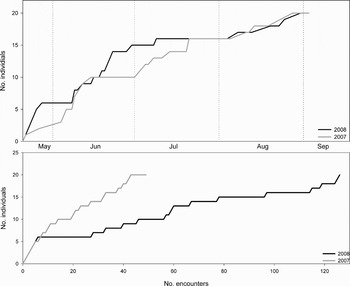
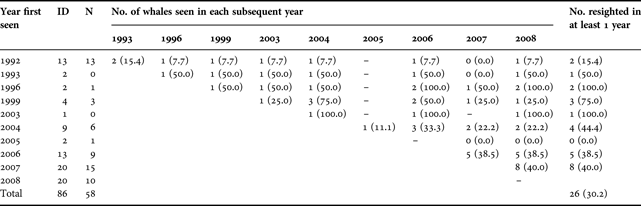
A total of 47 and 126 ID-photos (20 and 56 photographs from the public, respectively) were collected during the two field seasons in 2007 and 2008, respectively. From the photographs collected, 20 individuals were identified in 2007 and 20 individuals were identified in 2008 (Figure 2). Most individuals had been identified by the beginning of July but new individuals were identified throughout both field seasons (Figure 2). Of the 20 individuals identified in 2007, a total of 8 (40.0%) were re-identified in 2008. 86 whales (58 individuals) were identified from ID-photos taken in Godthaabsfjord from 1992 to 2008 (Table 1). Of these, 26 (30.2%) were re-identified in the fjord during the 16 year period. One individual photographed in Godthaabsfjord in 1992 was resighted again in 2008 and at least in 7 other different years over the 16 year period.
Discovery curves of humpback whales in Godthaabsfjord. (Top) Number of new individuals identified during the field months (modified Julian days, where 1 May is day 1 to disregard leap year in 2008); (Bottom) number of new individuals identified per whale encounter. Plateaus signify repeated encounters where no new individuals were identified.

Number of whales resighted in the period from 1992 to 2008 in Godthaabsfjord.
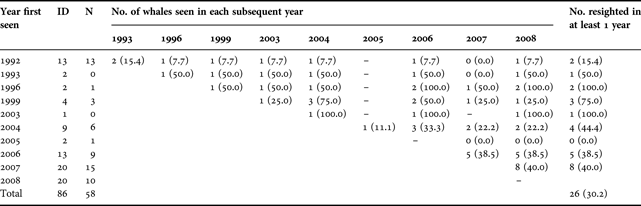
No data available is indicated by missing numbers. ID is the number of identified whales from 1992–2008. N is the number of new individuals identified from 1992–2008. The numbers in parentheses are per cent.
Temporal and spatial distribution
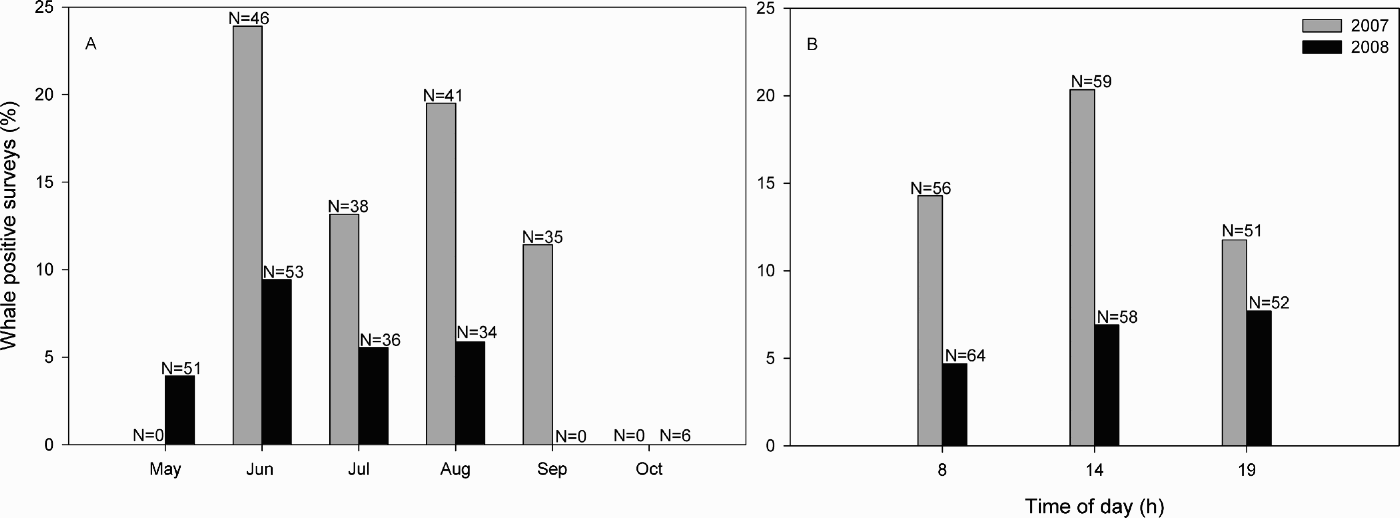
In 2007 and 2008, 166 and 174 theodolite surveys (half hour duration) were carried out. This corresponds to a total of 170 hours of surveys (Figure 3A). In both 2007 and 2008 most whales were sighted during the summer months from June–August where June had the majority of whale positive surveys (23.9% and 9.4% respectively). In both years August had a few more whale positive surveys than July (13.2% and 5.6% in July contrary to 17.1% and 5.9% in August of 2007 and 2008 correspondingly). Fewer whales were spotted in May 2008 and October 2007. Mean effort between 2007 and 2008 by time of the day was 60, 58.5 and 51.5 hours at 08:00, 14:00 and 19:00, respectively (Figure 3B). When comparing the two field seasons, no specific pattern was found between time of day and the number of whale positive surveys.
(A) Number of surveys (%) in the months of both field seasons, where humpback whales were seen. N is the total number surveys conducted in the given month; (B) number of surveys (%) at the different time periods, where humpback whales were seen. N is the total number of surveys conducted at the given time.
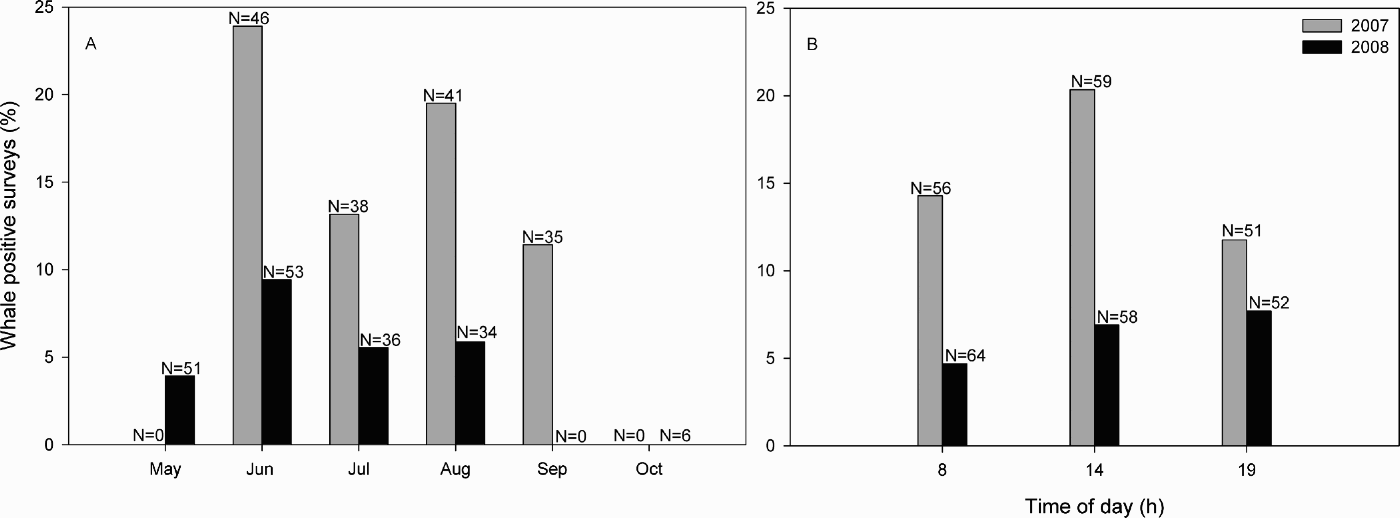
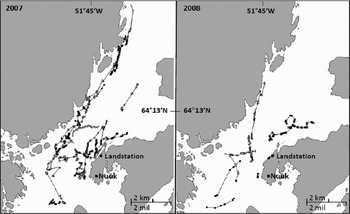
As seen in Figure 3 more whales were sighted in 2007 during the theodolite surveys compared to 2008 (16.9% whale positive surveys in 2007 compared to 6.3% whales positive surveys in 2008). A total of 27 and 10 tracks of humpback whales movements were collected in the season of 2007 and 2008, respectively (Figure 4).
Tracks of individual whales in 2007 (27 tracks of 27 different whales) and 2008 (10 track of 10 different whales).

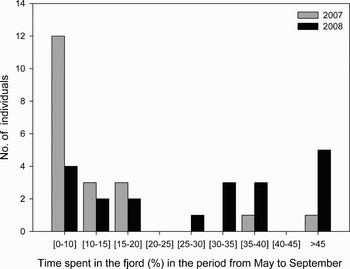
The photo-ID data showed that time spent in the fjord by each whale during the field season varied among individuals, with individuals being present in the fjord from 7% to 60% of the total field season (Figure 5). In both years, the majority of the whales (80%) were photographed during a single period (defined as continuous weeks of observations) within a year. Seven whales were photographed in two different periods in the same year and a single whale was photographed over three different periods (Figure 5).
Time spent in the fjord in both field periods for humpback whales in 2007 and 2008.

Effects of whale watching boats on whale behaviour
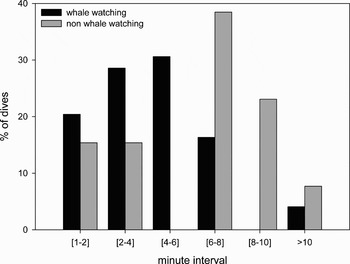
Sufficient data for analysis of the effect of whale watching were obtained only in 2007. When a whale watching boat was present (from the first time the boat came within 100 m of the whale until the boat left the whale) the median apparent speed of the whales (6.1 km/h ± 4.3, median ± IQR) increased significantly contrary to when no boats were present (5.4 km/h ± 4.5, median ± IQR)) (Mann–Whitney, P = 0.001). Furthermore, whales with no boats present carried out long dives of longer duration than whales followed by whale watching boats (Figure 6). Long dives of whales followed by boats were on average 117 seconds shorter than long dives carried out by whales without whale watching boats present (271 ± 195 and 388 ± 222, respectively) (Mann–Whitney, P = 0.031). The whales performed less than half the amount of surfacing between long dives when whale watching boats were present contrary to non-whale watching (Student's t-test, t 15 = −2.393, P = 0.03). On average only 4.3 surfacings were made contrary to 9.3 surfacings when left undisturbed. Directionality seemed unaffected by presence of whale watching boats (Student's t-test, t 342 = 0.774, P =0.439).
The duration of long dives (defined as dives exceeding 60 seconds). The whales carry out longer long dives when no whale watching boats are present. Nwhale watching = 49, Nnon whale watching = 13.

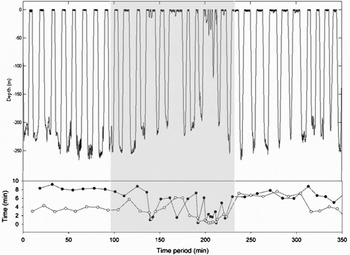
Figure 7 illustrates a dive profile recorded with a DTAG onboard a humpback whale exposed to whale watching. Before exposure (0–110 minutes) the whale made regular long dives between 7 and 9 minutes of length. After some time in presence of a whale watching boat, driving fast towards the whale with closest distances of less than 30 m, long dives became shorter, of decreased depth, and the whale surfaced fewer times before long dives (130–230 minutes) (Figure 7). After exposure (230–350 minutes) a regular dive pattern was resumed, however within the first hour (230–300 minutes) the whale had longer surface times before long dives, compared to pre-exposure.
Dive profile of humpback whale. The shadowed area illustrates the time period where the whale was exposed to whale watching and where high levels of engine noise were measured on and off. (Top) Illustrates the diving pattern of the whale over time; (Bottom) illustrates diving duration (•) and time combined spent at the surface (o) over time.

DISCUSSION
Temporal patterns of habitat use within years
If the population of humpback whales in Godthaabsfjord constituted a closed population, the discovery curve (Figure 2) would gradually level off as no new individuals would enter the fjord and the same individuals would be observed during subsequent encounters. Our discovery curves did not level off in either year. This strongly indicates that the humpback whales foraging in Godthaabsfjord are an open population where individuals from the West Greenland feeding aggregation migrate in and out of the fjord during the summer months. This is not unexpected as Godthaabsfjord is an open fjord system which allows the whales to migrate in and out easily, making it accessible to all whales travelling along the coast of West Greenland. An interesting feature of the discovery curves for both years is that there are plateaus: periods where no new individuals were added to the catalogue. These plateaus likely represent periods when few whales are entering the fjord system.
The time spent in the fjord amongst each individual was highly variable and we did not observe any whales that stayed in the fjord for the entire season. Moreover, the amount of periods that each whale resided in the fjord varied between one, two and three periods of various lengths. Although this could merely reflect that the individual whales were not photographed within the fjord during consecutive weeks, we believe that if a whale was present in the study area of Godthaabsfjord it was likely to have been photographed due to an almost daily effort on the water by either the whale watching boats or our crew. In addition, other studies have shown that humpback whales do migrate between different feeding areas within the foraging season (Heide-Jørgensen & Laidre, Reference Heide-Jørgensen and Laidre2007). Normally temporal use of habitat would be quantified using the concept of residence time. However, with the opportunistic collection of photo-ID it was not possible to follow the strict definitions of residence time and we have rather used the term ‘time spent in the fjord’. As Godthaabsfjord is open for migration there is a large probability of the whales migrating into the Davis Strait and we cannot assure that individuals were resident in the fjord between sightings. Yet, the fact that an individual is photographed several times in the fjord within a short time window does suggest that the individual has remained in or at least within the proximity of the fjord in those weeks. Although humpback whales can move long distances within a relatively short time period (e.g. Della Rosa et al., Reference Della Rosa, Secchi, Maia, Zerbini and Heide-Jørgensen2008), we believe that the time limit set in this study, does not allow the individuals to migrate far distances and reach Godthaabsfjord in time to qualify for more than a single period of occupancy.
Site fidelity across years
Of the 20 whales identified in Godthaabsfjord in 2007, 40% were resighted in the fjord in 2008. Furthermore, of the individuals identified from the ID-photos available from Godthaabsfjord in the time period from 1992 to 2008, we found a return rate of 30.2%. These high resight rates are despite the small sample size (Table 1) and effort over that entire period and the number thus represents the minimum rates of return during the 16 year period.
Few studies on humpback whales have looked at site fidelity on a regional scale. However, Clapham et al. (Reference Clapham, Baraff, Carlson, Christian, Mattila, Mayo, Murphy and Pittman1993) addressed the issue and found a mean rate of return of 73.2% in individual humpback whales foraging in the Southern Gulf of Maine. Also, Weinrich (Reference Weinrich1998) did a study on small scale site fidelity in calves in the Gulf of Maine and found a strong degree of small scale site fidelity for calves (79.4%) returning to a regional area where they had been observed the year before. He argued that calves are introduced to the feeding areas during their year of maternal dependence and this introduction appears essential to their future choice of feeding ground on a regional scale. We also sighted young calves in the company of adult animals. It seems highly unlikely that the high rate of resightings found in both 2008 and in the period from 1992 to 2008 is a mere coincidence. First, the coast of West Greenland from Disko Bay to Arsuk, where foraging by humpback whales is known to take place, stretches more than 1000 km (Heide-Jørgensen & Laidre, Reference Heide-Jørgensen and Laidre2007) and with a highly convoluted coastline with numerous fjords. Secondly, 3000 humpback whales are estimated to comprise the West Greenland feeding aggregation and could in theory enter the open fjord system. Therefore, the likelihood of at least 40% out of some 20 individuals from a 3000 animal population entering the fjord two years in a row by coincidence is very low. Thus, our findings here support the notion of small scale site fidelity reported by Weinrich (Reference Weinrich1998). Secondly we demonstrate that individual humpback whales not only return to the same general feeding areas within hundreds of kilometres but also within few kilometres, illustrating strong navigational skills, and long term memory of the spatial and temporal distribution of food resources, likely introduced to them by their mothers.
Small scale site fidelity has been documented in other migrating cetacean species as well. Ciano & Heule (Reference Ciano and Heule2001) found individual sperm whales (Physeter macrocephalus) returning to Bleik Canyon, Norway, over years. One individual in their study was resighted during 10 consecutive years. We also confirmed an individual to return to Godthaabsfjord during at least 7 years in the period from 1992 to 2008. As the number of ID-photos covering this entire period is scarce, the resight rate of 7 years for this individual whale must be a minimum.
As the coloration patterns of humpback whale calves can change dramatically within the first two years (Carlson et al., Reference Carlson, Mayo and Whitehead1990; Blackmer et al., Reference Blackmer, Anderson and Weinrich2000), there is a chance that some of the new identifications in 2008 are individuals identified in 2007 that have undergone large changes in fluke coloration, leading to an underestimation of the degree of small scale site fidelity. Collection of genetic samples can in the future establish if new individuals are offspring of the individual humpback whales that already show a strong degree of small scale site fidelity towards Godthaabsfjord.
Seasonal patterns and habitat use
As seen in Figure 3A the highest numbers of whales were observed from the land station in June. In July fewer whales were present during surveys but in August more whales were yet again spotted during the survey hours. This was the case in both 2007 and 2008 although more so in 2007. This pattern is consistent with the number of individuals identified during the field seasons with photo-id. In both years, we identified most whales in June but in July the number of new individuals seemed to level off. In August new individuals continued to be identified. This suggests that most whales are present in the early summer month but during mid-summer few new encounters are made indicating little new arrival. Also, the decrease in observations from the land station during July suggests that some individuals move elsewhere to feed. This notion is supported by a single id-photo taken by locals in Aasiaat (approximately 550 km north of Nuuk in Disko Bay) in July 2008 which we matched to an individual photographed in Godthaabsfjord in June the same year. Satellite data on humpack whales in West Greenland also support this notion (Heide-Jørgensen et al., Reference Heide-Jørgensen, Simon and Laidre2007).
The first whales arrive to Godthaabsfjord in May. In the same month capelin migrate from the depth of the banks and into the shallow waters of the fjord to spawn. Capelin spawning is separated temporally along the west coast of Greenland and begins in April at the southern tip of Greenland (Friis-Rødel & Kanneworf, Reference Friis-Rødel and Kanneworf2002). Spawning starts in Godthaabsfjord in mid-May in the innermost part of the fjord and ends in June in the outermost parts (Hedeholm, personal communication). In the north from Disko Bay to Uummannaq spawning occurs from mid-June to mid-July. It seems likely that some whales time their arrival to coincide with capelin spawning in Godthaabsfjord. It is possible that some of them migrate northwards during the foraging season to benefit from the staggered spawning behaviour of capelin. Other whales may stay/arrive to take advantage of other food sources such as euphausiids. Upwelling during the winter forms the basis of a spring and a late summer bloom in Godthaabsfjord due to the highly nutrient water (Larsen & Hammond, Reference Larsen and Hammond2004). This creates favourable conditions for the herbivorous euphausiids feeding on algae. Large amounts of euphausiids were caught during the 2008 ‘Dana’ cruise in Godthaabsfjord in mid-August (Rysgaard, personal communication). Furthermore, in late May 2008 we observed humpback whales lunge feeding on the surface in areas with high densities of visual observable euphausiids, and on one occasion euphausiids were observed inside the mouth of a feeding whale in June. Hence, it appears that the variable residence time within our field seasons reflect that the humpback whales, influenced by small scale site fidelity, employ different regional migratory patterns to match the availability of different food sources during the foraging season.
In other areas humpback whales have been shown to alter their distribution regionally subsequent to changes in the distribution of their prey species between years (Payne et al., Reference Payne, Wiley, Young, Pittman, Clapham and Jossi1990; Weinrich et al., Reference Weinrich, Martin, Griffiths, Bove and Schilling1997). In this study a change in the distribution of humpback whales was also found between our consecutive field seasons as indicated in several ways. During the collection of ID-photos, whales where mostly present in the main course of the fjord from Saarloq to Kangeq in 2007. In 2008 the whales were more often spotted in the transversal waters running from Qorqut to south-west of Sermitsiaq (Figure 1). Consequently, during our land based surveys fewer observations of whales were made in 2008 compared to 2007. We do not have data on the distribution of humpback whale prey species in Godthaabsfjord in either field season and we are therefore not able to investigate if prey caused this difference in whale distribution or the shorter residence time of humpback whales in 2007.
The fact that more whales are seen moving than staying suggests that the survey area (i.e. between Nuuk and Nordland) is used for transit, rather than as a feeding area. This was especially true for 2008.
Management implications of small-scale site fidelity and low local-population size
When considering reopening a hunt on humpback whales in Greenland the small scale site fidelity displayed by the whales in this study along with the limited number of individuals identified in the fjord in both field seasons should be considered. The small scale site fidelity and the fact that only a small fraction of the West Greenland humpback whale population makes use of Godthaabsfjord imply that, if individuals are hunted within the fjord, the number of whales in the fjord may decrease in the years to follow. The whale watching boats in Nuuk depend on the whales that stay within the fjord as whale watching is only carried out in the vicinity of Nuuk city and not in Davis Strait. Thus, a debate on a quota on West Greenland humpback whales should consider the high site fidelity in the light of the economic interests in non-lethal exploitation through whale watching.
Whale watching in Godthaabsfjord
Whale watching worldwide was estimated to turn over 2.1 billion US$ in 2008 and attracting more than 13 million guests (O'Connor et al., Reference O'Connor, Campbell, Cortez and Knowles2009). Several studies on whale watching have shown that disturbances from vessels or swimmers cause a significant change in behaviour in many cetacean species (e.g. Bejder et al., Reference Bejder, Dawson and Harraway1999, Reference Bejder, Samuels, Whitehead, Gales, Mann, Connor, Heithaus, Watson-Capps, Flaherty and Krützen2006; Scheidat et al., Reference Scheidat, Castro, Gonzalez and Williams2004; Lusseau et al., Reference Lusseau, Slooten and Currey2006). From our results it is clear that the humpback whales in Godthaabsfjord can be disturbed by the sometimes aggressive and unregulated whale watching, as testified by a significant change in diving behaviour when foraging. Increased apparent median swimming speed in the presence of boats is a sign of avoidance along with the fact that the whales are surfacing fewer times before a long dive when boats are present (Scheidat et al., Reference Scheidat, Castro, Gonzalez and Williams2004). The fewer surfacing periods apparently result in truncated long dives due to a decrease in the time to replenish oxygen stores when at the surface. Among the parameters measured, only the degree of change in directionality was not different between the two situations. A similar situation was observed by Williams et al. (Reference Williams, Lusseau and Hammond2006), where killer whales approached by boats responded by decreasing their dive times and increasing the change in direction. Also, Scheidat et al. (Reference Scheidat, Castro, Gonzalez and Williams2004) observed that humpback whales in Ecuador reacted to whale watching boats by significantly increasing their swimming speeds and through more erratic swimming paths. Because our data were homogenized to avoid problems of tracks of different length, our tracks may have become too short to be able to distinguish between whale watching and non-whale watching situations with respect to change of headings. Yet, our results could also reflect that humpback whales display different avoidance techniques in the presence of boats. The increase of the whale watching industry and the many private boats that exercise whale watching in Godthaabsfjord thus have the potential to cause significant disturbance of individual humpback whales in Godthaabsfjord. Animals with long residence times could be particularly exposed.
Whale watching in Greenland is not regulated and on most occasions we observed boats at high speeds within few metres of the whales. On several incidents more than one boat was present and we counted up to 15 boats on a single occasion. If the relatively small number of humpback whales, identified in this study, to some degree reflects the abundance in Godthaabsfjord, and given that they are not all present at the same time, it is likely that the same individuals are being repeatedly targeted by whale watching boats during their stay in the fjord.
As the summer season provides the only chance for the whales to restore their fat reserves, repeated disturbance may likely reduce the food intake over the season along with the additional energetic costs of avoidance. Figure 7 shows shorter dive duration when foraging, most likely as a result of the shorter time period spent at the surface before diving. The profile also indicates a post-exposure reaction as the whale spends additional time at the surface between long dives an hour after the boat had left. Thus the whales seem affected for an almost equally long period during exposure and post-exposure. This could indicate an oxygen debt incurred during the exposure and the need for additional ventilation due to increased speed and less time spent at the surface in the vicinity of the boat. However, more dive profiles of whales both exposed to whale watching and whales unexposed would be needed to make general conclusions.
In most countries with commercial whale watching, regulations and codes of conduct have been developed to mitigate negative effects on the targeted animals. In New Zealand the Marine Mammal Protection Regulations 1992 are established (MMPR; New Zealand Government, 2008) to provide guidelines on how to interact with whales in a least intrusive manner. A study by Lusseau (Reference Lusseau2003) in New Zealand showed that bottlenose dolphin, Tursiops spp., behaved differently according to boats either respecting or ignoring the MMPR guidelines. He found, that a research vessel, which in an 8 year period had respected the MMPR guidelines, did not seem to affect the behaviour of the dolphins. On the contrary, boats with an intrusive approach caused the dolphins to increase their dive intervals.
While limited whale watching, despite short term disturbance, may not have any long term effects on individual animals nor the part of the West Greenland population that use Godthaabsfjord, more intense whale watching could render such negative effects real. If the presently unregulated whale watching in Godthaabsfjord continues to grow, it may have an indirect effect on fitness of individual humpback whales as the energy needed, e.g. migration and calving is reduced if the food intake is reduced through vessel induced disturbances of normal foraging behaviour. For example, a reduction in food intake of 5% over the season may cause some whales to skip a breeding season, hereby avoiding migration due to insufficient energy reserves. This will result in fewer calves being born overall. Furthermore, intense whale watching could result in females having decreased energetic resources to produce or nurse their offspring which will have a direct effect on survival of the calves.
So while whale watching is often considered an economically important and non-invasive use of whales, our findings indicate that expanded and intensive, unregulated whale watching may cause fitness reductions for some individuals in the West Greenland stock, which calls for guidelines if such effects are to be mitigated.
CONCLUDING REMARKS
Although the humpback whales in Godthaabsfjord do not reside in this area for the entire foraging season but migrate between foraging areas, these whales display a strong degree of small scale site fidelity where the same limited number of individuals out of an estimated population of 3000 return to Godthaabsfjord between and within years. This demonstrates that individual, migrating humpback whales have navigational skills that allow them to find a fjord entrance that is less than 10 km wide. If humpback whales are hunted within the fjord it is questionable if such individuals will be replaced. This will affect the still growing whale watching industry in Nuuk which lies on the whales within the fjord system. Intense and unregulated whale watching can have more subtle negative effects on the humpback whales foraging in Godthaabsfjord, causing a change in both swimming and foraging behaviour. To ensure a sustainable whale watching industry we suggest that guidelines similar to the MMPR are enforced in Greenland.
ACKNOWLEDGEMENTS
We thank K. Clausen, R. Hedeholm, L. Heilmann, F. Heinrich, H. Bates and F. Ugarte for assistance in the field. We thank the locals in Nuuk, Tupilak Travel and the crew on IVIK for all their help in collecting ID-photos. Thanks to M. Weinrich, L. Bejder, J. Teilmann and F. Ugarte for comments on previous versions of the manuscript. The study was funded by the Oticon Foundation, KIIIN (Department of Culture, Education, Research and Church in Nuuk) and the Centre of Marine Ecology and Climate Effects, Greenland Institute of Natural Resources. P.T.M. was supported by the Danish Natural Science Research Council via a Steno and frame grants.