INTRODUCTION
Marine shells are common components of coastal archaeological sites, and in some contexts provide more reliable radiocarbon (14C) dates than other material types. Eastern oyster (Crassostrea virginica) shells, for example, are among the most common materials excavated from coastal archaeological sites in eastern North America, and unlike charcoal and other organic material types, they are not subject to contamination by modern organic carbon (Thomas Reference Thomas2008). Additionally, most marine mollusks have relatively short lifespans, and larger shells and shell fragments may not move as readily through the stratigraphic column compared to smaller artifacts (Kennett et al. Reference Kennett, Ingram, Southon and Wise2002; Thomas Reference Thomas2008:346). However, obtaining an accurate age from marine shell is complicated by a variety of factors. It is well established that the marine carbon reservoir is depleted in 14C relative to the atmosphere, and that variations in coastal geomorphology, ocean circulation, and upwelling create localized, time-dependent deviations from the global-averaged marine calibration curve. A correction, designated ΔR, must be applied to 14C dates of marine shells to account for local carbon reservoir offsets (Stuiver et al. Reference Stuiver, Pearson and Braziunas1986). Estuaries are semi-enclosed, coastal bodies of water in which sea water is significantly diluted with fresh water derived from land drainage (Perillo 1995). Because they are places where marine, freshwater, and terrestrial biomes meet, there is also potential for significant mixing of carbon reservoirs. Estuarine materials are especially problematic for 14C dating because ΔR may vary over multiple spatial and temporal scales (e.g., Hadden and Cherkinsky Reference Hadden and Cherkinsky2015, Reference Hadden and Cherkinsky2016; Lougheed et al. Reference Lougheed, Filipsson and Snowball2013; Rick et al. Reference Rick, Henkes, Lowery, Colman and Culleton2012; Rick and Henkes Reference Rick and Henkes2014; Thomas Reference Thomas2008).
The goals of this paper are to (1) evaluate spatiotemporal variability in carbon reservoir effects within a small estuarine system; and (2) estimate ΔR for eastern oysters from Apalachicola Bay, USA. We present a total of 17 14C measurements from known-age, pre-bomb oysters representing three different positions within a horizontal salinity gradient. These data demonstrate significant variability in reservoir effects over a relatively small (~80 km) spatial scale, with ΔR values roughly correlated with salinity. Estimates of ΔR for Apalachicola Bay, and other estuarine systems, must take into account the possibility of sub-regional variability reservoir offsets due to the dynamic nature of estuarine carbon reservoirs.
Study Area
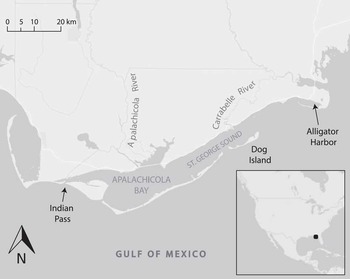
The Apalachicola estuary is a coastal lagoon and barrier island complex on the northern Gulf of Mexico, Florida, USA. The lagoon is a shallow (2–3 m), wind- and tide-dominated system oriented in an east–west direction (Figure 1). It is well-mixed vertically during most of the year, although portions of the estuary are stratified seasonally (Livingston Reference Livingston1984). Four rivers contribute freshwater into Apalachicola Bay, with the vast majority entering through the main stem of the Apalachicola River (Huang and Jones Reference Huang and Jones2001). The Apalachicola River is the terminus of the Apalachicola-Chattahoochee-Flint (ACF) river system and is the primary source of fresh water to the Apalachicola estuary.
Map of study area.

Horizontal salinity zones within the study area depend on proximity to the mouth of the river, river flow, local rainfall, wind speed and direction, and water currents (Livingston Reference Livingston1984). Alligator Harbor (Figure 1) is the easternmost extent of the study area and is marine-dominated, with salinities generally in excess of 30‰ (euhaline conditions) (Sastry 1963). Apalachicola Bay is fringed by three barrier islands that limit the flow of water between the Gulf of Mexico and the estuary. The dominant flow pattern within the bay is from east to west. Ocean water enters the estuary from the east, via St. George Sound, where mean salinities vary between polyhaline (18–30‰) and euhaline conditions (Linvingston 1984). The lower reaches of the Apalachicola River constitute the limnetic zone, with salinities reaching 0.5‰ (Livingston Reference Livingston1984). The freshwater plume from the river flows westward into the bay (Huang and Jones Reference Huang and Jones2001; Livingston Reference Livingston1984). Salinities in the western, river-dominated regions of the bay typically are in the mesohaline (5–18‰) salinity range. The river-diluted water enters the Gulf of Mexico at the western edge of the lagoon, through West Pass and Indian Pass. The flow pattern also reverses at times, particularly during periods of low river flow, with salt water intruding into the bay through West and Indian passes, and the freshwater plume extending eastward into the mid-bay region (Huang and Jones Reference Huang and Jones1997). The estuary is generally marine-dominated in the autumn, a period of low river flow, and river-dominated in the spring, during high river flow (Chanton and Lewis Reference Chanton and Lewis1999).
Eastern oysters thrive in a wide range of salinity and temperature regimes, making them particularly well-suited to estuarine environments, including Apalachicola Bay. The Apalachicola estuary has supported a productive commercial oyster fishery since the mid-19th century. Oyster shell middens are a common feature of this coastal landscape. Over 60 sites are known along the bayshore and barrier islands of the Apalachicola estuary, the earliest dating to ca. 3000 BP (White Reference White2014). Oysters are one of the most abundant archaeological materials available for 14C dating in this region.
The ACF basin drains approximately 50,000 km2 of the southeastern United States and passes through several geologic provinces on its way to the Gulf of Mexico, including Miocene- and Oligocene-age limestones (Scott et al. Reference Scott, Campbell, Rupert, Arthur, Missimer, Lloyd, Yon and Duncan2001). These ancient carbonates are a potentially significant source of 14C-depleted dissolved inorganic carbon (DIC) to the Apalachicola estuary (Hadden and Cherkinsky Reference Hadden and Cherkinsky2015). As such, “hard water effects” within the estuary were expected to vary across the horizontal salinity gradient, manifest in both DIC as well as biological organisms that derive their carbon from DIC, including oysters.
MATERIALS AND METHODS
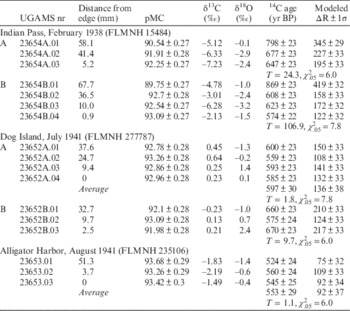
We selected five pre-bomb oyster shells for AMS analysis, representing three different positions within the horizontal salinity gradient. Shell specimens were loaned to the Center for Applied Isotope Studies from the malacology collection at the Florida Museum of Natural History (FLMNH). The specimens were collected between AD 1938 and AD 1941 from Alligator Harbor, the bay-side of Dog Island, and Indian Pass (Table 1 and Figure 1). Museum records indicated that UGAMS-23653 was live-collected. UGAMS-23652 and UGAMS-23654 were presumed to be live-collected based on the presence of dried flesh near ligament attachments. The shells were manually cleaned and placed in an ultrasonic bath for 40 min to remove superficial contaminants, sonicated with diluted HCl for 15 min to leach surface contamination, and then rinsed and dried at 105°C.
Sequential isotopic measurements of known-age pre-bomb oyster shells from Apalachicola Bay, Florida.

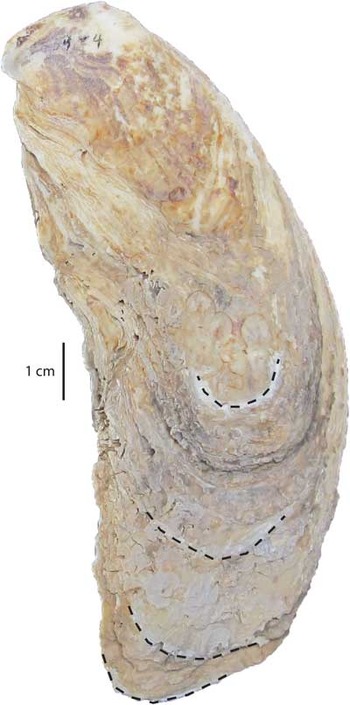
The shell height is measured along the primary axis of growth, from the umbo to the ventral valve margin. New layers of shell form on the interior surface of the valves, on top of previous layers. Shells grow in height by accreting new shell beyond the margins of previous layers resulting in terrace-like growth increments (Carriker et al. Reference Carriker, Palmer and Prezant1980). In true calendar years, the oldest portion of the shell is the exterior surface of the umbo (the chondrophore of the left valve), and the terminal growing edge is the youngest. In order to observe variability in 14C over the life of the organism, which typically does not exceed 20 yr (Buroker Reference Buroker1983), samples were obtained from different regions of each shell. Three to four samples were drilled from each shell in transects following the shell’s visible growth lines (Figure 2). Carbonate samples were drilled using a Dremmel tool with a 0.5-mm diamond drill bit, and ranged from 11 to 19 mg in size. We obtained a total of 17 samples from the five specimens.
Crassostrea virginica specimen UGAMS-26134B with sampling paths shown as dashed lines.

The carbonate samples were reacted under vacuum with 100% H3PO4 to recover CO2. The resulting CO2 was cryogenically purified from the other reaction products and catalytically converted to graphite (Cherkinsky et al. Reference Cherkinsky, Culp, Dvoracek and Noakes2010). Graphite 14C/13C ratios were measured using the NEC 500 kV Tandem Pelletron accelerator mass spectrometer at the CAIS, University of Georgia, USA. The sample ratios were compared to the ratios measured from oxalic acid I (NBS SRM 4990). Carrara marble (IAEA C1) was used as the background, and travertine (IAEA C2) was used as a secondary standard. The sample 13C/12C ratios were measured separately using a MAT-253 stable isotope ratio mass spectrometer and expressed with respect to PDB, with an error of less than 0.1‰. The error is quoted as one standard deviation and reflects both statistical and experimental errors. All 14C dates have been corrected for natural isotope fractionation using the isotope ratio mass spectrometer value. Pearson’s product-moment correlation tests were implemented in R to test for correlations among 14C age, δ13C, and δ18O.
All dates were calibrated using OxCal 4.2 (Bronk Ramsey Reference Bronk Ramsey2009a). Chi-squared (χ2) tests as described by Ward and Wilson (Reference Ward and Wilson1978), implemented using the R_Combine() function, were used to test for homogeneity within groups of dates. If samples from the same shell were statistically homogenous i.e., T-statistics were less than the critical value for α=0.05, the pooled average age was used to estimate an average ΔR according to the following equation:
 $${\rm Average}\,\Delta {\rm R}{\equals}{\rm P}-{\rm Q}$$
where P is the pooled average 14C age of the shell, and Q is the expected marine model age from Reimer et al. (Reference Reimer, Bard, Bayliss, Beck, Blackwell, Bronk Ramsey, Buck, Cheng, Edwards, Friedrich, Grootes, Guilderson, Haflidason, Hajda, Hatté, Heaton, Hoffmann, Hogg, Hughen, Kaiser, Kromer, Manning, Niu, Reimer, Richards, Scott, Southon, Staff, Turney and van der Plicht2013) based on the collection year. Uncertainty in ∆R was calculated as
 $\sigma _{R} {\equals}\sqrt {\sigma _{P} ^{2} {\plus}\sigma _{Q} ^{2} } $
(Stuiver et al. Reference Stuiver, Pearson and Braziunas1986). Pooled average age and average ∆R were only estimated for shells with homogenous 14C age distributions.
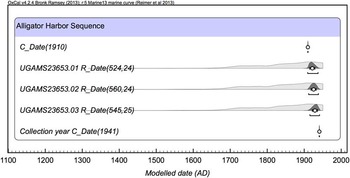
To evaluate variability in ∆R within shells, we also constructed a Bayesian sequence model (see Figure 3) for each shell that allowed us to estimate ∆R at each sample position. The 14C dates were modeled as a sequence based on distance from shell edge, bracketed by a terminus ante quem (TAQ) and terminus post quem (TPQ) specified in calendar years based on the collection year and assuming a maximum lifespan of ca. 30 yr. A uniform prior for ΔR was specified within the limits of 0 and 500 yr for each 14C measurement. This approach allows estimates for ΔR to be extracted from the data in the model itself (Bronk Ramsey and Lee Reference Bronk Ramsey and Lee2013), and for ΔR to be modeled independently for each 14C measurement.
Example of Bayesian sequence model for UGAMS-23653, constructed from incremental 14C data and known collection year.

RESULTS AND DISCUSSION
14C ages and ΔR estimates for the Apalachicola oysters are presented in Table 1. 14C ages varied within shells by as little as 36 14C yr (UGAMS-23653) to as much as 295 14C yr (UGAMS-23654B). For two of the five specimens, UGAMS-23652A and UGAMS-23653, the T statistics indicated excellent agreement within shells, therefore the individual 14C measurements could be combined into statistically valid pooled average ages. The remaining three specimens exhibited considerable intrashell variability, precluding statistically valid pooled average ages and ΔR values.
The chi-squared values for the combined Alligator Harbor samples (Table 1) indicate that a sub-regional ΔR=92±37 yr is appropriate for the marine salinity zone to the east of the bay. For St. George Sound near Dog Island, the weighted mean age and standard deviation (607±43 14C yr BP) correspond to a sub-regional ΔR=146±49 yr. The combined Indian Pass samples (686±108 14C yr BP) correspond to an average offset of ΔR=227±110 yr. Chi-squared values for the combined Dog Island (T=20.4,
 ${\rm \chi }_{{.05}}^{2} {\equals}12.6$
) and Indian Pass (T=136.2,
 ${\rm \chi }_{{.05}}^{2} {\equals}12.6$
) samples indicate that ΔR values have a wide dispersion within these two river-influenced locales, indicating the sub-regional averages are not statistically robust.
Several factors can influence intra- and inter-shell variability in 14C. Fluctuations in the source and/or volume of freshwater inputs, upwelling, carbon cycling, and terrestrial run-off can all lead to variability in the local 14C reservoir (Culleton et al. Reference Culleton, Kennett, Ingram and Erlandson2006; Forman and Polyak Reference Forman and Polyak1997; Jones et al. Reference Jones, Hodgins, Dettman, Andrus, Nelson and Etayo-Cadavid2007, Reference Jones, Hodgins, Etayo-Cadavid, Andrus and Sandweiss2010; Ingram and Southon Reference Ingram and Southon1996; Rick and Henkes Reference Rick and Henkes2014). Determining the precise cause of the variability observed is difficult with this small dataset, however the Apalachicola River is a major source of 14C-depleted freshwater into the bay. DIC in the Apalachicola River water is known to be depleted in 13C relative to marine DIC because it is derived from re-mineralization of organic materials combined with the weathering of carbonate minerals (Chanton and Lewis Reference Chanton and Lewis1999), while marine DIC is near isotopic equilibrium with atmospheric CO2 (Mook and Tan Reference Mook and Tan1991). The weathering of geologic-age carbonate limestone also introduces “old” carbon into the Apalachicola estuary carbon reservoir. Variability in carbon reservoir offsets within the estuary reflects to a large degree the spatiotemporal variability in the concentration of riverine DIC in the estuary.
δ13C values of DIC within the Apalachicola estuary are positively correlated with salinity (Chanton and Lewis Reference Chanton and Lewis1999). A relatively weak, but statistically significant correlation between 14C and δ13C (R=–0.49, p=0.047) among Apalachicola oysters suggests that ΔR and salinity are inversely correlated. Indian Pass exhibits the largest and most variable ΔR values of the samples studied, reflecting the large and seasonally variable inputs of riverine DIC from the westward-flowing freshwater plume. Conversely, the smallest and most stable ΔR values are observed at the eastern edge of the study area, at Alligator Harbor, beyond the influence of the Apalachicola River (Table 1 and Figure 1).
Rick and colleagues (2012) observed variability in ΔR on the order of 100–200 yr among eastern oysters from the Chesapeake Bay and Middle Atlantic regions, and recommended calculating sub-regional ΔR values using the weighted mean 14C ages for different locales. In that case study, sub-regional variability in reservoir offsets was attributed to the size and complexity of the Chesapeake Bay, which covers of an area of over 11,000 km2, and includes over 150 major rivers in its roughly 166,000 km2 watershed. In comparison, Apalachicola Bay covers an area of only 540 km2, and has one major freshwater source with a drainage basin that is approximately a third the size of the Chesapeake watershed, yet ΔR varies on the order of centuries. In the case of the Apalachicola Bay study area, we suspect that the significant mixing of ocean and freshwater over a relatively small spatial scale, combined with the limestone geology of the ACF drainage basin, are responsible for the variability in the estuarine carbon reservoir. Along the west-central coast of Florida, the mixing of marine and hard-water effects was so variable that Cherkinsky and colleagues (Reference Cherkinsky, Pluckhahn and Thompson2014) concluded that oyster shell could not be used to date archaeological events in that region at all. In contrast, the reservoir age offset near St. Catherines Island, on the coast of Georgia, USA, was not only consistent throughout the estuary (ΔR=–134±26), but also relatively constant over the past 2000 yr (Thomas Reference Thomas2008). An important point is that not all estuaries are the same. Sub-regional variability in ΔR is not exclusively a function of the size of the estuary, nor the size of its watershed. More local and sub-regional studies are needed to understand carbon reservoir dynamics in diverse estuarine settings.
There also are challenges in using data from modern pre-bomb shells to correct 14C dates from archaeological specimens. Changes in ocean circulation can produce long-term variability in reservoir age, as has been reported for the Pacific Northwest (Deo et al. Reference Deo, Stone and Stein2004) and the North Atlantic (Ascough et al. Reference Ascough, Cook, Dugmore and Scott2007). Smaller scale changes can significantly alter water circulation within estuaries: rivers change their course over time; landforms drift, erode, emerge, and disappear; and sea level rises and falls (e.g., Schnable and Goodell Reference Schnable and Goodell1968; Stewart and Gorsline Reference Stewart and Gorsline1962; White Reference White2014:86). The water circulation patterns that are responsible for spatial variability in reservoir offsets within Apalachicola Bay in the 20th century may not directly translate into the more distant past, or with the same scale of geographical specificity.
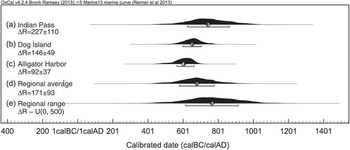
It is important that coastal archaeologists appreciate that reservoir offsets are dynamic over multiple spatial and temporal scales, and that decisions about how to account for that variability could potentially influence archaeological interpretations. To demonstrate, we present an example of a late-Holocene age oyster shell excavated from site 8FR364, one of the many barrier island shell middens that fringes Apalachicola Bay. The shell was dated at 1890±30 14C yr BP (UGAMS-28500; δ13C=–2.07). It is generally assumed that shellfish that were gathered for food most likely originated near the archaeological site where they are found (e.g., Berger et al. Reference Berger, Taylor and Libby1966), therefore warranting the use of one of the sub-regional ΔR values (Figure 4a–c). However, in southeastern North America coastal dwellers routinely harvested shellfish from multiple salinity zones within an estuary and transported them to residential sites for processing and/or discard (e.g., Andrus and Thompson Reference Andrus and Thompson2012). Geographical specificity in ΔR may not be warranted if the if the shell origin is unknown, or if stability in sub-regional ΔR values over time is uncertain. In those cases, we recommend an alternative approach that accounts for uncertainty in estuarine reservoir offsets more generally, either by using a mean ΔR with a large uncertainty term that reflects the possible scale of offsets (Bronk Ramsey Reference Bronk Ramsey2009b; Jones and Nicholls Reference Jones and Nicholls2001), as in Figure 4d, or by specifying a uniform distribution for ΔR over the entire range of observed values (Bronk Ramsey and Lee Reference Bronk Ramsey and Lee2013), as in Figure 4e.
Results of five alternative calibrations for an archaeological oyster shell from Apalachicola Bay (UGAMS-28500, 1890±30 14C yr BP). Bracket indicates the 68% confidence interval; the open circle and plus sign indicate the mean and median, respectively.

The five alternative specifications for ΔR resulted in five different probability distributions for the calibrated age of the archaeological oyster shell (Figure 4). The good news is that the 68% confidence intervals for all five distributions overlap. In this case, the scale of variability in reservoir offsets is small enough that all specifications of ΔR produce similar overlapping calibrated age ranges. The bad news is that the choice of ΔR strongly influences the measures of central tendency (i.e., the mean and median), as well as the size of the calibrated age range. Greater variability and/or uncertainty in ΔR leads to greater uncertainty in the calibrated age. For example, the estimate for ΔR with the smallest measure of uncertainty (Figure 4c) resulted in a 68% confidence interval that spans 100 cal yr, compared to 300 cal yr for the uniform distribution for ΔR (Figure 4e). The effect would likely be amplified in areas where the reservoir age is more variable, including areas with significant upwelling such as California and Peru (e.g., Jones et al. 2001, Reference Jones, Hodgins, Dettman, Andrus, Nelson and Etayo-Cadavid2007; Kennett et al. Reference Kennett, Ingram, Erlandson and Walker1997).
CONCLUSIONS
In this paper we examined variability in 14C within and among five modern, pre-bomb oyster shells collected from Apalachicola Bay. In this case, significant mixing of marine and 14C-depleted fresh water over a small geographic scale likely is responsible for the variability observed. Reservoir offsets become larger and more variable from east to west within the bay, from 92±37 yr to 227±110 yr, reflecting the east–west salinity gradient and the influence of the Apalachicola River. In addition, reservoir offsets were generally quite variable over the short lifespan of an oyster, possibly on a seasonal basis.
Sub-regional variability in ΔR is not exclusively a function of the size of the estuary, nor the size of its watershed. Dynamic carbon reservoirs can pose problems for the estimation of ΔR and for building coastal chronologies. However, there are complicating factors with 14C dating all material types, not only those of marine or estuarine origin (e.g., Higham Reference Higham2011; Schiffer Reference Schiffer1986). In coastal settings, marine-influenced materials may vastly outnumber terrestrial materials, or may be better preserved or more closely related to the event or context that the archaeologist wishes to date than other datable materials (Thomas Reference Thomas2008). In these cases, care must be taken to account for uncertainty and variability in the local reservoir age, considering that large uncertainty in ΔR leads to larger uncertainty in the calibrated age.
Highly variable reservoir offsets can be accounted for statistically, either by using a mean ΔR with a large uncertainty term that reflects the possible scale of offsets (Bronk Ramsey Reference Bronk Ramsey2009b; Jones and Nicholls Reference Jones and Nicholls2001), or by specifying a uniform distribution for ΔR over the entire range of possible values (Bronk Ramsey and Lee Reference Bronk Ramsey and Lee2013). Finally, we note that point estimates of a calibrated age (i.e., the mean and median) and the precision of the calibration are particularly sensitive to input values of ΔR. The best method for presenting any calibrated 14C date is to use the whole probability density function (Michczyòski Reference Michczyòski2007); this is especially true in cases where a reservoir correction is applied.
ACKNOWLEDGMENTS
AMS dating was carried out with the support of Robert J Speakman and CAIS. We wish to thank Gustav Paulay and John Slapcinsky at the Florida Museum of Natural History for providing access to pre-bomb oyster specimens, as well as Nancy M White at the University of South Florida Department of Anthropology for providing the archaeological oyster shell. We also thank Torben Rick and an anonymous reviewer for their constructive comments in the revision of this paper.