As if it were mere slander if scholarly men, rightly praised for their clever thoughts and charming writings, are suspected of ignorance in a specific art (such as architecture).Footnote 1
With these words, Willem Goeree (1645–1711), theorist of architecture and draughtsmanship, as well as autodidact theologian, justified his criticism of the prominent Reformed theologian Johannes Cocceius (1603–69), on an aspect of biblical interpretation, which was the latter's home ground. Cocceius might have been an excellent exegete, but he was no expert in architectural theory. This article examines the conflict that led Goeree to justify his stance repeatedly, a conflict which saw academic theology clash with vernacular scholarship, and which broadens our view of the hermeneutical debates in the decades around 1700.
The interpretation of the Bible in the seventeenth century has been a topic of much interest over the past two decades. The relative importance accorded to human reason in biblical interpretation by various seventeenth-century actors has been a predominant template for historical research, guided by the assumption that philosophical rationalism eventually overcame theological dogmatism. Dmitri Levitin has recently argued that the evolving status of the Bible in the course of the seventeenth century was due to a much more complex interplay of factors. Rather than an opposition between rationalism and dogmatism, tilting gradually in favour of the rationalists, Levitin sees a continuous expansion of historical contextualization of the Bible within Reformed biblical scholarship. Ever greater parts of Divine Revelation were swallowed up by the local details of particular historical constellations.Footnote 2
One hotly debated issue in early modern biblical interpretation which is hard to fit into the scheme of dogmatists versus rationalists is the attempt to reconstruct the Temple of Jerusalem. Seventeenth-century Europe saw a steady outpour of ‘Temple scholarship’. It attracted professional theologians as well as lay outsiders, the latter often combining technical knowledge with spiritual aspirations.Footnote 3 In particular, architects indulged in reconstructing Solomon's Temple as the prototype of building design, to lend divine lustre to their profession.Footnote 4 In the Dutch Republic, Willem Goeree was representative of the latter group.
The Temple debate, which this article examines as it unfolded in the Dutch Republic between 1669 and 1710, shows one way in which professional Reformed biblical scholars, while increasingly engaging with historical criticism and antiquarian context, took exception to the contribution of an outsider who vaunted his technical skill. In what follows, we start out with surveying the background of the Temple debate in the Dutch theological constellation of the second half of the seventeenth century. In the second section, we examine the contribution to the Temple debate by Willem Goeree. In the final section, we will see that, while academic theologians wrongly accused Goeree of Spinozism, he did build his vernacular Temple scholarship on theological assumptions which were beyond the pale of the Public Church. Consequently, his lay theology would fail to take root as eighteenth-century theologians applied themselves to vernacular biblical scholarship.
I
Since the Reformation, especially in Protestant parts of Christian Europe, the authenticity and the historical meaning of the Bible continuously demanded scholarly attention. Well known are the achievements of seventeenth-century Reformed theologians such as Louis Cappel (1585–1658), Johann Buxtorf Sr (1564–1629) and Jr (1599–1664) – following the lead of sixteenth-century Catholic predecessors such as Benito Arias Montano (1527–98) – in distinguishing textual variants and accretions, comparing the historical literature of various linguistic traditions, and systematically piecing together chronologies.Footnote 5 So are the disconcerting twists that eccentric authors such as Thomas Hobbes (1588–1679), Isaac la Peyrère (1596–1676), and Benedictus de Spinoza (1632–77) gave to such scholarship, insinuating that biblical authors had political motives, inventing people before Adam, and disproving the authenticity of much of the Bible itself.Footnote 6
In the Dutch context, theological and political conflicts in the early seventeenth century initiated a troubled history of dealing with the historical texts of the Bible as a foundation for the Public Church. Arminians (Remonstrants) and Gomarists (Calvinists) grounded their diverging positions on predestination and state–church relationship in different readings of the Bible. After the Arminians’ defeat at the Synod of Dordt in 1618, the States General facilitated the publication of an official translation of the biblical source texts into the vernacular.Footnote 7 The appearance of this ‘States Translation’ (1637), the Dutch Authorized Version, diminished the relevance of philological hair-splitting to public interests, turning it into an academic pursuit.Footnote 8
In the second half of the seventeenth century, a range of disagreements saw the Dutch theological landscape polarize anew. On one side were the so-called Voetians (named after Gisbert Voetius, 1589–1676), who promoted the sanctification of everyday life, similar to English puritan precisians. On the other side were the Cocceians (called after Johannes Cocceius), who stressed prophetical speculation and historical scholarship, while leaving intervention in the conduct of lay people to political authorities.Footnote 9 In the late seventeenth and early eighteenth centuries, the two currents were represented evenly among the Dutch Reformed clergy. After the rise to power of the quasi-monarchical stadtholder William III (1650–1702) in 1672, the Voetians dominated for about thirty years. When the stadtholder (from 1688 also king of England) died in 1702, the tables turned and the Cocceians gained the upper hand in public life.Footnote 10
In general, Voetians deferred to the States Translation, whereas Cocceians continued to investigate the scriptural source texts so as to enhance biblical interpretation. Cocceians employed scholarship to reconstruct the history of salvation evolving in stages, in an eschatological perspective. Their strong sense of eschatology found expression in attempts to accommodate all known world history in a seven-tiered chronological scheme. Their prophetic exegesis drew on literature from pagan, Jewish, and Christian Antiquity, as well as the more recent insights of scholars such as Arias Montano and Cappel.Footnote 11 Much of their exegetical output consisted of reconstructions of scriptural minutiae, drawing in particular on antiquarianism – the study of ancient customs, institutions, and material realities.Footnote 12
Cocceians’ continued philological investigation of the Bible, despite the availability of the officially endorsed States Translation with its explanatory annotations, made them suspect in the eyes of their Voetian opponents.Footnote 13 It earned them the reputation of aligning with rationalist and sceptical critics, of a Cartesian bent, and prone to degenerate into Spinozism. In fact, any affinity existing between Cocceian theologians and Cartesian philosophers was a matter of convenience rather than of content: both currents agreed that philosophy and theology should be separate disciplines and that the one should not be subordinate to the other. Nevertheless, the unjustified allegation that Cocceians favoured reason over Revelation forced them on the defensive in the final decades of the seventeenth century.Footnote 14 This also determined, as we will see, the particular turn which the Dutch Temple debate took. However, it was allegorizing, rather than sceptical or rational hermeneutics, which characterized Cocceius's initial engagement with the Temple.
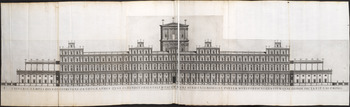
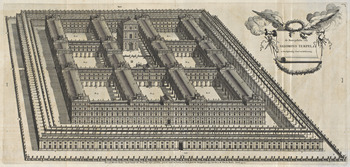
Cocceius's central concern was to correct what he perceived to be a gross error in the most influential work on the Temple to date, the impressive study of Temple architecture by the Jesuit Juan Bautista Villalpando (1552–1608), part of an Ezekiel commentary which appeared between 1596 and 1605. Villalpando's reconstruction ensued from a concerted enterprise at the court of King Philip II of Spain (1527–98) to project the palace-monastery of the Escorial as a renewal of Solomon's construction.Footnote 15 Villalpando created a sizeable square complex, articulated in symmetrically laid-out courtyards, surrounded by walls and supported on the Temple Mount by a giant substructure. The Jesuit weaved a web of symbolical meanings around the architectural harmony he detected, turning the temple into a microcosm of Creation. The imagery which accompanied Villalpando's reconstruction would have a strong impact on subsequent representations of Solomon's Temple, both in graphic art, in three-dimensional models, and in religious architecture (Figure 1).Footnote 16
Reconstruction of the Temple of Solomon, frontal view, from Jerónimo De Prado and Juan Bautista Villalpando, In Ezechielem explanationes et apparatus urbis, ac templi Hierosolymitani (3 vols., Rome, 1596–1605). Courtesy of Amsterdam University Library, Special Collections, call nr OTM: KF 61 658.

Crucial to Villalpando's calculations was the temple described in painstaking detail in the Book of Ezekiel. The prophecy of Ezekiel is associated with the period of the Babylonian exile of the Jewish people following the destruction of the First Temple in the sixth century bce. The prophetic text reflects the desire of the Jews to return to the Holy Land and renew divine service. The temple envisioned by Ezekiel constituted the spatial centre of the Jewish cult that was to rise again in the Holy City.Footnote 17
The description of the temple in Ezekiel 40–4 has meticulous measurements. The prophet reports a vision of a man of brass, who guided him through a temple-city. The brass man pointed out the architectural details of the complex, and measured them out using a measuring reed. Despite the numerous details – the width of the gateway, the extension of the courtyard, the distances between pillars, etc. – the design of the temple remains elusive. Already at the outset, the specification of the measuring unit is ambiguous: ‘in the man's hand a measuring reed six cubits long, of a cubit and a handbreadth each: so he measured the thickness of the building, one reed; and the height, one reed’ (Ezekiel 40:5). The Hebrew text reads: ‘a measuring reed, six cubits by the cubit and a handbreadth’.Footnote 18 It was unclear whether the six cubits marked on the reed were particularly large, each outsizing the regular cubit by a handbreadth; or whether the reed as a whole measured six cubits and one extra handbreadth. This was to become one of the key problems of much Temple scholarship.
The larger issue behind this technical question was the relation of Ezekiel's vision to historical realities: was Ezekiel's temple identical, either with the destroyed Temple of Solomon, or with the Temple subsequently rebuilt in Jerusalem? Or was it a spiritual construction, unconnected to any architectural reality? This was relevant both for the historical continuity of the sacred architecture since the days of Solomon and the prospective restoration of that architecture in the eschatological New Jerusalem.Footnote 19 Thus, it was a concern for the consistency of the very fabric of salvation history which made scholars ruminate on the particulars of the Temple's halls, porches, colonnades, throughout the centuries – in the same way as the quantifyable aspects of the Deluge and the Ark of Noah repeatedly invited scrutiny and provoked contestation.Footnote 20
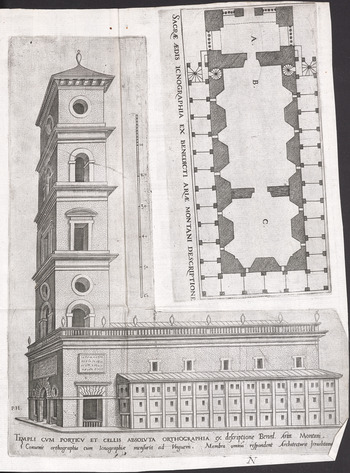
Villalpando's equation of Ezekiel's temple with the Temple of Solomon did not go uncontested – even before it appeared in print. Notably, Arias Montano, librarian at the Spanish court when both Villalpando's Ezekiel-commentary and the Escorial were in the making, denied that the temple in Ezekiel's vision corresponded with any historical reality. Already in 1572, he suggested an alternative reconstruction of Solomon's Temple, based entirely on 1 Kings 6 and 2 Chronicles 3–4 (Figure 2).Footnote 21
Reconstruction of the Temple of Solomon, from Benito Arias Montano, Antiquitatum Iudaicarum libri IX (Leiden, 1593). Courtesy of Amsterdam University Library, Special Collections, call nr OTM: OG 63 6134.

Villalpando's fusion of architectural harmony with divine providence was seized upon in subsequent graphical and architectural reconstructions of the Temple – for instance in several Dutch church designs, such as in Haarlem, near Amsterdam, where it inspired the Nieuwe Kerk (‘New Church’) designed by Jacob van Campen (1595–1657), opened in 1648.Footnote 22 The position of Montano, however, also enjoyed support, particularly among theologians who read Ezekiel's prophecy in a radically different way, as an allegory which prefigured the future Church of Christ. Samuel Lee (c. 1625–91), for instance, a nonconformist minister close to the Royal Society, in his Orbis Miraculum (1659) rejected the identification of Ezekiel's temple with any historical buildings in Jerusalem. He observed that Villalpando's reconstruction, based on Ezekiel's vision, was simply too large to fit on the Temple Mount, an argument in which he closely followed Louis Cappel.Footnote 23 A similar spiritual interpretation, informed by mathematical precision, was put forward ten years later by Cocceius.
In 1669, Cocceius published a commentary on Ezekiel. He reconstructed and depicted the temple envisioned (Figure 3).Footnote 24 Like Lee before him, he interpreted the prophet's temple as an allegorical figure of the true Church of God: ‘God does not live in temples made by hand. Therefore, if mention is made of any house of His on earth, it should be judged an allegory of the true, uncreated house.’Footnote 25 The man of brass was a symbol of Christ, who conducted human beings through the divine Temple and taught them to appreciate the immense proportions and the innumerable marvels of God's power.Footnote 26 Despite his spiritual representation, Cocceius made sure to craft a convincing graphic reconstruction, possibly stimulated by a Dutch fascination for the Temple architecture which had built up since the 1630s, and which brought forth the internationally renowned reconstruction by Jacob Judah Leon ‘a Templo’ (1603–75).Footnote 27 Yet, despite the input of technical experts, including the mathematician Samuel Carl Kechel (1611–68), Cocceius insisted on the primacy of the biblical text.Footnote 28
Reconstruction of the temple of the vision of Ezechiel, from Johannes Cocceius, De prophetie van Ezechiel, trans. J. H. Cocceius (Amsterdam, 1691/2). Courtesy of Amsterdam University Library, Special Collections, call nr OTM: O 62–578.

To render his spiritual reconstruction plausible, Cocceius had to invalidate Villalpando's work. He criticized his predecessor on many points of detail, including the latter's interpretation of ‘a measuring reed, six cubits by the cubit and a handbreadth’. Rather than a reed of six cubits and one handbreadth, as Villalpando had understood the phrase, Cocceius claimed that the reed measured six cubits which were increased by one handbreadth each. Like Cappel, moreover, Cocceius dwelt on the consequences of Villalpando's calculations for the relation between the size of Ezekiel's temple and the geography of the Holy Land. He focused on the area outside the outer walls (Ezekiel 48:8–21, 30–4). Cocceius argued that the territory surrounding the temple-city in Ezekiel's vision was much more extensive than the actual situation in Palestine allowed.Footnote 29 Therefore, it was implausible that Ezekiel's temple corresponded to any of the buildings that had ever actually stood there.
Two decades after Cocceius's death, the Franeker theologian Campegius Vitringa (1659–1722) felt uneasy about the former's Temple scholarship. In general, Vitringa sided with the Cocceians, and followed their historicizing eschatology rather than the precisian nomianism of the Voetians.Footnote 30 Nevertheless, he found Villalpando's reconstruction of the temple of Ezekiel, and its identification with Solomon's Temple, more convincing than the spiritual edifice of his Reformed colleague. Vitringa failed to see why God would have shown Ezekiel any construction other than Solomon's edifice – which already was the best design thinkable.Footnote 31
To counter Cocceius, Vitringa had to resolve the problem of the excessive space surrounding the building in Ezekiel's vision. He adopted a philological solution. The biblical verses specifying the surrounding territory mentioned no unit of measurement. Many interpreters assumed that the measuring reed of the introductory passage (Ezekiel 40:3) was still implicitly intended here. However, Vitringa stressed, there was no textual evidence for this. He suggested that these later passages did not express dimensions in reeds, measuring ‘six cubits by the cubit and a handbreadth’, but in single cubits.Footnote 32 This decreased the surrounding territory by a factor of six, bringing it back to the known proportions of the land of Canaan.
Consequently, Vitringa drew Cocceius's entire reconstruction of Ezekiel's temple in doubt. But he was hesitant to proffer his own alternative – lamenting that he was no engineer and therefore lacked the skills required. Convinced that Ezekiel's and Solomon's Temples were identical, Vitringa eagerly anticipated a detailed description of the latter that he knew was soon to be published by an expert in architecture: Willem Goeree.Footnote 33
II
Cocceius and Vitringa, academic theologians, limited themselves to textual scholarship. After 1690, an entirely new criterion came into play in the Dutch Temple debate: whether the design of the biblical Temples conformed to the architectural principles relevant to practising engineers.
In 1691, Willem Goeree published the reconstruction of the Temple of Solomon that Vitringa had alluded to. Goeree was not a professional theologian, but earned his living as a book publisher. Family circumstances – his father Hugo, doctor of divinity and medicine, died when Willem was young – had prevented him from receiving formal academic education. Yet he was a very accomplished autodidact in historia sacra. Skilled in architectural and graphic design, while working in the book trade, he also put tremendous effort into disseminating knowledge of biblical history and antiquities.Footnote 34
Goeree's reconstruction of the Temple appeared in Voor-bereidselen tot de bybelsche wysheid (‘Prolegomena to Biblical Wisdom’, 1691), a two-volume compendium of biblical and early ecclesiastical history.Footnote 35 The author drew extensively on the temple in Ezekiel's vision, which he assumed to be identical with the Temple of Solomon. After all, he argued, what use were the detailed measurements specified in the prophecy, if the description referred only to a spiritual construction rather than a material reality?Footnote 36 He thus sided with Villalpando and Vitringa, against Cocceius. But he took a different approach altogether.
Voor-bereidselen is a curious mixture of vernacular religious history, antiquarian scholarship, and applied knowledge. Vernacular biblical scholarship started to appear in considerable volumes in the decades around 1700. Already before that, religious texts had a sizeable share in the vernacular book market – in 1650 it has been estimated at 35 per cent. But these were usually either edifying, devotional, or polemical works.Footnote 37 Dutch-language publications of historical and antiquarian scholarship concerning the Bible and religion, by contrast, became popular especially in the last quarter of the century.
Goeree himself started out by publishing a translation of Petrus Cunaeus's history of the Hebrew Republic, De republyk der Hebreen (‘The Hebrew republic’, 1682), with comments written by his deceased father, as well as a number of sequels.Footnote 38 After these modest volumes in octavo, more grandiose publications followed suit: Goeree's Voor-bereidselen (1691), and then four folio volumes on the Mosaize Historie der Hebreeuwse kerke (‘Mosaic history of the Hebrew church’, 1700).Footnote 39 An interesting parallel to Goeree's vernacular biblical scholarship was Hieroglyphica (1735), a history of religions in emblems, illustrated and authored by another engraver, Romeyn de Hooghe (1645–1708). The posthumously published Hieroglyphica consisted of sixty-three full-page etchings, which condensed biblical and ecclesiastical history, classical scholarship, and natural philosophy, accompanied by elaborate explanatory texts.Footnote 40 Like Goeree, De Hooghe was a professional artist, who lacked formal training in theology, but was extraordinarily well informed nevertheless.Footnote 41 Both conveyed the technical details of sacred history to their readership in a profuse and imaginative manner.
In the preface to his translation of Cunaeus, Goeree justified his engagement as a layperson with sacred history: ‘Some will call out that it is improper for us, to treat of theological things, since they imagine that this domain is entirely reserved for them…Wisdom turns down nobody,…Therefore everyone ought to stand up and convince himself of being worthy of such divine things.’Footnote 42 Goeree aspired to let his vernacular audience in on the arcane world of biblical scholarship. Moreover, in the first of the sequels to Cunaeus's De republyk der Hebreen, he hinted at the need to combine erudition and technical expertise in scriptural exegesis. After arguing that the tabernacle of Moses had pilasters, while Solomon's temple had round columns, he added:
if someone of erudition and linguistic proficiency were to join forces with someone experienced in the rules of architecture and draughtmanship… and they would set out to retrieve all architectural wisdom in Scripture from scratch and disclose it, surely the resulting improvement would be so remarkeable as to replace all previous, erroneous depictions, as the light replaces the darkness.Footnote 43
This goes to show that Goeree not only felt entitled, as a non-professional, to publish works of biblical scholarship in the vernacular. He actually thought he could improve on the biblical interpretation of philologically trained theologians by contributing his expertise in architecture and draughtmanship. We will see below that this would make him vulnerable to the attacks of professional theologians who felt belittled by his work.
With Voor-bereidselen, Goeree entered an area which was dominated by classically trained academic scholars. In keeping with the historicizing trend in Cocceian biblical scholarship, the Nijmegen theologian Johannes Braun (1628–1708), for instance, published an elaborate study of the garments of Jewish priests (1680), and his colleague Antonius Bynaeus (1654–98) a book on Hebrew footwear (1682).Footnote 44 Determining spatial measures and units of weight was becoming an integral part of such antiquarian scholarship, relevant to sacred as well as profane history.Footnote 45 Goeree's work, though, was quite extraordinary in its reliance on architectural theory to lay the groundwork for the reconstruction of the Temple, more pronounced even than in the work of Villalpando. Whereas Braun and Bynaeus, for instance, both professional theologians, followed common procedure by founding their biblical antiquarian works on the accumulation of scriptural and classical quotations, Goeree started out with a reflection on the numerical proportions which lay at the basis of any architectural design.
For this, we need to turn to Goeree's background as a writer on architecture and draughtmanship. Villalpando's Temple publication had inspired not only artistic renderings and imitations of the Temple, but also architectural theory. Architects elaborated Villalpando's claims about the Vitruvian building orders and their Solomonic ancestry, as well as the divine ideation that underlay them, so as to ennoble the art of building which they aimed to systematize.Footnote 46 In the Dutch Republic, for instance, Salomon de Bray (1597–1664) in 1631 appealed to Villalpando to argue for the divine origin of architectural conventions, construing a direct line of development from biblical building practice down to the restrained style of Dutch Reformed church design. Goeree followed suit in D'algmeene Bouwkonst (‘General Architecture’), in 1681. In this book, he expounded an architectural system which encompassed monumental, civil, and private building practice.Footnote 47
Goeree attached great value to the regularities in nature which he thought mankind was able to uncover. The divine artisan had not only created his masterwork, but also the rules which determined the numerical proportions between its parts. These rules materialized, for instance, in the Solomonic order of architecture which structured the Temple in Jerusalem, and from which the classical orders known from Antiquity derived. Goeree was convinced of the mathematical regularity which underlay nature, and which simultaneously enabled the human faculties to recreate and enhance nature. This mathematical regularity presupposed a view of nature as a work of art.Footnote 48 To the extent that Goeree expressed these views in his architectural theory, he was neither very original nor particularly offensive. But when he subsequently reversed the order, and inserted a comprehensive discussion of the Temple of Solomon in his massive vernacular religious history, informed by his architectural know-how and critical of one of the most prominent theologians of the Dutch Reformed Church, he brought the wrath of the latter's heir on his own head.
Central to Goeree's reconstruction of the Temple was the measuring reed mentioned in Ezekiel's prophecy which, as we have seen, was a major bone of contention among scholars. Goeree claimed that the exact length of the measuring reed specified in Ezekiel 40:5 was really irrelevant. What mattered were the building proportions. The reed functioned as a modulus, a unit of measurement that served to determine the optimal proportions of the building. The modulus was the distance between two pillars, and it was related to the total width of the outer wall and the number of pillars lining it. Once the modulus was known, it was possible to design – and hence also to reconstruct – the entire building according to the proportions given by Vitruvius.Footnote 49 So far, Goeree followed Villalpando.Footnote 50 But rather than proceed with a survey of the ethical and numerological symbolism of the divine modulus, as the Jesuit did, Goeree then embarked on a discussion of the practical implications of the application of architectural theory.
There were complications, and here Goeree had to resort to speculation to reconcile the biblical text with his interpretation of the measuring reed. At the outset of his chapter on measures, he gave the most common measuring units of Antiquity, of which the most important are given in the following table:

The biblical text referred to ‘a measuring reed, six cubits by the cubit and a handbreadth’. Many exegetes interpreted this as signifying that the six cubits were of a special kind, being one handbreadth longer than the common cubit – Johannes Cocceius, for instance, who attributed this difference to the normal cubit being measured from the elbow to the top of a closed fist, and the larger ‘sacred’ cubit from the elbow to the tip of the fingers of an outstretched hand.Footnote 51 This made no sense to Goeree: since one normal cubit equalled six handbreadths, the six enlarged cubits would measure 6 * (6 handbreadths +1 handbreadth) = 42 handbreadths = 7 normal cubits – so it would have been easier to specify simply that the reed measured seven cubits.Footnote 52
However, it did make sense if only one handbreadth was added to the total of six cubits. Such a modification turned the reed into a more useful measuring instrument. Since many measurements in the subsequent description of the Temple (e.g. the sides of the precinct, and the total width of the gate and its gatehouses) amounted to multiples of twenty-five cubits, a measuring reed of exactly six cubits would never yield the proper length. By adding one handbreadth to the six cubits of the reed, however, the brass-like man could use it to measure out multiples of twenty-five.Footnote 53
Unfortunately, this alternative forced Goeree to sacrifice the consistency of the meaning of the words used in the biblical text, in favour of the consistency of his logic as an architect. The extra handbreadth that he required for the reed was two fingers longer than a common handbreadth. For instance, according to Goeree's suggestion, the width of the gate and the gatehouses (Ezekiel 40:13), which amounted to twenty-five cubits, was measured out by applying four times the reed, measuring six cubits and a quarter of a cubit (4 * (6 + 1/4) = 25). A quarter of a cubit equalled six fingers. The handbreadth in use among the Hebrews, however, measured four fingers. Goeree was aware of this inconsistency and suggested that the Israelites simply had no other word available for a measure of six fingers, and therefore called it a handbreadth.
Let us establish that these 25 cubits have been measured with four complete Reeds, and that every Measuring reed measured six cubits, and one quarter to add, which equals six fingers, and that the Prophet has indicated these six Fingers to us, calling them a Handbreadth, possibly because the Hebrews did not use any other measure that came closer to the measurement of the handbreadth.Footnote 54
In Goeree's view, Ezekiel's prophecy, divinely inspired, described an architectural reality in agreement with the conventions of engineering. This also explained what puzzled some exegetes, Vitringa among them: despite the use of the measuring reed, Ezekiel specified those measurements which exceeded the length of one reed in cubits, rather than in numbers of reeds (e.g. the outer wall measured ‘500 cubits’, not ‘eighty reeds’). Goeree reassured his readers that this was perfectly customary in architecture: ‘Yes, Architecture forces us to embrace that opinion.’Footnote 55 Had the prophet specified lengths in numbers of reeds instead of in cubits, so Goeree continued to explain, this would have required readers to reconvert the numbers into regular cubits again. Such an obscure way of reporting measurements would have gone ‘against the Customs of Architectural description’.Footnote 56 In this way, Goeree appealed repeatedly to his expertise in architecture in interpreting the reality conveyed by the prophetic text.
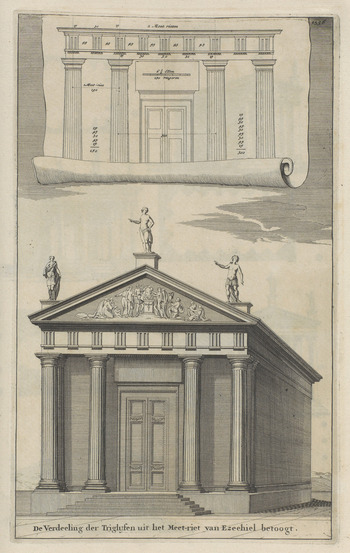
After his extensive discussion of the cubits and the measuring reed, Goeree used the measurements of the pillars, as given by Ezekiel, to calculate the proportions of the entire building. This reconstruction was entirely based on his understanding of the building orders of Vitruvius. The dimensions of the columns suggested to Goeree the dimensions of the triglyphs; those in turn suggested the proportions of the façade; and so on (Figure 4). This enabled him to envisage the Temple of Solomon as built in accordance with Vitruvian dimensions.
The proportions between the various measurements of the façade, based on the modulus, from Willem Goeree, Voor-bereidselen tot de bybelsche wysheid, en gebruik der heilige en kerklijke historien (2 vols., Amsterdam, 1691). Courtesy of National Library of the Netherlands (Koninklijke Bibliotheek), Special Collections, call nr KW 495 A 4.

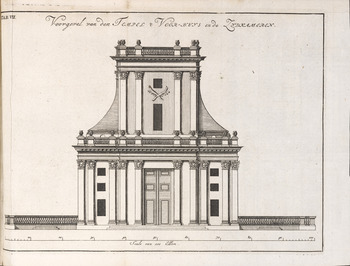
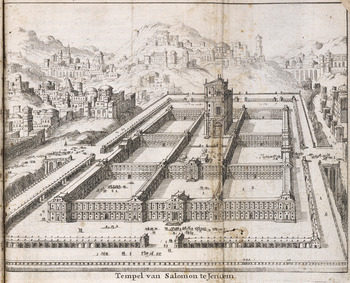
The result of Goeree's reconstruction conformed perfectly to Villalpando's work, almost a century earlier. The plate with which Goeree had the entire edifice depicted, amounted to a three-dimensional integration of the two-dimensional profiles that the Jesuit had included in his magnificent volume at the beginning of the century (Figures 1 and 5).Footnote 57 In fact, a less detailed version of the same three-dimensional view of the Temple, based on Villalpando's work, had already appeared in Goeree's 1682 translation of Cunaeus's De republyk der Hebreen (Figure 6).Footnote 58 It was not so much Goeree's reconstruction as such, but rather his reasoning, favouring technical know-how over theological method, which gave his adversaries an opportunity to mark him as a radical critic.
Reconstruction of the Temple of Solomon, from Willem Goeree, Voor-bereidselen tot de bybelsche wysheid, en gebruik der heilige en kerklijke historien (2 vols., Amsterdam, 1691), ii, between pp. 1604–5. Courtesy of National Library of the Netherlands (Koninklijke Bibliotheek), Special Collections, call nr KW 495 A 4.

Reconstruction of the Temple of Solomon, from Petrus Cunaeus, De republyk der Hebreen, of Gemeenebest der Joden, trans. Willem Goeree (Amsterdam, 1682). Courtesy of Amsterdam University Library, Special Collections, call nr OTM: ROK A 1705.

III
Goeree brought architectural theory to bear on biblical exegesis, after almost a century in which architects had drawn on Villalpando mainly to sanctify their own profession. However, whereas architectural theory could benefit from the divine sanction implied by biblical precedent, conversely theological authority seemed to suffer from the involvement of architectural expertise. This led professional theologians to shoot unfounded, but damaging, critique at the architect. Goeree would incur the accusation of fertilizing the ground on which Spinozist atheism grew.
The immediate occasion was Goeree's public belittlement of Cocceius's spiritual interpretation of Ezekiel's vision. In the tense religious atmosphere in the Dutch Republic in the final quarter of the seventeenth century, Cocceius's son, Johannes Henricus Cocceius (†1712), took action to vindicate his father. Cocceius Jr, a senior civil servant, had been trained as a theologian.Footnote 59 In a number of books, Cocceius Jr attacked Vitringa and Goeree, with the evident aim of rehabilitating his deceased father.Footnote 60 As the debate evolved, Cocceius Jr extended his critique, accusing Goeree not only of denying that God had designed the Temple of Solomon, but of going so far as to deny God's ‘authorship’ of the divine laws – tantamount to rejecting the divine inspiration of the Bible.
Initially, Cocceius Jr concentrated on the Temple. He judged Goeree's application of Vitruvian theory misguided, which had forced him to alter the conventional meaning of scriptural words: Goeree measured the handbreadth at six fingers instead of the usual four, so as to be able to interpret the measuring reed as a modulus.Footnote 61 Not only did Vitruvius record the architectural rules only in the first century ce. What was more important, these rules were derived from the cultic architecture of pagans, ‘the idolatrous temples of the heathens, with whom Israel's seed was not allowed to intermingle’. These rules could not have been binding for the Israelites, and certainly not for the ‘Architect of Heaven and Earth’.Footnote 62 Cocceius Jr accused Goeree of subordinating God's omnipotence to architectural conventions invented by idolatrous human beings. Cocceius Jr stressed the primacy of linguistic and textual analysis to determine the meaning of biblical terms and phrases, instead.
Goeree did not take Cocceius Jr's criticism lying down. On the contrary, he took his approach to biblical history one step further, in his massive history of the Old Testament Jews, Mosaize historie der Hebreeuwse kerke (1700). Provocatively, he advocated in general terms the derivation of Jewish religious institutions and structures from pagan origins – and specifically Egyptian origins.Footnote 63 He singled out the architecture of the Temple as a case in point, arguing that the Egyptians must have already known the architectural rules that Vitruvius later wrote down. He posited the existence of a primaeval, pure religion. Pagans like the Egyptians had corrupted this religion, and the Hebrews had subsequently purified it again. Even the divine laws that Moses introduced in the Sinai were not new, but a reformation of the travesty that the Egyptians had made of the original religious ceremonial.Footnote 64
Despite Goeree's explicit, if idiosyncratic, adherence to Scriptural Revelation, his opponents associated his characterization of Old Testament religion with a position which passed for outright apostasy: Spinozism.Footnote 65 It did not help that he received implicit support from a real Spinozist, Frederik van Leenhof (1647–1712).
Leenhof started out as a representative of the Cocceians, when he was a young minister, in the 1670s and 1680s. His vernacular expositions of Cocceian theology appeared in 1673 as co-productions of Goeree and an Amsterdam publisher.Footnote 66 In subsequent years, Leenhof's perspective on the Christian religion developed unmistakably in a Spinozist direction. In 1703, he published Hemel op aarden, ‘Heaven on earth’, in Zwolle.Footnote 67 In this small book, the author unfolded a naturalistic view of religion and public life in which the Spinozist leanings were hard to miss – especially Spinoza's rationalization of the social utility of Holy Scripture, as expounded in the Tractatus Theologico-Politicus (1670). Leenhof distinguished two ways of grasping the divine order of things: rational inquiry into the causal relationships between phenomena, and obedience to precepts. He intimated that the former was preferable, but unattainable by most people. For the majority of people, it was necessary to provide guidance in the form of figures which would appeal to their imagination and which would incite them to obedience. This necessity explained the occurrence of biblical concepts such as Heaven and Hell. According to Leenhof, it was perfectly fine for clergy to use such imagery to induce the less reflective to behave piously, as long as the images used were faithful to the true religion, which meant living together in harmony and peace, and above all: cheerfully. Leenhof had no patience for the gloom with which his colleagues preached about sin and damnation.Footnote 68
The book caused a furore and a fierce exchange of pamphlets ensued.Footnote 69 In one of the pamphlets that Leenhof published in his defence (1704), he admitted that he had taken certain expressions from Spinoza. He declared that it was fine to borrow concepts from anyone, even from pagans, and even from atheists. In a provocative afterthought he added that even Jesuit writings could be valuable: ‘the construction of the temple, poorly understood by Mr. Cocceius, owes its lustre to that grand Villalpando’.Footnote 70
Cocceius Jr seized upon this opportunity to associate Goeree with the controversial Leenhof. In a vitriolic essay, Cocceius Jr first denounced the minister of Zwolle for mentioning Spinoza and his father in one breath, and for comparing his father unfavourably with a Jesuit. He then faulted Goeree for endorsing that same Jesuit, thus providing encouragement for atheists such as Leenhof.Footnote 71 Cocceius Jr turned to Goeree's claim that the Temple of Jerusalem had Egyptian origins. According to Cocceius Jr, this blurred the distinction between pagans and the divinely chosen people. If Goeree argued that Solomon had built the Temple following the Egyptian example, what was to stop atheists from claiming that the Bible itself was a scrapbook of pagan laws, as well?Footnote 72 Cocceius Jr suggested that Goeree's audacious use of pagan knowledge in sacred matters fed into Spinozist atheism.
Cocceius Jr's accusation seems contrived, a manoeuvre of a vindictive son who had recourse to the strongest deterrent available to slander his adversary. This is borne out by his collaboration with the minister Frans Burman Jr (1671–1719), the son of the late Cocceian professor Frans Burman (1628–79).Footnote 73 Cocceius Jr's essay against Goeree was appended to Burman Jr's book against the Spinozism of Leenhof – which was itself a sequel to Burmannorum Pietas, a publication intended to exonerate Burman Jr's father from the accusation of Spinozist sympathies.Footnote 74 A strong motive of the two sons seems to have been to dissociate themselves and their family names from any suspicion of heterodoxy. Consequently, the use of the label ‘Spinozism’ may have been merely instrumental for disqualifying their opponents. Nevertheless, the notion that Goeree entertained an unconventional, even radical, philosophy of religion has met with approval among modern historians.Footnote 75 Goeree's approach to biblical Revelation therefore merits further examination.
It may be helpful to look for analogies of Goeree's religious programme beyond the borders of the Dutch Republic, and thus beyond the usual suspects of Dutch biblical criticism. In particular, we may turn briefly to the theologies of John Spencer (1630–93) and Isaac Newton (1642–1727), with both of whom Goeree had traits in common, even if he differed from both in important ways as well. His argument that Solomon's Temple was built acording to architectural rules known to the Egyptians, and his wider framework of the Egyptian origins of religious ceremonial and laws which he developed in Mosaize historie, parallels their historical theories.
John Spencer, master of Corpus Christi College in Cambridge, developed an evolutionary model of religion, drawing heavily on Maimonides (1135–1204). Spencer joined a spate of Protestant scholars who speculated about the earliest Jewish religion, and its relationship to the rites of the Sabeans, legendary star worshippers in the Near East. Spencer designated the ancient Egyptians as Sabeans, and claimed that the Hebrews derived many of the ceremonial laws specified in the Pentateuch from Egyptian rituals. He cursorily included the erection of the Temple among the cultic acts in which the Hebrews imitated their former masters.Footnote 76 This was controversial because it reversed the order commonly accepted by Protestant theologians: instead of the Egyptians having corrupted pre-existing Jewish ceremonial, according to Spencer it was the Jews who adopted pre-existing Egyptian rites. Moses adapted the Egyptian ceremonial which the Jews were already familiar with, so as to facilitate their acceptance of their newly found true divinity. Spencer intimated that for similar reasons Christians had incorporated elements of Jewish and pagan ceremonial, elements which were inconsequential for human salvation and therefore perfectly legitimate.Footnote 77
In a recent study of Spencer's project, Dmitri Levitin claims that it was intended primarily to respond to Calvinist nonconformists, who condemned Anglican rites as non-biblical and protested their commitment to Old Testament religious ceremonial. However, later authors with different aims drew upon Spencer's explanation of the origin of Jewish ceremonial, using his ‘Egyptian thesis’ for their own benefit. Anti-clerical authors such as Charles Blount (1654–93) and Robert Howard (1626–98), for instance, happily paraded the ‘Egyptian thesis’ to contend that all religious ceremonial had been invented by powermongering Egyptian priests, disregarding Spencer's notion of the salvific essence of organized religion. Again, Newton thought he found confirmation in Spencer's work of his own idea that Moses had uncovered a core of pure religion present in Egyptian ceremonial, which in its turn was a corruption of an ancient, true Noachide religion.Footnote 78
The reception of Spencer's work in the Dutch Republic awaits study, but it was certainly noted among Reformed theologians – and heavily criticized.Footnote 79 Already the ‘pre-publication’, Dissertatio de Urim and Thummim (1669/70) in which Spencer argued for the Egyptian origins of the oracle stones of the Jewish high priest, met with disapproval. Johannes Braun, for instance, devoted a chapter of his book on the priestly garments (1680) to disproving Spencer's claim concerning the Egyptian origin of the oracle stones.Footnote 80 Herman Witsius (1636–1708), an eminent professor at Utrecht University, scathingly rebutted Spencer's ‘Egyptian thesis’ in Aegyptiaca (1683). After listing several biblical precepts which forbade the Jews to imitate the Egyptians, Witsius rhetorically snarled: ‘Do you hear, Spencer, on which grounds God has called the Israelites away from Egyptian vanities, toward the observation of his commandments?’Footnote 81 Major Dutch theologians were thus dismissive of what they perceived as Spencer's profanation of biblical ceremonial.
Goeree knew of Spencer, listing him among authoritative exegetes in the preface to the Mosaize historie, even if he did not explicitly reference him when discussing the origin of the Jewish ritual laws.Footnote 82 In any case, he was not deterred by the pungent responses of Dutch theologians to Spencer's ‘Egyptian thesis’. Goeree similarly interpreted Mosaic legislation as an adaptation of the perverted ceremonial of the Egyptians, a purified derivation of pagan rites.
If Goeree did indeed take his cue from Spencer's work, he gave it a twist similar to Newton. After all, like Newton, Goeree hypothesized that Moses’ version of the Egyptian cult was more than a mere instrument to ensure a smooth transition to Mosaic monotheism. It constituted a recovery of a simple primaeval cult which had already existed before the decadence under the Egyptians had set in. In Goeree's religious history, the Jewish Temple was the architectural expression of a primitive religion which was, like Newton's (and unlike Spencer's), a pious celebration of the regularities of nature.
Newton famously produced his own Temple scholarship. Newton's Old Testament Jews were privileged witnesses to the primaeval Prytanean cult of Noah, centred on a round temple with fire in the middle, which symbolized heliocentrism. Newton's reconstruction of the measurements and dimensions of the Temple of Solomon served as the key to understanding the prophetically disclosed celebration of divinely ordered Creation, which constituted a pure, monotheistic, abstract religion. His study of the Temple was part of an attempt to integrate biblical history and natural philosophy in an overarching eschatological scheme, informed by ‘clues’ that God had hidden in both nature and history to instruct the well-informed observer about the final destiny of the World.Footnote 83
Like Goeree, Newton liberally employed his practical expertise to remedy the lack of clarity of the biblical texts. Jed Buchwald and Mordechai Feingold argue that Newton was convinced of the essential regularity of the dynamics of biblical culture, on a par with nature.Footnote 84 Goeree agreed. That very principle led him rigorously to apply architectural theory to biblical reality, even if it meant bending the biblical text somewhat to make it all fit. It was exactly that liberal approach to the words of Scripture which Cocceius Jr publicly decried. The fallout signals a withdrawal of professional exegetes on terrain they were comfortable with.
According to Scott Mandelbrote, Newton regarded the investigation of prophecy as a private enterprise, exclusively accessible to people of learning, capable of stomaching ‘strong meat’ (Hebrews 5:13–14). Theology in the public arena should be limited to the basic tenets of Christianity, the simple Golden Rule, which Newton designated, following the Apostle Paul, ‘baby's milk’. Accordingly, he preferred to keep his biblical speculations, including the reconstruction of the Temple and its measurement units, to himself.Footnote 85 The Dutch Temple discussion, by comparison, was anything but a private affair. Goeree flaunted his religious theory, including his Temple reconstruction, in the most public fashion possible. The ‘strong meat’ which he served was hard to stomach for his academically educated adversaries. The expertise that this lay exegete offered in reconstructing the Temple would not be endorsed by professional theologians.
This was apparent already in 1707, when Johannes Meier (1651–1725), a Cocceian theologian at Harderwijk University, published a Latin dissertation on the Vision of Ezekiel. He set out to prove Cocceius right: Ezekiel's temple was a spiritual representation. The title of the fifth and final section summarizes Meier's opinion well: ‘The Visions which are in the last nine chapters of Ezekiel have an allegorical and a mystical meaning.’Footnote 86 Significantly, Meier sidestepped the vernacular debate conducted between the opponents and supporters of Cocceius's Temple scholarship. He did devote a section to disproving Spinoza's ironic remark that rabbis had almost repudiated the Book of Ezekiel because some passages seemed to run counter to Moses’ law.Footnote 87 As for the identity of Ezekiel's vision with the historical temples of Jerusalem, the issue which had sparked off the Dutch Temple debate, Meier focused on philological issues.Footnote 88 This was accordance with Cocceius Jr's admonition that biblical interpretation must be founded on philological expertise. The professional theologian Meier chose to ignore the lay exegete who had built his hermeneutics on the premise that the regularities of nature had consistently informed the core of monotheistic religion, ever since the hazy beginnings of humankind.
When by the end of the eighteenth century the production of vernacular compendia of biblical commentary became common among Reformed theologians, it was clear that Goeree's technical contribution to the Temple debate had failed to take root. In a multi-volume biblical commentary published around 1785 in Dutch, for instance, in which the theologian Ysbrand van Hamelsveld (1743–1812) succinctly reviewed many of the debates of the previous centuries, the relation of the Vision of Ezekiel to the historical temples of Jerusalem had lost nothing of its relevance. Van Hamelsveld discussed the nature of the Temple described by Ezekiel, which he, like Cocceius, considered to be a spiritual figure. He debated Vitringa's position – but did not mention Goeree's.Footnote 89 Writing in the vernacular, Van Hamelsveld did not have to shy away from citing Dutch publications. Moreover, as a member of the first National Assembly in the revolutionary period, who dedicated himself to social policy in terms of the utility of professions, he might have been expected to appreciate the contribution of a skilled engineer.Footnote 90 However, the architectural expertise of Goeree had become alien to the professional exegete.
In that same period, another work appeared which similarly shows how the contribution of an engineer such as Goeree to the Temple debate failed to take hold. This was the Bybel der natuur (‘Nature's Bible’, 1784–92), the Dutch translation of the German Kupfer-Bibel, a survey of natural and physical phenomena occurring in the Bible, published originally in the 1730s by the Swiss physician Johann Jakob Scheuchzer (1672–1733). Scheuchzer commented on the measurements and the construction of Ezekiel's temple, drawing on architects such as Leonhard Christoph Sturm (1669–1719), as well as Villalpando.Footnote 91 The Dutch translator, however, Laurentius Meijer (1727–98), professor of theology in Franeker, added a commentary which was entirely philological. He cautiously defended the authenticity of the Book of Ezekiel, referencing renowned philologists such as Johann Gottfried Eichhorn (1752–1827) and Johann Salomo Semler (1725–91).Footnote 92 Significantly, he quoted Johann David Michaelis (1717–91), who deplored the interference of ‘mathematicians’ who had not been proficient in Hebrew, such as Sturm and Villapando – and, we may add, Goeree. The intricacies of biblical Hebrew were such, so Michaelis implied, that it was hardly possible to reconstruct the Temple by having recourse to architectural expertise.Footnote 93
The Bible had become a text first and foremost, which required academic training in philological scholarship.Footnote 94 For Dutch theologians, explaining the Bible in the eighteenth century came to signify commenting on its textual consistency and linguistic peculiarities. Professional theologians took charge of the production of sumptuous volumes of vernacular biblical history and antiquities – avoiding the unpredictable capers of lay scholars. The astonishing volumes which Goeree published around 1700 constituted an attempt to open up biblical scholarship to the skilled laity to which he himself belonged. Academically trained theologians, however, ascertained their exclusive competency in reconstructing the edifice of Revelation.
IV
Willem Goeree became tainted with radical criticism, as a consequence of his application of architectural knowledge to biblical interpretation, because it threatened to sideline the philological scholarship which was the preserve of professional theologians. The Temple debate thus shows how hermeneutical conflicts in the seventeenth century were not solely about the applicability of human reason to biblical interpretation. They were as much about who was better equipped for distilling meaning out of the biblical texts, the philologically trained theologian or the expert in a technical skill.
Dutch Latinate theologians were concerned about retaining a grip on their holy texts, as well as on the reputation of their family names. The spectre of radical philosphy and biblical criticism made all participants in theological debate on edge in this period. Spinozism was a label which was easily stuck onto the opponent, and difficult to get rid of. By entering into more detail in his Temple reconstruction, and his wider religious philosophy, we have seen that Goeree hardly qualified as a Spinozist. He had a peculiar theology, historically construed, based on the conviction that Creation is deeply regular, that religion should be a celebration of this regularity, and that biblical prophecy informed mankind about the features of such a religion. The Temple as reconstructed by Goeree was one instantiation of this. These features of his religion were analogous to Isaac Newton's theology, and the historical substructure seems similarly derived from an evolutionary model as proposed by John Spencer.
Through the reconstruction of the Temple of Solomon, Goeree meant to demonstrate how his architectural theory was essential to a proper understanding of a biblical reality – like all arts which were similarly based on experience and reason. Goeree strove to present his readers with a religion which was accessible in the Bible, on the condition that the proper preliminary knowledge, of any kind, be employed to navigate potential misunderstandings. Whereas Villalpando had had recourse to Vitruvian architecture in the framework of a neo-Platonist integration of Creator and Creation, Goeree appealed to Vitruvius because he was convinced of the intrinsic mathematical regularities inherent in all realities, biblical as well profane, setting aside any micro-macrocosm parallels. Goeree presented an alternative to the Temple scholarship, and biblical interpretation in general, of professional Reformed theologians. His contribution, however, failed to find resonance in later eighteenth-century biblical scholarship, not even in the vernacular works by theologians, which started to replace the Latin ones.