In most countries in which schooling is taught through a nonnative medium, school enrollment and completion rates are low (UNESCO, 2000). Typically, students beginning school in a language they do not speak at home experience failure and often drop out before attaining even minimal literacy. In countries where primary education is taught through the native tongue, but secondary is taught through a nonnative medium, students frequently drop out before completing secondary school.
However, Singapore seems to be an exception to this trend. Singapore's education system has been hailed as a success because of its first-place ranking in math (Mullis et al., Reference Mullis, Martin, Gonzalez, Gregory, Garden and O'Connor2000) and second place in science (Martin et al., Reference Martin, Mullis, Gonzalez, Gregory, Smith and Chrostowski2000) compared to 38 countries on the Third International Math and Science Study—Repeat, which was conducted by the International Association for the Evaluation of Educational Achievement. Although these results may reflect the quality of mathematics and science education rather than language, an underemphasized fact is that this superlative achievement in mathematics and science was attained through a nonnative medium, English. Each country in the Third International Math and Science Study—Repeat was tested in the language of instruction, which is English in Singapore. However, only 27% of Singapore's students reported “always using the language of the test at home” (Singapore Ministry of Education, 2001), whereas three-quarters of participating countries had 80% or more of their students always speaking the language of the test at home (Dixon, Reference Dixon2005; Mullis et al., Reference Mullis, Martin, Gonzalez, Gregory, Garden and O'Connor2000). In addition, Singapore's Primary 4 students scored significantly higher than the international average and 15 countries of the 35 countries tested in the International Association for the Evaluation of Educational Achievement's Progress in International Reading Literacy Study 2001 (Mullis, Martin, Gonzalez, & Kennedy, Reference Mullis, Martin, Gonzalez and Kennedy2003). The Progress in International Reading Literacy Study 2001 tested 10-year-olds (with 4 years of formal schooling) on reading for literary and informational purposes. The tests were again administered in the language of instruction of each country (i.e., English for Singapore). Overall, Singaporean Primary 4 (fourth grade) students achieved an average score that was not significantly different from Scotland and New Zealand but was significantly lower than England and the United States. An unanswered question is why Singaporean students perform so well in math and as well as at least two native English-speaking countries in reading on these international comparisons.
It is clear that Singaporean students must achieve adequate vocabulary in English in order to perform at high levels through the medium of English at school. (For more detailed information on Singapore's language in education policy, see Dixon, Reference Dixon2005, Reference Dixon2009.) English vocabulary is essential both in order to understand a teacher's oral instruction and to develop the reading skills necessary to comprehend school textbooks. Many studies have documented the oral-language skills first-language (L1) learners need to master in order to become skilled readers of English (see Snow, Burns, & Griffin, Reference Snow, Burns and Griffin1998), including vocabulary skills. In many cases, students' performance on these skills in kindergarten predicts their later school success or failure. Meta-analyses indicate that kindergarten vocabulary size is moderately correlated with later reading proficiency; that is, kindergartners with larger vocabularies tend to develop into more proficient readers in the early grades in an L1 context (Scarborough, Reference Scarborough, Shapiro, Accardo and Capute1998, Reference Scarborough, Neuman and Dickinson2001; Swanson, Trainin, Necoechea, & Hammil, Reference Swanson, Trainin, Necoechea and Hammill2004). Second-language (L2) learners are assumed to be at a disadvantage in vocabulary size compared to L1 learners (Gunderson & Clarke, Reference Gunderson, Clarke, Shanahan and Rodriguez-Brown1998) and are therefore considered “at risk” for reading problems in the L2 in contexts where the language of schooling is the L1 of the majority group in society. In addition, building vocabulary has been found to be more complex than simply memorizing a new word and its definition (Bloom, Reference Bloom2000) because learning a new word changes the connotations of existing words and the relationships between old and new words (Landauer & Dumais, Reference Landauer and Dumais1997). Bilingual or L2 learners may not have access to the same pools of lexical and semantic knowledge as L1 learners, especially in a context in which the majority of their classmates and their teachers are bilingual or L2 speakers of the language of instruction, most with limited proficiency and likely poor models of the target language (see, e.g., Gass & Selinker, Reference Gass and Selinker2001). Thus, L2 vocabulary size may be even more important to the development of reading skills for L2 learners. In addition, oral proficiency (of which vocabulary is one measure) may be more important to children learning a language with a “deep” orthography, such as English, than a “shallow” or transparent orthography, such as voweled Hebrew (Geva & Siegel, Reference Geva and Siegel2000). Children reading a shallow orthography easily learn to decode words once the basic grapheme–phoneme correspondences are learned; however, those reading a deep orthography may need to rely more on their knowledge of the language in order to use context to decode unfamiliar words with nontransparent spellings.
The few studies that have looked at oral-language skills in L2 learners of English focus on L2 English learners in countries like the United States, in which the majority of the population are native speakers of English. In these studies, the same skills have been shown to be important for L2 learners of English; but vocabulary skills, in particular, are harder for L2 learners of English to acquire (Carlisle, Beeman, Davis, & Spharim, Reference Carlisle, Beeman, Davis and Spharim1999; Chiappe & Siegel, Reference Chiappe and Siegel1999; Geva, Yaghoub-Zadeh, & Schuster, Reference Geva, Yaghoub-Zadeh and Schuster2000; Muter & Diethelm, Reference Muter and Diethelm2001).
Singaporean students' high levels of academic achievement at Grade 4 and higher suggest that students, despite being bilingual or L2 learners of English, may start their schooling with successful English vocabulary learning. Singapore thus provides a fascinating and understudied context in which to examine the relationship between the vocabulary in bilingual children's two languages. Two questions are addressed in this paper:
1. What is the level of English vocabulary achieved among Singaporean kindergartners?
2. What home and school factors best predict English vocabulary achievement at kindergarten?
THEORETICAL BACKGROUND
Many different home and school factors may predict English vocabulary among Singaporean kindergartners. The main predictors examined in the current study include socioeconomic status, language exposure, ethnicity, and mother tongue vocabulary.
Socioeconomic status
Many studies conducted in the United States indicate that socioeconomic status is a strong predictor of vocabulary size (Snow et al., Reference Snow, Burns and Griffin1998). More educated mothers, for example, are likely to have larger vocabularies and to talk and read more with their children, leading in turn to greater vocabulary growth in their children (Hart & Risley, Reference Hart and Risley1995). It is expected that socioeconomic status will likewise predict English vocabulary in Singaporean children. In the Singapore context in particular, more highly educated mothers are more likely to have completed more years of English-medium schooling, potentially leading to a sharper difference in their children's English vocabulary compared to less educated mothers who may be much less proficient in English orally as well as academically.
Language exposure
Singapore is a multilingual nation comprised of three major ethnic groups: 77% Chinese, 14% Malay, and 8% Indian (Singapore Department of Statistics, 2002). In every ethnic group, some percentage of families report English as their main home language. As vocabulary knowledge in each language is related to a child's exposure to each language (e.g., De Houwer, Reference De Houwer, Fletcher and MacWhinney1995; Duursma et al., Reference Duursma, Romero-Contreras, Szuber, Proctor, Snow and August2007; Jarovinskij, Reference Jarovinskij1979; Vermeer, Reference Vermeer2001), it is reasonable to hypothesize that those Singaporean families who speak English as their primary language at home will produce children with higher levels of English vocabulary.
In addition, television (TV) is another source of language exposure. Studies among L1 English-speaking children found that children learned new vocabulary presented through TV (Rice & Woodsmall, Reference Rice and Woodsmall1988) and that viewing educational TV shows such as Sesame Street and Barney was correlated with vocabulary growth among L1 English speakers (deGroot, Reference deGroot1994; Rice, Hutson, Truglio, & Wright, Reference Rice, Huston, Truglio and Wright1990). Studies of TV viewing and vocabulary acquisition among L2 learners indicate kindergarten and school-aged children can acquire L2 vocabulary through TV viewing. One study found home TV viewing of educational English-language TV significantly predicted US Spanish–English bilingual kindergartners’ receptive and expressive English vocabulary scores at the beginning and end of their kindergarten year (Uchikoshi, Reference Uchikoshi2006); another study indicated Dutch children could learn English vocabulary through subtitled and unsubtitled TV programs (Koolstra & Beentjes, Reference Koolstra and Beentjes1999). Although most of the studies discussed above look at specific high-quality educational TV programs, it is hypothesized that Singaporean kindergartners who watch TV programs in English more than in other languages will demonstrate higher English vocabulary because TV may provide access to English vocabulary that children would not encounter through their interactions with limited-English- or non-English-speaking caretakers.
Ethnicity
Cultural differences in childrearing may contribute to home language and literacy practices that differ by ethnic group leading to differences in English vocabulary, controlling for English use at home. In internal exams, Singaporean students at the end of Grade 6 and in secondary school demonstrate differences in academic achievement among the different ethnic groups (Singapore Ministry of Education, 2002). One possibility, therefore, is that these ethnic differences in achievement begin in kindergarten and that ethnicity, controlling for English use at home, may predict differences in English vocabulary. By controlling for mother's education and English exposure, this study will isolate ethnicity as a possible contributor to differences in English attainment.
Mother tongue vocabulary
The relationship of vocabulary in a child's two languages is complex. Bilingual children's proportion of vocabulary in each language has been shown to change according to the language exposure circumstances (De Houwer, Reference De Houwer, Fletcher and MacWhinney1995). Thus, vocabulary in the two languages may be negatively correlated, because the two scores may reflect differing exposure to the two languages within a fixed total exposure time.
In contrast, Cummins’ interdependence hypothesis (Reference Cummins1979, Reference Cummins2000) suggests that an L2 is learned more easily from a solid base in one's L1; and research has confirmed that transfer between a bilingual's two languages does occur for reading (Cummins, Reference Cummins1984) and writing skills (Lanauze & Snow, Reference Lanauze and Snow1989). The link between vocabulary in a bilingual's two languages, however, is less clear. Cummins’ interdependence hypothesis could indicate a link between vocabulary in two languages; in addition, current theory concerning how bilinguals store vocabulary in their two languages proposes one shared conceptual lexicon, indicating that a concept already learned in one language would be more easily acquired in the L2 than a new concept (Kroll & de Groot, Reference Kroll, Groot, de Groot and Kroll1997).
Empirical studies of the association between L1 and L2 vocabulary among L2 learning children in the United States mostly support a negative correlation between languages (Oller & Eilers, Reference Oller and Eilers2002; Ordonez, Carlo, Snow, & McLaughlin, Reference Ordonez, Carlo, Snow and McLaughlin2002; Rolla San Francisco, Carlo, August, & Snow, Reference Rolla San Francisco, Carlo, August and Snow2006). One study in the United States showed a marginally significant positive effect of Spanish vocabulary at the beginning of kindergarten predicting English vocabulary at the same time (Uchikoshi, Reference Uchikoshi2006), but Spanish vocabulary did not predict the rate of growth of English vocabulary over the kindergarten year in a growth analysis. One study that was specifically designed to test Cummins's interdependence hypothesis indicated no transfer of vocabulary from L1 (Turkish) to L2 (Dutch) among Turkish-speaking 6-year-olds in the Netherlands (Verhoeven, Reference Verhoeven1994). Singapore is of course a different context from the United States and the Netherlands, but it might be hypothesized that Singaporean kindergartners with higher mother tongue skills might have experienced more mother tongue and therefore less English exposure. Thus, the negative correlation found in most other studies would be replicated.
METHOD
Participants
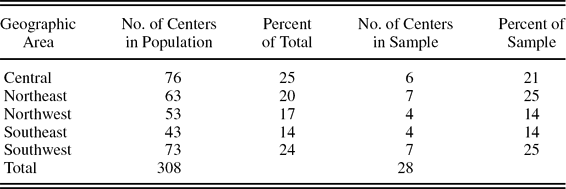
Children attending kindergarten 2 (K2) classes were recruited through their kindergarten centers, all run by the People's Action Party (the ruling political party of Singapore) Community Foundation (PCF). A 1991 report indicated that about 70% of kindergarten-aged children attended PCF kindergartens (Gupta, Reference Gupta1994). A random sample of PCF kindergarten centers, proportionally stratified by geographic area of the island of Singapore, was invited to participate in the study. Thus, areas with more total centers provided more centers for my sample (see Table 1). Within each center, a random sample, stratified by ethnicity, of the K2 children in the center were invited to participate through letters to their parents. K2 in Singapore refers to the year before first grade. Overall, 74% of invited students obtained parental permission to participate and thus were included in the study. Approximately 10% of the Chinese pupils in each center participated. Malay and Indian students were deliberately oversampled to allow for intergroup comparisons; about half of the Malay and Indian students from each center participated. Children from an ethnic group that made up less than 2% of the student body at that center were excluded in order to avoid any potential effects ethnic isolation might have on children's language development. Children not of the three major ethnic groups (Chinese, Malay, or Indian) were also excluded (e.g., Eurasian), because their numbers would be too small to draw any statistical conclusions. In addition, children with identified learning disabilities or medical conditions that prevented them from seeing, hearing, or speaking within the normal range for this age group were excluded.
Number of total People's Action Party Community Foundation kindergarten centers and number in sample by geographic area
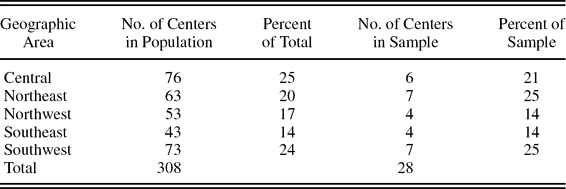
Note: The percentages may not add up to 100% because of rounding.
The 284 children in this study represent a subsample of the total sample of 297 children who were recruited to participate in a larger study of English oral language and early literacy skills in Singaporean kindergartners. Because 12 children of Indian ethnicity did not speak Tamil as a home language, they were excluded from these analyses. The small numbers of children speaking each non-Tamil Indian language made development or translation of a vocabulary measure unfeasible. One other child was excluded after a sensitivity analysis of the models conducted with the sample of 285 children indicated one extreme outlier that substantially affected the results. Further investigation revealed that the one outlier was a very recent immigrantFootnote 1 to Singapore from Indonesia, and therefore was excluded from the sample and all analyses reconducted. The resulting sample consisted of 168 Chinese, 65 Malay, and 51 Indian pupils. Fifty percent of the children were boys. Of the children, 92% were born in Singapore, 3% in India, 2% in Malaysia, and 1% in Indonesia. The remaining 2% of the sample were born in China, Australia, and Sri Lanka (1 child each) or indicated they were not born in Singapore but did not specify their country of birth (2 children). Most (73%) of the mothers and 84% of the fathers were also born in Singapore. All of the children were born in the same year, making them range in age between 5 years, 6 months (5;6) and 6;6 (M = 6;0) at the time of data collection and eligible to begin first grade in the national Singapore education system the following January.Footnote 2
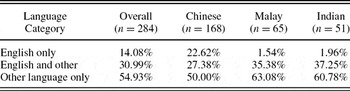
A variety of languages were reported spoken in the home, with Singapore's four official languages (English, Mandarin, Malay, and Tamil) spoken by the vast majority of families. The primary caretaker of the child usually spoke only English to the child in 14% of the families, 31% reported English plus other languages (generally the official mother tongue for their ethnic group), and 55% reported the primary caretaker usually used only non-English languages (mostly the official mother tongue) with the child (see Table 2).
Percentages of families reporting different combinations of languages that the primary caretaker usually speaks to the child

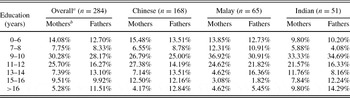
Years of education completed by parents ranged from 0 to 23. Mean years of education were similar for mothers (M = 10.7, SD = 3.4) and fathers (M = 11.4, SD = 3.9). For mothers, 14% had completed 6 years of education or less; 23% had completed 10 years (end of secondary school) only; and 22% had some tertiary education (see Table 3). For fathers, 13% had completed 6 years of education or less; 25% had completed 10 years of education only; and about 35% had some higher education.
Percentages of mothers and fathers with years of education overall and by ethnic group

aYears of education were missing for 32 fathers overall (20 Chinese, 10 Malay, and 2 Indian) and are excluded from this analysis.
bYears of education were imputed for 19 mothers (9 Chinese, 7 Malay, 3 Indian), who are included in these figures. For 16 mothers, the mode of years of education for mothers with the same level of education (secondary diploma, technical college, etc.) was used as the imputed value for mother's education. In one case for which there were too few other cases at the reported level of education to use a reasonable mode, a multiple regression model with mother's level of education, father's years of education, father's level of education, supervisory status of father, and housing type was used to predict mother's education. Two cases remained with no level of education reported for the mother. For one of these cases, a multiple regression model including father's years of education, father's level of education, supervisory status of father, housing type, and family income was used to predict mother's education. For the final case, for which no education, housing, or family income data were available for either mother or father, the mean mother's education for the case's ethnic group and reported languages used with the child was used as the imputed value.
Family income ranged from less than S $1000 (Singapore dollars) per month (approximately US $7500/year) to over S $10,000 per month (approximately US $75,000/year). In 2000, median monthly family income from workFootnote 3 for the Singapore population was S $2,234 (Singapore Department of Statistics, 2002), and the lowest taxable income bracket was S $1600 per month. Thirty-three percent of the families in the sample reported earning less than S $2000 per month (approximately US $15,000/year); an additional 34% reported family income of between S $2000 and under S $4000 per month (approximately US $22,500–$30,000/year). Just 13% reported a family income of S $7000 per month (approximately US $52,500/year) or more. Thus, the sample represents a broad range of income levels. Income varied by ethnicity; about 48% of Malays, compared with about 30% of Indians and 28% of Chinese, reported family incomes of below S $2000. By contrast, 16% of Chinese, compared with 7% of Malay and 8% of Indians, indicated incomes of S $7000 or above.
Instruments
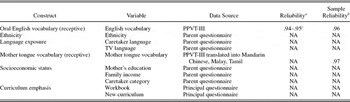
Peabody Picture Vocabulary Test—Third Edition (PPVT-III). Receptive English oral vocabulary was assessed (see Table 4) using the PPVT-III Form A (Dunn, Dunn, & Dunn, Reference Dunn, Dunn and Dunn1997). One item on the PPVT-III, the term squash (the vegetable) was not administered and not counted toward ceiling calculations because of its unfamiliarity even to university-educated Singaporeans. The PPVT-III is a standardized test normed on monolingual English speakers in the United States (mean = 100, SD = 15). The split-half (odd–even) sample reliability for the PPVT-III was .96 (with Spearman–Brown correction).
Constructs measured as outcome and predictor variables, data source or instrument used, and published and sample reliability estimates

Note: PPVT-III, Peabody Picture Vocabulary Test—III; NA, not applicable.
aReliability alpha estimates.
bSplit-half (odd/even) reliability with Spearman–Brown correction.
cReliability differs for each normed age group.
PPVT-III translated. As a measure of the child's official mother tongue, the PPVT-III Form B was translated into Mandarin, Malay, and Tamil. A minimum of two fluent bilingual translators were used to translate the items, and the two (or more) translations were then compared, with conflicting translations being aligned through discussion and ultimate agreement of fluent bilinguals. No items were determined to be unknown to Singaporean speakers of the language. Although translating a vocabulary test developed in English is not ideal, it was considered the most reasonable alternative for obtaining approximately equivalent measures of a child's vocabulary in the three different mother tongues. No standardized measures are available for these languages that have been normed on the Singapore population. Thus, the raw scores for the mother tongue PPVT were used in these analyses, along with child's age to control for vocabulary differences that may be due to development or additional months of language exposure. The split-half (odd–even) reliability on the translated mother tongue PPVT was 0.97 (with Spearman–Brown correction). For these analyses, the sample mean score of 53.17 was subtracted from each participant's raw mother tongue vocabulary score to create a centered variable with a mean of 0; those with scores above the mean have positive scores, whereas those below the mean have negative scores. Age was similarly centered around the mean of 72.29 months.
Parent questionnaire. A questionnaire was sent home to parents along with information on the study and permission forms. The questionnaire was provided in English and one mother tongue (Chinese, Malay, or Tamil, as appropriate) so each family could respond in the language of their choice. The questionnaire asked mostly closed-choice questions regarding background information, parental educational levels, household income, languages used with the child, primary caretaker of the child, language of TV watched, and child's age and ethnicity.
Language exposure was operationalized in two parts: caretaker language and TV language. “Home language” is a complex phenomenon in Singapore, where most of the population uses two or more languages regularly. For this study, the languages parents reported that the primary caretaker (whether the parent or not) “usually” speaks with the child was used as the variable called caretaker language. Most families reported speaking Singapore's official languages of Mandarin, Malay, Tamil, or English with their children, or a combination of English and one of the other official languages. To consolidate responses regarding caretaker language, three mutually exclusive categories were formed: (a) the caretaker usually spoke only English to the child (English only), (b) the caretaker usually spoke English and other languages to the child (English plus), and (c) the caretaker usually spoke only languages other than English with the child (no English). Parents were not asked to estimate the percentage of time they or the caretaker spoke one language or another because of the unreliability of such self-reported estimates (Romaine, Reference Romaine1995). In analysis, no English was used as the comparison group because over half of the students fell into that group.
TV provides an additional source of language input beyond the home and kindergarten. Responses to the question regarding TV language were grouped into three categories represented by three dichotomous variables: the child watches TV programs “only” or “mostly” in English (TV English mostly), the child watches programs in English and one other language “about equally” (TV English plus other), or the child watches programs “mostly” or “only” in languages other than English (TV other mostly).
Children were selected through stratification by ethnicity according to center records, and ethnicity was confirmed through the parent questionnaire. The three official vernacular languages of Singapore, Mandarin, Malay, and Tamil, are collectively termed the official mother tongues of the three major ethnic groups (Chinese, Malay, and Indian, respectively), although they are best characterized as heritage languages of the ethnic groups. Most families speak one of these languages, English, or a combination of English and one mother tongue at home with their children. It is not always easy to determine if this so-called mother tongue is actually a child's first-acquired language (L1), has been acquired in parallel with English (simultaneous bilingualism), or is a child's later-acquired language (L2) learned because of the mother tongue requirement in the Singapore national school system. For this study, the term mother tongue is retained to follow Singaporean use, but it is important to note that this is the child's heritage language and may not be the child's L1.
Socioeconomic status was operationalized as mother's education and family income. Mother's years of education was seen as a marker for some of the home language and literacy practices that constitute children's home language environments. For these analyses, mother's education was centered around the sample median of 10 years of education, which corresponds to the end of secondary school in Singapore (but does not include the preuniversity course). Family income is more indirectly linked to children's language development, but it could represent more varied life experiences, such as trips to the zoo, museums, or even international travel, which offer more opportunities for rich vocabulary development. In addition, the widespread practice in Singapore of hiring tutors to coach children in academic subjects, particularly languages (Kwan-Terry, Reference Kwan-Terry1991), warrants investigation into whether family wealth predicts language outcomes, potentially by “buying” children access to additional language-learning resources. One study indicated that over 50% of students in Grades 3 to 6 received private language lessons (Kwan-Terry, Reference Kwan-Terry1991); whether these extra lessons begin at the age of the children in this study is undocumented.
However, in Singapore, family income could also work against English vocabulary development, considering the widespread practice of affluent families hiring maids with little education to care for their children and household. In addition, many families (especially dual-career families) put children in the care of grandparents, who generally have much lower education levels than the professional parents. A variable was thus created that divided the sample into three categories of primary caretaker: parent (mother, father or aunt), grandparent or maid (grandmother, maid, or babysitter), or parent and grandparent/maid (when at least one caretaker from each of the other two categories were named). It was hypothesized that children cared for by grandparents or maids/babysitters would have lower vocabulary because of the lower education (and thus English vocabulary) levels of their caretaker.
Principal questionnaire. Principals or center directors were given a written questionnaire to fill out regarding center demographic information, as well as whether the center was using the traditional kindergarten workbooks and how much the center had implemented the new kindergarten curriculum. The traditional kindergarten workbooks are theme based and emphasize copywork, matching and fill-in-the-blank exercises. It is hypothesized that use of the traditional workbooks might be associated with lower oral vocabulary scores, as oral language is not typically developed under the traditional workbook-based curriculum. A dichotomous variable, workbook, was created. However, the Singapore Ministry of Education's new curriculum guidelines, released at the beginning of 2003, emphasize oral language development and learning through play and exploration (Preschool Education Unit, 2003). Full implementation of the new curriculum, therefore, was expected to be associated with higher oral vocabulary scores. Three dichotomous variables, full new curriculum, partial new curriculum, and no new curriculum, were created to reflect implementation of the new guidelines.
Procedures
Six bilingual research assistants (RAs) were recruited from local universities and intensively trained to administer the instruments to each child individually. Three RAs were bilingual in Mandarin and English, two were bilingual in Malay and English, and one was bilingual in Tamil and English. With this configuration, each child could be assessed by an RA of his or her own ethnicity who also spoke the child's two potential languages, with a few exceptions. Six Indian children whose home language was Malay were tested entirely by a Malay RA. In addition, in order to complete testing of all of the participants within the testing window, nine Indian children and two Malay children were tested by an RA not of their ethnicity on the assessments of English proficiency but by a coethnic RA for their mother tongue assessment.
RAs were sent as pairs to one to two centers per day to assess approximately five children per RA per day. The Principal Investigator also visited the centers each day to supervise the RAs, ensure the consistency and quality of data collection, and to provide feedback on data collection procedures to the RAs.
Assessment sessions lasted approximately 45 min for each child. The RAs first chatted with the child to build rapport and to confirm the child's name and, if possible, birth date. The assessments, including several used for the larger study, were administered to the children in the following order: PPVT-III (English), three tests used for the larger study, and finally the PPVT-III (translated) for those being assessed in mother tongue. The assessments were ordered from easy to hard (as determined by pilot testing), with mother tongue PPVT-III last because not all children (in the larger study) were being assessed in mother tongue. The English PPVT-III was considered a particularly comfortable way to ease the child into the assessment situation as it only required the child to point to pictures rather than to produce language. Children were permitted to stop testing at any time.
All children were assessed during a 3-week testing window in July 2003, which corresponded to the beginning of the second term of K2.
Data analysis
Descriptive and inferential analysis. Measures of central tendency and measures of variance were calculated for the children's scores on the English PPVT-III. In addition, measures of central tendency and measures of variance were calculated for each ethnic group and for each caretaker language group. Analyses of variance were conducted to test for significant differences in test scores by ethnic group and by caretaker language category.
Multilevel regression analyses. Correlations were figured between the outcome variable, English vocabulary, and all the variables to be tried in the multilevel model. A series of theoretically driven nested multilevel regression models were fit using maximum likelihood estimation (Raudenbush & Bryk, Reference Raudenbush and Bryk2002). Because the students in the sample were drawn from 28 kindergarten centers (rather than randomly at the individual level from the universe of Singaporean K2 pupils), multilevel modeling (also called hierarchical linear modeling) was the appropriate analytic choice. Multilevel modeling statistically controls for the fact that children sampled from the same center were not independent of each other, but rather shared the common experience of attending kindergarten at that center. Multilevel modeling also allows for the consideration of variables at more than one level of analysis (Hox, Reference Hox1995), in this case two levels: the child level and the center level. Control and question predictors were systematically tried in nested models in the following order: mother's education, gender, ethnicity, caretaker language, caretaker, family income, TV language, curriculum emphasis, mother tongue vocabulary, child's age, and interaction terms between pairs of these variables. Once a final model was determined by the significance of the parameter estimates for each included predictor and the significance of the difference between the −2 log likelihood (−2LL) statistics of the model overall compared with the previous nested model, dropped variables were added back in to check for significance when controlling for the variables kept in the model, and the model was checked for possible interactions between pairs of variables in the model. In addition, residuals were checked for possible assumption violations and influence statistics were examined to identify outliers that may have strongly affected the results.
RESULTS
Characteristics of the sample
K2 pupils in the sample in Singapore scored an average of 1.33 SD below the American normed group on English vocabulary. In addition, children had a mean raw score of 53.17 on their mother tongue vocabulary test (SD = 22, range = 6–125) compared to a mean raw score of 55.97 (SD = 17) on the English PPVT. Children who were usually spoken to in English at home, however, scored an average of 10 points (~0.66 SD) higher on English vocabulary than children who were usually spoken to in languages other than English at home. Children who were usually spoken to in English and other languages scored an average of about 6 points (~0.33 SD) higher on English vocabulary than children who were usually spoken to in languages other than English at home. These differences among children being exposed to differing amounts of English at home were statistically significant, F (2, 281) = 8.61, p = .0002; overall (N = 284), M = 80.15, SD = 15.35, minimum = 40, maximum = 117; English only (n = 40), M = 86.85, SD = 14.0; English plus other languages (n = 88), M = 82.64, SD = 14.0; non-English languages only (n = 156), M = 77.04, SD = 15.7. A Scheffé post hoc test indicated no significant difference between the English only and the English plus other languages groups in their English vocabulary. Within the sample, we observed differences of about 3 points on mean PPVT-III scores for the different ethnic groups, but these differences were not statistically significant, F (2, 281) = 1.52, p = .2207; Chinese (n = 168), M = 81.03, SD = 16.5; Malay (n = 65), M = 77.25, SD = 14.1; Indian (n = 51), M = 80.98, SD = 12.5.
Predicting children's English vocabulary
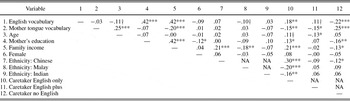
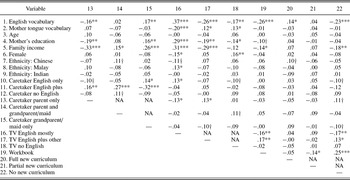
As shown in Table 5 and Table 6, the following variables are significantly correlated with English vocabulary: mother's education and family income (moderately) and caretaker language, TV language, and curriculum emphasis (weakly). None of the predictor variables are strongly correlated with each other, although mother's education and family income are moderately and significantly correlated. None of the predictor variables were considered so strongly correlated that multicollinearity would be a substantial problem.
Pearson correlation coefficients among English vocabulary and various predictors (n = 284)

Note: NA, not applicable.
†p < .10. *p < .05. **p < .01. ***p < .001.
Pearson correlation coefficients among English vocabulary and various predictors (n = 284)

Note: NA, not applicable.
†p < .10. *p < .05. **p < .01. ***p < .001.
Multilevel regression models were systematically fit by entering each predictor variable and then retaining those that were significant and added predictive power compared to the previous model. Gender, caretaker, and new curriculum implementation were found not to be significant predictors of English vocabulary and were therefore dropped from the model.
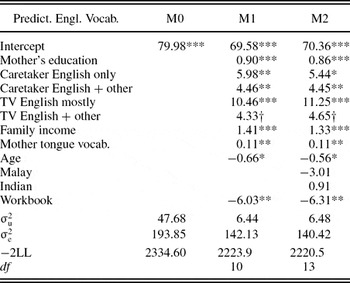
The final multilevel regression model (see Table 7) included the following significant predictors of English vocabulary: mother's years of education, caretaker language, TV language, family income, mother tongue vocabulary, age, and curriculum emphasis.Footnote 4 In these analyses, 86% of the between-center variation and 27% of the within-center variation is accounted for by the final significant model; ethnicity was not significant in the final model and adds little to this explanation. The parameter estimates for each of the predictors in the model will be explained in the following text.
Parameter estimates, within- and between-center variance estimates, −2 log likelihood statistic, and degrees of freedom for three multilevel regression models (n = 284)

Note: M0, unconditional model; M1, final significant model (no ethnicity variables); M2, final model with ethnicity for Singaporean kindergarten pupils.
†p < .10. *p < .05. **p < .01. ***p < .001.
Caretaker language was a significant predictor of English vocabulary among kindergartners in Singapore, controlling for mother's education, TV language watched, family income, mother tongue vocabulary, age, and curriculum emphasis. Compared to children who were not usually exposed to English by their primary caretaker, children who were usually exposed only to English by their caretakers scored about 6 points (>0.33 SD) in predicted English vocabulary scores, controlling for the other variables in the model. Children who were usually exposed to English and another language (or languages) showed a similar advantage, scoring about 4.5 points (~0.33 SD) above children who were usually spoken to in languages other than English by their primary caretakers. This may indicate that among children speaking the major languages of Singapore, the main influence on predicted English vocabulary scores may be the use of English by the primary caretaker with the child, whether other languages are also usually used. In Singapore, many families (especially dual-career families) put children in the care of grandparents or maids, who have much lower education levels than the professional parents. It was hypothesized that children cared for by grandparents or maids/babysitters would have lower vocabulary because of the lower education (and likely vocabulary) levels of their caretaker. Caretaker category was found not to be significant in the model, either as a main effect or as an interaction with caretaker language or mother's years of education.
It is more interesting that children who “only” or “mostly” watch English language TV programs are predicted to score over 10 points (~0.66 SD) higher on English vocabulary compared to children who “only” or “mostly” watch TV programs in languages other than English, controlling for the other variables in the model. Children who watch TV programs in English and another language “about equally” are predicted to score about 4 points (~0.33 SD) higher on English vocabulary compared to children who “only” or “mostly” watch TV programs in languages other than English, controlling for the other variables in the model. This is a larger predicted difference than that seen with caretaker language.
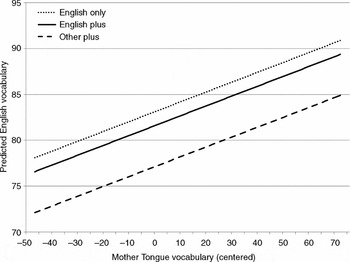
Contrary to the hypothesized negative relationship, mother tongue vocabulary was found to be a significant, positive predictor of English vocabulary (see Figure 1). A 10-point positive difference in mother tongue vocabulary is associated with about a 1-point positive difference in predicted English vocabulary, controlling for mother's education, caretaker language, TV language, family income, age, and curriculum emphasis. This is a small effect, but this finding suggests that children learning two languages in Singapore need not sacrifice vocabulary in one to build vocabulary in the other.
The English vocabulary scores for Singaporean kindergartners predicted by mother tongue vocabulary (centered around the sample median) for children whose caretakers speak English only, English plus other languages, or other languages only to them, controlling for mother's education, TV language, family income, age, and curriculum emphasis (n = 284). The scores were determined according to the following equation: predicted English vocabulary = 69.58 + 0.8976 mother's education + 5.9779 English only + 4.4627 English plus other + 10.4609 TV English mostly + 4.3263 TV English other equally + 1.4136 family income + 0.1073 mother tongue vocabulary + (−0.6593) age + (−6.0263) workbook.

Controlling for the other variables in the model, a difference of approximately 1.8 points in children's English vocabulary is predicted for each 2-year difference in mother's years of education. Mother's education may be an indicator of the mother's English skills, the amount of English language interaction in the home, and/or home literacy practices such as book reading that involve rich English language interactions.
The dummy variable representing Malay ethnicity was a significant predictor of English vocabulary with only ethnicity in the model at the p < .05 level, and the difference between the ethnicity-only model and the unconditional model reached the p < .05 level of significance, Δ−2LL = 6.30, df = 2; χ2 (α = 0.05) = 5.991. Controlling for the other predictors in the model, however, ethnicity was no longer significant.Footnote 5 For comparison purposes, the final model with and without ethnicity is shown in Table 7.
Curriculum emphasis as represented by use of the traditional workbooks in the classroom was found to be a significant predictor of children's English vocabulary. Controlling for the other variables in the model, children who attended centers that used the workbooks tended to score over 0.33 SD (6 points) lower on English vocabulary than children who attended centers that did not use the workbooks. The variables representing full or partial implementation of the new curriculum guidelines were not found to be significant predictors of English vocabulary.
DISCUSSION
The purpose of this study was to describe Singaporean kindergartners’ English vocabulary knowledge, and to examine the roles of home and school factors in predicting kindergartners’ English vocabulary knowledge. Each of these relationships will be discussed in turn in the following sections.
Describing vocabulary knowledge
Singaporean kindergartners seem to be doing well overall compared to other kindergartners around the world. Although their English vocabulary skills are lower than English monolinguals in the United States, they are higher than children in many other types of contexts. Perhaps Singaporean students perform so well on international comparisons because they start school with a solid foundation of vocabulary in English, which is the language of instruction at school.
The use of a standardized vocabulary assessment allows for comparison of the sample mean with the population mean of the norming group, American monolingual English speakers. The Singaporean kindergartners in this sample scored on average 1.33 SD below the American normed group, which is not surprising given that a majority do not report English as the usual language spoken to them by their primary caretaker. Other studies of children learning through a nonnative medium also show L2 speakers of the target language attaining much lower oral vocabulary skills than L1 speakers of the same language. Of course, in some contexts, some sort of vocabulary difference may even be part of the determination of whether a child is considered an L1 or L2 speaker of a language (e.g., the “limited English proficient” designation common in schools in the United States).
The Singaporean kindergartners in this sample performed about the same on the PPVT-III than older L1 Spanish-speaking first graders in the United States (56 vs. 57 in raw scores; Gottardo, Reference Gottardo2002) but worse than younger L1 Spanish-speaking Head Start children at the end of their prekindergarten year (80 vs. 84 standard scores; Miccio, Tabors, Paez, Hammer, & Wagstaff, Reference Miccio, Tabors, Paez, Hammer and Wagstaff2003), equivalent to K1 in Singapore. This apparent contradiction in findings may be due to differences between the two Spanish-speaking samples. The Mexican parents of the first-graders worked mostly as migrant farm laborers or factory workers and spoke exclusively Spanish to their children in the home (Gottardo, Reference Gottardo2002); half of the Puerto Rican mothers of the prekindergarten sample reported speaking both Spanish and English to their children in the home (Miccio et al., Reference Miccio, Tabors, Paez, Hammer and Wagstaff2003). Thus, the Puerto Rican American prekindergartners may be more analogous to the current study's group who spoke English and another language at home; their PPVT mean score was 83 (SD = 14), essentially the same as the Puerto Rican American prekindergartners’ end of year score.
In another multilingual context, South Africa, kindergartners scored, on average, higher than the kindergartners in this Singaporean sample (Willenberg, Reference Willenberg2004). The South African children, who were from the community formerly designated “Colored” and systematically disadvantaged under the apartheid regime, were all considered L1 speakers of English. However, closer examination revealed that about half of their parents were L1 Afrikaans speakers who claimed to speak only English to their children but were observed to sometimes speak Afrikaans to them as well (Willenberg, Reference Willenberg2004). This complex home language situation, with parents typically speaking Afrikaans to each other but a mixture of English and Afrikaans to their children, may make these South African children more analogous to the group in this study's sample whose primary caretakers “usually” spoke only English with them, who may also have sometimes used another language. This study's English only group attained an average score of 87 (SD = 14) on the PPVT, very close to the South African sample. However, the South African children were slightly older on average (6 years, 2 months) and were tested at the end of their kindergarten year, slightly later academically than the Singaporean children. Thus, these Singaporean children may be performing a bit better in English than their English-speaking Colored South African counterparts.
As indicated above in comparisons between other studies and subgroups of the Singaporean sample divided by caretaker language, language spoken to the child (English only, English plus another language, another language only) marked significant differences in English vocabulary scores. It is unremarkable that children who are exposed to more English at home have larger English vocabularies than children who are not usually exposed to much English at home. However, even those Singaporean children usually spoken to only in English at home scored on average close to 1 SD below the American normed sample. One possibility is that the measure used, the PPVT-III, is not an appropriate measure of Singaporean English. The vocabulary chosen for the PPVT-III is based on the frequency of items in American English, and the scores are determined accordingly. Singaporean English, with its British roots and localized usage, may not match the frequency of specific vocabulary items in American English. In addition, Singaporeans are largely acquiring English through classroom use, and thus the order of acquisition of items in the PPVT may differ based on the context of acquisition.
In contrast, lower English vocabulary scores compared to US norms may reflect the “distributed nature” of bilingual children's vocabularies (Oller & Eilers, Reference Oller and Eilers2002), because in Singapore even children who usually are spoken to only in English at home still study two languages in school (starting with kindergarten) and may well be exposed to other languages in the home, through the media, and/or in the community. For bilingual individuals, vocabulary is learned in one language or another because of context; kitchen vocabulary, for example, may only be learned in the language of the family's cook, whereas classroom vocabulary may only be learned in the language of the school. Comparing a bilingual child's vocabulary to monolingual norms often indicates lower than average vocabulary in both languages; however, bilingual children seem to acquire new vocabulary before acquiring translation equivalents of concepts already known in one of their languages (Taeschner, Reference Taeschner1983; Umbel, Pearson, Fernandez, & Oller, Reference Umbel, Pearson, Fernandez and Oller1992), meaning their total conceptual vocabulary is not lower than monolinguals’. For this sample, had it been possible to construct a combined score of the children's vocabulary in both their languages, these kindergartners might have scored at or above monolingual norms.
Given that ethnic differences among Singaporean students occur in later years in English and other academic subjects (taught through English), it is interesting that no significant differences were found in English vocabulary among the three major ethnic groups. Of course, it is possible that the lack of ethnic differences seen in this kindergarten cohort will persist throughout these children's schooling and that this group represents a historical shift toward equal chances of high academic achievement across all ethnicities. Alternatively, perhaps ethnic differences that appear later in schooling are accounted for by factors other than differences in English vocabulary at kindergarten.
The relationship of background variables to English vocabulary
The role of language exposure. In this study, data were collected on the language exposure of the child beyond the “predominant home language” reported on the census. To this end, caretaker language was defined as the language the caregiver “usually” speaks to the child, recognizing that other languages are most likely present in the home. In addition, information on the language of the TV programs children watch was collected to investigate the effect of language exposure through this medium. Caretaker language, when divided into categories that could roughly be considered to reflect amount of English exposure at home, proved to be a significant predictor of English vocabulary when controlling for mother's education, family income, and the other variables in the model. It was interesting, however, that it did not seem to matter much whether English was the only language, or one of two or more languages, usually spoken to the child; in both cases, English as a caretaker language contributed about the same amount in predicted English vocabulary, controlling for the other variables in the model.
However, it is more interesting that the language of TV programs proved to be a strong predictor of English vocabulary and that watching TV mostly or only in English yielded twice the advantage of having English spoken to the child by the caretaker, controlling for the other variables in the model. This finding may simply indicate that parental report of the languages watched by their children on TV may be a better indicator of the child's dominant language compared to parental report of the language usually used by the primary caretaker with the child.
In contrast, this finding hints that TV may be teaching children English vocabulary at an early age, suggesting children may be obtaining more language input from the TV than from their caregivers. In addition, watching English and another language about equally did not have as large an effect as only or mostly watching TV in English. This is the type of graded effect expected for varying levels of English exposure, but not found with caretaker language. However, this finding could simply be reflective of the more detailed data estimating amount of English watched on TV (only, mostly, about equally with other, other mostly, other only) versus a more general difference in caretaker language (English usually, English and other usually, other usually). Although the current study did not examine the specific programs children watched on TV, its findings potentially extend previous findings that L1 English-speaking children learned new vocabulary presented through a TV cartoon with a voiceover (Rice & Woodsmall, Reference Rice and Woodsmall1988), as well as another study that indicated Dutch children could learn English vocabulary through subtitled and unsubtitled TV programs (Koolstra & Beentjes, Reference Koolstra and Beentjes1999). Although more research is needed to determine whether TV is a stronger source of English vocabulary than children's caretakers, this hypothesis is plausible because adult caretakers most likely grew up speaking a different language at home and learned English through school. Perhaps the nature of TV, which can virtually transport children to unfamiliar settings and thus introduce more varied vocabulary, aids in vocabulary acquisition more than a primary caretaker whose English proficiency may be limited.
The role of mother tongue vocabulary. Cummins' (Reference Cummins1979, Reference Cummins2000) interdependence hypothesis suggests that an L2 is learned more easily from a solid base in one's L1. In this study, children with higher mother tongue vocabulary tended to have higher English vocabulary (controlling for the other variables in the model). Although the effect is small, this finding opens the question of whether high mother tongue vocabulary aids directly in acquiring English vocabulary, or the practices within families that produce high-vocabulary children encourage the acquisition of vocabulary in both of the child's major languages. For example, these families may simply spend more time talking with their children; doing this in either language may boost vocabulary in the other language as well.
The fact that this relationship between mother tongue vocabulary and English vocabulary is a positive one suggests that these children in Singapore are experiencing additive bilingualism (Lambert, Reference Lambert and Campbell1984), meaning they are learning two languages without losing ground in either one. This finding contrasts with the subtractive bilingualism (Lambert) often experienced by many bilingual children in majority monolingual countries such as the United States, where gains in the majority language often come at the expense of proficiency in their ethnic language, which is typically held in low regard.
This finding may be explained by the multilingual environment, and state-sponsored bilingualism, of Singapore. Although English is the dominant language in the larger societal context of Singapore, Mandarin Chinese and Malay also enjoy high status. Among Chinese, Mandarin enjoys high regard, and using Mandarin with other Chinese may serve as a marker of solidarity; in addition, with the rising economic importance of China in the world, Mandarin Chinese is gaining status in Singapore (and elsewhere) as a language with economic benefits. Within the Malay community, Malay is revered as central to ethnic and religious identity and values. Languages other than the majority language in monolingual societies, in contrast, often are held in low regard, leading language minority children to lose proficiency in their home language even if schooled through bilingual programs intended to maintain both their languages (Oller & Eilers, Reference Oller and Eilers2002).
The Oller and Eilers (Reference Oller and Eilers2002) study in Miami is quite interesting as a point of comparison to the context of Singapore. Miami maintains a high-status, politically strong Spanish-speaking community within the larger monolingual English-speaking context of the United States. The Miami study investigated the English and Spanish outcomes of Hispanic children matched for socioeconomic status in English immersion programs versus two-way Spanish–English bilingual programs. The children in the English immersion programs studied Spanish as a subject, much like Singaporean children study mother tongue as a single subject. The children in the two-way program studied subject–area content through both English and Spanish. Oller and Eilers found overall that children in both groups were dominant in English and achieved the same level of English proficiency (although lower than that of English monolinguals), but children in the two-way program maintained a higher level of Spanish proficiency than those in English immersion. These findings in the United States suggest that Singapore could implement some content-area instruction through the medium of mother tongue without lowering children's English proficiency.
The role of family income. The finding that high-income children tend to have higher English vocabulary, controlling for other variables including language spoken to the child and mother's education, suggests that high-income families may be buying their children access to additional English exposure, for example, through tutoring, additional English classes, or other enriching activities. Perhaps higher income families are simply able to do more language-rich activities, by bringing their children to novel settings with opportunities for richer vocabulary exposure.
The role of ethnicity. Ethnicity, as foreshadowed by the analysis that showed no significant differences in the mean English vocabulary scores among the groups, did not prove to be a significant predictor of English vocabulary when controlling for mother's education, caretaker language, and other variables. Children with more highly educated mothers tended to have larger English vocabularies, which is similar to findings from the United States and elsewhere (Dickinson & Tabors, Reference Dickinson and Tabors2001). In the current Singapore education system, the Chinese ethnic group performs best overall and is overrepresented in the higher “streams” or educational tracks and in the preuniversity courses and universities. These differences in educational attainment at the secondary and tertiary levels may translate into differences among parents of young children, which may then perpetuate differences in educational attainment among the next generation (e.g., if Malays as a group have lower levels of education, as parents they may be less able to guide their children's academic development, thus resulting in another generation of Malays with lower educational achievement). Ethnic differences, then, may not be separable from effects of mother's education or language spoken to the child.
Mother's education may stand as a marker for mother's English skills, because English is the medium of education in Singapore. In contrast, the parents of these K2 children in 2003 may not all have experienced full English-medium education in Singapore. Some parents, especially Chinese, may have been educated through their mother tongue and may not have attained a high level of proficiency in English. Thus, the effect of mother's education may be entwined with the medium of that education (which was not measured in this study). In addition, more highly educated mothers may interact differently with their children than mothers with lower levels of education, as documented in the United States by Hart and Risley (Reference Hart and Risley1995). Highly educated mothers may talk more with their children, use more low-incidence vocabulary, and/or engage in more rich literacy activities such as book-reading with their children.
The relationship of curriculum to English vocabulary
Use of the traditional kindergarten theme-based workbooks was associated with lower English vocabulary scores for children in centers that used them. This finding suggests that the kindergarten curriculum would benefit from increased attention to oral language, as outlined in the new curriculum guidelines. At the time of the study, implementation of the new curriculum guidelines (Preschool Education Unit, 2003) was not significantly related to enhanced English vocabulary, but that may reflect the novelty of the curriculum. Even in centers reporting full implementation of the new curriculum, it is likely that teachers were not yet well trained to build children's oral language skills.
Directions for future research
To investigate the relationship between mother tongue vocabulary and English vocabulary further, it would be very illuminating to follow a cohort of children longitudinally to examine their bilingual development in both mother tongue and English and to analyze whether the relationship between vocabulary in the two languages holds steady or changes over time. It would also be interesting to investigate whether mother tongue vocabulary in K2 significantly predicts English vocabulary and/or academic achievement (in English) in later years. Collecting data on both breadth and depth of vocabulary knowledge in both languages would provide for a more fine-grained analysis of what specifically may transfer between Singaporean children's two languages.
In addition, obtaining detailed information on home language use and literacy practices was beyond the scope of this study, nor could close examination of classroom language and literacy practices be obtained. In this study, self-report of language usually used by parents (or parental report of language usually used by primary caretaker) with their child was used to indicate home language. It is clear, however, that home language in Singaporean households is much more complicated than was captured in this study, and it would be fascinating to document some “typical” children's language exposure and language use through intensive observation, such as following a child through the day to record language environment and interactions. Such intensive observation could only be done with a small number of families, but additional less-intensive data could be gathered by audiotaping families’ mealtime conversations or other shared events. Further, it would be interesting to describe and analyze kindergarten teachers’ classroom talk both in terms of language used (Standard Singapore English vs. “Singlish”) and amount of scaffolding provided to children acquiring English.
CONCLUSION AND IMPLICATIONS
This study indicates that Singaporean kindergartners may be experiencing additive bilingualism, that is, the acquisition of two languages without loss of either, as shown by the positive relationship between mother tongue vocabulary and English vocabulary. These findings lend support to the theoretical basis underpinning bilingual education programs for language minority children in the United States: developing the child's first language will aid the child in acquiring strong English skills as well.
ACKNOWLEDGMENTS
This work was completed as part of the author's dissertation work at Harvard University Graduate School of Education. The author acknowledges and thanks her advisor, Professor Catherine Snow, and her committee members, Professors Terry Tivnan and Barbara Pan, for their excellent advice and guidance throughout the dissertation process. Thanks also to Professor John Willett for guidance on multilevel modeling. A Spencer Research Training Grant funded work with Professor Tivnan that led to the design of this study and with Professor Willett that guided some of the analyses. Portions of these findings were presented at the 14th World Congress of Applied Linguistics (July 2005) and at the 5th International Symposium on Bilingualism (March 2005). The author also thanks Professor Hersh Waxman at Texas A&M University for his very helpful comments on drafts of this article, as well as the editor and two anonymous reviewers for their useful suggestions for revision.