INTRODUCTION
More than two decades ago, a seminal paper on psychotherapy outcome research called attention to the concept of treatment enactment (Lichstein, Riedel, & Grieve, Reference Lichstein, Riedel and Grieve1994). The authors argued that the effects of an intervention studied in a clinical trial could be interpreted only in the context of the rigor with which the treatment was implemented, and that the examination of treatment implementation must go beyond the familiar evaluation of treatment fidelity. Fidelity, also known as treatment integrity (Grow, Collins, Harrop, & Marlatt, Reference Grow, Collins, Harrop and Marlatt2015), refers to the extent to which a therapist has delivered the treatment as intended. Both adherence to the treatment protocol and skillfulness of the therapist in delivering its content may be examined (Faulkner, Reference Faulkner2012). However, treatment fidelity refers to the behavior of the therapist; Lichstein et al. (1994) drew attention to the behavior of the patient as the “primary change agent” (p. 13). No matter how faithfully the therapist renders the treatment, the desired changes in patient behavior cannot occur unless the patient understands what to do (treatment receipt) and actually does it in his or her daily life (treatment enactment).
Subsequent authors have elaborated the means by which each of these phases of treatment implementation may be optimized and measured in clinical research (Bellg et al., Reference Bellg, Borrelli, Resnick, Hecht, Minicucci, Ory, Ogedegbe, Orwig, Ernst and Czajkowski2004). Therapist behavior, that is, fidelity, is often assessed by evaluating audio or video recordings of treatment sessions. A less labor-intensive strategy is to have therapists’ complete checklists during each treatment contact, to help ensure that important elements are not omitted, nor proscribed elements accidentally included. Treatment receipt may be assessed and reinforced as needed during treatment sessions, using such methods as quizzing patients, asking them to repeat important content in their own words, or observing them as they practice methods taught in session or engage in role plays. Patient satisfaction and engagement with treatment, and the “fit” of the intervention to cultural factors are also relevant to treatment receipt (Rixon et al., Reference Rixon, Baron, McGale, Lorencatto, Francis and Davies2016). As the intervention is progressing, treatment enactment may be evaluated through patients’ completion of homework assignments, their descriptions of relevant behaviors between therapy sessions, or their self-reported attainment of therapy goals at each treatment contact (Spillane et al., Reference Spillane, Byrne, Byrne, Leathem, O’Malley and Cupples2007).
But what about treatment enactment once the intervention is over? Typically, the ultimate goal of a behavioral intervention is long-lasting, if not permanent, change in behavior. Quantitative follow-up assessment, such as measuring participant mood states several months after cessation of a treatment designed to improve mood, can speak to treatment efficacy overall, but does not show whether or not participants are using specific strategies to achieve lasting outcomes (Faulkner, Reference Faulkner2012). Writing for the National Institutes of Health Behavior Change Consortium, Bellg et al. (Reference Bellg, Borrelli, Resnick, Hecht, Minicucci, Ory, Ogedegbe, Orwig, Ernst and Czajkowski2004) acknowledged that long-term enactment is the most challenging phase of fidelity assessment. They suggested strategies such as follow-up interviews, use of electronic monitoring when appropriate (e.g., movement sensors to record physical activity), or observation of in vivo interactions. The last of these methods might be used in self-contained settings such as classrooms or residential facilities, but is less feasible for trials with community-dwelling participants.
Given the practical and conceptual challenges of measuring real-world behavior, it is perhaps not surprising that the literature contains relatively few examples of assessing treatment enactment. In one smoking cessation trial, investigators surveyed patients several months after treatment and also tracked the number of logons and page views within the study website (Duffy et al., Reference Duffy, Cummins, Fellows, Harrington, Kirby, Rogers, Scheuermann, Tindle and Waltje2015). A study of resourcefulness training for caregivers of persons with dementia included an instruction for participants to maintain a journal, which both reinforced the use of trained methods and allowed investigators to assess which strategies were used most often in the home setting (Zauszniewski, Lekhak, Burant, Underwood, & Morris, Reference Zauszniewski, Lekhak, Burant, Underwood and Morris2016). Grow et al. (Reference Grow, Collins, Harrop and Marlatt2015), in a trial of mindfulness meditation to reduce substance misuse, queried participants as to the type, frequency, and duration of mindfulness practice completed per week for up to 4 months after program completion; the degree of treatment enactment was negatively associated with both substance use and craving. Those authors also emphasized the importance of including therapy ingredients that have the express purpose of building long-term habits, a call echoed by others in rehabilitation (Dobkin, Reference Dobkin2016; Whyte et al., Reference Whyte, Dijkers, Hart, Van Stan, Packel, Turkstra, Zanca, Chen and Ferraro2018). For example, Taub et al. (Reference Taub, Uswatte, Mark, Morris, Barman, Bowman, Bryson, Delgado and Bishop-McKay2013) have shown that the efficacy of Constraint-Induced Movement therapy for chronic stroke is magnified by inclusion of a “transfer package” of ingredients to enhance home practice, including behavioral contracts and problem-solving to overcome barriers to home enactment. It could be argued that assessment and promotion of treatment enactment are particularly critical for the people served by neuropsychological interventions, whose cognitive and behavioral impairments might pose special challenges to development and maintenance of new routines.
The current study was designed to assess treatment enactment of the concepts and skills presented in a multisite randomized controlled trial that compared two psychoeducational treatments delivered to community-dwelling people with chronic moderate to severe traumatic brain injury (TBI) and problematic anger/irritability (Hart et al., Reference Hart, Brockway, Maiuro, Vaccaro, Fann, Mellick, Harrison-Felix, Barber and Temkin2017). In this trial, we achieved a high level of treatment completion and excellent treatment fidelity, as assessed through systematic examination of audio-recorded sessions in both treatment arms, with feedback integrated into therapist supervision. For the present study of enactment, we used a structured interview, conducted by phone several months after treatment cessation, to examine the extent to which participants were using learned material in daily life, and the degree to which they found various treatment components to be currently helpful.
As described in more detail below, the parent trial compared an eight-session, one-on-one treatment called anger self-management training (ASMT) to a structurally equivalent therapy designed to control for nonspecific therapeutic effects, called personal readjustment and education (PRE). The ASMT program provided education to normalize anger, particularly in the context of TBI, and training in the concept and process of self-monitoring for physiological and psychological signals that could help participants both to use an expanded emotional vocabulary to interpret their distress and to prevent maladaptive anger responses. ASMT participants also learned and practiced specific techniques such as taking time out to solve problems without anger, and using positive communication strategies. The PRE treatment provided education about the effects of TBI, emphasizing the recovery process and the concomitant changes and adjustments at the personal level as well as in relationships and community roles. PRE therapists also gave emotional support and opportunities to ventilate feelings, without teaching specific ways of managing anger. Both treatment conditions were highly structured, with detailed therapist manuals and printed exercises and worksheets for participants. In both treatment arms, participants were invited but not required to include a significant other (SO), a friend or relative, in portions of three sessions.
Although some outcomes were found to be superior for the ASMT arm, the differences between conditions were smaller than hypothesized (Hart et al., Reference Hart, Brockway, Maiuro, Vaccaro, Fann, Mellick, Harrison-Felix, Barber and Temkin2017). Partly for this reason, and to achieve a better understanding of nonspecific treatment effects, we elected to examine treatment enactment in both the experimental and active control arms of the parent trial. Because treatments providing education and emotional support are commonly provided to people with TBI, we reasoned that information on more or less helpful concepts might be useful to both practicing clinicians and researchers seeking to develop similar interventions. With regard to the ASMT treatment, we considered information on the enactment of specific anger management techniques to be potentially useful to professionals working in this area with persons who have experienced TBI, since anger and irritability are important clinical problems in this population.
Given the paucity of prior work in this area, we considered this study to be largely descriptive and exploratory. We wished to determine which treatment components within the ASMT and PRE programs continued to be used most often by participants, and which were considered to be most helpful in daily life. We were also interested in whether the two treatment programs differed as to the overall degree of later enactment reported by participants. To enrich our understanding of treatment enactment and to provide ideas for improving the therapy protocols, we gathered qualitative data, such as participants’ descriptions of how they had used treatment principles or methods in daily life, and what barriers to enactment they had experienced. We also examined the predictive utility of participants’ pretreatment level of anger and selected neuropsychological characteristics, with the expectation that both declarative memory and executive function might influence the ability of participants to implement learned concepts in daily life situations. Additionally, we tested the hypotheses that degree of treatment enactment would be positively associated with (1) the participation of a relative or friend in the treatment program and (2) the magnitude of treatment response, as measured by change from baseline to posttreatment follow-up in the anger measures that were used as primary outcomes in the parent trial.
METHODS
Participants
Participants in the current study were 71 of the 90 participants in the parent trial: 48 of 60 (80%) in the ASMT condition and 23 of 30 (77%) in the PRE condition (sample sizes were unequal due to the use of a 2:1 randomization scheme). Inclusion/exclusion criteria are published elsewhere (Hart, Brockway, Fann, Maiuro, & Vaccaro, Reference Hart, Brockway, Fann, Maiuro and Vaccaro2015, Hart et al., Reference Hart, Brockway, Maiuro, Vaccaro, Fann, Mellick, Harrison-Felix, Barber and Temkin2017). In brief, participants were aged 18–65, were at least 6 months post moderate/severe TBI, and acknowledged anger that was new, or worse, since injury. Problematic anger was verified by a score ≥1 standard deviation above the demographically adjusted mean on the Trait Anger (TA) or Anger Expression-Out (AX-O) subscales of the State-Trait Anger Expression Inventory-2 (STAXI-2; Spielberger, Reference Spielberger2000), or a score of ≥9 on the Brief Anger-Aggression Questionnaire (Maiuro, Vitaliano, & Cahn, Reference Maiuro, Vitaliano and Cahn1987). Trial participants were contacted for a treatment enactment interview unless they had attended fewer than half of their treatment sessions (n = 4), were lost to follow-up in the parent study (n = 4), or could not be reached thereafter (n = 2). The Institutional Review Board at one treatment site did not permit remote consenting for the interview, which was added partway through the trial, resulting in the loss of that site’s early participants (n = 7). Two additional participants declined the interview. Participants gave informed consent and were compensated for interviews.
Measures
TBI-related variables included time postinjury, mechanism of injury, and severity. Injury severity was confirmed for inclusion using any one or more of the following indices extracted from prospective medical records: postresuscitation score on the Glasgow Coma Scale (GCS) <13 or GCS Motor <6; loss of consciousness, unresponsiveness or coma attributable to the TBI and persisting ≥1 hr; post-traumatic amnesia (PTA) attributable to the TBI and persisting ≥24 hr; or neuro-imaging study positive for TBI-related findings. Because primary records were not consistent with respect to the available severity indices, we also administered a structured interview (Hart et al., Reference Hart, Dijkers, Whyte, Braden, Trott and Fraser2010, Reference Hart, Benn, Bagiella, Arenth, Dikmen, Hesdorffer, Novack, Ricker and Zafonte2014) to provide a retrospective estimation of PTA duration. This afforded a severity index common to all trial participants. Baseline neuropsychological measures included the Full Scale IQ (FSIQ) from the Wechsler Abbreviated Scale of Intelligence (WASI; Wechsler, Reference Wechsler1999) and the sum of trials 1–5 on the Rey Auditory Verbal Learning Test (RAVLT), with raw scores converted to Z-scores using age corrections by decade (Schmidt, Reference Schmidt1996). Executive function was assessed using the Trail Making Test, Part B T-score (Reitan & Wolfson, Reference Reitan and Wolfson1985), and the self-report Total T-score from the Frontal Systems Behavior Scale (FrSBe; Grace & Malloy, Reference Grace and Malloy2001). Emotional status was measured using the Global Severity Index (GSI) of the Brief Symptom Inventory (BSI; Derogatis, Reference Derogatis1993).
Self-reported anger was measured using the STAXI-2 TA and AX-O subscales administered at four time points including pretreatment baseline (T1), interim (T2), 1 week posttreatment (T3), and 2-month follow-up (T4). TA is the tendency to become angry, for example, by perceiving situations as hostile or unjust (Veenstra, Bushman, & Koole, Reference Veenstra, Bushman and Koole2018); this predisposition is an important precursor to the expression of anger, the outward manifestations of which are tapped by the AX-O scale. Thus, TA is a broader construct and is typically used to measure efficacy of mainstream anger management protocols (DiGuiseppe & Tafrate, Reference DiGuiseppe and Tafrate2003). In this study, treatment response was calculated as the change in T-scores between T1 and T4 on each of the STAXI-2 measures; T3 values were substituted for one participant who had missed the T4.
Treatment Enactment Interview
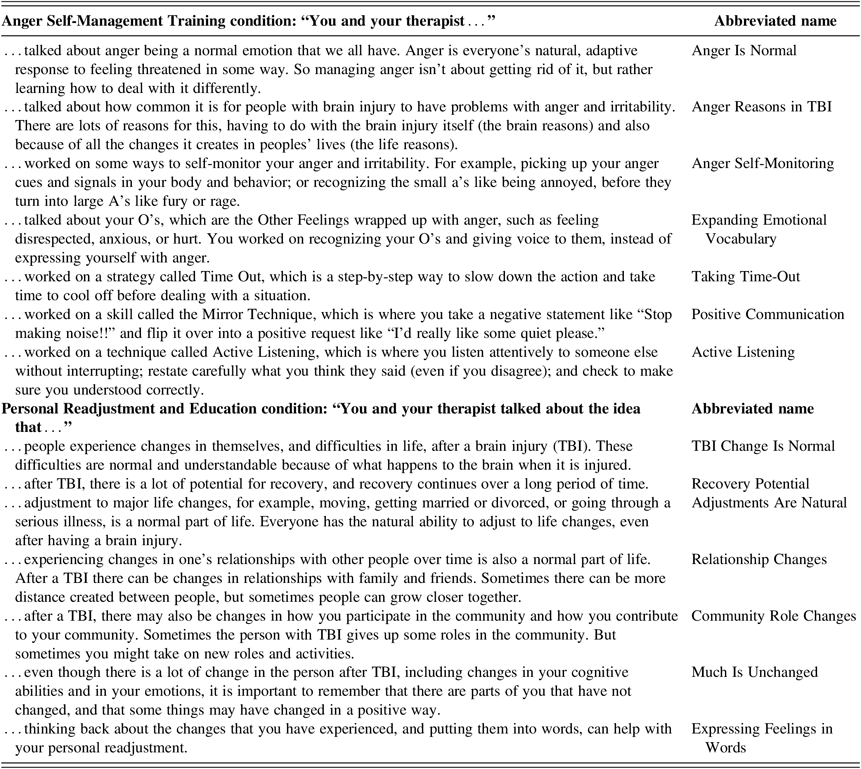
The enactment interview (available on request) was divided into three parts. For Part 1, each of the treatment programs was divided into seven main components. Some of these were concepts or “take-home messages” that were emphasized across sessions, while others (particularly in ASMT) were techniques introduced in a given session and practiced thereafter. During the enactment interviews, the interviewer described each of these components to participants and asked if they recalled it. Table 1 lists the descriptions that were read and/or paraphrased to participants, and a brief name used for each component throughout the remainder of the manuscript and tables.
Treatment components described to participants and abbreviated names used in text

For each component that the participant reported recognizing, the interviewer then asked, “How often, nowadays, do you find yourself reminded of this (idea, strategy, topic, etc.), or how often do you use it in some way? Not at all (0), rarely (1), occasionally (2), frequently (3), or very frequently (4)?” For each item rated >0, the interviewer asked, “And how helpful would you say that this (idea, strategy, topic, etc.) is to you, in your daily life? Not at all (0), slightly (1), somewhat (2), very (3), or extremely (4)?” Finally, the interviewer asked for examples of how and when the treatment component was used. To explain what was meant by “using” an idea or concept, as opposed to a behavioral technique, the interviewer gave examples such as recalling an idea or concept to help manage emotions or their expression, to shift perspective on or adjust to a situation, or to understand and normalize experiences.
In Part 2, participants were asked whether they were still using the written tools they had used during the trial. In ASMT, these consisted of anger logs, which were used in treatment sessions to promote discussion of triggers and emotional events surrounding anger episodes, and the outcome of strategies employed. In PRE, the written record was a free-form “personal events diary” in which participants were encouraged to record salient events and ventilate feelings. All participants were also asked how often, if at all, they were still reviewing the handouts they had received during the trial.
Part 3 dealt with barriers to enactment: participants were asked what, if anything, they thought had gotten in the way of their being able to use the ideas and strategies discussed in treatment. Responses were recorded as free text. One author (TH) generated categories and sorted responses based on barriers mentioned by two or more participants; another author (MV) independently verified the categories and sorted responses into them. Agreement exceeded 90% and discrepancies were resolved via discussion.
Procedures
All enactment interviews were conducted via phone by one author (SN), a Masters trained researcher with experience in telephone interviewing and counseling. She was otherwise unconnected with the parent trial and had never interacted with any participants. Interviews were scheduled for a minimum of 2 months following the cessation of treatment, although many occurred at a longer interval. Before administering the questions, the interviewer presented a preamble emphasizing the importance of knowing the true opinions and activities of each participant. Respondents were also reassured that their responses were confidential and would not be shared with their previous therapist. This was done in an attempt to minimize the demand characteristics for positive responses regarding the degree of treatment enactment. All interviews were audio-recorded. The interviewer took detailed notes during the interview and listened to the recording immediately afterward to clarify or insert material.
Data Analysis
The number of concepts or techniques recognized by each participant was tallied. Descriptive statistics for each treatment component included the proportion of participants endorsing each frequency score and, for frequency scores >0, the proportion of participants endorsing each helpfulness score. A treatment enactment score for each participant was calculated by averaging the frequency ratings across all seven treatment components. This score and an additional score comprised of each participant’s averaged helpfulness ratings were compared across treatment conditions using t-tests for independent samples. T-tests were also used to compare enactment in those with and without SOs participating in treatment. The proportions of participants who had maintained the use of the written log/diary, and who were still using therapy handouts, were compared across conditions with χ-square tests. Pearson correlations were used to examine the association between treatment enactment and treatment response, for the two anger scales separately. A simple least squares regression with simultaneous variable entry was conducted with treatment enactment score as the dependent variable and the following predictors, after ruling out multicollinearity: pretreatment STAXI-2 TA T-score, RAVLT Z-scores, Trails B T-score, FrSBe Total T-score, WASI FSIQ, and BSI GSI T-score. Alpha was set at .05.
RESULTS
Participant Characteristics
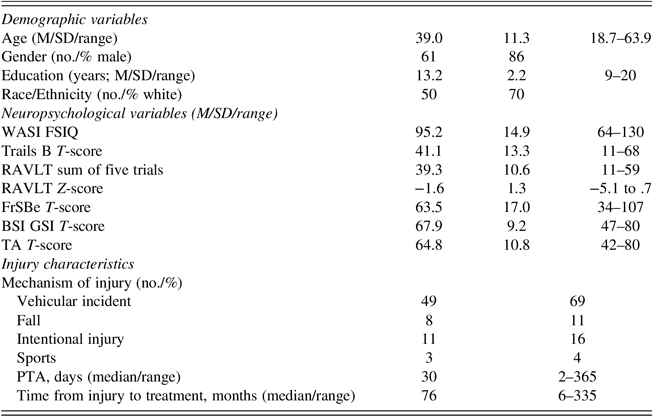
As shown in Table 2, participants were mostly male and mostly white, although nearly one-third were from racial/ethnic minority groups. The values for PTA duration and time between injury and treatment confirm that the sample was composed of people with chronic, severe TBI. Baseline values of the neuropsychological variables used to predict treatment enactment are also displayed in Table 2. There were no clinically significant differences between participants in the current study and those in the parent study who did not receive an enactment interview with regard to age, sex, education, race/ethnicity, PTA duration, time postinjury, involvement of an SO, or baseline anger scale scores (data not shown).
Participant characteristics (N = 71)

Notes: PTA = post-traumatic amnesia; WASI FSIQ = Wechsler Abbreviated Scale of Intelligence Full Scale IQ; RAVLT = Rey Auditory Verbal Learning Test; FrSBe = Frontal Systems Behavior Scale; BSI GSI = Brief Symptom Inventory Global Severity Index; TA = Trait Anger
Enactment Interview Findings
The interviews averaged 51 min (±12) for ASMT participants and 46 min (±16) for those in the PRE condition. The difference in interview duration was not significant (t = −1.31, p = .20). Interviews occurred from 64 to 586 days (median 97.5) posttreatment for ASMT participants and from 70 to 274 days (median 94.0) for PRE participants; this difference was also not significant. In light of the wide range of intervals posttreatment, we examined the correlation between this time span and the treatment enactment variable; there was no significant relationship (Spearman r = .05).
The majority of participants in both conditions (43, or 89% of ASMT participants and 15, or 65% of PRE participants) reported that they recognized all seven treatment elements described by the interviewer. Seven participants in the PRE condition did not recognize the “Expressing Feelings in Words” component (see Table 1). Only two participants in each group recognized fewer than six elements from their treatment program.
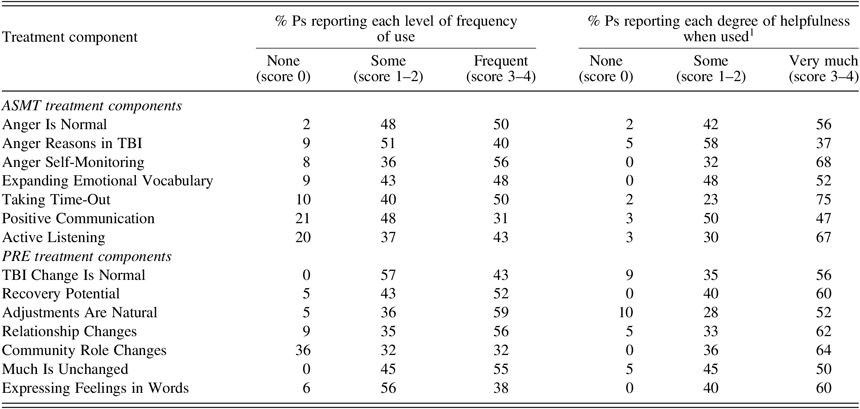
Descriptive statistics for the frequency and helpfulness ratings are displayed in Table 3. In the ASMT condition, there were three items receiving frequent use by at least one-half of participants: The idea that Anger Is Normal; Anger Self-Monitoring, which emphasized attention not only to bodily signals of anger but also to low levels of irritation that could escalate; and Taking Time-Out, a key method of “stopping the action” to engage in problem-solving when anger signals are perceived. These components also received high helpfulness ratings from the majority of participants using them (see Table 3). Items used frequently by at least one-half of the PRE sample included Recovery Potential, Adjustments Are Natural, Relationship Changes, and Much Is Unchanged; these have to do with adjustments following a major life event such as a TBI being normal and achievable, and the idea that TBI leaves many parts of the person intact.
Frequency and helpfulness ratings of treatment components in the two conditions

Notes: P = participant; ASMT = Anger Self-Management Training; PRE = Personal Readjustment and Education.
1 Proportions of helpfulness ratings are based on Ps who reported using each treatment component, that is, frequency score >0.
As noted above, an overall enactment score was calculated for each participant as the average of the seven frequency ratings. This value was identical for the two conditions (2.3 ± .7); the groups were therefore combined for the regression described below. An average helpfulness score was also calculated per participant, across treatment components; this score was slightly, but not significantly higher for ASMT (2.7 ± .7) versus PRE (2.5 ± .9); t = −.66, p = .50. There was also no significant difference between conditions in the proportions of participants who were still using the anger logs/personal events diary (21% for ASMT, 39% for PRE; χ-square = 2.66, p = .10) or were still referring to study handouts (48% for ASMT, 39% for PRE; χ-square = .48, p = .49).
Predictors and Correlates of Treatment Enactment
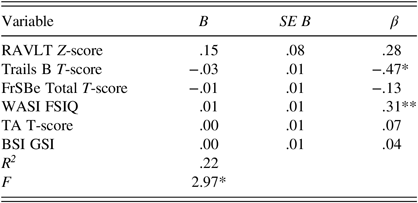
Table 4 shows the results of the regression analysis predicting the enactment score from baseline anger and neuropsychological characteristics, collapsing across treatment groups. The overall model was significant; the contribution of memory did not quite reach significance at p = .06. However, FSIQ contributed significantly to the model such that higher IQ was associated with greater enactment, as was a higher level of executive function when measured objectively (Trails B T-score) but not when self-reported (FrSBe score). Levels of anger and emotional distress at baseline were also nonsignificant.
Summary of regression analysis for predicting treatment enactment (N = 70)

*p < .01, **p < .05.
Notes: WASI FSIQ = Wechsler Abbreviated Scale of Intelligence Full Scale IQ; RAVLT = Rey Auditory Verbal Learning Test; BSI GSI = Brief Symptom Inventory Global Severity Index; FrSBe = Frontal Systems Behavior Scale; TA = Trait Anger.
The enactment scores for participants who had an SO involved in treatment were slightly higher than those who did not (2.35 vs. 2.13), but this did not approach significance (t = −1.32, p = .19). Enactment was, however, significantly and positively related to treatment response as measured by the STAXI-2 TA score (r = .25, p < .05) but not the AX-O score (r = .13, ns).
Qualitative Findings
Barriers to enactment were mentioned by the majority of participants in both conditions: 14 (29%) of ASMT and 9 (39%) of PRE participants said that nothing had interfered with their ability to use the techniques and concepts learned in treatment. The most frequently cited barrier to enactment, mentioned by 17 (35%) of ASMT participants and 9 (39%) of those in PRE, was lack of memory for the material, either altogether or at the time it was needed. For ASMT participants, the reactions of other people to the attempted use of strategies were cited as a barrier by 13 participants (27%); 4 PRE participants (17%) also cited others’ reactions as barriers. Several in the ASMT condition mentioned that using the strategies to remain calm made them look weak in the eyes of other people; another problem mentioned was that some family members simply continued to argue instead of cooperating with a more reasoned approach. Five participants in the ASMT condition stated that it was sometimes hard to enact treatment techniques in the constraints of the “real world,” particularly in work settings, and two in that condition, as well as one in PRE, said that they sometimes became angry “too fast” to make good use of the strategies they had learned. Two participants in ASMT and one in PRE stated that not all of the treatment content had applied to their problems, which interfered with enactment in daily life.
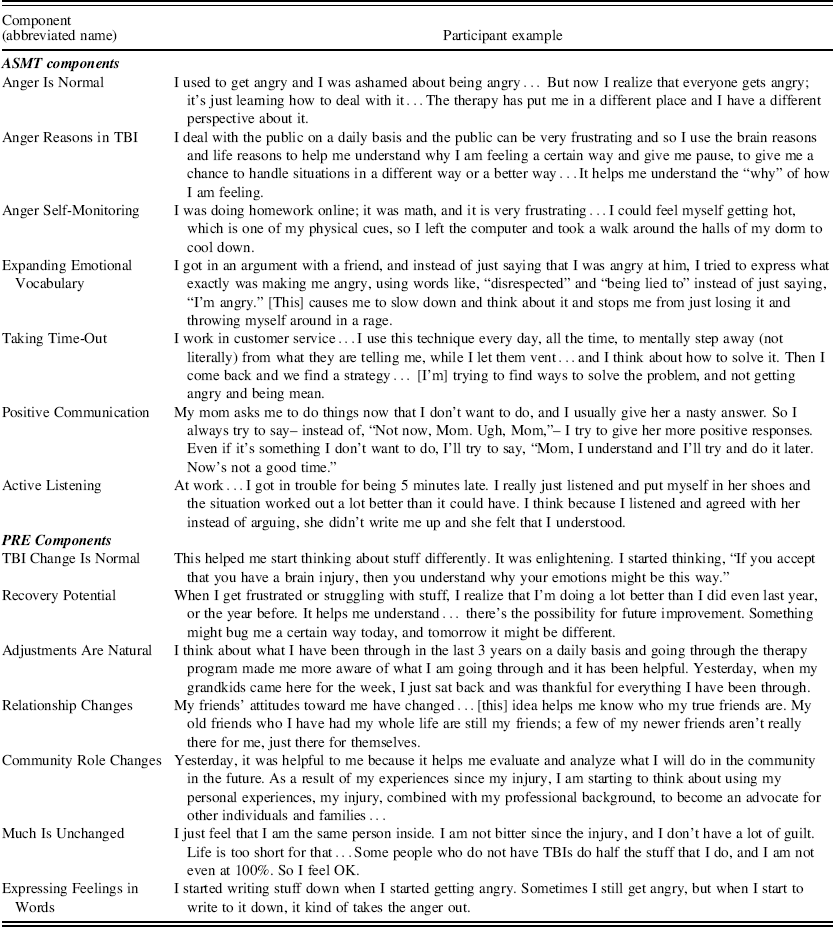
Despite the barriers, participants in both conditions gave numerous examples of how each of the treatment components had been applied in daily life. These are illustrated, with one participant comment per component, in Table 5.
Examples of treatment enactment for each treatment component

DISCUSSION
The purpose of this study was to explore the concept of treatment enactment in a clinical trial that compared two 8-week psychoeducational interventions: one, a program designed to provide education and skill development toward more effective self-management of anger following TBI and the other, developed as an educational/supportive therapy to control for nonspecific effects. In addition to the specific findings discussed below, we hope that this paper serves as an example that may prompt others to consider examining the sustained use of treatment concepts and techniques in daily life, so as to further our understanding of how to enhance treatment enactment and prevent relapse in the longer term.
The majority of our participants with moderate to severe TBI stated that they recognized all of the main concepts and strategies presented in their program more than 2 months after cessation of treatment. We used a recognition format, with the interviewer describing each treatment element, deliberately to maximize recollection since we were interested in enactment as opposed to verbal recall. Despite our explicit instructions to respondents, we cannot rule out the impact of social desirability, that is, claiming to recognize a concept that was actually not remembered. Still, we were encouraged by the number of concepts endorsed as recalled, by the number of examples offered when participants were asked how they had used each treatment component in daily life, and by the distribution of frequency and helpfulness ratings for each component: all but one of the components in each treatment condition were used “frequently” or “very frequently” by more than one-third of the participants who had been exposed to them.
A striking finding was the close similarity in both frequency and helpfulness ratings across the two treatment arms, one of which was designed as a control condition. This generally comports with the results of the parent trial (Hart et al., Reference Hart, Brockway, Maiuro, Vaccaro, Fann, Mellick, Harrison-Felix, Barber and Temkin2017), which found a stronger than the expected response on anger measures in the PRE condition, and serves to highlight what we have termed the “dilemma” of the control condition for behavioral treatment trials (Hart, Fann, & Novack, Reference Hart, Fann and Novack2008). Ideally, an active control contains all of the ingredients in the experimental condition save the active ones responsible for change in the target behavior(s). But such ingredients are difficult to isolate and operationalize, let alone remove, in novel, complex interpersonal interventions (Hart, Reference Hart2009). The so-called nonspecific factors such as warmth and therapist attention may be necessary delivery vehicles for the active ingredients within specific, theoretically motivated treatment protocols; to render an interpersonal treatment without such factors, or containing material that is completely irrelevant to the target problem, could bias a trial in favor of the experimental treatment by alienating participants. Experts in mainstream anger management programs have expressed concern about the lack of evidence for the superiority of specific over nonspecific factors as well (Olatunji & Lohr, Reference Olatunji and Lohr2004).
While we cannot offer a solution to this dilemma, our findings may help to illuminate some of the concepts most engaging to participants receiving brain injury psychoeducational interventions, which are often provided in clinical as well as research settings. Specifically, our PRE participants seemed to find the most value in ideas that normalized their experiences and provided perspective about positive as well as negative changes, as well as the perspective of long-term recovery. Regarding this last concept, we did not imply that there would be complete recovery following moderate to severe TBI, only that recent research has shown that positive changes may occur for longer than previously expected (Corrigan & Hammond, Reference Corrigan and Hammond2013).
Participants in the ASMT program also valued the normalizing concepts used in that treatment. In ASMT, the emphasis was on normalizing anger as an essential, protective response to threat, which could be managed to one’s advantage, and on validating the many reasons for exacerbation of anger following TBI. The first step in learning to manage anger is learning to better recognize when one is becoming angry via self-monitoring, a skill that more than half of participants reported using frequently. After anger is recognized, one needs a method for managing the situation; the Time-Out technique, which was also among the most frequently enacted of the treatment components, provides the basis for selecting a reasoned response rather than the knee-jerk reaction of acting out (or passive aggression). It was not surprising that relatively fewer participants reported using the specific communication techniques (Positive Communication, Active Listening), as these may be used only in interpersonal situations and are therefore less “all-purpose” than the Time-Out strategy. During the treatment sessions, ASMT participants developed a list of what we termed Calming Strategies, which were personal methods for dealing constructively with anger-provoking situations. A main purpose of the Time-Out technique is to allow the person time to decide which strategy will be most effective in dealing with a given situation. The fact that several participants cited becoming angry “too fast” for the strategies to be effectively used implies that programs such as ASMT might be more effective if important strategies are practiced to a criterion of automaticity, so that they can be enacted with less effort under stress.
Regardless of the treatment to which participants were assigned, the predictors of greater treatment enactment included executive function and general intelligence, but not baseline anger or emotional distress. It is not surprising that persons with more cognitive flexibility and problem-solving ability would find more ways to generalize treated skills and concepts to everyday situations. The integrity of pretreatment episodic memory was a weaker predictor, just missing statistical significance. However, this trend was consistent with the number of participants who cited memory for treatment content as a barrier to enactment. A clear direction for future research would be including booster sessions to reinforce the material and to help prevent relapse, or a software application that could be used “just-in-time,” that is, at the first sign of an imminent anger response, to remind people of their preferred strategies.
The hypothesis that the involvement of an SO in treatment would be reflected in greater treatment enactment was not confirmed. In fact, a substantial number of participants cited other people as a barrier to enactment, even when they had relatives involved in treatment sessions. Our enactment interviews did not include questions about whether the “other people” cited as barriers were the SOs involved in treatment or different people; future trials should consider including such questions. In this study, the barriers involving other people were described as others belittling or not cooperating with participants’ attempts to express feelings other than anger, or concerns that participants would appear weak if they used strategies that obviated anger responses. This serves as a reminder that anger expression is at least in part culturally determined, and that future efforts in this direction need to take cultural and familial factors into account.
In this study, treatment enactment was significantly associated with treatment response as measured by change in TA. Although the causal direction of this association cannot be firmly established in this study, it may be that the use of learned strategies by the participants in daily life maximizes the impact of the treatment by helping to diminish the tendency to perceive situations as hostile or threatening.
Limitations of this study include a relatively small sample and a reliance on self-report, which could introduce significant distortions from cognitive limitations as well as demand characteristics of the research. Future enactment research would benefit from exploring ways of improving or confirming self-report. For instance, participants’ examples of enactment might be formally evaluated for accuracy, a process not undertaken in the current study due to resource limitations. A two-step process in which participants are first asked for free recall of components, followed by a recognition procedure, might also help to improve confidence in the validity of the data. In addition, collateral respondents close to the participant might be interviewed, or participants might be asked to keep logs of enactment; this type of activity might also serve as an additional reminder to keep using the treatment material (Zauszniewski et al., Reference Zauszniewski, Lekhak, Burant, Underwood and Morris2016). It would also be helpful for future studies to compare treatment enactment during treatment with enactment following treatment, to learn more about changes over time. In the current study, therapists assessed and reinforced enactment during the treatment phase via review of homework, response to practice exercises, etc., but this was not measured in a formal way. Where appropriate to the intervention, such as treatments to improve sleep quality or increase physical activity, future studies might also assess enactment using passive activity monitoring systems (e.g., Fitbits), as suggested by previous authors (Bellg et al., Reference Bellg, Borrelli, Resnick, Hecht, Minicucci, Ory, Ogedegbe, Orwig, Ernst and Czajkowski2004).
CONCLUSION
While treatment enactment is difficult to measure, the effort to do so is worthwhile if we are to understand the factors that affect our patients’ ability to maintain benefit from treatments provided in the clinic or in intervention trials. Some treatments may effect their changes during the interval in which the therapist and patient are working together, but many, if not most, neuropsychological treatments depend for their long-term effects on the adoption of new strategies and habits. Measuring the individual differences and treatment components that support these long-term changes will help to advance the efficacy and effectiveness of treatments in our field.
ACKNOWLEDGEMENTS
This work was supported by the National Institutes of Health (R01HD042738) and the Peer Review Committee of Moss Rehabilitation Research Institute. The authors express deep appreciation to Jo Ann Brockway, PhD for her contributions to this work.
CONFLICT OF INTEREST
The authors have nothing to disclose.