INTRODUCTION
Free radicals generated by a partial reduction of O2 cause a serious hazard to tissues and vital organs, especially membrane lipids, connective tissues, and nucleic acids of cells. Thus, they have to be neutralized by the antioxidative defence mechanism of plants. This mechanism comprises a variety of antioxidant molecules and enzymes encoded by genes. The capacity and activity of the antioxidative defence system are important in both limiting the oxidative damage and destroying active oxygen species that are produced in excess of those normally required for metabolism (Arora et al., Reference Arora, Sairam and Srivastava2002).
Many enzymatic and non-enzymatic antioxidant defences exist, including superoxide dismutase (SOD), glutathione peroxidase (GPX), catalase (CAT) enzymes and glutathione (GSH), beta-carotene (vitamin A), ascorbic acid (vitamin C) and alpha-tocopherol (vitamin E) chemical compounds (Mates and Sanchez-Jiménez, Reference Mates and Sanchez-Jiménez1999). The balance between SOD and APX or CAT activities in cells is crucial for determining the steady-state level of superoxide radicals and hydrogen peroxide. Different affinities of APX and CAT for hydrogen peroxide suggest that they belong to two different classes of H2O2-scavenging enzymes: APX possibly being responsible for fine modulation of reactive oxygen intermediates (ROIs) for signalling and CAT being responsible for the removal of excess ROIs during stress (Mittler, Reference Mittler2002).
The effects of fungal, bacterial and virus infections on the activity of antioxidative enzymes in plants have been previously reported. The response of antioxidative enzymes against plum pox virus (PPV) was examined in two apricot (Prunus armeniaca L.) cultivars, which behaved differently against PPV infection (Hernandez et al., Reference Hernandez, Talavera, Martinez-Gomez, Dicenta and Sevilla2001). Kumquat [Fortunella margarita (Lour.) Swingle] ‘Nagami’ leaves were exposed to bacteria of Xanthomonas axonopodis pv. citri and a higher CAT activity was observed in inoculated leaves (Kumar et al., Reference Kumar, Ebel and Roberts2011). Wu et al. (Reference Wu, Zou and Xia2006a) reported increased antioxidative enzymes (SOD, CAT and APX) in Citrus tangerine roots infected with an arbuscular mycorrhizal (AM) fungus under water stress. Similarly, higher levels of SOD, CAT and peroxidase activities were also reported in micropropagated mycorrhizal P. trifoliata plants than those in non-mycorrhizal plants (Wu et al., Reference Wu, Zou, Xia and Wang2006b). Infection of the strawberry leaves with Mycosphaerella fragariae fungi resulted in an increase in SOD activities of resistant and susceptible cultivars (Ehsani-Moghaddam et al., Reference Ehsani-Moghaddam, Charles, Carisse and Khanizadeh2006). In another study, Reverberi et al. (Reference Reverberi, Betti, Fabbri, Zjalic, Spadoni, Mattei and Fanelli2008) reported that the synchronous presence of hydrolytic enzymes, toxic compounds, oxidative stress inducers and membrane transporters in the fungus, and the differential ability to modulate the lipoperoxidative pathway in the host, can play a significant role in Phoma tracheiphila infection of C. limon. Recently, Zhang et al. (Reference Zhang, Lu, Xu, Korpelainen and Li2010) reported that male poplar trees showed higher antioxidant activities and less H2O2 accumulation than did females after being infected by Melampsora laricipopulina Kleb., responsible for rust disease.
In the Mediterranean Basin, mal secco caused by P. tracheiphila is one of the most destructive fungal diseases of lemons. The disease occurs in Italy, Spain, Greece, Tunisia, Algeria, Cyprus, Turkey and Israel, and reduces the quantity and quality of lemon production in the areas where the pathogen is present. Complete control of mal secco with chemicals and other control measures such as sanitary applications is not possible. Furthermore, the mechanism of tolerance to this disease is unknown. Development of cultivars tolerant or resistant to this disease is essential (Gulsen et al., Reference Gulsen, Uzun, Pala, Canihos and Kafa2007; Tuzcu et al., Reference Tuzcu, Cinar, Kaplankiran, Erkilic and Yesiloglu1989; Uzun et al., Reference Uzun, Gulsen, Kafa, Seday, Tuzcu and Yesiloglu2009b). Variations in resistance of citrus rootstocks against mal secco were reported. For instance, while Cleopatra mandarin (C. reshni Hort. ex Tan.) was intermediate resistant, Volkameriana (C. volkameriana Tan. and Pasq.), rough lemon (C. jambhiri Lush.), sour orange (C. aurantium L.) and trifoliate orange (P. trifoliata (L.) Raf.) were susceptible (Tuzcu et al., Reference Tuzcu, Cinar, Kaplankiran, Erkilic and Yesiloglu1989).
To date, no information on effects of mal secco infection on activated antioxidative enzymes in citrus rootstocks is available. In the present work, antioxidant enzyme activity in different mal secco-resistant and susceptible citrus rootstocks was examined to evaluate the possible differences in constitutive levels of these antioxidant enzymes and correlations between enzymatic levels and mal secco susceptibility/resistance in citrus rootstocks.
MATERIALS AND METHODS
Plant material
Six citrus rootstocks including Cleopatra mandarin, volkameriana, rough lemon, sour orange, trifoliate orange and Carrizo citrange were used as plant material in this study (Table 1). They vary in resistance to mal secco caused by P. tracheiphila (Tuzcu et al., Reference Tuzcu, Cinar, Kaplankiran, Erkilic and Yesiloglu1989). Seeds were obtained from 25-year-old plants from the citrus collection plot of the Alata Horticultural Research Station (AHRS), Mersin, Turkey. Seeds were treated with benomyl to eliminate pest development and germinated in boxes containing river sand in a semi-controlled greenhouse. When plants reached to 15 cm, 12 plants were transferred to 4-L pots containing a mixture of sand, organic matter and soil (1:1:1) for further plant growth. All plants were managed according to the same standard local commercial practices.
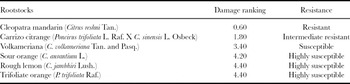
Disease ratings of Citrus rootstocks to mal secco in this study.

Inoculation and evaluation of mal secco
Phoma tracheiphila isolation, propagation, inoculation and further processes were performed according to Solel and Spiegel-Roy (Reference Solel and Spiegel-Roy1978) and Gulsen et al. (Reference Gulsen, Uzun, Pala, Canihos and Kafa2007). The pathogen was isolated from 1-year-old tissue of the tree with severe mal secco symptoms located on the orchard of the AHRS, where the disease is epidemic. Five replications of 10-month-old seedlings for each rootstock were inoculated by inserting pathogen plaque under cambium tissue 20 cm above the soil level in February. Then, cambium tissue was covered with wet cotton and wrapped to maintain moisture for pathogen development. Plants were kept in temperature range between 20 and 24 °C. Five seedlings of each 10-month-old rootstock were maintained as control treatment in another greenhouse. Aluminium foil and cotton were removed after 15 days. Mal secco symptoms were evaluated after three months of inoculation using a scale: 0 = no symptoms; 1 = shoot tip is died; 2 = side branches and twigs are died; 3 = whole crown down to infection site is died; 4 = whole crown down to bud union is died; 5 = whole tree including rootstock is died (Tuzcu et al., Reference Tuzcu, Cinar, Kaplankiran, Erkilic and Yesiloglu1989). Plant resistance was classified in accordance with Tuzcu et al. (Reference Tuzcu, Cinar, Kaplankiran, Erkilic and Yesiloglu1989) as follows:
0.00–0.99: resistant; 1.00–1.99: intermediate resistant; 2.00–3.99: susceptible; 4.00–5.00: highly susceptible.
Enzyme extraction and assays
Leaf samples of six citrus rootstocks were collected one month after inoculations when mal secco symptoms were visible on susceptible rootstocks. At the same time, leaf samples of non-infected control plants were also collected. Soluble proteins were extracted from 20 mg of plant tissue, using a standard sap extraction method described by Gulsen et al. (Reference Gulsen, Eickhoff, Heng-Moss, Shearman, Baxendale, Sarath and Lee2010) with little modifications. Plant tissues were placed between two rollers of a sap extraction apparatus (Ravenel Specialities Co., Seneca, SC). One and a half ml solution of a 20-mM HEPES(4-(2-hydroxyethyl)-1-piperazineethanesulfonic acid) buffer at pH 7.2, containing a protease inhibitor cocktail [0.3 g L−1 g of tissue of 4-(2-aminoethyl) benzenesulfonyl fluoride, bestatin, pepstatin A, E-64, leupeptin, 1,10-phenanthroline (Sigma, St. Louis, MO)] and 1% polyvinylpyrrolidone (PVP) was dropped on the top of the roller. Homogenate was collected from the bottom of the roller and centrifuged at 15,000 rpm for 15 min at 4 °C. Supernatant was collected and placed at 4 °C (<4 h) for further analysis.
Ascorbate peroxidase (APX) activity was estimated according to Nakano and Asada (Reference Nakano and Asada1981) with some modifications. The reaction mixture contained a 50-mM potassium-phosphate buffer (pH 7.6), 0.25 mM L(-) ascorbic acid, 12 mM H2O2 and 1 μg mL−1 protein extract. Volume of the reaction mixture was adjusted to 200 μL and the reaction was evaluated every 30 s for 2 min. Activity of APX was calculated from oxidized ascorbate concentration by using an extinction coefficient of 2.8 mM−1 cm−1. One enzyme unit was defined as mmol mL−1 oxidized ascorbate per min.
Total peroxidase (TPX) activity was measured by monitoring increase in absorbance at 470 nm for 2 min as described by Gulsen et al. (Reference Gulsen, Eickhoff, Heng-Moss, Shearman, Baxendale, Sarath and Lee2010). The reaction mixture included 2 μL of 30% hydrogen peroxide to wells of a 96-well microplate containing 60 μL of 18 mM guaiacol, 20 μL of 200 mM HEPES (pH 7.0), 117 μL of distilled water and 1 μL of enzyme extract. Specific activity of peroxidase was determined using molar absorptivity of guaiacol at 470 nm (26.6 × 10³ M−1 cm−1).
Catalase activity was assayed according to Cakmak and Marschner (Reference Cakmak and Marschner1992). The reaction mixture included a 25-mm phosphate buffer (pH 7.0), 10 mM H2O2 and enzyme. Decomposition of H2O2 was followed at 240 nm (39.4 mM cm−1).
STATISTICAL ANALYSIS
Data were analysed by using JMP software (Version 5.0.1; SAS Institute, 2002). Statistical significance was judged at the p < 0.05 level and least significant difference (Student's multiple range test) procedure was used to separate means.
RESULTS
Responses of rootstocks to mal secco
Citrus rootstocks showed differences with regard to resistance against mal secco. Damage ranking of rootstocks varied between 0.60 and 4.40 (Table 1). While Cleopatra mandarin was the most resistant rootstock, Carrizo citrange was classified as intermediate resistant rootstock (1.80). On the other hand, Volkameriana was susceptible whereas the rest, rough lemon, sour orange and trifoliate orange, were highly susceptible.
Antioxidative enzyme activity
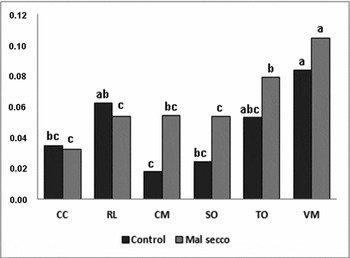
Several antioxidative enzyme activities were determined in leaves of control and P. tracheiphila inoculated plants in order to assess responses of the six citrus rootstocks to mal secco. For APX activity, there were differences between the control and infected plants (Figure 1). In control plants, the highest activity was observed in Volkameriana, whereas Cleopatra mandarin had the lowest activity. Infected plants increased the APX activity except for Carrizo citrange and rough lemon compared to the control plants. Inoculated plants of Cleopatra mandarin, resistant rootstock, showed a significant increase of about 2.5-fold compared to control plants. Similarly, APX activity of sour orange also increased 2.5-fold. The inoculation did not affect APX activity of Carrizo citrange, while this activity slightly decreased in highly susceptible rough lemon.
Ascorbate peroxidase activity of rootstock leaves in response to mal secco. Enzyme activity was expressed as (mg protein)−1. Each point is the average value of three independent measurements. CC: Carrizo citrange; RL: rough lemon; CM: Cleopatra mandarin; SO: sour orange; TO: trifoliate orange; VM: Volkameriana. Columns with different letters are significantly different (p < 0.05) according to Student's multiple range test.

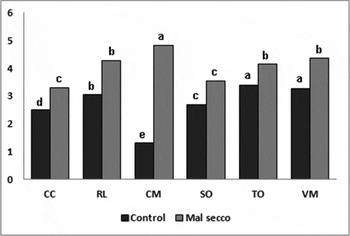
TPX activity of control plants except for Cleopatra mandarin showed little difference. The highest activity was obtained from highly susceptible trifoliate orange, whereas the lowest activity was determined in mal secco-resistant Cleopatra mandarin (Figure 2). For all rootstocks, TPX activity increased in inoculated plants compared to the control plants. Mal secco-resistant Cleopatra mandarin showed a significant increase of over 3.5-fold in infected plants compared to the control plants. The rest varied between 1.31- (Carrizo citrange) and 1.48-fold (trifoliate orange).
Total peroxidase activity of rootstock leaves infected with P. tracheiphila. Enzyme activity was expressed as (mg protein)−1. Each point is the average value of three independent measurements. CC: Carrizo citrange; RL: rough lemon; CM: Cleopatra mandarin; SO: sour orange; TO: trifoliate orange; VM: Volkameriana. Columns with different letters are significantly different (p < 0.05) according to Student's multiple range test.

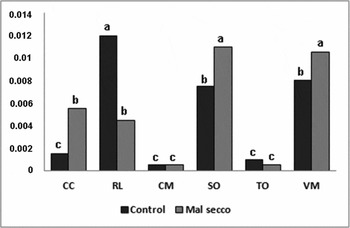
There were significant differences in CAT activities of the control plants. Rough lemon showed the highest activity and Cleopatra mandarin showed the lowest activity (Figure 3). Inoculation with P. tracheiphila produced different responses in CAT activity for rootstocks. Enzyme activity of Carrizo citrange, sour orange and Volkameriana increased with inoculation. In contrast, CAT decreased nearly threefold in diseased rough lemon plants compared to control plants. Also, trifoliate orange showed decrease in enzyme activity with inoculation. CAT activity of mal secco-resistant rootstock, Cleopatra mandarin, did not change in response to inoculation.
Catalase activity of rootstocks leaves infected with P. tracheiphila. Enzyme activity was expressed as (mg protein)−1. Each point is the average value of three independent measurements. CC: Carrizo citrange; RL: rough lemon; CM: Cleopatra mandarin; SO: sour orange; TO: trifoliate orange; VM: Volkameriana. Columns with different letters are significantly different (p < 0.05) according to Student's multiple range test.

DISCUSSION
Mal secco is a serious disease of Citrus, especially of lemons. Development of resistant or tolerant cultivars is an essential way to prevent mal secco in Citrus (Gulsen et al., Reference Gulsen, Uzun, Pala, Canihos and Kafa2007; Tuzcu et al., Reference Tuzcu, Cinar, Kaplankiran, Erkilic and Yesiloglu1989; Uzun et al., Reference Uzun, Gulsen, Kafa, Seday, Tuzcu and Yesiloglu2009b). The disease does not show constant epidemics. Different ecological factors and cultural measures affect the response of hosts and desirable results have not been obtained from the breeding programmes (Tuzcu et al., Reference Tuzcu, Cinar, Kaplankiran, Erkilic and Yesiloglu1989). While Cleopatra mandarin was found to be resistant, Carrizo citrange was classified as intermediate resistant in the present study. Similarly, Tuzcu et al. (Reference Tuzcu, Cinar, Kaplankiran, Erkilic and Yesiloglu1989) reported Cleopatra mandarin as intermediate resistant rootstock. On the other hand, Volkameriana was susceptible, whereas the rest of three rootstocks, rough lemon, sour orange and trifoliate orange, were highly susceptible. These four rootstocks were found as susceptible in a previous study (Tuzcu et al., Reference Tuzcu, Cinar, Kaplankiran, Erkilic and Yesiloglu1989). Current results as regards responses of rootstocks to mal secco were mostly consistent with the previous study.
Note that one of the most important events in the early phase of the incompatible plant–pathogen interaction was the rapid and transient production of activated oxygen species (AOS), such as superoxide radical (O2·−), hydrogen peroxide (H2O2), hydroxyl radical (·OH) and singlet oxygen (O2), called the oxidative burst (Baker and Orlandi, Reference Baker and Orlandi1995; Hernandez et al., Reference Hernandez, Rubio, Olmos, Ros-Barcelo and Martinez-Gomez2004). In order to cope with this stress, plants evolved some mechanisms called antioxidative systems to detoxify these oxidative chemicals. These include enzymes such as SOD, CAT and peroxidases (Hernandez et al., Reference Hernandez, Rubio, Olmos, Ros-Barcelo and Martinez-Gomez2004). Changes in response to P. tracheiphila were investigated in this study. Change of enzyme activities of rootstocks as regards this infection differed. APX activity increased in mal secco-resistant Cleopatra mandarin, susceptible Volkameriana, and highly susceptible sour orange and trifoliate orange but with varying levels. APX did not change in intermediate resistant Carrizo citrange, while decreased in highly susceptible rough lemon. APX induction might cause reduction in the H2O2 level, and thus it may have a limited signal transduction effect, by effectively removing H2O2, as it was formed (Hernandez et al., Reference Hernandez, Talavera, Martinez-Gomez, Dicenta and Sevilla2001). APX level was found to be higher in mycorrhizal fungus-inoculated C. tangerine roots than non-inoculated roots (Wu et al., Reference Wu, Zou and Xia2006a). Similar results were also obtained from shoots of O. europaea ssp. sylvestris that was inoculated with mycorrhizal fungi (Alguacil et al., Reference Alguacil, Hernandez, Caravaca, Portillo and Roldan2003). APX activity showed a gradual increase compared to control after the beginning of fungi (Mycosphaerella fragariae) inoculation in strawberry genotypes tested and peaked on the third day, after which activities returned to initial levels (Ding et al., Reference Ding, Charles, Carisse, Tsao, Dube and Khanizadeh2011). Higher increase of APX activity was found in the leaves of resistant genotypes when compared to susceptible ones. Increased APX activity was due to the increased H2O2 production and the resistant genotypes obviously had greater capacity to metabolize H2O2 to H2O to alleviate the injury to strawberry leaves. It was notified that an increase in APX activity could not stop the development of symptoms caused by infection, but may have helped to reduce severity of the disease and possibly to allow the plants to recover (Hernandez et al., Reference Hernandez, Rubio, Olmos, Ros-Barcelo and Martinez-Gomez2004). This may apply in this study. In another study, APX activity decreased in orange fruit flavedo and albedo infected with Penicillium digitatum compared to control (Ballester et al., Reference Ballester, Lafuente and Gonzales-Candelas2006). Similarly, activity of APX markedly decreased in tomato leaves following the inoculation of Botrytis cinerea fungi (Kuzniak and Sklodowska, Reference Kuzniak and Sklodowska2005).
It was previously suggested that increased peroxidase activity in resistant plants might allow the plant to detoxify peroxides and therefore sustain less tissue damage than susceptible plants (Heng-Moss et al., Reference Heng-Moss, Sarath, Baxendale, Novak, Bose, Ni and Quisenberry2004; Hildebrand et al., Reference Hildebrand, Rodriguez, Brown, Luu and Volden1986). Increased TPX activity was observed in all resistant and susceptible rootstocks in response to mal secco, and indicated the highest correlation with disease rating of infected plants. Similarly, total peroxidases also increased in apple fruits inoculated with Penicillium expansum (Torres et al., Reference Torres, Valentines, Usall, Vinas and Larrigaudiere2003). Accordingly, tomato peroxidase activity increased with inoculation of Fusarium oxysporum f. sp. lycopersici (Mandal et al., Reference Mandal, Mitra and Mallick2008).
In the present study, there was no positive correlation between CAT activity and mal secco resistance. It did not change in resistant Cleopatra mandarin, whereas it increased in highly susceptible sour orange and decreased in highly susceptible rough lemon. Similar results were also reported for other plants. Increased catalase activity was not associated with increased levels of resistance to insects (Heng-Moss et al., Reference Heng-Moss, Sarath, Baxendale, Novak, Bose, Ni and Quisenberry2004; Hildebrand et al., Reference Hildebrand, Rodriguez, Brown, Luu and Volden1986). CAT activity was higher in the leaves of mycorrhizal P. trifoliata than those in non-mychorrizal plants (Wu et al., Reference Wu, Zou, Xia and Wang2006b). In O. europaea plants, the inoculation treatments of mycorrhizal fungus increased the CAT level compared to non-inoculated plants (Alguacil et al., Reference Alguacil, Hernandez, Caravaca, Portillo and Roldan2003). CAT activity in fungus (Botrytis cinerea) inoculated tomato leaves was induced at the initial phase of the tomato–B. cinerea interaction, later CAT activity decreased (Kuzniak and Sklodowska, Reference Kuzniak and Sklodowska2005). The researchers reported that the role of CAT in the biotic stress process might be more complex than in abiotic stress. An increase of foliar CAT activity was also observed in both susceptible and resistant oats (Avena sativa L.) in responses to attack by the biotrophic fungal pathogen Blumeria graminis, which causes powdery mildew (Vanacker et al., Reference Vanacker, Foyer and Carver1998). On the other hand, it was reported that plants overproducing CAT have a decreased resistance to pathogen infection (Mittler, Reference Mittler2002; Polidoros et al., Reference Polidoros, Mylona and Scandalios2001). Abedi and Pakniyat (Reference Abedi and Pakniyat2010) argued that reduction of CAT activity was probably due to the inhibition of enzyme synthesis or change in the assembly of enzyme subunits under stress conditions. They also reported that downregulation of CAT activity was due to degradation caused by induced peroxisomal proteases or due to photo-inactivation of the enzyme.
In the present study, morphological and antioxidant enzyme responses of six citrus rootstocks inoculated with P. tracheiphila were evaluated. This was the first report to evaluate antioxidative enzyme responses of citrus rootstocks infected with P. tracheiphila. Resistances of rootstocks to mal secco varied and the results were generally consistent with previous reports. As regards antioxidant enzymes, high-level increases of APX and TPX in resistant Cleopatra mandarin may be associated with the resistance to mal secco. This study brought valuable insights into defence mechanisms of six citrus rootstocks with varying genetic compositions (Gulsen et al., Reference Gulsen and Roose2001; Uzun et al., Reference Uzun, Yesiloglu, Aka-Kacar, Tuzcu and Gulsen2009a). Further studies including other antioxidant enzymes could allow a better understanding of the relation between disease resistance and antioxidant enzyme activity.