INTRODUCTION
Grooming is a primary defence against ectoparasitic arthropods by both birds and mammals (Marshall, Reference Marshall1981; Murray, Reference Murray1987; Hart, Reference Hart, Clayton and Moore1997). In wild birds a naturally damaged beak results in higher numbers of ectoparasites, which is well documented for lice (Marshall, Reference Marshall1981; Clayton et al. Reference Clayton, Lee, Tompkins and Brodie1999, Reference Clayton, Koop, Harbison, Moyer and Bush2010). Among wild bird species, the degree of upper mandible overhang is correlated with lower louse abundance and diversity (Clayton and Walther, Reference Clayton and Walther2001). Ample experimental evidence also exists in wild birds to show that an intact beak is required for louse suppression, and the overhang of the upper mandible and resulting shear forces during grooming bouts are especially critical for control (Clayton et al. Reference Clayton, Moyer, Bysh, Jones, Gardiner, Rhodes and Goller2005).
Competitive interactions among organisms have major impacts on community structure, and such interactions among ectoparasites likely contribute to considerable niche specialization and resource partitioning (Marshall, Reference Marshall1981; Poulin, Reference Poulin2007). Very little is known, however, about how host grooming may affect interactions among ectoparasites themselves. In one of the few such studies, Bush and Malenke (Reference Bush and Malenke2008) studied interactions between the body louse Campanulotes compar (Burmeister) and the wing louse Columbicola columbae (L.) on pigeons. Host defensive grooming mediated the interaction, and C. compar outcompeted the wing louse particularly on grooming-impaired hosts. Ectoparasite studies also may provide novel theoretical support for other important community interactions. For example, one might predict that inferior competitors might be better dispersers, and thus could colonize a new habitat (such as an immunologically naïve, young hen) and exploit it before the arrival of a superior competitor (Levins, Reference Levins1979; Harbison et al. Reference Harbison, Bush, Malenke and Clayton2008).
In animal agriculture welfare issues are an increasing concern, particularly in the developed world (Mench, Reference Mench2008; Barnett and Hemsworth, Reference Barnett and Hemsworth2009). In commercial egg-laying hens, discussions centre on methods of housing (e.g. cage space and design), beak trimming, moulting, transport, and euthanasia (Hester, Reference Hester2005; Blokhuis et al. Reference Blokhuis, Van Niekirk, Bessei, Elson, Guemene, Kjaer, Levrino, Nicol, Tauson, Weeks and DeWeerd2007; United Egg Producers, 2008). The European Union banned suspended wire (battery) cages for laying hens by 2012 (Anonymous, 1999), and the recent (November 2008) passage of Proposition 2 in California mandated increased space for caged laying hens by 2015.
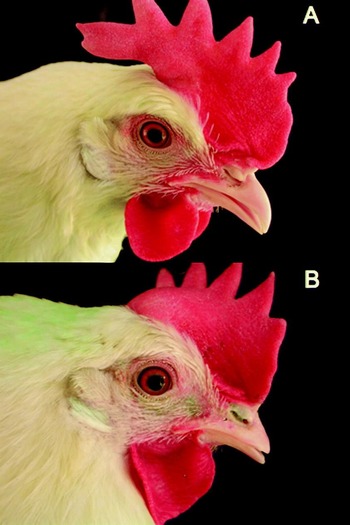
Beak trimming in poultry is done to prevent injurious feather picking, cannibalism, and feed waste and thus improve production and some aspects of hen welfare (Cheng, Reference Cheng2006; Guesdon et al. Reference Guesdon, Ahmed, Mallet, Faure and Nys2006; Mertens et al. Reference Mertens, Loeffle, De Baere, Zoons, De Baerdemaeker, Decuypere and De Ketelaere2009). The most common method removes the distal 30–50% of a chick's beak at 7–10 days of age using a hot blade trimmer (Mertens et al. Reference Mertens, Loeffle, De Baere, Zoons, De Baerdemaeker, Decuypere and De Ketelaere2009), although newer and possibly less-traumatic trimming techniques are under development (Gentle and McKeegan, Reference Gentle and McKeegan2007). The trimmed beak heals to produce a blunt tip (Fig. 1). Objections to beak trimming include initial discomfort and possibility of chronic pain (Gentle et al. Reference Gentle, Hughes, Fox and Waddington1997; Cheng, Reference Cheng2006), and the procedure does cost time and effort by producers. It thus is generally considered desirable to work towards selective breeding for docile behaviour, in which case the need for beak trimming would be reduced (Cheng, Reference Cheng2006).
Beak-intact (top) and beak-trimmed (bottom) white leghorn hens. Note the sharp tip and overhang in the intact beak that is critical for ectoparasite reduction through grooming.

It has been anecdotally noted, but never documented, that it is unusual to find both the chicken body louse (Menacanthus stramineus (Nitzsch)) and the northern fowl mite (Ornithonyssus sylviarum (Canestrini and Fanzago)) on the same individual chicken (Axtell and Arends, Reference Axtell and Arends1990), implying some interaction. In typical (beak-trimmed) hen flocks, both species reduce egg production, body weight gains, and feed utilization efficiency and thus cause substantial economic damage (DeVaney, Reference DeVaney1976; Mullens et al. Reference Mullens, Owen, Kuney, Szijj and Klingler2009). The mites also cause tremendous distress to workers, and it often is worker complaints that trigger pesticide applications (Mullens et al. Reference Mullens, Hinkle, Kuney and Szijj2004a). To date the only remediation available to a producer is to use pesticides, which themselves are being increasingly reduced and regulated due to environmental and health concerns. There are very few materials and target resistance is high, particularly among mite populations (Mullens et al. Reference Mullens, Velten, Hinkle, Kuney and Szijj2004b).
Given the established relationship between beak condition/grooming and ectoparasite abundance on wild birds, and the economic importance of poultry ectoparasites, it is surprising that beak condition has not been more thoroughly examined for its possible role in ectoparasite suppression in domestic poultry. Using small numbers of chickens and almost completely removing the upper mandible (extreme and unrepresentative of the modern poultry industry), experimental adult chickens had more body lice than untrimmed birds (Kartman, Reference Kartman1949). Similarly, when 1-month-old chicks had the upper 0·5 cm of the beak removed and were infested with body lice, the trimmed chicks had more lice than the untrimmed counterparts 1 month later (Brown, Reference Brown1972). Only one very preliminary observation suggested that adult beak-trimmed hens might have larger numbers of northern fowl mites than untrimmed birds (Matthysse et al. Reference Matthysse, Jones and Purnasi1974). Recently, we demonstrated that beak condition and cage density distinctly alter numbers of both northern fowl mites and chicken body lice on hens infested with only a single ectoparasite species (Mullens et al. Reference Mullens, Chen and Owen2010).
The present study investigated the influence of host beak condition on the 2 dominant poultry ectoparasites, and specifically whether the presence of one ectoparasite influences numbers of the alternate ectoparasite on the host over time.
MATERIALS AND METHODS
A popular commercial white leghorn strain bred for docility, Hy-Line W-36, was used to avoid cannibalism (Craig et al. Reference Craig, Craig and Milliken1992). Hens were purchased from a commercial operator as ready-to-lay pullets (18 weeks of age), and the same hen cohort was used for all treatments within an experiment. Two hens were held (same beak condition) per 31 cm×31 cm suspended wire cage (normal commercial density) in experimental hen houses on the Agricultural Operations property near UC Riverside, CA, USA. The light cycle was 15L:9D, and hens had continuous access to water cups and commercial layer feed. One of each hen pair had coloured leg bands to allow it to be distinguished individually. Banks of 4 free-standing cages (8 hens per bank, half beak-intact and half beak-trimmed) were separated by 1·3 m, and strict handling protocols prevented cross-contamination by different ectoparasites until the reciprocal transfers were done.
Body lice and northern fowl mites, initially obtained from southern California commercial caged layer operations, were maintained on source hens at UC Riverside. Timing of the experiments was coordinated to consider the much faster life cycle of the mites (5–7 days versus about 2·5 weeks for the lice), and the fact that the abundance of blood-feeding mites is influenced temporally by the host immune response (Owen et al. Reference Owen, Delany and Mullens2008; Mullens et al. Reference Mullens, Owen, Kuney, Szijj and Klingler2009). Lice were added (40 mixed adult/juvenile lice per hen) to 16 individual hens (2 cage banks) using a fine paintbrush when hens were 21 weeks old (beginning oviposition). Three weeks later 20 adult mites/hen were added to 2 other cage banks (16 hens). Lice were monitored weekly by visual inspection of 3 body areas, each about 9 cm long by 6 cm wide- the anterior keel, lower abdomen anterior to the vent, and under both wings. Lice were counted by parting the feathers in 3 locations on the anterior keel and lower abdomen, and the more lightly feathered under-wing area was examined as a whole. Lice were summed (adults and juveniles) per body area. Live mites were estimated only in the lower abdomen, their preferred body region, using a categorical scoring system developed for them (Arthur and Axtell, Reference Arthur and Axtell1983) as follows: 0=no mites seen, 1=1–10, 2=11–50, 3=51–100, 4=101–500, 5=501–1000, 6=1000–10000 and 7=>10 000. The scores are conservative especially at the higher mite densities, but are repeatable by an observer and well correlated (r=0·93) with actual total mite numbers derived from vent feather removal (Owen et al. Reference Owen, Delany, Cardona, Bickford and Mullens2009).
The reciprocal ectoparasite transfers were timed to coincide with moderate but increasing populations of both species (visual scores of 30 lice or 100 mites per hen). Trial 1 ran continuously for 15 weeks using both beak-intact and beak-trimmed hens. Ectoparasite treatments were (i) mites only (20 mites/hen added in week 3), (ii) mites followed by lice (20 mites/hen added in week 3 and 20 lice/hen added in week 5), (iii) lice only (40 lice/hen added in week 0), and (iv) lice followed by mites (40 lice/hen followed by 40 mites/hen in week 5).
The entire experiment was repeated (Trial 2) in the hot summer months, and the warm weather initially slowed mite population growth until we could air condition the poultry house at week 10, keeping the air temperatures below 30°C. This delayed the reciprocal transfers and the trial ran for 22 weeks. With the longer time-frame, the initial number of lice was reduced to 5 lice/hen. Transfer of mites to the designated louse-infested hens occurred on week 10 for 4 hens and on week 12 for the other 4 hens. Mites established on test hens to the level required for reciprocal transfer of lice to those hens (mite scores of 2–4) at week 9 for 4 hens and week 11 for the other 4 hens.
In a final test, we further quantified the impact of louse introduction on mite populations. Individual, beak-trimmed hens were subjected to a whole-body washing technique as described by Clayton and Drown (Reference Clayton and Drown2001), which is superior for obtaining absolute ectoparasite counts. Clayton and Drown (Reference Clayton and Drown2001) recovered >87% of body lice on pigeons using washing in a paint shaker. A logistic decay curve was fitted previously to data from consecutive 5 min washes of beak-trimmed hens infested with variable (unknown) numbers of M. stramineus (Mullens et al. Reference Mullens, Chen and Owen2010). This estimated statistically that 99·8% of lice were removed in 3 hen hand-washing cycles. We did not confirm this with experimental addition of known numbers of lice to hens or feather digestion, however. Ten heavily mite-infested hens from a single strain and age cohort were divided into 2 groups, which were intentionally matched according to visual mite infestation. One group of 5 mite-infested, beak-trimmed hens (mean mite score=5·8) was infested with 20 lice/hen and was held for 10 weeks, relative to the same number of similarly mite-infested hens (mean mite score=5·7) that were not infested with lice. After 10 weeks, euthanized hens were washed in 3 separate, consecutive soapy water washes of 5 min each, running the water through a 230-mesh sieve to recover lice and/or mites. For hens infested with mites only, the larger mite numbers were estimated in serially diluted ethanol subsamples (Owen et al. Reference Owen, Delany, Cardona, Bickford and Mullens2009). For the louse-infested hens, the entire samples were meticulously searched for mites using a stereomicroscope.
RESULTS
Performance of single ectoparasite species versus host beak condition
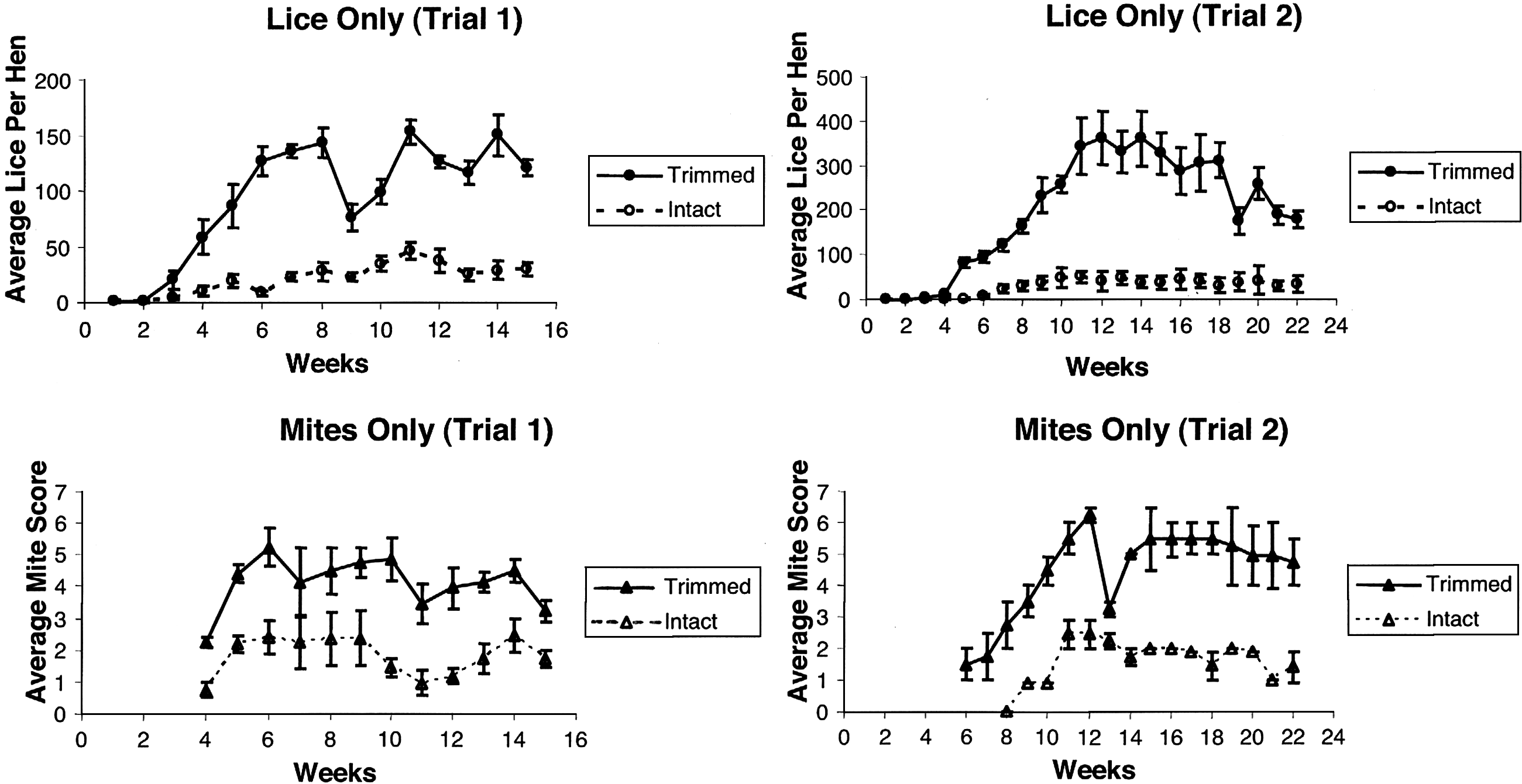
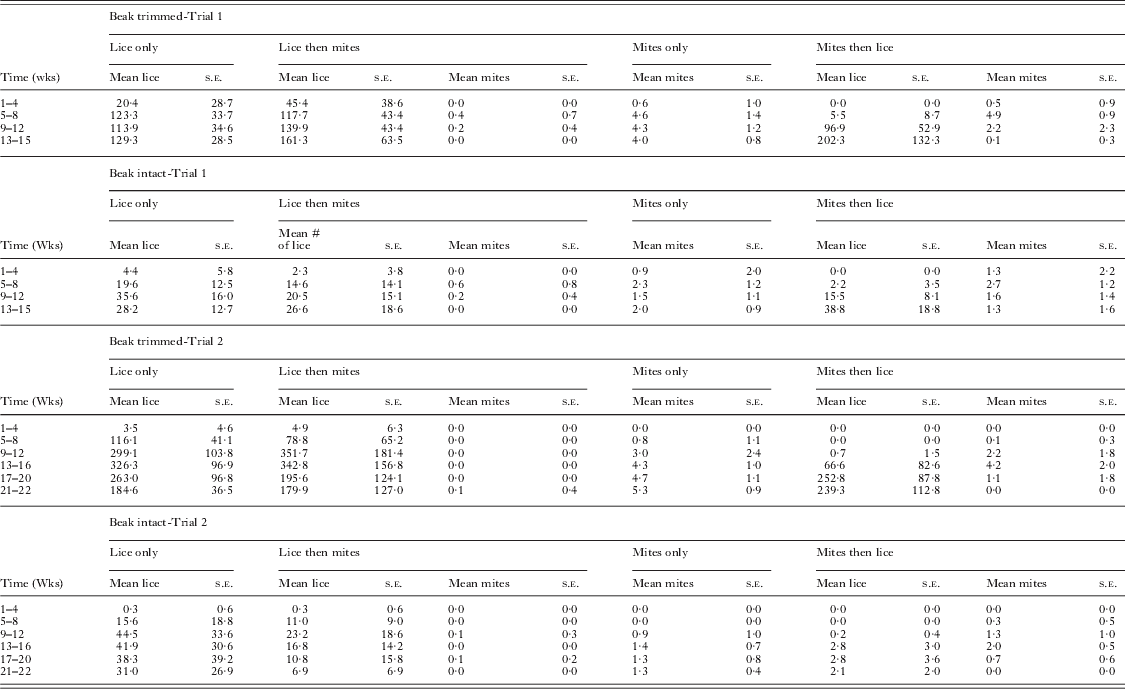
Table 1 provides an overview of mean ectoparasite densities and their variation over time (primarily periods of 4 weeks) for the 2 trials and treatments. Weekly abundance of the separate, respective ectoparasites on beak-intact and beak-trimmed hens is shown in Fig. 2. In trial 1, lice required at least 6 weeks to reach high numbers, while mites were most abundant at week 6 (3 weeks after their first introduction at week 3). In trial 2, louse density increased steadily, while high temperature stress delayed mite population increases until after week 9 (Table 1). Regardless, using repeat-measures ANOVA, beak condition had a large effect on the densities of both lice and mites and in both trials (P<0·002 in all cases). Using peak louse densities occurring in weeks 13–15 (Trial 1) or 13–16 (Trial 2), beak-trimmed hens harboured 4·6 times the number of lice visually estimated on beak-intact hens in Trial 1 (129 versus 28) and 7·8 times as many in Trial 2 (326 versus 42) (Table 1). Using visually estimated peak mite densities occurring in weeks 5–8 in Trial 1 or weeks 21–22 in Trial 2, beak-trimmed hens harboured about 5 times the number of mites in Trial 1 (average mite score of 4·6 versus 2·3 for beak-intact hens) and 40 times as many in Trial 2 (average mite score of 5·3 versus 1·3 for beak-intact hens). In the longer-running Trial 2, numbers of lice on both beak-trimmed and beak-intact hens declined somewhat after reaching a peak at 9–16 weeks post-infestation (Table 1).
Visual assessments of numbers of lice (top) and mite scores (bottom) on hens which are beak-trimmed or beak-intact and infested with only 1 of the ectoparasites in 2 experimental trials. Note far higher numbers on beak-trimmed hens.

Summary statistics for numbers of chicken body lice, Menacanthus stramineus, and relative scores of northern fowl mites, Ornithonyssus sylviarum, on hens as a function of beak condition (see text)

Beak effects on spatial distribution of lice
Spatial distribution of body lice also differed between beak-intact and beak-trimmed hens, especially in early-mid stages of louse colonization (Fig. 3). Louse numbers were too low for analysis in week 1 of Trial 1, and differences in timing of louse introductions made direct statistical comparisons inappropriate for Trial 2. The significant chi-square values for week 2 and each week thereafter for the duration of Trial 1 (chi-square⩾8·51, D.F.=2, P<0·001) represent an overall relative shift in numbers found in each of the 3 body areas for beak-trimmed versus beak-intact hens. In Trial 1 about half of the lice on beak-trimmed hens were found in the vent region, while below 20% of lice on beak-intact hens occupied this area of the body. The trend was delayed by the smaller initial louse number, but appeared similar (weeks 12–14) in Trial 2.
Percentage of body lice in different body regions of beak-intact (top) and beak-trimmed (bottom) hens in 2 experimental trials. Note the higher proportional representation of lice in the vent region of beak-trimmed hens, especially in the earlier and middle stages of louse infestation.

Reciprocal ectoparasite transfers: lice introduced with pre-existing mite infestations
The overview results of the louse transfers on mites are shown in Table 1. Introduction of lice to mite-infested, beak-trimmed hens resulted in the near-disappearance of mites over time in both trials, while mites sometimes could persist at low levels together with the lower louse numbers on beak-intact hens. By weeks 13–15 in Trial 1, beak-trimmed hens with mites alone had an average mite score of 4 (about 100 mites), while their counterparts which had received lice (now an average louse density of 202 per hen) had essentially no mites (mite score of 0·1). Beak-intact hens with mites only harboured an average of about 10 mites (mite score of 2), while those that later received lice now had about 2–3 mites per hen (mite score of 1·3) together with an average 39 lice per hen.
The weekly detail is seen in Fig. 4. In Trial 1, using hens initially infested with mites at week 3 followed by lice at week 5, mites increased through week 6 on both beak-trimmed and beak-intact hens (Fig. 4A and B). On beak-intact hens, the relatively low numbers of lice (averages usually <20 per hen) (Table 1) corresponded to some mite reduction between weeks 6 and 11, but mites were able to co-exist at low densities (10–20 mites per hen) (Fig. 4A). Significant numbers of lice (averages >100 per hen on beak-trimmed hens) were observed on the beak-trimmed hens by week 10, which corresponded to a very substantial reduction in mite density (Fig. 4B). Because the beak-intact and beak-trimmed hens were held in separate but adjacent cages in the same bank, the occasional mites on intact hens may have been dispersing from adjacent, more heavily infested, trimmed hens. For weeks 11–15, mite populations on beak-trimmed hens with mites only (Fig. 2) were far higher than mite populations on beak-trimmed hens which subsequently were infested with lice (Fig. 4B) (t-test, P<0·001). The same negative effect of lice on mites was clear in Trial 2 (P<0·01)(Fig. 4C and D), although in this case mites disappeared by week 21 even on the beak-intact hens. Therefore, increasing abundance of lice was correlated with disappearance of mites in both trials, particularly on the beak-trimmed hosts.
Mite responses to louse introduction on beak-intact (top) and beak-trimmed (bottom) hens in 2 experimental trials (week 9 addition of lice for Trial 2 on right). Note the rapid collapse of mite numbers on beak-trimmed hens 4–6 weeks after louse introduction (louse numbers not shown for clarity).

Louse numbers in Trial 2 were maintained at a particularly low level on only one treatment: beak-intact hens that had prior experience with mites (Table 1). In this case, mean louse counts of below 4 on intact hosts prevailed throughout the duration of the trial.
Reciprocal ectoparasite transfers: mites introduced with pre-existing louse infestations
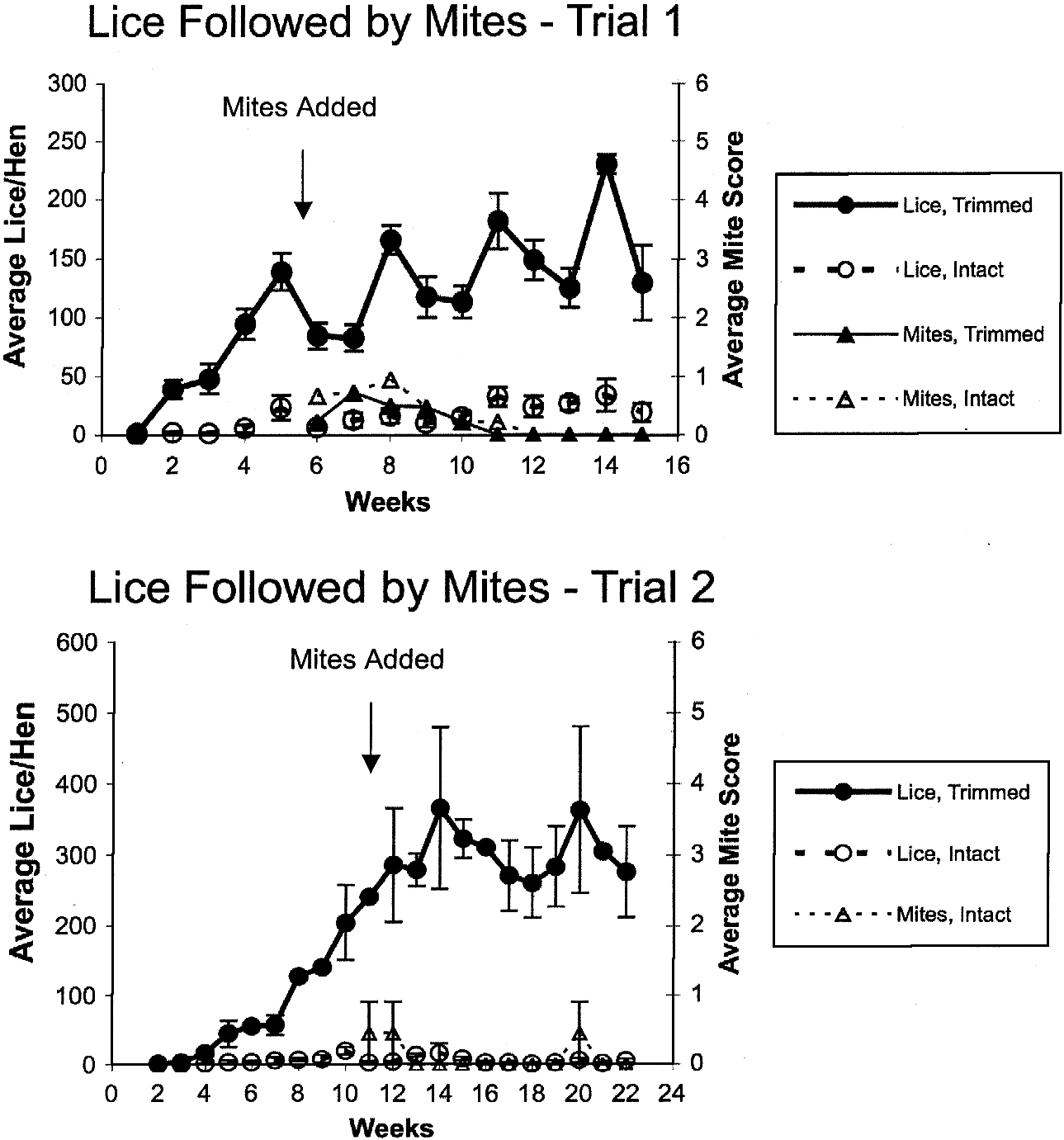
In the reverse transfer, mites were introduced to hens that already had lice (Table 1). Mites were able to persist only transiently and at very low densities on the louse-infested hens, regardless of whether they were beak intact or beak trimmed, and mites almost never exceeded 5–10 mites/hen. Mites did not establish at all on beak-trimmed, louse-infested hosts in Trial 2. Weekly details are seen in Fig. 5. Fewer than 5–10 mites were observed per hen shortly after their introduction, and within 6–7 weeks no mites were seen on any of the louse-infested hens. Louse populations were unchanged after mite introduction relative to hens infested only by lice (t-test, P>0·50). The same trends were evident in Trial 2 (Fig. 5); mites had no effect on lice and were unable to establish long-term infestations on louse-infested hosts regardless of beak condition.
Louse responses to mite introduction on beak-intact and beak-trimmed hens in 2 experimental trials (week 11 addition of mites for Trial 2 below). Note the failure of mites to establish or persist on louse-infested hens beyond 3–6 weeks after introduction, and continued robust louse numbers on those hens, particularly if beak-trimmed.

Absolute ectoparasite numbers on hens with mites versus a dual infestation with lice
Based on visual examinations of the vent, mites on beak-trimmed hens had been virtually eliminated by introduction of lice. However, the previously mite-infested feathers, still somewhat encrusted with mite feces, might harbour mites that could not be observed. Also, it was impossible to fully examine the body of an animal visually, and smaller numbers of mites may have remained on the louse-infested hens in some other body region (hundreds of mites can live on a single feather). Following the meticulous hen washing/sieving technique of ectoparasite extraction, the mite-only hens harboured 18 128±3702 mites (mean±s.e.). Hens subsequently infested with lice harboured 143±82 mites, 288±55 louse adults and 5172±552 louse nymphs. The log10-transformed number of mites was very different on the hens which had lice introduced (t-test, P<0·01). Although no live mites were seen in the vent region of any of the 5 louse-infested hens prior to euthanasia, 2 hens had small but established mite populations (320 and 366 mites, respectively). Three hens had much smaller mite numbers (3–20 per hen) that might have represented transient mites (i.e. not actually established/reproducing on that hen). Introduction of lice on beak-trimmed hens therefore resulted in a 127-fold reduction in actual mite numbers over the 10-week period.
DISCUSSION
Beak-intact hens greatly reduced both ectoparasites relative to beak-trimmed hens. This also was seen in earlier cage-layer trials using hens held both alone and with cagemates (Mullens et al. Reference Mullens, Chen and Owen2010). While the substantially lower numbers of lice and mites on beak-intact hens could sometimes co-exist, mites could not establish well on louse-infested hosts (even if beak-intact). Even if they did establish temporarily, mites could not persist with even moderate densities of lice over time. On beak-trimmed hens, the larger louse numbers drastically reduced or entirely eliminated mites quite quickly.
Host grooming influences ectoparasite densities and sometimes distributions on the host body (e.g. Murray, Reference Murray1987). The spatial pattern reported here probably reflects particularly impaired grooming by beak-trimmed hens towards the vent region. The vent area is the preferred habitat for mites (Lemke et al. Reference Lemke, Collison and Kim1988; Axtell and Arends, Reference Axtell and Arends1990) and is also heavily utilized by lice if the host is less able to groom. Louse populations on beak-intact hens were comprised of a much higher proportion of adults (19%, versus 7% on beak-trimmed hosts), which was hypothesized to result from better grooming of egg masses on the feathers (Mullens et al. Reference Mullens, Chen and Owen2010). In the present study, lice recovered by host washing were 5·3% adults, which is similar to the 7% figure observed before from beak-trimmed hosts (Mullens et al. Reference Mullens, Chen and Owen2010). There is limited experimental evidence for shifting ectoparasite occupation of body regions that are not defended by normal host grooming (e.g. altered parasite distribution as a function of host beak, limb, or mouth/teeth damage). In an earlier study, Bell et al. (1962) showed that rodent lice would occupy particular body regions that no longer could be groomed by the host due to limb amputation. The ecological concept of enemy-free space (Jeffries and Lawton, Reference Jeffries and Lawton1984) applies to our system in the sense that the host is in this case the enemy, suppressing numbers and altering ectoparasite distributions through grooming activity. Lice on the damaged (beak-trimmed) hosts are especially able to occupy the lower abdomen in large numbers, apparently due to the impaired host grooming (i.e. the lower abdomen then is enemy-free space). This has severe consequences for the mites, which are restricted to that zone due to its unique microhabitat characteristics on a chicken (Halbritter and Mullens, Reference Halbritter and Mullens2011) and thus are forced to interact, ineffectively, with the far larger lice.
Very few studies have examined possible host-mediation (e.g. grooming, immune responses) of competitive interactions in ectoparasite communities (Clayton et al. Reference Clayton, Moyer, Bysh, Jones, Gardiner, Rhodes and Goller2005; Poulin, Reference Poulin2007). Waage and Davies (Reference Waage and Davies1986) showed that residence (feeding) time of 2 biting fly species (Tabanidae) was influenced by density-dependent horse behavioural defences, and these may also be responsible for some of the distinctive host resource partitioning seen in that family of flies (Mullens and Gerhardt, Reference Mullens and Gerhardt1979). Similarly, Schofield and Torr (Reference Schofield and Torr2002) demonstrated that the 2 dominant biting flies attacking cattle in Zimbabwe, Glossina spp. (tsetse flies) and Stomoxys spp. (stable flies), were differentially sensitive to host defensive behaviour. Thus engorgement success of the more easily disrupted tsetse flies was especially sensitive to disturbance caused by the stable fly triggering of host defences. In our system, grooming by beak-intact hens seems to be particularly vigorous in response to mite infestations, as evidenced by skin bruising near the vent feathers that is only obvious with mite-infested, intact hens (and not with louse-infested, intact hens)(Mullens et al. Reference Mullens, Chen and Owen2010). Thus the previous experience of beak-intact hens with mites in the present experiments may have contributed to the very low success (density) of lice when they were added later in the Trial 2 reciprocal transfer experiment.
Our findings are similar to a study of 2 louse species co-habiting rock doves (Bush and Malenke, Reference Bush and Malenke2008). They showed that numbers of the wing louse, Columbicola columbae, were lower in the presence of the body louse, Campanulotes compar (but not vice versa). Wing louse body distribution further was substantially shifted in the presence of body lice, and the interaction was asymmetrical. Grooming-impaired rock doves, with their higher body louse numbers, harboured even fewer wing lice. In our system, the intense occupation of the lower abdomen by lice in beak-trimmed hens had severe consequences for the mites, which are mostly restricted to that zone. At this point we are unsure of the mechanism(s), which might include feather consumption by lice (eliminating preferred mite resting/reproduction habitat), physical interference with mite blood-feeding by lice (larger, more active, and dwell mostly in the skin), or actual opportunistic predation on mites by lice. This is a fruitful area for further research.
As shown here, O. sylviarum reaches high (peak) densities much sooner than M. stramineus does. This relates to the shorter generation interval, which is 5–12 days for O. sylviarum (Sikes and Chamberlain, Reference Sikes and Chamberlain1954) and 2·5–3 weeks for M. stramineus (Stockdale and Raun, Reference Stockdale and Raun1965). The mites are, however, susceptible to high temperature stress, which we have observed over many years will delay their population increase. The superior competitive ability of M. stramineus over O. sylviarum in the present experiments could also relate to their typical population dynamics and dispersal features in hen groups. The two species are capable of rapid increases in both proportional infestation and mean density (the primary components of parasite load) on infested hosts in the population, especially in commercial flocks of hens held at high density in adjacent cages (DeVaney et al. Reference DeVaney, Quisenberry, Doran and Bradley1980; Mullens et al. Reference Mullens, Owen, Kuney, Szijj and Klingler2009). However, the mites are superior dispersers. Mites show up off-host commonly when high densities occur in the field, travelling across open (empty) cages to infest new hosts (Mullens et al. Reference Mullens, Hinkle, Robinson and Szijj2001). Northern fowl mites also travel phoretically on rodents (Miller and Price, Reference Miller and Price1977) and have been found on at least 72 spp. of wild birds in 26 families (Knee and Proctor, Reference Knee and Proctor2007), on which they also may reproduce. While mite host range is relatively broad, M. stramineus probably originated on wild turkeys and is restricted to only a very few galliform birds including domestic chickens, guinea fowl, peafowl, quail and pheasants (Price and Graham, Reference Price and Graham1997). So the present interaction study involves a rather host-specific and slowly reproducing louse competing with a generalist mite, which matures and reproduces much faster. There likely is a trade-off, therefore, between dispersal and competitiveness, as shown by Harbison et al. (Reference Harbison, Bush, Malenke and Clayton2008) for pigeon lice.
The situation is further complicated by the fact that mites invoke a powerful immune response, typically limiting their most effective use of a new (naïve) host resource to a period of less than 10–12 weeks (Mullens et al. Reference Mullens, Owen, Kuney, Szijj and Klingler2009; Owen et al. Reference Owen, Delany and Mullens2008, Reference Owen, Delany, Cardona, Bickford and Mullens2009) and making regular dispersal to new hosts probably even more necessary. The body louse, while it does take serum and blood from the host, does not seem to invoke an equally potent immune response. Our study showed, however, that louse densities decline after about 4 months, which could be due to a variety of factors. This deserves further study. Lice in the same suborder (Amblycera) have been hypothesized to be subject to evolutionary pressure from an immune response (Moller and Rosza, 2005). Careful and comprehensive studies of the multiple arms of the immune response (innate, cellular and humoral) relative to actual experimental parasite infestations are the best way to demonstrate that (Owen and Clayton, Reference Owen and Clayton2008).
As is true for wild vertebrates (Marshall, Reference Marshall1981; Murray, Reference Murray1987; Hart, Reference Hart, Clayton and Moore1997; Clayton et al. Reference Clayton, Lee, Tompkins and Brodie1999; Clayton and Walther, Reference Clayton and Walther2001), domestic hens themselves thus can very substantially reduce ectoparasite loads, provided the beak is intact. The relative increase in louse density as a result of beak trimming is at least equal to the increase of body lice shown for rock doves (about 3-fold) which had the beak overhang removed (Clayton and Walther, Reference Clayton and Walther2001). Northern fowl mites are the key pest of egg-laying hens in the USA (Axtell and Arends, Reference Axtell and Arends1990). The production damage is caused by the initial intense mite population buildup, and particularly the consequent and metabolically costly immune response during the initial 6–10 weeks after infestation (Mullens et al. Reference Mullens, Owen, Kuney, Szijj and Klingler2009; Owen et al. Reference Owen, Delany, Cardona, Bickford and Mullens2009). The other part of mite damage, worker irritation, is mainly due to people encountering large numbers of mites on eggs, and this usually triggers costly chemical treatments by producers (Mullens et al. Reference Mullens, Hinkle, Kuney and Szijj2004a). Worker irritation should be reduced greatly by using beak-intact hens; it was uncommon to see mites on eggs from beak-intact birds in the present studies.
The present study is one of the first clear examples of grooming-mediated exclusion within an ectoparasite community. Lice should essentially eliminate mites from a typical beak-trimmed flock over time. Lice are far less prevalent than mites among commercial flocks in southern California, probably for 2 reasons. First, lice are relatively easier to control in a flock via pesticide application (B.A. Mullens, personal observation). Second, and perhaps more importantly, once a flock is moved out of a facility, any relic lice away from a host will die in a few days or less (Chen and Mullens, Reference Chen and Mullens2008). Thus, in chicken houses typically left vacant 2 weeks between flocks, the new uninfested hens would remain louse-free. In contrast, northern fowl mites can easily survive 2–4 weeks away from a host (Chen and Mullens, Reference Chen and Mullens2008), readily re-infesting a clean, new incoming flock (e.g. Mullens et al. Reference Mullens, Owen, Kuney, Szijj and Klingler2009). The mites also are haplo-diploid (Oliver, Reference Oliver1965), and a single, virgin adult female mite (pathenogenetic) infesting a new host could conceivably give rise to a viable population through the female mating with her own haploid male offspring. This would substantially enhance their ultimate colonization abilities relative to lice.
Mites are extremely damaging and difficult to eradicate using pesticides, which also has led to high levels of mite resistance in the field (Mullens et al. Reference Mullens, Velten, Hinkle, Kuney and Szijj2004b, Reference Mullens, Owen, Kuney, Szijj and Klingler2009). If a producer were desperate enough and willing to accept temporary economic damage from lice, they might even be used for long-term eradication of mites in a facility. This would need to be tested, and selling the idea to a producer would be difficult, to say the least. The idea of using one damaging parasite to eliminate another, more difficult-to-manage parasite is not without precedent, however. Malaria therapy, for example, was used for syphilis control in the first half of the 20th century prior to effective antibiotic therapies (Sartin and Perry, Reference Sartin and Perry1995). Conceptually, the deleterious impacts of one parasite (especially microparasites) upon another more frequently are thought to be mediated by the vertebrate immune response (Lafferty, Reference Lafferty2010). Host immunity is likely involved, for example, in the potential for tapeworm infestations to mitigate allergies (Erb, Reference Erb2009) or co-infections with certain viruses to mitigate HIV loads (Aronoff, Reference Aronoff2002). Immune system involvement in the louse-mite interaction is also a possibility in our study, although the chances are high that the impact of lice on mites is more direct.
In light of current concerns regarding agricultural animal welfare and pesticide residues, use of beak-intact hens may provide a win-win scenario. The results of the present studies should spur development of docile hen strains that can be held without beak trimming (i.e. will not injure each other) but still retain desirable production characteristics. Assuming increased feed waste in beak-intact hens could be reduced by changes in feed trough design, producer costs of beak trimming might be avoided. Further, it is likely that the need for pesticide applications for control (and the subsequent costs and concerns about hen and worker exposure) would either be eliminated or greatly reduced by letting the hens control their own ectoparasites.
ACKNOWLEDGEMENTS
We appreciate the assistance of M. Pastor, K. Klingler, and L. Gonzalez with hen care and the UC Riverside Graduate Division Fellowship for B. Chen.