INTRODUCTION
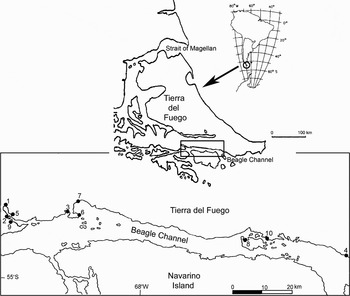
The Beagle Channel is located at the southern tip of South America, limited by the Isla Grande de Tierra del Fuego to the north and a group of islands to the south (Navarino, Hoste, Gordon, Picton, Nueva, Lenox, and several smaller islets) (Figure 1). This channel, joining the Atlantic and Pacific Oceans, is a drowned ancient glacial valley, running from west to east for about 250 km. During the Pleistocene, the entire basin repeatedly was glaciated (Rabassa et al., Reference Rabassa, Coronato, Bujalesky, Salemme, Roig, Meglioli, Heusser, Gordillo, Roig, Borromei and Quattrocchio2000). Presently available evidence, strongly suggests that a glacial lake resulting from ice melting was formed about 12,000 years ago (Heusser, Reference Heusser1989, Reference Heusser1998). Later, about 8000 years ago, the area was flooded progressively with marine waters from the open oceans, becoming a marine ecosystem about 7500 years before present (Rabassa et al., Reference Rabassa, Heusser and Stuckenrath1986). Therefore, the Quaternary appears to be a key period for the understanding of the origin of the present marine fauna of the Beagle Channel.
Location map: 1, Lago Roca; 2, Río Lapataia; 3, Bahía Golondrina; 4, Río Varela; 5, Alakush; 6, Península Ushuaia; 7, Playa Larga; 8, Isla Gable; 9, Río Ovando; 10, Estancia Harberton.

The present paper updates the knowledge about the gastropods inhabiting the Beagle Channel at the time when marine conditions were being established in this area. This information updates the preliminary list of molluscs by Gordillo et al. (Reference Gordillo, Coronato and Rabassa2005) and other faunistic data (Hägg in Halle (Reference Halle1910); Porter et al. (Reference Porter, Stuiver and Heusser1984); Rabassa et al. (Reference Rabassa, Heusser and Stuckenrath1986)).
Quaternary marine deposits in Tierra del Fuego
The first descriptions on the Fuegian Quaternary deposits were made by Charles Darwin in 1833, on the basis of observations made during his visit to South America on-board the HMS ‘Beagle’. Later on, Anderson (Reference Anderson1906), Halle (Reference Halle1910), Caldenius (Reference Caldenius1932), Feruglio (Reference Feruglio1950), Auer (Reference Auer1956, Reference Auer1959, Reference Auer1965, Reference Auer1970, Reference Auer1974), Urien (Reference Urien1966), Codignotto & Malumián (Reference Codignotto and Malumián1981), Porter et al. (Reference Porter, Stuiver and Heusser1984), Rabassa et al. (Reference Rabassa, Heusser and Stuckenrath1986, Reference Rabassa, Serrat, Heusser, Bono and Coronato1990, Reference Rabassa, Coronato, Bujalesky, Salemme, Roig, Meglioli, Heusser, Gordillo, Roig, Borromei and Quattrocchio2000), Codignotto (Reference Codignotto1987), Mörner (Reference Mörner1987, Reference Mörner1991), Gordillo et al. (Reference Gordillo, Bujalesky, Pirazzoli, Rabassa and Saliége1992), Gordillo (Reference Gordillo1993), Bujalesky (Reference Bujalesky1998), and Bujalesky et al. (Reference Bujalesky, Coronato and Isla2001), provided additional information. The Quaternary of Tierra del Fuego is represented by glacial, glaciofluvial, glaciolacustrine, marine, and aeolian deposits. Marine deposits were formed during the Pleistocene interglacial stages and during the Holocene. Pleistocene marine deposits are not well preserved in the Beagle Channel area due to the erosive effect of the last glaciations. The only known Pleistocene beach not eroded by glacial activity is a marine terrace remnant containing various fauna of molluscs, recently found on the southern coast of the Beagle Channel, on Navarino Island (Gordillo et al., Reference Gordillo, Cusminsky, Bernasconi, Ponce, Rabassa and Pino2010). In contrast, littoral Holocene deposits are very common in the area. The southern coast of Tierra del Fuego, under the Scotia Plate Domain, is located in the active seismotectonic setting of the Fuegian Andes (Bujalesky, Reference Bujalesky1998). Consequently, Holocene deposits along the Beagle Channel originated from isostatic recovery and neotectonic uplift (Rabassa et al., Reference Rabassa, Heusser and Stuckenrath1986; Gordillo et al., Reference Gordillo, Bujalesky, Pirazzoli, Rabassa and Saliége1992, Reference Gordillo, Coronato and Rabassa1993).
Studies on Holocene marine molluscs in Tierra del Fuego
The first report on Quaternary molluscs from the Beagle Channel was made by R. Hägg (in Halle, Reference Halle1910), who listed 12 species from raised beaches collected by Thore G. Halle at Isla Gable. Porter et al. (Reference Porter, Stuiver and Heusser1984) reported the presence of marine shells in a Holocene beach at the north-west end of Península Gusano, Navarino Island. Later, Rabassa et al. (Reference Rabassa, Heusser and Stuckenrath1986) provided a preliminary report of the invertebrate fauna (including molluscs) collected at Tierra del Fuego National Park. Gordillo (Reference Gordillo1992) carried out a taphonomic analysis of the mollusc assemblages in 18 marine deposits from the Beagle Channel. Additional studies on the fossil molluscs from this area were performed by Gordillo (Reference Gordillo1993, Reference Gordillo1999) and Gordillo et al. (Reference Gordillo, Coronato and Rabassa2005). The last paper provides a preliminary list of the taxa collected from four raised beaches that are considered in detail in the present study. Holocene molluscs from the Atlantic coast of Tierra del Fuego were studied by Feruglio (Reference Feruglio1950), Richards & Craig (Reference Richards and Craig1963) and Gordillo (Reference Gordillo1992); and those of Magellan Strait by Porter et al. (Reference Porter, Stuiver and Heusser1984), Di Geronimo & Rosso (Reference Di Geronimo and Rosso1996), and Cárdenas & Gordillo (Reference Cárdenas and Gordillo2009).
MATERIALS AND METHODS
The species studied in this paper were collected from bulk sediment samples from four sites on the northern coast of the Beagle Channel (Figure 1):
(1) Río Ovando (54°51′S 68°35′W) is a stratigraphic sequence composed of coarse sand with pebbles of varied lithology, located at 2.5 m above present sea level (a.s.l.), and dated at 4160 ± 45 years before present (Pta 7573; Coronato et al., Reference Coronato, Rabassa, Borromei, Quatroccio and Bujalesky1999).
(2) Lago Roca (54°49′S 68°34′W) is a massive, greyish silty bed (>1.0 m), located at 3.0 m a.s.l. The area was dated at 7518 ± 58 years before present (NZ-7830; Gordillo et al., Reference Gordillo, Coronato and Rabassa1993).
(3) Bahía Golondrina (54°50′S 68°19′W) is a massive bed of fine sandy clays, at 2.0 m a.s.l., and dated at 6276 ± 41 years before present (AA 62801; Gordillo et al., Reference Gordillo, Rabassa and Coronato2008).
(4) Río Varela (54°12′S 67°11′W) is a massive, greyish clay (>1.7 m), located 3 m a.s.l., dated at 6240 ± 70 years before present (Pta 7581; Coronato et al., Reference Coronato, Rabassa, Borromei, Quatroccio and Bujalesky1999).
Other material from Alakush (54°50′S 68°34′W), Playa Larga (54°49′S 68°14′W), Península Ushuaia (54°51′S 68°18′W), Isla Gable (55°55′S 67°30′W), Río Lapataia (54°50′S 68°34′W), and Estancia Harberton (54°53′S 67°24′W), were included in this study (Figure 1).
Stratigraphic information on these sites is provided by Gordillo (Reference Gordillo1991, Reference Gordillo1992) and Gordillo et al. (Reference Gordillo, Bujalesky, Pirazzoli, Rabassa and Saliége1992).
Larger specimens (>20 mm of maximum size) were separated from the sediment matrix in the field. The smaller ones were sorted in the laboratory under a stereoscopic microscope, from a bulk sediment sub-sample of 30–50 dm3.
Gastropods were identified at the lower taxonomic level possible, and figured using a scanning electron microscope and digital photography. The synonymy lists are not exhaustive, but only provide those references in which new combinations were provided. When listing the material examined for each locality, the number of specimens is given. The four classes used refer to the maximum size of a species: minute: <2 mm; small: 2–10 mm; medium: 10–20 mm; large: > 20 mm.
The material studied was deposited at the Centro de Investigaciones Paleobiológicas, Universidad Nacional de Córdoba (CEGH-UNC).
The present distribution of each species is based on the information provided by Zelaya (Reference Zelaya2006), who performed a revision on the diversity of gastropods from the southern tip of South America.
SYSTEMATICS
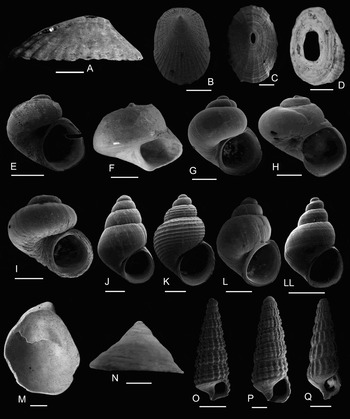
(A) Nacella deaurata (CEGH-UNC 22725); (B) Iothia coppingeri (CEGH-UNC 22434); (C) Fissurella picta (CEGH-UNC 22438); (D) Fissurellidea patagonica (CEGH-UNC 22511); (E) Scissurella clathrata (CEGH-UNC 22447); (F) Calliostoma dozei (CEGH-UNC 22522); (G) Ganesa sp. (CEGH-UNC 22452); (H) Margarella violacea (CEGH-UNC 22683); (I) Cyclostrema crassicostatum (CEGH-UNC 22451); (J) Eatoniella denticula (CEGH-UNC 22439); (K) Onoba schythei (CEGH-UNC 22441); (L) Laevilitorina caliginosa (CEGH-UNC 22450); (LL) Laevilitorina sp. (CEGH-UNC 22448); (M) Crepidula cf. dilatata (CEGH-UNC 22531); (N) Trochita pileolus (CEGH-UNC 22688); (O) Cerithiopsilla (?) burd woodiona (CEGH-UNC 22444); (P) Cerithiella sp. 2 (CEGH-UNC 22443); (Q) Eumetula michaelseni (CEGH-UNC 22445). Scale bars: A, 10 mm; B, C, L, LL, O, Q, 1 mm; D, 5 mm; E, G, H, J, K, P, 500 µm; F, M, N, 5 mm; I, 250 µm.

Patella aenea Martyn, 1784: figure 17 (non-binomiol fide ICZN, 1957);
Patella deaurata Gmelin, Reference Gmelin1791, p. 3719.
Patella varicosa Reeve, 1854, pl. 11, figure 21a–c.
Nacella strigatella Rochebrune & Mabille, Reference Rochebrune and Mabille1885, p. 110.
Patinella deaurata Gmelin-Chemnitz. Strebel, Reference Strebel1907, p. 137, pl. 5, figures 62–65, 68–70; pl. 6, figures 76, 81.
Patinella delicatissima Strebel, Reference Strebel1907, p. 145, pl. 5, figures 71, 72, 74, 75.
Helcioniscus bennetti Preston, Reference Preston1913, p. 221.
Patinigera deaurata (Gmelin) 1790. Carcelles & Williamson, Reference Carcelles and Williamson1951, p. 256.
TYPE LOCALITIES
Freto Magellanico [Strait of Magellan] (Patella deaurata). Uschuaia (sic) [Ushuaia, Beagle Channel]; Bahía Inutil; Tuesday Bay; Magellan-Str [Strait of Magallan] (Patinella delicatissima). Cap Horn [Cape Horn] (Nacella strigatella). Port Stanley [Malvinas (Falkland) Islands] (Helcioniscus bennetti). Tierra del Fuego (Patella varicosa).
DIAGNOSIS
Shell large, moderately solid, ovate in outline, triangular in lateral view, with the apex forwardly directed. Anterior margin nearly straight; posterior margin convex. Shell surface sculptured with strong radial ribs to almost smooth.
MATERIAL EXAMINED
One specimen, Playa Larga, Beagle Channel (CEGH-UNC 22725).
OTHER FOSSIL REFERENCES
Atlantic Ocean: ‘Argentine Patagonia’ (Feruglio, Reference Feruglio1950; Aguirre & Farinati, Reference Aguirre and Farinati2000; Pastorino, Reference Pastorino2000: Quaternary); San Jorge Gulf (Aguirre, Reference Aguirre2003: Holocene and Pleistocene); Bahía Bustamante (Aguirre et al., Reference Aguirre, Negro Sirch and Richiano2005: Holocene and Pleistocene); Bahía Vera and Bahía Camarones (Aguirre et al., Reference Aguirre, Richiano and Negro Sirch2006: Holocene and Pleistocene); Beagle Channel (Gordillo, Reference Gordillo1992: Holocene).
PRESENT DISTRIBUTION
Chiloé, Chile to Malvinas (Falkland) Islands, and extending northwards in the Atlantic Ocean up to Santa Cruz Province, Argentina. Intertidal to subtidal.
REMARKS
Patinigera aenea Powell, Reference Powell1951 (non-Martyn); and Helcioniscus bennetti were considered to be a synonyms of N. deaurata by Dell (Reference Dell1971) and Powell (Reference Powell1951), respectively; Powell (Reference Powell1973) added Nacella strigatella and Patella varicosa to the synonymy, and considered Patinella delicatissima to be a variety.
Tectura (Pilidium) coppingeri Smith, Reference Smith1881, p. 35, pl. 4, figures 12, 12a.
Lepeta copingeri Smith E.A. Pilsbry, Reference Pilsbry1891, p. 71, pl. 39, figures 20, 21.
Pilidium coppingeri Smith E.A. Strebel, Reference Strebel1907, p. 110, pl. 3, figure 38a,b.
Lepeta (Pilidium) coppingeri (Edg. Smith). Thiele, 1912, p. 185.
Iothia coppingeri Smith E.A. Moskalev, Reference Moskalev1977, p. 63, figures 5, 6.
TYPE LOCALITY
Sandy Point [Punta Arenas, Strait of Magellan], 9–10 fathoms [16–18 m].
DIAGNOSIS
Shell small, patelliform in outline, delicate, whitish. Apex anteriorly displaced. Shell surface sculptured with rows of tubercles radiating from the apex, and concentric growth lines.
MATERIAL EXAMINED
Fourteen specimens, Río Ovando (CEGH-UNC 22434, 22704).
OTHER FOSSIL REFERENCES
Pickard (Reference Pickard1985) reported the species as present in Holocene deposits of Vestfold Hills, East Antarctica, but this record requires confirmation (see Remarks).
PRESENT DISTRIBUTION
Chiloé, Chile to Malvinas (Falkland) Islands. 5–96 m.
REMARKS
Powell (Reference Powell1951) reported Lepeta (Pilidium) antarctica Smith, 1907 to be a synonym of Iothia coppingeri. Based on this synonymy, the species was subsequently reported as occurring in the Antarctic waters (e.g. Dell, Reference Dell1990; Hain, Reference Hain1990). However, Zelaya (Reference Zelaya2006) pointed out some differences between Magellanic and Antarctic specimens, and concluded that a systematic revision of these taxa is needed for re-evaluating their conspecificity. In the meantime, the distribution of Iothia coppingeri is considered to be restricted to the Magellan Region.
Patella personata Martyn, 1784: figure 64 (non-binomial fide ICZN, 1957).
Patella picta Gmelin, Reference Gmelin1791, p. 3729.
Fissurella picta (Gmelin). Lamarck, Reference Lamarck1822, p. 10.
Fissurella atrata Reeve, Reference Reeve and Reeve1850, pl. 11, figure 73.
Fissurella muricata Reeve, Reference Reeve and Reeve1850, pl. 14, figure 103.
Fissurella (Balboaina) picta Gmelin. Powell, Reference Powell1951, p. 85.
Fissurella (Fissurella) picta picta (Gmelin, Reference Gmelin1791). McLean, Reference McLean1984a, p. 37, figures 123–146.
TYPE LOCALITIES
Falkland Isl. [Malvinas (Falkland) Islands] (Patella personata). Freto Magellanico [Strait of Magellan] (Patella picta). ? (Fissurella atrata, Fissurella muricata).
DIAGNOSIS
Shell large, patelliform in outline, somewhat depressed, solid, with a small foramen in subcentral position. Shell surface whitish with wide purplish or blackish radial bands; sculptured with radial ribs and conspicuous growth lines.
MATERIAL EXAMINED
One specimen, Río Ovando (CEGH-UNC 22438); 2 specimens, Río Varela (CEGH-UNC 22736, 22737).
OTHER FOSSIL REFERENCES
Atlantic Ocean: ‘Argentine Patagonia’ (Aguirre & Farinati, Reference Aguirre and Farinati2000; Pastorino, Reference Pastorino2000: Quaternary); Bahía Vera and Bahía Camarones (Aguirre et al., Reference Aguirre, Richiano and Negro Sirch2006: Holocene and Pleistocene). Pacific Ocean: Cahuil, Chile (Philippi, Reference Philippi1887: Quaternary). Beagle Channel (Gordillo et al., Reference Gordillo, Coronato and Rabassa2005 as Fisurella spp.: Holocene).
PRESENT DISTRIBUTION
Fissurella picta picta distributes from Chiloé, Chile to Puerto Deseado, Argentina. Intertidal to 92 m.
REMARKS
In a revision of the Magellanic species of Fissurella, McLean (Reference McLean1984a) considered F. atrata and F. muricata to be synonymys of Fissurella picta.
Megatebenus patagonicus Strebel, Reference Strebel1907, p. 98, pl. 2, figure 23a–f.
Fissurellidea patagonica (Strebel, Reference Strebel1907). Mclean, Reference McLean1984b, p. 26, figures 10–18.
TYPE LOCALITIES
Lennox Insel [Beagle Channel], 10–25 fathoms [18–46 m]; Port Louis [Malvinas (Falkland) Islands].
DIAGNOSIS
Shell large, ovate in outline, slightly elevated. Foramen large (1/4 to 1/3 shell length), subcentrally located. Shell surface whitish to light brownish, with greyish, brownish or pinkish radial bands; sculptured with flat radial ribs and growth lines, more evident toward the margin.
MATERIAL EXAMINED
One specimen, Río Ovando (CEGH-UNC 22698); 3 specimens, Río Varela (CEGH-UNC 22840); 1 specimen, Río Lapataia (CEGH-UNC 22511).
OTHER FOSSIL REFERENCES
Unknown.
PRESENT DISTRIBUTION
Chiloé, Chile to Malvinas (Falkland) Islands, and extending northwards, in the Atlantic Ocean, up to Uruguay. Intertidal to 46 m.
Scissurella clathrata Strebel, Reference Strebel1908, p. 77, pl. 6, figure 84a–d.
Scissurella eucharista Melvill & Standen, Reference Melvill and Standen1912, p. 344, pl., figures 1, 1a.
Schizotrochus clathrata (Strebel) 1908. Carcelles & Williamson, Reference Carcelles and Williamson1951, p. 251.
Anatoma clathrata (Strebel, Reference Strebel1908). Lozouet, Reference Lozouet1986, p. 112.
TYPE LOCALITIES
54°43′S 64°08′W, Feuerland [Tierra del Fuego], 36 m (Scissurella clathrata). 54°25′S 57°32′W, Burdwood Bank, 56 ft [102 m] (Scissurella eucharista).
DIAGNOSIS
Shell minute, globose, whitish, with delicate cancellated sculpture. Spire low. Teleoconch of up to two whorls, the last with a groove on the periphery (selenizone), which gives rise to an open slip at the outer margin of the aperture. Umbilicus moderately narrow. Aperture rounded.
MATERIAL EXAMINED
One specimen, Río Ovando (CEGH-UNC 22447).
OTHER FOSSIL REFERENCES
Beagle Channel (Gordillo et al., Reference Gordillo, Coronato and Rabassa2005 as Scissurella timora: Holocene).
PRESENT DISTRIBUTION
Chiloé, Chile to Malvinas (Falkland) Islands, and extending northwards in the Atlantic Ocean up to Comodoro Rivadavia, Argentina. Intertidal to 110 m.
REMARKS
Zelaya & Geiger (Reference Zelaya and Geiger2007) redescribed Scissurella clathrata and discussed on its generic placement. According to the authors, Scissurella eucharista is a synonymy of S. clathrata.
Calliostoma dozei Mabille & Rochebrune in Rochebrune & Mabille, Reference Rochebrune and Mabille1889, p. 77, pl. 4, figure 4.
TYPE LOCALITY
Au sud-est de l'île Scott [Nassau Bay].
DIAGNOSIS
Shell large, conical–pyramidal, higher than wide. Whorls rounded, separated by deep sutures. Last whorl angulated at base. Shell surface pinkish, almost smooth. Aperture rounded.
MATERIAL EXAMINED
One specimen, Río Ovando (CEGH-UNC 22522).
OTHER FOSSIL REFERENCES
Beagle Channel (Gordillo et al., Reference Gordillo, Coronato and Rabassa2005 as Calliostoma cf. nudum: Holocene).
PRESENT DISTRIBUTION
Beagle Channel. 15–40 m.
DIAGNOSIS
Shell small, globose, thin. Spire low, with rounded whorls. Shell surface sculptured only with low growth lines. Umbilicus narrow, elongated. Aperture nearly circular.
MATERIAL EXAMINED
3 specimens, Río Ovando (CEGH-UNC 22452, 22757).
OTHER FOSSIL REFERENCES
Unknown.
PRESENT DISTRIBUTION
Beagle Channel. 30–80 m.
Margarita violacea King, Reference King1832, p. 346.
Trochus (Photinula) violaceus King. Smith, Reference Smith1881, p. 33.
Photinula violacea (King). Pelseneer, Reference Pelseneer1903, p. 6.
Margarella violacea (King). Powell, Reference Powell1951, p. 96.
TYPE LOCALITY
Fretum Magellanicum [Strait of Magellan].
DIAGNOSIS
Shell medium in size, inflated, moderately solid, pinkish. Spire relatively low. Whorls rounded, the last one laterally expanded, many specimens angulated at the base. Juveniles with open umbilicus, which is covered by a wide, white columellar callus in the adults. Aperture rounded. Interior nacreous.
MATERIAL EXAMINED
Eight specimens, Río Ovando (CEGH-UNC 22683, 22706); 37 specimens, Lago roca (CEGH-UNC 22844); 2 specimens, Bahía Golondrina (CEGH-UNC 22721); 1 specimen, Río Varela (CEGH-UNC 22740).
OTHER FOSSIL REFERENCES
Beagle Channel (Gordillo, Reference Gordillo1992; Gordillo et al., Reference Gordillo, Coronato and Rabassa2005: Holocene; Gordillo et al., Reference Gordillo, Cusminsky, Bernasconi, Ponce, Rabassa and Pino2010: Pleistocene).
PRESENT DISTRIBUTION
Chiloé, Chile to Malvinas (Falkland) Islands, and extending northwards in the Atlantic Ocean up to Puerto Deseado, Argentina. Intertidal to 155 m.
REMARKS
The generic placement of this species was reviewed by Zelaya (Reference Zelaya2004), who concluded that Margarita, Trochus and Photinula were previously wrongly employed.
Cyclostrema crassicostatum Strebel, Reference Strebel1908, p. 76, pl. 6, figure 83a–c.
Brookula crassicostatum (Strebel), 1907. Carcelles & Williamson, Reference Carcelles and Williamson1951, p. 267.
Brookula crassicostata (Strebel) 1908. Carcelles, Reference Carcelles1953, p. 170.
TYPE LOCALITY
54°43′S 64°08′W [Isla de los Estados], 36 m.
DIAGNOSIS
Shell minute, rounded, somewhat depressed, solid, white. Last whorl inflated, sculptured with prominent axial cords. Umbilicus wide and deep. Aperture evenly rounded.
MATERIAL EXAMINED
Two specimens, Río Ovando (CEGH-UNC 22451, 22755).
OTHER FOSSIL REFERENCES
Unknown.
PRESENT DISTRIBUTION
Beagle Channel to Isla de los Estados. 12–63 m.
REMARKS
Cyclostrema crassicostatum was assigned to the genus Brookula by Carcelles & Williamson (Reference Carcelles and Williamson1951) and Carcelles (Reference Carcelles1953), but Zelaya et al. (Reference Zelaya, Pimenta and Absalão2006) concluded that this placement is wrong.
Eatoniella (Eatoniella ) denticula Ponder & Worsfold, Reference Ponder and Worsfold1994, p. 7, figures 5b,c, 6c, 7b,c, 8b,f,g.
TYPE LOCALITY
54°45.25′S 64°02.3′W, Puerto Cook, Isla de los Estados.
DIAGNOSIS
Shell small, fusiform, solid, grey in colour. Spire moderately high, with rounded whorls. Last whorl somewhat globose, angulated at the base. Shell surface sculptured only with very low growth lines. Aperture circular. Umbilicus small, narrow.
MATERIAL EXAMINED
Sixty-two specimens, Río Ovando (CEGH-UNC 22839); 5 specimens, Lago Roca (CEGH-UNC 22712); 7 specimens, Río Varela (CEGH-UNC 22416, 22439, 22440).
OTHER FOSSIL REFERENCES
Beagle Channel (Gordillo et al., Reference Gordillo, Coronato and Rabassa2005 as Eatoniella sp.: Holocene; Gordillo et al., Reference Gordillo, Cusminsky, Bernasconi, Ponce, Rabassa and Pino2010 as Eatoniella sp.: Pleistocene).
PRESENT DISTRIBUTION
Chiloé, Chile to Isla de los Estados. Intertidal to 35 m.
Rissoa schythei Philippi, Reference Philippi1868, p. 225.
Onoba scyhthei (Philippi, Reference Philippi1868). Ponder & Worsfold, Reference Ponder and Worsfold1994, p. 39, figures 23a,c, 24d,h, 28, 29.
TYPE LOCALITY
Freto Magellanico [Strait of Magellan].
DIAGNOSIS
Shell small, fusiform, solid, white. Spire moderately high. Protoconch with delicate spiral sculpture. Teleoconch with strong, regularly distributed spiral cords. Last whorl globose. Aperture ovate. Umbilicus narrow.
MATERIAL EXAMINED
Two specimens, Río Ovando (CEGH-UNC 22441, 22703); 2 specimens, Río Varela (CEGH-UNC 22842).
OTHER FOSSIL REFERENCES
Beagle Channel (Gordillo et al., Reference Gordillo, Coronato and Rabassa2005 as Onoba spp.: Holocene).
PRESENT DISTRIBUTION
Chiloe, Chile to Isla de los Estadow. 5–36 m.
Littorina caliginosa Gould, 1848, p. 83.
Paludestrina caliginosa Gould. Rochebrune & Mabille, Reference Rochebrune and Mabille1889, p. 42.
Laevilitorina caliginosa Gould. von Martens & Pfeffer, Reference Martens and Pfeffer1886, p. 81, pl. 1, figure 8a–d.
Littorina (Laevilittorina) caliginosa (Gould). Melvill & Standen, Reference Melvill and Standen1907, p. 100.
Laevilittorina (sic) caliginosa (Gould). Melvill & Standen, Reference Melvill and Standen1914, p. 118.
TYPE LOCALITY
Terra (sic) del Fuego [Tierra del Fuego].
DIAGNOSIS
Shell small, fusiform, thin, brownish. Spire relatively low, with rounded whorls. Last whorl globose, occupying most of shell length. Shell sculptured only with low growth lines. Umbilicus wide. Aperture ovate. Columellar callus solid, white.
MATERIAL EXAMINED
1 specimen, Río Ovando (CEGH-UNC 22450); 6 specimens, Río Varela (CEGH-UNC22838).
OTHER FOSSIL REFERENCES
Beagle Channel (Gordillo et al., Reference Gordillo, Coronato and Rabassa2005: Holocene; Gordillo et al., Reference Gordillo, Cusminsky, Bernasconi, Ponce, Rabassa and Pino2010: Pleistocene).
PRESENT DISTRIBUTION
Strait of Magellan to Malvinas (Falkland) Islands. Intertidal to 65 m.
REMARKS
Laevilitorina caliginosa was also reported as occurring in the Antarctic waters (e.g. Lamy, Reference Lamy1905, Reference Lamy1906, Reference Lamy1911; Hedley, Reference Hedley1916; Arnaud, Reference Arnaud1972; Arnaud & Bandel, Reference Arnaud and Bandel1978), but these records need revision.
DIAGNOSIS
Shell small, fusiform, thin, ochraceous. Spire acute, moderately high, with rounded to somewhat gradated whorls. Last whorl globose, angulated at base. Umbilicus narrow. Aperture ovate. Columellar callus delicate, white.
MATERIAL EXAMINED
Five specimens, Río Ovando (CEGH-UNC 22448, 22700, 22841).
OTHER FOSSIL REFERENCES
This material does not correspond to any fossil species currently known for the area. Beagle Channel (Gordillo et al., Reference Gordillo, Cusminsky, Bernasconi, Ponce, Rabassa and Pino2010 as Laevilitorina sp.: Pleistocene).
PRESENT DISTRIBUTION
Beagle Channel and Strait of Magellan. 15–40 m.
Crepidula dilatata Lamarck, Reference Lamarck1822, p. 25.
Calyptraea dilatata Lam. Broderip, Reference Broderip1835, p. 203, pl. 27, figure 11.
? Crepidula pallida Broderip, 1835, p. 204, pl. 29, figure 3.
Crepipatella dilatata Lamarck. Smith, 1881, p. 32.
? Crepidula subdilatata Mabille & Rochebrune in Rochebrune & Mabille, 1889: p. 37, pl. 4, figure 11.
TYPE LOCALITIES
West coast of South America? (Crepidula dilatata) [fide Mermod (Reference Mermod1950)]. Insulas Falkland [Malvinas (Falkland) Islands] (Crepidula pallida). Baie Orange [Cape Horn]; côte ouest de la Terre du Feu [West Tierra del Fuego] (Crepidula subdilatata).
DIAGNOSIS
Shell large, variable in shape, usually ovate. Spire minute, at the right posterior end; last whorl occupying the total shell length. Shell surface with very low growth lines. Interior with a wide, white, sinuate septum.
MATERIAL EXAMINED
Two specimens, Río Varela (CEGH-UNC22846); 1 specimen, Estancia Harberton (CEGH-UNC 22506); 1 specimen, Isla Gable (CEGH-UNC 22531).
OTHER FOSSIL REFERENCES
Atlantic Ocean: ‘Argentine Patagonia’ (Feruglio, Reference Feruglio1950; Aguirre & Farinati, Reference Aguirre and Farinati2000; Pastorino, Reference Pastorino2000: Quaternary); Cabo Buen Tiempo (‘Araucaniano’ [Miocene]), Puerto Belgrano (‘Belgranense’ [Pleistocene], Bahía Sanguineto (‘Prequequense’ [?]) (Carcelles, Reference Carcelles1944); Bahía Bustamante (Aguirre et al., Reference Aguirre, Negro Sirch and Richiano2005: Holocene and Pleistocene); Bahía Vera and Bahía Camarones (Aguirre et al., Reference Aguirre, Richiano and Negro Sirch2006: Holocene and Pleistocene). Beagle Channel (Gordillo, Reference Gordillo1992: Holocene; Gordillo et al., Reference Gordillo, Cusminsky, Bernasconi, Ponce, Rabassa and Pino2010: Pleistocene). Pacific Ocean: Mejillones and Coquimbo, Chile (Philippi, Reference Philippi1887: Quaternary); ‘northern Chile’ (Herm, Reference Herm1969: Plio-Pleistocene); Cahuil, Chile (Quaternary) (Carcelles, Reference Carcelles1944); Caldera, Chile (Guzmán et al., Reference Guzmán, Marquardt, Ortlieb and Frassinetti2000: Holocene–Pleistocene); La Portada Formation, Mejillones, Chile (Marquardt et al., Reference Marquardt, Wilke, Frassinetti, Marincovic, Vargas and Suárez2003: Pliocene); Mejillones and Caldera, Chile (Ortlieb et al., Reference Ortlieb, Guzmán and Marquardt2003: Pleistocene, Isotope Stage 11).
PRESENT DISTRIBUTION
Perú to Malvinas (Falkland) Islands, and extending northwards in the Atlantic Ocean up to Buenos Aires Province, Argentina. Intertidal to 55 m.
REMARKS
Parodiz (Reference Parodiz1939) and Powell (Reference Powell1951), based on the general shell similarities, placed Crepidula pallida Broderip, Reference Broderip1835 and Crepidula subdilatata Mabille and Rochebrune in Rochebrune & Mabille, Reference Rochebrune and Mabille1889 in the synonymy of C. dilatata. However, shell morphology proved to fail in species distinction among Crepidula species. In fact, a cryptic species of Crepidula dilatata is known from central Chile: Crepidula fecunda Gallardo, Reference Gallardo1979. To date, C. fecunda may be separated from C. dilatata only by reproductive characteristics. As this character is unknown for the material studied here, the identity of this species is tentative. Penchaszadeh et al. (Reference Penchaszadeh, Pastorino and Cledon2002) concluded that Crepidula dilatata is the species currently living at the Beagle Channel; C. fecunda is not known south of 45°43′S (Véliz et al., Reference Véliz, Winkler and Guisado2003).
Calyptraea (Trochatella) pileolus d'Orbigny, 1841, p. 463.
Calyptraea decipiens Philippi, Reference Philippi1845, p. 61.
Infundibulum pileolus d'Orbigny, Reference d'Orbigny and Bertrand1847, pl. 78, figures 5, 6.
Galerus mamillaris Ortmann, Reference Ortmann1902, p. 182, pl. 32, figure 8a,b.
Trochita clypeolum Reeve, Reference Reeve and Reeve1859, pl. 3, figures 14a,b.
Trochita pileolus (Lamarck, Reference Lamarck1822). Linse, Reference Linse2002: 90, pl. 10, figure 9.1.1-74.
TYPE LOCALITIES
Continent Americáine (Calyptraea (Trochatella) pileolus). Fretum Magellanicaum [Strait of Magellan] (Calyptraea decipiens). Cape Fairweather [Argentina] (Galerus mamillaris). Strait of Magalhaens [Strait of Magellan] (Trochita clypeolum).
DIAGNOSIS
Shell large, circular in outline, conical–triangular in lateral view, moderately high. Whorls separated by deep sutures. Shell surface whitish, almost smooth, with very low growth lines. Internal septum present.
MATERIAL EXAMINED
Nine specimens, Río Ovando (CEGH-UNC 22534, 22688, 22759); 8 specimens, Lago Roca (CEGH-UNC 22845).
OTHER FOSSIL REFERENCES
Atlantic Ocean: ‘Argentine Patagonia’ (Feruglio, Reference Feruglio1950: Quaternary); 40°53′S 57°10′W (Richards & Craig, Reference Richards and Craig1963: Pleistocene); Santa Cruz (‘Patagoniano’ [Oligocene–Miocene]), Yegua Quemada (‘Superpatagoniano’ [Oligocene–Miocene]), Cabo Tres Puntas, Golfo San Jorge (‘Patagoniano’ [Oligocene–Miocene]), Pan de Azucar and Manantial Salado, San Julián (‘Patagoniano’ [Oligocene–Miocene]) (von Ihering, Reference Ihering1907). Pacific Ocean: Tubul, Chile (Valdovinos, Reference Valdovinos1996: Plio-Pleistocene). Beagle Channel (Gordillo, Reference Gordillo1992; Gordillo et al., Reference Gordillo, Coronato and Rabassa2005: Holocene).
PRESENT DISTRIBUTION
Strait of Magellan to Malvinas (Falkland) Islands, extending northwards, in the Atlantic Ocean, throughout the coast line up to Santa Cruz Province, and from deeper waters up to off Buenos Aires Province, Argentina. 5–111 m.
REMARKS
von Ihering (Reference Ihering1907) included Calyptraea decipiens and Galerus mamillaris in the synonymy of Trochita pileolus. Judging from the original description, Trochita clypeolum also seems to be a synonym.
TYPE LOCALITY
Burdwood Bank (Islas Malvinas), 56 fathoms (102 m).
DIAGNOSIS
Shell small, elongate, with a high spire of nearly straight whorls, solid, brownish. Protoconch of 1.5 whorls, sculptured with prominent axial ribs. Teleoconch sculptured with three prominent spiral cords per whorl and axial ribs, forming small nodules at intersections; an additional smooth cord present at the sutures. Base flat and smooth. Aperture ovate, projected into a short and narrow siphonal canal.
MATERIAL EXAMINED
One specimen, Río Ovando (CEGH-UNC 22444).
OTHER FOSSIL REFERENCES
Beagle Channel (Gordillo et al., Reference Gordillo, Cusminsky, Bernasconi, Ponce, Rabassa and Pino2010 as Cerithiella sp.: Pleistocene).
PRESENT DISTRIBUTION
Canal Beagle and Malvinas (Falkland) Islas. 15–102 m.
DIAGNOSIS
Shell small, high-spired, with nearly straight whorls, separated by deep sutures, solid, whitish. Protoconch smooth, of one whorl. Teleoconch cancellated, with two strong and one less developed apical spiral cords per whorl, and axial ribs, which produce low nodules at intersections. Base inflated and smooth. Aperture ovate, projected into a short and wide siphonal canal.
MATERIAL EXAMINED
Three specimens, Lago Roca (CEGH-UNC 22443).
OTHER FOSSIL REFERENCES
This material does not correspond to any of the fossil species currently known for the area.
PRESENT DISTRIBUTION
Beagle Channel. 15–35 m.
Bittium michaelseni Strebel, Reference Strebel1905b, p. 655, pl. 23, figure 41a–c.
Eumeta michaelseni (Strebel). Thiele, Reference Thiele1912, p. 262.
Eumetula michaelseni (Strebel) 1905. Carcelles & Williamson, Reference Carcelles and Williamson1951, p. 275.
TYPE LOCALITIES
Punta Arenas [Strait of Magellan]; Uschuaia (sic) [Ushuaia, Beagle Channel].
DIAGNOSIS
Shell small, elongated, with a high spire of rounded whorls, separated by deep sutures. Teleoconch sculptured with two flat spiral cords per whorl, and strong axial ribs. Base narrow, smooth. Aperture ovate, with a short and relatively wide siphonal canal.
MATERIAL EXAMINED
One specimen, Lago Roca (CEGH-UNC 22445).
OTHER FOSSIL REFERENCES
Beagle Channel (Gordillo, Reference Gordillo1992; Gordillo et al., Reference Gordillo, Coronato and Rabassa2005: Holocene).
PRESENT DISTRIBUTION
Beagle Channel and Strait of Magellan to Malvinas (Falkland) Islands. 96 m.
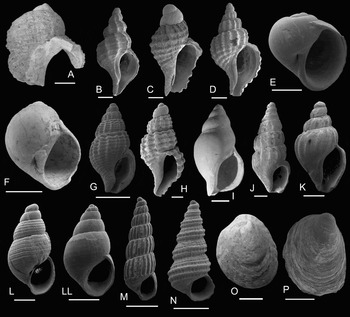
(A) Achantina monodon (CEGH-UNC 22480); (B) Fuegotrophon pallidus (CEGH-UNC 22725); (C) Trophon geversianus (CEGH-UNC 22671); (D) Xymenopsis muriciformis (CEGH-UNC 22699); (E) Falsilunatia soluta (CEGH-UNC 22697); (F) Tectonatica impervia (CEGH-UNC 22520); (G) Glypteuthria meridionalis (CEGH-UNC 22435); (H) Lachesis? euthrioides (CEGH-UNC 22753); (I) Pareuthria plumbea (CEGH-UNC 22525); (J) Savatieria meridionalis (CEGH-UNC 22436); (K) Belalora thielei (CEGH-UNC 22437); (L) Odostomia sp. 1 (CEGH-UNC 22442); (LL) Odostomia sp. 2 (CEGH-UNC 22449); (M) Turbonilla smithi (CEGH-UNC 22422); (N) Mathilda magellanica (CEGH-UNC 22446); (O) Kerguelenella lateralis (CEGH-UNC 22433); (P) Siphonaria lessonii (CEGH-UNC 22518). Scale bars: A, 10 mm; B, H, LL, P, 500 µm; C–E, G, J–L, M–O, 1 mm; F, I, 5 mm.

Buccinum monodon Pallas, Reference Pallas1774, p. 33, pl. 3, figures 3, 4.
Calcar longum Martyn, 1784, figure 50 (non-binomial fide ICZN, 1957).
Buccinum calcar Bruguière, Reference Brugière1789, p. 253, vol. 1, figure 10.
Acanthina monodon (Solander, 1786). Dell, Reference Dell1971, p. 208.
TYPE LOCALITIES
Americanae (sic) (Buccinum monodon). Cap Horn [Cape Horn] (Calcar longum; Buccinum calcar).
DIAGNOSIS
Shell large, solid, fusiform, low-spired, with rounded whorls, the last one inflated, occupying most of shell length. Aperture ovate, with inner margin nearly straight; outer margin rounded, with a prominent tooth at base. Siphonal canal short and wide. Shell surface smooth or sculptured with weak or prominent, sometimes imbricate, spiral ribs.
MATERIAL EXAMINED
One specimen, Isla Gable (CEGH-UNC 22480, 22485, 22486).
OTHER FOSSIL REFERENCES
Atlantic Ocean: ‘Argentine Patagonia’ (Feruglio, Reference Feruglio1950; Aguirre & Farinati, Reference Aguirre and Farinati2000; Pastorino, Reference Pastorino2000: Quaternary); Bahía Bustamante (Aguirre et al., Reference Aguirre, Negro Sirch and Richiano2005: Holocene); Bahía Vera and Bahía Camarones (Aguirre et al., Reference Aguirre, Richiano and Negro Sirch2006: Pleistocene). Beagle Channel (Gordillo, Reference Gordillo1992 as Acanthina imbricata: Holocene).
PRESENT DISTRIBUTION
Chiloé, Chile to Malvinas (Falkland) Islands, and extending northwards in the Atlantic Ocean, up to Santa Cruz Province, Argentina. Intertidal to 17 m.
REMARKS
In a revision of the genus Acanthina, de Vries (Reference Vries2003) confirmed the synonymy of Buccinum calcar and Acanthina monodon, and traced back the occurrence of this species up to the upper Pleistocene.
Murex pallidus Broderip in Broderip & Sowerby, Reference Broderip and Sowerby1833, p. 194.
Fusus fasciculatus Hombron & Jacquinot in Rousseau, Reference Rousseau1854, p. 110, pl. 25, figures 15, 16.
Trophon fimbriatus Hupé in Gay, Reference Gay1854, p. 165, pl. 4, figures 7, 7a, 7b (non-Borson, 1821).
Fusus crispus Gould, 1849, p. 141.
Trohon crispus burdwoodianus Strebel, Reference Strebel1908, p. 38, pl. 1, figure 15a–c.
Trophon pallidus Sow. Adams H. & Adams A., Reference Adams and Adams1853, p. 77.
Trophon (Fuegotrophon) pallidus (Broderip). Powell, Reference Powell1951, p. 157.
TYPE LOCALITIES
Insulas Falkland dictas [Malvinas (Falkland) Islands] (Murex pallidus). Strait of Magellan (Trophon fimbriatus, Fusus fasciculatus). Orange Harbour [Cape Horn] (Fusus crispus). Burdwood Bank (Trophon crispus burdwoodianus).
DIAGNOSIS
Shell medium in size, fusiform, solid, white. Spire relatively high. Protoconch of one whorl, smooth. Teleoconch of rounded whorls, sculptured with prominent axial ribs and narrower spiral cords. Aperture ovate, projected into a long and narrow siphonal canal. Inner margin arcuate.
MATERIAL EXAMINED
One specimen, Río Ovando (CEGH-UNC 22725); 1 specimen, Río Varela (CEGH-UNC 22727).
OTHER FOSSIL REFERENCES
Atlantic Ocean: ‘Argentine Patagonia’ (Feruglio, Reference Feruglio1950; Aguirre & Farinati, Reference Aguirre and Farinati2000; Pastorino, Reference Pastorino2000: Quaternary). Beagle Channel (Gordillo et al., Reference Gordillo, Coronato and Rabassa2005: Holocene; Gordillo et al., Reference Gordillo, Cusminsky, Bernasconi, Ponce, Rabassa and Pino2010: Pleistocene).
PRESENT DISTRIBUTION
Strait of Magellan to Malvinas (Falkland) Islands, and extending northwards in the Atlantic Ocean up to off Buenos Aires Province, Argentina. 10–150 m.
REMARKS
Powell (Reference Powell1951) reported Fusus fasciculatus, Fusus crispus, Trophon fimbriatus and Trophon crispus burdwoodianus to be synonyms of Fuegotrophon pallidus. Canteras & Arnaud (Reference Canteras and Arnaud1985) reported the species as occurring in Crozet Island; however, this record requires confirmation.
Buccinum geversianus Pallas, Reference Pallas1774, p. 33, pl. 3, figures 1, 2.
Buccinum foliaceum multifariam frondosum Chemnitz, Reference Chemnitz1780, p. 130, pl. 139, figure 1297 (non-binomial).
Buccinum fimbriatum Martyn, 1784, figure 6 (non-binomial fide ICZN, 1957).
Murex magellanicus Gmelin, Reference Gmelin1791, p. 3548 (in part).
Neptunea foliacea Röding, Reference Röding1798, p. 116 (pro Murex magellanicus Gmelin).
Trophon geversianus Pallas. Montfort, Reference Montfort1810, p. 483.
Polyplex bulbosa Perry, Reference Perry1811, pl. 9, figure 5.
Murex lamellosus Dillwyn, Reference Dillwyn1817, p. 730.
Murex foliatus Schumacher, Reference Schumacher1817, p. 215.
Fusus geversianus (Pallas). Gould, Reference Gould1852, p. 227, pl. 6, figure 227.
Fussus intermedius Hupé in Gay, Reference Gay1854, p. 166, pl. 4, figures 6, 6a, 6b.
Fusus geversianus. Hupé in Gay, Reference Gay1854, p. 167.
Trophon geversianus var. calva Kobelt, Reference Kobelt1878, p. 305, pl. 75, figure 1.
Trophon geversianus var. lirata Kobelt, Reference Kobelt1878, p. 305, pl. 76, figures 1, 2.
Trophon philippianus Dunker in Kobelt, Reference Kobelt1878, p. 277, pl. 75, figures 4, 5.
TYPE LOCALITIES
Americanae (Buccinum geversianus). Falkland Isl. [Malvinas (Falkland) Islands] (Buccinum fimbriatum). Freto Magellanico [Strait of Magellan] (Buccinum foliaceus). Freto Magellanico [Estrecho de Magallanes] (Murex magellanicus). Indian Seas (sic) (Polyplex bulbosa). Malouinas (sic) [Malvinas (Falkland) Islands]; Estrecho de Magallanes [Strait of Magellan] (Fussus intermedius). Straights of Magellan [Strait of Magellan]; Falkland Islands [Malvinas (Falkland) Islands] (Murex lamellosus). ? (Trophon philippianus; Murex foliatus; Trophon geversianus var. calva; Trophon geversianus var. lirata).
DIAGNOSIS
Shell large, fusiform, with a relatively low spire and subquadrate last whorl. Protoconch of two whorls, smooth. Teleoconch with variable sculpture: spiral ribs, axial lamellae, or cancellate; sometimes completely smooth. Aperture ovate, with arcuate inner margin, projected into a narrow and moderately long siphonal canal.
MATERIAL EXAMINED
Nine specimens, Río Ovando (CEGH-UNC 22671); 2 specimens, Lago Roca (CEGH-UNC 22532, 22533); 1 specimen, Río Varela (CEGH-UNC 22738).
OTHER FOSSIL REFERENCES
Atlantic Ocean: ‘Argentine Patagonia’ (Aguirre & Farinati, Reference Aguirre and Farinati2000; Pastorino, Reference Pastorino2000: Quaternary); 52°33′S 65°50′W, 52°38.2′S 69°10.5′W (Richards & Craig, Reference Richards and Craig1963: Pleistocene); Puerto Deseado (Bellosi, Reference Bellosi1995: ‘Patagoniano’ [Oligocene–Miocene]); off Punta Alta (Farinati, Reference Farinati1985: Holocene); Punta Atlas (‘Patagoniano’ [Oligocene–Miocene], ‘Pampeano’ [?]), Sierra Laziar (‘Araucaniano’ [Miocene]) (von Ihering, Reference Ihering1907); Golfo San Jorge (Aguirre, Reference Aguirre2003: Holocene and Pleistocene); Bahía Bustamante (Aguirre et al., Reference Aguirre, Negro Sirch and Richiano2005: Holocene and Pleistocene); Bahía Vera and Bahía Camarones (Aguirre et al., Reference Aguirre, Richiano and Negro Sirch2006: Holocene and Pleistocene); San Pablo, Tierra del Fuego (Gordillo, Reference Gordillo1992); Río Grande (Feruglio, Reference Feruglio1950). Beagle Channel (Gordillo, Reference Gordillo1992; Gordillo et al., Reference Gordillo, Coronato and Rabassa2005: Holocene; Gordillo et al., Reference Gordillo, Cusminsky, Bernasconi, Ponce, Rabassa and Pino2010: Pleistocene).
PRESENT DISTRIBUTION
Chiloé, Chile to Malvinas (Falkland) Islands, and extending northwards in the Atlantic Ocean up to Buenos Aires Province, Argentina. 1–84 m.
REMARKS
In a revision of the Magellanic Trophon species, Pastorino (Reference Pastorino2005b) considered Buccinum fimbriatum, Murex magellanicus, Neptunea foliacea, Polyplex bulbosa, Murex lamellosus, Murex foliatus, Fussus intermedius, Trophon geversianus var. calva, Trophon geversianus var. lirata and Trophon philippianus to be synonymy of Trophon geversianus. This species is characteristic from the southern tip of South America (Pastorino, Reference Pastorino2005b); the records from South Orkney Islands are doubtful, and most probably correspond to T. nucelliformis Oliver & Picken, Reference Oliver and Picken1984.
Buccinum muriciforme King, Reference King1832, p. 348.
Fusus buccineus: Sowerby in Gray, Reference Gray and Beechey1839 (non-Lamarck, 1816), p. 155, pl. 36, figure 12.
Fusus decolor Philippi, Reference Philippi1845, p. 68.
Buccinum cancellaroides Reeve, Reference Reeve and Reeve1847, pl. 14, figure 113.
Fusus liratus Gould, 1849, p. 141.
Fusus muriciformis King. Cunningham, Reference Cunningham1871, p. 476.
Trophon loebbeckei Kobelt, Reference Kobelt1878, p. 294.
Trophon muriciformis King. Smith, Reference Smith1881, p. 28.
Trophon lebruni Mabille & Rochebrune in Rochebrune & Mabille, Reference Rochebrune and Mabille1889, p. 55.
Trophon violaceus Mabille & Rochebrune in Rochebrune & Mabille, Reference Rochebrune and Mabille1889, p. 56, pl. 2, figure 1.
Trophon paessleri Strebel, Reference Strebel1904, p. 213, pl. 7, figure 56a–f.
Trophon elongatus Strebel, Reference Strebel1904, p. 217, pl. 7, figure 58a–f.
Trophon pseudoelongatus Strebel, Reference Strebel1904, p. 220, pl. 7, figure 60a,b.
Trophon albus Strebel, Reference Strebel1904, p. 221, pl. 7, figure 61.
Trophon acuminatus Strebel, Reference Strebel1904, p. 222, pl. 7, figure 63.
Trophon obesus Strebel, Reference Strebel1904, p. 223, pl. 7, figure 62.
Trophon fenestratus Strebel, Reference Strebel1904, p. 225, pl. 7, figure 59a–d.
Trophon couthouyi Strebel, Reference Strebel1904, p. 236, pl. 7, figure 65a–e; pl. 8, figure 76.
Trophon elegans Strebel, Reference Strebel1904, p. 241, pl. 8, figure 71.
Xymenopsis muriciformis (King & Broderip, 1831). Dell, Reference Dell1972, p. 38, figures 31, 32.
TYPE LOCALITIES
Strait of Magellan (Buccinum muriciforme). Port Grappler, Smyth Channel [Chile] (Trophon couthouyi). Fretum Magellanicum [Strait of Magallan]; insulae Chonos [Chile] (Fusus decolor). Puerto Angosto [Strait of Magallan] (Trophon elongatus). Punta Arenas [Strait of Magallan] (Trophon acuminatus; Trophon obesus). Gregory Bank [Estrecho de Magallanes] (Trophon fenestratus). Orange Harbour [Cape Horn] (Fusus liratus). Baie Orange [Cape Horn] (Trophon violaceus; Trophon paessleri). Santa Cruz [Argentina] (Trophon lebruni); Ushuaia [Beagle Channel] (Trophon pseudoelongatus; Trophon albus). Port Stanley [Malvinas (Falkland) Islands] (Trophon elegans). ? (Buccinum cancellaroides; Trophon loebeckei).
DIAGNOSIS
Shell medium in size, fusiform, elongated, whitish. Spire relatively high. Protoconch of three whorls, smooth. Teleoconch sculptured with prominent axial ribs (16–20 on the last whorl), and spiral ribs, the latter wide and flat. Aperture ovate, projected into a short and wide siphonal canal. Inner margin arcuate.
MATERIAL EXAMINED
Three specimens, Río Ovando (CEGH-UNC 22699); 5 specimens, Lago Roca (CEGH-UNC 22709); 1 specimen, Río Varela (CEGH-UNC 22728).
OTHER FOSSIL REFERENCES
Atlantic Ocean: ‘Argentine Patagonia’ (Feruglio, Reference Feruglio1950; Pastorino, Reference Pastorino2000: Quaternary). Beagle Channel (Gordillo, Reference Gordillo1992; Gordillo et al., Reference Gordillo, Coronato and Rabassa2005: Holocene; Gordillo et al., Reference Gordillo, Cusminsky, Bernasconi, Ponce, Rabassa and Pino2010: Pleistocene).
PRESENT DISTRIBUTION
50°S, in the south-eastern Pacific Ocean, to Malvinas (Falkland) Islands, and extending northwards in the Atlantic Ocean up to Puerto Deseado, Argentina. Intertidal to 170 m.
REMARKS
Pastorino & Harasewych (Reference Pastorino and Harasewych2000) concluded that Fusus liratus, Trophon lebruni, Trophon violaceus, Trophon paessleri, Trophon elongatus, Trophon pseudoelongatus, Trophon albus, Trophon acuminatus, Trophon elegans, Trophon obesus, Trophon fenestratus, Buccinum cancellaroides, Trophon loebbeckei and Trophon couthouyi correspond to synonyms of Xymenopsis muriciformis.
Natica soluta Gould, 1847, p. 239.
Polynices (sic) solutus (Gould) 1847. Carcelles, Reference Carcelles1950, p. 58, pl. 2, figure 26.
Falsilunatia soluta (Gould). Powell, Reference Powell1951, p. 119.
TYPE LOCALITY
Off Eddystone Rock, East Falkland [Malvinas (Falkland) Islands] [fide Pastorino, 2005a].
DIAGNOSIS
Shell medium in size, globose, solid, whitish, sculptured with low growth lines. Spire low and rounded. Whorls separated by deep sutures. Umbilicus open, partially filled by a weak callus. Aperture ovate, thickened at the basal lip.
MATERIAL EXAMINED
One specimen, Río Ovando (CEGH-UNC 22697).
OTHER FOSSIL REFERENCES
Atlantic Ocean: ‘Argentine Patagonia’ (Feruglio, Reference Feruglio1950: Quaternary). Beagle Channel (Gordillo, Reference Gordillo1992 as Falsilunatia limbata: Holocene).
PRESENT DISTRIBUTION
Strait of Magellan and Beagle Channel to Malvinas (Falkland) Islands, and extending northwards in the Atlantic Ocean, to off Uruguay. 6–1886 m.
Natica impervia Philippi, Reference Philippi1845, p. 65.
Natica acuta Philippi, Reference Philippi1845, p. 65.
Natica philippiana Nyst, Reference Nyst1845, p. 153 (non-Reeve, Reference Reeve and Reeve1855) (replacement name for N. acuta Philippi, Reference Philippi1845, non-Deshayes, 1838).
Natica obturata Philippi, Reference Philippi1855, p. 208.
Natica payeni Rochebrune & Mabille, Reference Rochebrune and Mabille1885, p. 104.
Tectonatica impervia (Philippi). Powell, Reference Powell1951, p. 122, pl. 10, figure 62, and J46.
Tectonica (sic) impervia (Philippi) 1845. Carcelles & Williamson, Reference Carcelles and Williamson1951, p. 283.
TYPE LOCALITIES
Fretum Magellanicum [Stait of Magellan] (Natica impervia). Cap Horn [Cape Horn] (Natica payeni). Estrecho de Magallanes [Stait of Magellan] (Natica obturata).
DIAGNOSIS
Shell medium in size, globose, with low and acute spire. Shell surface whitish, sculptured with irregular growth lines. Umbilicus narrow, partially covered by a thick callus. Aperture ovate.
MATERIAL EXAMINED
One specimen, Península Ushuaia (CEGH-UNC 22520).
OTHER FOSSIL REFERENCES
Atlantic Ocean: ‘Argentine Patagonia’ (Feruglio, Reference Feruglio1950: Quaternary). Beagle Channel (Gordillo, Reference Gordillo1992: Holocene).
PRESENT DISTRIBUTION
Strait of Magellan to Malvinas (Falkland) Islands, and extending northwards in the Atlantic Ocean, to off Buenos Aires Province, Argentina. 2–460 m.
REMARKS
Pastorino (Reference Pastorino2005a) considered Natica acuta, Natica philippiana Nyst, Reference Nyst1845 (non-Reeve, Reference Reeve and Reeve1855), Natica obturata, and Natica payeni to be synonyms of T. impervia.
Euthria meridionalis Smith, 1881, p. 29, pl. 4, figure 6.
Euthria (Glypteuthria) meridionalis Smith E.A. Strebel, 1905b, p. 627, pl. 21, figures 11, 11a–d.
Glypteuthria meridionalis (E. Smith). Thiele, 1912, p. 263, pl. 13, figure 6 and pl. 16, figure 17.
TYPE LOCALITIES
Portland Bay, 10 ft [3 m]; Punta Arenas [Strait of Magellan], 9–10 ft [2.7–3 m].
DIAGNOSIS
Shell small, fusiform with nearly straight whorls, solid, brownish. Spire moderately high. Protoconch sculptured with narrow spiral threads; teleoconch with strong but relatively low axial cords, and narrower spiral ribs. Aperture ovate, with short siphonal canal.
MATERIAL EXAMINED
9 specimens, Lago Roca (CEGH-UNC 22711); 1 specimen, Río Ovando (CEGH-UNC 22435).
OTHER FOSSIL REFERENCES
Beagle Channel (Hägg in Halle, Reference Halle1910: Isla Gable, Holocene; Gordillo et al., Reference Gordillo, Cusminsky, Bernasconi, Ponce, Rabassa and Pino2010: Pleistocene).
PRESENT DISTRIBUTION
Chiloé, Chile to Beagle Channel. 10–46 m.
Lachesis euthrioides Melvill & Standen, Reference Melvill and Standen1898, p. 98, pl. 1, figure 9.
Chauvetia euthrioides (Melvill & Standen) 1898. Carcelles & Williamson, Reference Carcelles and Williamson1951, p. 297.
Glypteuthria euthrioides (Melvill & Standen, Reference Melvill and Standen1898). Powell, Reference Powell1960, p. 148.
TYPE LOCALITY
Lively Island [Malvinas (Falkland) Islands].
DIAGNOSIS
Shell small, fusiform, moderately solid, brownish. Spire moderately high, with almost straight whorls, crenulated in outline by spiral sculpture. Protoconch of one whorl, sculptured with delicate axial lines; teleoconch strongly sculptured with prominent axial ribs and spiral keels, forming nodules at intersections. Aperture ovate, projected into a long and narrow siphonal canal.
MATERIAL EXAMINED
One specimen, Río Ovando (CEGH-UNC 22753); 17 specimens, Lago Roca (CEGH-UNC 22843).
OTHER FOSSIL RECORDS
Beagle Channel (Gordillo et al., Reference Gordillo, Cusminsky, Bernasconi, Ponce, Rabassa and Pino2010: Pleistocene).
PRESENT DISTRIBUTION
Beagle Channel and Strait of Magellan to Malvinas (Falkland) Islands. 15–80 m.
REMARKS
Dell (Reference Dell1972) considered Lachesis? euthrioides to be a probable synonym of Glypteuthria meridionalis, but both species are regarded as distinct by Zelaya (Reference Zelaya2006). The generic placement of this species should be revised considering soft part anatomy and radula.
Fussus plumbeus Philippi, 1844, p. 108, pl. 1, figure 3.
Trophon plumbeus Phil. Adams H. & Adams A., Reference Adams and Adams1853, p. 77.
Euthria plumbea (Philippi). Pelseneer, Reference Pelseneer1903, p. 8.
Euthria (Pareuthria) plumbea (Phil). Melvill & Standen, Reference Melvill and Standen1914, p. 122.
Northia (Pareuthria) plumbea (Philippi) 1845. Carcelles, Reference Carcelles1950, p. 61, pl. 2, figure 34.
Pareuthria plumbea (Philippi). Powell, Reference Powell1951, p. 133.
TYPE LOCALITY
Orae australes Republicae Chilensis [Chile].
DIAGNOSIS
Shell medium in size, fusiform, with relatively high spire of rounded whorls, solid, grey. Shell surface usually smooth; sometimes with axial ribs on the first whorls. Aperture ovate, projected into a short and wide siphonal canal.
MATERIAL EXAMINED
Two specimens, Lago Roca (CEGH-UNC 22708); 1 specimen, Alakush (CEGH-UNC 22525).
OTHER FOSSIL REFERENCES
Atlantic Ocean: ‘Argentine Patagonia’ (Feruglio, Reference Feruglio1950; Aguirre & Farinati, Reference Aguirre and Farinati2000; Pastorino, Reference Pastorino2000: Quaternary); Golfo San Jorge (Aguirre, Reference Aguirre2003: Pleistocene); Bahía Bustamante (Aguirre et al., Reference Aguirre, Negro Sirch and Richiano2005: Holocene); Bahía Vera and Bahía Camarones (Aguirre et al., Reference Aguirre, Richiano and Negro Sirch2006: Holocene and Pleistocene); Río Grande (Feruglio, Reference Feruglio1950: Quaternary); San Pablo (Gordillo, Reference Gordillo1992: Holocene). Pacific Ocean: Tubul, Chile (Valdovinos, Reference Valdovinos1996: Plio-Pleistocene). Beagle Channel (Gordillo, Reference Gordillo1992: Holocene; Gordillo et al., Reference Gordillo, Cusminsky, Bernasconi, Ponce, Rabassa and Pino2010: Pleistocene).
PRESENT DISTRIBUTION
Chiloé, Chile to Malvinas (Falkland) Islands, and extending northwards in the Atlantic Ocean up to Península Valdés, Argentina. Intertidal to 80 m.
Lachesis meridionalis Smith, Reference Smith1881, p. 28, pl. 4, figure 3.
Savatieria meridionalis (Smith, Reference Smith1881). Dell, Reference Dell1972, p. 37, figure 16.
TYPE LOCALITY
Boija Bay [Strait of Magellan], 20 fathoms [37 m].
DIAGNOSIS
Shell small, elongate, with a high spire of straight whorls, separated by deep sutures. Teleoconch sculptured with strong axial ribs. Aperture ovate, with short and wide siphonal canal.
MATERIAL EXAMINED
Four specimens, Río Ovando (CEGH-UNC 22750, 22752); 1 specimen, Lago Roca (CEGH-UNC 22436).
OTHER FOSSIL REFERENCES
Beagle Channel (Gordillo et al., Reference Gordillo, Coronato and Rabassa2005 as Savatieria frigida: Holocene).
PRESENT DISTRIBUTION
Beagle Channel to Malvinas (Falkland) Islands, and extending northwards in the Atlantic Ocean, up to Santa Cruz Province, Argentina. 27–96 m.
Belalora thielei Powell, Reference Powell1951, p. 172, pl. 6, figure 20.
TYPE LOCALITY
48°26′15″S 61°28′W [off Argentina]. 165 m.
DIAGNOSIS
Shell small, solid, with a moderately high spire of rounded whorls, brownish. Last whorl globose. Shell surface sculptured with prosocline axial ribs, crossed by numerous spiral threads. Aperture ovate, projected into a short and wide siphonal canal.
MATERIAL EXAMINED
One specimen, Río Ovando (CEGH-UNC 22437).
OTHER FOSSIL REFERENCES
Unknown.
PRESENT DISTRIBUTION
Beagle Channel to 48°S, in the south-western Atlantic Ocean. 19–165 m.
DIAGNOSIS
Shell small, elongated, inflated, solid, white. Spire relatively high, with rounded whorls. Teleoconch sculptured with flat spiral cords, and delicate axial threads. Umbilicus small, narrow. Aperture ovate, with a prominent tooth at the inner margin.
MATERIAL EXAMINED
Two specimens, Río Ovando (CEGH-UNC 22442, 22702); 7 specimens, Lago Roca (CEGH-UNC 22836); 6 specimens, Río Varela (CEGH-UNC 22837).
OTHER FOSSIL REFERENCES
Beagle Channel (Gordillo et al., Reference Gordillo, Cusminsky, Bernasconi, Ponce, Rabassa and Pino2010: Pleistocene).
PRESENT DISTRIBUTION
Beagle Channel. 30–80 m.
DIAGNOSIS
Shell small, elongated, inflated, solid, brownish. Spire moderately high, with rounded whorls. Teleoconch sculptured with obscure spirals cords. Umbilicus covered by columellar callus. Aperture ovate, with a prominent tooth at the inner margin.
MATERIAL EXAMINED
One specimen, Río Ovando (CEGH-UNC 22449).
OTHER FOSSIL REFERENCES
Beagle Channel (Gordillo et al., Reference Gordillo, Cusminsky, Bernasconi, Ponce, Rabassa and Pino2010: Pleistocene).
PRESENT DISTRIBUTION
Beagle Channel. 5–20 m.
Turbonilla smithi Strebel (Pfeffer, MS), 1905b, p. 659, pl. 23, figure 42a–d.
Turbonilla (Chemnitzia) smithi Pfeffer. Ageitos de Castellanos, Reference Ageitos de Castellanos1982, p. 66, figures 2, 3.
TYPE LOCALITY
Strait le Maire, 65 fathoms [119 m].
DIAGNOSIS
Shell small, elongated, with a high spire of rounded whorls, delicate, white. Protoconch smooth, heterostrophic. Teleoconch with rectangular, nearly straight, axial furrows. Base convex, smooth. Aperture ovate.
MATERIAL EXAMINED
One specimen, Río Ovando (CEGH-UNC 22422).
OTHER FOSSIL REFERENCES
Atlantic Ocean: Ingeniero White (Farinati, Reference Farinati1985: Holocene). Beagle Channel (Gordillo et al., Reference Gordillo, Coronato and Rabassa2005: Holocene; Gordillo et al., Reference Gordillo, Cusminsky, Bernasconi, Ponce, Rabassa and Pino2010: Pleistocene).
PRESENT DISTRIBUTION
Strait of Magellan and Beagle Channel to Malvinas (Falkland) Islands, and extending northwards, in the Atlantic Ocean, up to Santa Cruz Province, Argentina. 12–119 m.
REMARKS
Ageitos de Castellanos (Reference Ageitos de Castellanos1982) reported the species as occurring in 37°56′S 57°28′W; according to the author this material was deposited in the collections of the Museo de La Plata, where it cannot now be found to confirm its identity (D.G. Zelaya, personal observation). No other records of the species outside the Magellan Region are known.
Mathilda magellanica Fischer in De Folin & Périer, 1870, p. 188, pl. 8, figure 8.
TYPE LOCALITY
Baie Fortescue [Strait of Magellan].
DIAGNOSIS
Shell small, elongated, with a high spire of gradated whorls, solid, ochraceous. Protoconch with faint spiral threads. Teleoconch sculptured with two primary and one or two secondary spiral cords per whorl, and narrower axial ribs. Base convex, with flat spiral cords. Aperture subquadrate, reflecting the outer margin the spiral sculpture.
MATERIAL EXAMINED
Two specimens, Lago Roca (CEGH-UNC 22446, 22701); 2 specimens, Río Varela (CEGH-UNC 22731).
OTHER FOSSIL REFERENCES
Beagle Channel (Gordillo et al., Reference Gordillo, Coronato and Rabassa2005 as Mathilda aff. malvinarum: Holocene).
PRESENT DISTRIBUTION
Beagle Channel to Malvinas (Falkland) Islands. 1–40 m.
Siphonaria lateralis Gould (Couthoy, MS), Reference Gould1846, p. 153.
Siphonaria magellanica Philippi, Reference Philippi1855: 208.
Siphonaria rediculum Reeve, Reference Reeve and Reeve1856, pl. 5, figure 24a,b.
Siphonaria (Liriola) lateralis Gould. Thiele, Reference Thiele1912, p. 250.
Siphonaria (Kerguelenia) lateralis (Gould, Reference Gould1846). Hubendick, Reference Hubendick1946, p. 26, pl. 1, figures 22–25.
Kerguelenella lateralis (Gould). Powell, Reference Powell1951, p. 181.
TYPE LOCALITIES
Burnt Island, Orange Harbor [Cape Horn] (Siphonaria lateralis). Magellanstrasse [Strait of Magellan] (Siphonaria magellanica). ? (Siphonaria rediculum).
DIAGNOSIS
Shell small, patelliform in outline, with the right margin notoriously projected. Apex acute, directed towards the postero-left side. Shell surface with zigzag radial cords and irregular growth folds.
MATERIAL EXAMINED
Two specimens, Río Ovando (CEGH-UNC 22433, 22705).
OTHER FOSSIL REFERENCES
Unknown.
PRESENT DISTRIBUTION
Kerguelenella lateralis lateralis distributes from the Beagle Channel to Malvinas (Falkland) Islands, extending northwards, in the Atlantic Ocean up to Puerto Deseado, Argentina. The species was also reported from South Georgia, although the identity of these specimens requires confirmation. Intertidal to 15 m.
REMARKS
Siphonaria magellanica and S. rediculum were considered synonyms of Kerguelenella lateralis by Powell (Reference Powell1951). Figueiras & Sicardi (Reference Figueiras and Sicardi1974) identified specimens from Uruguay as Siphonaria lateralis, but according to Scarabino & Zaffaroni (Reference Scarabino and Zaffaroni2004) this material corresponds to S. lessonii Blainville, Reference Blainville1827.
Siphonaria lessonii Blainville, Reference Blainville1827, p. 296, pl. 44, figures 2, 2a.
Siphonaria (Liriola) lessoni (Blainville, 1824). Carcelles, Reference Carcelles1944, p. 265.
Siphonaria (Pachysiphonaria) lessoni (Blainville, 1824). Hubendick, Reference Hubendick1946, p. 21, pl. 1, figures 1–3.
Pachysiphonaria lessoni (Blainville). Powell, Reference Powell1951, p. 181.
Siphonaria (Talisiphon) lessonii (Blainville, Reference Blainville1827). Morrison, Reference Morrison1964, p. 7.
TYPE LOCALITY
îles Malouines [Malvinas (Falkland) Islands].
DIAGNOSIS
Shell medium in size, patelliform in outline, with the right margin slightly projected. Apex acute or rounded, centrally located, backwardly pointed. Sculpture variable: from thick and straight radial ribs to almost smooth.
MATERIAL EXAMINED
One specimen, Isla Gable (CEGH-UNC 22518).
OTHER FOSSIL REFERENCES
Atlantic Ocean: ‘Argentine Patagonia’ (Feruglio, Reference Feruglio1950; Aguirre & Farinati, Reference Aguirre and Farinati2000; Pastorino, Reference Pastorino2000: Quaternary); near Montevideo, Uruguay (d'Orbigny, 1842: Quaternary); Buenos Aires coast (Aguirre, Reference Aguirre1990: Holocene); Punta Cigüeña and Villa del Mar (Farinati, Reference Farinati1985); Puerto Belgrano and Quequén (Carcelles, Reference Carcelles1944: Holocene); Golfo San Jorge (Aguirre, Reference Aguirre2003: Holocene); Bahía Bustamante (Aguirre et al., Reference Aguirre, Negro Sirch and Richiano2005: Holocene); Bahía Vera and Bahía Camarones (Aguirre et al., Reference Aguirre, Richiano and Negro Sirch2006: Pleistocene). Pacific Ocean: Mejillones, Chile (Ortlieb et al., Reference Ortlieb, Guzmán and Marquardt2003: Pleistocene, Isotope Stage 11). Beagle Channel (Gordillo, Reference Gordillo1992: Holocene).
PRESENT DISTRIBUTION
Callao, Perú to Malvinas (Falkland) Islands, and extending northwards in the Atlantic Ocean, up to Uruguay. Intertidal to 37 m.
DISCUSSION
The Beagle Channel is a relatively young marine ecosystem, originated about 8000–7500 years ago. To date, the knowledge of the Holocene molluscan fauna from this area is limited to checklists such as those by Hägg (in Halle, Reference Halle1910), Rabassa et al. (Reference Rabassa, Heusser and Stuckenrath1986), Gordillo (Reference Gordillo1993, Reference Gordillo1999), and Gordillo et al. (Reference Gordillo, Coronato and Rabassa2005). This limitation in the quality of information is addressed in the present study. As a result, 31 species of gastropods collected at four sampling localities are described and illustrated; the first Holocene fossil record for 18 gastropod species is provided: Iothia coppingeri, Fissurellidea patagonica, Scissurella clathrata, Calliostoma dozei, Ganesa sp., Cyclostrema crassicostatum, Eatoniella denticula, Onoba schythei, Laevilitorina sp., Cerith: opsilla: burd woodiana, Cerithiella sp. 2, Lachesis? euthrioides, Savatieria meridionalis, Belalora thielei, Odostomia sp. 1, Odostomia sp. 2, Mathilda magellanica, Kerguelenella lateralis; and the identity of nine species previously reported for the area by Gordillo et al. (Reference Gordillo, Coronato and Rabassa2005) is updated, providing a more reliable source of information for a subsequent biogeographical study. The high number of new records clearly makes evident the little attention given to small molluscs in previous palaeontological studies.
In general, the material studied exhibited a good state of preservation, evidenced by well-preserved shell sculpture, and periostracum persistency. However, a small amount of transport must have taken place as some shells were broken. In addition, some shells have signs of dissolution by the current environmental conditions in a freshwater environment. These facts plead for an autochthonous or para-autochtonous nature of these sediments, rather than to the transport of an allocthonous dead fauna.
In addition to the 31 species of gastropods found in the four sites examined in detail during this study, four other species of gastropods (Nacella deaurata, Acanthina monodon, Tectonatica impervia and Siphonaria lessonii) were found in other fossil sites of the Beagle Channel, and included in the present study in an attempt to improve the information on the Quaternary molluscs from the area; all these species are large taxa, and two of them (Nacella deaurata and Siphonaria lessonii) typically intertidal. Thus, a total of 35 gastropod species was identified from Holocene deposits of the Beagle Channel. Eight other species were listed by Hägg (in Halle, Reference Halle1910) from ‘Holocene deposits’ (without precision of age) from Isla Gable: Savatieria dubia Strebel, Reference Strebel1905a, Euthria rosea (Hombron & Jacquinot in Rousseau, Reference Rousseau1854) (= Pareuthria powelli Cernohorsky, 1977), Pareuthria cerealis (Rochebrune & Mabille, Reference Rochebrune and Mabille1889) (under Euthria), Meteuthria martensi (Strebel, Reference Strebel1905a) (= under Euthria), Antistreptus magellanicus Dall, Reference Dall1902, Buccinum laciniatum Martyn, Reference Martyn1784 (= Trophon plicatus (Lightfoot, 1786) ?), Trophon dispar Mabille & Rochebrune in Rochebrune & Mabille, Reference Rochebrune and Mabille1889, and Cerithium pullum Philippi, Reference Philippi1845; and a ninth species was added by Gordillo (Reference Gordillo1992): Nacella magellanica.
All the species reported in this study are currently found as living taxa in the area (Zelaya, Reference Zelaya2006). This fact strongly suggests that during the Holocene the mollusc fauna from the Beagle Channel has not suffered a faunistic replacement since its establishment as a marine environment. Taking into account the geologicol youthfulness of this area and its intermediate position between the Pacific and the Atlantic Oceans, it is inferred that the mollusc fauna for this area originated by migration from the adjacent Atlantic or Pacific waters. In this regard, the Beagle Channel probably represented a favourable way (a ‘corridor’) that facilitated dispersal between the Atlantic and Pacific Oceans, contributing to the establishment of a relatively homogeneous molluscan fauna in the southern tip of South America, as part of a single biogeographical unit: the Magellan Region. Certainly the Beagle Channel should not be regarded as the sole possible way for molluscs' dispersion between the Pacific and Atlantic Oceans; there are, in fact, two other potential ‘faunistic corridors’: the Strait of Magellan and the Drake Passage. The Strait of Magellan, at the northern side of the Isla Grande de Tierra del Fuego, is contemporary with the Beagle Channel and originated by similar processes (Clapperton, Reference Clapperton1992).
It is to be noted that there are several molluscs that appear in fossil deposits of both sides, Atlantic and Pacific, of the Magellan Region, with ages older than those corresponding to the opening of the Beagle Channel and the Magellan Strait; e.g. Tegula atra (Lesson, Reference Lesson1831) and Acanthina unicornis (Brugière, Reference Brugière1789) (Carcelles, Reference Carcelles1945; Pastorino, Reference Pastorino2000; de Vries, Reference Vries2003). These species most probably dispersed through the Drake Passage which originated 50–30 million years ago, when the southern tip of South America separated from the Antarctic Peninsula (Livermore et al., Reference Livermore, Nankivell, Eagles and Morris2005). Unfortunately nothing is known of the Quaternary and pre-Quaternary molluscs from these areas to evaluate their significance in the dispersive process of the Magellanic mollusc species.
ACKNOWLEDGEMENTS
The authors express their gratitude to Gene Coan and Paul Valentich Scott for helping with literature; and Alan G. Beu for his valuable comments which greatly improved the manuscript. The authors are members of the CONICET, Argentina.