Introduction
Numerous theories have been proposed to explain why cetaceans beach themselves, but relatively few are supported by unequivocal evidence. Some hypotheses include naval exercises involving sonar, diseases, global warming, lunar cycles, anomalies in weather and ocean bottom topography, parasitism and chemical or noise pollutants, to mention a few (Klinowska Reference Klinowska1985; Perrin & Geraci Reference Perrin, Geraci, Perrin, Wurseg and Thewissen2002; Walker et al. Reference Walker, Keith, Yankovsky and Odell2005; Brownell et al. Reference Brownell, Ralls, Baumann-Pickering and Toole2009; D'Amico et al. Reference D'Amico, Gisiner, Ketten, Hammock, Johnson, Tyack and Mead2009; Morell Reference Morell2009; Hays Reference Hays2011; Fernandez et al. Reference Fernandez2012). In many beaching cases, whales and dolphins can often be turned around and ‘shuttled’ back to sea and they swim off to deeper water, suggesting a contagion or injury was not involved (D'Amico et al. Reference D'Amico, Gisiner, Ketten, Hammock, Johnson, Tyack and Mead2009; Sutton Reference Sutton2013).
Unfortunately, necropsies of beached cetaceans are relatively infrequent; nevertheless, when performed they have definitively not identified a common causal agent. For example, in a 2005 beaching incident involving 19 whales in Ireland, biologists indicated, ‘It was one of the healthiest pods we've examined’ (Rogan et al. Reference Rogan, Baker, Jepson, Berrow and Kiely1997). Of 35 stranding incidents involving whales and dolphins in the USA from 1991 to 2013, the majority (26) were of undetermined causes (74.3%), five tested positive to a biotoxin (14.3%), two were due to human interactions (5.7%), one was due to an ecological factor (2.8%) and only one was due to an infectious disease (2.8%) (NOAA 2013). Finally, despite complete necropsies on three stranded whales in the Mediterranean Sea, no definitive cause was identified (Mazzariol et al. Reference Mazzariol2011). (Additional examples are in the section Discussion.)
In no case to date has: (1) a common microorganism been identified in cases of beachings; (2) nor has an organism been isolated from a beached cetacean and grown in pure culture; (3) nor has a pathogen from a pure culture caused an animal to beach when inoculated into a cetacean; (4) nor has the pathogen been re-isolated from the new host and shown to be the same as the originally inoculated pathogen. These are four standard criteria (Koch's Postulates) used to identify the causative agent of an infectious disease. Regardless of their feasibility to perform experiments on cetaceans, an absence of evidence using such a definitive test protocol indicates no specific or combination of contagions has been definitively proven to be responsible for beachings. Because of this situation, the cetacean stranding literature is replete with ‘Belief Bias:’ evaluating the strength of an argument based on the believability of its conclusion. This status opens the possibility that perhaps the stranding disorder may not be due to a biotic agent.
One abiotic possibility involves the failure of an animal's magnetoception sense (internal compass) to perceive Earth's geomagnetic field for orientation purposes. Many animals, invertebrates, microbes, insects and plants have been shown to be sensitive to magnetic fields (Philips Reference Philips1977; Ossenkopp & Barbeito Reference Ossenkopp and Barbeito1978; Kirschvink & Gould Reference Kirschvink and Gould1981; Tomlinson et al. Reference Tomlinson, McGinty and Kish1981; Bauer et al. Reference Bauer, Fuller, Perry, Dunn, Zoeger, Kirschvink, Jones and McFadden1985; Kirschvink et al. Reference Kirschvink, Jones and MacFadden1985; Walker & Bitterman Reference Walker and Bitterman1985; Lohmann & Lohmann Reference Lohmann and Lohmann1994; Beason & Semm Reference Beason and Semm1996; Wiltschko & Wiltschko Reference Wiltschko and Wiltschko1996; Gould Reference Gould1998; Cain et al. Reference Cain, Boles, Wang and Lohmann2005; Galland & Pazur Reference Galland and Pazur2005; Johnson & Lohmann Reference Johnson and Lohmann2005; Walker et al. Reference Walker, Diebel, Kirschvink, Haraand and Zielinski2006; Johnson & Lohmann Reference Johnson and Lohmann2008; Frankel Reference Frankel2009; Hsu et al. Reference Hsu, Ko, Li, Fann and Lue2010; Wajnberg et al. Reference Wajnberg, Acosa-Avalos, Alves, Ferreira de Oliveira, Srygley and Esquivel2010; Winklhofer Reference Winklhofer2010). Several reports have indicated cetaceans have a magnetic sense and that it can be disrupted during severe geomagnetic disturbances to Earth's magnetosphere (Kirschvink Reference Kirschvink, Thomas and Kastelein1990; Walker et al. Reference Walker, Kirschvink, Ahmid and Dizon1992; Vanselow & Ricklefs Reference Vanselow and Rickles2005; Vanselow et al. Reference Vanselow, Rickles and Colijn2009). Twenty per cent of sperm whale stranding events in the North Sea over the past 400 years were correlated with averaged geomagnetic variability using the aa-Index (an average measure of fluctuations in Earth's magnetosphere derived from two antipodal geophysical observatories) (Vanselow & Ricklefs Reference Vanselow and Rickles2005). In addition, strandings correlated with occurrence of geomagnetic storms during peaks and lulls in the sunspot cycle from 1712 to 2003 (Vanselow et al. Reference Vanselow, Rickles and Colijn2009). The authors reported that 90% of 97 sperm whale stranding events around the North Sea took place when the smoothed sunspot period length was below a mean value of 11 years. Their statistical tests indicated a ‘1% error probability (P < 0.01) that sperm whale strandings can depend on solar activity.’ The results suggest that variations in Earth's magnetic field, due to intense energy fluxes from the Sun to Earth, may cause a temporary disorientation of migrating animals. In support of that hypothesis, Walker et al. (Reference Walker, Kirschvink, Ahmid and Dizon1992) found an association of whale sightings in ocean areas with low geomagnetic intensity and gradient in winter and fall. Their results implied that fin whales possess a sensitive magnetic sense that they use to guide migration. Consistent with this hypothesis is evidence of a magnetic receptor molecule, magnetite (Fe3O4), in cetaceans that they could use as a basis for magnetic field detection (Kirschvink & Gould Reference Kirschvink and Gould1981; Zoeger et al. Reference Zoeger, Dunn and Fuller1981; Bauer et al. Reference Bauer, Fuller, Perry, Dunn, Zoeger, Kirschvink, Jones and McFadden1985; Kirschvink et al. Reference Kirschvink, Jones and MacFadden1985). In magnetotactic bacteria, chains of this molecule are contained in sub cellular organelles called magnetosomes.
Because cetaceans are so huge, humans frequently find them after they become disoriented, swim onto a shore and become stranded. For this reason, reasonably accurate dates of beaching incidents have been reported in the past for whales and dolphins making it possible to correlate beaching dates with documented disruptions in Earth's geomagnetic field. As a result, the hypothesis that major geomagnetic storms can disrupt cetacean orientation and cause beachings can be tested statistically using a correlation analysis between the two events.
An ongoing problem with magneto-sensory biology is that humans do not possess a magnetoreception sense. As a result, neither innate nor intuitive understandings of the phenomenon are possible for individuals. If a severe geomagnetic storm would occur, similar to a magnitude 5 earthquake or hurricane, humans would not sense it. However, other insects and animals are able to perceive magnetic fields, and evidence that their magnetoreceptive sense is involved in orientation and navigation has grown considerably since the mid 1950s. It soon became clear that experimentally induced disturbances in magnetic fields could disrupt an organism's internal compass and cause them to become disoriented (Moore Reference Moore1977; Ossenkopp & Barbeito Reference Ossenkopp and Barbeito1978; Walcott Reference Walcott, Schmidt-Koenig and Keeton1978; Tomlinson et al. Reference Tomlinson, McGinty and Kish1981; Walker & Bitterman Reference Walker and Bitterman1986; Walker et al. Reference Walker, Baird and Bitterman1989; Wiltschko et al. Reference Wiltschko, Munro, Ford and Wiltschko1998; Irwin & Lohmann Reference Irwin and Lohmann2003, Reference Irwin and Lohmann2005; Esquivel et al. Reference Esquivel, Wajnberg, Nacimento, Pinho, Lins de Barros and Eizemberg2007; Ferrari Reference Ferrari2014).
The question arises then as to whether or not cetaceans can become disoriented during geomagnetic disturbances and, eventually, get lost and beach themselves. With that hypothesis in mind, this report examined six independent beaching surveys: (A) in the Mediterranean Sea (Podesta et al. Reference Podesta, D'Amico, Pavan, Drougas, Komnenou and Portunato2006); (B) in the Gulf of Mexico (NOAA 2014a); (C) the east coast of the USA (NOAA 2014b); (D) the panhandle of Florida (NOAA 2004a) and (E) a worldwide survey (D'Amico et al. Reference D'Amico, Gisiner, Ketten, Hammock, Johnson, Tyack and Mead2009). Taken together with the survey described herein (F), each study indicates a strong statistical correlation exists between the time of cetacean beachings with the time of major geomagnetic storm activity here on Earth.
Materials and methods
Since 1995, the National Oceanic and Atmospheric Agency (NOAA) and the Solar Weather Prediction Center (SWPC 1994) began recording daily geomagnetic activity (K-indices) in eight, 3-h periods based on Greenwich Mean Time (GMT) (http://legacy-www.swpc.noaa.gov/ftpmenu/indices/old_indices.html). The geomagnetic scale is semi-logarithmic (0–9) and measures the fluctuation intensity (in nT) of the horizontal component in the magnetosphere's three-dimensional status. Observatories around the world collect the data, but the most sensitive sites are closest to the North Pole. For this reason, information from the College Observatory (N65, W102) in Alaska, USA, was used in this study. It is more sensitive to geomagnetic disturbances than other observatories and information is more complete than other stations. Unfortunately, a consistent compilation of K-index values only dates back to about 1997. Therefore, only a comparison of recorded beaching incidents with daily geomagnetic activity was compiled from 1997 to 2013.
Major geomagnetic storms are considered to have a K-index that is ≥5 (NOAA 2005). Thus, only days with a magnitude 5 or greater were correlated with beachings. Migratory animals are affected at K p = 5 and higher levels (NOAA 2005), which is an average of worldwide K values from different observatories, and which is slightly lower in intensity compared with a K = 5 value (70–120 nT) at College, Alaska. It is important to use the most sensitive observatory because severe category 5 storms will be ‘missed’ using the planetary K p index. For example, a major storm (3 2 6 5 6 6 4 4) was detected on 26 January 2013 at the Alaska observatory, but was ‘missed’ using the K p index (4 2 3 3 3 3 4 4), which suggested no category 5 storm occurred. A similar situation exists using the aa index, which is an average of the eight daily K values.
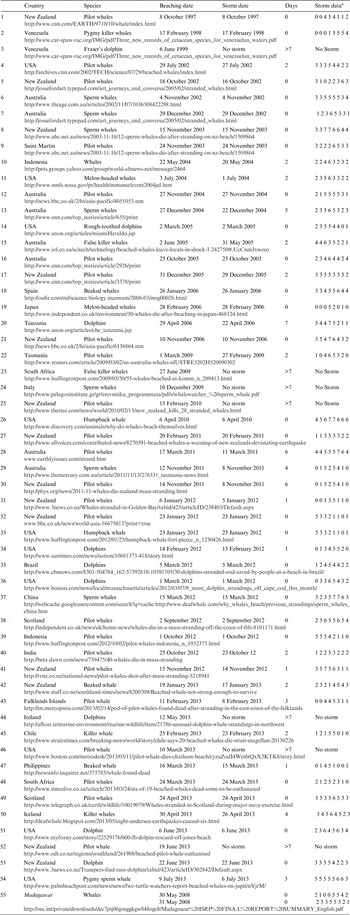
Worldwide beachings of cetaceans (whales and dolphins) were obtained from internet reports (Appendix) and six published sources (NOAA 2004a, 2014a, b, 2015a; Podesta et al. Reference Podesta, D'Amico, Pavan, Drougas, Komnenou and Portunato2006; D'Amico et al. Reference D'Amico, Gisiner, Ketten, Hammock, Johnson, Tyack and Mead2009). The stranding dates were then correlated with major geomagnetic storms that occurred in Earth's magnetosphere (K-index ≥ 5, College Alaska observatory). As a rule, when differences in stranding and geomagnetic storm dates exceeded 7 days, the two events were considered unrelated. This is because time-course curves from all six surveys approached zero or levelled off by that time (see Figs. 1–5 for example); thereafter, strandings occurred at random and infrequently. The random pattern indicates other factors also contribute to strandings as well as geomagnetic storms: such as boating accidents, shark attacks, diseases and pests. Therefore, strandings that occurred after 7 days were considered unrelated to geomagnetic storms and were not included in data analysis. Strandings are defined as one or more fresh dead or live cetaceans left in a helpless condition on a beach and did not have obvious signs of trauma due to collisions with boats and shark bites.
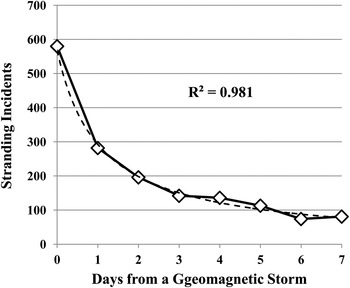
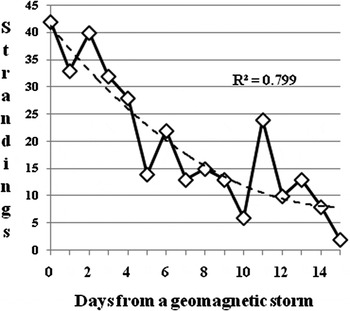
Days after a geomagnetic storm when cetacean beaching incidents were reported (pooled data from Table 1). The dashed line represents a power trend line.

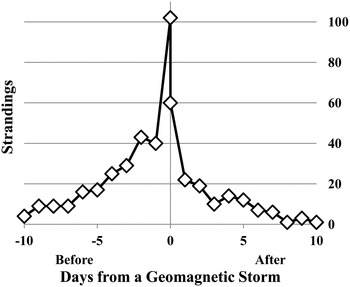
Days before or after a geomagnetic storm that cetacean beachings were reported in the northern Gulf of Mexico. Stranding data are for ‘Alive’ or ‘Fresh Dead’ categories from 2002 to 2009 (273 strandings) (NOAA 2015a).


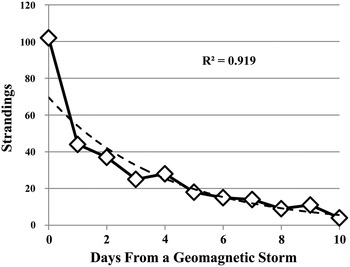
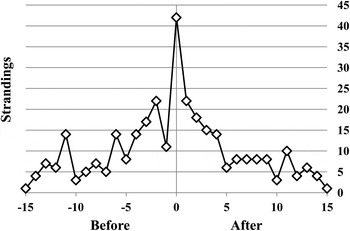
Days before or after a geomagnetic storm that cetacean beachings were reported on the East Coast of the USA. Strandings (350) are for bottlenose dolphins (NOAA 2014b).

Correlation of days before and after (combined, from figure 4) a geomagnetic storm that cetacean beachings were reported on the east coast of the USA. Dashed line is a polynomial trend line.

Strandings documented in six surveys are listed in Table 1. First, Podesta et al. (Reference Podesta, D'Amico, Pavan, Drougas, Komnenou and Portunato2006) compiled records of Beaked whale strandings in the Mediterranean Sea from 1803 to 2003. Second, NOAA Fisheries (2014a) reported cetacean beachings in the northern Gulf of Mexico from 2002 to 2009. Third, NOAA Fisheries (2014b) reported dolphin beachings along the east coast of the USA from June 2013 to January 2014. Fourth, NOAA (2004a) reported Bottlenose dolphin strandings along the Florida panhandle. Fifth, D'Amico et al. (Reference D'Amico, Gisiner, Ketten, Hammock, Johnson, Tyack and Mead2009) reported worldwide Beaked whale beachings from 1894 thru July 2004. Sixth, in this study beaching reports for whales and dolphins from around the world were accumulated (Appendix) from 1997 to July 2013 (Fig. 6). Therefore, information reported and described herein includes six independent surveys.
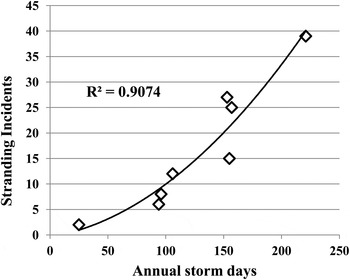
Number of yearly stranding versus number of annual storm days that occurred from 2002 to 2009. Whale and dolphin stranding categories ‘Live’ and ‘Fresh Dead’ were from the northern Gulf of Mexico (2014a).

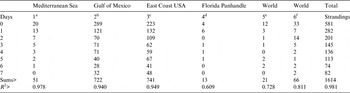
Surveys of cetacean strandings from around the world and days from a major geomagnetic storm beaching events were discovered. Ranked according to total strandings

a Podesta et al. (Reference Podesta, D'Amico, Pavan, Drougas, Komnenou and Portunato2006).
b NOAA (2014a).
c NOAA F (2014b).
d NOAA (2004a).
e 5. D'Amico (2009).
f 6. Appendix.
Annual sunspot data was obtained from the Royal Observatory of Belgium, which harbours the Sunspot Index Data Center (SIDC 2014). [To download raw data, ‘click’ on ‘Show Data Tables’ tab at bottom of home page].
Results
The ‘Appendix’ contains a list of 55 beachings (strandings) that were found during an internet search involving ‘whale and dolphin beachings.’ Information contains the date when beachings were discovered and date of the nearest geomagnetic storm. Data are summarized in a format consistent with the five prior surveys of beachings (Table 1).
Correlation analyses from Appendix data and five other independent sources regarding stranding incidents and major geomagnetic storms were consistent with each other (Table 1):
-
1. Of 51 strandings documented by Podesta et al. (Reference Podesta, D'Amico, Pavan, Drougas, Komnenou and Portunato2006) from January 1997 to December 2003, 45 (88.2%) were found within 3 days of a major geomagnetic storm (R 2 = 0.978).
-
2. Of 722 strandings recorded by NOAA Fisheries (2014a) in the northern gulf of Mexico, 622 (86.1%) were found within 4 days of a major geomagnetic storm (R 2 = 0.940).
-
3. Of 741 strandings on the east coast of the USA (NOAA 2014b) from July 2013 to January 2014, 652 (88.0%) were found within 5 days of a geomagnetic storm. (R 2 = 0.949).
-
4. Of 13 strandings of dolphins along the Florida panhandle (NOAA 2004a), 10 (76.9%) were reported within 1 day of a major geomagnetic storm (R 2 = 0.609).
-
5. Of 21 Beaked whale strandings reported globally (D'Amico et al. Reference D'Amico, Gisiner, Ketten, Hammock, Johnson, Tyack and Mead2009), 17 (80.0%) were reported within 3 days of a major geomagnetic storm. (R 2 = 0.933).
-
6. Of 51 worldwide beaching reported herein (Appendix) from October 1997 to July 2013, 59 (89.4%) occurred within 3 days of a major geomagnetic storm (R 2 = 0.811).
-
7. Of 1614 strandings (pooled data, reports 1–6), 1458 (87.2%) occurred within 5 days of a major geomagnetic storm. (Fig. 1, R 2 = 0.981).
In the survey of dolphin beachings along the northern Gulf of Mexico, information on the status of the mammals was also documented (NOAA 2013). Categories included Alive, Fresh Dead, Moderate Decomposition, Advanced Decomposition and Mummified/Skeletal. When ‘Alive’ and ‘Fresh Dead’ animals were counted, on a yearly basis from 2002 to 2008, more than half (55.8%) were discovered within 48 h of geomagnetic storm (Fig. 2). These two categories were chosen because the date of the stranding and the number of days from a geomagnetic storm would be most accurate. The more decomposed the carcass, the less accurate the actual date of the stranding occurrence. Also, a strong correlation (R 2 = 0.981) resulted when the number of days from a geomagnetic disturbance for the six surveys were pooled (Fig. 1, Table 1).
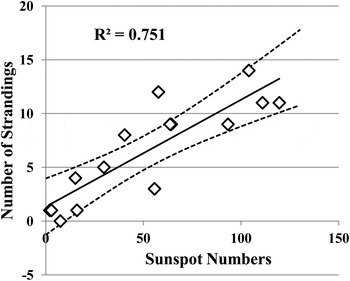
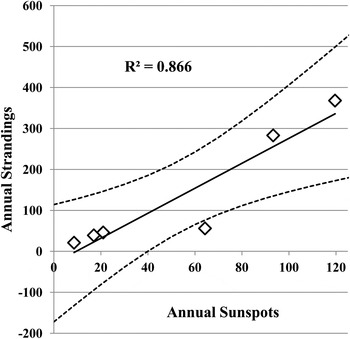
When the number of beachings from Podesta et al. (Reference Podesta, D'Amico, Pavan, Drougas, Komnenou and Portunato2006), D'Amico et al. (Reference D'Amico, Gisiner, Ketten, Hammock, Johnson, Tyack and Mead2009) and the survey presented herein (Appendix) were ranked according to increasing sunspot numbers, an increasing trend line was produced (Fig. 7). A similar result was obtained with whale stranding data obtained by Gulland et al. (Reference Gulland2005) (Fig. 8).
Correlation of annual sunspot numbers with cetacean beachings from 1998 to 2012. Pooled data from Podesta et al. (Reference Podesta, D'Amico, Pavan, Drougas, Komnenou and Portunato2006), D'Amico et al. (Reference D'Amico, Gisiner, Ketten, Hammock, Johnson, Tyack and Mead2009) and herein (Appendix). Dashed lines represent the 95% confidence interval.

Correlation of annual sunspot numbers with Grey Whale (Eschrichtius robustus) beachings from 1995 to 2000. Data taken from Gulland et al. (Reference Gulland2005). Dashed lines represent the 95% confidence interval.

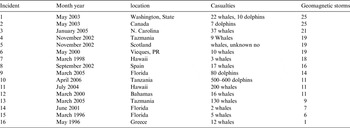
A report of worldwide whale and dolphin deaths by location from March 1996 to April 2006 is presented in Table 2. Investigators selected the 16 months with the intent to correlate strandings with sonar during naval exercises in the locations identified (ANON 1996–2006, http://www.anon.org/lfas_news.jsp). For 13 of the 16 months documented (81.2%), 9 or more storms per month occurred (on average, one every 3 days).
Monthly whale and dolphin deaths and frequency of monthly geomagnetic storms that occurred

Monthly beachings were reported by ANON (2012). Low frequency active sonar (LFAS)/Active sonar in the news. (Retrieved 18 December 2012 from www.anon.org/lfas_news.jsp). Geomagnetic storm frequency (ranked from most to least) was obtained from (http://legacy-www.swpc.noaa.gov/ftpmenu/indices/old_indices.html).
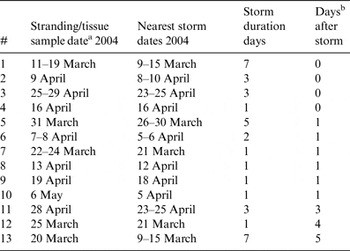
In 2004, an unusual mortality event involving 107 bottlenose dolphins occurred along the panhandle of Florida (NOAA 2004a). Stranding dates (11 March–6 May 2004) were compared with geomagnetic storm dates (K-index ≥ 5) (Table 3). Of the 13 dates when tissues samples were taken following the beaching events, 10 (76.9%) were discovered within 24 h of a major geomagnetic storm.
Bottlenose Dolphin unusual mortality events correlate with occurrences of geomagnetic storms

a ‘Sample Date’ refers to the time when tissues samples were taken for pathological analysis (NOAA 2004b).
b ‘Days’ (ranked from least to most) refers to the number of days after a storm that the strandings were discovered (‘0’ is the same day as a major storm).
Discussion
Data analysis
When data from the six independent beaching surveys were totalled (Table 1), a declining trend line (R 2 = 0.981) indicated a very strong association of when geomagnetic storms occurred and when stranding events occurred (Fig. 1). Of experimental and statistical importance, correlation of beachings with major geomagnetic storms represents a ‘sextuple-blind’ experiment: six independent surveys of strandings were carried out without knowledge of NOAA/SWPC's daily record of geomagnetic disturbances (K-indices) in Earth's atmosphere. Inferences regarding the biological influences of abnormal geomagnetic activity based on K-index values are fraught with the usual perils of inferring causality from statistical correlation between two variables. However, in the present situation an impossible scenario is produced: do cetacean strandings cause geomagnetic storms, or do geomagnetic storms cause cetacean beachings?
What property of a solar storm that is causing the beachings is still unidentified. For example, which solar particle(s) (protons, electrons, atomic ions) interact with the biological magnetoreceptor molecule (magnetite) involved in a cetacean's magnetoreception sense and then causes it to malfunction is unknown. Or, does the distortion of Earth's magnetic field during a storm produce a ‘compass’ misreading and thereby cause misdirection? Alternatively, do a storm's subatomic particles interfere with the transfer of information along the neural magnetoreception pathway? Despite these three unknowns, a ‘cause and effect’ is consistent with the following evidence and arguments as to the basis for cetacean beachings.
A small proportion of stranding reports occur several days after a geomagnetic storm. These events can be explained on the basis that many strandings occur on remote beaches and it may take days for humans to discover them. Another cause may be because geomagnetic fluctuations occur in three dimensions – north/south, east/west and ‘up/down’ (vertical). Disturbance measurements used in this study involved only the east/west horizontal component. It's possible disturbances in other vectors could cause beachings as well. Another problem involves time-zone differences in various regions of the world versus when geomagnetic information was reported by the observatory in Alaska. Also, a beaching that occurs at night will not likely be discovered until the next day. These problems or combinations of them can create differences between when a geomagnetic storm occurs and when a beaching was discovered.
Sonar
Attempts have been made to associate strandings with modern naval sonar exercises (Yang et al. Reference Yang2008; D'Amico et al. Reference D'Amico, Gisiner, Ketten, Hammock, Johnson, Tyack and Mead2009; Morell Reference Morell2009; Hays Reference Hays2011; Fernandez et al. Reference Fernandez2012). The evidence is tenuous and fraught with ‘belief bias’ – appraising the strength of a hypothesis based on the believability of its conclusion. The sonar premise is fraught with inconsistencies. First: Of 126 Beaked whale strandings recorded by D'Amico et al. (Reference D'Amico, Gisiner, Ketten, Hammock, Johnson, Tyack and Mead2009), 90% had no link with any naval activity, including beachings that occurred near a naval base or ship. However, data revealed a significant correlation (R 2 = 0.933) with days from a geomagnetic storm, and 72.6% occurred within 48 h of a storm. Second: During an incident in the Canary Islands (Fernandez et al. Reference Fernandez2012), the timing and location of four whale strandings attributed to sonar (from 21 to 26 July 2004) all happened simultaneously with a 7-day geomagnetic storm (22–28 July 2004). Third, on 3 July 2004, between 150 and 200 melon-headed whales occupied Hanalei Bay, milled in the bay and eventually headed to shore: volunteers herded them back out to open water (NOAA 2004b). Coincidentally, during the prior 3 days the whales experienced a severe geomagnetic storm. Fourth: On 15–16 March 2000, a multispecies mass stranding occurred and involved 17 cetaceans in the Bahamas (NOAA 2001). Again, the cause was postulated to be sonar during naval exercises. However, a geomagnetic storm occurred on the day before the stranding was discovered. Fifth: In a case involving 16 monthly reports of worldwide strandings from 1996 to 2006, a range of geomagnetic storms also occurred, coincidentally, during each month (Table 2). In 13 of the months identified, there were from 9 to 25 storm days per month. Seventh: During May–June 2008, 100–200 melon-headed whales (Peponocephala electra) stranded in a lagoon system northwest of Madagascar (Southall et al. Reference Southall, Rowles, Gulland, Gaird and Jepson2013). The first known stranding was observed on 30 May and was preceded on 29 May with the use of an echo sounder system during an ocean topography survey. Coincidentally, on 30 May a geomagnetic storm also occurred along with another that occurred 2 days before the stranding. In summary, many associations of strandings with acoustic anomalies were compromised because a geomagnetic storm occurred at the same time.
Such coincidences of beachings with geomagnetic storms compromise – scientifically – the likelihood that sonar might have been the cause for the deaths. Given that strandings have occurred since the days of wooden ships, well before sonar was even invented, it seems unlikely that sonar is a cause of beachings.
Pathogen causes
Experts cannot – consistently – find evidence of a common infectious disease, internal trauma, physical injury, inflammatory or neoplastic disease, or congenital and toxic factors in beached cetaceans (Jauniaux et al. Reference Jauniaux, Brosens, Jacquinet, Lambrigts, Addink, Smeenk and Coignoul1998; NOAA 2004b; Yang et al. Reference Yang2008; Fernandez et al. Reference Fernandez2012; Marsili et al. Reference Marsili, Maltese, Coppola, Carletti, Mazzariol and Fossi2014). In a 2005 beaching incident involving 19 whales in Ireland, biologists indicated, ‘It was one of the healthiest pods we've examined’ (Rogan et al. Reference Rogan, Baker, Jepson, Berrow and Kiely1997). Several post mortem examinations have been performed:
-
1. In the 2008 Madagascar whale stranding incidents, four detailed necropsies found no evidence for morbillivirus and three tested negative for infectious diseases (Southall et al. Reference Southall, Rowles, Gulland, Gaird and Jepson2013).
-
2. In a particularly devastating stranding of 107 dolphins in 2004 from 10 March to 13 April along the Florida panhandle, USA, a detailed report of post mortem examinations emphasized: ‘The evidence based on gross and histological findings does not indicate an infectious process and viral testing has ruled out morbillivirus…’ (NOAA 2004a). Coincidentally, when the beachings occurred from 11 March to 6 May, a period of 56 days – there were 26 days when severe geomagnetic storms occurred. Of the 13 stranding dates identified, 76.9% occurred within 24 h of a geomagnetic storm. The report also noted that on 12 March 2004, 26 dolphins stranded within a 3-day period; again, coincidentally, that period also corresponded with the peak in a major storm that lasted 7 days, which was an unusually severe storm.
-
3. Six stranded whales found off the Pacific coast each had different factors that were attributed to their death (Gulland et al. Reference Gulland2005). The authors also reported that in 1999 and 2000 more strandings occurred than in 1996–1998, which also coincided, coincidentally, with a peak and trough in the sunspot cycle.
-
4. In still another case, of six stranded cetaceans that tested positive for morbillivirus (Di Guardo et al. Reference Di Guardo2013), two were discovered within 24 h of a major geomagnetic storm; one was within 5 days of a severe 3-day storm; a fifth stranded whale was found 4 days after a major storm. A sixth beached dolphin was found more than 15 days after a storm; therefore, its demise was likely due to some other cause. Thus, five of six cetaceans infected with morbillivirus occurred within 5 days of geomagnetic storms.
-
5. Autopsies on 15 animals following an unusual mortality event in Taiwan found them to be in good condition (Yang et al. Reference Yang2008). There was no evidence of diseases, physical injury or starvation. The strandings occurred from 19 July to 13 August 2005; coincidentally, major geomagnetic storms occurred on 8 days throughout the same period (12–14, 21, 23 and 24 July; 9 and 10 August).
-
6. From 2010 to 2014, of 179 cetacean strandings, only 54 (30.2%) tested positive for Brucella (NOAA 2015b). Coincidentally, of the strandings that tested positive or ‘suspect positive’ for Brucella, 42 (77.8%) of them occurred within 7 days (79.2%) of a geomagnetic storm.
-
7. Autopsies of three beaked whales stranded in the Canary Islands found no inflammatory or neoplastic disease (potentially responsible for the cause of death) in any organs taken from them (Fernandez et al. Reference Fernandez2012). However, during the period when strandings were discovered (21–26 July 2004) they were preceded by two geomagnetic storms, and storms also occurred during the stranding period (23–28 July 2004).
-
8. Of 32 cetacean beachings studied from 1991 to 2013, 24 were of an undetermined cause, five contained a biotoxin, two were due to human interaction and only one was due to a disease (NOAA 2013). Results indicated several potential causes and that a pathogen was involved in only one of the 32 incidents.
-
9. Detailed post mortem examinations on three of seven sperm whales that stranded alive in December 2009 did not find presence of morbillivirus or Brucella (Mazzariol et al. Reference Mazzariol2011), evidence these infectious organisms were not the cause.
-
10. In another investigation, detailed post mortem examinations of six cetaceans stranded between 2009 and 2011 found presence of morbillivirus in brain tissues (Di Guardo et al. Reference Di Guardo2013). Coincidentally, two were found within 24 h of a major geomagnetic storm, and three within 5 days of a storm. One was found more than 15 days of a storm and, therefore, was likely due to another cause.
-
11. In January 2005, 33 pilot whales beached themselves on the coast of North Carolina, USA (Hays Reference Hays2011). Blood and urine were sampled from the animals and experts examined ears and sensory organs for damage, but found little: ‘Some were sick but others were healthy.’ Coincidentally, during that 31-day period there were 21 days when geomagnetic storms occurred, including an exceptionally severe 9-day storm.
-
12. Complete necropsies were performed on three of 9 whales that beached on December 10, 2009 along the coast of Italy (Mazzariol et al. Reference Mazzariol2011; Marsili et al. Reference Marsili, Maltese, Coppola, Carletti, Mazzariol and Fossi2014). No specific pathogen was identified as a cause. Instead, authors concluded multiple factors were likely involved in the strandings. However, there was a severe geomagnetic storm 3 days before they were found trapped in shallow waters of a bay.
-
13. During winter 1994–95, four sperm whales (Physeter niacrocephalus) were stranded along the Belgian and the Dutch coasts. Detailed necropsies and tissue samplings were collected 24 h post mortem and whereas numerous physical injuries were found, no plausible disease as a cause of the beachings was identified.
Presence of weak associations between pathogens and/or specific injuries with cetacean strandings implies some other factor causes strandings. It should be emphasized that diseased or injured cetaceans that, nevertheless, still possess a functional magnetoreceptive sense would become susceptible to becoming disoriented during a geomagnetic storm and therefore become vulnerable to beaching themselves – along with healthy mammals. Many of the aforementioned studies indicated healthy as well as an array of disorders and diseases were present in stranded cetaceans. This is consistent with a magneto-reception disorder being primarily involved with strandings. Other animals, including migrating birds (Moore Reference Moore1977) and honey bees (Ferrari Reference Ferrari2014) – organisms that are not susceptible to morbillivirus or Brucella – have been shown to change orientation and get lost as a result of geomagnetic disturbances, which is not consistent with the hypothesis that a disease was the cause of strandings. In fact, there is a significantly better correlation of beachings with geomagnetic storm incidents than any disease or pest as a contributing factor.
Instances of beachings were observed on virtually the same day in different parts of the world (Appendix, incidents 32–33; Table 1). Such coincidences are inconsistent with local causes for beachings, such as sonar, earthquakes, weather abnormalities, alga blooms, disease, bathymetric anomalies, social behaviour of pods and food poisoning. However, two or more distant strandings on the same or nearly the same day is consistent with a global phenomenon as a causal agent, such as a geomagnetic storm. Overall, evidence indicates a disease, such as morbillivirus or Brucella, is not a primary cause of beachings.
Pollution
Anthropogenic influences involving pollution have not occurred in prior centuries when humans possessed a much smaller population, and large industrial complexes were nonexistent; therefore, humans cannot be a major cause of mass strandings in the past. Moreover, many beachings occur in remote areas of Earth where human activity is minimal (Appendix). In one noteworthy exception, there was a 3.5-fold increase in beachings following the Deepwater Horizon oil spill in the northern Gulf of Mexico (March and April 2010) and there was no correlation with geomagnetic activity. In a second exception, seven stranded sperm whales along the Adriatic coast showed several stressful physical conditions, including malnutrition, emaciation, presence of pollutants and acute infections, all which were suspected to contribute to immune system impairment (Mazzariol et al. Reference Mazzariol2011). No geomagnetic storm activity occurred within 14 days prior to or after the observed beaching incidents, an indication that another cause was probably responsible for the beaching. The two examples provided indicate man-made pollution and diseases can also cause cetacean disorientation, which leads to beachings. However, over time little data supports human activity or disease as a primary cause of beachings.
Magnetoreception disorder
The lack of supporting data for most theories would argue that some other factor is causing cetacean beachings; importantly, the cause must have been present for centuries. Many behavioural scientists have demonstrated the capability of a wide range of organisms to extract directional information from Earth's ambient magnetic field (Ossenkopp & Barbeito Reference Ossenkopp and Barbeito1978; Gould et al. Reference Gould, Kirschvink, Deffeyes and Brines1980; Wiltschko et al. Reference Wiltschko, Munro, Ford and Wiltschko1998; Perrin & Geraci Reference Perrin, Geraci, Perrin, Wurseg and Thewissen2002; Walker et al. Reference Walker, Diebel, Kirschvink, Haraand and Zielinski2006; Johnson & Lohmann Reference Johnson and Lohmann2008; Hsu et al. Reference Hsu, Ko, Li, Fann and Lue2010; Wajnberg et al. Reference Wajnberg, Acosa-Avalos, Alves, Ferreira de Oliveira, Srygley and Esquivel2010). Consistent with the magnetoreception disorder theory is the observation that application of altered magnetic fields or strong magnetic pulses to many organisms either randomized their preferred orientation direction or else deflected it slightly relative to controls (Walcott Reference Walcott, Schmidt-Koenig and Keeton1978; Gould et al. Reference Gould, Kirschvink, Deffeyes and Brines1980; Tomlinson et al. Reference Tomlinson, McGinty and Kish1981; Walker et al. Reference Walker, Baird and Bitterman1989; Cain et al. Reference Cain, Boles, Wang and Lohmann2005; Irwin & Lohmann Reference Irwin and Lohmann2005; Ferrari Reference Ferrari2014). Finally, the nest departure angle for the stingless bee Girucu changed significantly during a major geomagnetic storm (Esquivel et al. Reference Esquivel, Wajnberg, Nacimento, Pinho, Lins de Barros and Eizemberg2007) indicating their magnetoreceptive sense was impaired.
Biogenic magnetite in many organisms is believed to be involved in the perception of the magnetic field (Kirschvink & Gould Reference Kirschvink and Gould1981; Kirschvink et al. Reference Kirschvink, Jones and MacFadden1985; Johnson & Lohmann Reference Johnson and Lohmann2008). Presence of biogenic magnetite in cetaceans is consistent with presence of a magnetoreception sense in these animals (Zoeger et al. Reference Zoeger, Dunn and Fuller1981; Bauer et al. Reference Bauer, Fuller, Perry, Dunn, Zoeger, Kirschvink, Jones and McFadden1985).
Geomagnetic disturbances
Data presented provides strong correlative evidence that is consistent with the theory that solar eruptions and resultant solar storms somehow cause beaching events. After an eruption occurs on our Sun, a solar magnetic storm is created, which contains ionizing radiation. Typically, it takes about 10–36 h to reach Earth. At any point on the Earth's surface, the observed magnetic field can be described as ‘vectors’ in three-dimensional space. Upon impact of a solar storm with Earth's magnetosphere, severe disturbances can occur in its magnetic field vectors. The degree of the disturbance in Earth's horizontal vector is reflected in the K-index. Cetaceans that use the magnetic field for orientation to travel, whether searching for food or during migration, will have their magnetic compass become imprecise because of turbulence in the magnetic field. As a result, they will become disoriented and follow an incorrect bearing while traveling, as has been demonstrated in Silvereyes (Wiltschko et al. Reference Wiltschko, Munro, Ford and Wiltschko1998), sea turtles (Irwin & Lohmann Reference Irwin and Lohmann2005), birds (Moore Reference Moore1977; Walcott Reference Walcott, Schmidt-Koenig and Keeton1978) and honey bees (Walcott Reference Walcott, Schmidt-Koenig and Keeton1978; Gould et al. Reference Gould, Kirschvink, Deffeyes and Brines1980; Tomlinson et al. Reference Tomlinson, McGinty and Kish1981; Walker et al. Reference Walker, Baird and Bitterman1989; Irwin & Lohmann Reference Irwin and Lohmann2005; Ferrari Reference Ferrari2014). Finally, evidence presented indicates the number of cetacean beachings was correlated with sunspot numbers (Figs. 7 and 8). In conclusion, considerable evidence indicates beaching and geomagnetic storms are related.
Synopsis: astrobiological implications
Based on statistically compelling correlation coefficients, evidence obtained involving when cetacean stranding incidents occurred and when geomagnetic disturbances occurred in Earth's atmosphere, indicate the two phenomena are linked. Normally, correlations would not relate to ‘cause and effect’ relationships between two independent variables. However, that ‘statistical rule’ makes little sense in the present case because we are faced with an illogical inference: (A) do geomagnetic disturbances cause cetaceans to become stranded; or, (B) do stranded cetaceans cause Earth's geomagnetic disturbances? The answer is obvious: ‘A.’
Major geomagnetic storms can occur for short periods, as few as 3 h, but they frequently occur for longer than 3 days. Clearly, whether a cetacean will strand or not depends on the duration of a geomagnetic storm, distance and direction to shore and how fast they swim before a storm ends. It appears some beached cetaceans can recover and swim away; therefore, they must be able to ‘reset’ their internal compass and regain their homing ability after a brief storm has ceased. For example, rescued cetaceans were turned around, released, swam off and survived (D'Amico et al. Reference D'Amico, Gisiner, Ketten, Hammock, Johnson, Tyack and Mead2009 – Appendix ‘e’; Sutton Reference Sutton2013). This ability to recover and return to the sea has been observed numerous times, and would be consistent with a brief geomagnetic storm – and inconsistent with a disease or injury. In the case of cetaceans whose altered bearing leads them toward land, they will eventually swim onto a shore and beach themselves. On the other hand, if a shift in their bearing leads them out to sea, they will go unnoticed. If they do land on a shore, and a geomagnetic storm ends, they can be turned around and they will swim off. If the storm is ongoing when turned around, they will return and rebeach themselves. Both situations are consistent with past observations, a cetacean's magneto receptive sense and a geomagnetic storm's duration. Taken together, evidence presented supports the involvement of coronal eruptions on our Sun, with solar storms they create and subsequent geomagnetic disturbances here on Earth with cetacean beachings.
The astorbiological implications are profoundly perplexing because evidence indicates a significantly strong correlation between the two incidents, but nothing can be done to mitigate either variable. Scientifically, strict controlled and double-blind experiments cannot be performed regarding variations or interactions between the two variables: (A) humans have no control over the occurrence or intensity of a solar eruption or arrival of the resulting solar storm. (B) Likewise, humans have no control over cetacean feeding behaviours or migration patterns. Obviously, it is impossible to design a scientific experiment to study the effects of geomagnetic disturbances on cetacean beachings when controls on Earth cannot be used nor can storms be induced during a lull period in the sunspot cycle without affecting controls on Earth! Fortunately, there is promise on how to monitor this astrobiological phenomenon because tracking devices on mammals can be used to monitor changes in swimming direction before, during and after a geomagnetic storm. Unfortunately, as for the future of life on behalf of a multitude of organisms that depend on Earth's magnetic field for orientation, we must rely on Darwinian evolution here on planet Earth to make future changes in this astrologically induced magnetoreception disorder.
Appendix
Worldwide Beachings of Cetaceans – 1997–2013