Conventional wisdom originating with Demsetz (Reference Demsetz1967) argues that trade encourages shifts from common to private property. By contrast, many Nigerian Igbo communities responded to the palm produce trade of the nineteenth and early twentieth centuries by restricting private rights over palm trees. In this article, I use the Ostrom (Reference Ostrom2007, Reference Ostrom2009) framework for analyzing social-ecological systems to explain the adoption of communal palm harvesting (imachi nkwu) in response to commercialization of palm oil among the Igbo of southeastern Nigeria. I use this framework to identify the characteristics of the resource system, resource units, the governance system, and users that explain this transition.
Under communal harvesting, the majority of palm trees would be set aside for the use of the entire community, regardless of who owned the land under them. Harvesting was only permitted on specific days, during which each member of the community could harvest as much as he wished. Communal harvesting simplified the act of detecting theft. Monitoring under private property was largely undertaken by the property owner or his relatives, was non-cooperative, and required proving that a thief had attempted to steal oil from the owner's trees. Under communal property, thieves needed only to be caught taking more than their share by harvesting on the wrong day. Any member of the community could catch a thief. Though property owners surrendered a share of the harvest under common property, rising palm oil prices increased the incentive to steal, accentuating the benefits of this arrangement. Communal harvesting gave all users, including potential thieves, incentives to monitor. Anything stolen was now also taken away from their share of the harvest. The value of this loss rose with the price of oil. Because theft often occurred before palm fruits were fully ripe, the costs of early harvesting were now borne in part by potential thieves. These incentives increased aggregate monitoring under communal property, reducing returns to effort in theft and the responsiveness of this effort to the price of oil.
I construct a simple model in which the key result is that, if the price of palm oil rises above a certain threshold, communal property will improve the welfare of property owners while making potential thieves no worse off. I validate this account using information recorded in colonial Native Court transcripts. I use these materials in two ways. First, these provide historical evidence on how property rights worked, how they changed, and how they were negotiated. Second, these records serve as evidence that the mechanisms highlighted by the model were those that drove the transition from private to communal harvesting.
Disputes over palm harvesting reflected a split between property-owning elders and thieving youths who wished to steal oil to pay for bride price, taxation, schooling, and other cash expenses. In addition to the economic value of palm oil, the cases show that controlling access to palm produce was a source of political authority. Communal harvesting was a means for elders to retain symbolic control while making economic concessions. The cases reveal that the enforcement of property rights was costly, and was complicated by the need to prove both points of fact and points of law. The communal harvesting arrangement involved costs, but they were lower. Communal harvesting was a scheme to reduce effort costs, though the specific rules used to implement it varied considerably across communities.
I test the framework in two ways. First, I extend the model to include colonial taxes, and argue that youths’ needs to collect oil for tax payment made it rational for elders to surrender some of their rights. This too is evident in the court records. The need to pay tax encouraged greater theft by youths, and spurred the creation of communal harvesting arrangements. The conflict that occurred over this transition drew in colonial officials, who struggled to simultaneously maintain the authority of the elders on whom they depended to implement colonial rule, while averting social conflict and collecting tax revenue. Second, I use characteristics of the resource system, resource units, the governance system, and users to account for differences between Igbo systems of property rights over palm trees and those practiced by the Yoruba and Urhobo.
This study is relevant to three broader questions. First, why does common property exist? The literature stresses benefits of the commons, including scale economies, risk pooling, and equity, and the difficulties of dividing it. Second, what facilitates collective action? The literature suggests several conditions for regulation of the commons, including group cohesiveness, feasibility, information, and resource value. Third, how does trade affect the commons? For the Igbo, equity, political considerations, and, most significantly, the costs of maintaining private property relative to those of monitoring collective harvesting drove the adoption of communal harvesting. The Igbo implemented collective palm cutting in relatively small, homogenous communities, using already-existing institutions of local governance. Trade did not erode the commons.
FRAMEWORK
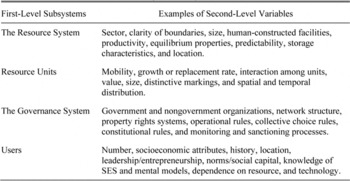
General framework. Ostrom (Reference Ostrom2007, Reference Ostrom2009) provides a general framework for the analysis of social-ecological systems (SESs). An SES consists of four first-level subsystems, each of which is made up of multiple second-level variables. Some examples are given in Table 1. This framework helps identify variables relevant for studying any specific SES. For example, E. Ostrom (Reference Ostrom2009) applies it to the question of when communities will avert a “tragedy of the commons.” She identifies characteristics of the resource system (size, productivity, and predictability), of resource units (mobility), of the governance system (collective-choice rules), and of users (number, leadership, norms and social capital, knowledge, and importance) as predictors, based on case study evidence. I am concerned with common pool resources, defined by their high subtractability (rivalry) of use and the difficulty of excluding potential beneficiaries. Understanding how property rights will respond to trade requires applying the framework to three questions:
THE OSTROM (Reference Ostrom2007, Reference Ostrom2009) FRAMEWORK

Sources:
Ostrom (Reference Ostrom2007, Reference Ostrom2009).
Why does common property exist? Private property over resources increases investment incentives, makes collateral available, eases exchange, and generates information (Libecap Reference Libecap2007). Why does the commons persist, despite its apparent inefficiencies?
Characteristics of the resource system and resource units shape likely outcomes. First, these can create particular benefits to common property. Scale economies can make common property attractive, as in the case of Alpine pastures (Netting Reference Netting1976). Similarly, a semicommons in which private and common rights coexist allows users to operate on multiple scales; the English open fields, for example, combined larger-scale common grazing with smaller-scale individual grain production (Smith Reference Smith2000). Common property or scattering within a semicommons can allow risk pooling or reduce transactions costs (McCloskey Reference McCloskey1976; Fenoaltea Reference Fenoaltea1976). Resources requiring large collective infrastructure, such as water in an irrigation system, are unlikely to be divided (Baland and Platteau Reference Baland, Platteau, Mäler and Vincent2003). Where output is a public good, common property can enhance efficiency by reducing free-riding (Besley and Ghatak Reference Besley, Ghatak, Rodrik and Rosenzweig2009).
Second, the benefits of securing exclusive access to a resource depend on its characteristics. Resources for which conservation and improvement require investment and maintenance are more likely to be privatized (Baland and Platteau Reference Baland, Platteau, Mäler and Vincent2003). Coastal salmon harvesters in the Pacific Northwest gained more accurate information about the effects of harvesting on salmon stocks if rival users could be excluded. Upstream harvesters could not gain a similar advantage, and were more likely to tolerate trespass (Johnsen Reference Johnsen2009). Where there is a race to exploit a resource, exclusive rights over unused claims may not be honored (Clay and Wright Reference Clay and Wright2005).
Third, the costs of surveying, defining, registering, marking, and defending rights will all depend on resource characteristics. Where resources are mobile or difficult to observe, property rights are more likely to be assigned to output flows rather than resource stocks (Libecap Reference Libecap2007). For example, the negative externalities of oil extraction at multiple points from the same reservoir create pressures for solutions such as unitization, prorationing, and lease consolidation (Libecap and Wiggins Reference Libecap and Wiggins1984). However, the transactions costs required to achieve these outcomes are increased if, for example, oil and gas exist within the same reservoir, or price fluctuations make information about resource value costly (Libecap and Smith Reference Libecap and Smith2002).
Characteristics of the governance system also influence outcomes. States may intervene where definition of rights becomes too complex for users, where the state believes that natural resources must be mobilized to achieve economic growth, or where state support of a particular property rights regime will benefit a politically powerful constituency (Libecap Reference Libecap1986). It is unrealistic to assume that formalization efforts will simply recognize existing claims. Women, in particular, are likely to lose rights, while elites typically manipulate registration processes in their favor (Platteau Reference Platteau1996). Allocation of rights generates both wealth and political influence, making it contentious (Libecap Reference Libecap2007).
Specification, monitoring, and enforcement of rights are separate functions, which states will not necessarily provide. What Libecap (Reference Libecap2007) calls “political transactions costs” also create path dependency, as they make initial allocations of property rights difficult to change later. Budgetary pressures and staffing levels may lead governments to underprovide definition and enforcement of property rights (Alston, Libecap, and Schneider Reference Alston, Libecap and Schneider1996).
All enforcement of property imposes costs on the possessor. On frontiers, communities of users have initially defined de facto property rights and helped each other to enforce their claims (Alston, Libecap, and Mueller Reference Alston, Libecap and Mueller1999). In these situations, it is likely that de jure rights enforced by the state will differ from de facto rights defined by possessors. This can lead to conflict when competing claimants have differing capacities for violence (Alston, Harris, and Mueller Reference Alston, Harris and Mueller2012). In the history of U.S. land policies, allocations based on prior use, adapted to local conditions, and free of government mandates were generally the most effective in avoiding resource degradation (Libecap Reference Libecap2007).
Political economy and legal considerations frequently lead to inefficient outcomes (Libecap Reference Libecap1986). In U.S. fisheries, for example, governments have emphasized the rights of all citizens to access, and have been unwilling to support voluntary agreements that could be considered antitrust violations or to assign rights over large areas (Johnson and Libecap Reference Johnson and Libecap1982). Inefficiently small producers have received the support of the state both on the U.S. great plains and in the oil sector (Hansen and Libecap Reference Hansen and Libecap2004; Libecap and Smith Reference Libecap and Smith2002). Prorationing has become more common than unitization or lease consolidation in the U.S. oil sector, since it satisfies the participation constraints of small producers, not because it is efficient (Libecap and Wiggins Reference Libecap and Wiggins1984).
Characteristics of users also matter. Demands for equity are particularly powerful, and help explain support for common property (Baland and Platteau Reference Baland and Platteau1998). Subjective views matter; for example, individuals may sabotage land sales to outsiders after privatization (Platteau Reference Platteau1996). On the Northwest Coast, reciprocal gifts insured First Nations groups against environmental shocks, strengthening their incentives to invest in building their salmon stocks. These gifts also provided possible rivals with a reason not to intrude on a group's fishing stocks, lessening the potential for conflict and violence (Johnsen Reference Johnsen2009). Monitoring common property may be cheaper, since users can work together to monitor each other and exclude outsiders (Runge Reference Runge1986).
If there are limited returns to investment or few new technologies available, the benefits of division may be low (Platteau Reference Platteau1996). Fixed investments made under an existing property rights arrangement raise the transactions costs of altering the regime (Libecap Reference Libecap2007). Resources such as land often have noneconomic value to users that inhibits privatization; in Africa, land is important for reasons of ancestry, emotion, group membership, social insurance, and its safety relative to financial assets (Platteau Reference Platteau1996).
What facilitates collective action? The capacity for collective action shapes the costs of supporting a common property regime. Characteristics of the resource system and of resource units influence its feasibility. Commons are governed more effectively when monitoring of resources and use is low-cost and verifiable, and when resources, population, technology, and socioeconomic conditions change slowly (Dietz, Ostrom, and Stern Reference Dietz, Ostrom and Stern2003). Feasibility demands that inexpensive means of conflict resolution and clear boundaries exist, so that intruders and violators are readily detectable and easily punished (Ostrom Reference Ostrom1991). Information is needed about the limits of the resource; because information acquisition is costly, resource dilemmas are rarely resolved before the problem has become severe (Libecap and Smith Reference Libecap and Smith2002). Specific features such as scattering can mitigate strategic behavior (Smith Reference Smith2000). Resource value can make regulation worthwhile (Libecap and Smith Reference Libecap and Smith2002).
The governance system also shapes collective action. States undermine local regulation of the commons by withholding services, by imposing top-down management, and by facilitating intrusion of outside interests (Baland and Platteau Reference Baland, Platteau, Mäler and Vincent2003). Rules must receive the support of users, and violations of social rules must be well-defined (Dietz, Ostrom, and Stern Reference Dietz, Ostrom and Stern2003). For example, authorities that supported herd reductions on the Navajo Reservation lost legitimacy, and grazing restrictions have been politically unpopular (Libecap and Johnson Reference Libecap and Johnson1980). Political economy concerns will also weigh on local governance structures; controls exercised within the commons will be subject to distributional pressures (Libecap Reference Libecap1986).
Users’ characteristics also matter. R. N. Johnson and G. D. Libecap (Reference Johnson and Libecap1982) argue high contracting costs among heterogeneous users with difficult-to-observe effort inhibit informal agreements. T. Dietz, E. Ostrom, and P.C. Stern (Reference Dietz, Ostrom and Stern2003) emphasize the need for frequent communication, social capital, and inexpensive exclusion of outsiders. In laboratory settings, communication may be more effective than punishment (Janssen et al. Reference Janssen, Holahan, Lee and Ostrom2010). Levels of trust and cooperation are influenced by contextual and microsituational variables (Poteete, Janssen, and Ostrom Reference Poteete, Janssen and Ostrom2010). Group cohesiveness provides past experiences of cooperation, existing arrangements, punishment systems, networks of mutual obligation, shared norms of reciprocity, trust, clear and stable group membership, and low rates of exit (Ostrom Reference Ostrom1991).
How does trade affect the commons? Several writers have adopted variants of the Demsetz (Reference Demsetz1967) approach, suggesting that increased resource value drives privatization. Many communities, ranging from irrigation users in the Philippines to herders in Switzerland, have been able to successfully regulate existing common property resources for commercial use (Ostrom Reference Ostrom1991). J.-M. Baland and J.-P. Platteau (Reference Baland and Platteau1998) note that Demsetz-type views are subject to selection bias; we observe not how institutions change, but which changes survive. These predictions ignore possibilities such as degeneration into open-access. Further, it is possible that the state simply expropriates the resource. T. Besley and M. Ghatak (Reference Besley, Ghatak, Rodrik and Rosenzweig2009) note that expropriation has been common historically, and is less likely where the state has a monopoly on coercive authority, where coercion is costly, where states can commit, build reputations, or have long time horizons, where resource prices are low, and where the quality of institutions is high.
Igbo Palm Harvesting
These questions help guide examination of the Igbo response to commercialization of palm oil. What were the advantages of common property over palm trees? What facilitated the collective action needed to regulate communal harvesting? What was the role of trade? Answering these questions within the Ostrom (Reference Ostrom2007, Reference Ostrom2009) framework requires identifying the relevant characteristics of the resource system, resource units, the governance system, and users and incorporating them into a model with predictive power. In this subsection, I discuss characteristics of Igbo palm harvesting. I introduce the model in the next section.
Users
The Igbo are Nigeria's third-largest ethnic group. During the colonial period, they lived mostly in communities of a few hundred to over two thousand persons (Gailey Reference Gailey1970, p. 23). The small size and homogeneity of these communities facilitated collective action. The Igbo used palm oil in cooking prior to commercialization (Martin Reference Martin1988, p. 32). Palm products were the most important Igbo exports during the nineteenth and twentieth centuries (Lynn Reference Lynn1997, p. 34). The purchasing power of palm oil rose continuously over the nineteenth century (Allen Reference Allen2011). Assessment Reports for the Aba and Bende Divisions estimated that palm produce contributed between 1 percent and 51 percent of household income, averaging 20 percent.Footnote 1 In the Aba Native Court Area, for example, palm nuts were cut every 24 days. On each occasion, a man would cut approximately five heads of fruit. Over a year, this would be enough to produce three tins of oil, worth 18s, and 400 lbs. of kernels, worth £2/4/0.Footnote 2
The Resource System and Resource Units
Palm trees were found in many locations, including near compounds, in wild groves, or scattered on farmland, though they were rarely planted intentionally (Chubb Reference Chubb1961, p. 47). One official estimated in 1907 that there were six palms per acre in the vicinity of Aba (Martin Reference Martin1988, p. 46). Palm fruits could be harvested year-round. While reaping palm fruit did not cause permanent damage to the trees, the village stock of palms was like a fishery insofar as the gathering fruits before they were ripe would reduce total yield.
The Governance System
Authority was decentralized in Igbo society, with power divided between the amala (village council), the Ezeala (Earth priest), umokpara (the ofo-holders, or compound heads), the okonko secret society, and the age grades (Oriji Reference Oriji1991, pp. 31–42). These already-existing institutions of local governance facilitated enforcement of communal harvesting, though the diffuseness of authority could create problems of overlapping jurisdiction. British rule in Igboland was initially carried out through the appointment of so-called “warrant chiefs.” In 1928, discontent with these chiefs, with recently enacted poll taxes, and with the depressed state of trade led to a period of unrest known as the “Women Riot.” The colonial government responded with institutional reforms (Martin Reference Martin1988, p. 106). The government created Native Courts, comprised in each village-group of a “massed bench of elders,” and established Native Authorities that included the eldest man of each ezi (compound) and any young men they chose to co-opt (Martin Reference Martin1988, p. 121). Records from these reformed Native Courts are the principal sources for this study.
Colonial and anthropological evidence suggests that many Igbo areas restricted individuals’ and lineages’ exclusive rights over palm trees during the nineteenth- and twentieth-century palm produce trade. In their place, Igbo groups such as the Ngwa enacted the practice of imachi nkwu, or communal palm cutting.Footnote 3 R. C. Allen noted it in his Intelligence Report on the Ngwa,Footnote 4 as well as his unpublished “Ngwa Customs,” which is quoted at length by Chubb (Reference Chubb1961, pp. 48–49). In Allen's description, appreciation of the value of palm produce prompted village councils to regulate harvesting, first from communal palms and later from privately owned trees. To give each community member an equal benefit and to prevent overharvesting, time was set aside roughly every twenty days for each individual to harvest as much as he wished. This was signaled by the beating of a drum kept in the care of an elder. Individuals harvesting at other times could be fined by the village council. After the introduction of poll taxes, village councils would declare periods of roughly three months during which all privately owned palms were vested in the community. Similar institutions were employed by the Aro, in Umuahia, and in other densely populated areas of Owerri Province (Chubb Reference Chubb1961, p. 49; Chuku Reference Chuku2005, p. 51).
Allen explains imachi nkwu as a result of the palm oil trade and the “communal spirit” of the Igbo. M. M. Green (Reference Green1941, pp. 17–19) adds taxes to this explanation. She conducted fieldwork during 1935 and 1937 at Umueke Agbaja, in Okigwi. While she found little land was left under group control, rights over palms were in a state of ambiguity, fluctuating between “restriction of rights to those who owned the land on which the palms stood and the extension of rights to anyone to cut anywhere.” In the past, people had restricted cutting palm nuts to trees on their own land, but during a period when the population dwindled, it had been decided that individuals could harvest anywhere within Umueke. After the population recovered, cutting was once more limited to the land of one's own lineage. The eldest man in the village had been instrumental in passing the restriction. He had many trees on his land, and lacked the vigor to compete with youth in harvesting. The rule had been passed because “the strongest people cut to the detriment of the less strong,” and because of the introduction of the head tax. Some landowners who could not climb found others harvesting from trees on their land, but found these others unwilling to help them pay their own tax. By 1937 the youth of the village had successfully challenged the rule, forcing the elders to accept an “intermediate” position between the two extremes of communal and private rights over palms.
Together, these characteristics of the governance system suggest that considerations of equity, politics, and the costs of monitoring and enforcing property rights help explain communal harvesting of palm oil.
MODEL
In this section, I outline a model of Igbo palm harvesting that includes basic elements of the resource system, resource units, the governance system, and users. I demonstrate that, as the price of palm oil rises, communal harvesting becomes a Pareto-improving alternative to private property.
Setup
There are two users—one elder E and one youth Y. The elder possesses a grove of trees that yield one unit of oil, which can be sold for a price of p. At the beginning of the game, the elder chooses between private property and communal property. If the elder chooses communal property, he also chooses what share θ of the oil he will offer the youth before the game begins. This is done subject to the constraint that he leaves the youth as well off under communal property as under private property. The purpose of this model is to demonstrate that, under reasonable conditions that fit those of the case under study, an increase in the price of palm oil can lead the elder to prefer communal property to private property, leaving the youth no worse off. Under either property rights system, the game has one stage. The elder chooses a level of costly monitoring, defending his grove against theft. This can be thought to encompass both pure monitoring and enforcement. Simultaneously, the youth chooses how much effort to expend in stealing. Under private property, the youth directs his efforts towards the entire grove. Under communal property, he only attempts to steal from the fraction 1 − θ of the oil that he would not otherwise receive as his communal share.
Private Property
Under private property, the elder chooses his level of monitoring m > 0 This costs him dm, where d > 0 is the elder's marginal cost of monitoring effort. The youth exerts effort s > 0 in stealing. The youth faces a cost of stealing cs, and so c > 0 is his marginal cost of effort. The oil is shared according to the amount of effort expended. That is, the youth receives a share
 $s \frac m + s$
, while the elder receives a share
 $m \frac m + s.$
This is a simple contest success function in the spirit of Hirshleifer (Reference Hirshleifer2001). If neither party exerts effort (i.e., m = s = 0), then the elder receives the full unit of oil.
The elder and youth's problems can be written as
 \begin{equation}
V_E^P = \mathop {\max }\limits_m \left\{ {\frac{m}{{m + s}}p - dm} \right\},\,{\rm and }V_Y^P = \mathop {\max }\limits_s \left\{ {\frac{s}{{m + s}}p - cs} \right\}
\end{equation}
These are concave, and so they can be maximized from their first-order conditions. Equilibrium levels of monitoring and stealing are
 \begin{equation}
\[
m_*^P = \left({\frac{c}{{c + d}}} \right)^2 \frac{p}{c},\,{\rm and }s_*^P \left({\frac{d}{{c + d}}} \right)^2 \frac{p}{d}
\]
\end{equation}
Effort in stealing or monitoring is, then, increasing in the price of the resource and decreasing in its own marginal cost. Substituting these into equation 1 gives equilibrium payoffs under private property
 \begin{equation}
V_E^P = \left({\frac{c}{{c + d}}} \right)^2 p,\,{\rm and} \\
V_E^P = \left({\frac{d}{{c + d}}} \right)^2 p \\
\end{equation}
The efficiency loss due to the costs of stealing and monitoring,
 $frac{{2cd}}{{\left({c + d} \right)^2 }}p$
is increasing in the price.
Communal Harvesting
Under communal property, the elder begins by offering a share θ of the oil to the youth. He is willing to do this because communal property simplified the act of monitoring, reducing its marginal cost. In particular, his marginal cost of monitoring is now γ, where d > γ > 0. It is assumed he can commit to θ. Communal property, however, also entails a fixed administrative cost of
 $k\macr$
. This captures the cost of organizing and overseeing the harvest according to a set schedule of days.
Thus, taking θ as given, the elder and youth's problems can be written as
 \begin{equation}
V_E^C = \mathop {{\rm max}}\limits_m \left\{ {\frac{m}{{m + s}}\left({1 - \theta } \right)p - \gamma m - \bar k} \right\},\,{\rm and} \\
V_Y^C = \mathop {{\rm max}}\limits_m \left\{ {\theta p + \frac{s}{{m + s}}\left({1 - \theta } \right)p - cs} \right\} \\
\end{equation}
Again, these are concave, and can be solved from their first-order conditions. Conditional on θ, equilibrium levels of monitoring and stealing are
 \begin{equation}
m_*^C = \left({\frac{c}{{c + \gamma }}} \right)^2 \frac{{\left({1 - \theta } \right)p}}{c},\,{\rm and} \\
s_*^C = \left({\frac{\gamma }{{c + \gamma }}} \right)^2 \frac{{\left({1 - \theta } \right)p}}{\gamma } \\
\end{equation}
Substituting these into equation 4 gives the equilibrium payoffs under communal property, conditional on θ
 \begin{equation}
V_E^C = \left({\frac{c}{{c + \gamma }}} \right)^2 \left({1 - \theta } \right)p - \bar k,\,{\rm and} \\
V_E^C = \theta p + \left({\frac{\gamma }{{c + \gamma }}} \right)^2 \left({1 - \theta } \right)p \\
\end{equation}
Given these conditional payoffs, the elder will choose the minimum θ that satisfies the youth's participation constraint that
 $V^c _Y \ge V^p _Y$
. In particular, he will choose
 \begin{equation}
\theta _*^C = \frac{{d^2 \left({c + \gamma } \right)^2 - \gamma ^2 \left({c + d} \right)^2 }}{{\left({c + d} \right)^2 \left({c^2 + 2c\gamma } \right)}}
\end{equation}
Substituting θ C * into equation 6 gives equilibrium payoffs under communal property
 \begin{equation}
V_E^C = \left({\frac{c}{{c + d}}} \right)^2 \left({\frac{{c + 2d}}{{c + 2\gamma }}} \right)p - \bar k,\,{\rm and}\,{\rm V}_Y^C = \left({\frac{d}{{c + d}}} \right)^2 p
\end{equation}
Commercialization
The elder will prefer communal property when
 $V^c _p \ge V^p _E$
. From equations 3 and 8, this is equivalent to stating that he will prefer communal property when
 \begin{equation}
p \ge \left({\frac{{c + d}}{c}} \right)^2 \left({\frac{{c + 2\gamma }}{{2\left({d - \gamma } \right)}}} \right)^2 \bar k
\end{equation}
That equation 9 is a positive cutoff for p follows directly from the assumption that d > γ. This is the main result of the model: a rise in the price of palm oil can induce the elder to switch to communal property in order to reduce monitoring costs, leaving the youth no worse off. If the elder is unable to choose θ, then a similar cutoff rule applies only if θ is sufficiently small. I show this result in the Appendix. In addition, I use the Appendix to discuss other possible responses by the elders and other considerations not included in the model. The other responses I consider are cooperative monitoring, judicial manipulation, and wage labor. The other considerations I discuss are altruism and reciprocity, observability, punishment, and seniority.
EVIDENCE
Archival evidence on Igbo palm harvesting demonstrates that the mechanisms stressed in the model were those that drove the evolution of property rights. Conflicts over palm harvesting in Igbo society largely pit elders against youths as interest groups, defense of property rights was costly, particularly when palms were private, and communal harvesting was used to restrict the effort costs associated with harvesting and monitoring. Further, these sources contain descriptive material not found in other accounts. They provide detail on the administration, defense, and evolution of property rights in a very poor country.
My principal sources of evidence are the records of colonial Native Courts. A selection of Civil Judgment Books from the the National Archives of Nigeria in Enugu were used based on their availability. These date mostly from the 1930s and later. These are rough transcripts handwritten in English by the court clerk during proceedings. I provide a sample in the Web Appendix. Each record begins by stating the names and home villages of the plaintiffs and defendants. In cases involving violations of palm cutting regulations, it is not uncommon to see more than ten defendants in a single case. The statement of grievance and any claim for damages are also given. Parties make statements and call witnesses. Cross-examination by the opposing party and the court is common. Cases are often adjourned for further witnesses, inspection of the land, or swearing of juju. The court's decision is recorded, along with any statement by the president.
INTERGENERATIONAL CONFLICT
Evidence
As in the model, the key participants in palm harvesting disputes were elders who exercised control of palm groves. This split can be found both in the language of the court cases and in the substantive facts behind them. Elders told the court that laws were passed “for the young ones to stop cutting the palm nuts,”Footnote 5 claimed damages for “cutting the elders’ palm nuts,”Footnote 6 and sued as the defendants’ “father”Footnote 7 or as “the elder.”Footnote 8 Defendants might similarly use terms such as “father” to refer to their accusers.Footnote 9 The facts of these cases show a similar division. A typical civil suit over palm harvesting in the court records involves an elder, either alone or on behalf of the amala, bringing action against a youth or group of youths either for trespass on a private okpulor (private grove) or for violating the village's rules concerning communal palm cutting. Youth would coordinate their efforts in theft, in order to misinform the amala.Footnote 10
Stakes
The model emphasizes the distinction between elders and youths on the basis of their differing endowments of resources. Palm oil was of prime economic importance to the Igbo, and could contribute a meaningful portion of a man's yearly income. In addition, elders and youth differed in their demands for cash. Green (Reference Green1941, p. 18) reported that the young men of Umueke, in their dealings with the elders, had outlined these pressures:
if the [elders] had refused to concede what they wanted they would have seized their cows and sheep and sold them, since they must live somehow. As [her informant] said, it is all very well for the old men, they have all got wives, but the young ones have still to get together bride price to marry theirs and they need palm oil to sell.
These generational conflicts were not only economic. They were also contests over political power. Whether palm trees were harvested communally or privately, control over them was a tool with which to wield political authority. Leeming reported that a common privilege of office for headmen and ezealas in the Aba Native Court Area was that certain days would be set aside for townsmen to cut and collect palm kernel heads while clearing the brush for the headman's farm.Footnote 11 Elders in the court records make similar claims. One argued that all family land, jujus (magical objects), and palm nuts had been vested in him.Footnote 12 Another claimed monopoly over all palm groves as the eldest man.Footnote 13
Control of palms could be used as leverage. In one case, the elders were unable to evict a man from their village for incest and adultery; instead they fined him and denied him the right to cut palm fruits until this was repaid.Footnote 14 As political authority was diffused outside the amala, other interests also exercised social control through regulation of palm cutting. In some villages, the okonko (secret society) had days specifically reserved for its members to harvest. In one suit, the defendant claimed that he had left the okonko after converting to Christianity and had since been denied any rights over communal palms.Footnote 15
The political value of this control helps explain why the elders attempted to settle disputes before the amala before taking cases to the Native Court. For example, in NU 55/25, the case was only brought to court after the defendant had been summoned to the amala by his father, but had refused to come. In another case, the plaintiff told the court that if the defendant had come to “beg” the amala, no action would have been taken in court.Footnote 16 Often, at least one defendant had already settled in the amala before the case reached court, weakening the position of the other defendants who refused to do so.Footnote 17 Those who refused to settle outside of court could be given additional fines.Footnote 18
By keeping control of the communal harvest, elders retained symbolic authority. One witness informed the court that the elders of his community inspected the villagers before cutting began.Footnote 19 Similarly, violations of harvesting rules were interpreted as signs of disrespect. One plaintiff, accused of having cut fruit on a day reserved for elders, was described by the plaintiff as a youth who “respects no elder.”Footnote 20 In his own defense, the defendant claimed that he had paid the dues necessary to become an elder, but had not been permitted to join the amala.
THE COSTS OF DEFENDING PROPERTY
The court records provide evidence of the costs of maintaining private rights over trees. In addition to the direct effort in monitoring, property owners had to prove points of fact and points of law in an environment where this was difficult. Although communal harvesting also required administration and monitoring, evidence from the court cases shows that this was simpler than what was needed under private property.
Private Property
Landowners often had to depend on their own kin to detect violators. One of the plaintiff's witnesses told the court that it was his children who had caught the defendant.Footnote 21 In the sample of court cases, there is no evidence of cooperative defense of private property.
Even when a thief was caught infringing on rights of private property, enforcing judgment was costly. Factual disputes most commonly centered around the boundaries on which the trees stood.Footnote 22 Proving facts before the amala and in the Native Court required either witnesses or oathing. A party who failed to bring supporting witnesses could lose on this ground alone.Footnote 23 A witness might not be enough; in one case, the reviewing officer accepted the evidence of the plaintiff's witness only because one of the defendants had contradicted his own story.Footnote 24 Physical evidence was of little use; the plaintiff of one dispute brought to court one bunch of nuts he alleged had been cut by the defendant, but it would have been impossible from these to tell who had harvested them and from what tree.Footnote 25 Inspection of the land by the court was possible, but also costly and potentially indeterminate.
Even with witnesses, oaths were frequently used to prove facts. In one case, the plaintiff was given judgment in the native court when he offered to swear on a Bible, but the defendants refused to provide one. The case was later reopened, and an inspection revealed that the defendants had in fact harvested from their own trees, and that the plaintiff had been motivated by malice.Footnote 26 Fear of supernatural punishment was not sufficient to induce truth-telling. The plaintiff of one suit accused the defendant and his people from going to the maker of the juju they had sworn on, paying him to remove its power.Footnote 27 Other litigants feared that their opponents, given the opportunity to swear falsely, would do so.Footnote 28
Points of law were equally problematic for landowners attempting to defend their rights. The claim that palms were harvested communally was a common defence.Footnote 29 Some of these assertions were outright lies. In some instances, however, the customary law was unclear. The young defendant in one case asked the court to decide whether he had the right to trees that had been planted by his father on land that had been pledged to his father. The court had to consult elders on this point.Footnote 30 Further, the procedure for redress was complicated by the diffusion of political authority, as disputes could be alternately settled before the amala, by the okonko, inside the ezi, within the age-grade, or with the help of the oke amadi, the wealthy members of the community who Allen labeled “the true de facto rulers of the village.”Footnote 31
Common Property
Some of the same difficulties in proving facts and negotiating the Native Court system would have applied to communal harvesting. One of the greatest sources of difficulty was ambiguity in the law. In some cases, one side will claim that common harvesting was practiced, while the other party will deny it.Footnote 32 A court unable to discern which claim was true might resort to the swearing of juju.Footnote 33
Collective action is made easier when the users of a natural resource are similar to each other. In cases where several sections of a village attempted to enact communal harvesting together or where other social conflicts intervened, co-operation would at times break down. For example, the community of Umueteghbe decided after repeated offenses against the communal harvesting regulations to no longer cut together, each onumara (quarter) keeping instead to its own land.Footnote 34 In another case, the amala had decided that each compound should cut separately after a violent dispute between the members of different compounds. Another witness in the same case, however, noted that regulations were still enacted to restrict harvesting during the time when tax payments came due.Footnote 35
Relative Costs
Where the rules were clear, monitoring under common property need only detect that a violation had occurred, not on whose land, and could be effected by any member of the village. Whereas defense of private property was a largely private act, maintaining the rules of communal harvesting was in the interest of the whole community. This is the critical distinction between the costs of monitoring under private and communal property in the model; while under private property the costs of monitoring rise with the price of oil, they do not rise as quickly under communal harvesting. The costs of maintaining private property could, as in the model above, be such that a regulated communal harvesting arrangement was preferred. The participants in one dispute explicitly told the court that they had united together in palm cutting because harvesting had led them to go to court too often.Footnote 36
The mechanics of communal harvesting provided other advantages that simplified monitoring. The witnesses in one case indicated that they gathered together before harvesting; this would make supervision easier.Footnote 37 The rigid schedule of communal harvesting also eased monitoring. One violator had been caught when a villager noticed that a tree had been cut before cutting had officially started. Cutting was halted until the perpetrator was found.Footnote 38 In another case, the amala had found the party guilty of violating the communal harvesting rules by making everyone swear juju and prosecuting the man who refused.Footnote 39 There were also positive spillovers across communities; the witnesses in one case knew to lie in wait to see if the neighboring community were trespassing on their land when their neighbors rung a bell to signal that communal cutting had begun.Footnote 40
COMMUNAL HARVESTING: VARIATIONS ON EFFORT RESTRICTION
Communal harvesting was, above all, a means to restrict effort expended in harvesting palm oil. Those communities that practiced imachi nkwu attempted to maintain strict controls over when and how their members could cut. Specific days were set aside at regular intervals during which individuals could cut palm fruits at will. The beginning of the communal harvest was signalled by the beating of a drum, and cutting when it had not been rung was punishable by a fine.
Within these broad outlines, regulations differed by village. Leeming wrote in 1927 of the Asa Native Court Area that:
The nuts are collected upon different principles in different villages of this area. In some, there is a day definitely fixed upon which the village will collect communally and competitively. In other villages, no such rules exist and people may collect where and when they will. In some cases, the fruit of the trees in the immediate vicinity of the village is reserved for the older people.Footnote 41
In some villages, the men had been divided into two groups, each with separate turns.Footnote 42 Some villages ceased completely to recognize private rights over trees while others did not. The defendant in one suit listed some individuals who had once held private rights to palm trees before the community had decided to deprive them of these.Footnote 43 Consistent with the interpretation that these restrictions were imposed to reduce the negative externalities of harvest effort, some villages permitted cutting to be suspended if a resident were under arrest or away at court.Footnote 44
Whether individuals could hire helpers or sell their own turns varied. Mayne noted that among the northern Ohuhu of the Umuahia Native Court Area, those individuals who could hire the greatest number of laborers from neighboring towns collected the most fruit.Footnote 45 In the village of Umuoke-nnunu, people were permitted to sell their turns, as was revealed when one of the defendants of one case was charged with selling his turn to each of the three other defendants at once.Footnote 46 The defendant in another suit claimed that hiring of up to three reapers was permitted at Umuejea. Although the plaintiff disputed this assertion, he took action against the defendant, and not against the man to whom the defendant had sold his turn.Footnote 47 At Ndiegora, a stranger living in the town was brought to court because, on the orders of his host, he joined the community in harvesting, despite having been warned to go to his own town for this.Footnote 48 Similarly, at Umumkpakara Mkpuru a person who hired an additional person was fined. The court fined a defendant who hired an adult to harvest in place of his school-age brother.Footnote 49 Together, these examples show the varied strategies communities used to limit harvesting effort while maintaining an appearance of legitimacy and equity.
TESTS
The Ostrom (Reference Ostrom2007, Reference Ostrom2009) framework can be tested by its capacity to predict how property rights systems respond to changes in context. In this section, I provide two tests of my explanation of communal palm harvesting. First, I add direct taxes to the model and show that the predictions fit evidence from the court records. Second, I use the Ostrom (Reference Ostrom2007, Reference Ostrom2009) framework to explain why Yoruba and Urhobo practices differed.
DIRECT TAXATION
Green (Reference Green1941) suggests that direct taxation under colonial rule intensified the conflict between elders and youth over palm harvesting, leading to communal harvesting in places where it had not already existed. Taxes also help explain why communal harvesting persisted, despite low interwar prices of palm oil. Suppose now that the youth must pay a tax of τ from the sale of palm oil, so that he faces the constraint
 $frac{s}{{m + s}}p \ge \tau$
. If this is binding, it implies that his optimal effort does not yield enough oil to pay the tax, and so he will invest only enough effort to just meet this constraint, i.e.,
 \begin{equation}
s^{TAX} = \frac{{\tau m}}{{p - \tau }}
\end{equation}
This will occur if the elder's preferred level of defense m
P
* is high enough that
 $S^TAX \gt S^p _BR$
. This will be the case if
 $\tau \gt \frac {{c}}{{c + d}} p$
. Once the youth's tax constraint is binding, the elder can receive no more than p − τ from the plot, since any additional defensive effort will be offset by increased stealing by the youth. His reaction function becomes
 \begin{equation}
m^{TAX} = \min \left\{ {\left({\frac{c}{{c + d}}} \right)^2 \frac{p}{c},\frac{{\left({p - \tau } \right)^2 }}{{pc}}} \right\}
\end{equation}
The model predicts that the imposition of a head tax on the youth will lead the elder to limit his defensive effort, knowing that he cannot keep the youth from stealing. Qualitatively, this will be similar to a common property system in which θ = τ/p. Reducing monitoring in order to let the youth steal is, like communal harvesting, another mechanism by which the elder chooses to self-interestedly cede his property rights.
Poll taxes were introduced in Igboland in 1928 to bolster the power of the Warrant Chiefs through the creation of Native Treasuries (Afigbo Reference Afigbo1966; Gailey Reference Gailey1970). Palms became a key source of cash income to pay taxes. E. J. Usoro (Reference Usoro1974, p. 60) makes a rough estimation that 20 percent of the value of palm oil exported in 1931 was collected as tax. When taxes were introduced, the value of the tax was roughly equivalent to one four-gallon tin of oil, though this physical burden doubled within a year due to falling prices (Martin Reference Martin1988, pp. 113–17). Where palm oil was harvested privately, they were still important sources of cash; the defendant in one case told the court that he had harvested palms to pay his younger brother's school fees.Footnote 50 In another suit, one party had pledged a private grove belonging to the ofo-holder on behalf of the onumara (quarter) in order to pay the collective fine levied after the Women Riot.Footnote 51
Allen wrote that palm produce was the only means of obtaining cash with which to pay tax or purchase imports. A. E. Afigbo (Reference Afigbo1966, p. 551) writes that, when taxation proposals were discussed with the Igbo, district officers were asked if they would prosecute people who pawned their children to pay the tax. It is clear that men did pawn themselves to pay tax (Afigbo Reference Afigbo1966, p. 553), and that women sometimes had to use their savings to pay their husbands’ tax the first year it was collected (Gailey Reference Gailey1970, p. 98).
Even where there was no conversion from private to communal property, the introduction of direct taxation increased the incentive for youth without groves of their own to steal. Green (Reference Green1941, p. 19) argues that “anything tending to increase the need for money—the introduction of tax, the increasing demand for European clothing, for schooling and so on” made the definition of rights over trees more important and contentious. The defendant in one case admitted that the plaintiff owned the trees from which he had harvested and accepted his contentions that private groves belonged to the eldest man in the family and that it was not lawful for any other person to harvest from them. Even still, he had reaped from these trees because he had no other means of paying the tax.Footnote 52
In several court cases, witnesses directly linked the imposition of communal controls to the payment of tax. In one example, a witness stated that the palms had been reserved for paying tax.Footnote 53 In another, the plaintiff stated that a rule had been made four weeks previously that no one was to cut palm fruits until notice was given, so that the fruits could ripen. This would allow the fruits to ripen and yield enough oil for the payment of tax.Footnote 54
One difficulty not captured by the model is that of holdout. Lone individuals might resist the conversion of their groves to common property. In one case, “the villagers” had asked all individuals who held palm trees on pledge to leave these to ripen, so that the amala could set them aside for general use. The defendant had objected, stating that he refused to give over his palm fruits so that others could pay their tax. The court found in his favor.Footnote 55 Others were less successful. In one suit, the eldest man of his village had been forced by the young men to join what he called a “tax meeting.” When he hired two men to cut palm fruits from his trees, he had been fined 10s.Footnote 56
These conflicts were a challenge for colonial officials. The British depended on elders to project power at the local level, and so tried to protect their authority. Allowing elders too much exclusive control of palm groves, however, made it more difficult to collect tax revenue and created disaffection among youth. Officials, then, also limited elders’ accumulation of property. The aims of Indirect Rule and the means of funding it pulled the men on the spot in opposite directions.
These tensions are clearly evident in two cases.Footnote 57 In the first case, the plaintiff had ceased to allow the young men to harvest fruit from his trees after he did not receive his share of the 10 percent rebate of tax revenues paid by the colonial government as compensation for assistance in tax collection. By his own estimation, this would have been 15s. The defendants were then compelled to borrow money to pay their taxes. When their creditors troubled them, they gathered oil from the fruits on his land. One witness told the court that the British officer had instructed the young men to meet with the elders in discussing these matters, but had also told the old men to limit themselves to one private grove only. The court found for the plaintiff, leaving him free to manage his trees as he wished.
In the second case, the elders of Umuakole had initially responded to the poll taxes by allowing young men to cut from private groves at set times. The arrangement collapsed, and a new decision was made that no one should cut except on appointed days. The defendants ignored this, forcing their way into the plaintiff's land. They believed that most of the individuals with private palm groves were not legitimately entitled to them, and that the plaintiff and others had exceeded what their ancestors had. The court initially found for the plaintiff, but on review the defendants were cautioned and discharged. The officer reviewing the case noted the elders’ belief that the young men would get out of control if the defendants were not punished. Nonetheless, he felt usurpation of private groves had been the heart of the trouble.
In both these cases, the youth admitted that the palm groves in question were the property of the elders, but were not willing to allow rights of ownership to interfere with their ability to pay tax. Colonial officials were caught in the middle. Tensions between revenue and the maintenance of law and order forced local administrators into a balancing act.
OTHER CASES
Yoruba
Ownership of (mostly wild) palms in Yoruba-speaking parts of Nigeria was largely private. The lineage was the unit that owned both land and trees (Ward-Price Reference Ward-Price1939). Many writers emphasize that they belonged to the head of the lineage on whose land they stood. Indeed, rights over palm trees on a plot of land marked ownership. Many tenants who rented land were forbidden from exploiting existing palms or planting new ones (Ward-Price Reference Ward-Price1939). Rights over palms might similarly be retained by the owner when land was pawned (Forde Reference Forde1951). Grants of uncleared land, by contrast, typically included ownership of the trees (Ward-Price Reference Ward-Price1939).
There are several reasons why the Yoruba and Igbo practices diverged. Characteristics of the resource system and resource units differed. The Igbo responded first to European demand, since the densest grove of wild trees in Africa is found around Owerri (Lynn Reference Lynn1997, p. 34). Combined with the unsuitability of Igboland for cocoa, this made palm oil more central to economic life, which made resource competition more responsive to trade. The governance system in the Yoruba city-states that emerged after the fall of Oyo was dissimilar from the decentralized authority exercised in Igbo villages. The war chiefs who dominated political life in precolonial Yorubaland also dominated the production of palm oil (Oroge Reference Oroge1971). Users also differed markedly. Resource competition in Igboland was intensified by its high population density. Yoruba-speaking provinces such as Ondo (56 persons per square mile in 1931), Oyo (37), Abeokuta (102), Ijebu (125), and even Ibadan (208) were less densely settled than the Igbo divisions that practiced communal harvesting, such as Aba (214), Owerri (527), and Okigwi (570) (Martin Reference Martin1988, p. 155). While a Yoruba farmer might farm a few acres annually, an Igbo farmer in Aba would often have access to an acre or less of land.Footnote 58 This made palms more subtractable in Igboland.
Urhobo
Within Urhobo territory, the rules governing wild palms were similar to those in Igboland. Wild palms were communally owned and exploited, and the community would regulate when palms could be harvested, and how much fruit could be harvested by each individual (Aweto Reference Aweto and Ekeh2005). Open and closed periods were set by the “gerontocratic” leadership of the village (Otite Reference Otite1979). This community ownership of palms differed from the more decentralized ownership of land by families (Otite Reference Otite1979).
Planted palms, by contrast, were harvested individually.Footnote 59 This allows the resource system and governance system to held constant. However, both resource units and users differed across planted and wild palms. Wild palms were too few and too scattered to provide full-time work. An extensive palm plantation, by contrast, would have lowered the opportunity cost of private monitoring, since this could be combined with regular labor. Most planters in these areas were chiefs (Bridges Reference Bridges1938). This lowered the costs of adjusting the institutional regime in response to this change in the nature of the resource.
Urhobo and related Isoko migrants, both called “Sobos” in colonial sources, were noted for their palm harvesting camps in the Edo-speaking and eastern Yoruba-speaking parts of Nigeria (Forde Reference Forde1951). These migrants traveled to regions of greater labor scarcity where the local population neglected palm production (Udo Reference Udo1964). The rights they acquired differed from the system in Urhoboland, and typically took the form of leases. In Ekiti, Yoruba lineage heads leased palm trees to immigrant groups in return for annual payments of cash and oil (Lloyd Reference Lloyd1953). Similar arrangements were found in Ijebu Waterside, Owo, and Ikale (Forde Reference Forde1951). Faced with a Yoruba resource system, resource units, and governance system, Urhobo users harvested within Yoruba property rights institutions.
CONCLUSION
This study has broader implications for our understanding of common property, collective action, and the impact of trade on the commons. The basic result is that common property can limit the costs of competing over natural resources. If this competition becomes more intense as the value of the resource rises, common property will become more attractive relative to private property, not less. This case will be most relevant to examples where it is simpler to monitor that resource extraction has occurred, rather than where or how much. The effort restrictions imposed by imachi nkwu resemble the seasonal closures, limits on entry, and total allowable catch restrictions that are found in fisheries where users vary by skill (Johnson and Libecap Reference Johnson and Libecap1982). For the Igbo, common property existed because it helped reduce the costs of defending private property that had intensified as palm oil became commercialized. It provided a mechanism by which those who did not own trees of their own could still pay taxes.
The collective action needed for the operation of communal harvesting was facilitated by the relative ease of detecting violations, by the small size of Igbo communities, and by the fact that it could be enacted within an existing institutional arrangement. It was hindered by the diffuseness of authority in Igbo society, by instances where the rules governing harvesting were not clear, and by the additional complications created by the Native Courts as a competing jurisdiction. Collective action worked in part by giving the broader community an interest in preserving the communal arrangement. Here, the essential feature of Igbo society is that defense of property was largely private. The result, then, is most relevant where state enforcement of private property is weak. This is true not only of small agrarian communities, but of many situations in developing countries.
The Igbo, like many other societies, were able to successfully manage common property and pursue collective action in the presence of international trade. This echoes the general findings of Ostrom (Reference Ostrom1991). Consistent with B. R. Copeland and M. S. Taylor (Reference Copeland and Taylor2009) and Baland and Platteau (Reference Baland and Platteau1998), it shows that a diversity of responses are possible to commercialization. The Ostrom (Reference Ostrom2007, Reference Ostrom2009) framework for analyzing social-ecological systems can be used to identify characteristics of the resource system, resource units, the governance system, and users that will guide these responses.