
Introduction
The dispersal of modern humans from Africa into different regions of Eurasia some 50000 years ago is generally seen to mark the onset of the Upper Palaeolithic, a period originally defined in Western Europe. Palaeogenetics demonstrate that this dispersal followed multiple pathways through southern Arabia and the Levant, and this has led scholars from various scientific fields, particularly archaeologists, to search for concrete evidence (e.g. Barker et al. Reference Barker, Barton, Birs, Daly, Datan, Dykes, Farr, Gilbertson, Harrisson, Hunt, Higham, Kealhofer, Krigbaum, Lewis, McLaren, Paz, Pike, Piper, Pyatt, Rabett, Reynolds, Rose, Rushworth, Stephens, Stringer, Thompson and Turney2007; Habgood & Franklin Reference Habgood and Franklin2008; Bar-Yosef & Belfer-Cohen Reference Bar-Yosef and Belfer-Cohen2013; Mellars et al. Reference Mellars, Gori, Carr, Soares and Richards2013). Research in western Eurasia disclosed a scenario that involves the demise of the Neanderthals and their replacement by modern humans. Interactions between the two populations led to the embedding of Neanderthal genes in the genome of modern populations from the Atlantic to the Pacific coasts (e.g. Green et al. Reference Green, Krause, Briggs, Maricic, Stenzel, Kircher, Patterson, Li, Zhai, Hsi-Yang Fritz, Hansen, Durand, Malaspinas, Jensen, Marques-Bonet, Alkan, Prüfer, Meyer, Burbano, Good, Schultz, Aximu-Petri, Butthof, Höber, Höffner, Siegemund, Weihmann, Nusbaum, Lander, Russ, Novod, Affourtit, Egholm, Verna, Rudan, Brajkovic, Kucan, Gušic, Doronichev, Golovanova, Lalueza-Fox, de la Rasilla, Fortea, Rosas, Schmitz, Johnson, Eichler, Falush, Birney, Mullikin, Slatkin, Nielsen, Kelso, Lachmann, Reich and Pääbo2010). In China and other countries in East and Southeast Asia, however, the archaeological evidence for this period is poorly understood. The colonisation of Australia some 45±5 kya cal BP indicates that technological capacities were sufficiently advanced to allow the colonisers to cross open seawater and reach Sahul (the continent of New Guinea and Australia, and several islands of Oceania) (Balme Reference Balme2013), although the nature of their vessels is unknown. The stone tool industries of Sahul were derived from either South China or Southeast Asia (Barker et al. Reference Barker, Barton, Birs, Daly, Datan, Dykes, Farr, Gilbertson, Harrisson, Hunt, Higham, Kealhofer, Krigbaum, Lewis, McLaren, Paz, Pike, Piper, Pyatt, Rabett, Reynolds, Rose, Rushworth, Stephens, Stringer, Thompson and Turney2007), and share similar core-and-flake knapping strategies. These differ from the well-known blade industries that characterise western and northern Eurasia, and indicate that the colonisers did not arrive from India.
Archaeological research demonstrates a major difference between the Palaeolithic sequence of China (e.g. Dennell Reference Dennell2009; Gao Reference Gao2013; Bar-Yosef Reference Bar-Yosef2015a) and that of most of Eurasia. Core-and-flake industries dominated throughout much of the sequence in mainland China, until a major change occurred during the late Pleistocene. From about 26–25 kya cal BP, a bladelet technology, known as a ‘microblade industry’, spread through northern China (e.g. Chen Reference Chen, Kuzmin, Keates and Shen2007; Du Reference Du2007; Zhang et al. Reference Zhang, Wang, Qiu, Shelach, Hu, Fu, Zhuang and Zhou2011; Qu et al. Reference Qu, Bar-Yosef, Wang and Wu2013; Bar-Yosef Reference Bar-Yosef, Coward, Hosefield, Pope and Wenban-Smith2015b), while the core-and-flake industry continued to be produced in the south. Against the background of these technological changes, identification of the presence of modern humans is not, therefore, a simple issue. A major reconsideration was prompted by the discovery of modern human bones dated to around 40 kya in Tianyuan Cave, near the famous Zhoukoudian Cave (Shang et al. Reference Shang, Tong, Zhang, Chen and Trinkaus2007; Shang & Trinkaus Reference Shang and Trinkaus2010), and by the ensuing genetic analysis (Fu et al. Reference Fu, Meyer, Gao, Stenzel, Burbano, Kelso and Pääbo2013). This find would suggest that the onset of the so-called Upper Palaeolithic is to be placed at around that date. If, however, we use the western Eurasian concept of blade industries as the marker of the Upper Palaeolithic, the Chinese lithic material does not support this contention. Unlike western Eurasia, where modern humans appear alongside the blade industries that characterise the Upper Palaeolithic, in China there is no such coincidence between the appearance of modern humans approximately 40000 years ago and the development of new types of lithic technology.
Undoubtedly, this is one of the key challenges that research on the Palaeolithic of mainland China poses to the long-accepted terminologies of western Eurasia (e.g. Bar-Yosef Reference Bar-Yosef, Coward, Hosefield, Pope and Wenban-Smith2015b). Previous analysis of a large number of lithic assemblages and associated finds suggests that a few bone tools and body decorations are present by 35–30 kya cal BP (Qu et al. Reference Qu, Bar-Yosef, Wang and Wu2013). The largest such collection was discovered in the Upper Cave at Zhoukoudian together with a quartz core-and-flake industry. A similar case is the cave of Ma'anshan where the same lithic industry was associated with a large collection of bone tools (Zhang et al. Reference Zhang, d'Errico, Backwell, Zhang, Gen and Gao2016). Also of note is the site of Shuidonggou 2, where ostrich eggshells were associated with the same kind of core-and-flake industry, dated to around 32–28 kya cal BP (Pei et al. Reference Pei, Gao, Wang, Kuman, Bae, Chen, Guan, Zhang, Zhang, Peng and Li2012). An obvious proposal, therefore, would be that the making of bone tools—even where only a single one is present—marks the onset of the new period within the Palaeolithic cultural sequence of the Chinese mainland. The discovery of Longquan Cave, reported here, provides additional evidence.
Longquan Cave
Longquan Cave (33°47’24”N, 111°36’28”E) is located in Longquan Mountain Park in Luanchuan County, Henan Province, China (Figure 1). The site was discovered by the Luanchuan Cultural Relics Administrative Institute, and a systematic investigation was conducted in the spring of 2011 by a joint archaeological team from Beijing Normal University and Luoyang city. During the excavations, stone artefacts, animal bones and a two-layer hearth were uncovered, as well as a unique bone point.
The location of Longquan Cave in Luanchuan County, Henan Province.

The immediate environment of Luanchuan County, in the west of Henan Province, is the Funiu Mountain area. Mountains and valleys cover the majority of this region. The rivers mostly flow into the Yihe River, which eventually joins the Yellow River via the Luohe River. A small number of streams flow westwards into the Hanshui River. The major soil types lie over Precambrian metamorphic and magmatic rocks, with some Cenozoic exposures along the valley sides.
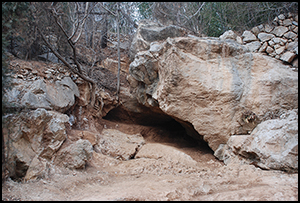
Longquan Cave faces east, and is situated about 6m above the Yihe River. The cave is heavily damaged by erosion and by recent quarrying of its limestone roof and walls. The remainder of the roof is partly collapsed and the sediments in the central part of the exposed area have been washed away (Figures 2 & 3). Preserved layers were found at the back of the cave near the southern, western and northern walls. The site was excavated within a grid of 1m2 sections and subdivided into zones A–D (Figure 2). Zone C had the deepest stratigraphy, followed by zones B, A and D, which are briefly described here.
Cross-section of the different zones inside Lonquan Cave.

Longquan Cave (photograph credit: Shuisheng Du).

Zone A: Near the current south-west entrance, this was the largest of the three excavated zones, with an area of around 8m2 excavated in 50mm arbitrary spits. It revealed the northern edge of a double hearth that had been destroyed when the front area of the cave was quarried. Most of the cultural remains were retrieved from the southern, interior part of this zone.
Zone B: Due to safety concerns arising from the partially collapsed roof, the deposits in this area were not excavated.
Zone C: Zone C was located in the lowermost area of the cave adjacent to zone D. It too covered an area of around 8m2, but only a small portion could be excavated. The uppermost 0.8m of the deposit extended over only around 3–4m2, and the lowest part, the infill of a crevice (Figure 2), had an area of less than 1m2. Very few artefacts and bones were found in this infill, which was labelled layer 3.
Zone D: This was the smallest excavated zone, with an area of about 1.5–2.5m2. It was near the cave wall and unlikely to have been a location of intense occupation, but served as a discard zone.
A total station was used to plot all the artefacts and bones in three dimensions, including, where possible, the inclination and orientation of the stone artefacts and animal bones. All excavated deposits were sieved through a 2mm mesh, allowing the recovery of a large number of stone chips, bone flakes, tooth fragments and rodent bones.
The layers that were recognised are shown in Figure 2 and described as follows:
Layer 1: In zone A this was primarily composed of pebbles and brownish-yellowish clay, 0.33–1.05m thick; in zone C it was a loose, yellowish, silty clay, 0.3–0.67m thick; and in zone D, it was only 50–150mm thick, severely disturbed by subsequent taphonomic and post-depositional effects. The bones and lithics were the same as those retrieved from the underlying layers.
Layer 2: A hard, reddish-brown clay, around 0.5–0.6m thick, with a few pebbles in some areas. Abundant animal bone and lithics were discovered in this layer.
Two hearths were uncovered in zone A at depths of 100mm and 200mm in layer 2. Charcoal samples were collected from zones A, C and D for radiocarbon dating and indicate a range of approximately 29–43 kya cal BP (Table 1). The majority of the readings, however, are from 29–33 kya. Given the date of 37 kya cal BP for layer 3, it seems that the date of 43 kya cal BP can be attributed to the ‘old wood’ effect.
Radiocarbon dates from Longquan Cave (Henan Province).

† Calibrated with IntCal13 in OxCal v4.2 (Bronk Ramsey 2009; Reimer et al. Reference Reimer, Bard, Bayliss, Beck, Blackwell, Ramsey, Buck, Cheng, Edwards, Friedrich, Grootes, Guilderson, Haflidason, Hajdas, Hatté, Heaton, Hoffmann, Hogg, Hughen, Kaiser, Kromer, Manning, Niu, Reimer, Richards, Scott, Southon, Staff, Turney and van der Plicht2013).
Layer 3: (Zone C) characterised by a light-yellow sand layer with embedded, brownish clay lenses. Around 0.7m of this deposit was excavated, but it contained very few animal bones or lithics.
The superimposed hearths
Two hearths were uncovered in zone A, not far from the original prehistoric entrance of the cave that was destroyed by quarrying. The hearths were observed in the exposed section, before the excavations, as two white ash layers. Subsequent excavations and dating further confirmed that there were two superimposed hearths attributed to different periods.
The upper hearth had a diameter of about 0.5–0.6m. A few brought-in small stones and a couple of older rocks lying on the bottom of the cave surrounded it. Three lenticular layers formed the stratigraphy of the hearth:
-
1) Viscous, brownish red clay, about 50–100mm thick, and similar to the clay outside the hearth. This layer contained burnt bone fragments and stone artefacts. A 14C sample from this layer gave a calibrated age of 28873±322 cal BP (Table 1).
-
2) Cemented layer of burnt bones, stones, stone artefacts, about 150–200mm thick and dark grey in colour. Some burnt stones had been reduced to powder and only their shapes could be recognised.
-
3) Black ash layer about 10mm thick, comprising a mixture of powder, clay and charcoal. Once this layer was cleaned and the stones removed, a 20–30mm layer of grey-white soil was noted covering a larger hearth beneath.
The lower hearth was 0.8–1m in diameter and further divided into two layers:
-
a) Cemented layer formed from a hardened crust of weathered stones, clay and burnt powder. At its centre was a black and red lens, about 20mm thick; other areas were black or grey, and about 10mm thick. Some burnt bone fragments were also found. A large quantity of burnt bones and stones were found on the surface of this hearth, and at its edge was a granite block that showed no trace of knapping but was broken into three parallel pieces, probably from the heat generated by the fire.
-
b) Pure black ashy deposit, several millimetres thick, that consisted mainly of charcoal. Sample 5, taken from this hearth, produced a radiocarbon date of 39487±420 cal BP (Table 1).
Radiocarbon dates
Radiocarbon dates are shown in Table 1. The age of the lower hearth in zone A is around 40 kya cal BP (sample 3 in Figure 2), and the upper one is around 30 kya cal BP (sample 1). The age of layer 3 in zone C is about 37 kya cal BP (sample 4). The upper part of zone D (sample 2) is dated to 31 kya cal BP, and the lower part (samples 5 and 6) to 33–29 kya cal BP. The wide date range for the deposits of Longquan Cave could in part be explained by the presence of dead wood. In addition, the stratigraphic interval between the two hearths could be shorter; the early date of 40 kya cal BP for the lower one seems excessive. In summary, we estimate that most of the accumulation at the back of the cave should fall in the range of 35–31 kya cal BP. The different nature of the sediments in the crevice within zone C, where rare artefacts were found, means that they could be much older than the main layer above.
The lithic industry
Overall, 512 pieces of flaked stone and 460 faunal elements were recovered. Of these, 164 stone artefacts and 153 faunal specimens came from zone A, 198 stone artefacts and 63 faunal specimens from zone C, and 134 artefacts and 244 animal bones were found in zone D. An additional 12 artefacts were collected when the site was first discovered.
A full technical analysis of the stone artefacts has been published elsewhere in Chinese (Zhou et al. Reference Zhou, Li, Pang and Du2011). These artefacts were mainly made of vein quartz, probably obtained from two localities, which could be divided into three grades according to its quality. The best was grade A—a white quartz with a compact texture from the Yihe riverbed about 3km from the site. Another, inferior, quartz was collected from natural crevices within 100m of the site. The latter can be divided into two grades of B and C according to the number of cracks.
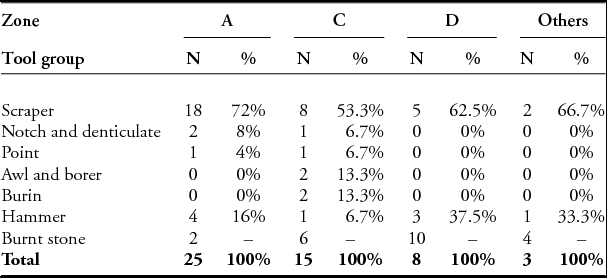
The 496 excavated stone artefacts included 96 cores (14 bipolar, 82 with clear striking platforms) and 60 flakes (2 of which are bipolar, the others are knapping flakes). In addition, 73 stone tools were found comprising 33 scrapers, 3 notches and denticulates, 2 points, 2 awls and borers, 2 burins, 9 hammer stones and 22 burnt cobbles (Tables 2–4). In the preliminary report (Zhou Reference Zhou, Li, Pang and Du2011), 3 cobbles, and 31 hammers and stone anvils were listed. Following a re-examination, however, 22 of these artefacts are now recognised to show no indications of knapping, but signs of burning that caused larger nodules to fracture into smaller pieces; these are now listed as ‘burnt items’. They are all granite apart from one that is composed of a coarse sandstone. As we did not find any cores or flakes made from these rocks, we assume that these are fire-cracked rocks or pot boilers (e.g. Gao et al. Reference Gao, Guan, Chen, Yi, Pei and Wang2014).
Tool types of zones A, C, D and ‘others’, collected when the site was first investigated (see Figure 4 for examples of some of the tool types).

Debitage of zones A, C, D and ‘others’, collected when the site was first investigated.

Cores of zones A, C, D and ‘others’, collected when the site was first investigated.

There were also 58 broken flakes, 225 chunks and many debitage fragments: 1327 were over 20mm long; 16854 were 5–20mm in length; chips under 5mm in size were not counted because there were so many. They are, however, the best indication of the in situ knapping practised inside the cave.
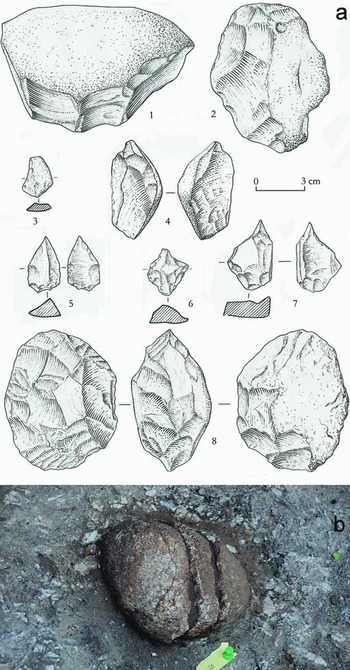
The manufacturing process of the stone assemblage in Longquan Cave would be described as a simple ‘core-and-flake’ technique. The local vein-quartz was reduced by direct percussion and sometimes by bipolar technique. The small number of flake scars (three to four) on the cores indicates a low rate of flake production. Several kinds of platforms were present on the cores, including single-, double- and multi-platform cores. A few cores were discoids. As can be seen in Figure 5.4, the bipolar technique accounted for a high proportion of cores on grade A vein-quartz. In terms of the chaîne opératoire, after obtaining a nodule of raw material, the first step was the removal of most of the cortical surfaces by hammering, before proceeding with the bipolar technique if the raw material was of the right quality.
The lithic industry of Longquan Cave. a) 1. Single platform core (LCMA2⑤:49); 2. Scraper (LCMA2④:10); 3. Scraper (LCMA2⑤:6); 4. Bipolar flake (LCMA2⑧:14); 5. Awl (LCMA2⑥:5); 6. Point (LCMA2③:13) 7. Drill (LCMC2⑭:2); 8. Discoidal core (LCMD2⑦:17). b) Heated stone (LCMA2⑤:42).

1) Percentage distribution of the raw materials from zones A, C and D: Q1, 2 & 3: vein-quartz 1, 2 and 3; M: magmatic rock; S: sandstone; C: crystal. 2) Percentage of types of stone artefacts from zones A, C and D: CO: cores; FLA: flakes; IN-FLA: incomplete flakes. 3) Frequencies of core types from zones A, C and D: SIP: single-platform cores; DP: double-platform cores; SEP: multi-platform cores; DIS: discoidal cores; BIP: bipolar cores. 4) Comparison of raw materials of cores: Q1, 2 and 3: vein-quartz 1, 2 and 3; M: magmatic rock; S: sandstone; C: crystal.

Although most flakes have a nearly equal length and width, 30 have parallel sides and a length twice their width. These flake-blades have complicated dorsal ridges and no obvious regularity. The flint knappers appear to have taken advantage of longitudinal ridges purposely to produce flake-blades, but continuous reduction on one working face was limited.
Comments on the spatial distribution of lithics and bones
As seen in Figure 5.1, high-quality quartz is most common in zone A, and is outnumbered by inferior quartz items in zones B and C. Figures 5.2 and 5.3 demonstrate high frequencies of cores, hammers and anvils in zone D, but in zones A and C, flakes, brokenflakes and tools (scrapers, points, burins and so on) were common. The frequency of bipolar cores, discoidal cores and multi-platform cores is higher in zone D than in zones A and C. In addition, Figures 6.1 and 6.2 show that the size of flakes in each zone is almost the same, but large cores were scattered throughout zone D, in contrast to zones A and C.
From the above considerations, we believe that the functions of zones A, C and D were different. First, in the core-and-flake tradition, hammers were used to detach flakes and shape some of them into scrapers and points. The latter were used for procuring and/or processing resources. From this perspective, zones A and C, where there were many flakes and tools, are interpreted as activity areas, and zone D, where so many cores, hammers and stone anvils were found, was probably used as a refuse area. Second, as previously mentioned, in zones A and C, single-platform and double-platform cores were abundant, but bipolar, multi-platform and discoidal cores dominated in zone D. Furthermore, the cores in zones A and C were in the early stages of reduction, whereas most cores in zone D were in their final, exhausted stage, and discoidal, bipolar and multi-platform cores were dumped because they had lost the correct angle for knapping. It seems that when a core was too small for reduction and the raw material was of highquality, it was often reduced by bipolar technique so as to make better use of the raw material. Figure 5.4 indicates the relationship between bipolar cores and raw materials.
The largest cores, mostly of low-quality quartz, were most common in zone D, while in zones A and C there were more high-quality, vein-quartz items (Figure 5.1). This high-quality quartz was intensively used and then discarded, but low-quality vein-quartz collected near the site was not so fully exploited. People used this latter material to produce just a few flakes and then abandoned it, although the cores had more usable platforms than the higher-quality quartz. We therefore suggest that zones A and C were used for making and using stone tools, while zone D functioned mainly as a dumping area. In sum, the occupants of Longquan Cave obtained high-quality stone and produced as many flakes as possible before discarding the reduced cores, but obtained fewer flakes from low-quality raw material.
The faunal assemblage
Preliminary observations on the bones indicate that these too show significant differences between the three areas. Figure 6.3 shows fewer bones in zone C than elsewhere. The animal bones demonstrate different fragmentation patterns in zones A and D. In zone A bones are <150mm and mainly <100mm in length, but in zone D there are more bones longer than 150mm. This supports the interpretation that the spaces at the back of the cave were used for different purposes.
Size distribution of cores, flakes and bone fragments.

A total of 460 animal bones, including 159 teeth, were identified (Table 5). They include 301 pieces of bones >30mm, all belonging to deer and buffalo. Of these, 63 pieces bear cut marks, and 10 pieces have rodent tooth marks. Weathering had affected 79 pieces severely and 44 pieces to a lesser degree; 109 fragments were burnt (32 seriously) and 3 pieces bear signs of abrasion. The many bones gnawed by rodents indicate that the main accumulation took place in the ‘discard’ zone at the back of the cave. The overall faunal spectrum reflects a forested environment of a slightly warmer time during Marine Isotope Stage 3 (MIS 3).
Measured values of taphonomic and archaeozoological variables from zones A, C, D and ‘others’, collected when the site was first investigated.

Unique bone tool
An elongated bone tool (specimen LCMD2⑤:46), found in spit 5, zone D, layer 2, was identified as an awl shaped from an ulna, probably of buffalo (Figures 7 & 8). It is 180mm long, 35mm across at its maximum width, 4mm at the widest part of its point and weighs 43.3g. Analysis conducted with the assistance of the late A.J. Legge allows us to present the object as well as the microscopic images.
Four views of the bone tool.

Detailed microscopic analysis of the bone tool.

Figure 7 shows the entire object; Figure 8 shows the piece under an optical microscope. In Figure 8.1 the area marked by an upper oval shape had been polished, but it was subsequently gnawed by a rodent. Figure 8.2 shows the detail of this portion of the bone tool with a number of parallel traces that are probably rodent tooth marks. The traces shown in rectangles indicate that the objects were formed by cutting and scraping with a stone tool. From the traces that modified the surface, the manufacturing process was reconstructed as follows:
-
1) Obtain a buffalo ulna. The ulna is long and thin, and its medullary cavity is small and narrow, which is not an ideal choice as a source of marrow but makes it suitable for making bone artefacts because of its hard and robust texture.
-
2) Shape the ulna by cutting a few centimetres from the proximal end along the lateral side of the bone and split into both the medial and lateral sides at the fracture. In order to keep the lateral and remove the medial, cut from medial to lateral again, about 80mm from the proximal end where the ulna becomes thinner. The cut is not vertical along the axis but is oblique, leaving a cut mark 47mm long.
-
3) Shape the pointed distal portion by scraping and polishing. The modification follows the natural tapering of the ulna in its medial section while the lateral side (that which faces the outer side of the body) is smooth and hard. The effects of polishing are visible under the microscope. The tip of the point was probably damaged and was not found.
On the whole, one side of the bone awl remained in its unworked initial state and tapers naturally from the middle to the tip. The other side displays cut marks indicating that the bone was an ulna that had deliberately been made into a tool. On this face, there are distinct traces of honing, suggesting that the bone awl was tapered to a point. The pointed portion of the bone awl bears many marks along the vertical axis, presumably formed during taphonomic processes.
Discussion
The radiocarbon dates for the initial occupation at Longquan Cave (layer 3) indicate an age of around 40 kya cal BP, while layer 2 dates to around 35–31 kya cal BP (Table 1). The early date corresponds to that of the time of the human fossil in Tianyuan Cave (Shang et al. Reference Shang, Tong, Zhang, Chen and Trinkaus2007); the more recent dates fit well with other Upper Palaeolithic sites in China, such as the Upper Cave at Zhoukoudian and several of the Shuidonggou localities (e.g. Pei et al. Reference Pei, Gao, Wang, Kuman, Bae, Chen, Guan, Zhang, Zhang, Peng and Li2012; Li et al. Reference Li, Kuhn, Gao and Chen2013; Qu et al. Reference Qu, Bar-Yosef, Wang and Wu2013 and references therein). The foragers who temporarily camped in Longquan Cave used the simple core-and-flake technique to obtain flakes with sharp cutting edges.
The Longquan occupation falls within MIS 3, a period that was marked by relatively rapid climatic fluctuations from colder to warmer on a millennial scale. In this region, the Pacific monsoon drove the wetter conditions prevailing during summertime. We suggest that the cave provided a shelter during the rainy season.
As discussed earlier, there were two contrasting lithic traditions during the Chinese Upper Palaeolithic. One was a microblade technology that emerged around 26–25 kya cal BP and spread across the northern regions, including Xinjiang, Ningxia, Inner Mongolia, Shaanxi, Shanxi, Shandong, Jilin and Heilongjiang (Du Reference Du2007; Bar-Yosef & Wang Reference Bar-Yosef and Wang2012; Qu et al. Reference Qu, Bar-Yosef, Wang and Wu2013). The other, which spread through southern China, was dominated by a core-and-flake industry. It was replaced around 20–22 kya cal BP by a cobble tool industry. The lithic assemblage from Longquan Cave reflects the core-and-flake technology prevalent in southern China, but may have been influenced by the flake and blade technology from sites such as Shuidonggou near the Yellow River (Pei et al. Reference Pei, Gao, Wang, Kuman, Bae, Chen, Guan, Zhang, Zhang, Peng and Li2012; Li et al. Reference Li, Kuhn, Gao and Chen2013).
The evidence for different activity areas inside Longquan Cave is similar to that from many Upper Palaeolithic sites in western Eurasia. Hence, while the stone tool tradition resembled that of earlier periods of the Chinese Palaeolithic, the later phases were characterised by the structured use of settlement space (Guan et al. Reference Guan, Gao, Wang, Chen, Pei, Zhang and Zhou2011).
The appearance of polished bone tools marks a significant innovation. It is noteworthy that four caves in China of approximately the same age as Longquan also contained polished bone tools: the Upper Cave at Zhoukoudian (Pei Reference Pei1939); Xiaogushan Cave in Liaoning Province (Huang et al. Reference Huang, Zhang, Fu, Chen, Liu, Zhu and Wu1986); Chuanfan Cave in Fujian Province (Chen et al. Reference Chen, Li and Yu2001; Li & Fan Reference Li and Fan2006); and Ma'anshan in Guizhou (Zhang et al. Reference Zhang, d'Errico, Backwell, Zhang, Gen and Gao2016). The polished bone tools from Upper Cave, Zhoukoudian and Xiaogushan are very similar to examples from the Upper Palaeolithic of western Eurasia, whereas those found at Longquan, Ma'anshan and Chuanfan Caves are of simpler types.
From the above discussion, we can conclude that, in the early part of the late Palaeolithic, human adaptations in China differed from those seen in western and north-eastern Asia, primarily through the continued use of a simple core-and-flake technology. Longquan Cave, however, provides evidence of traits regarded as similar to other modern human behaviour, notably the distinct zoning of domestic areas for specific purposes, the use of hearths and rocks to store thermal energy and the use of polished bone tools.
Corroborative evidence for the use of core-and-flake technology by modern humans comes, for example, from the stone artefacts and skeletal remains excavated in Niah Cave in Malaysia (e.g. Barker et al. Reference Barker, Barton, Birs, Daly, Datan, Dykes, Farr, Gilbertson, Harrisson, Hunt, Higham, Kealhofer, Krigbaum, Lewis, McLaren, Paz, Pike, Piper, Pyatt, Rabett, Reynolds, Rose, Rushworth, Stephens, Stringer, Thompson and Turney2007). The occupants of Niah Cave practised simple core-and-flake technology, but their behaviour was comparable to that known from various parts of Eurasia. They may have used poison to capture mammals and fish, and may have made bamboo tools. Hence, the earliest modern humans in Southeast Asia employed an older tradition in making the lithic tools they used for wood-working, butchery and other tasks that required sharp edges. The discovery of the same lithic industry at Longquan Cave, along with the presence of a bone awl and dates of 39–31 kya cal BP for layer 2 (disregarding samples subject to old wood effect), supports the view that the early Upper Palaeolithic in this part of Asia followed a different chaîne opératoire than the contemporary tool-makers of western Eurasia.
Acknowledgements
The first author would like to thank Robin Dennell, whose scrutiny of this paper and suggestions resulted in invaluable amendments. Thanks are also offered to Qi Guoqin and Tong Haowen from the Institute of Vertebrate Paleontology and Paleoanthropology for identifying the fauna from Longquan Cave. Huang Yunping from Peking University examined the bone tool and confirmed that it had been polished. The project was supported by the ‘Strategic Priority Research Programme—Climate Change: Carbon Budget and Relevant Issues’ of the Chinese Academy of Sciences, grant number XDA05130201, National Natural Science Foundation of China, grant number 41372169 and by the Fundamental Research Funds for the Central Universities SKZZY2014029. Ofer Bar-Yosef wishes to thank the American School of Prehistoric Research (Peabody Museum, Harvard University), which sponsors his research in China.