The aims of our study were to establish a practical protocol for treadmill testing incorporating small increments of exercise, programming it in such a way using volunteers to permit its future use in patients aged from 4 to 75 years. We also sought to establish reference values covering this population. It is well established that both young and chronically ill patients are able to use a treadmill. Up to now, the Bruce protocol,Reference Bruce, Blackmon and Jones1 known to be feasible for older children, has also been used for children as young as 4 years old, albeit that the increments of exercise are recognised as being too high or intensive for each stage of the protocol. The disadvantage of this protocol is the possible underestimation of exercise capacity when testing patients due to a short period of oxygen debt at the beginning of each increment of exercise. Another problem is the need for those undertaking the test to run before they have become acclimated to the test. Young children in particular stop sooner because of the need for an early switch from walking to running. It is also possible that the reference values established for this protocol do not reflect the present physiognomy, such as weight, gain, and height, of the tested probands, especially adolescents. The reference values currently used were derived from a small number of healthy volunteers,Reference Cumming, Everatt and Hastmann2 with values lacking for those aged from 4 to 75 years. Based on our experience, those undertaking the test with either shorter legs or advanced age, in general being less mobile, are not able readily to reach their peak uptake of oxygen. Thus, the speed of starting the test, and the intervals used, have had to be reduced.Reference Dubowy, Baden and Camphausen3 When performing exercise tests using the treadmill, it is necessary to take into account the balance of energy, ensuring that consumption of oxygen and production of carbon dioxide are proportional,Reference Lavoisier and Laplace4 and to establish that those undertaking the test have an individual maximal consumption of oxygen.Reference Hill and Lupton5 Exercise requires a great increase in the supply of oxygen for the muscles. Simultaneously, a large quantity of carbon dioxide is produced, resulting in external exercise.
Materials and methods
Participants
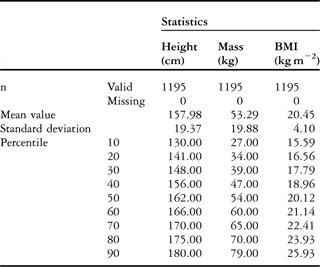
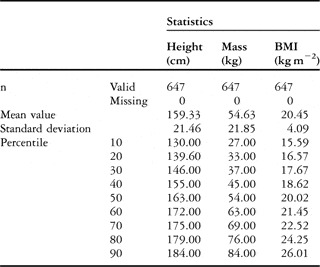
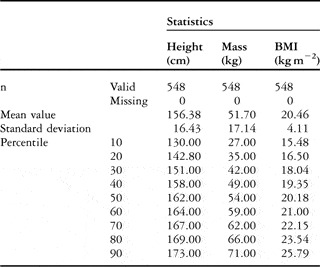
We examined 1195 healthy volunteers from 3 to 75 years of age using a new modified step-type treadmill test.Reference Dubowy, Baden and Camphausen3 Those undertaking the test were recruited from local kindergardens, schools, facilities for adult education, and family members, and studied in two centres in Northern and Southern Germany (Table 1). The protocol received approval from the local ethics boards. All those participating either gave individual consent, or else consent was provided by the parents after a short explanation of the procedure. All those tested were healthy, not taking any medications, nor having any history of severe disease. They were asked to wear comfortable clothing and appropriate footwear, and had to abstain from eating for at least 2 hours before the test.Reference Washington and Bricker6 We excluded any subjects in whom we detected cardiopulmonary disease, neuromuscular or musculoskeletal disorders, any metabolic disease, emotional or psychological distress, or pregnancy. We also excluded any test in which the equipment failed, or those expressing apprehension of the test, or suffering any acute discomfort. The height, mass, and body mass index of the subjects are shown in Table 2, whereas Tables 3 and 4 differentiate these items according to gender. We calculated body surface area according to the formula of DuBois.Reference DuBois and DuBois7
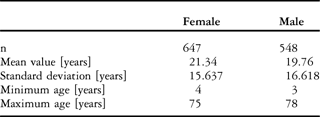
Distribution of age for all probands.
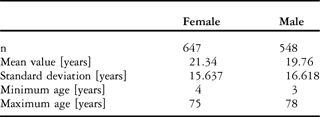
Body measurements of all probands.

Body measurements of male probands.
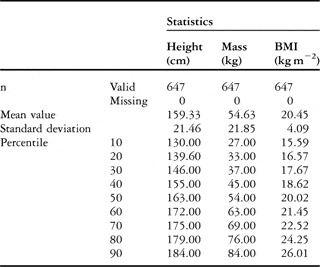
Body measurements of female probands.

Design of the study
The design was prospective in nature, the objective being to establish reference values for parameters of spiroergometry in healthy volunteers.
Exercise protocol
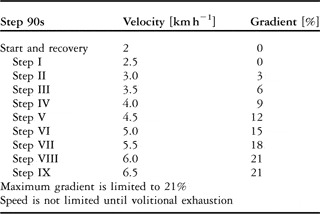
We used an altered and improved protocol with phased increases in time as recommended by the German Society for Paediatric Cardiology,Reference Dubowy, Baden and Camphausen3 using small increments of exercise similar to a ramp protocol. Starting with a speed of 2 kilometres per hour, and a flat treadmill, we increased the speed by 0.5 kilometres per hour, and the incline by 3%, after each 90 seconds (Table 5). After an initial period of 90 seconds, the phase of exercise was continued until the subject became physically exhausted. The maximal incline was limited to 21%, but the speed of the treadmill was increased with no limitation. The recovery phase, also of 90 seconds, was initiated at the request of the volunteer, when he or she indicated their exhaustion, at a speed of 2 kilometres per hour, again with a flat treadmill. Plethysmography was performed to exclude any of those undertaking the test who might have suffered pulmonary disease, especially exercise-induced asthma. Analysis of blood gases included the measurement of haemoglobin, glucose, minerals and lactate. These results will be published in the future.
Protocol for treadmill testing from the German Society for Paediatric Cardiology.

Measurements
Plethysmography and ergospirometry were performed using a ZAN 500/Power jog GX100 and Jaeger Master lab/Jaeger LE 200. Exercise was done on a computer-directed motor driven treadmill. Quality assurance was achieved by means of several daily calibrations and external quality control. The speed and grade of the treadmill were validated by an internally qualified medical technician, with external quality control undertaken by the German Technical Control Group. Uptake of oxygen was measured in breath-by-breath fashion, recording mean values over 30 seconds. The breath gas analyzer was internally calibrated directly prior to each measurement by using a reference gas, carbon dioxide at 5% and oxygen at 15.9%, manufactured by Linde company. The volume of gases and the flow sensor were also calibrated directly prior to the test, validating the calibration twice a year by independent surveillance from the German Technical Control Group.
Terminating the test
As stated, the primary endpoint was volitional exhaustion, albeit that we also terminated the test in the following circumstances:Reference Duncan, Howley and Johnson8
• maximum heart rate of 220 beats per minute minus years of age
• lack of ventilatory reserve
• respiratory exchange rate higher than 1.15
• ventilatory equivalent higher than 35
• plateau in consumption of oxygen, with an increase lower than 150 ml/min−1 about 30s
• personal discomfort
• severe cardiac arrhythmia.
Measured items
Each subject had to perform a plethysmography before and after testing to exclude any pulmonary illness. Analysis of capillary blood gases and lactate was performed on a sample obtained by a finger prick. Before, during, and after the test we recorded continuously the pulse, blood pressure, breathing frequency, minute volume, uptake of oxygen, and elimination of carbon dioxide. Blood gas analyses were recorded, at the minimum, at rest, at ventilatory threshold when reaching a respiratory quotient of 1, and 90 seconds after completing the test. The ventilatory threshold was calculated by the computer based on the V-slope.Reference Beaver, Lamarra and Wasserman9 Uptake of oxygen, elimination of carbon dioxide, breathing frequency, and tidal volume were recorded at rest while standing, at the anaerobic threshold, and upon termination of the test. The distance achieved during the test was measured by the system, as was the time of performance.
Statistical analysis
The centiles were calculated by a method summarizing the changing distribution by three curves representing the median, coefficient of variation and skewness, the latter expressed as a Box-Cox power. Using penalized likelihood the three curves can be fitted as cubic splines by non-linear regression. The extent of smoothing required can be expressed in terms of smoothing parameters or equivalent degrees of freedom. Centiles for all recorded parameters provide values for skewness, medians, and coefficients of variation, which are then used to calculate the centiles and the standard deviation scores, using the formulas.


Where L(t), M(t) and S(t) are the age, and specific values for gender for skewness, medians, and coefficients of variation for those tested. Y are the person-individually-values of the measured variables, and zα are the quantiles of the normal distribution, for example α = 95%, zα = 1.96.Reference Cole and Green10
Results
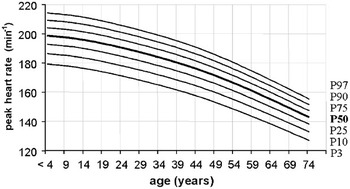
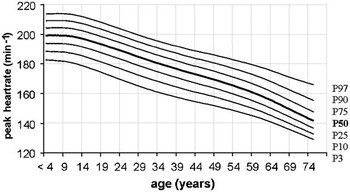
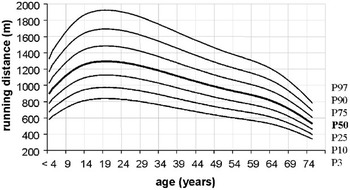
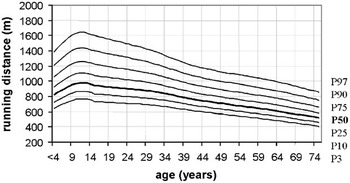
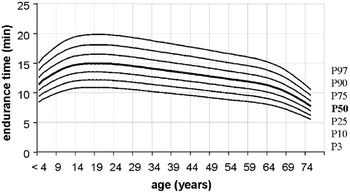
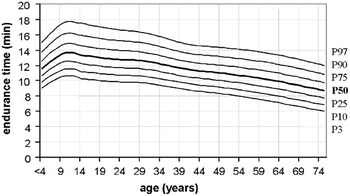
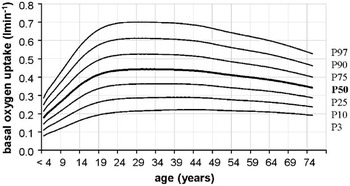
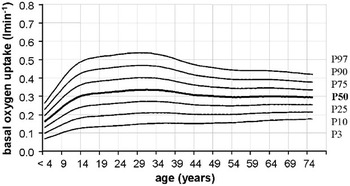
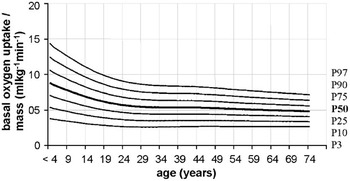
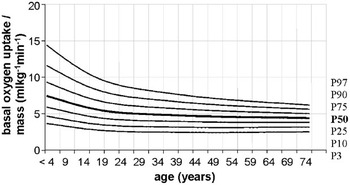
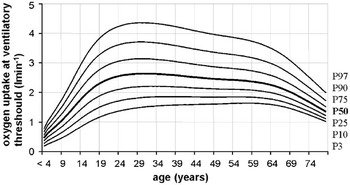
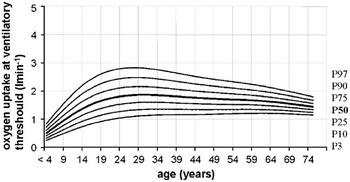
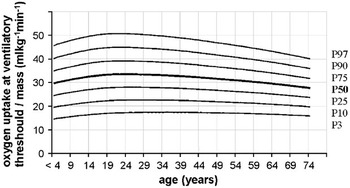
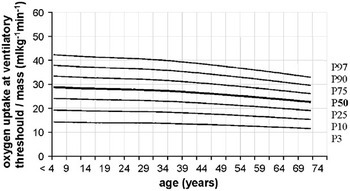
In Figures 1 and 2, we show the age-dependent development of maximal heart rate for the males and females at the termination of the test. As can be seen, beginning with a maximum rate of 200 beats per minute at 3 years, the frequency decreases to 140 beats per minute in senior citizens. The easiest way to quantify physical capacity when using the treadmill is to determine the distance achieved, and the time of the exercise period. The distance achieved by males increases until the age of 19, whereas in females it decreases continuously from puberty (Figs 3 and 4). Similar changes are observed for endurance (Figs 5 and 6). The basal uptake of oxygen of both boys and girls increases continuously until puberty. Females reach the plateau of basal consumption of oxygen at an earlier age, which decreases in general from the age of 34 years. In men, this decrease does not begin until the age of approximately 39 years (Figs 7–10). The uptake of oxygen at ventilatory threshold shows a similar age dependence in both males and females (Figs 11–14), as does the peak uptake of oxygen (Figs 15–18). The production of carbon dioxide at the individual threshold was proportional to the average uptake of oxygen in all age groups beyond 70% of the maximum permissible load. Absolute uptake of oxygen at ventilatory threshold is higher for men, reflecting their larger muscle mass. Gender-specific differences in physical efficiency are evident, as shown in Figures 11–14. Depending on age and body mass, uptake of oxygen and production of carbon dioxide decrease at rest. Due to their higher muscle mass, male adolescents and young men show higher basic consumption of oxygen than do their female counterparts.Reference Neu, Manz and Schoenau11
Centiles of male probands for peak heart rate.

Centiles of female probands for peak heart rate.

Centiles of male probands for distance covered during the test.

Centiles of female probands for distance covered during the test.

Centiles of male probands for endurance.

Centiles of female probands for endurance.

Centiles of male probands for basal uptake of oxygen.

Centiles of female probands for basal uptake of oxygen.

Centiles of male probands for basal uptake of oxygen related to mass.

Centiles of female probands for basal uptake of oxygen related to mass.

Centiles of male probands for uptake of oxygen at ventilatory threshold.

Centiles of female probands for uptake of oxygen at ventilatory threshold.

Centiles of male probands for uptake of oxygen at ventilatory threshold related to mass.

Centiles of female probands for uptake of oxygen at ventilatory threshold related to mass.

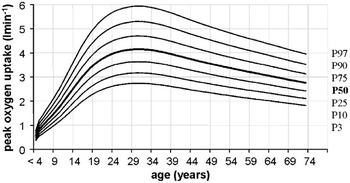
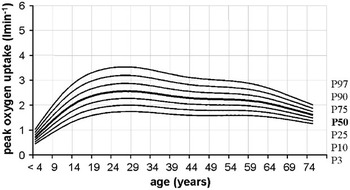
Centiles of male probands for peak uptake of oxygen.

Centiles of female probands for peak uptake of oxygen.

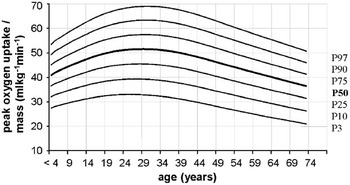
Centiles of male probands for peak uptake of oxygen related to mass.

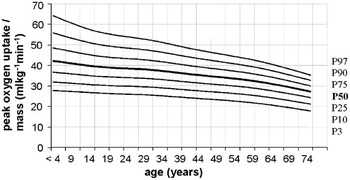
Centiles of female probands for peak uptake of oxygen related to mass.

Aerobe performance is generally described by peak uptake of oxygen. It depends on uptake of oxygen by the heart and lungs, the capacity for transportation, and the respiratory chain reaction in skeletal muscles, and also shows gender-specific differences.
The absolute peak uptake of oxygen increases continuously up to puberty in both boys and girls (Figs 15 and 16). Significant gender differences then start at puberty (Figs 17 and 18). Males have an approximately 35% higher uptake of oxygen during maximal exercise loading compared to females until the age of 40 years. Peak uptake of oxygen related to mass increases in men up to 30 years of age (Fig. 17), whereas mass-related peak uptake of oxygen decreases in women, beginning in early childhood (Fig. 18).
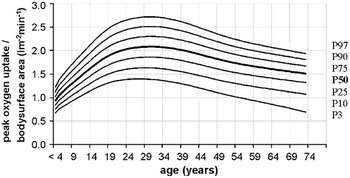
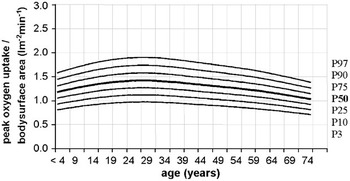
Peak uptake of oxygen in relation to body surface area also reflects gender specific differences (Figs 19 and 20). Peak uptake of oxygen related to body surface area of middle-aged men is nearly a third higher than for women, with a substantial increase noted in healthy men beyond puberty. Relative peak uptake of oxygen is directly dependent on body mass. The postulated unchanged peak uptake of oxygen, as purportedly shown elsewhere,Reference Fredriksen, Ingjer and Nystad12, Reference Pettersen and Fredriksen13 was not confirmed, albeit that an age-dependent dynamic still exists.
Centiles of male probands for peak uptake of oxygen related to body surface area.

Centiles of female probands for peak uptake of oxygen related to body surface area.

Discussion
Standardized tests can be performed to evaluate the physical capacity of healthy people, and are often undertaken in patients who have not previously undergone exercise testing. The tests are often performed in age-dependent fashion, and with differing protocols. Because of this, it is difficult to compare physical performance throughout the life of an individual, particularly should that individual become ill. Ideally, therefore, tests of exercise performance should be standardized and applicable to all, particularly those who are chronically ill. It was because of the need to establish an exercise protocol permitting long-term observation that we embarked on this study. We believe we have been successful in creating such a uniform and coherent protocol for treadmill exercise testing for almost all age groups, and in establishing appropriate reference values.
Using a treadmill is much easier than cycling for healthy or chronically ill children, adolescents and adults, as it corresponds to the natural mode of locomotion in daily life.Reference Cumming, Everatt and Hastmann2, Reference Hebestreit14 Even those attending kindergarden schooling can be examined, albeit that little has been written concerning pre-school children.Reference Cumming, Everatt and Hastmann2 A possible reason may be that other protocolsReference Bruce, Blackmon and Jones1, Reference Cumming, Everatt and Hastmann2, Reference Cumming G and Langford15 do not fit the physiological conditions of such young children, nor the elderly and chronically ill patients, especially those with congenitally malformed hearts.Reference Fredriksen, Ingjer and Nystad12 When considering the potential of using a modified Balke test,Reference Balke and Ware16 we agree with othersReference Cumming, Everatt and Hastmann2 who argued that this protocol lasts too long, and that boredom becomes a determining factor long before exhaustion occurs. By using the treadmill protocol established by the German Society for Paediatric Cardiology, in contrast, ergometry can be undertaken without hindrance after a short training session by those aged no more than 3 and 4 years, and also by the elderly.
Peak uptake of oxygen it is the most reliable and reproducible parameter for evaluating exercise performance by examining physical capacity in load investigations.17 Uptake of oxygen is the limiting factor for the processes supplying energy over the long term. Thus, it best reflects the cardiopulmonary capacity and metabolic system. As a valid indicator of fatigue with progressively increasing exercise, it is the so-called levelling-off phenomenon as an expression of uptake of oxygen that is regarded as the classical criterion of maximal consumption of oxygen, albeit that this has been proven for only a small minority of examined children, if at all.Reference Armstrong, Welsman and Winsley18
In our study, we evaluated a significant sample of healthy Caucasian volunteers aged from 3 to 75 years, whereas others have included relatively few young participants.Reference Cumming, Everatt and Hastmann2 We have shown that uptake of oxygen at rest increases constantly independent of gender up to the end of puberty. This is due to an increased transformation of energy and the associated higher demand for oxygen during growth.19 In men, testosterone produced at puberty causes an increase of the muscle mass that outweighs the body mass, thus producing a rising basal uptake of oxygen in adulthood.Reference Tipton20 It is the uptake of oxygen related to mass that accounts for the higher aerobe metabolic capacity during early infancy. The portion of muscle tissue increases slowly in relation to the total organism during growth.Reference Beneke, Leithäuser and Hütler21 Uptake of oxygen at rest, therefore, is dependent on age and gender in the same way as the basal metabolism. In schoolchildren, and prior to schooling, the basal uptake of oxygen is related to the growth rate, and is strongly influenced by gender-specific changes during pubescence and following adolescence.
The determined uptake of oxygen at the ventilatory threshold was comparable to the data already published for boys aged from 7 to 15.Reference Al-Hazzaa22 During adolescence, the measured values for girls deviate clearly from those of boys of the same age. Uptake of oxygen at the ventilatory threshold increases constantly in females up to the age of 13 or 14, but beyond that age no further substantial changes were found. The mass related relative uptake of oxygen at the ventilatory threshold decreases in females constantly until adulthood. Apart from a clear increase in the proportions of body fat, beginning at puberty, numerous experiments in rats have shown a removal of muscle proteins under the influence of ovarian hormones.Reference Tipton20 A dependence on age and gender is observed similar to maximum uptake of oxygen.
Data of peak uptake of oxygen during exercise volume load can be compared. Reference values for our recent participants aged from 3 to 6 years were previously lacking. Similar results have been shown for children aged from 8 to 10 years,Reference Fredriksen, Ingjer and Nystad23 and our findings are in strong agreement for those provided for those aged 10 years.Reference Armstrong, Welsman and Winsley18 In all ages studied, the values of peak oxygen were higher, in contrast to the body mass, for males compared to females, again confirming many previous studies.Reference Fredriksen, Ingjer and Nystad12, Reference Armstrong, Welsman and Winsley18, Reference Armstrong and Welsman24, Reference Eiberg, Hasselstrom and Gronfeldt25 Gender differences for maximal uptake of oxygen continue to increase starting from puberty. Until now, however, an accelerated increase of absolute peak uptake of oxygen in boys has not been noted.Reference Fredriksen, Ingjer and Nystad23 An accelerated increase of muscle cross section with boys starting at age 12 has been noted,Reference Neu, Manz and Schoenau11 with changes in protein metabolism conditioned by testosterone offered in explanation.Reference Tipton20 During growth, the peak uptake of oxygen of our male probands was shown to be higher by one-third compared to their female counterparts, endorsing other studied.Reference Fredriksen, Ingjer and Nystad23, Reference Armstrong and Welsman24
A linear process of uptake of oxygen in relation to the body surface has been described for girls, beginning at the age of 8.Reference Pettersen and Fredriksen13 These computations,Reference Pettersen and Fredriksen13 however, were based on data from children and adolescents aged from 8 to 17 years.Reference Fredriksen, Ingjer and Nystad23 Those of adjacent ages were not considered. The differences are still more pronounced when considering males. An almost constant plateau has also been established with boys aged from 7 to 15 years. The existent dynamics in the lower and higher age groups remain constant. Based on our work, such a statement does not apply to younger children. Growth-caused processes show a dynamic in peak uptake of oxygen during childhood and adolescence. At present, attempts fail to predict the individual aerobic efficiency by mathematical models. Until now, it has not been possible to accept in uncritical fashion the data of average values in children and young people for peak consumption of oxygen without considering age or gender.Reference Neu, Manz and Schoenau11, Reference Al-Hazzaa22, Reference Mandadzhieva, Marinov and Kostianev26 There is, however, no doubt about age and gender-dependent dynamics for peak uptake of oxygen.
We suggest, therefore, that exercise performance should be assessed on the basis of the centile curves currently provided. Due to the uniform conditions of the test, it is now possible to make individual and inter-individual comparisons throughout life with healthy children and adults, and in the future with chronically ill patients. We submit that, on the basis of the exercise protocol used, we have provided standard values for children, young people, adults and elderly that previously have been lacking.